


Optics 2026, 7(1), 17; https://doi.org/10.3390/opt7010017 - 13 Feb 2026
Abstract
►
Show Figures
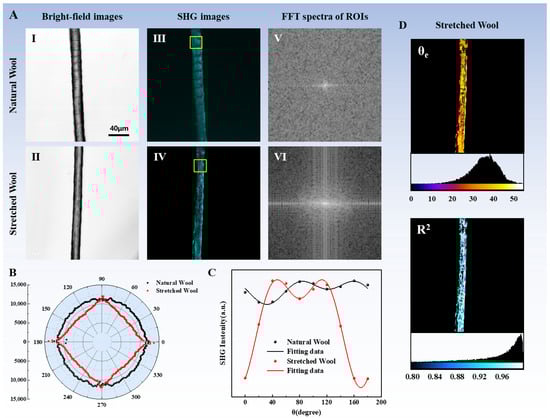
Wool fibers undergo significant structural changes during industrial stretching, which directly impact their mechanical properties and textile performance, making monitoring of the stretching process essential for optimizing wool products. In this study, we demonstrate the effective use of polarized second harmonic generation (P-SHG)
[...] Read more.
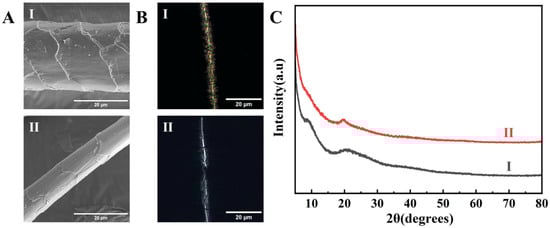
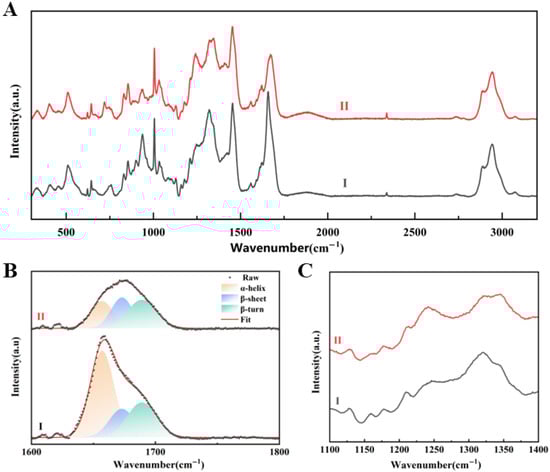
Wool fibers undergo significant structural changes during industrial stretching, which directly impact their mechanical properties and textile performance, making monitoring of the stretching process essential for optimizing wool products. In this study, we demonstrate the effective use of polarized second harmonic generation (P-SHG) imaging for monitoring the wool fiber stretching process. P-SHG is highly sensitive to non-centrosymmetric structures, enabling clear observation of changes in α-keratin alignment and the reconstruction of cortical interfaces during stretching. Quantitative P-SHG analysis revealed a significant decrease in the effective pitch angle (θe) from 54° ± 1° to 33° ± 3° after stretching, confirming the dipole orientation changes in keratin molecules. These findings were further validated through additional characterization techniques, including scanning electron microscopy (SEM), polarizing optical microscopy (POM), X-ray diffraction (XRD), and Raman spectroscopy (RS). The results show that the industrial stretching process of wool alters the morphology at the surface scale, enhances the alignment of macroscopic fibers, and induces a transition from α-helix to β-sheet. Our technique is simple, effective, and capable of in situ monitoring of the structural changes in wool fibers, making it highly promising for applications in the wool industry.
Full article
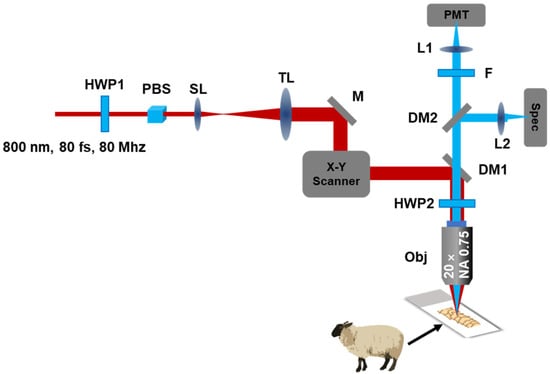
Figure 1