Article

1D U-Net Enhanced QEPAS Sensor for Trace Water Vapor Detection

1
International Cooperation Joint Laboratory for Optoelectronic Hybrid Integrated Circuits, Jinan University, Guangzhou 510632, China
2
Key Laboratory of Visible Light Communications of Guangzhou, Jinan University, Guangzhou 510632, China
3
Department of Optoelectronic Engineering, Jinan University, Guanghzou 510632, China
4
Institute of Semiconductors, Chinese Academy of Sciences, Beijing 100083, China
*
Author to whom correspondence should be addressed.
Optics 2026, 7(1), 15; https://doi.org/10.3390/opt7010015
Submission received: 6 January 2026 / Revised: 25 January 2026 / Accepted: 4 February 2026 / Published: 9 February 2026
(This article belongs to the Section Laser Sciences and Technology)

Abstract

We report a deep learning-assisted quartz-enhanced photoacoustic spectroscopy (QEPAS) sensor for trace water vapor detection in air. A 1392 nm butterfly-packaged DFB laser is wavelength-modulated at f0/2, and the QEPAS signal is retrieved by second-harmonic (2f) lock-in demodulation using a commercial quartz tuning fork gas cell. After optimizing the modulation depth to 400 mV, a 1D U-Net denoising network trained with pseudo-clean supervision is applied to the measured 2f traces, yielding an SNR improvement of 2.05× (3.11 dB). Allan deviation analysis indicates a minimum detection limit (MDL) of ~2.21 ppm at an optimum averaging time of ~619 s, corresponding to an ~2.1× improvement compared with the raw output. These results demonstrate that neural-network-based post-processing can improve QEPAS water vapor sensing performance without modifying the optical hardware.

1. Introduction

Photoacoustic spectroscopy (PAS) converts molecular absorption of modulated light into an acoustic response through non-radiative relaxation, enabling selective and sensitive trace-gas sensing with an inherently low optical background. In recent years, PAS has been actively advanced by innovations in resonant architectures and miniaturized transducers, which improve signal build-up and facilitate compact, field-deployable instruments. Representative developments include multi-resonator PAS configurations for sensitivity enhancement, mid-infrared PAS sensors achieving ppb-level performance, non-dispersive schemes using mid-infrared LEDs with differential mode excitation, and emerging broadband implementations such as cavity-enhanced photoacoustic dual-comb spectroscopy and fiber-based optomechanical photoacoustic sensors. These advances highlight PAS as a versatile platform for environmental monitoring, industrial process control, and related applications [1,2,3,4,5,6,7,8].
Quartz-enhanced photoacoustic spectroscopy (QEPAS) is a rapidly growing branch of PAS that replaces the conventional microphone with a quartz tuning fork (QTF) acting as a piezoelectric acoustic-to-electrical transducer. The core advantage arises from the QTF’s extremely high quality factor (Q) and narrowband resonance, which efficiently amplifies the photoacoustic signal at the fork resonance while suppressing broadband ambient noise. In addition, QTFs originate from mature, mass-manufactured timing components, offering excellent consistency and cost-effectiveness. Beyond QEPAS, QTFs have also been explored as miniature optical/infrared detectors and ultra-broadband detectors, indicating the broader utility of quartz devices in spectroscopy and sensing. With the development of custom QTFs, QEPAS is also being pushed toward industrialization and practical packaging [9,10,11,12]. Driven by these strengths, QEPAS has been demonstrated for numerous gas species and realistic measurement scenarios. Examples include near-infrared or mid-infrared QEPAS methane sensing with optimized spectrophone configurations, compact ppb-level NO2 detection enabled by high-power laser diodes and grooved tuning forks, portable CO monitoring in urban environments, and sub-ppb N2O sensing based on compact quantum cascade laser modules. QEPAS has also been applied to challenging matrices and applications such as NH3 impurities in H2, sarin simulant detection using tailored tuning-fork geometries, rapid field ventilation-rate measurement using an SF6 sensor, SF6 matrix studies with T-shaped tuning forks, and continuous real-time monitoring of CO2 emitted from human skin. Compact atmospheric platforms have further expanded multi-species monitoring capabilities in real environments [13,14,15,16,17,18,19,20,21,22].
To further enhance speed, robustness, and sensitivity, a range of QEPAS and PAS variants have been explored. These include all-optical off-axis QEPAS with dual-wavelength demodulation of out-of-plane vibration modes, swept cavity-enhanced photoacoustic spectroscopy using a QTF, and beat-frequency QEPAS architectures, including optomechanical energy enhancement, to enable fast and sensitive gas sensing under practical constraints [23,24,25,26]. In parallel, quartz-based photothermal/thermoelastic techniques such as quartz-enhanced photothermal spectroscopy and light-induced thermoelastic spectroscopy (LITES) have provided complementary routes to gas detection, leveraging QTF transducers with different excitation/readout modalities and demonstrating high sensitivity with low-frequency or high-frequency forks and multipass configurations [27,28,29,30,31]. Chip-scale photothermal spectroscopy concepts, such as suspended-waveguide enhancement and slow-light enhancement, together with fiber-based Fabry–Pérot photothermal interferometry, further indicate the field’s broader trend toward integrated and miniaturized photothermal/photoacoustic sensing platforms [32,33,34]. Meanwhile, multi-gas optical sensing strategies such as TDM/FDM in TDLAS continue to motivate robust multi-component measurement workflows and signal processing requirements [35]. Alongside hardware advances, algorithmic enhancement has become a cost-effective pathway to improve detection limits without increasing system complexity. Stochastic resonance has been used to improve QEPAS sensitivity in weak-signal regimes, and advanced denoising/decomposition strategies have been reported to enhance QEPAS system performance [36,37]. More recently, deep learning (DL) has shown strong capability in time-series denoising and feature extraction for photoacoustic spectroscopy, including DL-based denoising frameworks and concentration prediction models designed to address correlation degradation [38,39].
Water vapor (H2O) is among the most abundant molecules in ambient air, making humidity monitoring both a practical necessity and a key factor influencing spectroscopic measurement accuracy. In photoacoustic techniques, H2O can affect the conversion efficiency through relaxation dynamics and collisional energy transfer, and can also contribute to interference in realistic air measurements [40]. Accordingly, simultaneous atmospheric monitoring of CH4, N2O, and H2O using a single QEPAS sensor, systematic interference studies (including CO2 and H2O effects and acoustic noise), and investigations of relaxation dynamics in wet matrices all underscore the importance of robust signal extraction for humidity-related sensing tasks [41,42,43]. This work uses trace water vapor detection as a representative case study and proposes a DL-enhanced QEPAS signal processing approach. Specifically, we employ a 1D U-Net denoising network to enhance QEPAS 2f signals measured with a 1392 nm laser in a commercial gas cell. Recent deep-learning enhancement for photoacoustic sensing has followed two main directions: (i) end-to-end concentration prediction models to mitigate correlation degradation, and (ii) data-driven denoising models (e.g., hybrid CNN–Transformer frameworks) for reconstructing low-SNR 2f signals [44,45,46,47]. In this work, we adopt a complementary strategy by performing trace-to-trace denoising of WMS–2f QEPAS line shapes acquired in a commercial QTF gas cell. Although the gain can be expressed as ~3 dB, it corresponds to a 2.05× increase in linear SNR under our definition (SNR = A/σ), and the ultimate detection capability is further quantified via Allan deviation, showing an ~2.1× MDL/LOD improvement without modifying the optical hardware. The novelty of this work lies in adapting a lightweight 1D U-Net denoiser (encoder–decoder with skip connections) to QEPAS 2f traces and validating the benefit using both short-term SNR and long-term Allan-limited detection limits. The proposed method achieves an SNR improvement of ~3 dB and reaches a minimum detection limit of ~2.21 ppm at an integration time of ~619 s, demonstrating an ~2.1× improvement in the ultimate detection capability compared with the raw output while keeping the hardware unchanged. For context, in optimized QEPAS sensors, incremental hardware refinements often yield modest gains on the order of ~1.3–1.5×, e.g., a 1.37× signal enhancement by introducing a fiber reflector and a 1.4× improvement by shaping the excitation beam into an elliptical profile [46,47].

2. Materials and Methods

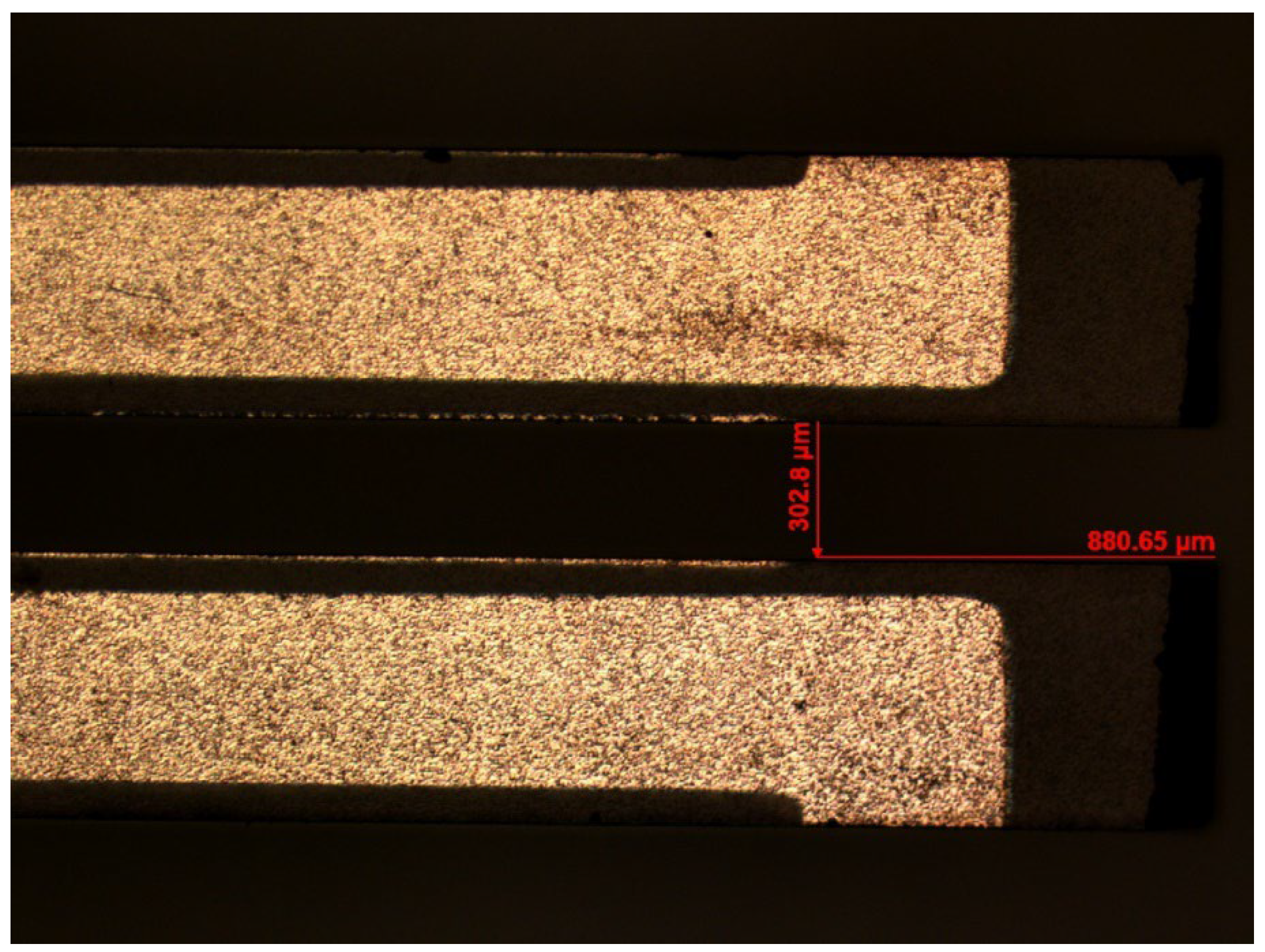
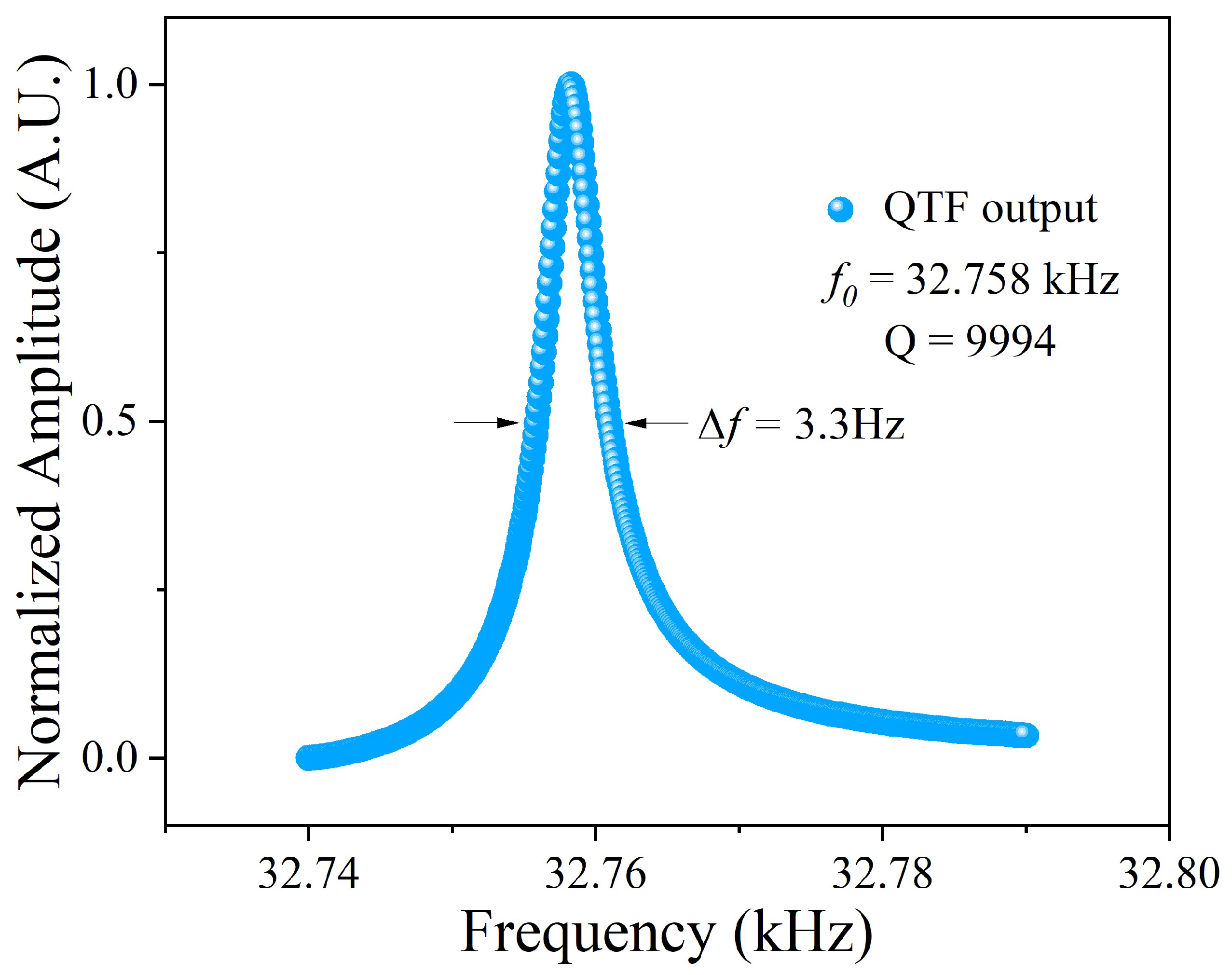
A commercial watch-type quartz tuning fork (QTF) (Kaihua Electronics Co., Ltd., Guangzhou, China) was first selected as the acoustic transducer for the QEPAS sensor. Figure 1 shows the microscope image of the QTF, where the laser beam is later aligned to pass through the gap between the prongs. To evaluate the resonant properties of the QTF, an electrical excitation test was performed. A function generator (Tektronix AFG3102, Tektronix, Beaverton, OR, USA) provided sinusoidal signals with identical amplitude but different frequencies to drive the QTF, and the corresponding electrical response was recorded as a function of the excitation frequency. The measured frequency response is shown in Figure 2, from which the resonance frequency is f0 = 32.758 kHz and the 3-dB bandwidth is Δf = 3.3 Hz. Therefore, the quality factor can be calculated by Q = f 0 / Δ f = 9994 .
Such a high-Q resonator is well suited for QEPAS because it provides high acoustic selectivity and enables efficient conversion of the photoacoustic wave into a detectable electrical signal. In recent photoacoustic research, strategies such as self-calibration have also been proposed to further mitigate system drift and improve robustness for trace-gas sensing [48], and QTF-based schemes have been explored for reconstructing spectral information under challenging modulation/measurement conditions [49]. A recent review focusing on trace photoacoustic sensing for COx detection highlights the importance of long-term stability and advanced signal processing in practical deployments [50]. In addition, conductance-photoacoustic spectroscopy (ConPAS) demonstrates that multi-physics readout can be integrated with a QTF for simultaneous multi-gas analysis, further underscoring the versatility of quartz-based resonant transducers [51].
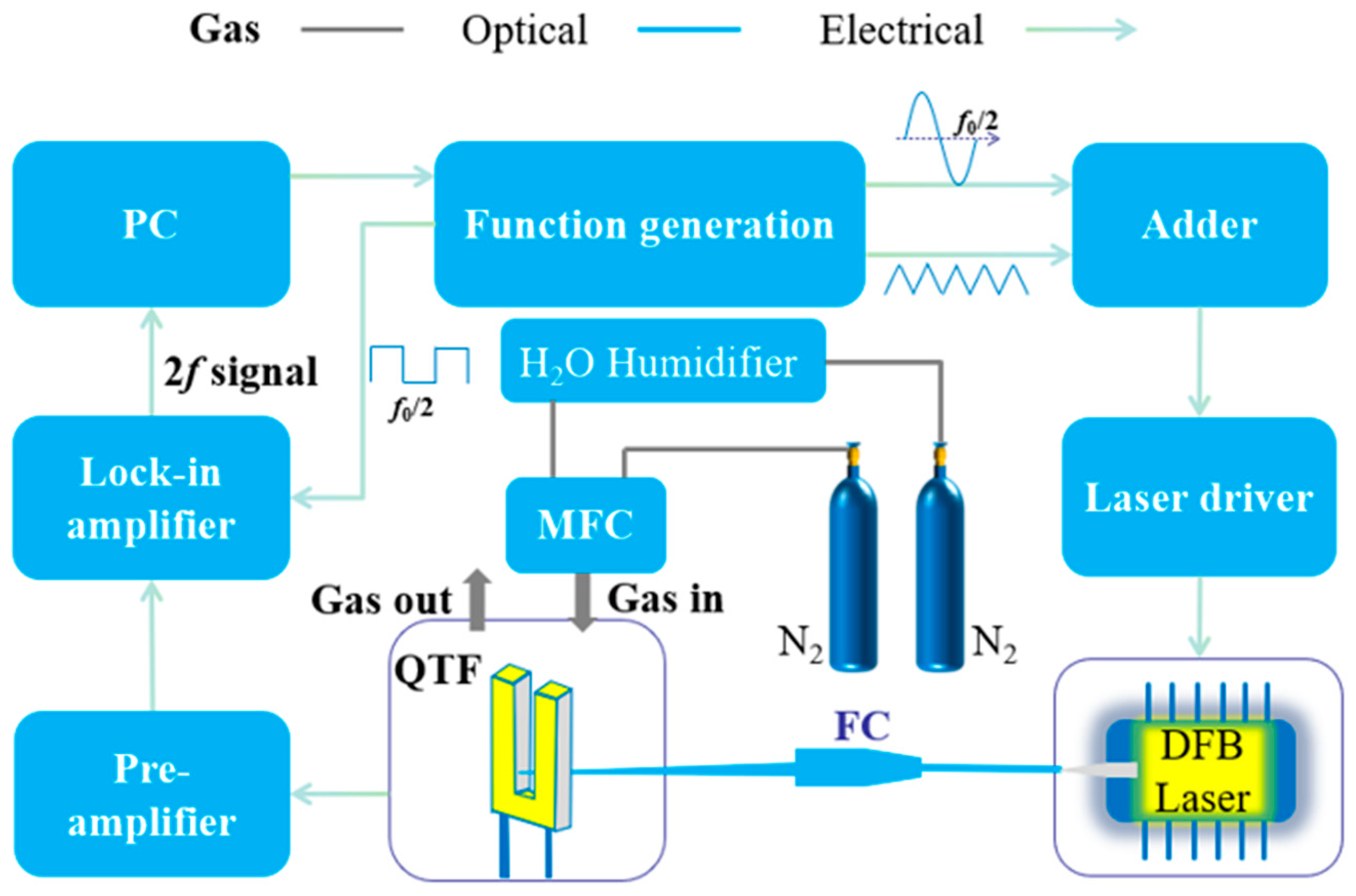
The experimental system is illustrated in Figure 3. A butterfly-packaged DFB laser (Thorlabs, Inc., Newton, NJ, USA) centered at 1392 nm was used as the excitation source. The laser chip was controlled by a laser driver/temperature controller (CLD1015, Thorlabs, Newton, NJ, USA) that provided both constant-current drive and temperature stabilization. The laser output was collimated and focused between the prongs of the QTF inside a commercially available gas cell.
Two channels of signals were generated by a function generator (Tektronix AFG3102, Tektronix, Beaverton, OR, USA). One channel produced a slow scanning waveform applied to the laser injection current for wavelength tuning across the H2O absorption feature. The other channel generated a sinusoidal modulation signal at f0/2, i.e., half of the QTF resonance frequency. In this work, we adopted the f0/2 detection technique, where the wavelength modulation frequency is set to f0/2 and the QEPAS signal is demodulated at the second harmonic (2f), resulting in an acoustic response at f0. The laser beam excites water vapor molecules in the inter-prong region, producing pressure waves that drive the QTF prongs in an anti-symmetric vibration mode. The piezoelectric current from the QTF was converted to voltage by a homemade transimpedance preamplifier, and the amplified signal was then fed into a lock-in amplifier (SR830, Stanford Research Systems, Sunnyvale, CA, USA) for 2f demodulation. The lock-in reference was synchronized with the function generator TTL signal (frequency f0/2). The lock-in amplifier operated in the 2 V input mode with a 1 s time constant and a 12 dB filter slope. The demodulated data were transferred to a computer via serial communication, and the overall system was controlled using a LabVIEW program(version 2025). Absorption of the wavelength-modulated laser radiation by the target gas produces periodic heating and pressure fluctuations, generating an acoustic wave at the QTF resonance frequency. The pressure waves excite the anti-symmetric flexural vibration of the quartz tuning fork (QTF). Due to the piezoelectric effect of quartz, the prong deflection induces an alternating piezoelectric charge/current on the QTF electrodes. This weak electrical current is converted into a voltage signal using a low-noise preamplifier (transimpedance configuration) and then sent to a lock-in amplifier (SR830, Stanford Research Systems) (Newton, NJ, USA) for 2f demodulation in the WMS–2f scheme. The QEPAS signal plotted in Figure 4 corresponds to the in-phase demodulated output, i.e., the lock-in amplifier X-channel output voltage, recorded synchronously by the LabVIEW program via serial communication. During the scan, the laser injection current was swept by the slow scan waveform, and the corresponding current values (x-axis in Figure 4) were obtained directly from the laser driver current readout (display).
Recent QEPAS studies have shown that detection geometry can significantly affect performance; for example, an off-plane configuration using a commercial QTF was demonstrated to relax optical alignment constraints while maintaining sensitivity [52]. Optical-field enhancement using compact resonant structures has also been reported, such as microfiber knot resonator-augmented QEPAS in the near-infrared [53]. Beyond environmental sensing, photoacoustic sensors have been applied to breath-related and food-related scenarios, where stable operation and strong noise suppression are equally critical [54]. In this context, QTF-based hybrid spectroscopy (e.g., QEPAS combined with conductance spectroscopy) provides a useful framework for multi-gas analysis and system validation [55], while QTF-based LITES systems commonly employ Allan deviation analysis for quantifying long-term stability and minimum detection limits [56].
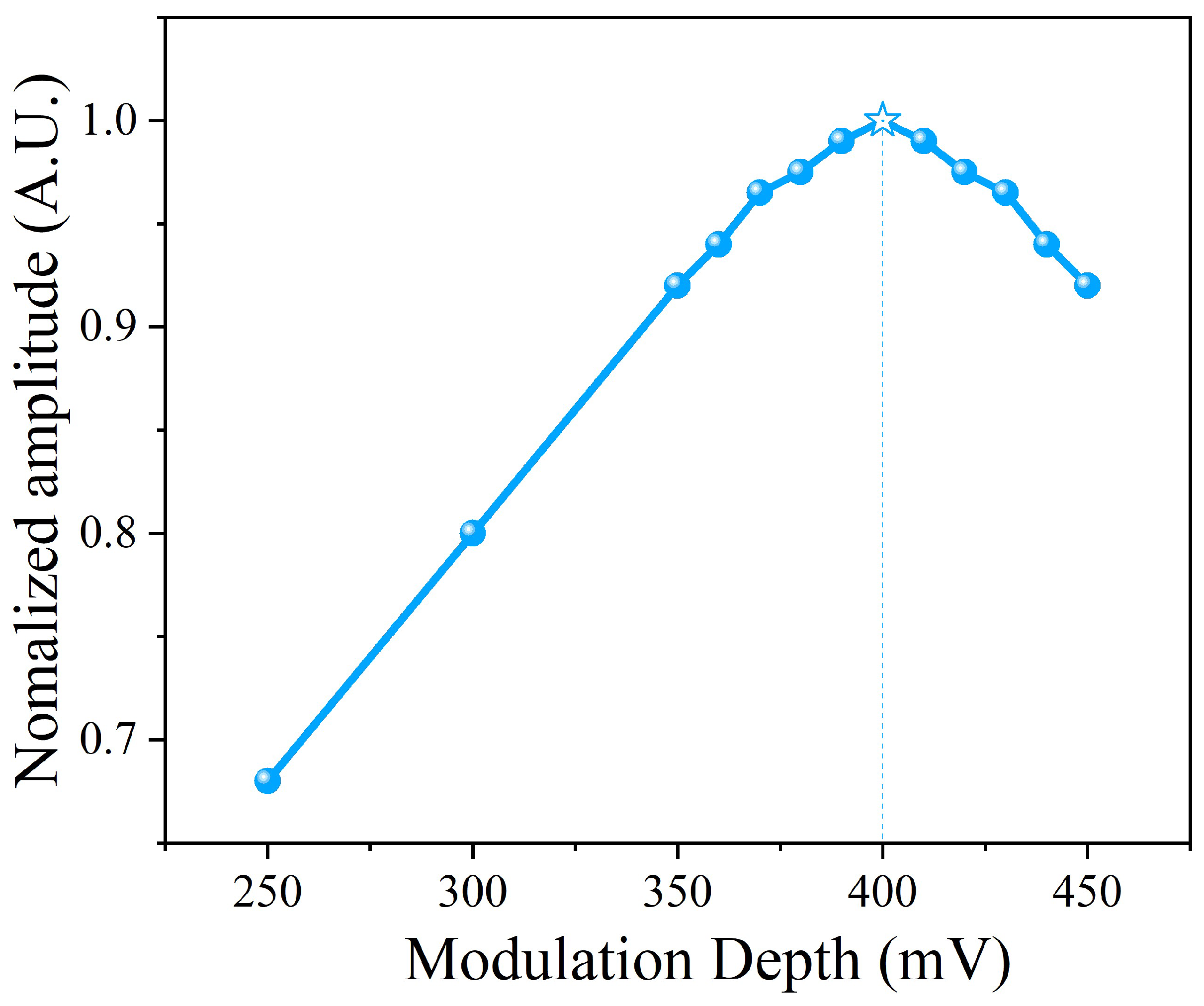
In our system, the modulation depth was controlled by adjusting the amplitude of the sinusoidal signal applied to the laser driver. As shown in Figure 5, when the modulation depth increased, the normalized 2f signal amplitude first increased, then approached saturation, and finally exhibited a slight variation at larger depths. The optimum modulation depth was found at 400 mV, corresponding to the maximum normalized 2f amplitude, and this value was used for all subsequent measurements. In this work, the effective SNR is calculated as SNR = A/σ, where A is the peak amplitude of the WMS–2f QEPAS signal at the absorption line center and σ is the RMS noise level (1σ standard deviation). The noise level σ is obtained from a noise-only time trace recorded with the laser tuned outside the H2O absorption line under identical lock-in settings, ensuring a fair comparison.

3. Results

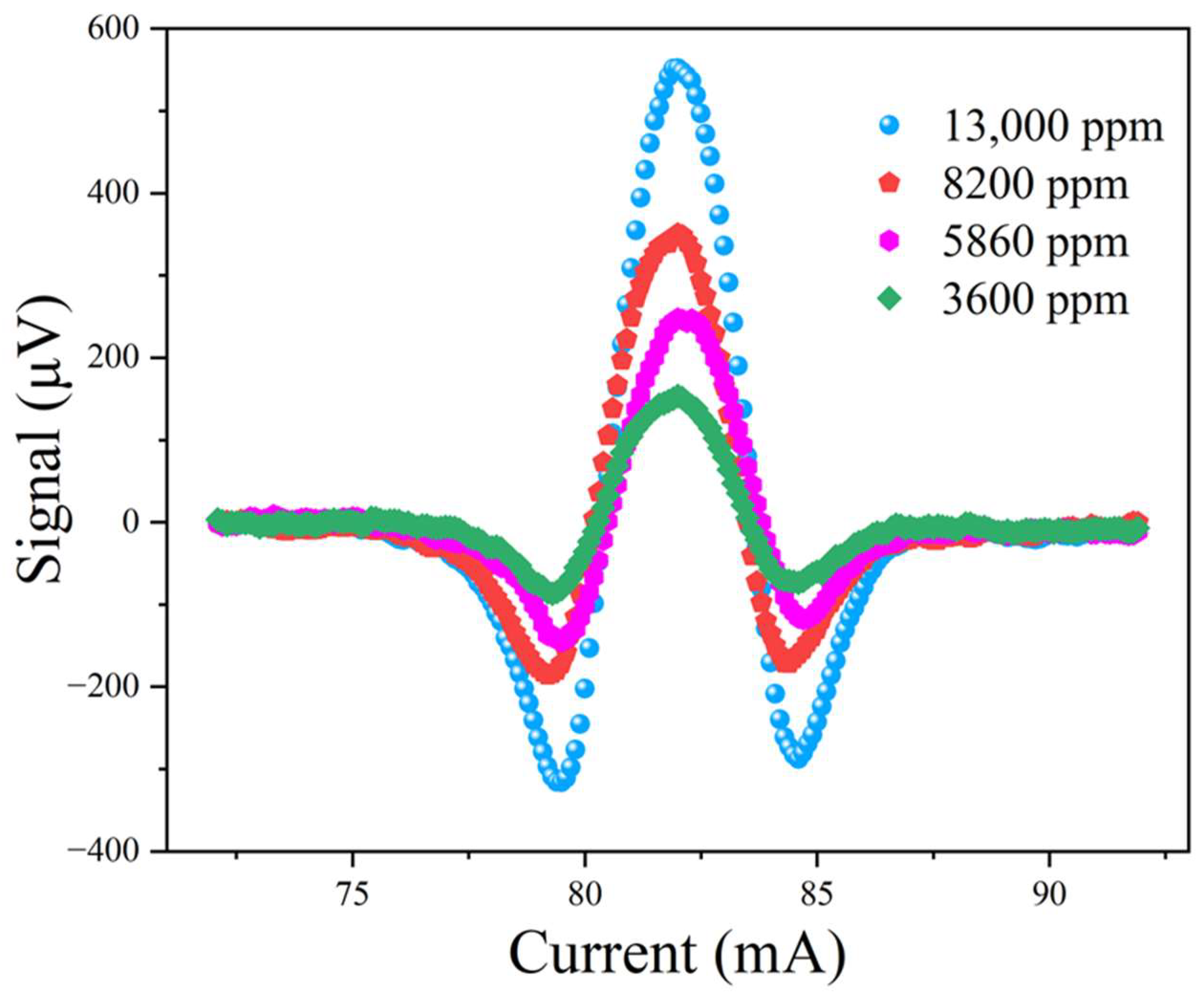
To generate controlled water vapor concentrations, a humidifier was used together with nitrogen dilution. By adjusting the mixing ratio, the water vapor concentration was varied, and an electronic hygrometer was used as an independent reference to verify the humidity level. Under the same optimized modulation depth (400 mV), we measured the demodulated 2f QEPAS signals at four water vapor concentrations. Figure 5 shows the resulting 2f line shapes, which exhibit the expected second-harmonic spectral profile. As the water vapor concentration increased, the 2f peak amplitude increased monotonically, confirming the proper system response and linear behavior over the investigated range.
Although lock-in detection effectively suppresses broadband noise, QEPAS signals can still be limited by residual electronic noise, laser-intensity fluctuations, and long-term drift, especially for low signal levels and long averaging times. Here, we implemented a deep-learning denoising method to further improve the QEPAS performance.
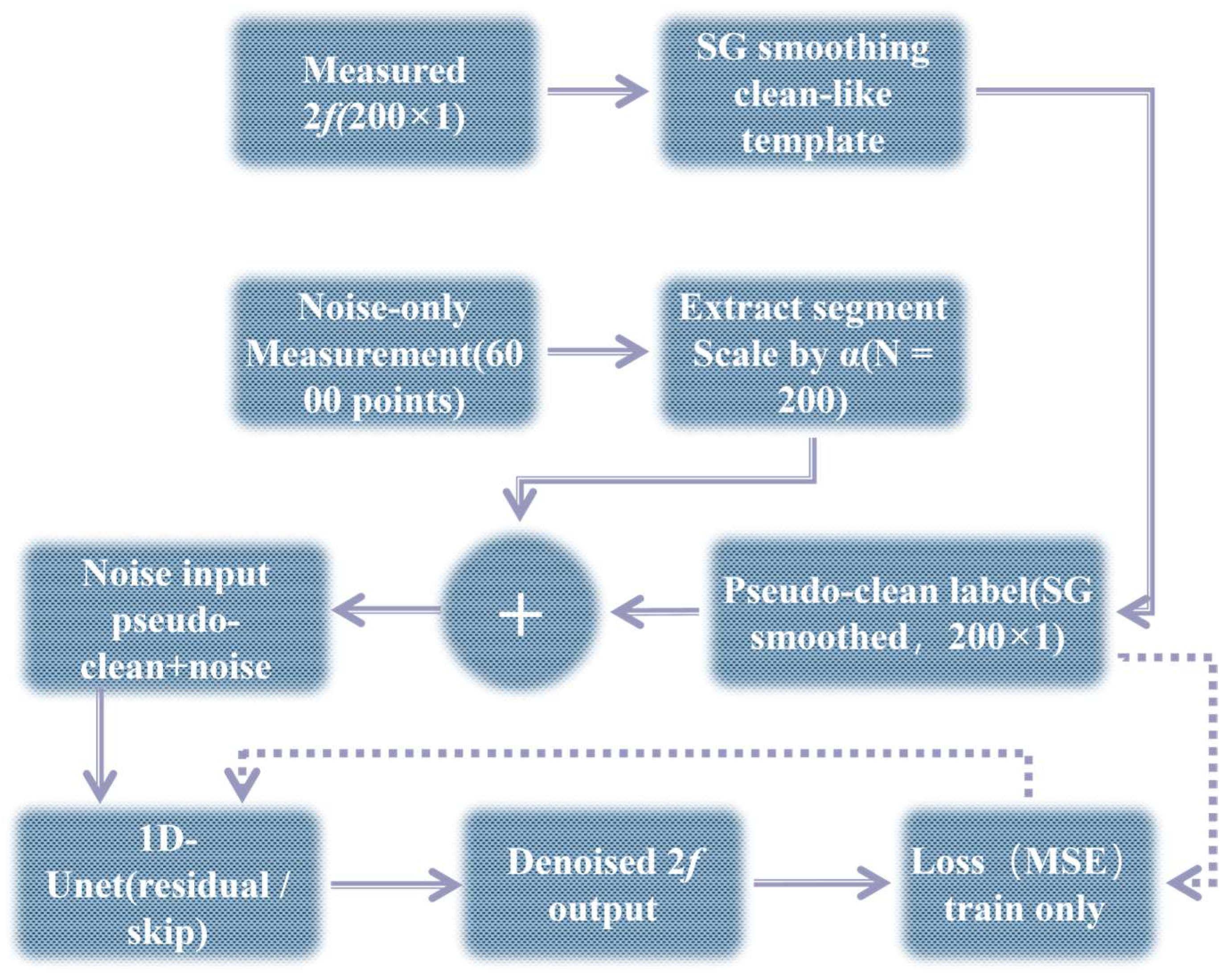
The overall workflow is shown in Figure 6. First, a noise-only trace was collected by tuning the laser wavelength outside the water absorption line, so that the recorded signal mainly represented the background noise of the system. Next, the experimentally measured 2f signals were processed by a Savitzky–Golay (SG) smoothing operation to generate a clean-like template (pseudo-clean label). Random noise segments were extracted from the noise-only record and scaled by a factor α, then added to the pseudo-clean label to form synthetic noisy inputs. A 1D U-Net model with encoder–decoder structure and skip connections was trained using the mean squared error (MSE) loss between the network output and the pseudo-clean target. After training, the network was used to denoise experimentally measured 2f traces in real time (offline processing in the current implementation).
The SG-smoothed trace is used here as a clean-like template rather than a perfect physical ground truth. Savitzky–Golay smoothing is a local polynomial least-squares filter commonly used in spectroscopic signal processing, but it may attenuate high-frequency components and introduce boundary artifacts if parameters are not chosen conservatively. To mitigate potential bias, we (i) apply SG smoothing only to construct the pseudo-clean template during training, while the inference is performed directly on raw experimental WMS–2f traces, and (ii) synthesize training inputs by adding randomly sampled and scaled experimentally measured noise-only traces, so that the network learns the statistics of the real instrument noise rather than a deterministic SG operator. Finally, we note that fully label-free/self-supervised denoising (e.g., Noise2Noise/Noise2Void) could further reduce reliance on pseudo-clean targets and is a promising direction for future work.
The denoiser adopts a canonical 1D U-Net encoder–decoder architecture with skip connections. It contains four encoder stages and four decoder stages with a bottleneck; each stage includes two Conv1D layers (kernel size = 3) followed by ReLU activations. Downsampling is performed by max-pooling (pool size = 2, stride = 2), and upsampling is performed by transposed convolution (kernel size = 2, stride = 2). The number of filters is 64, 128, 256, and 512 in the encoder, with 1024 filters at the bottleneck, and then symmetrically decreases in the decoder. A final 1 × 1 Conv1D layer outputs a single denoised trace with a linear activation (regression). The dataset used for training the network contains 6000 paired samples generated following Figure 6. The samples were randomly split into 4800/600/600 for training/validation/testing (80%/10%/10%). The validation set was used to monitor generalization and to select the final model (minimum validation loss), while the test set was reserved for final evaluation only. In this work, each WMS–2f QEPAS trace is represented as a 1D vector with N = 200 sampled points; therefore, the denoiser input and output dimensions are 200 × 1. The noise-only record contains 6000 points, and random noise segments with the same length (N = 200) are extracted and added to the pseudo-clean template to form synthetic noisy inputs.

4. Discussion

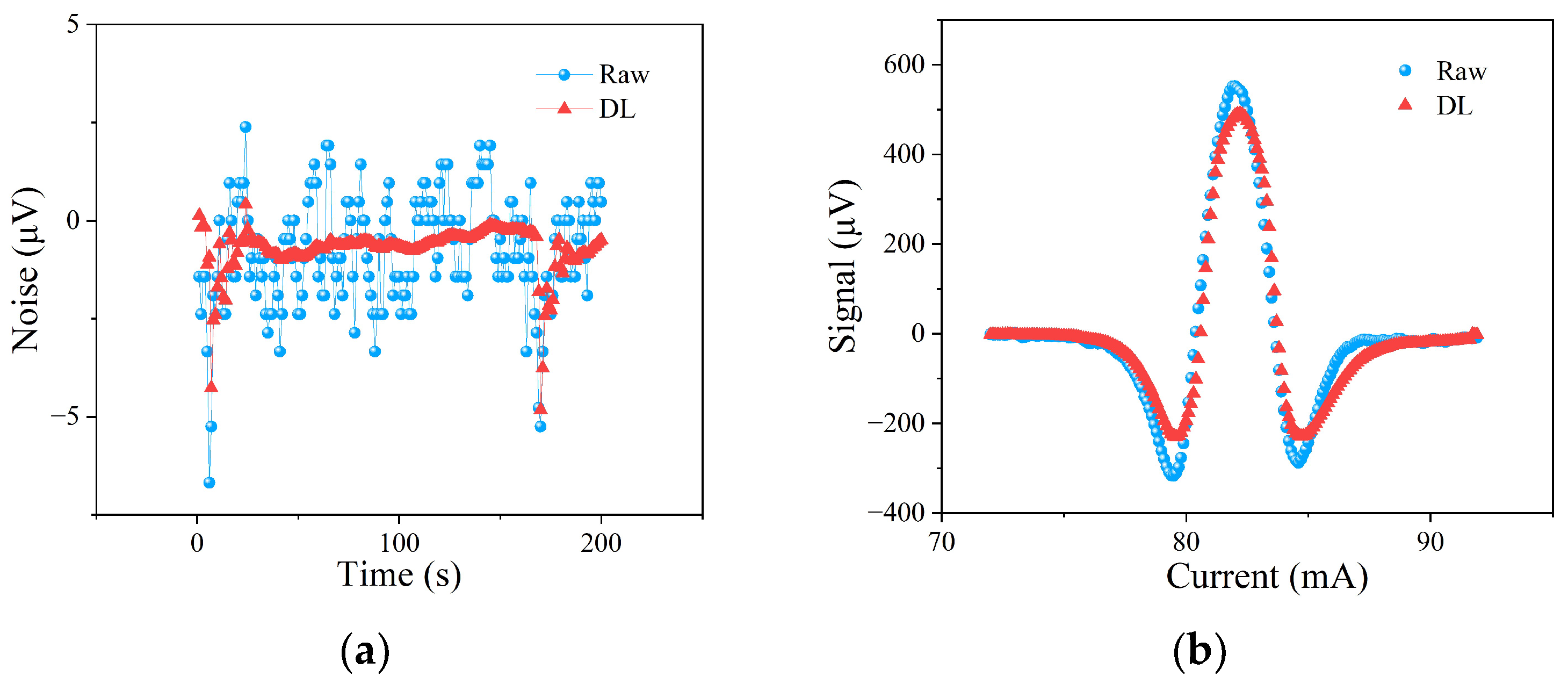
Figure 7a compares a representative noise-only trace before and after denoising, showing that the 1D U-net significantly suppresses random fluctuations while preserving the slow baseline behavior. Figure 7b shows the measured 2f signal together with the denoised output. Quantitatively, the RMS noise level decreases from σraw = 1.496 μV to σDL = 0.650 μV, while the 2f peak amplitude changes from Araw = 551.585 μV to ADL = 490.824 μV. Therefore, SNRraw = Arawraw = 368.65 and SNRDL = ADLDL = 754.89, corresponding to an improvement factor of SNRDL/SNRraw = 2.05× (i.e., 10log10 (SNRDL/SNRraw) = 3.11 dB). These results indicate that deep-learning post-processing can provide a tangible benefit for QEPAS measurements without changing the optical hardware. Notably, the denoised trace in Figure 7b exhibits a modest peak-amplitude scaling (Araw = 551.585 μV versus ADL = 490.824 μV, i.e., ~11% reduction). Such a change is expected for data-driven denoisers and mainly manifests as a multiplicative scale factor. Importantly, this does not alter the monotonic/approximately linear concentration dependence of WMS–2f signals in the weak-absorption regime; instead, it changes the calibration slope. Therefore, for quantitative concentration retrieval, we recommend constructing the concentration–signal calibration curve using the DL-processed outputs (or equivalently applying a constant scale factor obtained from calibration), ensuring unbiased concentration estimates while retaining the improved noise performance and MDL.

5. Validation

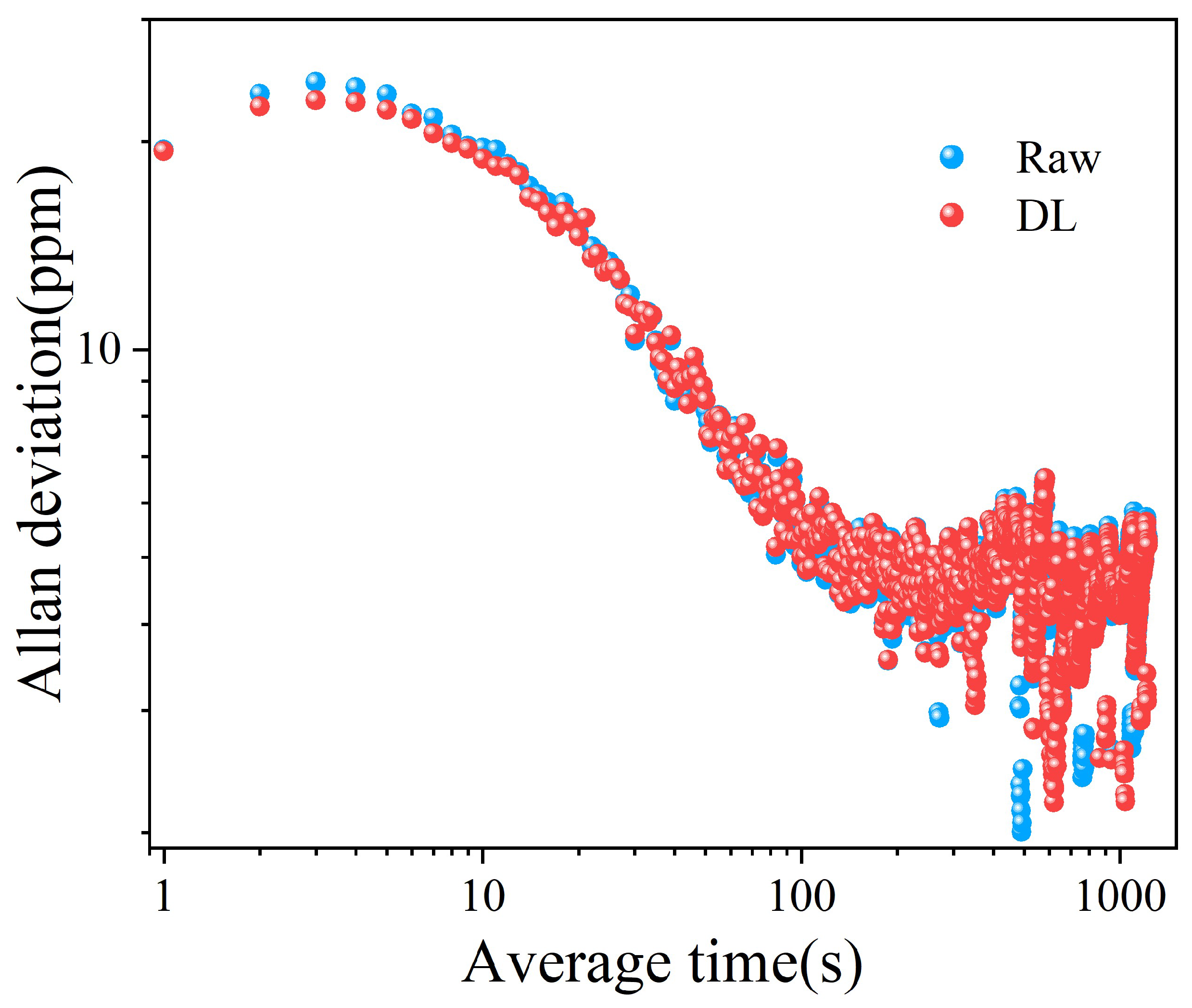
To quantify the long-term stability and minimum detection limit (MDL), an Allan deviation analysis was performed for both the raw output (Raw) and the deep-learning denoised output (DL), as shown in Figure 8. The Allan deviation decreases with increasing averaging time and reaches an optimum, after which drift contributions become dominant. The DL-processed signal reaches a minimum Allan deviation (ultimate MDL) of ~2.21 ppm at an averaging time of ~619 s. In contrast, the raw output corresponds to ~4.62 ppm at the same averaging time, indicating an ~2.1× improvement in the ultimate detection capability after NN denoising.
The Allan deviation plot is not only a metric for optimum averaging time and ultimate MDL/LOD, but also a diagnostic tool for identifying the dominant noise contributions in QEPAS sensors. In QEPAS systems, the short-averaging-time regime is often limited by approximately white noise contributions associated with the sensor/electronics (e.g., QTF thermal noise and Johnson/electronic noise), while the long-averaging-time regime is typically limited by slow drifts such as laser power instabilities, temperature fluctuations, and mechanical/optical drifts. Consequently, a data-driven denoiser mainly improves performance by suppressing structured and correlated technical noise components in the recorded traces, whereas it cannot eliminate the fundamental random noise floor set by the physical detector and readout chain, nor can it fully remove slow drifts without additional stabilization or referencing. This explains why the achievable improvement is ultimately bounded by the physical noise sources even when post-processing is applied.
In practice, the denoiser is most effective on noise components that are statistically structured and recurrent in the measurement traces (i.e., “learnable” noise), such as correlated baseline fluctuations, periodic electrical pickup (e.g., mains-related components), interference/fringe-like patterns, and other repeatable technical artifacts. These components exhibit temporal correlation or characteristic morphology and can therefore be modeled and suppressed by a data-driven network trained on representative measurements. By contrast, “non-learnable” noise components are dominated by fundamental stochastic noise floors and slow drifts that are not predictable from a single trace without additional physical references. In QEPAS, the ultimate short-term floor is often set by detector/electronics noise such as QTF thermal noise and electronic/Johnson noise, which cannot be removed by post-processing and is commonly diagnosed via Allan deviation analysis. Therefore, deep-learning post-processing primarily reduces structured technical noise, while the achievable improvement is ultimately bounded by the physical noise floor and long-term drift mechanisms.

6. Conclusions

In this work, we developed a QEPAS-based water vapor sensor and demonstrated that deep-learning denoising can provide a practical performance gain without modifying the spectrophone hardware. A tuning-fork-based QEPAS module was characterized and integrated into a WMS–2f detection architecture driven by a 1392 nm DFB laser and a commercial gas cell. The modulation depth was experimentally optimized to maximize the normalized 2f signal amplitude, providing a stable operating point for subsequent humidity measurements. Water vapor 2f spectra were acquired at several concentrations, and a 1D U-Net denoising model (trained under a pseudo-clean supervision framework) was introduced to suppress measurement noise. Although the denoised waveform shows a modest reduction in peak amplitude (i.e., an amplitude scaling), this effect primarily changes the calibration slope and does not affect quantitative concentration retrieval as long as the calibration is performed using the same DL-processed signals (or an equivalent scaling correction is applied). The overall smoothness and baseline fluctuations are significantly improved, leading to a net SNR enhancement of 2.05× (3.11 dB). By evaluating the Allan deviation, the sensor achieved an ultimate MDL of ~2.21 ppm at an averaging time of ~619 s, corresponding to an ~2.1× improvement compared with the raw output. These results confirm that deep-learning-assisted signal processing is an effective route to improve QEPAS humidity sensing performance, and it can be readily extended to other trace-gas targets and real-time implementations with lightweight neural networks.

Author Contributions

Conceptualization, H.X. and H.Z.; methodology, H.X. and H.Z.; software, H.L. and J.H.; validation, L.W., R.Z., Z.S. and W.Z.; formal analysis, H.X. and J.W.; investigation, J.W., H.L., L.W., R.Z., G.H., J.X., J.Y., W.Z. and Y.Z.; resources, L.L.; data curation, R.Z., G.H., Z.S. and J.X.; writing—original draft preparation, H.X.; writing—review and editing, H.Z. and Z.S.; visualization, J.X. and J.Y.; supervision, H.Z.; project administration, H.Z. and L.L.; funding acquisition, H.Z. All authors have read and agreed to the published version of the manuscript.

Funding

This work is supported by Beijing Natural Science Foundation (Grant No. L254015), National Natural Science Foundation of China (Grant Nos. 62375111, 62005105, 12174156, 12174155, 62105125, 62075088, and 62175137), the Ministry of Education of China (Grant No. 8091B03012309), Fundamental and Interdisciplinary Disciplines Breakthrough Plan of the Ministry of Education of China (No. JYB2025XDXM802), Natural Science Foundation of Guangdong Province (Nos. 2020B1515020024 and 2023B1515020027), the Guangdong Special Support Program (No. 2024TQ08A171), the Science and Technology Projects of Guangzhou (Nos. 202102020445 and 2025A04J5212), Special Project in Key Fields of the Higher Education Institutions of Guangdong Province (Nos. 2020ZDZX3022, 2025ZDZX1001), the Fundamental Research Funds for the Central Universities (Nos. 21619402, 11618413, and 21624113), Special Funds for the Cultivation of Guangdong College Students’ Scientific and Technological Innovation (Nos. pdjh2023a0052, pdjh2024a051, pdjh2024a048, and pdjh2025ak027), National Innovation and Entrepreneurship Training Program for Undergraduate (Nos. 202310559088, 202410559001, and 202510559033).

Data Availability Statement

The original contributions presented in this study are included in the article. Further inquiries can be directed to the corresponding author.

Conflicts of Interest

The authors declare no conflicts of interest.

Abbreviations

The following abbreviations are used in this manuscript:
QEPASquartz-enhanced photoacoustic spectroscopy
PASphotoacoustic spectroscopy
QTFquartz tuning fork
LITESlight-induced thermoelastic spectroscopy
DLdeep learning
SNRsignal-to-noise ratio
MDLminimum detection limit
TDMtime division multiplexing
FDMfrequency division multiplexing
TDLAStunable diode laser absorption spectroscopy

References

  1. Yin, X.; Wu, H.; Dong, L.; Li, B.; Ma, W.; Zhang, L.; Yin, W.; Xiao, L.; Jia, S.; Tittel, F.K. Ppb-level SO2 photoacoustic sensors with a suppressed absorption–desorption effect by using a 7.41 μm external-cavity quantum cascade laser. ACS Sens. 2020, 5, 549–556. [Google Scholar] [CrossRef]
  2. Wei, T.; Zifarelli, A.; Dello Russo, S.; Wu, H.; Menduni, G.; Patimisco, P.; Sampaolo, A.; Spagnolo, V.; Dong, L. High and flat spectral responsivity of quartz tuning fork used as infrared photodetector in tunable diode laser spectroscopy. Appl. Phys. Rev. 2021, 8, 041409. [Google Scholar] [CrossRef]
  3. Li, S.; Lu, J.; Shang, Z.; Zeng, X.; Yuan, Y.; Wu, H.; Pan, Y.; Sampaolo, A.; Patimisco, P.; Spagnolo, V.; et al. Compact quartz-enhanced photoacoustic sensor for ppb-level ambient NO2 detection by use of a high-power laser diode and a grooved tuning fork. Photoacoustics 2022, 25, 100325. [Google Scholar] [CrossRef]
  4. Shang, Z.; Wu, H.; Li, S.; Wang, G.; Sampaolo, A.; Patimisco, P.; Spagnolo, V.; Dong, L. Ppb-level mid-IR quartz-enhanced photoacoustic sensor for sarin simulant detection using a T-shaped tuning fork. Sens. Actuators B Chem. 2023, 390, 133937. [Google Scholar] [CrossRef]
  5. Zhang, C.; Gao, Y.; Cui, R.; Zhang, H.; Tian, J.; Tang, Y.; Yang, L.; Feng, C.; Patimisco, P.; Sampaolo, A.; et al. Enhancing photoacoustic trace gas detection via a CNN–transformer denoising framework. Photoacoustics 2025, 45, 100758. [Google Scholar] [CrossRef] [PubMed]
  6. Feng, C.; Cui, R.; Menduni, G.; Zifarelli, A.; Patimisco, P.; Sampaolo, A.; Spagnolo, V.; Dong, L.; Wu, H. Detection of NH3 impurities in H2 environment exploiting quartz-enhanced photoacoustic spectroscopy with optimized spectrophone. Sens. Actuators B Chem. 2025, 432, 137488. [Google Scholar] [CrossRef]
  7. Olivieri, M.; Giglio, M.; Dello Russo, S.; Menduni, G.; Zifarelli, A.; Patimisco, P.; Sampaolo, A.; Wu, H.; Dong, L.; Spagnolo, V. Assessment of vibrational-translational relaxation dynamics of methane isotopologues in a wet-nitrogen matrix through quartz-enhanced photoacoustic spectroscopy. Photoacoustics 2023, 31, 100518. [Google Scholar] [CrossRef]
  8. Liu, Y.; Qiao, S.; Fang, C.; He, Y.; Sun, H.; Liu, J.; Ma, Y. A highly sensitive LITES sensor based on a multi-pass cell with dense spot pattern and a novel quartz tuning fork with low frequency. Opto-Electron. Adv. 2024, 7, 230230. [Google Scholar] [CrossRef]
  9. Qiao, S.; Sampaolo, A.; Patimisco, P.; Spagnolo, V.; Ma, Y. Ultra-highly sensitive HCl-LITES sensor based on low-frequency quartz tuning fork and fiber-coupled multi-pass cell. Photoacoustics 2022, 27, 100381. [Google Scholar] [CrossRef] [PubMed]
  10. Wang, Y.; He, Y.; Qiao, S.; Liu, X.; Zhang, C.; Duan, X.; Ma, Y. Fast step heterodyne light-induced thermoelastic spectroscopy gas sensing based on a quartz tuning fork with high-frequency of 100 kHz. Opto-Electron. Adv. 2026, 9, 250150. [Google Scholar] [CrossRef]
  11. Xie, Y.; Xiong, H.; Feng, S.; Pan, N.; Li, C.; Liu, Y.; Zhang, Y.; Shao, L.; Lu, G.; Liu, K.; et al. Sensitivity improvement of quartz-enhanced photoacoustic spectroscopy using stochastic resonance method. Photoacoustics 2025, 43, 100707. [Google Scholar] [CrossRef]
  12. Yi, H.; Laurent, O.; Schilt, S.; Ramonet, M.; Gao, X.; Dong, L.; Chen, W. Simultaneous monitoring of atmospheric CH4, N2O, and H2O using a single gas sensor based on Mid-IR quartz-enhanced photoacoustic spectroscopy. Anal. Chem. 2022, 94, 17522–17532. [Google Scholar] [CrossRef]
  13. Wang, Z.; Yang, M.; Fu, L.; Chen, C.; You, R.; Ren, W. Rapid field measurement of ventilation rate using a quartz-enhanced photoacoustic SF6 gas sensor. Meas. Sci. Technol. 2020, 31, 085105. [Google Scholar] [CrossRef]
  14. Yang, M.; Wang, Z.; Sun, H.; Hu, M.; Yeung, P.T.; Nie, Q.; Liu, S.; Akikusa, N.; Ren, W. Highly sensitive QEPAS sensor for sub-ppb N2O detection using a compact butterfly-packaged quantum cascade laser. Appl. Phys. B 2024, 130, 6. [Google Scholar] [CrossRef]
  15. Hu, L.; Zheng, C.; Zhang, M.; Yao, D.; Zheng, J.; Zhang, Y.; Wang, Y.; Tittel, F.K. Quartz-enhanced photoacoustic spectroscopy methane sensor system using quartz tuning fork-embedded, double-pass and off-beam configuration. Photoacoustics 2020, 18, 100174. [Google Scholar] [CrossRef]
  16. Xu, H.; Feng, Y.; Chen, Z.; Zhuang, Z.; Xia, J.; Zhao, Y.; Zhang, S. Dual-component beat-frequency quartz-enhanced photoacoustic spectroscopy gas detection system. Photonics 2025, 12, 747. [Google Scholar] [CrossRef]
  17. Sgobba, F.; Sampaolo, A.; Patimisco, P.; Giglio, M.; Menduni, G.; Ranieri, A.C.; Hoelzl, C.; Rossmadl, H.; Brehm, C.; Mackowiak, V.; et al. Compact and portable quartz-enhanced photoacoustic spectroscopy sensor for carbon monoxide environmental monitoring in urban areas. Photoacoustics 2022, 25, 100318. [Google Scholar] [CrossRef]
  18. Menduni, G.; Zifarelli, A.; Kniazeva, E.; Dello Russo, S.; Ranieri, A.C.; Ranieri, E.; Patimisco, P.; Sampaolo, A.; Giglio, M.; Manassero, F.; et al. Measurement of methane, nitrous oxide and ammonia in atmosphere with compact quartz-enhanced photoacoustic sensor. Sens. Actuators B Chem. 2023, 375, 132953. [Google Scholar] [CrossRef]
  19. Zhang, Y.; Xie, Y.; Lu, J.; Zhao, J.; Wu, Y.; Tong, J.; Shao, J. Continuous real-time monitoring of carbon dioxide emitted from human skin by quartz-enhanced photoacoustic spectroscopy. Photoacoustics 2023, 30, 100488. [Google Scholar] [CrossRef] [PubMed]
  20. Zhao, J.; Pan, Y.; Lu, P.; Zhang, X.; Li, T.; Zhang, J.; Sima, C.; Liu, D. Ppb-level all-optical off-axis QEPAS gas sensor based on dual-wavelength demodulation of out-of-plane vibration mode. Sens. Actuators B Chem. 2023, 385, 133689. [Google Scholar] [CrossRef]
  21. Wang, Z.; Nie, Q.; Sun, H.; Wang, Q.; Borri, S.; De Natale, P.; Ren, W. Cavity-enhanced photoacoustic dual-comb spectroscopy. Light Sci. Appl. 2024, 13, 11. [Google Scholar] [CrossRef]
  22. Li, T.; Zhao, P.; Wang, P.; Krishnaiah, K.V.; Jin, W.; Zhang, A.P. Miniature optical fiber photoacoustic gas sensor based on a 3D microprinted ferrule-top optomechanical resonator. In Proceedings of the Advanced Fiber Laser Conference (AFL 2024); SPIE: Bremerhaven, Germany, 2025; Volume 13544, pp. 263–268. [Google Scholar]
  23. Shi, J.; Zhao, J.; Zhang, H.; Fu, Y.; Qin, L.; Zhao, Y.; Feng, Y.; Chen, D.; Wang, Z. Signal enhancement of gas detection based on quartz-enhanced photothermal spectroscopy technology. Opt. Express 2024, 32, 27176–27187. [Google Scholar] [CrossRef]
  24. Feng, Y.; Chang, J.; Chen, X.; Zhang, Q.; Wang, Z.; Sun, J.; Zhang, Z. Application of TDM and FDM methods in TDLAS based multi-gas detection. Opt. Quantum Electron. 2021, 53, 195. [Google Scholar] [CrossRef]
  25. Nie, Q.; Wang, Z.; Borri, S.; De Natale, P.; Ren, W. Mid-infrared swept cavity-enhanced photoacoustic spectroscopy using a quartz tuning fork. Appl. Phys. Lett. 2023, 123, 054102. [Google Scholar] [CrossRef]
  26. Zheng, K.; Liao, H.; Han, F.; Wang, X.; Zhang, Y.; Gu, J.; Zhao, P.; Bao, H.; Yu, S.; Du, Q.; et al. Suspended waveguide-enhanced near-infrared photothermal spectroscopy for ppb-level molecular gas sensing on a chalcogenide chip. arXiv 2025, arXiv:2512.12171. [Google Scholar]
  27. Zheng, K.; Peng, Z.; Liao, H.; Huang, Y.; Bao, H.; Zhao, S.; Zhang, Y.; Zheng, C.; Wang, Y.; Jin, W. Dual slow-light enhanced photothermal gas spectroscopy on a silicon chip. Nat. Commun. 2025, 16, 10549. [Google Scholar] [CrossRef]
  28. Yao, C.; Shi, Z.; Li, Z.; Zhao, X. Fabry-Pérot photothermal interferometry in hollow-core antiresonant fiber for gas detection in mid-infrared. Sens. Actuators B Chem. 2024, 414, 135930. [Google Scholar] [CrossRef]
  29. Xiao, H.; Zhao, J.; Sima, C.; Lu, P.; Long, Y.; Ai, Y.; Zhang, W.; Pan, Y.; Zhang, J.; Liu, D. Ultra-sensitive ppb-level methane detection based on near-infrared all-optical photoacoustic spectroscopy using differential fiber-optic microphones with a gold-chromium composite nanomembrane. Photoacoustics 2022, 26, 100353. [Google Scholar] [CrossRef] [PubMed]
  30. Chen, X.; Xu, Y.; Qi, H.; Wang, H.; Li, C.; Zhao, X.; Chen, K. E-type resonant cell based photoacoustic sensor for flowing gas measurement. Sens. Actuators B Chem. 2025, 443, 138223. [Google Scholar] [CrossRef]
  31. Zhang, X.; Yang, Y.; Liu, L.; Sun, J.; Zeng, Y.; Yang, Z.; Yin, X.; Zhao, X.; Huan, H.; Shao, X.; et al. Branch enhanced photoacoustic sensor for comprehensive sevoflurane monitoring. ACS Sens. 2025, 10, 2598–2608. [Google Scholar] [CrossRef]
  32. Lou, C.; Liu, X.; Wang, Y.; Zhang, Y.; Li, Y.; Yao, J.; Chang, C.; Ma, Y.; Liu, X. Ultra-broadband optical detection from visible to terahertz range using a miniature quartz tuning fork. Opt. Lett. 2022, 47, 1875–1878. [Google Scholar] [CrossRef] [PubMed]
  33. Su, Z.; Wang, P.; Li, Z.; Li, Y.; Zhao, T.; Duan, Y.; Wang, F.; Zhu, C. Gas concentration prediction in photoacoustic spectroscopy using PSO-EAP-CNN to address correlation degradation. Photoacoustics 2025, 43, 100717. [Google Scholar] [CrossRef] [PubMed]
  34. Ye, W.; He, L.; Liu, W.; Yuan, Z.; Zheng, K.; Li, G. Optomechanical energy enhanced BF-QEPAS for fast and sensitive gas sensing. Photoacoustics 2025, 41, 100677. [Google Scholar] [CrossRef]
  35. Liu, K.; Mei, J.; Zhang, W.; Chen, W.; Gao, X. Multi-resonator photoacoustic spectroscopy. Sens. Actuators B Chem. 2017, 251, 632–636. [Google Scholar] [CrossRef]
  36. Rück, T.; Bierl, R.; Matysik, F.M. NO2 trace gas monitoring in air using off-beam quartz-enhanced photoacoustic spectroscopy and interference studies towards CO2, H2O and acoustic noise. Sens. Actuators B Chem. 2018, 255, 2462–2471. [Google Scholar] [CrossRef]
  37. Mordmueller, M.; Köhring, M.; Schade, W. Quartz-enhanced photoacoustic spectroscopy with electrical co-excitation for photoacoustic measurements in fluctuating background gases. Appl. Phys. B 2017, 123, 224. [Google Scholar] [CrossRef]
  38. Rey, J.M.; Sigrist, M.W. Non-dispersive sensing scheme based on mid-infrared light emitting diode and differential mode excitation in photoacoustic spectroscopy. Photoacoustics 2023, 29, 100455. [Google Scholar] [CrossRef]
  39. Duquesnoy, M.; Melkonian, J.-M.; Mammez, M.-H.; Levy, R.; Aoust, G.; Raybaut, M. Photoacoustic gas spectroscopy with custom quartz tuning forks: On the path to industrialization. In Optica Imaging Congress 2024 (3D, AOMS, COSI, ISA, pcAOP), Technical Digest Series, paper JTh2A.1; Optica Publishing Group: Washington, DC, USA, 2024. [Google Scholar] [CrossRef]
  40. Sampaolo, A.; Patimisco, P.; Giglio, M.; Zifarelli, A.; Wu, H.; Dong, L.; Spagnolo, V. Quartz-enhanced photoacoustic spectroscopy for multi-gas detection: A review. Anal. Chim. Acta 2021, 1161, 338894. [Google Scholar] [CrossRef]
  41. Sun, B.; Li, Y.; Gao, Z.; Zhang, M. Quartz-enhanced photoacoustic spectroscopy for SF6 gas matrix based on a T-shaped quartz tuning fork. Front. Phys. 2025, 13, 1569734. [Google Scholar] [CrossRef]
  42. Bi, S.; Zhang, X.; Zhang, Z.; Liu, X.; Qin, L.; Shi, J.; Zhao, Y.; Wang, Z. A light-induced thermoelastic spectroscopy using surface mounted device quartz tuning fork. Photoacoustics 2025, 42, 100686. [Google Scholar] [CrossRef] [PubMed]
  43. Zhang, T.; Gu, Y.; Zhang, Q.; Wei, Y.; Wang, L.; Li, C.; Wang, W.; Lv, J.; Feng, Y. Performance improvement of quartz-enhanced photoacoustic spectroscopy gas system using ICEEMDAN-PE-WTD. Infrared Phys. Technol. 2025, 145, 105650. [Google Scholar] [CrossRef]
  44. Manwar, R.; Zafar, M.; Xu, Q. Signal and image processing in biomedical photoacoustic imaging: A review. Optics 2020, 2, 1–24. [Google Scholar] [CrossRef]
  45. Kozmin, A.; Erushin, E.; Miroshnichenko, I.; Kostyukova, N.; Boyko, A.; Redyuk, A. Wavelet-Based Machine Learning Algorithms for Photoacoustic Gas Sensing. Optics 2024, 5, 207–222. [Google Scholar] [CrossRef]
  46. Shang, Z.; Li, S.; Wu, H.; Dong, L. Quartz enhanced photoacoustic detection based on an elliptical laser beam. Appl. Sci. 2020, 10, 1197. [Google Scholar] [CrossRef]
  47. Wang, Z.L.; Tian, C.W.; Liu, Q.; Chang, J.; Zhang, Q.D. The SNR improvement for quartz-enhanced photoacoustic spectroscopy using wavelength calibration and fiber reflector. Opt. Quantum Electron. 2018, 50, 187. [Google Scholar] [CrossRef]
  48. Chen, B.; He, T.; Chen, L.; Hu, Z.; Li, J. Self-calibration photoacoustic sensor for trace gas detection. Appl. Phys. B 2025, 131, 205. [Google Scholar] [CrossRef]
  49. Zifarelli, A.; Mongelli, L.A.; Kinjalk, K.; Baranov, A.; Patimisco, P.; Wang, Q.; Spagnolo, V.; Sampaolo, A. Reconstruction of the benzene absorption band at 14.8 μm in amplitude modulation exploiting a quartz tuning fork as optical detector. Sens. Actuators A Phys. 2025, 396, 117239. [Google Scholar] [CrossRef]
  50. Yin, X.; Zhu, C.; Yang, X.; Xu, K.; Liang, Y.; Zhang, D.; Mao, W.; Wu, H. Trace photoacoustic spectroscopy gas sensors for COx detection. Measurement 2026, 262, 120059. [Google Scholar] [CrossRef]
  51. Zhuang, R.; He, J.; Lin, H.; Luo, H.; Lin, L.; Wang, L.; Liu, B.; Zhu, W.; Zhong, Y.; Yu, J.; et al. Conductance-photoacoustic spectroscopy for fast and concurrent sensing of hydrogen and hydrocarbons. Photoacoustics 2025, 45, 100752. [Google Scholar] [CrossRef]
  52. Luo, H.; Li, J.; Lv, H.; Xie, J.; Wang, C.; Lin, H.; Zhuang, R.; Zhu, W.; Zhong, Y.; Kan, R.; et al. Off-plane quartz-enhanced photoacoustic spectroscopy. Opt. Lett. 2024, 49, 3206–3209. [Google Scholar] [CrossRef]
  53. Xie, J.; Lv, H.; Li, J.; Wang, C.; Lin, H.; Zhu, W.; Tang, J.; Zhong, Y.; He, X.; Yu, J.; et al. Microfiber knot resonator augmented quartz-enhanced photoacoustic spectroscopy. Infrared Phys. Technol. 2024, 136, 105037. [Google Scholar] [CrossRef]
  54. Luo, H.; Yang, Z.; Zhuang, R.; Lv, H.; Wang, C.; Lin, H.; Zhang, D.; Zhu, W.; Zhong, Y.; Cao, Y.; et al. Ppbv-level mid-infrared photoacoustic sensor for mouth alcohol test after consuming lychee fruits. Photoacoustics 2023, 33, 100559. [Google Scholar] [CrossRef] [PubMed]
  55. Zhuang, R.; Lin, L.; Wang, C.; Lin, H.; Luo, H.; Lv, H.; Zhu, W.; Zhong, Y.; Liu, B.; Kan, R.; et al. Quartz-enhanced photoacoustic spectroscopy-conductance spectroscopy for gas mixture analysis. Anal. Chem. 2023, 95, 9575–9580. [Google Scholar] [CrossRef] [PubMed]
  56. Lin, L.; Lin, H.; Hong, G.; He, J.; Wang, L.; Zhuang, R.; Zhu, W.; Zhong, Y.; Yu, J.; Zheng, H. A compact 2.3 μm DFB-laser CO sensor using MPC-LITES for real-time monitoring of cigarette smoke. Sensors 2025, 25, 6894. [Google Scholar] [CrossRef] [PubMed]
Figure 1. Photograph of a QEPAS QTF taken with an optical microscope.
Optics 07 00015 g001
Figure 2. Frequency response curve of the QTF under atmospheric pressure, obtained by electrical excitation.
Optics 07 00015 g002
Figure 3. Schematic diagram of the QEPAS experimental setup.
Optics 07 00015 g003
Figure 4. 2f QEPAS signals of water vapor measured at four concentrations. The WMS–2f demodulated signal is plotted as a function of laser injection current for H2O concentrations of 13,000 ppm, 8200 ppm, 5860 ppm, and 3600 ppm. Here, the “Current (mA)” axis corresponds to the injection current readout displayed by the laser driver during the scan, and the “Signal (µV)” axis corresponds to the lock-in amplifier demodulated X-output voltage.
Optics 07 00015 g004
Figure 5. Dependence of normalized signal amplitude on modulation depth, showing a maximum (star sign) at 400 mV.
Optics 07 00015 g005
Figure 6. Deep-learning pipeline for denoising 2f QEPAS signals using pseudo-clean supervision.
Optics 07 00015 g006
Figure 7. Comparison of noise and signal before and after deep-learning (DL) denoising for the QEPAS-based H2O sensor. (a) Raw noise trace (Raw) and the DL-denoised noise trace (DL). (b) Raw and DL-denoised 2f QEPAS signals. The RMS noise levels are 1.496 μV (Raw) and 0.650 μV (DL), and the corresponding 2f peak amplitudes are 551.585 μV (Raw) and 490.824 μV (DL), yielding SNRraw = 368.65 and SNRDL = 754.89.
Optics 07 00015 g007
Figure 8. Allan deviation analysis of the QEPAS sensor output for the raw signal (Raw) and the deep-learning denoised signal (DL). The minimum of the Allan deviation curve corresponds to the ultimate MDL/LOD at the optimum averaging time.
Optics 07 00015 g008
Disclaimer/Publisher’s Note: The statements, opinions and data contained in all publications are solely those of the individual author(s) and contributor(s) and not of MDPI and/or the editor(s). MDPI and/or the editor(s) disclaim responsibility for any injury to people or property resulting from any ideas, methods, instructions or products referred to in the content.