Skip Content
You are currently on the new version of our website. Access the old version .

Non-Coding RNA

Non-Coding RNA is an international, peer-reviewed, open access journal on non-coding RNA research dealing with elucidating the structure, function and biology of regulatory non-coding RNAs, and published bimonthly online by MDPI. 

Indexed in PubMed | Quartile Ranking JCR - Q2 (Genetics and Heredity)

All Articles (593)

Background/Objectives: Human milk is a complex biological fluid containing not only macro- and micronutrients but also diverse bioactive molecules, including extracellular RNAs. Although RNA has been detected in milk for decades, only a subset of RNA species has been characterized in detail, and abundant families such as tRNA-, yRNA-, and rRNA-derived fragments remain underexplored. This study aimed to define the composition, fragmentation patterns, stability, and exploratory functional activity of these highly abundant RNAs in human milk. Methods: We performed small RNA sequencing on skim milk samples and analyzed the resulting profiles in comparison with publicly available milk and biofluid datasets. RNA stability assays, Northern blotting, and RT-qPCR were conducted to validate RNA abundance and degradation kinetics. Extracellular vesicles (EVs) and non-vesicular fractions were analyzed to determine the subcellular distribution of RNA species. Exploratory functional assays using synthetic RNA fragments were carried out to assess their ability to modulate cellular responses in vitro. Results: Human milk was found to be highly enriched in small RNA fragments derived from tRNA, yRNA, and rRNA, dominated by a limited set of discrete sequences. These profiles were highly reproducible across independent datasets and distinct biofluids. Orthologal validation assays confirmed their abundance and stability, with RNA levels exceeding those of serum by over two orders of magnitude. Full-length transcripts were enriched in EVs, whereas shorter fragments predominated in the non-vesicular fraction. Synthetic milk-derived exRNAs showed detectable pro-survival activity under stress conditions in vitro. Conclusions: This study reveals that human milk carries a limited set of highly abundant stable sRNA molecules, primarily derived from tRNAs, yRNAs, and rRNAs. These findings provide new insights into the RNA cargo of human milk and offer preliminary evidence that selected sRNA fragments can modulate cellular stress responses in in vitro models.

9 February 2026
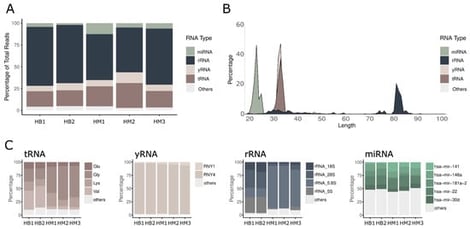
exRNA profiling in human skim milk. (A) Percentage distribution of sRNA biotypes in human skim milk samples collected for this study (HM1–3) and those described in the Human Biofluid RNA Atlas (HB1–2). (B) sRNA length distribution by biotype in the complete dataset. (C) Percentage distribution of the most abundant RNA fragments derived from tRNAs, rRNAs, and yRNAs in human skim milk. Categories with <5% average abundance across all samples were grouped as “others”.

Mechanisms at the Intersection of lncRNA and m6A Biology

  • Samuel J. Gonzalez,
  • Edgardo Linares and
  • Aaron M. Johnson
  • + 1 author

This review provides a thorough survey of long noncoding RNAs that bear the RNA modification N6-methyladenosine (m6A) and current work to understand the resulting mechanistic and biological consequences. We give an overview of lncRNA and m6A biology first, describing the writers, erasers, and readers of m6A and their targeting of lncRNAs. Next, we give an in-depth review of the field of nuclear lncRNAs that regulate chromatin and their regulation via m6A. We then describe the growing appreciation of liquid–liquid phase separation properties in lncRNA and m6A biology. Finally, we cover examples of cytoplasmic lncRNAs regulated by m6A. Overall, this review aims to emphasize how epitranscriptomics influences noncoding RNA mechanisms to provide additional layers of regulation, integrated into downstream biological processes.

31 January 2026

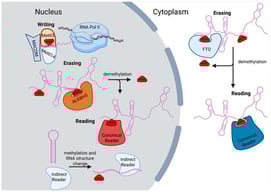
General m6A machinery. The primary writer of m6A within mammalian cells is Mettl3/14, in complex with many regulatory subunits (WTAP, VIRMA, AC3H13, HAKAI, and RBM15) that make up the MACOM. Deposition of m6A marks on lncRNAs occurs co-transcriptionally. Readers of m6A can preferentially localize to the nucleus or the cytoplasm, coming in two main types: canonical readers and indirect readers. Canonical readers directly bind m6A, while indirect readers bind the RNA sequence that becomes available due to changes in the secondary structure of the RNA upon m6A methylation. The two primary erasers of m6A are ALKBH5 and FTO; ALKBH5 functions primarily in the nucleus, while FTO functions primarily in the cytoplasm. Created in BioRender. Gonzalez, S. (2025) https://BioRender.com/i0u2r64 (accedd on 21 November 2025).

Background/Objectives: In severe peripheral artery disease (PAD) with limb ischemia, hypercholesterolemia (HC) is associated with impaired neovascularization. Extracellular vesicles (EVs) are present within ischemic muscles, and they contain microRNAs (miRs) involved in several biological functions, including angiogenesis and neovascularization. Methods: We used a mouse model of PAD and compared the response to hindlimb ischemia in hypercholesterolemic ApoE−/− vs. normocholesterolemic mice. Next-generation sequencing (NGS) was used to perform full miR expression profiling in ischemic skeletal muscles and in EVs of varying sizes—large EVs (lEVs) and small EVs (sEVs)—within these muscles. Results: We identified several miRs with potential pro-angiogenic effects (angiomiRs) that are reduced by HC in lEVs (Let-7b-5p, miR-151-3p, Let-7c-5p) or sEVs (miR-21a-5p, miR-196b-5p, miR-340-5p). As proof of principle, we showed that the overexpression of Let-7b-5p in lEVs, or miR-21a-5p in sEVs, can significantly increase the angiogenic capacity of these EVs in vitro. HC also impaired the enrichment of specific angiomiRs in lEVs (miR-100-5p), sEVs (miR-142a-3p), or in both lEVs and sEVs (miR-146b-5p). In silico approaches, including the prediction of miR targets, pathway unions, and gene unions, identified the resulting predictive effects of HC-modulated miRs in EVs on processes with key roles in the modulation of angiogenesis and neovascularization, such as the regulation of the actin cytoskeleton and focal adhesion and the HIF-1, MAPK, AMPK, and PI3K-Akt signaling pathways. Conclusions: Our results constitute an important first step towards the identification of specific miRs that could be targeted to improve EV angiogenic function in hypercholesterolemic conditions and reduce tissue ischemia in patients with severe PAD.

26 January 2026

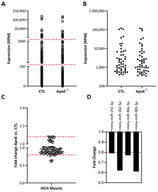
Effect of hypercholesterolemia on miR expression profile in whole ischemic skeletal muscles. (A,B). Expression profile of all miRs (A) or 50 most expressed miRs (B) isolated in whole ischemic skeletal muscles of hypercholesterolemic ApoE−/− mice (pool of 3) or normocholesterolemic control mice (CTL, pool of 4). (C). Fold change representation of effect of hypercholesterolemia on 50 most expressed miRs in ischemic muscles. (D). Representation of 4 miRs that were reduced by more than 20% in hypercholesterolemic conditions, including 1 potential angiomiR (miR-151-3p).

The Role of microRNAs as Potential Biomarkers in Diffuse Large B-Cell Lymphoma

  • Eirini Panteli,
  • Epameinondas Koumpis and
  • Eleftheria Hatzimichael
  • + 5 authors

Diffuse large B-cell lymphoma (DLBCL) is the most common and clinically aggressive subtype of non-Hodgkin lymphoma (NHL). While novel therapies such as rituximab and polatuzumab vedotin have led to improved outcomes, approximately 35% of patients eventually develop relapsed or refractory disease. MicroRNAs (miRNAs), a class of endogenous single-stranded RNAs approximately 22 nucleotides in length, play a pivotal role in the regulation of gene expression at the post-transcriptional level through interactions with complementary target RNAs and contribute significantly to the development, progression, and treatment response of DLBCL. Oncogenic miRNAs, such as miR-155, miR-21, and the miR-17–92 cluster, promote proliferation, survival, immune evasion, and therapy resistance by modulating pathways including PI3K/AKT, NF-κB, and MYC. Conversely, tumor-suppressive miRNAs such as miR-34a, miR-144, miR-181a, and miR-124-3p inhibit oncogene activity and enhance apoptosis, with their loss often associated with adverse outcomes. Among these, miR-155 and miR-21 are particularly well studied, playing central roles in both tumor progression and remodeling of the tumor microenvironment. This review summarizes current evidence on the biological and clinical relevance of miRNAs in DLBCL, emphasizing their diagnostic and prognostic potential.

7 January 2026

miRNAs are transcribed by RNA polymerase II as primary transcripts (pri-miRNAs), which are then processed in the nucleus by the enzyme Drosha along with its cofactor DGCR8 into precursor miRNAs (pre-miRNAs). These pre-miRNAs are transported to the cytoplasm via exportin 5, where they associate with the Dicer/TRBP complex and are cleaved into short double-stranded RNA molecules. One strand of this miRNA duplex is then incorporated into the Argonaute protein to form the RNA-induced silencing complex (RISC). RISC then binds to specific target mRNAs, leading to their degradation, destabilization, or inhibition of translation. In addition to the canonical pathway, miRNAs can be generated through non-canonical biogenesis routes, including Drosha-independent mechanisms (where pri-miRNAs are processed by the spliceosome) as well as Dicer-independent pathways. Abbreviations: Ago2: Argonaute 2, DGCR8: DiGeorge syndrome critical region 8, RISC: RNA-induced silencing complex, TRBP: Transactivation response element RNA-binding protein. Created in https://BioRender.com (accessed on 8 July 2025). Modified from Seyhan, Attila 2023 [51].

News & Conferences

Issues

Open for Submission

Editor's Choice

Get Alerted

Add your email address to receive forthcoming issues of this journal.

XFacebookLinkedIn
Non-Coding RNA - ISSN 2311-553X