


ijms-logo

Journal Browser

Journal Browser

Latest Review Papers in Molecular Pathology, Diagnostics, and Therapeutics

Editor


E-Mail Website
Collection Editor
Biosanitary Research Institute (IIB-VIU), Valencian International University (VIU), 46002 Valencia, Spain
Interests: diabetes and diabetes complication; cardiovascular; peripheral artery disease (PAD); critical limb ischemia pathology (CLI); regulatory standards; clinical trials; advanced therapies; advanced therapies medicinal products (ATMP); stem cells; good manufacturing practice (GMP); quality assurance (QA); quality control (QC); molecular and cellular biology; epigenetics; microRNAs
Special Issues, Collections and Topics in MDPI journals

Topical Collection Information

Dear Colleagues,

We are pleased to announce a Topical Collection dedicated to authoritative and comprehensive review articles that showcase the most significant recent developments in the dynamic fields of molecular pathology, diagnostics, and therapeutics. We warmly invite leading researchers and emerging experts to contribute in-depth analyses that highlight cutting-edge discoveries, novel methodologies, and anticipated future advances across these interconnected disciplines.

The scope of this Topical Collection encompasses advances in molecular mechanisms underlying human diseases, innovative diagnostic technologies—including genomics, transcriptomics, and proteomics—biomarker discovery, and the development of targeted and personalized therapeutic strategies. We especially welcome reviews that address the integration of multi-omics data, artificial intelligence-driven approaches, and translational research bridging laboratory findings with clinical applications.

Full-length review articles are encouraged to be submitted to provide critical assessments of current knowledge, identify emerging challenges, and discuss future opportunities that will shape the landscape of molecular pathology, diagnostics, and therapeutics. Reviews that foster interdisciplinary collaboration, highlight innovative strategies, or connect fundamental research with real-world clinical impact are particularly welcome.

We look forward to receiving your contributions, which will enrich this collection and drive continued progress and innovation in the molecular medicine research community.

Dr. Abdelkrim Hmadcha
Collection Editor

Manuscript Submission Information

Manuscripts should be submitted online at www.mdpi.com by registering and logging in to this website. Once you are registered, click here to go to the submission form. All submissions that pass pre-check are peer-reviewed. Accepted papers will be published continuously in the journal (as soon as accepted) and will be listed together on the collection website. Research articles, review articles as well as short communications are invited. For planned papers, a title and short abstract (about 250 words) can be sent to the Editorial Office for assessment.

Submitted manuscripts should not have been published previously, nor be under consideration for publication elsewhere (except conference proceedings papers). All manuscripts are thoroughly refereed through a single-blind peer-review process. A guide for authors and other relevant information for submission of manuscripts is available on the Instructions for Authors page. International Journal of Molecular Sciences is an international peer-reviewed open access semimonthly journal published by MDPI.

Please visit the Instructions for Authors page before submitting a manuscript. There is an Article Processing Charge (APC) for publication in this open access journal. For details about the APC please see here. Submitted papers should be well formatted and use good English. Authors may use MDPI's English editing service prior to publication or during author revisions.

Keywords

  • molecular pathology
  • biomarkers
  • molecular diagnostics
  • precision medicine
  • multi-omics integration
  • liquid biopsy
  • genomics
  • proteomics
  • transcriptomics
  • artificial intelligence in diagnostics
  • targeted therapeutics
  • immunotherapy
  • drug resistance
  • personalized medicine
  • translational research
  • clinical applications
  • disease mechanisms
  • novel therapeutic strategies
  • bioinformatics
  • next-generation sequencing
  • emerging diagnostic technologies
  • real-world data in therapeutics
  • therapeutic monitoring
  • cancer molecular pathology
  • infectious diseases
  • autoimmune diseases
  • neurodegenerative diseases

Published Papers (1 paper)

2026

26 pages, 1104 KB  
Review
The Placenta in Gestational Diabetes: An Integrated Review on Metabolic Pathways, Genetic, Epigenetic and Ultrasound Biomarkers for Clinical Perspectives
by Giovanni Tossetta, Roberto Campagna, Arianna Vignini, Giuseppe Maria Maruotti, Mariarosaria Motta, Chiara Murolo, Laura Sarno, Camilla Grelloni, Monia Cecati, Stefano Raffaele Giannubilo and Andrea Ciavattini
Int. J. Mol. Sci. 2026, 27(2), 919; https://doi.org/10.3390/ijms27020919 - 16 Jan 2026
Viewed by 621
Abstract
Pregnancies complicated by diabetes, including pregestational and gestational diabetes mellitus, are associated with increased maternal and fetal morbidity. Early identification of at-risk pregnancies is crucial for timely intervention and improved outcomes. Emerging evidence highlights the interplay of genetic predisposition, epigenetic modifications, and non-invasive [...] Read more.
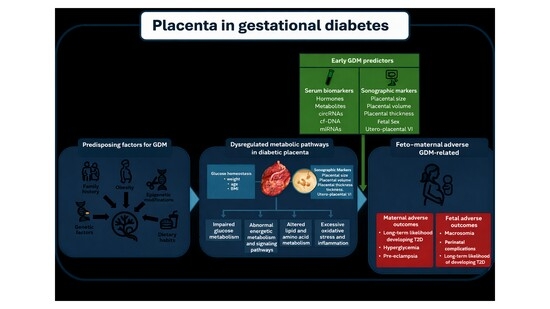
Pregnancies complicated by diabetes, including pregestational and gestational diabetes mellitus, are associated with increased maternal and fetal morbidity. Early identification of at-risk pregnancies is crucial for timely intervention and improved outcomes. Emerging evidence highlights the interplay of genetic predisposition, epigenetic modifications, and non-invasive biomarkers in the early detection of diabetic pregnancies. Genetic factors influencing insulin signaling, glucose metabolism, and pancreatic β-cell function may contribute to susceptibility to gestational hyperglycemia. Concurrently, epigenetic alterations, such as DNA methylation and histone modifications in maternal and placental tissues, have been linked to dysregulated metabolic pathways and adverse pregnancy outcomes. Non-invasive biomarkers, including circulating cell-free DNA and microRNAs in maternal blood, show promise for early diagnosis by offering a safer and more practical alternative to invasive testing. Integrating genetic, epigenetic, and molecular marker data could enhance risk stratification and enable personalized monitoring and management strategies. This review synthesizes current knowledge on the molecular underpinnings of diabetic pregnancies, evaluates the potential of emerging biomarkers for early diagnosis, and discusses the challenges and future perspectives for translating these findings into clinical practice. Understanding these mechanisms may pave the way for precision medicine approaches, ultimately improving maternal and neonatal outcomes in pregnancies affected by diabetes. Full article
Show Figures

Graphical abstract

Back to TopTop