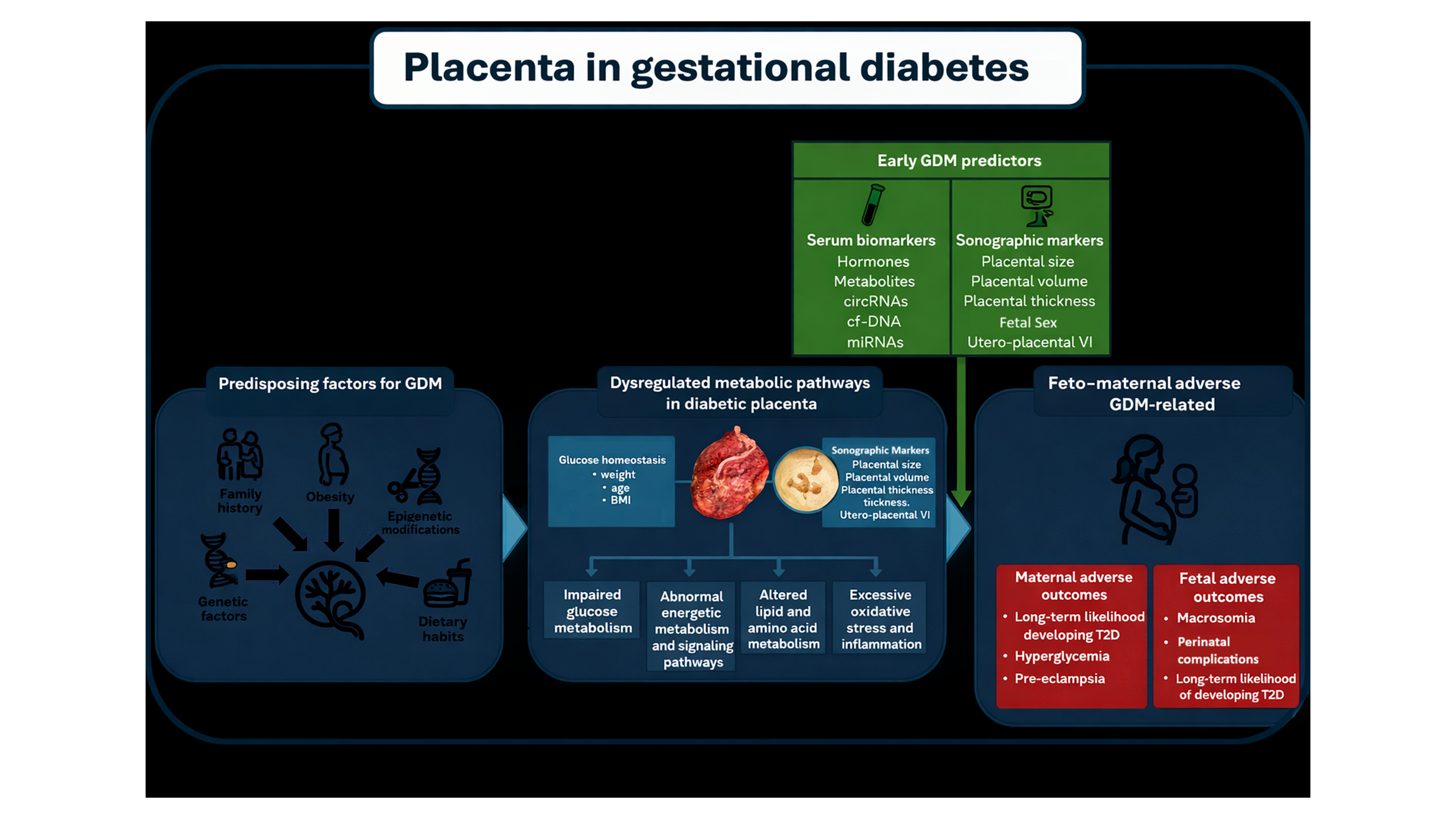
The Placenta in Gestational Diabetes: An Integrated Review on Metabolic Pathways, Genetic, Epigenetic and Ultrasound Biomarkers for Clinical Perspectives

 ,
,  ,
,  ,
,  , , ,
, , ,  and
and 
Abstract
1. Introduction
2. Methods
3. Predisposing Factors for GDM
3.1. Genetic Factors
3.2. Epigenetic Factors
4. Dysregulated Metabolic Pathways in Diabetic Placenta
4.1. Glucose Metabolism
4.2. Energy Metabolism and Signaling Pathways
4.3. Lipid and Amino Acidic Metabolism
4.4. Oxidative Stress and Inflammation
5. Non-Invasive Biomarkers for the Early Diagnosis of GDM
5.1. Serum Biomarkers
Serum Biomarkers and Practical Clinical Applications
- 1st Trimester Risk Stratification (High-Risk Women)
- −
- Afamin + SHBG: ↑Afamin/↓SHBG at 11–13 w identifies high-risk women (AUC 0.70–0.75); triggers earlier OGTT (14–16 w) in BMI > 30 or family history cases [139]
- −
- Clinical Action: Reduces unnecessary OGTTs in low-risk (NPV 80%); prioritizes intensive lifestyle counseling
- miRNA & cfDNA Panels: Early Prediction
- −
- miR-29a/miR-223/miR-16 panel (meta-analysis): AUC 0.72–0.82; Sens 85% at 12 w for GDM development [140]
- −
- 3 CpG cfDNA signature (n = 32): AUC 0.85; discriminates GDM vs. non-GDM before hyperglycemia
- −
- Clinical Action: Personalized screening—low-risk panel → standard 24 w OGTT; high-risk: immediate intervention
- Exosomal circRNA (circ0039480): Progression Monitoring
- −
- Sens 85%, Spec 78% across GDM stages; tracks response to lifestyle/insulin
- −
- Clinical Action: Dynamic monitoring in confirmed GDM; predicts insulin need (PPV 75%).
5.2. Sonographic Markers
Potential Integration of Placental Ultrasound Biomarkers into Routine Clinical Practice
- 1st Trimester Placental Vascular Assessment
- −
- 3D-PD indices VI/FI/VFI at 11–13 w: ↓vascularization predicts GDM (AUC 0.75); combined with clinical nomogram → AUC 0.866
- −
- Clinical Action: Risk re-stratification—abnormal US + clinical risk → early OGTT/metformin consideration
- 2nd/3rd Trimester Surveillance
- -
- Placental volume/thickness: ↑volume correlates with glycemic control; monitors treatment efficacy
- -
- Clinical Action: Serial assessment in GDM (20–32 w); predicts macrosomia/placental insufficiency
6. Conclusions
6.1. Genetic Risk Scores Limitations
- Modest effect sizes and limited discrimination: most single SNPs and combined GRS increase GDM risk only modestly (e.g., 10% risk increase per allele; OR around 1.8 for MTNR1B, which is insufficient to replace clinical risk factors or OGTT for individual-level prediction. GRS often add only small increments in AUC when combined with age, BMI, family history and obstetric history, so their impact on clinical decision-making is limited in real-world settings.
- Population specificity and poor generalizability: many GRS are derived from European or East Asian cohorts, with under-representation of African, Hispanic or mixed-ancestry populations, so performance may degrade when applied across ancestries. Allele frequencies and linkage disequilibrium patterns differ by ethnicity, meaning that a score calibrated in one population can misclassify risk or widen health disparities in another.
- Gene–environment interactions and clinical interpretability: genetic risk often interacts with obesity, physical inactivity and diet (e.g., mitigating effect of Mediterranean diet), so the same GRS does not translate into a fixed absolute risk across lifestyles. There is no consensus on risk thresholds that should trigger specific interventions (e.g., earlier OGTT, insulin counseling), and guidelines do not yet incorporate GRS-based algorithms.
6.2. Epigenetic Biomarkers: Biological and Technical Constraints
- Tissue specificity and sampling issues: most robust signals come from the placenta, which is only available at delivery, whereas clinicians need first-trimester or preconception markers; blood-based methylation or miRNA profiles only partially reflect placental epigenetics. Epigenetic patterns differ between tissues (placenta, maternal blood, cord blood, saliva), so a CpG or miRNA validated in one compartment may not be informative in another.
- Temporal variability and stability: GDM is a dynamic process; DNA methylation and circulating miRNAs change across trimesters, so a single timepoint may misclassify risk or miss early windows of pathophysiology. Few longitudinal studies have tested whether epigenetic marks are stable enough, or reversible with lifestyle or medical treatment, to be used as reliable monitoring tools.
- Causality vs. consequence: many epigenetic differences (e.g., global hypermethylation, TRIM67 promoter changes, Wnt/cadherin pathway DMCs) may be downstream of hyperglycemia, dyslipidemia, oxidative stress or inflammation rather than primary causes of disease.
6.3. Analytical and Implementation Barriers
- Assay standardization and reproducibility: Different platforms (arrays, bisulfite sequencing, qPCR panels) and pipelines give variable results; cut-offs for “abnormal” methylation or miRNA expression are not standardized across laboratories. Pre-analytical variables (sample type, processing time, storage, gestational age at collection) significantly influence biomarker levels and contribute to inconsistent findings between studies.
- Cost, complexity and turnaround time: High-throughput genotyping and epigenomic assays remain more expensive and slower than standard OGTT and routine biochemistry in most healthcare systems. Bioinformatic analysis and interpretation require specialized expertise and infrastructure that are not widely available in routine obstetric practice.
- Limited linkage to hard clinical outcomes: for many proposed genetic and epigenetic markers, associations are strongest with GDM diagnosis, but links to clinically critical endpoints (macrosomia, preeclampsia, neonatal morbidity, long-term offspring metabolic disease) are inconsistent or weak. Without robust outcome prediction and clear added value over simple clinical models, payers and guideline panels are unlikely to endorse routine use.
Author Contributions
Funding
Institutional Review Board Statement
Informed Consent Statement
Data Availability Statement
Conflicts of Interest
References
- Lowe, W.L., Jr. Genetics and Epigenetics: Implications for the Life Course of Gestational Diabetes. Int. J. Mol. Sci. 2023, 24, 6047. [Google Scholar] [CrossRef]
- Zhang, Y.; Tao, Q.; Cheng, Y.; Fawad, M.; Liang, Z.; Xu, X. Gestational diabetes mellitus, body mass index, and cardiometabolic multimorbidity: A prospective cohort study. Ann. Epidemiol. 2024, 99, 9–15. [Google Scholar] [CrossRef]
- Kc, K.; Shakya, S.; Zhang, H. Gestational diabetes mellitus and macrosomia: A literature review. Ann. Nutr. Metab. 2015, 66, 14–20. [Google Scholar] [CrossRef]
- Sweeting, A.; Wong, J.; Murphy, H.R.; Ross, G.P. A Clinical Update on Gestational Diabetes Mellitus. Endocr. Rev. 2022, 43, 763–793. [Google Scholar] [CrossRef]
- Nijs, H.; Benhalima, K. Gestational Diabetes Mellitus and the Long-Term Risk for Glucose Intolerance and Overweight in the Offspring: A Narrative Review. J. Clin. Med. 2020, 9, 599. [Google Scholar] [CrossRef] [PubMed]
- Garnica, A.D.; Chan, W.Y. The role of the placenta in fetal nutrition and growth. J. Am. Coll. Nutr. 1996, 15, 206–222. [Google Scholar] [CrossRef]
- Desforges, M.; Sibley, C.P. Placental nutrient supply and fetal growth. Int. J. Dev. Biol. 2010, 54, 377–390. [Google Scholar] [CrossRef]
- Desoye, G.; Hartmann, M.; Blaschitz, A.; Dohr, G.; Hahn, T.; Kohnen, G.; Kaufmann, P. Insulin receptors in syncytiotrophoblast and fetal endothelium of human placenta. Immunohistochemical evidence for developmental changes in distribution pattern. Histochemistry 1994, 101, 277–285. [Google Scholar] [CrossRef]
- Bodner, J.; Ebenbichler, C.F.; Wolf, H.J.; Muller-Holzner, E.; Stanzl, U.; Gander, R.; Huter, O.; Patsch, J.R. Leptin receptor in human term placenta: In situ hybridization and immunohistochemical localization. Placenta 1999, 20, 677–682. [Google Scholar] [CrossRef]
- Daskalakis, G.; Marinopoulos, S.; Krielesi, V.; Papapanagiotou, A.; Papantoniou, N.; Mesogitis, S.; Antsaklis, A. Placental pathology in women with gestational diabetes. Acta Obstet. Gynecol. Scand. 2008, 87, 403–407. [Google Scholar] [CrossRef]
- Schafer-Graf, U.M.; Dupak, J.; Vogel, M.; Dudenhausen, J.W.; Kjos, S.L.; Buchanan, T.A.; Vetter, K. Hyperinsulinism, neonatal obesity and placental immaturity in infants born to women with one abnormal glucose tolerance test value. J. Perinat. Med. 1998, 26, 27–36. [Google Scholar] [CrossRef]
- Calderon, I.M.; Damasceno, D.C.; Amorin, R.L.; Costa, R.A.; Brasil, M.A.; Rudge, M.V. Morphometric study of placental villi and vessels in women with mild hyperglycemia or gestational or overt diabetes. Diabetes Res. Clin. Pract. 2007, 78, 65–71. [Google Scholar] [CrossRef]
- Reynolds, L.P.; Redmer, D.A. Angiogenesis in the placenta. Biol. Reprod. 2001, 64, 1033–1040. [Google Scholar] [CrossRef]
- Grissa, O.; Yessoufou, A.; Mrisak, I.; Hichami, A.; Amoussou-Guenou, D.; Grissa, A.; Djrolo, F.; Moutairou, K.; Miled, A.; Khairi, H.; et al. Growth factor concentrations and their placental mRNA expression are modulated in gestational diabetes mellitus: Possible interactions with macrosomia. BMC Pregnancy Childbirth 2010, 10, 7. [Google Scholar] [CrossRef]
- Holdsworth-Carson, S.J.; Lim, R.; Mitton, A.; Whitehead, C.; Rice, G.E.; Permezel, M.; Lappas, M. Peroxisome proliferator-activated receptors are altered in pathologies of the human placenta: Gestational diabetes mellitus, intrauterine growth restriction and preeclampsia. Placenta 2010, 31, 222–229. [Google Scholar] [CrossRef] [PubMed]
- Babawale, M.O.; Lovat, S.; Mayhew, T.M.; Lammiman, M.J.; James, D.K.; Leach, L. Effects of gestational diabetes on junctional adhesion molecules in human term placental vasculature. Diabetologia 2000, 43, 1185–1196. [Google Scholar] [CrossRef] [PubMed]
- Molitierno, R.; Imparato, A.; Iavazzo, N.; Salzillo, C.; Marzullo, A.; Lagana, A.S.; Etrusco, A.; Agrifoglio, V.; D’Amato, A.; Renata, E.; et al. Microscopic changes and gross morphology of placenta in women affected by gestational diabetes mellitus in dietary treatment: A systematic review. Open Med. 2025, 20, 20251142. [Google Scholar] [CrossRef]
- Vignini, A.; Cecati, M.; Nanetti, L.; Raffaelli, F.; Ciavattini, A.; Giannubilo, S.R.; Mazzanti, L.; Saccucci, F.; Emanuelli, M.; Tranquilli, A.L. Placental expression of endothelial and inducible nitric oxide synthase and NO metabolism in gestational hypertension: A case-control study. J. Matern. Fetal Neonatal Med. 2016, 29, 576–581. [Google Scholar] [CrossRef]
- Mazzanti, L.; Cecati, M.; Vignini, A.; D’Eusanio, S.; Emanuelli, M.; Giannubilo, S.R.; Saccucci, F.; Tranquilli, A.L. Placental expression of endothelial and inducible nitric oxide synthase and nitric oxide levels in patients with HELLP syndrome. Am. J. Obstet. Gynecol. 2011, 205, 236.e1–236.e7. [Google Scholar] [CrossRef]
- Cecati, M.; Fumarola, S.; Vaiasicca, S.; Cianfruglia, L.; Vignini, A.; Giannubilo, S.R.; Emanuelli, M.; Ciavattini, A. Preeclampsia as a Study Model for Aging: The Klotho Gene Paradigm. Int. J. Mol. Sci. 2025, 26, 902. [Google Scholar] [CrossRef] [PubMed]
- Cecati, M.; Giannubilo, S.R.; Saccucci, F.; Sartini, D.; Ciavattini, A.; Emanuelli, M.; Tranquilli, A.L. Potential Role of Placental Klotho in the Pathogenesis of Preeclampsia. Cell Biochem. Biophys. 2016, 74, 49–57. [Google Scholar] [CrossRef]
- Cecati, M.; Emanuelli, M.; Giannubilo, S.R.; Quarona, V.; Senetta, R.; Malavasi, F.; Tranquilli, A.L.; Saccucci, F. Contribution of adenosine-producing ectoenzymes to the mechanisms underlying the mitigation of maternal-fetal conflicts. J. Biol. Regul. Homeost. Agents 2013, 27, 519–529. [Google Scholar]
- Zhou, X.; Jiang, Y.; Wang, Z.; Wei, L.; Zhang, H.; Fang, C.; Zhu, S.; Du, Y.; Su, R.; Li, W.; et al. Chemerin alleviates the placental oxidative stress and improves fetal overgrowth of gestational diabetes mellitus mice induced by high fat diet. Mol. Med. 2024, 30, 239. [Google Scholar] [CrossRef]
- Yi, Y.; Wang, T.; Xu, W.; Zhang, S.H. Epigenetic modifications of placenta in women with gestational diabetes mellitus and their offspring. World J. Diabetes 2024, 15, 378–391. [Google Scholar] [CrossRef] [PubMed]
- Wang, W.; Zhang, Q.; Lu, J.; Zhou, L. Transcriptome Sequencing Identifies PCK1 and IRS4 as Key Regulators of Gestational Diabetes Mellitus in Placenta: A Pilot Study. Diabetes Metab. Syndr. Obes. 2025, 18, 3985–3997. [Google Scholar] [CrossRef]
- Laurenti, M.C.; Dalla Man, C.; Varghese, R.T.; Andrews, J.C.; Rizza, R.A.; Matveyenko, A.; De Nicolao, G.; Cobelli, C.; Vella, A. Diabetes-associated genetic variation in TCF7L2 alters pulsatile insulin secretion in humans. JCI Insight 2020, 5, e136136. [Google Scholar] [CrossRef]
- da Silva Xavier, G.; Mondragon, A.; Sun, G.; Chen, L.; McGinty, J.A.; French, P.M.; Rutter, G.A. Abnormal glucose tolerance and insulin secretion in pancreas-specific Tcf7l2-null mice. Diabetologia 2012, 55, 2667–2676. [Google Scholar] [CrossRef]
- Lyssenko, V.; Nagorny, C.L.; Erdos, M.R.; Wierup, N.; Jonsson, A.; Spegel, P.; Bugliani, M.; Saxena, R.; Fex, M.; Pulizzi, N.; et al. Common variant in MTNR1B associated with increased risk of type 2 diabetes and impaired early insulin secretion. Nat. Genet. 2009, 41, 82–88. [Google Scholar] [CrossRef]
- Emelyanov, A.O.; Sechko, E.; Koksharova, E.; Sklyanik, I.; Kuraeva, T.; Mayorov, A.; Peterkova, V.; Dedov, I. A glucokinase gene mutation in a young boy with diabetes mellitus, hyperinsulinemia, and insulin resistance. Int. Med. Case Rep. J. 2017, 10, 77–80. [Google Scholar] [CrossRef] [PubMed]
- Zhen, J.; Gu, Y.; Wang, P.; Wang, W.; Bian, S.; Huang, S.; Liang, H.; Huang, M.; Yu, Y.; Chen, Q.; et al. Genome-wide association and Mendelian randomisation analysis among 30,699 Chinese pregnant women identifies novel genetic and molecular risk factors for gestational diabetes and glycaemic traits. Diabetologia 2024, 67, 703–713. [Google Scholar] [CrossRef] [PubMed]
- Chang, S.; Wang, Z.; Wu, L.; Lu, X.; Shangguan, S.; Xin, Y.; Li, L.; Wang, L. Association between TCF7L2 polymorphisms and gestational diabetes mellitus: A meta-analysis. J. Diabetes Investig. 2017, 8, 560–570. [Google Scholar] [CrossRef]
- Rosta, K.; Al-Aissa, Z.; Hadarits, O.; Harreiter, J.; Nadasdi, A.; Kelemen, F.; Bancher-Todesca, D.; Komlosi, Z.; Nemeth, L.; Rigo, J., Jr.; et al. Association Study with 77 SNPs Confirms the Robust Role for the rs10830963/G of MTNR1B Variant and Identifies Two Novel Associations in Gestational Diabetes Mellitus Development. PLoS ONE 2017, 12, e0169781. [Google Scholar] [CrossRef] [PubMed]
- Zhang, C.; Bao, W.; Rong, Y.; Yang, H.; Bowers, K.; Yeung, E.; Kiely, M. Genetic variants and the risk of gestational diabetes mellitus: A systematic review. Hum. Reprod. Update 2013, 19, 376–390. [Google Scholar] [CrossRef]
- Fang, X.; Jin, L.; Tang, M.; Lu, W.; Lai, S.; Zhang, R.; Zhang, H.; Jiang, F.; Luo, M.; Hu, C. Common single-nucleotide polymorphisms combined with a genetic risk score provide new insights regarding the etiology of gestational diabetes mellitus. Diabet. Med. 2022, 39, e14885. [Google Scholar] [CrossRef] [PubMed]
- Ding, M.; Chavarro, J.; Olsen, S.; Lin, Y.; Ley, S.H.; Bao, W.; Rawal, S.; Grunnet, L.G.; Thuesen, A.C.B.; Mills, J.L.; et al. Genetic variants of gestational diabetes mellitus: A study of 112 SNPs among 8722 women in two independent populations. Diabetologia 2018, 61, 1758–1768. [Google Scholar] [CrossRef]
- Ekelund, M.; Shaat, N.; Almgren, P.; Anderberg, E.; Landin-Olsson, M.; Lyssenko, V.; Groop, L.; Berntorp, K. Genetic prediction of postpartum diabetes in women with gestational diabetes mellitus. Diabetes Res. Clin. Pract. 2012, 97, 394–398. [Google Scholar] [CrossRef]
- Ramos-Levi, A.; Barabash, A.; Valerio, J.; Garcia de la Torre, N.; Mendizabal, L.; Zulueta, M.; de Miguel, M.P.; Diaz, A.; Duran, A.; Familiar, C.; et al. Genetic variants for prediction of gestational diabetes mellitus and modulation of susceptibility by a nutritional intervention based on a Mediterranean diet. Front. Endocrinol. 2022, 13, 1036088. [Google Scholar] [CrossRef]
- Penno, J.; Santos-Bezerra, D.P.; Cavaleiro, A.M.; da Silva Sousa, A.M.; Zaccara, T.A.; da Costa, R.A.; Francisco, R.P.V.; Correa-Giannella, M.L. Variant rs17619600 in the gene encoding serotonin receptor 2B (HTR2B) increases the risk of gestational diabetes mellitus: A case-control study. Eur. J. Med. Res. 2023, 28, 243. [Google Scholar] [CrossRef] [PubMed]
- Liu, Y.; Ge, Z.P.; Sun, L.Z.; Tong, P.; Lu, H.M. Genetic variation of rs3811463 is associated with gestational diabetes mellitus susceptibility. Exp. Ther. Med. 2017, 14, 5157–5162. [Google Scholar] [CrossRef]
- Ao, D.; Wang, H.J.; Wang, L.F.; Song, J.Y.; Yang, H.X.; Wang, Y. The rs2237892 Polymorphism in KCNQ1 Influences Gestational Diabetes Mellitus and Glucose Levels: A Case-Control Study and Meta-Analysis. PLoS ONE 2015, 10, e0128901. [Google Scholar] [CrossRef]
- Monod, C.; Kotzaeridi, G.; Linder, T.; Eppel, D.; Rosicky, I.; Filippi, V.; Tura, A.; Hosli, I.; Gobl, C.S. Prevalence of gestational diabetes mellitus in women with a family history of type 2 diabetes in first- and second-degree relatives. Acta Diabetol. 2023, 60, 345–351. [Google Scholar] [CrossRef]
- Lewandowska, M. Gestational Diabetes Mellitus (GDM) Risk for Declared Family History of Diabetes, in Combination with BMI Categories. Int. J. Environ. Res. Public Health 2021, 18, 6936. [Google Scholar] [CrossRef]
- Pervjakova, N.; Moen, G.H.; Borges, M.C.; Ferreira, T.; Cook, J.P.; Allard, C.; Beaumont, R.N.; Canouil, M.; Hatem, G.; Heiskala, A.; et al. Multi-ancestry genome-wide association study of gestational diabetes mellitus highlights genetic links with type 2 diabetes. Hum. Mol. Genet. 2022, 31, 3377–3391. [Google Scholar] [CrossRef] [PubMed]
- Kawai, V.K.; Levinson, R.T.; Adefurin, A.; Kurnik, D.; Collier, S.P.; Conway, D.; Stein, C.M. A genetic risk score that includes common type 2 diabetes risk variants is associated with gestational diabetes. Clin. Endocrinol. 2017, 87, 149–155. [Google Scholar] [CrossRef]
- Giannubilo, S.R.; Cecati, M.; Marzioni, D.; Ciavattini, A. Circulating miRNAs and Preeclampsia: From Implantation to Epigenetics. Int. J. Mol. Sci. 2024, 25, 1418. [Google Scholar] [CrossRef] [PubMed]
- Koukoura, O.; Sifakis, S.; Spandidos, D.A. DNA methylation in the human placenta and fetal growth (review). Mol. Med. Rep. 2012, 5, 883–889. [Google Scholar] [CrossRef] [PubMed]
- Stolzenbach, F.; Valdivia, S.; Ojeda-Provoste, P.; Toledo, F.; Sobrevia, L.; Kerr, B. DNA methylation changes in genes coding for leptin and insulin receptors during metabolic-altered pregnancies. Biochim. Biophys. Acta Mol. Basis Dis. 2020, 1866, 165465. [Google Scholar] [CrossRef]
- Reichetzeder, C.; Dwi Putra, S.E.; Pfab, T.; Slowinski, T.; Neuber, C.; Kleuser, B.; Hocher, B. Increased global placental DNA methylation levels are associated with gestational diabetes. Clin. Epigenetics 2016, 8, 82. [Google Scholar] [CrossRef]
- Meyrueix, L.P.; Gharaibeh, R.; Xue, J.; Brouwer, C.; Jones, C.; Adair, L.; Norris, S.A.; Ideraabdullah, F. Gestational diabetes mellitus placentas exhibit epimutations at placental development genes. Epigenetics 2022, 17, 2157–2177. [Google Scholar] [CrossRef]
- Linares-Pineda, T.; Pena-Montero, N.; Fragoso-Bargas, N.; Gutierrez-Repiso, C.; Lima-Rubio, F.; Suarez-Arana, M.; Sanchez-Pozo, A.; Tinahones, F.J.; Molina-Vega, M.; Picon-Cesar, M.J.; et al. Epigenetic marks associated with gestational diabetes mellitus across two time points during pregnancy. Clin. Epigenetics 2023, 15, 110. [Google Scholar] [CrossRef]
- Lu, S.; Wang, J.; Kakongoma, N.; Hua, W.; Xu, J.; Wang, Y.; He, S.; Gu, H.; Shi, J.; Hu, W. DNA methylation and expression profiles of placenta and umbilical cord blood reveal the characteristics of gestational diabetes mellitus patients and offspring. Clin. Epigenetics 2022, 14, 69. [Google Scholar] [CrossRef]
- Chen, F.; Fei, X.; Zhu, W.; Zhang, Z.; Shen, Y.; Mao, Y.; Zhu, Q.; Xu, J.; Zhou, W.; Li, M.; et al. Placental DNA methylation changes in gestational diabetes mellitus. Epigenetics 2022, 17, 2109–2121. [Google Scholar] [CrossRef]
- Dalfra, M.G.; Burlina, S.; Del Vescovo, G.G.; Lapolla, A. Genetics and Epigenetics: New Insight on Gestational Diabetes Mellitus. Front. Endocrinol. 2020, 11, 602477. [Google Scholar] [CrossRef]
- Linares-Pineda, T.M.; Lendinez-Jurado, A.; Piserra-Lopez, A.; Suarez-Arana, M.; Pozo, M.; Molina-Vega, M.; Picon-Cesar, M.J.; Morcillo, S. Longitudinal DNA methylation profiles in saliva of offspring from mothers with gestational diabetes: Associations with early childhood growth patterns. Cardiovasc. Diabetol. 2025, 24, 15. [Google Scholar] [CrossRef] [PubMed]
- Mitra, T.; Gulati, R.; Ramachandran, K.; Rajiv, R.; Enninga, E.A.L.; Pierret, C.K.; Kumari, R.S.; Janardhanan, R. Endocrine disrupting chemicals: Gestational diabetes and beyond. Diabetol. Metab. Syndr. 2024, 16, 95. [Google Scholar] [CrossRef]
- Kadam, I.; Dalloul, M.; Hausser, J.; Huntley, M.; Hoepner, L.; Fordjour, L.; Hittelman, J.; Saxena, A.; Liu, J.; Futterman, I.D.; et al. Associations between nutrients in one-carbon metabolism and fetal DNA methylation in pregnancies with or without gestational diabetes mellitus. Clin. Epigenetics 2023, 15, 137. [Google Scholar] [CrossRef]
- Kong, D.; Kowalik, O.; Garratt, E.; Godfrey, K.M.; Chan, S.Y.; Teo, A.K.K. Genetics and epigenetics in gestational diabetes contributing to type 2 diabetes. Trends Endocrinol. Metab. 2025, 36, 929–942. [Google Scholar] [CrossRef]
- Zhang, Z.; Zhang, Y.; Huang, S.; Li, M.; Li, L.; Qi, L.; He, Y.; Xu, Z.; Tang, J. Influence of gestational diabetes mellitus on the cardiovascular system and its underlying mechanisms. Front. Endocrinol. 2025, 16, 1474643. [Google Scholar] [CrossRef] [PubMed]
- Linares-Pineda, T.M.; Fragoso-Bargas, N.; Picon, M.J.; Molina-Vega, M.; Jenum, A.K.; Sletner, L.; Lee-Odegard, S.; Opsahl, J.O.; Moen, G.H.; Qvigstad, E.; et al. DNA methylation risk score for type 2 diabetes is associated with gestational diabetes. Cardiovasc. Diabetol. 2024, 23, 68. [Google Scholar] [CrossRef]
- Wang, W.J.; Huang, R.; Zheng, T.; Du, Q.; Yang, M.N.; Xu, Y.J.; Liu, X.; Tao, M.Y.; He, H.; Fang, F.; et al. Genome-Wide Placental Gene Methylations in Gestational Diabetes Mellitus, Fetal Growth and Metabolic Health Biomarkers in Cord Blood. Front. Endocrinol. 2022, 13, 875180. [Google Scholar] [CrossRef] [PubMed]
- Bell, A.W.; Ehrhardt, R.A. Regulation of placental nutrient transport and implications for fetal growth. Nutr. Res. Rev. 2002, 15, 211–230. [Google Scholar] [CrossRef]
- Plows, J.F.; Stanley, J.L.; Baker, P.N.; Reynolds, C.M.; Vickers, M.H. The Pathophysiology of Gestational Diabetes Mellitus. Int. J. Mol. Sci. 2018, 19, 3342. [Google Scholar] [CrossRef]
- Illsley, N.P.; Baumann, M.U. Human placental glucose transport in fetoplacental growth and metabolism. Biochim. Biophys. Acta Mol. Basis Dis. 2020, 1866, 165359. [Google Scholar] [CrossRef] [PubMed]
- Jansson, T.; Wennergren, M.; Illsley, N.P. Glucose transporter protein expression in human placenta throughout gestation and in intrauterine growth retardation. J. Clin. Endocrinol. Metab. 1993, 77, 1554–1562. [Google Scholar] [CrossRef] [PubMed]
- Aldahmash, W.; Harrath, A.H.; Aljerian, K.; Sabr, Y.; Alwasel, S. Expression of Glucose Transporters 1 and 3 in the Placenta of Pregnant Women with Gestational Diabetes Mellitus. Life 2023, 13, 993. [Google Scholar] [CrossRef] [PubMed]
- Paneque, A.; Fortus, H.; Zheng, J.; Werlen, G.; Jacinto, E. The Hexosamine Biosynthesis Pathway: Regulation and Function. Genes 2023, 14, 933. [Google Scholar] [CrossRef]
- Lima, V.V.; Spitler, K.; Choi, H.; Webb, R.C.; Tostes, R.C. O-GlcNAcylation and oxidation of proteins: Is signalling in the cardiovascular system becoming sweeter? Clin. Sci. 2012, 123, 473–486. [Google Scholar] [CrossRef]
- Lima, V.V.; Dela Justina, V.; Dos Passos, R.R., Jr.; Volpato, G.T.; Souto, P.C.S.; San Martin, S.; Giachini, F.R. O-GlcNAc Modification During Pregnancy: Focus on Placental Environment. Front. Physiol. 2018, 9, 1263. [Google Scholar] [CrossRef]
- Dela Justina, V.; Goncalves, J.S.; de Freitas, R.A.; Fonseca, A.D.; Volpato, G.T.; Tostes, R.C.; Carneiro, F.S.; Lima, V.V.; Giachini, F.R. Increased O-Linked N-Acetylglucosamine Modification of NF-KappaB and Augmented Cytokine Production in the Placentas from Hyperglycemic Rats. Inflammation 2017, 40, 1773–1781. [Google Scholar] [CrossRef]
- Yang, Y.R.; Jang, H.J.; Lee, Y.H.; Kim, I.S.; Lee, H.; Ryu, S.H.; Suh, P.G. O-GlcNAc cycling enzymes control vascular development of the placenta by modulating the levels of HIF-1alpha. Placenta 2015, 36, 1063–1068. [Google Scholar] [CrossRef]
- Guinez, C.; Filhoulaud, G.; Rayah-Benhamed, F.; Marmier, S.; Dubuquoy, C.; Dentin, R.; Moldes, M.; Burnol, A.F.; Yang, X.; Lefebvre, T.; et al. O-GlcNAcylation increases ChREBP protein content and transcriptional activity in the liver. Diabetes 2011, 60, 1399–1413. [Google Scholar] [CrossRef]
- Zhang, Y.; Li, T.; Wang, Z.H.; Liu, Y. Correlation between serum advanced glycation end-products and their receptor-mediated oxidative stress and perinatal outcomes in gestational diabetes mellitus. World J. Diabetes 2025, 16, 104177. [Google Scholar] [CrossRef] [PubMed]
- Jansson, T.; Cetin, I.; Powell, T.L.; Desoye, G.; Radaelli, T.; Ericsson, A.; Sibley, C.P. Placental transport and metabolism in fetal overgrowth -- a workshop report. Placenta 2006, 27, S109–S113. [Google Scholar] [CrossRef]
- Lizarraga, D.; Garcia-Gasca, A. The Placenta as a Target of Epigenetic Alterations in Women with Gestational Diabetes Mellitus and Potential Implications for the Offspring. Epigenomes 2021, 5, 13. [Google Scholar] [CrossRef] [PubMed]
- Hivert, M.F.; Cardenas, A.; Allard, C.; Doyon, M.; Powe, C.E.; Catalano, P.M.; Perron, P.; Bouchard, L. Interplay of Placental DNA Methylation and Maternal Insulin Sensitivity in Pregnancy. Diabetes 2020, 69, 484–492. [Google Scholar] [CrossRef]
- Brett, K.E.; Ferraro, Z.M.; Holcik, M.; Adamo, K.B. Prenatal physical activity and diet composition affect the expression of nutrient transporters and mTOR signaling molecules in the human placenta. Placenta 2015, 36, 204–212. [Google Scholar] [CrossRef]
- Lazo-de-la-Vega-Monroy, M.L.; Mata-Tapia, K.A.; Garcia-Santillan, J.A.; Corona-Figueroa, M.A.; Gonzalez-Dominguez, M.I.; Gomez-Zapata, H.M.; Malacara, J.M.; Daza-Benitez, L.; Barbosa-Sabanero, G. Association of placental nutrient sensing pathways with birth weight. Reproduction 2020, 160, 455–468. [Google Scholar] [CrossRef] [PubMed]
- Yan, Y.; Zhou, X.E.; Xu, H.E.; Melcher, K. Structure and Physiological Regulation of AMPK. Int. J. Mol. Sci. 2018, 19, 3534. [Google Scholar] [CrossRef] [PubMed]
- Hung, T.H.; Huang, S.Y.; Chen, S.F.; Wu, C.P.; Hsieh, T.T. Decreased placental apoptosis and autophagy in pregnancies complicated by gestational diabetes with large-for-gestational age fetuses. Placenta 2020, 90, 27–36. [Google Scholar] [CrossRef]
- Shang, M.; Wen, Z. Increased placental IGF-1/mTOR activity in macrosomia born to women with gestational diabetes. Diabetes Res. Clin. Pract. 2018, 146, 211–219. [Google Scholar] [CrossRef]
- Diaz, P.; Powell, T.L.; Jansson, T. The role of placental nutrient sensing in maternal-fetal resource allocation. Biol. Reprod. 2014, 91, 82. [Google Scholar] [CrossRef]
- Hung, T.H.; Wu, C.P.; Chen, S.F. Differential Changes in Akt and AMPK Phosphorylation Regulating mTOR Activity in the Placentas of Pregnancies Complicated by Fetal Growth Restriction and Gestational Diabetes Mellitus With Large-For-Gestational Age Infants. Front. Med. 2021, 8, 788969. [Google Scholar] [CrossRef]
- Zhang, Y.; Liang, Y.; Liu, H.; Huang, Y.; Li, H.; Chen, B. Paeoniflorin attenuates gestational diabetes via Akt/mTOR pathway in a rat model. Food. Nutr. Res. 2020, 64, 10-29219. [Google Scholar] [CrossRef]
- Rosario, F.J.; Powell, T.L.; Jansson, T. Activation of placental insulin and mTOR signaling in a mouse model of maternal obesity associated with fetal overgrowth. Am. J. Physiol. Regul. Integr. Comp. Physiol. 2016, 310, R87–R93. [Google Scholar] [CrossRef]
- Muralimanoharan, S.; Maloyan, A.; Myatt, L. Mitochondrial function and glucose metabolism in the placenta with gestational diabetes mellitus: Role of miR-143. Clin. Sci. 2016, 130, 931–941. [Google Scholar] [CrossRef]
- Jiang, S.; Teague, A.M.; Tryggestad, J.B.; Lyons, T.J.; Chernausek, S.D. Fetal circulating human resistin increases in diabetes during pregnancy and impairs placental mitochondrial biogenesis. Mol. Med. 2020, 26, 76. [Google Scholar] [CrossRef]
- Ramirez-Emiliano, J.; Fajardo-Araujo, M.E.; Zuniga-Trujillo, I.; Perez-Vazquez, V.; Sandoval-Salazar, C.; Ornelas-Vazquez, J.K. Mitochondrial content, oxidative, and nitrosative stress in human full-term placentas with gestational diabetes mellitus. Reprod. Biol. Endocrinol. 2017, 15, 26. [Google Scholar] [CrossRef] [PubMed]
- Cvitic, S.; Desoye, G.; Hiden, U. Glucose, insulin, and oxygen interplay in placental hypervascularisation in diabetes mellitus. Biomed. Res. Int. 2014, 2014, 145846. [Google Scholar] [CrossRef] [PubMed]
- Butte, N.F. Carbohydrate and lipid metabolism in pregnancy: Normal compared with gestational diabetes mellitus. Am. J. Clin. Nutr. 2000, 71, 1256S–1261S. [Google Scholar] [CrossRef]
- Herrera, E.; Gomez-Coronado, D.; Lasuncion, M.A. Lipid metabolism in pregnancy. Biol. Neonate 1987, 51, 70–77. [Google Scholar] [CrossRef] [PubMed]
- Ryckman, K.K.; Spracklen, C.N.; Smith, C.J.; Robinson, J.G.; Saftlas, A.F. Maternal lipid levels during pregnancy and gestational diabetes: A systematic review and meta-analysis. BJOG 2015, 122, 643–651. [Google Scholar] [CrossRef] [PubMed]
- Huhtala, M.; Ronnemaa, T.; Tertti, K. Insulin Resistance Is Associated with an Unfavorable Serum Lipoprotein Lipid Profile in Women with Newly Diagnosed Gestational Diabetes. Biomolecules 2023, 13, 470. [Google Scholar] [CrossRef]
- Herrera, E.; Desoye, G. Maternal and fetal lipid metabolism under normal and gestational diabetic conditions. Horm. Mol. Biol. Clin. Investig. 2016, 26, 109–127. [Google Scholar] [CrossRef]
- Furse, S.; Koulman, A.; Ozanne, S.E.; Poston, L.; White, S.L.; Meek, C.L. Altered Lipid Metabolism in Obese Women With Gestational Diabetes and Associations With Offspring Adiposity. J. Clin. Endocrinol. Metab. 2022, 107, e2825–e2832. [Google Scholar] [CrossRef]
- Zhao, R.; Hu, J.; Li, Y.; Chen, X.; Wang, Q.; Wu, T.; Zhou, W.; Bi, Y.; Shen, S.; Ge, Z. Influence of maternal lipid levels on adverse pregnancy outcomes in women with gestational diabetes mellitus. Front. Endocrinol. 2025, 16, 1545393. [Google Scholar] [CrossRef] [PubMed]
- Yang, Z.; Li, Z.; Cheng, Y.; Chen, P.; Wang, D.; Chen, H.; Chen, W.; Wang, Z. Association between lipid trajectories during pregnancy and risk of postpartum glucose intolerance after gestational diabetes mellitus: A cohort study. Acta Diabetol. 2022, 59, 1209–1218. [Google Scholar] [CrossRef]
- Yang, J.; Wu, J.; Tekola-Ayele, F.; Li, L.J.; Bremer, A.A.; Lu, R.; Rahman, M.L.; Weir, N.L.; Pang, W.W.; Chen, Z.; et al. Plasma Amino Acids in Early Pregnancy and Midpregnancy and Their Interplay With Phospholipid Fatty Acids in Association With the Risk of Gestational Diabetes Mellitus: Results From a Longitudinal Prospective Cohort. Diabetes Care 2023, 46, 722–732. [Google Scholar] [CrossRef] [PubMed]
- Susarla, S.M.; Fiehn, O.; Thiele, I.; Ngo, A.L.; Barupal, D.K.; Chehab, R.F.; Ferrara, A.; Zhu, Y. Microbiome-derived metabolites in early to mid-pregnancy and risk of gestational diabetes: A metabolome-wide association study. BMC Med. 2024, 22, 449. [Google Scholar] [CrossRef]
- Wang, L.; Wang, H.; Gou, X.; Li, P.; Fan, D.; Huang, F.; Yu, D.; Yang, X.; Suo, D.; Liu, Z.; et al. Exploring the mediating effects of amino acids on BMI and gestational diabetes mellitus: A longitudinal population-based cohort study. Front. Endocrinol. 2025, 16, 1502678. [Google Scholar] [CrossRef]
- Park, S.; Park, J.Y.; Lee, J.H.; Kim, S.H. Plasma levels of lysine, tyrosine, and valine during pregnancy are independent risk factors of insulin resistance and gestational diabetes. Metab. Syndr. Relat. Disord. 2015, 13, 64–70. [Google Scholar] [CrossRef]
- Enquobahrie, D.A.; Denis, M.; Tadesse, M.G.; Gelaye, B.; Ressom, H.W.; Williams, M.A. Maternal Early Pregnancy Serum Metabolites and Risk of Gestational Diabetes Mellitus. J. Clin. Endocrinol. Metab. 2015, 100, 4348–4356. [Google Scholar] [CrossRef]
- Frankevich, N.A.; Tokareva, A.O.; Yuriev, S.Y.; Chagovets, V.V.; Kutsenko, A.A.; Novoselova, A.V.; Karapetian, T.E.; Lagutin, V.V.; Frankevich, V.E.; Sukhikh, G.T. Amino Acid Profile Alterations in the Mother-Fetus System in Gestational Diabetes Mellitus and Macrosomia. Int. J. Mol. Sci. 2025, 26, 8351. [Google Scholar] [CrossRef]
- Lai, M.; Liu, Y.; Ronnett, G.V.; Wu, A.; Cox, B.J.; Dai, F.F.; Rost, H.L.; Gunderson, E.P.; Wheeler, M.B. Amino acid and lipid metabolism in post-gestational diabetes and progression to type 2 diabetes: A metabolic profiling study. PLoS Med. 2020, 17, e1003112. [Google Scholar] [CrossRef]
- Bala, C.G.; Rusu, A.; Ciobanu, D.; Bucsa, C.; Roman, G. Amino Acid Signature of Oxidative Stress in Patients with Type 2 Diabetes: Targeted Exploratory Metabolomic Research. Antioxidants 2021, 10, 610. [Google Scholar] [CrossRef] [PubMed]
- Wu, G.; Fang, Y.Z.; Yang, S.; Lupton, J.R.; Turner, N.D. Glutathione metabolism and its implications for health. J. Nutr. 2004, 134, 489–492. [Google Scholar] [CrossRef] [PubMed]
- Saucedo, R.; Ortega-Camarillo, C.; Ferreira-Hermosillo, A.; Diaz-Velazquez, M.F.; Meixueiro-Calderon, C.; Valencia-Ortega, J. Role of Oxidative Stress and Inflammation in Gestational Diabetes Mellitus. Antioxidants 2023, 12, 1812. [Google Scholar] [CrossRef]
- Szeto, A.; Cecati, M.; Ahmed, R.; McCabe, P.M.; Mendez, A.J. Oxytocin reduces adipose tissue inflammation in obese mice. Lipids Health Dis. 2020, 19, 188. [Google Scholar] [CrossRef] [PubMed]
- Spada, A.P.; Damasceno, D.C.; Sinzato, Y.K.; Campos, K.E.; Faria, P.A.; Dallaqua, B.; Calderon, I.M.; Rudge, M.V.; Rodrigues, T. Oxidative Stress in Maternal Blood and Placenta From Mild Diabetic Rats. Reprod. Sci. 2014, 21, 973–977. [Google Scholar] [CrossRef]
- Saad, M.I.; Abdelkhalek, T.M.; Saleh, M.M.; Haiba, M.M.; Tawfik, S.H.; Kamel, M.A. Maternal diabetes impairs oxidative and inflammatory response in murine placenta. Springerplus 2016, 5, 532. [Google Scholar] [CrossRef]
- Chung, S.S.; Ho, E.C.; Lam, K.S.; Chung, S.K. Contribution of polyol pathway to diabetes-induced oxidative stress. J. Am. Soc. Nephrol. 2003, 14, S233–S236. [Google Scholar] [CrossRef]
- Presicce, P.; Roland, C.; Senthamaraikannan, P.; Cappelletti, M.; Hammons, M.; Miller, L.A.; Jobe, A.H.; Chougnet, C.A.; DeFranco, E.; Kallapur, S.G. IL-1 and TNF mediates IL-6 signaling at the maternal-fetal interface during intrauterine inflammation. Front. Immunol. 2024, 15, 1416162. [Google Scholar] [CrossRef]
- Vrachnis, N.; Belitsos, P.; Sifakis, S.; Dafopoulos, K.; Siristatidis, C.; Pappa, K.I.; Iliodromiti, Z. Role of adipokines and other inflammatory mediators in gestational diabetes mellitus and previous gestational diabetes mellitus. Int. J. Endocrinol. 2012, 2012, 549748. [Google Scholar] [CrossRef]
- Varthaliti, A.; Lygizos, V.; Fanaki, M.; Pergialiotis, V.; Papapanagiotou, A.; Pappa, K.; Theodora, M.; Daskalaki, M.A.; Antsaklis, P.; Daskalakis, G. The Role of IL-6 and TNF-alpha as Early Biomarkers in the Prediction and Diagnosis of Gestational Diabetes Mellitus. Biomedicines 2025, 13, 1627. [Google Scholar] [CrossRef] [PubMed]
- Zgutka, K.; Tkacz, M.; Tomasiak, P.; Piotrowska, K.; Ustianowski, P.; Pawlik, A.; Tarnowski, M. Gestational Diabetes Mellitus-Induced Inflammation in the Placenta via IL-1beta and Toll-like Receptor Pathways. Int. J. Mol. Sci. 2024, 25, 11409. [Google Scholar] [CrossRef]
- Yanez, M.J.; Leiva, A. Human Placental Intracellular Cholesterol Transport: A Focus on Lysosomal and Mitochondrial Dysfunction and Oxidative Stress. Antioxidants 2022, 11, 500. [Google Scholar] [CrossRef] [PubMed]
- Yang, M.; Xu, Y.; Hu, C.; Zhang, S.; Kuang, M.; Zou, Y. Association between hypertriglyceridemic-waist phenotype and non-alcoholic fatty liver disease: A general population-based study. Lipids Health Dis. 2022, 21, 50. [Google Scholar] [CrossRef]
- Hung, T.H.; Skepper, J.N.; Charnock-Jones, D.S.; Burton, G.J. Hypoxia-reoxygenation: A potent inducer of apoptotic changes in the human placenta and possible etiological factor in preeclampsia. Circ. Res. 2002, 90, 1274–1281. [Google Scholar] [CrossRef] [PubMed]
- Tong, W.; Allison, B.J.; Brain, K.L.; Patey, O.V.; Niu, Y.; Botting, K.J.; Ford, S.G.; Garrud, T.A.; Wooding, P.F.B.; Lyu, Q.; et al. Placental mitochondrial metabolic adaptation maintains cellular energy balance in pregnancy complicated by gestational hypoxia. J. Physiol. 2025. [Google Scholar] [CrossRef]
- Huang, D.; Li, T.; Li, X.; Zhang, L.; Sun, L.; He, X.; Zhong, X.; Jia, D.; Song, L.; Semenza, G.L.; et al. HIF-1-mediated suppression of acyl-CoA dehydrogenases and fatty acid oxidation is critical for cancer progression. Cell Rep. 2014, 8, 1930–1942. [Google Scholar] [CrossRef]
- Mando, C.; Castiglioni, S.; Novielli, C.; Anelli, G.M.; Serati, A.; Parisi, F.; Lubrano, C.; Zocchi, M.; Ottria, R.; Giovarelli, M. Placental Bioenergetics and Antioxidant Homeostasis in Maternal Obesity and Gestational Diabetes. Antioxidants 2024, 13, 858. [Google Scholar] [CrossRef]
- Capobianco, E.; Fornes, D.; Linenberg, I.; Powell, T.L.; Jansson, T.; Jawerbaum, A. A novel rat model of gestational diabetes induced by intrauterine programming is associated with alterations in placental signaling and fetal overgrowth. Mol. Cell. Endocrinol. 2016, 422, 221–232. [Google Scholar] [CrossRef] [PubMed]
- Niu, Y.; DesMarais, T.L.; Tong, Z.; Yao, Y.; Costa, M. Oxidative stress alters global histone modification and DNA methylation. Free Radic. Biol. Med. 2015, 82, 22–28. [Google Scholar] [CrossRef] [PubMed]
- Xu, P.; Dong, S.; Wu, L.; Bai, Y.; Bi, X.; Li, Y.; Shu, C. Maternal and Placental DNA Methylation Changes Associated with the Pathogenesis of Gestational Diabetes Mellitus. Nutrients 2022, 15, 70. [Google Scholar] [CrossRef] [PubMed]
- Amini, M.; Kazemnejad, A.; Zayeri, F.; Montazeri, A.; Rasekhi, A.; Amirian, A.; Kariman, N. Diagnostic accuracy of maternal serum multiple marker screening for early detection of gestational diabetes mellitus in the absence of a gold standard test. BMC Pregnancy Childbirth 2020, 20, 375. [Google Scholar] [CrossRef]
- Tramontana, A.; Dieplinger, B.; Stangl, G.; Hafner, E.; Dieplinger, H. First trimester serum afamin concentrations are associated with the development of pre-eclampsia and gestational diabetes mellitus in pregnant women. Clin. Chim. Acta 2018, 476, 160–166. [Google Scholar] [CrossRef]
- Ravnsborg, T.; Svaneklink, S.; Andersen, L.L.T.; Larsen, M.R.; Jensen, D.M.; Overgaard, M. First-trimester proteomic profiling identifies novel predictors of gestational diabetes mellitus. PLoS ONE 2019, 14, e0214457. [Google Scholar] [CrossRef]
- Correa, P.J.; Venegas, P.; Palmeiro, Y.; Albers, D.; Rice, G.; Roa, J.; Cortez, J.; Monckeberg, M.; Schepeler, M.; Osorio, E.; et al. First trimester prediction of gestational diabetes mellitus using plasma biomarkers: A case-control study. J. Perinat. Med. 2019, 47, 161–168. [Google Scholar] [CrossRef]
- Fatema, N.; Deeba, F.; Akter, S.; Sultana, N.; Nasrin, B.; Ali, L.; Begum, S.A. CRP (C-reactive protein) in Early Pregnancy Predictor for Development of GDM. Mymensingh Med. J. 2016, 25, 271–276. [Google Scholar]
- Mavreli, D.; Evangelinakis, N.; Papantoniou, N.; Kolialexi, A. Quantitative Comparative Proteomics Reveals Candidate Biomarkers for the Early Prediction of Gestational Diabetes Mellitus: A Preliminary Study. In Vivo 2020, 34, 517–525. [Google Scholar] [CrossRef]
- Avellini, C.; Licini, C.; Lazzarini, R.; Gesuita, R.; Guerra, E.; Tossetta, G.; Castellucci, C.; Giannubilo, S.R.; Procopio, A.; Alberti, S.; et al. The trophoblast cell surface antigen 2 and miR-125b axis in urothelial bladder cancer. Oncotarget 2017, 8, 58642–58653. [Google Scholar] [CrossRef]
- Dinesen, S.; El-Faitarouni, A.; Frisk, N.L.S.; Sorensen, A.E.; Dalgaard, L.T. Circulating microRNA as Biomarkers for Gestational Diabetes Mellitus-A Systematic Review and Meta-Analysis. Int. J. Mol. Sci. 2023, 24, 6186. [Google Scholar] [CrossRef]
- Chen, L.L. The expanding regulatory mechanisms and cellular functions of circular RNAs. Nat. Rev. Mol. Cell Biol. 2020, 21, 475–490. [Google Scholar] [CrossRef]
- Jiang, B.; Zhang, J.; Sun, X.; Yang, C.; Cheng, G.; Xu, M.; Li, S.; Wang, L. Circulating exosomal hsa_circRNA_0039480 is highly expressed in gestational diabetes mellitus and may be served as a biomarker for early diagnosis of GDM. J. Transl. Med. 2022, 20, 5. [Google Scholar] [CrossRef] [PubMed]
- Fawzy, A.; Sweify, K.M.; El-Fayoumy, H.M.; Nofal, N. Quantitative analysis of plasma cell-free DNA and its DNA integrity in patients with metastatic prostate cancer using ALU sequence. J. Egypt Natl. Cancer Inst. 2016, 28, 235–242. [Google Scholar] [CrossRef] [PubMed]
- Fumarola, S.; Cecati, M.; Marchegiani, F.; Francini, E.; Maniscalco, R.; Sabbatinelli, J.; Gasparrini, M.; Lattanzio, F.; Olivieri, F.; Cardelli, M. Repeatome Analysis of Plasma Circulating DNA in Patients with Cardiovascular Disease: Variation with Cell-Free DNA Integrity/Length and Clinical Parameters. Int. J. Mol. Sci. 2025, 26, 6657. [Google Scholar] [CrossRef] [PubMed]
- Wang, Y.; Sun, P.; Zhao, Z.; Yan, Y.; Yue, W.; Yang, K.; Liu, R.; Huang, H.; Wang, Y.; Chen, Y.; et al. Identify gestational diabetes mellitus by deep learning model from cell-free DNA at the early gestation stage. Brief. Bioinform. 2023, 25, bbad492. [Google Scholar] [CrossRef]
- Lin, J.; Zhao, D.; Liang, Y.; Liang, Z.; Wang, M.; Tang, X.; Zhuang, H.; Wang, H.; Yin, X.; Huang, Y.; et al. Proteomic analysis of plasma total exosomes and placenta-derived exosomes in patients with gestational diabetes mellitus in the first and second trimesters. BMC Pregnancy Childbirth 2024, 24, 713. [Google Scholar] [CrossRef]
- Razo-Azamar, M.; Nambo-Venegas, R.; Quevedo, I.R.; Juarez-Luna, G.; Salomon, C.; Guevara-Cruz, M.; Palacios-Gonzalez, B. Early-Pregnancy Serum Maternal and Placenta-Derived Exosomes miRNAs Vary Based on Pancreatic beta-Cell Function in GDM. J. Clin. Endocrinol. Metab. 2024, 109, 1526–1539. [Google Scholar] [CrossRef]
- Gouda, W.; Mageed, L.; Okasha, A.; Afify, M. Evaluation of the Potential Clinical Utility of Maternal Serum Biomarkers for Risk Assessment in Gestational Diabetes. Clin. Lab. 2024, 70. [Google Scholar] [CrossRef]
- Kaymak, D.; Ozgu-Erdinc, A.S. Advances in gestational diabetes mellitus screening: Emerging trends and future directions. World J. Diabetes 2025, 16, 111309. [Google Scholar] [CrossRef]
- Wang, Y.; Zheng, M.; Bao, M.; Wang, H. Assessment of uteroplacental perfusion with 3D power Doppler for the early prediction of pre-eclampsia: A systematic review and meta-analysis. Quant. Imaging Med. Surg. 2025, 15, 9765–9777. [Google Scholar] [CrossRef]
- Reijnders, I.F.; Mulders, A.; Koster, M.; Kropman, A.; Koning, A.; Willemsen, S.P.; Steegers, E.; Steegers-Theunissen, R. First-trimester maternal haemodynamic adaptation to pregnancy and placental, embryonic and fetal development: The prospective observational Rotterdam Periconception cohort. BJOG 2022, 129, 785–795. [Google Scholar] [CrossRef]
- Han, Z.; Zhang, Y.; Li, X.; Chiu, W.H.; Yin, Y.; Hou, H. Investigation Into the Predictive Potential of Three-Dimensional Ultrasonographic Placental Volume and Vascular Indices in Gestational Diabetes Mellitus. Front. Endocrinol. 2021, 12, 689888. [Google Scholar] [CrossRef]
- Carrasco-Wong, I.; Moller, A.; Giachini, F.R.; Lima, V.V.; Toledo, F.; Stojanova, J.; Sobrevia, L.; San Martin, S. Placental structure in gestational diabetes mellitus. Biochim. Biophys. Acta. Mol. Basis Dis. 2020, 1866, 165535. [Google Scholar] [CrossRef] [PubMed]
- Wong, C.H.; Chen, C.P.; Sun, F.J.; Chen, C.Y. Comparison of placental three-dimensional power Doppler indices and volume in the first and the second trimesters of pregnancy complicated by gestational diabetes mellitus. J. Matern. Fetal Neonatal Med. 2019, 32, 3784–3791. [Google Scholar] [CrossRef] [PubMed]
- Pala, H.G.; Artunc-Ulkumen, B.; Koyuncu, F.M.; Bulbul-Baytur, Y. Three-dimensional ultrasonographic placental volume in gestational diabetes mellitus. J. Matern. Fetal Neonatal Med. 2016, 29, 610–614. [Google Scholar] [CrossRef]
- Berceanu, C.; Tetileanu, A.V.; Ofiteru, A.M.; Bratila, E.; Mehedintu, C.; Voicu, N.L.; Szasz, F.A.; Berceanu, S.; Vladareanu, S.; Navolan, D.B. Morphological and ultrasound findings in the placenta of diabetic pregnancy. Rom. J. Morphol. Embryol. 2018, 59, 175–186. [Google Scholar]
- Clifton, V.L. Review: Sex and the human placenta: Mediating differential strategies of fetal growth and survival. Placenta 2010, 31, S33–S39. [Google Scholar] [CrossRef]
- Giannubilo, S.R.; Pasculli, A.; Ballatori, C.; Biagini, A.; Ciavattini, A. Fetal Sex, Need for Insulin, and Perinatal Outcomes in Gestational Diabetes Mellitus: An Observational Cohort Study. Clin. Ther. 2018, 40, 587–592. [Google Scholar] [CrossRef]
- Ehlers, E.; Talton, O.O.; Schust, D.J.; Schulz, L.C. Placental structural abnormalities in gestational diabetes and when they develop: A scoping review. Placenta 2021, 116, 58–66. [Google Scholar] [CrossRef] [PubMed]
- Higgins, M.; Felle, P.; Mooney, E.E.; Bannigan, J.; McAuliffe, F.M. Stereology of the placenta in type 1 and type 2 diabetes. Placenta 2011, 32, 564–569. [Google Scholar] [CrossRef] [PubMed]
- Zhu, T.; Tang, L.; Qin, M.; Wang, W.W.; Chen, L. Prediction of Gestational Diabetes Mellitus (GDM) risk in early pregnancy based on clinical data and ultrasound information: A nomogram. BMC Med. Inform. Decis. Mak. 2025, 25, 138. [Google Scholar] [CrossRef] [PubMed]


| Author(s) | Study Focus | Main Findings |
|---|---|---|
| Lowe Jr. W. L. [1] | Genetic susceptibility to GDM | Variants in TCF7L2, MTNR1B and GCK impair insulin secretion and glucose tolerance during pregnancy |
| Zhen J. et al. [30] | GWAS in Chinese population | Identified four GDM susceptibility loci (MTNR1B, CDKAL1, SLC30A8, CPO) |
| Chang S. et al. [31] | TCF7L2 polymorphisms | Significant association between TCF7L2 variants and GDM risk |
| Rosta K. et al. [32] | MTNR1B polymorphisms | rs10830963 G allele strongly associated with increased GDM risk |
| Zhang C. et al. [33] | Systematic review of genetic variants | Identified nine SNPs across seven genes associated with GDM |
| Fang X. et al. [34] | Genetic risk score (GRS) | Combined SNPs improve prediction of GDM risk |
| Ding M et al. [35] | SNP analysis in two cohorts | Multiple variants contribute cumulatively to GDM susceptibility |
| Ekelund M et al. [36] | Postpartum diabetes prediction | Genetic risk score predicts future T2DM after GDM |
| Ramos-Levi A. et al. [37] | Gene–diet interaction | Mediterranean diet attenuates genetic risk of GDM |
| Penno J. et al. [38] | HTR2B polymorphism | rs17619600 variant associated with higher GDM risk |
| Liu Y. et al. [39] | Lin28/let-7 genetic variation | Polymorphisms linked to postprandial glucose dysregulation |
| Ao D. et al. [40] | KCNQ1 polymorphism | rs2237892 associated with elevated glucose levels and GDM |
| Monod C. et al. [41] | Family history of diabetes | First- and second-degree relatives with T2DM increase GDM risk |
| Lewandowska M. [42] | Family history and BMI | Parental diabetes increases GDM risk 3–4 fold |
| Pervjakova N. et al. [43] | Trans-ancestral GWAS | Genetic overlap between GDM and T2DM confirmed |
| Kawai V. K. et al. [44] | Polygenic risk score | Each additional T2DM risk allele increases GDM risk by ~10% |
| Author(s) | Epigenetic Mechanism | Main Findings |
|---|---|---|
| Giannubilo S. R. et al. [45] | Placental epigenetic regulation | DNA methylation and miRNA modulation affect placental function and fetal growth |
| Koukoura O. et al. [46] | Placental DNA methylation | Altered imprinting influences fetal metabolic programming |
| Stolzenbach F. et al. [47] | Gene-specific methylation | Environmental factors modulate placental leptin and insulin receptor methylation |
| Reichetzeder C. et al. [48] | Global DNA methylation | Higher global placental methylation in GDM vs. controls |
| Meyrueix L. P. et al. [49] | EWAS | Epigenetic changes specific to GDM, independent of obesity |
| Linares-Pineda T. M. et al. [50] | EWAS in maternal blood | Identified CpGs distinguishing GDM from non-GDM pregnancies |
| Lu S. et al. [51] | Integrated methylome/transcriptome | Altered genes enriched in insulin signaling and secretion pathways |
| Chen F. et al. [52] | Promoter methylation | TRIM67 hypermethylation correlates with OGTT glucose levels |
| Dalfrà M. G. et al. [53] | Review of epigenetic reprogramming | Maternal hyperglycemia drives placenta-specific epigenetic changes |
| Linares-Pineda T. M. et al. [54] | Longitudinal epigenetic study | Transgenerational metabolic susceptibility in offspring |
| Mitra T. et al. [55] | Environmental epigenetics | Diet and endocrine disruptors influence placental methylation |
| Kadam I et al. [56] | One-carbon metabolism | Maternal methyl donors affect placental DNA methylation |
| Kong D. et al. [57] | Epigenetic programming | GDM alters placental epigenetic memory, increasing future metabolic risk |
| Zhang Z. et al. [58] | Epigenetic mechanisms | DNA methylation, miRNAs, and histone modifications alter endothelial and metabolic function |
| Linares-Pineda T. M. et al. [59] | Epigenetic risk score | DNA methylation marks for T2DM also predict GDM |
| Wang W. Et al. [60] | Placental methylation and outcomes | Epigenetic changes detected but weak correlation with cord blood biomarkers |
| Biomarker | Association with GDM | Clinical Utility | Limitations |
|---|---|---|---|
| Afamin | ↑ in 1st trimester GDM | AUC 0.70 0.75 | Small studies, conflicting results |
| SHBG | ↓ in early GDM | AUC 0.68 | Overlaps with PCOS/obesity |
| miRNA panel (miR 29a, miR 223, etc.) | Meta-analysis ↑ sensitivity | AUC 0.72 0.82 | Platform variability, no standardization |
| cfDNA methylation (3 CpGs) | Early discrimination (n = 32) | AUC 0.85 | Small cohorts, validation needed |
| Exosomal circRNA (circ0039480) | ↑ across GDM stages | Sens 85%, Spec | Single study, assay complexity |
| Parameter | Timing | GDM Finding | Predictive Value |
|---|---|---|---|
| Placental Volume/Thickness | 2nd/3rd trimester | ↑ volume from 21–24 w | AUC 0.65–0.70 |
| 3D-PD Indices (VI, FI, VFI) | 12 w+ | ↓ vascularization | AUC 0.75 1st trimester) |
| Nomogram Model (clinical + US) | 11–13 w | Combined AUC 0.866 | Promising but retrospective |
Disclaimer/Publisher’s Note: The statements, opinions and data contained in all publications are solely those of the individual author(s) and contributor(s) and not of MDPI and/or the editor(s). MDPI and/or the editor(s) disclaim responsibility for any injury to people or property resulting from any ideas, methods, instructions or products referred to in the content. |
© 2026 by the authors. Licensee MDPI, Basel, Switzerland. This article is an open access article distributed under the terms and conditions of the Creative Commons Attribution (CC BY) license.
Share and Cite
Tossetta, G.; Campagna, R.; Vignini, A.; Maruotti, G.M.; Motta, M.; Murolo, C.; Sarno, L.; Grelloni, C.; Cecati, M.; Giannubilo, S.R.; et al. The Placenta in Gestational Diabetes: An Integrated Review on Metabolic Pathways, Genetic, Epigenetic and Ultrasound Biomarkers for Clinical Perspectives. Int. J. Mol. Sci. 2026, 27, 919. https://doi.org/10.3390/ijms27020919
Tossetta G, Campagna R, Vignini A, Maruotti GM, Motta M, Murolo C, Sarno L, Grelloni C, Cecati M, Giannubilo SR, et al. The Placenta in Gestational Diabetes: An Integrated Review on Metabolic Pathways, Genetic, Epigenetic and Ultrasound Biomarkers for Clinical Perspectives. International Journal of Molecular Sciences. 2026; 27(2):919. https://doi.org/10.3390/ijms27020919
Chicago/Turabian StyleTossetta, Giovanni, Roberto Campagna, Arianna Vignini, Giuseppe Maria Maruotti, Mariarosaria Motta, Chiara Murolo, Laura Sarno, Camilla Grelloni, Monia Cecati, Stefano Raffaele Giannubilo, and et al. 2026. "The Placenta in Gestational Diabetes: An Integrated Review on Metabolic Pathways, Genetic, Epigenetic and Ultrasound Biomarkers for Clinical Perspectives" International Journal of Molecular Sciences 27, no. 2: 919. https://doi.org/10.3390/ijms27020919
APA StyleTossetta, G., Campagna, R., Vignini, A., Maruotti, G. M., Motta, M., Murolo, C., Sarno, L., Grelloni, C., Cecati, M., Giannubilo, S. R., & Ciavattini, A. (2026). The Placenta in Gestational Diabetes: An Integrated Review on Metabolic Pathways, Genetic, Epigenetic and Ultrasound Biomarkers for Clinical Perspectives. International Journal of Molecular Sciences, 27(2), 919. https://doi.org/10.3390/ijms27020919