



The Research of Change: Catalysts for a Sustainable Future
A special issue of Coatings (ISSN 2079-6412). This special issue belongs to the section "Surface Engineering for Energy Harvesting, Conversion, and Storage".
Deadline for manuscript submissions: 25 June 2026 | Viewed by 1578
Special Issue Editor

Interests: nanotechnology; nanomaterials; applications of multifunctional nanoparticles; development of new catalyst materials; biosensors; solid-state materials chemistry; electrochemical synthesis; surface science
Special Issues, Collections and Topics in MDPI journals
Special Issue Information
Dear Colleagues,
The transition toward a sustainable future requires innovative solutions across all technological sectors, with materials and surface science playing a decisive role. Material surfaces, acting as both functional and protective layers, are not only essential for enhancing material performance but also serve as catalysts for change by enabling greener technologies, extending product lifetimes, enhancing energy production, and minimizing environmental impact.
This Special Issue, entitled “The Research of Change: Catalysts for a Sustainable Future,” aims to highlight recent advances in catalyst research that drive sustainable transformation. We welcome original Articles, Reviews, and Communications, focusing on coatings and surface properties that address current environmental, industrial, and societal challenges.
Topics of interest include, but are not limited to, the following:
- Development of eco-friendly, non-toxic, and biodegradable catalysts.
- Photocatalytic and functional catalysts for environmental remediation and clean energy.
- Durable, corrosion-resistant, and wear-resistant coatings that extend catalysts' life cycles.
- Nanostructured, smart, and multifunctional catalysts supporting sustainable applications.
- Recycling, circular economy, and life cycle assessment in catalyst technology.
- Advanced characterization and modeling methods for understanding sustainable performance.
Dr. Oana-Georgiana Dragos-Pinzaru
Guest Editor
Manuscript Submission Information
Manuscripts should be submitted online at www.mdpi.com by registering and logging in to this website. Once you are registered, click here to go to the submission form. Manuscripts can be submitted until the deadline. All submissions that pass pre-check are peer-reviewed. Accepted papers will be published continuously in the journal (as soon as accepted) and will be listed together on the special issue website. Research articles, review articles as well as short communications are invited. For planned papers, a title and short abstract (about 250 words) can be sent to the Editorial Office for assessment.
Submitted manuscripts should not have been published previously, nor be under consideration for publication elsewhere (except conference proceedings papers). All manuscripts are thoroughly refereed through a single-blind peer-review process. A guide for authors and other relevant information for submission of manuscripts is available on the Instructions for Authors page. Coatings is an international peer-reviewed open access monthly journal published by MDPI.
Please visit the Instructions for Authors page before submitting a manuscript. The Article Processing Charge (APC) for publication in this open access journal is 2600 CHF (Swiss Francs). Submitted papers should be well formatted and use good English. Authors may use MDPI's English editing service prior to publication or during author revisions.
Keywords
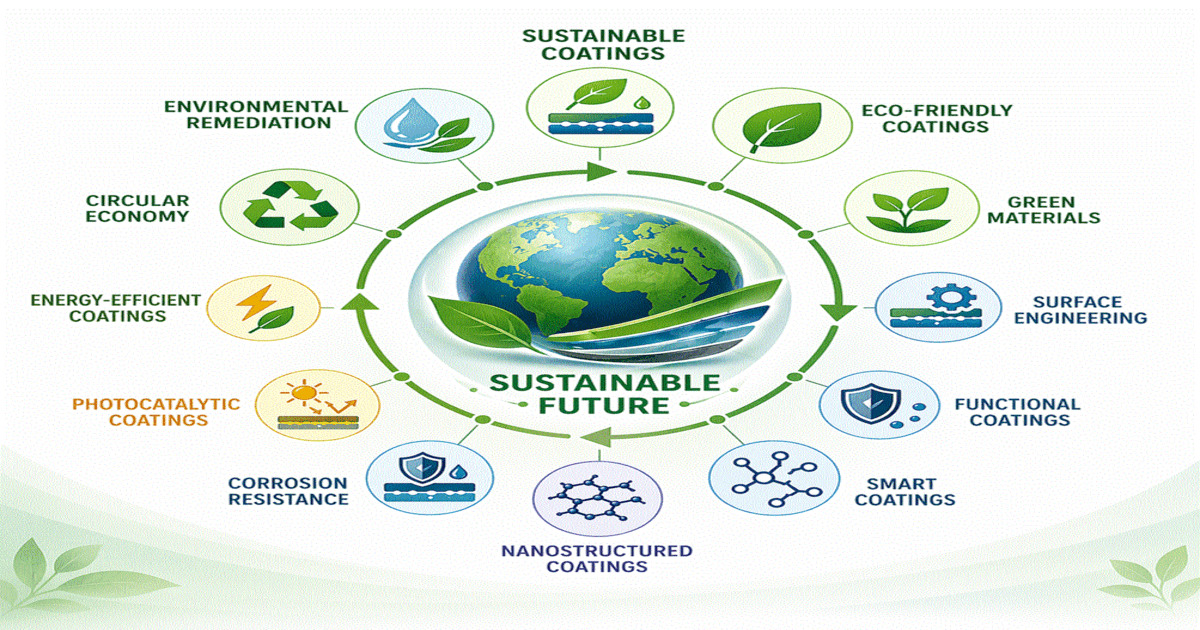
- sustainable coatings
- eco-friendly coatings
- green materials
- surface engineering
- functional coatings
- smart coatings
- nanostructured coatings
- corrosion resistance
- photocatalytic coatings
- energy-efficient coatings
- circular economy
- life cycle assessment
- environmental remediation
Benefits of Publishing in a Special Issue
- Ease of navigation: Grouping papers by topic helps scholars navigate broad scope journals more efficiently.
- Greater discoverability: Special Issues support the reach and impact of scientific research. Articles in Special Issues are more discoverable and cited more frequently.
- Expansion of research network: Special Issues facilitate connections among authors, fostering scientific collaborations.
- External promotion: Articles in Special Issues are often promoted through the journal's social media, increasing their visibility.
- Reprint: MDPI Books provides the opportunity to republish successful Special Issues in book format, both online and in print.
Further information on MDPI's Special Issue policies can be found here.
