

Clocks & Sleep 2026, 8(3), 46; https://doi.org/10.3390/clockssleep8030046 - 12 Aug 2026
Abstract
Background: Obstructive sleep apnea (OSA) has been implicated in declarative memory impairment. Here, we evaluated immediate recall and overnight declarative memory in patients with suspected OSA before and after standard clinical management in a longitudinal cohort of 265 patients. Methods: A nocturnal polysomnographic
[...] Read more.
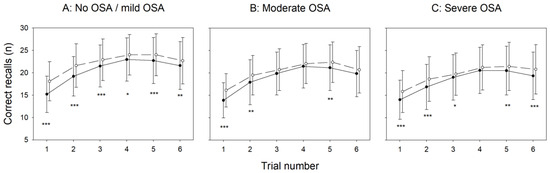
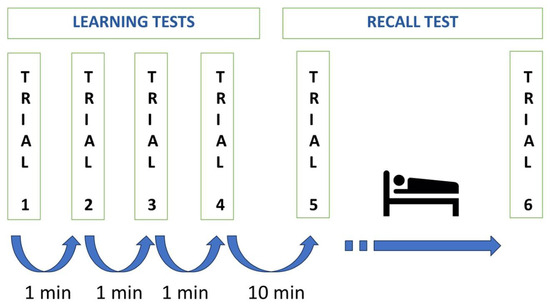
Background: Obstructive sleep apnea (OSA) has been implicated in declarative memory impairment. Here, we evaluated immediate recall and overnight declarative memory in patients with suspected OSA before and after standard clinical management in a longitudinal cohort of 265 patients. Methods: A nocturnal polysomnographic study (PSG) was performed at baseline and repeated six months later. The Pictorial-Based Declarative Memory Questionnaire (PDMQ) was administered and consisted of four learning trials followed by free-recall 10 min before PSG and the following morning upon awakening. The primary cognitive endpoint was the change in pictorial declarative memory performance from baseline to 6-month follow-up, expressed as the number of correctly recalled items on the PDMQ. Results: Both immediate and delayed recall performances significantly improved in the no OSA/mild OSA and severe OSA groups, whereas only immediate recall improved in the moderate OSA group. In the severe group, comparisons between patients whose apnea–hypopnea index decreased to <30 events/hour and those whose AHI remained >30 revealed significant cognitive improvements in both subgroups, particularly in initial and late trials (Trials 1, 2, 5, 6). In multivariable models, baseline PDMQ performance and indices of SpO2 desaturation and sleep fragmentation emerged as independent predictors of change in declarative memory. Conclusions: These findings suggest that routine clinical management of patients with OSA was accompanied by modest, albeit statistically significant improvements in declarative memory, and that both intermittent hypoxia and sleep fragmentation play important roles in memory change.
Full article
(This article belongs to the Section Disorders)
►
Show Figures
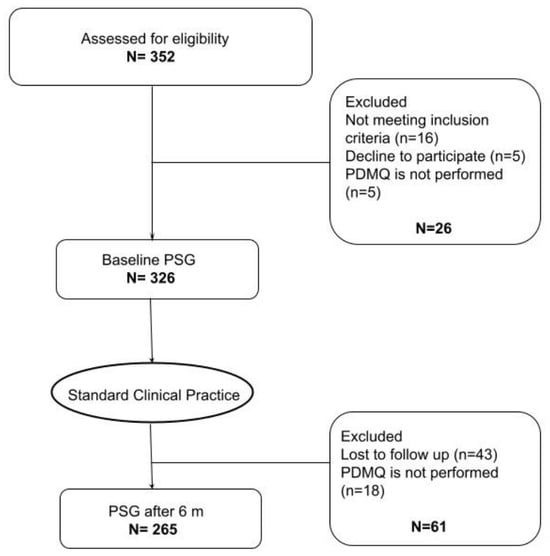
Figure 1