Understanding the Impact of Dopamine Receptors Diversity in the Central Nervous System
Share This Topical Collection
Editors
 Dr. Alicia Rivera
Dr. Alicia Rivera
E-Mail
Website
Collection Editor
Department of Cell Biology, University of Malaga, Instituto de Investigación Biomédica (IBIMA), 29076 Malaga, Spain
Interests: basal ganglia; drug addiction; Parkinson's disease; pain; G protein coupled receptor; dopaminergic system; receptor-receptor interaction
 Dr. Belén Gago
Dr. Belén Gago
E-Mail
Website
Collection Editor
Department of Human Physiology, University of Malaga, Instituto de Investigación Biomédica (IBIMA), 29076 Malaga, Spain
Interests: basal ganglia; Parkinson’s disease; dopaminergic system; receptor-receptor interaction; neuropeptides; impulse control disorders; mood disorders
Topical Collection Information
Dear Colleagues,
The neurotransmitter dopamine interacts with five types of dopamine receptors (D1R–D5R) to regulate a great variety of functions in the brain, including learning, motivation, and movement. These dopamine receptors belong to the superfamily of G protein-coupled receptors and have been classified in two families (D1-like and D2-like) according to their pharmacological and biochemical properties. Dysfunction of dopamine neurotransmission and its receptors leads to several neurological disorders such as Parkinson’s and Huntington’s diseases, addiction, and attention deficit/hyperactivity disorder. Since the cloning of the dopamine receptors in the 1990s, numerous studies have been conducted to elucidate the specific function of each of them. In addition, research on dopamine receptors has also focused on their ability to form homo- and heteroreceptor complexes, which significantly increase the variety and complexity of the integrative mechanisms of dopamine signal.
The aim of this Topical Collection is to compile research and review articles studying the molecular biology, pharmacology, and function of dopamine receptors, especially those less studied, i.e., D3R, D4R, and D5R. Articles on other important aspects of dopamine homo- and heteroreceptor complexes relevant to both health and neurological disorders are also welcome.
Dr. Alicia Rivera
Dr. Belén Gago
Collection Editors
Manuscript Submission Information
Manuscripts should be submitted online at www.mdpi.com by registering and logging in to this website. Once you are registered, click here to go to the submission form. All submissions that pass pre-check are peer-reviewed. Accepted papers will be published continuously in the journal (as soon as accepted) and will be listed together on the collection website. Research articles, review articles as well as short communications are invited. For planned papers, a title and short abstract (about 250 words) can be sent to the Editorial Office for assessment.
Submitted manuscripts should not have been published previously, nor be under consideration for publication elsewhere (except conference proceedings papers). All manuscripts are thoroughly refereed through a single-blind peer-review process. A guide for authors and other relevant information for submission of manuscripts is available on the Instructions for Authors page. Cells is an international peer-reviewed open access semimonthly journal published by MDPI.
Please visit the Instructions for Authors page before submitting a manuscript.
The Article Processing Charge (APC) for publication in this open access journal is 2700 CHF (Swiss Francs).
Submitted papers should be well formatted and use good English. Authors may use MDPI's
English editing service prior to publication or during author revisions.
Keywords
- Dopamine
- dopamine receptors
- dopamine heteroreceptor complexes
- Parkinson’s disease, addiction, dopaminergic disease
- basal ganglia, limbic circuit
- learning
- neuroplasticity
Published Papers (1 paper)
2025
Open AccessArticle
Exploring Consequences of Predator Stress on Behaviors of Mice Lacking Trace Amine-Associated Receptor 5 (TAAR5)
by
Vsevolod V. Nemets, Vladimir P. Grinevich, Evgeniia N. Petrunina, Evgeny A. Budygin and Raul R. Gainetdinov
Viewed by 622
Abstract
Recent studies indicated a connection between trace amine-associated receptor 5 (TAAR5) and emotional behaviors related to anxiety and depression; however, the neurobiological basis of this link is still unclear. Using mutant TAAR5 knockout (TAAR5-KO) mice, we explored the consequences of receptor deletion on
[...] Read more.
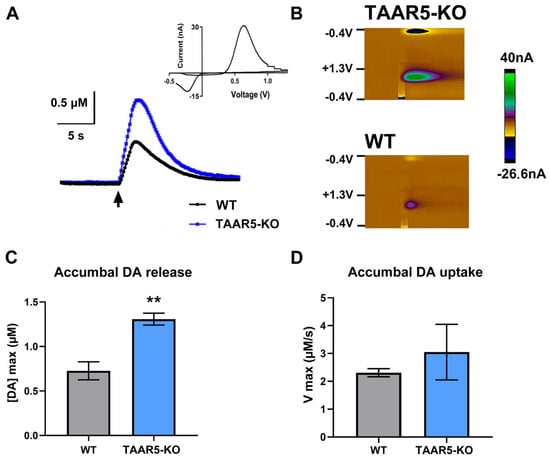
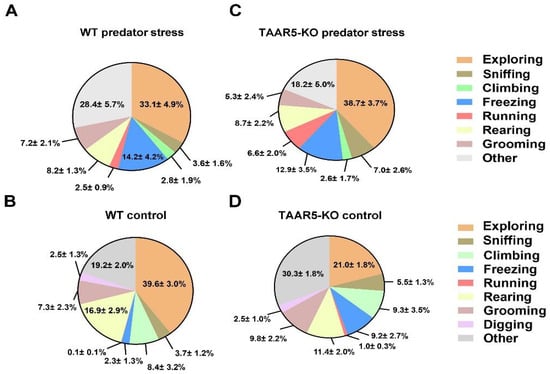
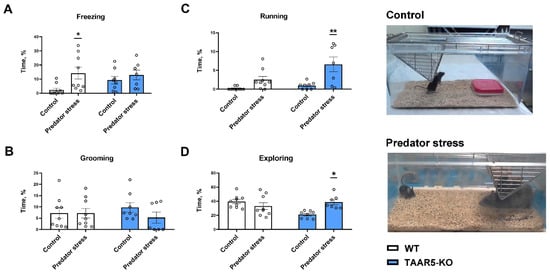
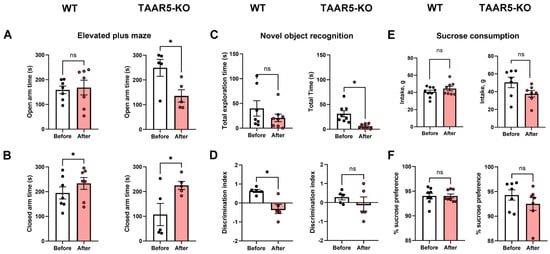
Recent studies indicated a connection between trace amine-associated receptor 5 (TAAR5) and emotional behaviors related to anxiety and depression; however, the neurobiological basis of this link is still unclear. Using mutant TAAR5 knockout (TAAR5-KO) mice, we explored the consequences of receptor deletion on dopamine (DA) dynamics in the ventral striatum and stress-related behaviors. Voltammetric measurements of DA in the nucleus accumbens (NAc) coupled with electrical stimulation of the ventral tegmental area (VTA) revealed that mice lacking TAAR5 display a greater DA release, while its reuptake is not affected. Behaviorally, mutants were significantly less anxious in the elevated plus maze (EPM) and consumed more sucrose in comparison with wild-type (WT) controls. The new object recognition test (NOR) did not uncover a difference between these genotypes. During predator (rat) stress exposure, mutant and WT mice showed quite distinct responses versus the behavior observed in stressless conditions. Control animals demonstrated a substantial increase in “freezing” (a sign of passive coping), while “running” and “exploring” patterns (signs of active coping) were significantly extended in mice lacking TAAR5. Short-term consequences of stress were explored 24 h following the predator exposure. The absence of TAAR5 did not prevent or reduce stress-induced anxiety in the EPM. In fact, the level of anxiety in mutants reached that observed in control mice. Furthermore, activity in NOR was significantly decreased in mice lacking TAAR5 but not in WT animals. On the other hand, predator exposure resulted in impaired NOR in the WT control, whereas mutants’ performance was not altered. These findings indicate that TAAR5 deletion leads to significant DA imbalance, which might at least partly explain the better stress-coping strategy and other stress-induced behavioral consequences observed in mutant animals.
Full article
►▼
Show Figures