


Novel Insights and Applications of Pluripotent Stem Cells

A special issue of Biomolecules (ISSN 2218-273X). This special issue belongs to the section "Cellular Biochemistry".

Deadline for manuscript submissions: 30 November 2026 | Viewed by 2058

Special Issue Editors


E-Mail Website
Guest Editor
Department of Chemistry and Biotechnology, Faculty of Science, Engineering and Technology, Swinburne University of Technology, John St, Hawthorn, VIC 3122, Australia
Interests: cell biology, stem cells and differentiation, genome editing; molecular biology
Special Issues, Collections and Topics in MDPI journals

E-Mail Website
Guest Editor
Department of Neuroscience, School of Translational Medicine, Monash University, Alfred Centre, Melbourne, VIC 3004, Australia
Interests: neuroscience; stem cell; drug discovery

Special Issue Information

Dear Colleagues,

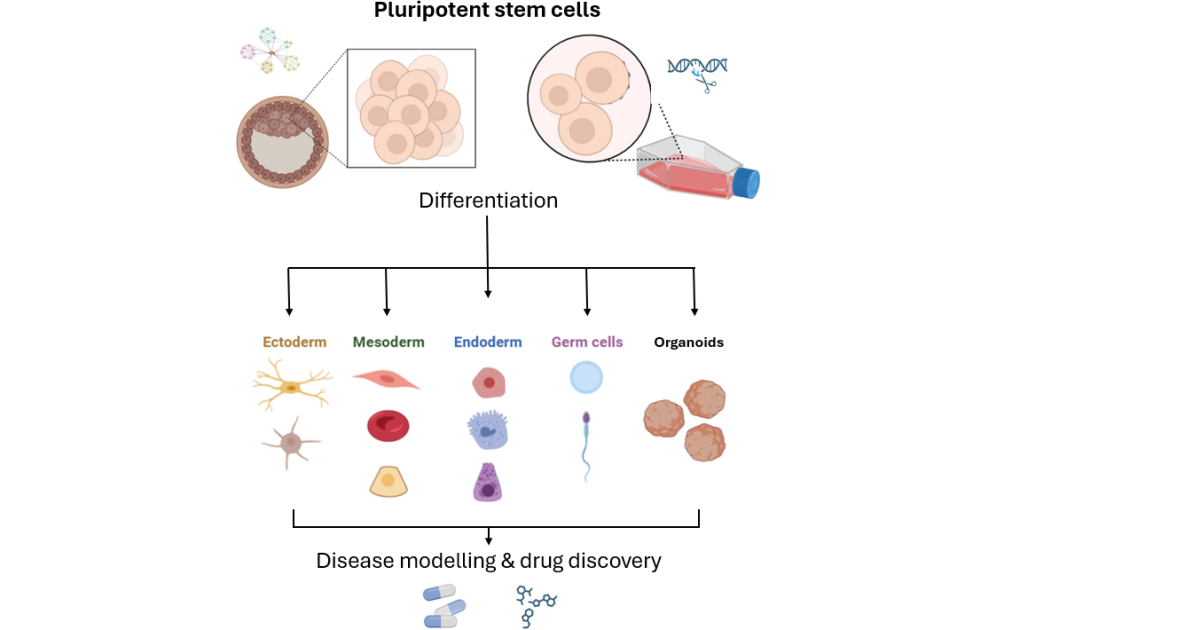
Pluripotent stem cells (PSCs), including embryonic stem cells (ESCs) and induced pluripotent stem cells (iPSCs), possess the remarkable ability to differentiate into all cell types of the body. These cells provide unparalleled opportunities for studying early human development, modeling human diseases, screening therapeutic compounds, and advancing regenerative medicine. In recent years, pluripotent stem cell-based technologies have transformed our understanding of human biology and opened new avenues for biomedical applications. 

This Special Issue will highlight novel insights and applications of pluripotent stem cells, with a focus on the molecular mechanisms governing pluripotency and differentiation, disease modeling using PSC-derived cells, biomolecules associated with PSC function, and emerging applications in biotechnology and medicine. We invite original research articles and comprehensive reviews covering areas such as biomolecular pathways in pluripotency, disease modeling, organoid technologies, cell-based therapies, and PSC-based biomolecule discovery. 

We look forward to your contributions to this Special Issue. 

Dr. Huseyin Sumer
Dr. Ben N. Rollo
Guest Editors

Manuscript Submission Information

Manuscripts should be submitted online at www.mdpi.com by registering and logging in to this website. Once you are registered, click here to go to the submission form. Manuscripts can be submitted until the deadline. All submissions that pass pre-check are peer-reviewed. Accepted papers will be published continuously in the journal (as soon as accepted) and will be listed together on the special issue website. Research articles, review articles as well as short communications are invited. For planned papers, a title and short abstract (about 250 words) can be sent to the Editorial Office for assessment.

Submitted manuscripts should not have been published previously, nor be under consideration for publication elsewhere (except conference proceedings papers). All manuscripts are thoroughly refereed through a single-blind peer-review process. A guide for authors and other relevant information for submission of manuscripts is available on the Instructions for Authors page. Biomolecules is an international peer-reviewed open access monthly journal published by MDPI.

Please visit the Instructions for Authors page before submitting a manuscript. The Article Processing Charge (APC) for publication in this open access journal is 2700 CHF (Swiss Francs). Submitted papers should be well formatted and use good English. Authors may use MDPI's English editing service prior to publication or during author revisions.

Keywords

  • pluripotent stem cells
  • pluripotency
  • differentiation
  • stem cell transplant
  • regenerative medicine
  • disease modeling
  • organoids
  • therapeutic screening
  • cell therapies
  • drug discovery

Benefits of Publishing in a Special Issue

  • Ease of navigation: Grouping papers by topic helps scholars navigate broad scope journals more efficiently.
  • Greater discoverability: Special Issues support the reach and impact of scientific research. Articles in Special Issues are more discoverable and cited more frequently.
  • Expansion of research network: Special Issues facilitate connections among authors, fostering scientific collaborations.
  • External promotion: Articles in Special Issues are often promoted through the journal's social media, increasing their visibility.
  • Reprint: MDPI Books provides the opportunity to republish successful Special Issues in book format, both online and in print.

Further information on MDPI's Special Issue policies can be found here.

Published Papers (2 papers)

Order results
Result details
Select all
Export citation of selected articles as:

Review

34 pages, 2743 KB  
Review
Enhancer Trajectories in Lineage Commitment: Regulatory Logic of States and Cooperation
by Myunggeun Oh, Seunghwa Jeong, Keunsoo Kang and Seung-Kyoon Kim
Biomolecules 2026, 16(1), 87; https://doi.org/10.3390/biom16010087 - 5 Jan 2026
Viewed by 863
Abstract
Cell fate determination depends on precise and timely control of gene expression programs governed by enhancers, which act as central regulatory elements within chromatin landscapes. Recent studies reveal that enhancers occupy distinct functional states, including poised, primed, and active configurations, and that these [...] Read more.
Cell fate determination depends on precise and timely control of gene expression programs governed by enhancers, which act as central regulatory elements within chromatin landscapes. Recent studies reveal that enhancers occupy distinct functional states, including poised, primed, and active configurations, and that these states dynamically transition during lineage specification. These transitions, in turn, coordinate chromatin accessibility and transcriptional competence, establishing when and how developmental genes become activated. Beyond individual enhancers, some fate-defining loci employ modular and shadow enhancer architectures that cooperatively regulate transcriptional dose, maintain threshold stability, and buffer developmental programs against stochastic and environmental variation. Comparative analyses across neural, cardiac, and hematopoietic systems illustrate how these enhancer modules are selectively deployed to achieve lineage-specific precision and robustness. Furthermore, enhancer timing, persistence, and quantitative thresholds collectively encode developmental tempo and stability, ensuring faithful progression of cell fate transitions. By considering molecular state transitions together with cooperative enhancer architecture, this review organizes current views on how enhancers may help translate transient cues into stable lineage outcomes, thereby linking chromatin dynamics to developmental precision. Full article
(This article belongs to the Special Issue Novel Insights and Applications of Pluripotent Stem Cells)
Show Figures

Figure 1

20 pages, 1245 KB  
Review
RNAa-Mediated Gene Activation in the Regulation of Stem Cell Fate
by Hyohi Lee, Jiin Moon and Seung-Kyoon Kim
Biomolecules 2026, 16(1), 5; https://doi.org/10.3390/biom16010005 - 19 Dec 2025
Cited by 1 | Viewed by 862
Abstract
Stem cell fate is governed by complex transcriptional networks and dynamic chromatin architectures, with RNA molecules acting as critical regulators. Traditionally, small RNAs have been associated with gene silencing; however, growing evidence reveals that certain RNA species can also activate transcription, a phenomenon [...] Read more.
Stem cell fate is governed by complex transcriptional networks and dynamic chromatin architectures, with RNA molecules acting as critical regulators. Traditionally, small RNAs have been associated with gene silencing; however, growing evidence reveals that certain RNA species can also activate transcription, a phenomenon termed RNA activation (RNAa). This evolutionarily conserved mechanism functions through both synthetic small activating RNAs (saRNAs) and endogenous RNA molecules, including promoter-targeting microRNAs, small modulatory double-stranded RNAs, and circular RNAs. By modulating chromatin accessibility and engaging the transcriptional machinery, these RNAs orchestrate gene expression programs that control pluripotency maintenance and lineage-specific differentiation in stem cells. This review integrates emerging mechanistic insights and functional evidence to provide a comprehensive perspective on RNAa-mediated gene activation in stem cell biology and highlights its potential as a precise tool for controlling cell fate through epigenetic modulation. Full article
(This article belongs to the Special Issue Novel Insights and Applications of Pluripotent Stem Cells)
Show Figures

Figure 1

Back to TopTop