

Signal Transduction and Pathway Regulation in Cancer

A special issue of Biomolecules (ISSN 2218-273X). This special issue belongs to the section "Molecular Biology".

Deadline for manuscript submissions: 30 April 2026 | Viewed by 783

Special Issue Editor


E-Mail Website
Guest Editor
Stefan S. Nicolau Institute of Virology, Romanian Academy, 030304 Bucharest, Romania
Interests: signal transduction; cytokine; proteome; genome, immunity; inflammation
Special Issues, Collections and Topics in MDPI journals

Special Issue Information

Dear Colleagues,

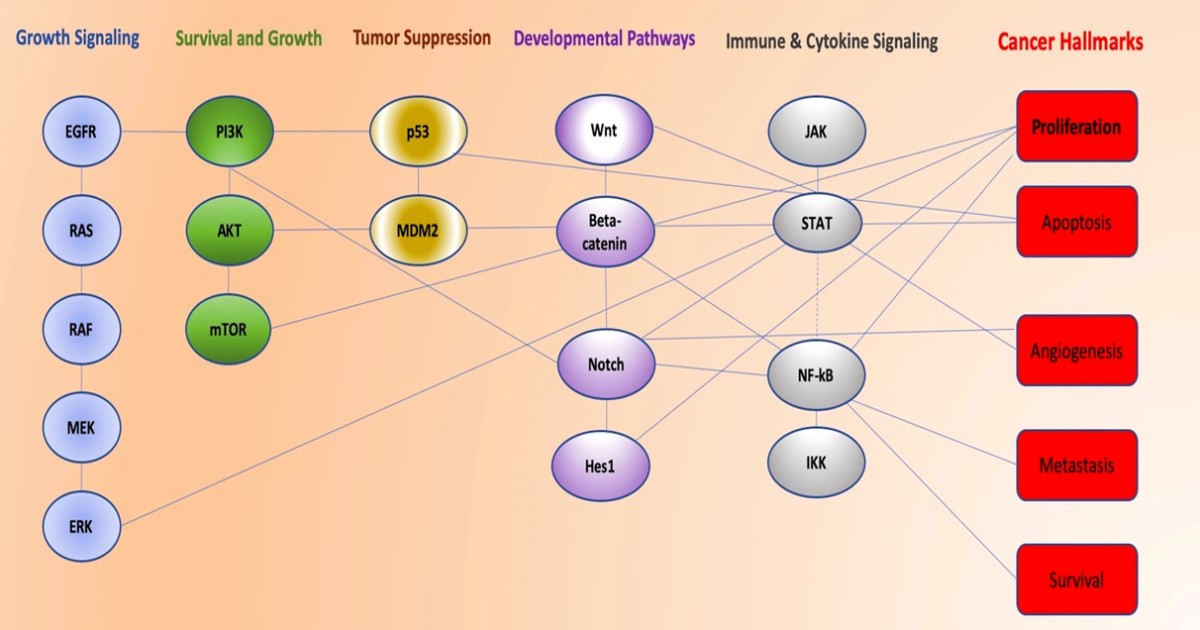
Dysregulation of the intricate signaling networks that govern cellular processes, such as growth, proliferation, and survival, is a defining characteristic of cancer. Canonical pathways, such as JAK/STAT, PI3K/Akt/mTOR, and MAPK/ERK, are part of interconnected networks with extensive crosstalk and intricate regulation, which has spurred a shift in research focus from single-gene mutations to the entire signaling network.

Despite all breakthroughs in targeted therapies that inhibit specific signaling pathway components, formidable challenges remain, including overcoming acquired resistance and addressing the heterogeneity of tumor signaling.

To move forward, we need a more comprehensive, systems-level approach that integrates genomic, proteomic, and single-cell data. This will be crucial for identifying new vulnerabilities in cancer and developing next-generation therapies that truly outsmart the disease.

This Special Issue of Biomolecules aims to gather expert opinions and provide a current overview of the cellular signaling landscape and pathway regulation, emphasizing their pivotal role in shaping the future of cancer treatment, diagnosis, prognosis, and prediction of treatment response.

Dr. Carmen Cristina Diaconu
Guest Editor

Manuscript Submission Information

Manuscripts should be submitted online at www.mdpi.com by registering and logging in to this website. Once you are registered, click here to go to the submission form. Manuscripts can be submitted until the deadline. All submissions that pass pre-check are peer-reviewed. Accepted papers will be published continuously in the journal (as soon as accepted) and will be listed together on the special issue website. Research articles, review articles as well as short communications are invited. For planned papers, a title and short abstract (about 250 words) can be sent to the Editorial Office for assessment.

Submitted manuscripts should not have been published previously, nor be under consideration for publication elsewhere (except conference proceedings papers). All manuscripts are thoroughly refereed through a single-blind peer-review process. A guide for authors and other relevant information for submission of manuscripts is available on the Instructions for Authors page. Biomolecules is an international peer-reviewed open access monthly journal published by MDPI.

Please visit the Instructions for Authors page before submitting a manuscript. The Article Processing Charge (APC) for publication in this open access journal is 2700 CHF (Swiss Francs). Submitted papers should be well formatted and use good English. Authors may use MDPI's English editing service prior to publication or during author revisions.

Keywords

  • signal transduction
  • pathway modulation
  • targeted treatment strategies
  • cancer treatment
  • drug resistance
  • cancer diagnosis
  • cancer prognosis

Benefits of Publishing in a Special Issue

  • Ease of navigation: Grouping papers by topic helps scholars navigate broad scope journals more efficiently.
  • Greater discoverability: Special Issues support the reach and impact of scientific research. Articles in Special Issues are more discoverable and cited more frequently.
  • Expansion of research network: Special Issues facilitate connections among authors, fostering scientific collaborations.
  • External promotion: Articles in Special Issues are often promoted through the journal's social media, increasing their visibility.
  • Reprint: MDPI Books provides the opportunity to republish successful Special Issues in book format, both online and in print.

Further information on MDPI's Special Issue policies can be found here.

Published Papers (2 papers)

Order results
Result details
Select all
Export citation of selected articles as:

Research

Jump to: Review

21 pages, 4051 KB  
Article
The Cap-Independent Translation of Survivin 5′UTR and HIV-1 IRES Sequences Is Inhibited by Oxidative Stress Produced by H. pylori Gamma-Glutamyl Transpeptidase Activity
by Mariaignacia Rubilar, Nicolás Carrasco-Véliz, Maritza P. Garrido, María I. Silva, Andrew F. G. Quest, María Fernanda González, Esteban Palacios, Joan Villena, Iván Montenegro and Manuel Valenzuela-Valderrama
Biomolecules 2026, 16(1), 164; https://doi.org/10.3390/biom16010164 - 19 Jan 2026
Viewed by 305
Abstract
Background: Survivin is an anti-apoptotic protein highly expressed during embryonic development and, in adults, mainly in the gastrointestinal epithelium. Its levels decrease in human gastric tissue and cultured cells upon exposure to Helicobacter pylori gamma-glutamyl transpeptidase (GGT), though the underlying mechanism remains unclear. [...] Read more.
Background: Survivin is an anti-apoptotic protein highly expressed during embryonic development and, in adults, mainly in the gastrointestinal epithelium. Its levels decrease in human gastric tissue and cultured cells upon exposure to Helicobacter pylori gamma-glutamyl transpeptidase (GGT), though the underlying mechanism remains unclear. Objective: We aimed to investigate the role of cap-independent translation driven by the Survivin 5′ untranslated region (5′UTR) in response to H. pylori infection in vitro. Methodology: Human cell lines (AGS, GES-1, HeLa, HEK293T) were used alongside bicistronic and monocistronic (Firefly/Renilla luciferases) reporter assays to assess short and long variants of the Survivin 5′UTR and HIV-1 internal ribosome entry site (IRES) sequences. Additional methods included in vitro transcription/translation, RT-qPCR, agarose gel electrophoresis, Western blotting, coupled/uncoupled translation assays, and siRNA silencing. Results: The short variant of the Survivin 5′ UTR supported cap-independent translation, like the HIV-1 IRES. Notably, H. pylori infection suppressed this translation in a GGT-dependent manner in gastric cells, and a similar reduction was observed following treatment with ATO, a known prooxidant. Conclusion: The Survivin 5′UTR exhibits cap-independent translation activity that is inhibited by H. pylori in a GGT-dependent manner, likely via oxidative stress. This mechanism helps to explain the downregulation of Survivin during gastric infection and indicates that oxidative stress can negatively affect both cellular and viral IRES-mediated translation. Full article
(This article belongs to the Special Issue Signal Transduction and Pathway Regulation in Cancer)
Show Figures

Figure 1

Review

Jump to: Research

21 pages, 1516 KB  
Review
Association Between Amino Acid Polymorphisms in MICA and MICA-NKG2D Interaction Affinity: Implications and Significance for Tumor Immunity
by Chuyu Xiao, Wang Wang, Yangyang Zhang, Ting Huang, Chunjing Chen, Biyuan Liu, Chang Liu, Yingying Yang, Fangguo Lu and Quan Zhu
Biomolecules 2026, 16(1), 47; https://doi.org/10.3390/biom16010047 - 28 Dec 2025
Viewed by 306
Abstract
Major histocompatibility complex class I-like related gene A (MICA) is the most polymorphic non-classical HLA gene. MICA proteins are expressed at low levels on the surface of normal cells but are highly expressed on the surface of tumor cells. Its most important biological [...] Read more.
Major histocompatibility complex class I-like related gene A (MICA) is the most polymorphic non-classical HLA gene. MICA proteins are expressed at low levels on the surface of normal cells but are highly expressed on the surface of tumor cells. Its most important biological function is to bind to activating receptors on the surface of natural killer (NK) cells or CD8+ T cells, then activate these immune cells to exert immune killing effects. Multiple studies have shown that the amino acids at specific loci in the MICA molecule can significantly affect its binding ability to NKG2D. The binding strength of MICA-NKG2D significantly affects the anti-tumor effect of NK cells in the body and the prognosis of many tumor patients. However, the strong MICA-NKG2D interaction can trigger negative feedback against this immune response by down-regulating the expression of NKG2D or generating soluble MICA, weakening the overly intense immune response. Therefore, simply evaluating the intensity of the anti-tumor immune response from the perspective of the amino acid polymorphism of MICA affecting its binding ability to NKG2D also has limitations. We review the effects of MICA amino acid polymorphism on the affinity of the NKG2D signal pathway and analyze in detail the specific role of MICA amino acid polymorphism in tumor immunity. The study provides a reference for understanding the mechanism of anti-tumor immune response by NK cells or other immune cells, as well as a theoretical basis for considering the MICA-NKG2D signal axis for anti-tumor immune therapy in future clinical practice. Full article
(This article belongs to the Special Issue Signal Transduction and Pathway Regulation in Cancer)
Show Figures

Figure 1

Back to TopTop