



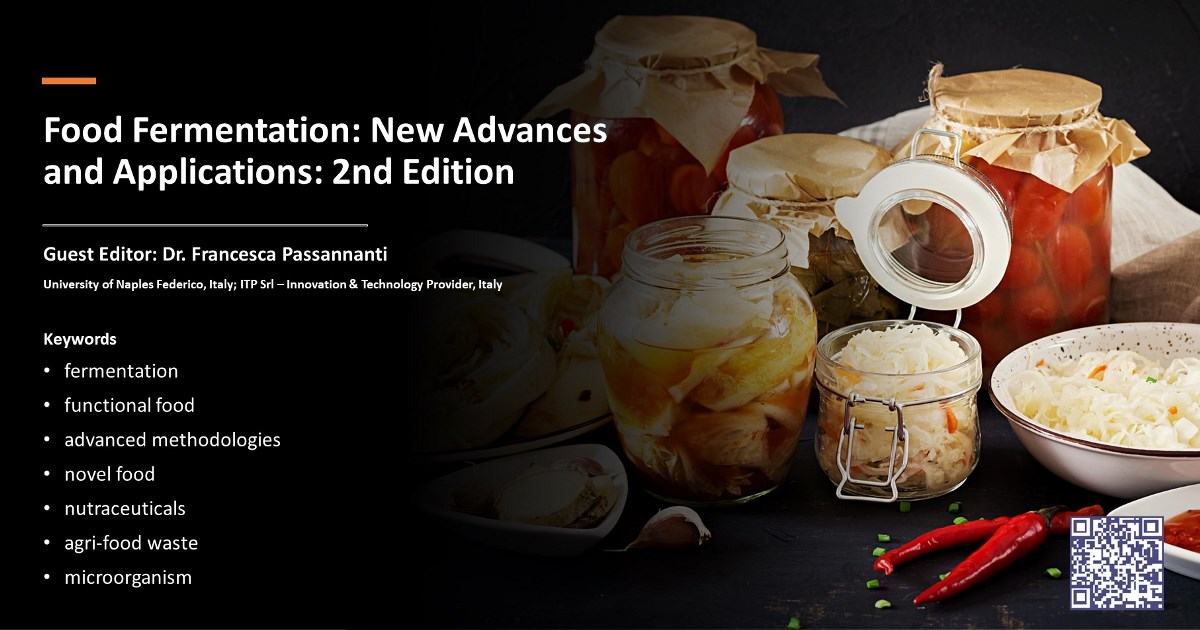
Food Fermentation: New Advances and Applications: 2nd Edition
A special issue of Applied Sciences (ISSN 2076-3417). This special issue belongs to the section "Food Science and Technology".
Deadline for manuscript submissions: 30 December 2026 | Viewed by 592
Editors

2. ITP Srl—Innovation & Technology Provider, Via Bisignano a Chiaia 68, Napoli, Italy
Interests: fermentation; functional foods; encapsulation; alginate-based hydrogels; alginates for fermentation; in vitro digestion; pre- and postbiotics
Special Issues, Collections and Topics in MDPI journals

Interests: bioactive compounds; biochemical engineering; industrial biotechnology; bioprocess technology; extraction of natural products; functional food; bioprocess engineering; fermentation technology
Special Issue Information
Dear Colleagues,
Food fermentation is an ancient biotechnological process, but given its variety of applications, it remains current. Since its adoption, it has been used for food preservation; however, it is increasingly becoming a useful tool to improve the sensory, nutritional, and/or health properties of foods, enabling the production of functional variants. It is also employed in the production of nutraceuticals, biochemicals, food ingredients, and enzymes, and it can be considered a sustainable process as it can facilitate the valorization of agri-food waste. Optimizing the efficiency of the fermentation process and its broader usefulness—for example, regarding expected health or technological impacts—depends mostly on the selection of the strain and the food substrate to be fermented, as well as other chosen process parameters.
This Special Issue aims to gather the latest knowledge on food fermentation, focusing on advanced methodologies and applications. Potential topics include but are not limited to
- Advanced methodologies to identify, enumerate, and characterize microorganisms in fermented foods;
- Advanced methodologies for fermentation processes and the development of novel foods;
- Scientific evidence of the impacts of fermented foods on human health;
- Research on the valorization of agri-food waste through fermentation;
- The engineering of microorganisms for improved or targeted production of specific metabolites.
Original works, review papers, and comparative studies are all welcome.
Dr. Francesca Passannanti
Dr. Rosa Colucci Cante
Guest Editors
Manuscript Submission Information
Manuscripts should be submitted online at www.mdpi.com by registering and logging in to this website. Once you are registered, click here to go to the submission form. Manuscripts can be submitted until the deadline. All submissions that pass pre-check are peer-reviewed. Accepted papers will be published continuously in the journal (as soon as accepted) and will be listed together on the special issue website. Research articles, review articles as well as short communications are invited. For planned papers, a title and short abstract (about 250 words) can be sent to the Editorial Office for assessment.
Submitted manuscripts should not have been published previously, nor be under consideration for publication elsewhere (except conference proceedings papers). All manuscripts are thoroughly refereed through a single-anonymized peer-review process. A guide for authors and other relevant information for submission of manuscripts is available on the Instructions for Authors page. Applied Sciences is an international peer-reviewed open access semimonthly journal published by MDPI.
Please visit the Instructions for Authors page before submitting a manuscript. The Article Processing Charge (APC) for publication in this open access journal is 2400 CHF (Swiss Francs). Submitted papers should be well formatted and use good English. Authors may use MDPI's English editing service prior to publication or during author revisions.
Keywords
- fermentation
- functional food
- advanced methodologies
- novel food
- nutraceuticals
- agri-food waste
- microorganism
Benefits of Publishing in a Special Issue
- Ease of navigation: Grouping papers by topic helps scholars navigate broad scope journals more efficiently.
- Greater discoverability: Special Issues support the reach and impact of scientific research. Articles in Special Issues are more discoverable and cited more frequently.
- Expansion of research network: Special Issues facilitate connections among authors, fostering scientific collaborations.
- External promotion: Articles in Special Issues are often promoted through the journal's social media, increasing their visibility.
- Reprint: MDPI Books provides the opportunity to republish successful Special Issues in book format, both online and in print.
Further information on MDPI's Special Issue policies can be found here.
Related Special Issue
- Food Fermentation: New Advances and Applications in Applied Sciences (5 articles)
