
Skip to Content

Animals

Animals is an international, peer-reviewed, open access journal devoted entirely to animals, including zoology and veterinary sciences, and is published semimonthly online by MDPI.
Indexed in PubMed | Quartile Ranking JCR - Q1 (Veterinary Sciences | Agriculture, Dairy and Animal Science)

Get Alerted

Add your email address to receive forthcoming issues of this journal.

All Articles (23,715)

  • Communication
  • Open Access

Heart Girth as a Predictor of Body Weight in Lactating Cows

  • Silvia Magro,
  • Alberto Guerra and
  • Mauro Penasa
  • + 2 authors

Body weight (BW) is an important trait in dairy cows; however, large-scale direct measurements are challenging. Heart girth (HG) has been proposed as a practical indicator of BW, but limited information is available for lactating cows, especially for locally adapted breeds. This study aimed to develop equations to estimate BW from HG in lactating Holstein, Simmental, and Rendena cows. A total of 293 cows (94 Holstein, 52 Simmental, and 147 Rendena) were selected from 6 farms equipped with an automatic milking system located in northern Italy. Both HG and BW were recorded on the same day, with HG measured using a tape and BW using a scale integrated into the automatic milking system. For each breed, linear, quadratic, and cubic regressions of BW on HG were tested, adjusting for days in milk and parity effects. The coefficient of determination and the root mean square error were reported. The best predictive performance was obtained with models adjusted for both days in milk and parity, with the highest accuracy achieved for Holstein and Simmental cows. These results corroborate that HG is a reliable predictor of BW in lactating cows of these breeds.

17 March 2026
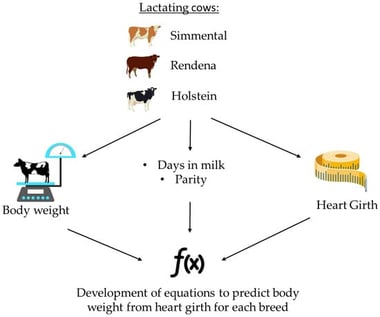
Experimental design.
  • Feature Paper
  • Article
  • Open Access

Valorisation of rabbit biodiversity plays a significant role in enhancing production by preserving genetic diversity, which is crucial for maintaining adaptability and resilience in rabbit populations, thereby supporting sustainable development and conservation efforts. With this in mind, the present research aimed at comparing live performance, carcass traits, meat quality and muscle fibre characteristics of different rabbit genotypes. Forty-five weaned rabbits (15 commercial hybrids—C; 15 Burgundy Fawn crosses—BF; 15 Vienna Blue crosses—VB) were farmed until slaughter (n = 15 replicated cages/rabbit genotype). The slaughter age was scheduled when all genotypes reached the same live weight (approx. 2800 g). After slaughtering and carcass dissection, the hind legs and longissimus lumborum muscles were excised and subjected to different evaluations. Hind legs were exploited for physicochemical analyses, while longissimus lumborum muscles were used for physical evaluations and for fibre typing, morphometric traits and enzymatic activity. As a direct response to the experimental design, results highlighted that the three genotypes exhibited different slaughter ages. Commercial hybrids displayed the fastest growth cycle, but they showed an efficiency comparable to that of VB crosses (p > 0.05). Genotypes displayed some differences in carcass characteristics, namely perirenal fat (p < 0.01) and hind leg weight (p < 0.05). The physical characteristics of meat were overall similar in the three genotypes, except for biceps femoris L*, which showed the highest value in the BF group. Meat chemical composition differed depending on the genotype, with BF rabbits having the highest ether extract (p < 0.05) content. The three genotypes displayed an overall similar fatty acid profile with some minor differences: VB rabbits had the highest C18:2 n-6 proportion (p < 0.01) and thus n-6/n-3 (p < 0.05). Cholesterol content was the highest in C rabbits (p < 0.05). Overall, the present research highlighted that BF and VB genotypes provided interesting potentialities which would be further valorised in rural farming conditions, given their higher resilience and adaptability than commercial hybrids.

17 March 2026

Gut microbiota dysbiosis is implicated in metabolic disorders, yet taxonomic and functional alterations in canine diabetes remain incompletely defined. Here, we performed shotgun metagenomic sequencing of fecal samples from 38 diabetic dogs and 37 healthy controls under controlled conditions (no recent antibiotic/probiotic exposure and stable commercial diets). Alpha-diversity indices did not differ between groups, whereas beta-diversity revealed significant separation of community structure at both genus and species levels (p < 0.05). Linear discriminant analysis effect size (LEfSe) identified enrichment of opportunistic-associated taxa in diabetic dogs, including Enterobacterales/Enterobacteriaceae (e.g., Escherichia coli, Klebsiella pneumoniae, Salmonella enterica) and Enterococcus faecalis. In contrast, healthy dogs were enriched for putatively beneficial taxa linked to bile acid and short-chain fatty acid (SCFA) metabolism, including Turicibacter spp. and Romboutsia spp. Functional profiling showed higher abundances of pathways related to carbohydrate/energy metabolism, membrane transport, and virulence/colonization in diabetic dogs; 17 KEGG level-3 pathways and 320 KOs differed at FDR < 0.05, with enriched modules including bacterial secretion systems, lipopolysaccharide biosynthesis, chemotaxis/flagellar assembly, and biofilm formation. Collectively, canine diabetes is associated with a remodeled gut microbiome characterized by expansion of opportunistic pathogens and elevated virulence and metabolic potential, supporting exploration of microbiota-targeted strategies as a complement to conventional management.

16 March 2026

The effects of three metabolizable energy (ME) levels and the use of guanidinoacetic acid (GAA) were evaluated on broiler performance and nutrient digestibility from 1 to 35 d of age. In total, 1944-d-old Ross AP95 male broilers were randomly distributed to six treatments (12 replicates/treatment). Diets were formulated to contain three ME levels (standard energy [SE], −50 kcal/kg reduced energy [−50 RE] and −100 kcal/kg reduced energy [−100 RE]) in all feeding phases with or without GAA inclusion. For the nutrient-metabolizable analysis, 960-day-old male broilers were separately raised in floor pens until 14 d of age and randomly distributed to six treatments (16 replicates/treatment). Data were analyzed with ANOVA and Tukey’s test at p ≤ 0.05. There was a significant interaction for the feed conversion ratio (FCR) at 21 days, in which the PC diet showed better FCR when GAA was included. In the evaluation of the main effects, an effect of metabolizable energy (ME) was observed on body condition score (BCS) at 7 and 21 days, feed intake (FI) at 21 and 35 days, and feed conversion ratio (FCR) at 21 days, with the PC diet showing better FCR and lower FI. An effect of GAA was observed on feed conversion ratio at 21 days, with the inclusion of GAA in the diet showing better FCR. In conclusion, broilers fed SE diets with GAA, beyond better performance, had improved AME and AMEn compared to broilers fed RE diets without GAA in starter diets.

16 March 2026

News & Conferences

Volumes

Latest Issues

Open for Submission

Editor's Choice

Reprints of Collections

Disease Epidemiology in Farm Animal Production
Reprint

Disease Epidemiology in Farm Animal Production

Editors: Gianmarco Ferrara, Serena Montagnaro
Pasture-Associated Poisoning in Grazing Animals
Reprint

Pasture-Associated Poisoning in Grazing Animals

Editors: Dominique-Marie Votion
XFacebookLinkedIn
Animals - ISSN 2076-2615