


Abstract
This grounded theory study examines how 40 married couples (N = 80) successfully maintained sexual abstinence until marriage, focusing on the strategies, relational processes, and spiritual commitments that sustained this non-normative practice. Because premarital abstinence is statistically uncommon among African Americans, this sample functions as a critical case context—offering a high-contrast environment in which grounded theory can clearly illuminate the relational and spiritual mechanisms that support abstinence maintenance. Using in-depth individual and dyadic interviews, the study explores how couples upheld abstinence in contexts where it was often encouraged within religious settings yet rarely modeled by parents, mentors, or peers. Findings revealed four interrelated processes: (a) a shared spiritual “why” grounded in sacred meaning, (b) mutual commitment and accountability, (c) proactive boundary-setting and trigger management, and (d) grace-based resilience and recommitment after lapses. Together, these processes illustrate the Premarital Sexual Abstinence Sustainability Model through which couples co-manage temptation and align their behaviors with shared spiritual values. Despite limited examples in their communities, many participants reported becoming perceived role models within their families and faith settings, demonstrating how new behavioral templates emerge when social models are absent. Overall, as the first study of its kind to document how abstaining couples sustain their commitment and experience success, this work offers new implications for research, relationship education, counseling, and faith-based program development.
1. Introduction
Sexual abstinence prior to marriage has long been promoted within religious traditions and family systems as a pathway toward relational stability, healthier marital adjustment, and spiritual integrity. Empirical research has linked abstinence and delayed sexual initiation with improved relationship outcomes, including higher relationship satisfaction, better communication, and lower divorce risk (Busby et al., 2010; Willoughby et al., 2014). Many faith traditions—particularly Evangelical Christianity, Mormonism, and Catholicism—frame sexual abstinence as a sacred mandate, moral discipline, or faith-based expectation rooted in covenant theology (Regnerus, 2007; Smith & Denton, 2005). Yet in contemporary society, the sociocultural landscape of romantic and sexual relationships has shifted dramatically. Premarital sex and cohabitation have become normative, culturally embedded, and widely accepted as developmental steps toward long-term partnership (Cherlin, 2020; Sassler & Lichter, 2020). Consequently, abstinence as a relational practice has become increasingly rare, statistically uncommon, and seldom modeled in families or communities.
Despite these trends, a minority of young adults—particularly those embedded in religious communities—continue to choose abstinence until marriage. For these individuals and couples, abstinence is not merely an individual-level moral decision but a long-term relational commitment that requires substantial self-regulation, mutual support, spiritual motivation, and intentional boundary setting. However, most existing scholarship conceptualizes abstinence as an individual action influenced by religiosity or moral convictions rather than a dyadic process sustained by two partners over time. Little is known about how couples jointly maintain abstinence over months or years as their emotional connection deepens, physical attraction increases, and relationship transitions intensify.
1.1. Current State of Abstinence Research
Much of the abstinence literature has historically centered on adolescents, school-based programs, or parental/religious messaging. In this body of work, abstinence is typically conceptualized as a preventive behavior—focused on reducing risks such as unintended pregnancy or sexually transmitted infections—rather than a relational process unfolding within ongoing romantic partnerships. Studies commonly examine individual-level predictors such as religiosity, moral values, or parental influence (Gardner, 2011; Regnerus, 2007), but they offer little insight into how abstinence is maintained in the context of a romantic relationship.
Historically, complete premarital abstinence has been relatively uncommon—even in eras when it was strongly normative or socially prescribed (Kinsey et al., 1948, 1953; Laumann et al., 1994; Regnerus & Uecker, 2011). Contemporary demographic patterns also document a separate trend of delayed or secondary abstinence among adults, including African Americans, who return to sexual abstinence after prior sexual debut for reasons unrelated to religion (Bradley et al., 2013; Rasberry & Goodson, 2009). These studies show that secondary abstainers are often motivated by past relational experiences—such as feeling used for sex, partner infidelity, or experiences of coercion—as well as a desire to create a “better life” by improving educational, emotional, spiritual, or relational stability. This contrasts with a different emerging trend in the general population: non-religious delays in sexual initiation associated with precautionary decision-making, future-planning, and what some scholars describe as a “new middle-class morality” (Regnerus, 2021). Together, these patterns illustrate that adults abstain for a variety of reasons, yet they also underscore the distinctiveness of the small subset of couples who voluntarily abstain until marriage for religious reasons—a group whose relational processes of abstinence maintenance remain empirically underexamined.
Purity culture scholarship further complicates the landscape by highlighting potential negative consequences of shame-based abstinence messages. Critics argue that some abstinence teachings have contributed to internalized sexual guilt, fear, and long-term anxiety surrounding intimacy (DeRogatis, 2015; Klein, 2019). Yet this literature has overshadowed research documenting that delayed sexual involvement is associated with clearer relational decision-making, stronger commitment, and healthier long-term relationship functioning (Busby et al., 2010; Hardy & Willoughby, 2017; Willoughby & Carroll, 2010). The field remains polarized, with abstinence portrayed as either harmful or beneficial depending on context and methodology. Importantly, both bodies of scholarship focus primarily on messaging, not maintenance, and provide limited guidance for couples who desire to abstain.
A crucial gap persists: no existing empirical studies describe how couples who succeed at abstinence actually sustain it. Abstinence within a romantic relationship is inherently dyadic—requiring mutual restraint, communication, shared boundaries, and joint meaning-making. Nonetheless, abstinence research overwhelmingly focuses on individuals, leaving a significant void in the family and relationship science literature.
1.2. The Understudied Context of Abstinence Within African American Couples
African American couples pursue abstinence within a socio-structural context where marriage is less common, delayed, or destabilized by economic constraints and demographic pressures. National data show lower marriage rates, later ages at first marriage, higher proportions of never-married adults, and elevated rates of nonmarital births and single-parent households among African Americans compared to national averages (Guzzo, 2014; Raley et al., 2015). Cohabitation frequently functions as a pathway into couplehood and childbearing, at times operating as an alternative to marriage rather than a bridge toward it (Cherlin, 2020). Within this demographic landscape, premarital abstinence is statistically uncommon and socially non-normative, rendering those who pursue it a theoretically significant subgroup for understanding alternative pathways to partnership, marriage, and family formation among Black adults.
Importantly, abstinence within this context carries implications beyond sexual behavior alone. By intentionally delaying sexual involvement until marriage, abstinent couples may also disrupt commonly observed sequences linking dating, cohabitation, sexual initiation, and childbearing. Abstinence, in this sense, functions as a potential re-sequencing strategy, shaping decisions related to cohabitation avoidance, timing of first births, and the alignment of parenthood with marital commitment. Understanding abstinence within African American couples, therefore, requires attention not only to sexual restraint but also to how abstinence intersects with broader patterns of relationship progression, marital entry, and marital versus nonmarital fertility.
At the same time, African American religious participation is robust (Marks et al., 2012), and faith communities routinely advocate for abstinence and covenantal sexuality. However, congregational life reflects the broader demographic realities of cohabitation, divorce, or parenting outside marriage. As a result, abstinent African American couples navigate a distinctive cultural juxtaposition: strong faith-based norms supporting abstinence alongside familial and community models in which nonmarital sex, cohabitation, and complex family structures are common. In this context, abstinence represents not merely a private moral commitment, but a relational, spiritual, and socio-structural stance undertaken in the absence of widely visible behavioral templates.
Building on prior qualitative work, McKnight (2020, 2025) documented that having children within the context of marriage was perceived as a meaningful advantage among abstinent African American couples, particularly in contrast to experiences of nonmarital fertility observed within participants’ families and communities. Subsequent analysis further demonstrated that many abstinent African Americans articulated their motivations in explicitly counter-narrative terms—seeking to defy prevailing patterns of early sexual initiation, unplanned pregnancy, cohabitation, and relational instability (McKnight & Perry, 2025). These findings established that abstinence, for this population, was often embedded in intentional efforts to interrupt intergenerational patterns and pursue alternative family trajectories.
Where prior work documented why African American couples chose abstinence and how they understood its advantages, the present study extends this scholarship by examining how abstinence is relationally sustained within dating and courtship. Given demographic trends indicating that premarital abstinence is statistically rare among African Americans, this sample functions as a critical case context—offering a high-contrast environment in which grounded theory can illuminate the relational, behavioral, and spiritual mechanisms that enable abstinence maintenance under particularly challenging social conditions.
1.3. Gap in the Literature
Across the broader abstinence literature, several gaps are evident. First, no studies examine abstinence as a relational process requiring coordination, communication, and mutual self-regulation. Second, no research identifies the strategies, behaviors, or relational mechanisms that enable couples to abstain in the context of strong attraction, emotional intimacy, or long-term commitment. Third, no frameworks currently integrate spiritual meaning-making, dyadic behavioral regulation, and romantic goal pursuit. Fourth, very few studies have examined how the presence or absence of effective role models shapes individuals’ ability to sustain sexual abstinence within romantic relationships. Finally, research on underrepresented populations, including African American abstinent couples, remains scarce. The absence of a theoretical explanation for abstinence maintenance underscores the need for a grounded theory approach capable of generating a process model based on lived experience rather than preexisting assumptions.
Grounded theory is particularly well-suited for examining relational processes that have not been systematically studied or theoretically conceptualized. Because no existing models explain how couples jointly maintain abstinence, grounded theory provides a methodological structure for inductively generating a conceptual explanation from participant narratives. This approach allows researchers to identify categories, actions, and relational processes that emerge directly from the data (Charmaz, 2014; Corbin & Strauss, 2015), rather than imposing external theoretical constructs.
Grounded theory also aligns with the dynamic, interactive nature of abstinence maintenance. Abstaining couples continually negotiate boundaries, manage attraction, draw on spiritual convictions, and engage in shared decision-making (McKnight, 2020). These behaviors are best understood as part of an evolving relational process—exactly the type of phenomenon grounded theory is designed to capture.
1.4. Purpose and Contribution of the Present Study
The present study builds directly on a pioneering qualitative project that explored the lived experiences of African American couples who abstained from sex until marriage (McKnight, 2020). Participants frequently reported that they had never seen a successful abstinent couple modeled in their families, churches, or peer networks. Instead, they relied on their personal relationship with God, spiritual conviction, mutual accountability, and relational intentionality to sustain their commitment. As adults, many expressed a desire to share their insights with younger couples in their communities—illustrating both social learning theory (Bandura, 1977) and Erikson’s concept of generativity (Erikson, 1982). Guided by the overarching inquiry of lived experience, couples were asked two focused questions: (1) What contributed to the success of maintaining abstinence until marriage? (2) What advice would you give to individuals or couples pursuing abstinence? This study focuses on the themes derived from these questions.
Grounded theory does not test hypotheses; instead, it seeks to generate an explanatory model. Thus, the purpose of this study was to inductively develop a conceptual theory of abstinence maintenance based on the couples who directly experienced it. The resulting model integrates spiritual motivations, dyadic regulation, and relational meaning-making to explain how couples jointly sustain premarital abstinence. Findings revealed a five-part process: (1) Shared spiritual purpose, (2) Personal development and identity formation, (3) Dyadic commitment and accountability, (4) Boundary setting and trigger management, and (5) Grace-based resilience after lapses.
Together, these components form a Premarital Sexual Abstinence Sustainability Model, the first empirically grounded model describing how couples jointly maintain abstinence in contemporary relationships. The model offers new insight for researchers, educators, clinicians, and faith-based leaders working with abstinent couples or designing relationship education interventions. This model synthesizes elements anticipated in the literature—sacred meaning-making, dyadic self-regulation, and relational coordination—and extends them into a data-driven explanatory framework grounded in participants’ accounts.
1.5. Theoretical and Conceptual Background
Although grounded theory avoids predefining the theoretical frame, it is necessary to situate abstinence within relevant scholarly domains to justify the study and highlight the conceptual gap. Abstinence intersects with several bodies of literature, including sexual decision-making, dyadic self-regulation, relationship goal pursuit, sanctification, and African American relational contexts.
1.5.1. Sexual Decision-Making and Abstinence Literature
In contrast to individual-level models, research on relationship decision-making demonstrates that the choices partners make together about the timing and progression of their relationship are closely tied to later relationship outcomes. Owen et al. (2010) found that individuals who used more thoughtful decision-making processes—such as being deliberate in partner selection and in navigating relational steps—reported higher levels of personal dedication and greater relationship quality. Scholars similarly note that dating partners who discuss and share a vision for the long-term trajectory of their relationship report lower stress, better functioning, and reduced involvement in casual romantic relationships (Owen & Fincham, 2011). Thus, intentionally making decisions about when to move forward at key relationship moments appears advantageous for relationship formation and long-term commitment.
Research on premarital sexual involvement further shows that engaging in sex outside of a committed partnership, having multiple sexual partners, or entering marriage following a hookup is associated with poorer marital outcomes (Rhoades & Stanley, 2014). Studies on “sliding versus deciding” likewise indicate that initiating sex before clarifying relationship expectations is linked to lower happiness, higher infidelity, and greater risk of divorce (Owen et al., 2013; Stanley & Rhoades, 2009; Teachman, 2004; Uecker, 2008). Collectively, this work illustrates how decision-making—or the absence of it—within relationships can influence later outcomes (Stanley et al., 2006). However, this literature still does not examine how couples make, coordinate, and sustain a joint decision to abstain from sex until marriage. Understanding abstinence, therefore, requires moving beyond individual decision models toward frameworks that account for dyadic regulation, growing interdependence, and partners’ shared pursuit of relational and spiritual goals.
1.5.2. Dyadic Regulation, Interdependence, and Relationship Goal Pursuit
Romantic relationships are inherently interdependent, with partners’ goals, emotions, and behaviors influencing one another over time. Dyadic coping theories highlight how partners jointly negotiate stressors, regulate emotions, and provide mutual support (Bodenmann, 2005). Interdependence theory similarly demonstrates how partners adjust their behaviors and goals as commitment grows, forming shared motivational systems that influence decision-making (Rusbult & Van Lange, 2003).
Abstinence requires a high degree of behavioral alignment, communication, and mutual regulation. Dyadic self-regulation research shows that couples support one another in maintaining long-term commitments through encouragement, boundary reinforcement, shared goal-setting, and collaborative self-control (Finkel & Fitzsimons, 2011). Relational goal pursuit literature further illustrates how partners jointly pursue goals that require discipline, negotiation, and intentional action (Impett et al., 2010). These relational processes strongly resemble the strategies that abstinent couples describe, yet no studies have applied these frameworks to abstinence maintenance. The lack of dyadic exploration reveals a notable conceptual gap.
1.5.3. Sexual Sanctification and Spiritual Meaning-Making
Many couples view sexuality and abstinence within a spiritual framework. Sexual sanctification theory posits that individuals who perceive sexuality or romantic relationships as spiritually significant are more likely to align their behaviors with sacred values, maintain higher relational commitment, and persevere through challenges (Hernandez et al., 2011; Pargament & Mahoney, 2005). For abstinent couples, sanctification can transform abstinence from a behavioral rule into a spiritually meaningful practice rooted in obedience, covenant, and faith-based identity.
Spiritual meaning-making enhances motivation and resilience, providing a theological rationale for boundaries, self-regulation, and emotional management. Sanctification also offers a framework for understanding how couples derive purpose from temptation, accountability, and recovery from lapses. Although sanctification is relevant to abstinence, its application to abstinent couples has not been empirically examined.
1.5.4. African American Spirituality and Relationship Contexts
African American couples operate within a cultural context shaped by strong religious involvement, communal support, and culturally embedded spiritual meaning-making (Chatters et al., 2008). The Black church has historically promoted abstinence, purity, and God-centered relationships, yet African Americans also contend with structural challenges that complicate romantic trajectories (Guzzo, 2014; Raley et al., 2015). These intersecting factors make abstinence both meaningful and difficult, positioning African American abstinent couples as a uniquely informative population for studying abstinence maintenance. Examining abstinence within this population sheds light on resilience, sacred relational processes, and culturally grounded pathways to relationship stability—bringing diversity and depth to abstinence scholarship.
Taken together, sexual decision-making research, dyadic relational theories, sanctification scholarship, and work on African American relational contexts each contribute important perspectives on how individuals and couples navigate intimacy, commitment, and spiritual meaning in romantic relationships. However, these frameworks have not yet been integrated to illuminate the relational, spiritual, and regulatory processes that emerge when couples intentionally pursue abstinence as part of their relationship trajectory. While existing theories informed initial sensitizing concepts and shaped expectations that spiritual meaning-making and dyadic regulation might emerge as central processes, they did not predetermine the analytic categories or theoretical model. Rather, they functioned as an interpretive lens that sharpened analytic sensitivity without constraining inductive emergence. A grounded theory approach is therefore well-suited to generate a data-driven explanation that reflects couples’ lived experiences and relational dynamics. The model developed in this study offers such an integrative perspective, articulating how abstaining couples navigate goals, boundaries, and spiritual commitments within a shared relational process.
2. Materials and Methods
The institutional review board (IRB) at the author’s former university approved this research, and all procedures complied with ethical standards for human subject research. The present study employed a constructivist grounded theory methodology (Charmaz, 2014; Corbin & Strauss, 2015) to develop an explanatory model of how African American couples successfully maintained sexual abstinence until marriage and what advice they offer to others pursuing abstinence. Grounded theory was selected because no existing framework describes abstinence maintenance as a dyadic, relational, and spiritually motivated process.
This study reanalyzes data from a larger qualitative project on abstinence among African American married couples (McKnight, 2020). Whereas the original study used phenomenology to explore broad lived experiences, the present grounded theory analysis specifically addresses the following research questions: (1) What processes contributed to the successful maintenance of sexual abstinence until marriage among African American couples? (2) What advice do abstinent couples give to individuals and couples who wish to abstain before marriage? Grounded theory’s emphasis on process, action, and meaning-making made it an appropriate methodology for generating new conceptual insight into abstinence maintenance.
2.1. Participants
Participants were recruited using criterion-based sampling supplemented with purposive, participant referral sampling. Recruitment began through outreach to predominantly African American churches across the United States, after which participants referred additional eligible couples. Eligibility criteria required that: (1) both partners identified as African American; (2) the couple was legally married and cohabiting at the time of the interview; and (3) both partners abstained from sexual intercourse for at least six months prior to marriage. Participation required involvement from both spouses.
The final sample consisted of 40 African American married couples (N = 80 individuals). Participant ages ranged from 25 to 82 years (M = 37.5). Most identified as Christian (89%) and demonstrated exceptionally high religiosity. Nearly all (99%) reported that religion was either extremely or very important in their lives, and 91% attended worship services weekly or more. The sample was well-educated (48% holding graduate degrees; 29% holding bachelor’s degrees), economically stable, and mainly in first marriages (89%). Participants represented diverse abstinence histories, including virgins (never had sex), secondary abstainers (sexual history, not with each other), and tertiary abstainers (couples who had previously engaged in sex with one another but later recommitted to abstinence). Detailed sociodemographic characteristics of the sample are presented in Table 1, and sexual history and abstinence characteristics are presented in Table 2.

Table 1.
Demographic Information by Sample.
Table 2.
Sexual History, by Sample (N = 80).
2.2. Definition of Sexual Abstinence
In the original study from which these data were drawn (McKnight, 2020, 2025), couples defined sexual abstinence strictly as the avoidance of vaginal–penile intercourse. This definition encompassed virgins, secondary abstainers, and tertiary abstainers. Permitted physical behaviors varied across couples, although most noted that they limited intimacy to kissing or holding hands and intentionally avoided genital stimulation. Participants occasionally mentioned non-coital sexual activities (e.g., genital touching, oral sex), but these were consistently described as “crossing the line” or as boundary violations rather than as components of their abstinence practice; therefore, such behaviors did not form distinct analytic categories in the grounded theory. Because definitions of abstinence vary widely across empirical studies, documenting the participant-defined operationalization provides essential context for interpreting the relational and behavioral processes identified in this grounded theory analysis.
Although participants uniformly defined sexual abstinence as the avoidance of vaginal–penile intercourse, some described moments in which they engaged in non-coital sexual behaviors (e.g., genital touching or oral sex) that violated their self-established physical boundaries. Participants consistently referred to these experiences as “crossing the line” or “falling short,” while still maintaining their abstinent status. For analytic clarity, such participant-described boundary violations are referred to throughout the manuscript as “lapses.” Importantly, lapses did not signify the abandonment of abstinence but rather momentary departures from self-defined boundaries within an ongoing commitment to abstinence.
2.3. Procedure
Data were collected between 2020 and 2024. Because of the COVID-19 pandemic, all recruitment, consent, and interviews were conducted online. After completing electronic informed consent and demographic surveys, each participant completed two semi-structured interviews: one Individual interview (45–60 min) and one Dyadic interview with their spouse (45–60 min). This resulted in 120 total interviews (80 individual + 40 dyadic). Interviews were conducted through Zoom and audio- and video-recorded. Transcriptions were produced using Otter.ai and manually validated for accuracy. Each participant received a $50 Amazon e-gift card after completing both interviews. All transcripts, recordings, and documents were stored in a secure university-controlled cloud drive with multi-factor authentication.
Semi-structured interview guides were used across individual and dyadic interviews. The present analysis focuses on responses to the following central questions: “What contributed to your success in maintaining abstinence until marriage?”; “What strategies or boundaries helped you remain abstinent?”; “What challenges did you encounter, and how did you overcome them as a couple?”; “What advice would you offer individuals or couples who want to abstain before marriage?” Interviews allowed participants to elaborate freely, enabling rich descriptions of emotional, spiritual, relational, and behavioral processes relevant to abstinence.
2.4. Data Analysis
Data were analyzed using constructivist grounded theory procedures (Charmaz, 2014). The analysis involved iterative cycles of initial coding, focused coding, constant comparison, memo writing, and theoretical integration. Primary analysis was conducted by the author using MAXQDA 2022 for data organization, coding, category development, memo management, and constant comparison. Initial coding involved line-by-line open coding to identify actions, decisions, emotions, meanings, and relational processes. Focused coding consolidated the most salient and frequent initial codes into conceptual categories, and axial coding examined relationships among categories, including antecedents, contexts, actions, and consequences. Theoretical coding then integrated these categories into an emergent explanatory model. Throughout the process, analytic memos were written to capture insights, questions, and emerging theoretical linkages, and coding decisions were logged and version-controlled within MAXQDA. Theoretical saturation was reached when no new conceptual insights emerged during the analysis of the final five couples. No custom computer code was created or used in this study, and the study was not preregistered.
To integrate modern technology and advanced coding systems, a generative AI tool (ChatGPT, GPT-5.2; OpenAI) was also used as a secondary analytic check after manual coding was completed by the human researcher. Generative AI was not used for primary coding, theme development, category creation, model generation, interpretation, or identifying processes or meaning structures. Instead, it was used in a limited capacity to examine high-level co-occurrence patterns among manually coded categories, to assist in checking the completeness of the category structure, to identify potential negative cases or conceptual contradictions, and to summarize human-created analytic memos for clarity (Chatzichristos, 2025; Nguyen & Welch, 2025). Only de-identified excerpts and researcher-generated summaries were entered into the AI system, and no transcript was uploaded in full. All insights produced by AI were verified, cross-checked, and accepted only when fully supported by the raw data.
2.5. Trustworthiness and Rigor
Credibility was enhanced through triangulation across individual and dyadic interviews, constant comparative analysis, reflexive memoing, and member-checking during interviews. Dependability was supported by a detailed audit trail of analytic decisions stored within MAXQDA. Thick description and the use of representative quotations increase transferability, while confidentiality was protected through the de-identification of all transcripts (Bloomberg & Volpe, 2016; Patton, 1999). Because sexual behavior research necessarily relies on self-report, this study implemented multiple verification layers. Sexual history data from demographic questionnaires were compared with individual and dyadic interview accounts, and discrepancies prompted private member-checking. This triangulation strengthened confidence in how participants described their abstinence processes.
3. Results
Grounded theory analysis generated a five-domain process model explaining how African American couples sustained premarital sexual abstinence and the advice they offered to others seeking to do the same. Although the dataset contained more than 260 individual statements of advice (see Table 3), constant comparison revealed considerable overlap, allowing these statements to be grouped into 12 substantive categories (see Table 4 for category-to-domain mapping). These categories clustered into five higher-order domains that comprise the Premarital Sexual Abstinence Sustainability Model: (1) Spiritual Foundation, (2) Personal Development and Identity Formation, (3) Relational Commitment and Accountability, (4) Physical Boundaries and Trigger Management, and (5) Grace and Resilience After Lapses. Below, each domain is described with representative quotations and illustrative advice statements. All participants’ names have been replaced with pseudonyms to protect their identities.
Table 3.
Representative Quotes by Advice Category.
Table 4.
Mapping the 12 Advice Categories to the Five-Domain Abstinence Model.
Although the sample included primary (never had sex prior to marriage), secondary (previous sexual activity, but not with spouse), and tertiary (sexual history with the current spouse, but recommitted) abstainers, grounded theory analysis did not reveal systematic differences in how these groups described sustaining abstinence. Participants across all three subgroups reported drawing on the same relational, spiritual, and behavioral processes outlined in the five domains. While these findings do not imply equivalence or rule out subgroup variation in other contexts, they suggest that once couples jointly commit to abstinence, the mechanisms of maintenance may operate similarly. This convergence is theoretically notable given the differing sexual histories represented in the sample, and it underscores the value of examining abstinence as a dyadic process rather than solely an individual behavioral stance.
3.1. Domain 1: Spiritual Foundation
Participants consistently emphasized abstinence as a fundamentally spiritual undertaking, with most couples describing their decision as originating in a personal conviction rooted in their relationship with God. Prior to committing, couples recommended prayer, introspection, and ensuring that the choice was grounded in obedience to God rather than external pressure. As Romell (age 40) mentioned, “You have to decide…you cannot enforce something that you have not made up in your mind is gonna happen.” Participants stressed that abstinence was sustainable only when anchored in a deeply internalized spiritual, moral, or personal conviction—often described as “knowing your why.” This “why” functioned as a spiritual and motivational anchor that sustained couples during periods of temptation. As Anita (age 32) advised, “Figure out why you want to… always remember that piece, go back to that piece, because it will not be easy.”
A closely related belief was that abstinence was not possible without God’s spiritual empowerment. Participants repeatedly rejected narratives of self-discipline or personal strength, instead emphasizing dependence on Christ. Roderick (age 33), a former athlete, explained:
I never wanted it to be one of those things where I’m like, “Look at me, look how strong I am.” I always wanted to make sure that I steered the conversation back to Christ…If you don’t, if you’re not grounded in Christ, if you aren’t seeking Him, like there is no way in your own strength that you will make it. You will always fall, every single time.
On a lighter note, many couples offered general encouragement—“You can do this,” “It’s attainable through Christ”—highlighting divine support as essential to perseverance. Many framed abstinence as an act of obedience, identity, purpose, or legacy, reinforcing their belief that abstinence must be grounded in a motivation “bigger than yourself.” Participants also warned against abstaining for a partner rather than personal conviction. Like Addison (age 33) shared, “I think it’s very important to make sure each individual knows why they’re doing it personally. You have to really resolve in your own heart that this is something you want to do.”
After establishing a spiritual foundation, participants described a second pathway to sustaining abstinence: redirecting sexual energy toward personal growth, which fostered the internal stability necessary to maintain their commitment.
3.2. Domain 2: Personal Development and Identity Formation
Participants emphasized that sustaining abstinence requires internal growth, emotional healing, and character development—processes that must occur before and during a relationship. Advice for single individuals centered on prioritizing spiritual formation and personal development rather than fixating on marriage itself. Participants frequently described the importance of cultivating a strong devotional life, clarifying personal purpose, strengthening self-worth, and addressing unresolved emotional wounds—often through prayer, reflection, or therapy. Maxwell (age 33) cautioned against centering one’s spiritual life solely on the desire for marriage, explaining:
I see people putting marriage at the forefront, as in, “This is all I want. This is all I’m praying about.” They’re not even focused on seeking after God. I just think it becomes idolatrous when it comes to marriage. So that would be my advice. It’s worth the wait. You won’t regret it, but make sure to prioritize your relationship with God, because it will bring up the things that could potentially get in the way when you get married.
Participants consistently framed this season of waiting as an opportunity for holistic preparation. Rather than viewing abstinence as passive restraint, couples described it as an active developmental process involving spiritual depth, emotional maturity, and purposeful living. For instance, Nathaniel and Aaliyah, both age 31, shared: “We were connected to our individual purpose, and I think that that helped us have lives outside of each other once we were together.”
This domain reflected participants’ belief that abstinence is not merely a behavioral decision but a formative process that prepares individuals for a healthy partnership. While personal development was viewed as essential groundwork, participants emphasized that abstinence ultimately becomes relational—requiring shared values, mutual accountability, and alignment once a partnership is formed.
3.3. Domain 3: Relational Commitment and Accountability
Couples underscored that abstinence is significantly easier—and often only possible—when both partners are committed. Aisha, 34, shares her advice to single women: “From a female perspective, when a girl tells me that she’s abstaining, and her boyfriend or fiancé said that he ‘respects that’, it’s just kind of like a red flag.” Participants advised that mutual alignment fosters shared accountability, strengthens unity, and reduces conflict. Romell, 40, reflected, “It’s going to be difficult to manage something if you’re the only person… It’s easier when both people have decided this is what they’re going to do.” Participants stressed that abstinence should be a mutual decision rooted in shared values. A more seasoned couple, Moses (age 82), and Denise (age 55), married 12 years, advised younger couples: “If he loves you more than he loves God, you’re in for hurt… it (decision to abstain) must be mutual, and it must be rooted in love for God.”
Once in a relationship, participants emphasized the importance of communication, emotional intimacy, intentional friendship, and shared accountability. Michaelangelo (age 37) and Delilah (age 36) shared, “When one person is weak, sometimes it’s gonna be up to the other person to step up.” Couples highlighted the importance of being each other’s encourager, limiting alone time, involving supportive community members, and connecting with married couples who had successfully abstained. The couple further shared:
Have accountability partners, people you trust, to help you through those hard times. Really lean on them. Accountability partners are only good for what you make them good for. So, if you want to abstain, then you have to use them and be honest with them.
Several couples noted that they wished they had models of abstinence to look to during their journey. Because they lacked this support themselves, participants strongly advised current couples to seek out married couples who had successfully abstained. As Anthony (age 40) and Mia (age 34) expressed: “Find community, definitely a couple that’s done it that can be, like accountability for you.” Others emphasized that having real examples—people who could speak honestly about the challenges, strategies, and spiritual rewards—would have strengthened their own accountability and encouraged them to stay the course.
Sharing their story after marriage was described as a form of relational accountability and encouragement, offering hope, modeling obedience, and normalizing the challenges and rewards of waiting. Participants believed that couples who had “made it” had a responsibility to pour back into the community and strengthen others on the journey. Taken together, this domain shows that sustained abstinence is deeply relational—supported by aligned partners, honest communication, and a community that reinforces the shared goal.
In addition to relational commitment, couples highlighted the practical dimensions of abstaining, noting that spiritual motivation and personal growth must be supported by concrete behavioral boundaries.
3.4. Domain 4: Physical Boundaries and Trigger Management
The most concrete and behaviorally focused advice centered on boundaries. Participants emphasized the necessity of setting and maintaining physical boundaries (pre-decisions to protect purity, e.g., dating “outside”) and managing triggers (things or actions that awaken sexual desire, e.g., heavy petting). They consistently warned against “positioning yourself to fail,” as Demetrius (age 45) explains, “Don’t position yourself to fail. Because you don’t know how weak you are until you have to be strong.”
While the specific boundaries varied widely across couples, participants unanimously agreed that some form of boundaries was essential. Each couple determined their boundaries based on their own personal vulnerabilities, relational dynamics, and past experiences. As Ahmad (age 32) and Aisha’s (age 34) shared from their journey, “Let’s not go to each other’s house, let’s always stay in public places, or only (meet)within these hours—those types of things we set earlier on, another piece of advice that (we) would give.”
Other couples recommended identifying early warning signs of arousal and adopting practical limits that protect their commitment. Many emphasized the importance of understanding individual triggers and approaching abstinence with wisdom rather than self-reliance. This domain reflected a shared belief that abstinence requires behavioral foresight and disciplined regulation of one’s environment and interactions.
One couple elaborated that abstinence requires practical boundary-setting, as Romell (age 40) and Bralyn (age 33) mentioned, “Establishing boundaries that you can be consistent in that are realistic, because you don’t want to block yourself out of building the relationship. So much so that it’s this rigid experience.”
Participants described a spectrum of boundary-setting practices. Some adopted stricter limits, such as reducing alone time or avoiding late-night communication. As Phillip, a 45-year-old therapist, explained:
At certain times at night, I wouldn’t be on the phone, and I wouldn’t talk to people while I’m in bed. If a woman calls, whether it’s a friend or anything, and I’m in bed, I’m not answering the call. I’d literally get up, get dressed, and walk out of the bedroom.
Others highlighted the need for candid communication about triggers as a form of mutual accountability. Chandler (age 42) described the safe space he created with his wife, Braya (age 43):
We created a safe place for you to kind of communicate and talk about what’s going on. I could say, “Well, I’m horny,” and you would understand what I’m saying. Or, I want to be with somebody, and I’m just trying to figure out how to deal with it. It’s important to communicate.”
Together, these strategies framed abstinence as an active, intentional form of behavioral self-regulation—positioning couples for success rather than setting them up for failure. Even with strong spiritual, personal, relational, and behavioral supports, participants acknowledged that abstinence is imperfect and requires ongoing grace, resilience, and the ability to recover after lapses.
3.5. Domain 5: Grace and Resilience
The final domain reflected couples’ belief that abstinence is rarely a flawless or linear journey. Participants repeatedly emphasized the need for grace, forgiveness, and the ability to reorient after a lapse. This theme surfaced most clearly when couples spoke candidly about the emotional complexity of waiting—acknowledging seasons of struggle, mixed motives, and the spiritual reassurance they experienced even when abstinence was maintained, yet physical or emotional boundaries were crossed.
Several participants emphasized how to respond immediately if “slip-ups” occurred, as Perry (age 27) and Samira (age 26) advised, “Whatever happens, just always go back to God, never get so comfortable being outside of his will.” Couples framed resilience as an act of spiritual maturity, advising others to return to their “why,” seek accountability, reestablish boundaries when necessary, and turn back to God for strength to endure. This message was echoed by Michaelangelo (age 37) and Delilah (age 36):
God loves you, and He will always forgive you if you ask for forgiveness and you repent. So, know that. Keep trying. If you fail, keep trying. If you’ve tested your boundaries, be real with yourself, be real with your partner, be real with your accountability partners, but keep trying.
Participants also noted that grace had to be extended not only to oneself but also toward a partner. Many described how empathy—recognizing that mindsets like, Ryad’s (age 35), “It’s just as hard for her as it is for you”—helped reconnect them emotionally and strengthen their resolve. Self-forgiveness and reframing lapses as opportunities for growth rather than as moral failures were essential themes.
Many couples also addressed situations where a slip-up may result in sexual intercourse. The consensus was to apply the same relational and spiritual grace, emphasizing continuity rather than termination of the abstinence journey. As Destiny (age 36) mentioned, counseling a young adult in her church once, “Even though she slipped up, that didn’t mean her abstinence journey was over. You can always restart, even though you won’t have that title of virgin again. You can always start a new journey with abstinence.”
Overall, couples described grace-based recovery as an essential mechanism in sustaining abstinence, helping individuals and couples maintain alignment and continue the journey rather than abandoning it. Rather than viewing struggle as a sign of unfitness, participants saw grace, resilience, and recommitment as integral to the abstinence journey—continually drawing them back to the spiritual foundation that anchored them from the start.
Taken together, the five domains—spiritual foundation, personal development and identity formation, relational commitment and accountability, physical boundaries and trigger management, and grace-based resilience—formed a coherent, cyclical process that couples used to sustain abstinence until marriage (see Figure 1). These interconnected processes illustrate that abstinence is not a single moral decision but an ongoing relational and spiritual practice that evolves over time and across contexts. The Premarital Sexual Abstinence Sustainability Model emerged from these findings as an integrative explanation of how individuals and couples navigate abstinence in a culture that seldom supports or models it. In the Discussion that follows, these findings are interpreted in relation to existing scholarship on sexual decision-making, relational spirituality, and abstinence behavior, with particular attention to how this model expands current theoretical and practical understandings of premarital abstinence.
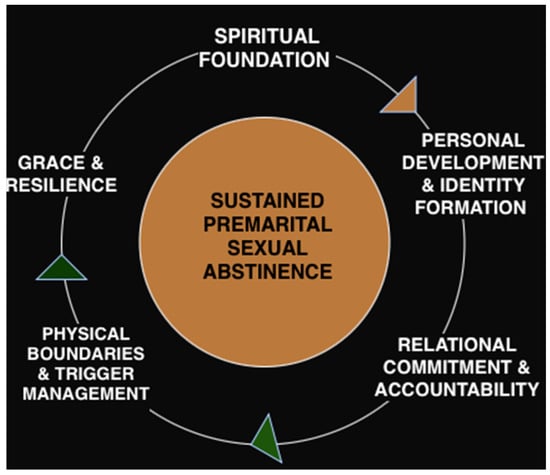
Figure 1.
The Premarital Sexual Abstinence Sustainability Model.
4. Discussion
The purpose of the present grounded theory study was to generate a process-oriented explanation for how African American couples successfully sustained sexual abstinence until marriage and to identify the advice they considered most essential for individuals and couples attempting the same path. The resulting Premarital Sexual Abstinence Sustainability Model illustrates abstinence not as a single moral choice, but as a dynamic, relational, and spiritually grounded process shaped by five interconnected domains: spiritual foundation and meaning-making, personal development and identity formation, relational commitment and accountability, physical boundaries and trigger management, and emotional grace and resilience. Together, these domains represent a cyclical framework through which couples continually orient themselves toward their long-term abstinence goal. Given that 99% of participants reported that religion was very or extremely important to them and 91% attended worship services weekly or more, these findings should be understood within the context of a highly religious sample whose abstinence practices were deeply intertwined with their faith. In addition to the sample’s high religiosity, the rarity of premarital abstinence among African Americans offers a unique analytic advantage for understanding how abstinence is sustained. Because abstinence is not the normative pattern within this demographic group, the sample creates a high-contrast context that enables grounded theory to identify the most salient relational and spiritual mechanisms supporting abstinence maintenance.
Consistent with prior research, spirituality was central to how participants understood their abstinence journey. Previous studies have shown that religiosity predicts abstinence intentions and delays in sexual debut among African American youth and adults (Regnerus, 2007; Uecker, 2015). The present findings extend this literature by demonstrating how religious beliefs functioned not only as behavioral motivations but as a shared sacred meaning system that infused the entire relationship. Couples described abstinence as obedience to God, part of their spiritual identity, or a divine assignment—language aligned with sanctification theory (Mahoney et al., 2001), which proposes that viewing aspects of one’s relationship as sacred increases motivation toward protective and self-regulatory behaviors. Importantly, couples’ advice also reflected this orientation. Statements such as “Do it for God,” “Pray before you decide,” and “God will meet you where you are” reinforce the conclusion that spiritual grounding was perceived as essential for both successful abstinence and long-term relational flourishing. Viewed through a sanctification lens, these patterns further illuminate sexual sanctification processes, wherein partners regard aspects of their relationship and sexual decision-making as sacred. This sacred framing appeared to strengthen couples’ motivation, shared meaning-making, and dyadic self-regulation—mechanisms consistent with sanctification theory’s expectations and supportive of the grounded theory model generated in this study.
The second domain—personal development and identity formation—emerged as a distinctive contribution of this study. While prior abstinence research has largely emphasized morality, religious norms, or behavioral restriction, couples in this study highlighted self-worth, purpose, emotional healing, and individual growth as key components of abstinence maintenance. Participants frequently encouraged singles to “focus on self-development,” “build a relationship with God,” “discover purpose,” “go to therapy if needed,” and “know your triggers before dating.” These insights suggest that abstinence sustainability is intertwined with emotional maturity, self-regulation, and a strong sense of identity—components that have received limited attention in abstinence literature. This domain also reflects a strengths-based cultural perspective, emphasizing resilience and self-efficacy within the African American context.
Relational commitment and accountability represented a third major process. The emphasis on mutual decision-making aligns with commitment theory and with relationship research that warns against “sliding” into sexual or relational milestones without intentional agreement (Stanley et al., 2006). Couples repeatedly emphasized that abstinence “only works if both partners are on the same page,” and that mutual accountability—open communication, shared boundaries, and spiritual practices such as praying together—strengthened both abstinence and relationship quality, processes known to enhance relationships in African American relationships (Marks et al., 2012; Skipper et al., 2018). This finding also intersects with social learning theory (Bandura, 1977), as several couples modeled abstinence for peers or sought mentorship from married couples who had waited, creating intergenerational pathways of learning and influence.
Physical boundaries and trigger management emerged as essential for translating spiritual and relational commitments into daily behavior. Participants spoke candidly about structuring dating to avoid high-risk situations. They emphasized practical strategies such as limiting late nights, avoiding extended time alone in private spaces, reducing sexualized media exposure, and being honest about triggers. These behaviors align with empirical research on self-regulation (Baumeister et al., 2007) and expand it by demonstrating how spiritual and relational commitments are operationalized through concrete behavioral practices.
Finally, emotional grace and resilience distinguished this model from traditional abstinence paradigms. Rather than promoting shame-based purity narratives, participants normalized the difficulties, temptations, and imperfections. Statements such as “If you fall, recover with grace,” “It’s OK—God’s grace still covers you,” and “You can get back up” reflect a compassionate, growth-oriented approach. This domain reframes abstinence not as fragile or dependent on perfection, but as resilient and spiritually restorative. This finding contributes to a more emotionally nuanced, psychologically informed, and theologically grounded understanding of abstinence maintenance—one that may be especially protective for individuals who have experienced prior sexual trauma, guilt, or inconsistent success with abstinence. These findings also align with constrained choice perspectives, which conceptualize behavior as continually shaped by relational, spiritual, and contextual conditions rather than by a single isolated decision (Bird & Rieker, 2008).
4.1. Limitations
Several limitations should be considered. The sample comprised African American couples, who were predominantly Christian, middle-class, and highly religious, which limits the generalizability of the findings to other racial, socioeconomic, or religious groups. This demographic profile likely reflects the church-based recruitment strategy and self-selection among couples who viewed their abstinence as spiritually meaningful and successful. However, the processes identified in this study—such as shared spiritual motivation, dyadic accountability, boundary setting, and grace-based resilience—may offer conceptual insight for other cultural or religious communities that promote premarital abstinence. Retrospective accounts may reflect idealization or reconstruction of past events. Couples who attempted abstinence but did not succeed were not included, restricting insight into discontinuation processes. As such, the study represents “success cases,” and future research should purposively recruit unsuccessful or mixed-outcome abstainers to explore contrasting pathways and sociodemographic patterns. The dyadic interview format may have introduced positive impression management, though the inclusion of individual interviews helped counterbalance this. Finally, while generative AI was incorporated only as a supplemental analytic check, interpretation remains grounded in the researcher’s qualitative judgment. Accordingly, the Premarital Sexual Abstinence Sustainability Model should be understood as a contextual, exploratory framework generated from a particular population (highly religious, well-educated, gainfully employed) rather than a universally generalizable explanation, pending validation with more diverse samples.
4.2. Implications
4.2.1. Implications for Abstinence Research and Sustainability Processes
Future research should explore how the processes identified in this study operate across more diverse populations, including couples from different racial, socioeconomic, religious, and cultural backgrounds. Because this sample included only couples who successfully maintained abstinence, future studies should intentionally recruit individuals and couples who attempted but did not sustain abstinence to better understand barriers, discontinuation processes, and turning points that lead to lapses. Although some prior studies have attempted to compare abstainers and non-abstainers, such work has typically involved very small abstinent subgroups and has included few, if any, African American participants. Future research would benefit from adequately powered, demographically diverse samples that allow meaningful comparisons of relational and spiritual processes across different sexual decision-making pathways, particularly among successful abstainers, unsuccessful abstainers, and non-abstainers, to better understand how relational and contextual factors shape developmental pathways.
Subgroup distinctions among primary abstainers (never engaged in sexual intercourse prior to marriage), secondary abstainers (previous sexual history, not with current spouse), and tertiary abstainers (sexual history with current but joint recommitment to abstinence) also warrant further study. In the present dataset, grounded theory analysis did not reveal patterned differences between these groups in the processes used to maintain abstinence; participants across subgroups described drawing on similar spiritual, relational, and behavioral mechanisms. This absence of subgroup differentiation should not be interpreted as evidence of universal equivalence, as larger and more socio-demographically diverse samples may clarify whether subgroup variation emerges under different relational, cultural, or religious conditions. Investigating these distinctions will be essential for determining whether the similarities observed here reflect characteristics unique to highly religious African American couples or represent broader patterns in abstinence maintenance.
Gendered dynamics also warrant further attention. Although gender differences in motivations, boundary-setting, or abstinence maintenance were explored in this study, no patterned variation emerged across men and women; the vast majority of participants described mutual alignment in commitment, accountability, and decision-making. These findings may reflect the sample’s high religiosity and shared spiritual frameworks. Future research with more religiously and culturally diverse samples may reveal gendered variations not evident in the present study.
4.2.2. Implications for African American Relationship Research
Within African American relational contexts, these processes are often embedded within intergenerational and faith-based systems. Additional work is also needed to examine how family-of-origin patterns, early religious socialization, and intergenerational modeling shape abstinence decision-making among emerging adults. Longitudinal studies would offer greater insight into how the five processes of the Premarital Sexual Abstinence Sustainability Model predict later marital outcomes, such as marital satisfaction, sexual satisfaction, spiritual connectedness, and stability. Future research should also evaluate how structured supports—including mentor couples, faith-community programs, or clinician-led premarital counseling—can enhance abstinence sustainability by reinforcing spiritual motivation, dyadic accountability, and boundary-setting skills.
4.2.3. Implications for Relationship Theory and Dyadic Regulation
Beyond individual and relational outcomes, the present grounded theory model also has implications for understanding broader relationship trajectories. Although this study did not examine marriage rates, cohabitation patterns, or premarital birth outcomes directly, the processes identified in the Premarital Sexual Abstinence Sustainability Model generate testable hypotheses regarding how sustained abstinence may shape the sequencing of dating, cohabitation, marriage, and childbearing. Future longitudinal and intervention-based research could examine whether applying this model within faith-based or community settings is associated with differences in transitions into marriage, reduced reliance on cohabitation as a precursor to commitment, and a greater likelihood of first births occurring within marital unions among individuals making faith-informed relationship decisions. These trajectory-level implications extend relationship theories emphasizing intentional progression and joint decision-making, including sliding versus deciding frameworks, by illustrating how abstinence operates as a dyadic regulatory strategy rather than an individual constraint.
In addition to examining variation within abstinent populations, future research should also consider the scope of the processes identified in this model beyond abstinence-specific contexts. The present findings conceptualize lapses as boundary violations that occur without engaging in vaginal–penile intercourse and demonstrate how couples utilized grace-based processes to restore alignment and sustain commitment to abstinence. From a theoretical standpoint, these findings align with dyadic self-regulation and interdependence theories, which emphasize partners’ shared management of goals, behavior, and repair within ongoing committed relationships. The emphasis on grace-based repair further suggests that sanctification processes may strengthen dyadic regulation by sustaining commitment and meaning following boundary disruptions. Future research could examine whether similar relational regulatory processes—such as meaning-making, mutual accountability, and grace-based repair—operate when the boundary crossed involves sexual intercourse. Such work would clarify whether the sustainability mechanisms identified here reflect abstinence-specific dynamics or more generalizable relational processes applicable across diverse sexual decision-making contexts.
4.2.4. Implications for Measurement, Validation, and Future Testing
Finally, the quantitative operationalization and validation of the model’s core constructs would enable broader testing across diverse demographic contexts and provide an empirical foundation for developing educational or therapeutic interventions designed to support couples who desire to maintain abstinence before marriage. Until such testing occurs, the Premarital Sexual Abstinence Sustainability Model should be understood as a contextual, exploratory framework that reflects the experiences of a highly religious subgroup of African American couples rather than a universally generalizable explanation of abstinence maintenance. These implications are theoretical and hypothesis-generating, as the present study was designed to explicate relational processes rather than assess demographic outcomes.
5. Conclusions
To the author’s knowledge, this is the first grounded theory study to examine how couples sustain premarital sexual abstinence. The Premarital Sexual Abstinence Sustainability Model captures the core processes couples identified and offers a relational and spiritually grounded framework for understanding how abstinence is maintained over time. Rather than viewing abstinence as a single moral decision, this model demonstrates the dynamic interplay of spiritual conviction, relational alignment, behavioral wisdom, and emotional resilience that supports couples’ long-term commitment.
Overall, this study contributes a deeper and more compassionate understanding of abstinence as a sustainable relational process. By illuminating how couples anchor their decision in shared faith, mutual support, wise boundaries, and emotional resilience, this grounded theory advances the field and provides a meaningful foundation for future research, practice, and support for individuals and couples committed to abstaining from sex until marriage.
Funding
This research received internal support from the Iowa State University Graduate Research Fund for a portion of the data collection. No external funding was received, and no funds were provided for article processing charges.
Institutional Review Board Statement
The study was conducted in accordance with the Declaration of Helsinki and approved by the Institutional Review Board of IOWA STATE UNIVERSITY (protocol code 20-268 approved on 7 January 2020).
Informed Consent Statement
Informed consent was obtained from all subjects involved in the study.
Data Availability Statement
The datasets generated for this study are not publicly available due to the confidential and sensitive nature of the material. Per IRB requirements and participant consent agreements, raw interview data cannot be shared.
Acknowledgments
Portions of this project were completed while the author was a graduate student at Iowa State University. The author gratefully acknowledges the institutional support provided during that phase of the research. Correspondence should be addressed to Emily N. McKnight at dr.emilymcknight@gmail.com. During the preparation of this manuscript, the author used ChatGPT (GPT-5.2; OpenAI) in a limited capacity after completion of manual coding to examine category co-occurrence patterns, assess structural completeness, identify potential contradictions or negative cases, and summarize researcher-generated memos. The author reviewed and edited the output and takes full responsibility for the content of this publication.
Conflicts of Interest
The author declares no conflicts of interest.
References
- Bandura, A. (1977). Social learning theory. Prentice Hall. [Google Scholar]
- Baumeister, R. F., Vohs, K. D., & Tice, D. M. (2007). The strength model of self-control. Current Directions in Psychological Science, 16(6), 351–355. [Google Scholar] [CrossRef]
- Bird, C. E., & Rieker, P. P. (2008). Gender and health: The effects of constrained choices and social policies. Cambridge University Press. [Google Scholar]
- Bloomberg, L., & Volpe, M. (2016). Completing your qualitative dissertation: A road map from beginning to end (3rd ed.). Sage. [Google Scholar]
- Bodenmann, G. (2005). Dyadic coping and its significance for marital functioning. In T. A. Revenson, K. Kayser, & G. Bodenmann (Eds.), Couples coping with stress: Emerging perspectives on dyadic coping (pp. 33–49). American Psychological Association. [Google Scholar] [CrossRef]
- Bradley, E. L. P., Sales, J. M., Elifson, K. W., & DiClemente, R. J. (2013). Motivations for secondary abstinence among African American females at risk for HIV/sexually transmitted infections. Journal of Black Psychology, 39(4), 355–374. [Google Scholar] [CrossRef]
- Busby, D. M., Carroll, J. S., & Willoughby, B. J. (2010). Compatibility or restraint? The effects of sexual timing on marriage relationships. Journal of Family Psychology, 24(6), 766. [Google Scholar] [CrossRef] [PubMed]
- Charmaz, K. (2014). Constructing grounded theory: A practical guide through qualitative analysis (2nd ed.). Sage. [Google Scholar]
- Chatters, L. M., Taylor, R. J., Jackson, J. S., & Lincoln, K. D. (2008). Religious coping among African Americans, Caribbean Blacks and non-Hispanic Whites. Journal of Community Psychology, 36(3), 371–386. [Google Scholar] [CrossRef] [PubMed]
- Chatzichristos, G. (2025). Qualitative research in the era of AI: A return to positivism or a new paradigm? International Journal of Qualitative Methods, 24, 16094069251337583. [Google Scholar] [CrossRef]
- Cherlin, A. J. (2020). Degrees of change: An assessment of the deinstitutionalization of marriage thesis. Journal of Marriage and Family, 82(1), 62–80. [Google Scholar] [CrossRef]
- Corbin, J. M., & Strauss, A. L. (2015). Basics of qualitative research: Techniques and procedures for developing grounded theory (4th ed.). Sage. [Google Scholar]
- DeRogatis, L. R. (2015). The Symptom Checklist-90-Revised (SCL-90-R). In The Corsini encyclopedia of psychology (4th ed.). John Wiley & Sons, Inc. [Google Scholar] [CrossRef]
- Erikson, E. H. (1982). The life cycle completed. W. W. Norton & Company. [Google Scholar]
- Finkel, E. J., & Fitzsimons, G. M. (2011). Advances in experimental social psychology (Vol. 44, pp. 317–389). Academic Press. [Google Scholar]
- Gardner, H. (2011). Frames of mind: The theory of multiple intelligences (3rd ed.). Basic Books. [Google Scholar]
- Guzzo, K. B. (2014). New partners, more kids: Multiple-partner fertility in the United States. The Annals of the American Academy of Political and Social Science, 654(1), 66. [Google Scholar] [CrossRef]
- Hardy, S. A., & Willoughby, B. J. (2017). Religiosity and chastity among single young adults and married adults. Psychology of Religion and Spirituality, 9(3), 285. [Google Scholar] [CrossRef]
- Hernandez, K. M., Mahoney, A., & Pargament, K. I. (2011). Sanctification of sexuality: Implications for newlyweds’ marital and sexual quality. Journal of Family Psychology, 25(5), 775–780. [Google Scholar] [CrossRef]
- Impett, E. A., Gordon, A. M., Kogan, A., Oveis, C., Gable, S. L., & Keltner, D. (2010). Moving toward more perfect unions: Daily and long-term consequences of approach and avoidance goals in romantic relationships. Journal of Personality and Social Psychology, 99(6), 948–963. [Google Scholar] [CrossRef]
- Kinsey, A. C., Pomeroy, W. B., & Martin, C. E. (1948). Sexual behavior in the human male. W. B. Saunders. [Google Scholar]
- Kinsey, A. C., Pomeroy, W. B., Martin, C. E., & Gebhard, P. H. (1953). Sexual behavior in the human female. W. B. Saunders. [Google Scholar]
- Klein, L. K. (2019). Pure: Inside the evangelical movement that shamed a generation of young women and how I broke free. Touchstone/Simon & Schuster. [Google Scholar]
- Laumann, E. O., Gagnon, J. H., Michael, R. T., & Michaels, S. (1994). The social organization of sexuality: Sexual practices in the United States. University of Chicago Press. [Google Scholar]
- Mahoney, A., Pargament, K. I., Murray-Swank, A., & Murray-Swank, N. (2001). Sanctification of marriage: Exploring new frontiers in religion and family relationships. Review of Religious Research, 43(2), 121–134. [Google Scholar]
- Marks, L. D., Tanner, K., Nesteruk, O., Chaney, C., & Baumgartner, J. (2012). A qualitative exploration of why faith matters in African American marriages and families. Journal of Comparative Family Studies, 43(5), 695–714. [Google Scholar] [CrossRef]
- McKnight, E. N. (2020). Deciding to wait: Exploring the lived experiences and relationship processes among African American couples who remained sexually abstinent until marriage (Publication No. 28256762) [Doctoral dissertation, Iowa State University]. [Google Scholar]
- McKnight, E. N. (2025). “Worth the Wait”: The perceived benefits of sexual abstinence until marriage. Marriage and Family Review, 61(8), 898–919. [Google Scholar] [CrossRef]
- McKnight, E. N., & Perry, A. R. (2025). “Defying the odds”: Black couples’ motivation to abstain from sex until marriage. Family Relations. Advance online publication. [Google Scholar] [CrossRef]
- Nguyen, D. C., & Welch, C. (2025). Generative artificial intelligence in qualitative data analysis: Analyzing—Or just chatting? Organizational Research Methods, 29, 3–39. [Google Scholar] [CrossRef]
- Owen, J. J., & Fincham, F. D. (2011). Young adults’ emotional reactions after hooking up encounters. Archives of Sexual Behavior, 40(2), 321–330. [Google Scholar] [CrossRef]
- Owen, J. J., Rhoades, G. K., & Stanley, S. M. (2013). Sliding versus deciding in relationships: Associations with relationship quality, commitment, and infidelity. Journal of Couple and Relationship Therapy, 12(2), 135–149. [Google Scholar] [CrossRef]
- Owen, J. J., Rhoades, G. K., Stanley, S. M., & Fincham, F. D. (2010). Hooking up among college students: Demographic and psychosocial correlates. Archives of Sexual Behavior, 39(3), 653–663. [Google Scholar] [CrossRef]
- Pargament, K. I., & Mahoney, A. (2005). Theory: Sacred matters: Sanctification as a vital topic for the psychology of religion. The International Journal for the Psychology of Religion, 15(3), 179–198. [Google Scholar] [CrossRef]
- Patton, M. Q. (1999). Enhancing the quality and credibility of qualitative analysis. Health Services Research, 34, 1189. [Google Scholar]
- Raley, R. K., Sweeney, M. M., & Wondra, D. (2015). The growing racial and ethnic divide in U.S. marriage patterns. The Future of Children, 25(2), 89–109. [Google Scholar] [CrossRef]
- Rasberry, C. N., & Goodson, P. (2009). Predictors of secondary abstinence in U.S. college undergraduates. Archives of Sexual Behavior, 38, 74–86. [Google Scholar] [CrossRef] [PubMed]
- Regnerus, M. (2007). Forbidden fruit: Sex & religion in the lives of American teenagers. Oxford University Press. [Google Scholar]
- Regnerus, M. (2021). The future of Christian marriage. Oxford University Press. [Google Scholar]
- Regnerus, M., & Uecker, J. (2011). Premarital sex in America: How young Americans meet, mate, and think about marrying. Oxford University Press. [Google Scholar]
- Rhoades, G. K., & Stanley, S. M. (2014). Before I do: What do premarital experiences have to do with marital quality among today’s young adults? National marriage project. Available online: https://nationalmarriageproject.org/sites/g/files/jsddwu1276/files/2025-06/SOCI221_NMP_BeforeIDoReport.pdf (accessed on 15 June 2020).
- Rusbult, C. E., & Van Lange, P. A. M. (2003). Interdependence, interaction, and relationships. Annual Review of Psychology, 54, 351–375. [Google Scholar] [CrossRef] [PubMed]
- Sassler, S., & Lichter, D. T. (2020). Cohabitation and marriage: Complexity and diversity in union-formation patterns. Journal of Marriage and Family, 82(1), 35–61. [Google Scholar] [CrossRef]
- Skipper, A., Moore, T. J., & Marks, L. (2018). The prayers of others helped: Intercessory prayer as a source of coping and resilience in Christian African American families. Journal of Religion & Spirituality in Social Work: Social Thought, 37(4), 373–394. [Google Scholar] [CrossRef]
- Smith, C., & Denton, M. L. (2005). Soul searching: The religious and spiritual lives of American teenagers. Oxford University Press. [Google Scholar]
- Stanley, S. M., & Rhoades, G. K. (2009). Marriages at risk: Relationship formation and opportunities for relationship education. In H. Benson, & S. Callan (Eds.), What works in relationship education: Lessons from academics and service deliverers in the United States and Europe (pp. 21–44). Doha International Institute for Family Studies and Development. Available online: https://pdfs.semanticscholar.org/5464/bdcde68d7eae2d2e72bf8c51f8b8d190d135.pdf (accessed on 15 June 2020).
- Stanley, S. M., Rhoades, G. K., & Markman, H. J. (2006). Sliding versus deciding: Inertia and the premarital cohabitation effect. Family Relations, 55(4), 499. [Google Scholar] [CrossRef]
- Teachman, J. (2004). Premarital sex, premarital cohabitation, and the risk of subsequent marital dissolution among women. Journal of Marriage and Family, 65(2), 444–455. [Google Scholar] [CrossRef]
- Uecker, J. E. (2008). Religion, pledging, and the premarital sexual behavior of married young adults. Journal of Marriage and Family, 70(3), 728–744. [Google Scholar] [CrossRef]
- Uecker, J. E. (2015). Social context and college completion in the United States: The role of congregational biblical literalism. Sociological Perspectives, 58(1), 120–137. [Google Scholar]
- Willoughby, B. J., & Carroll, J. S. (2010). Sexual experience and couple formation attitudes among emerging adults. Journal of Adult Development, 17(1), 1–11. [Google Scholar] [CrossRef]
- Willoughby, B. J., Carroll, J. S., & Busby, D. M. (2014). Differing relationship outcomes when sex happens before, on, or after first dates. Journal of Sex Research, 51(1), 52–61. [Google Scholar] [CrossRef]
Disclaimer/Publisher’s Note: The statements, opinions and data contained in all publications are solely those of the individual author(s) and contributor(s) and not of MDPI and/or the editor(s). MDPI and/or the editor(s) disclaim responsibility for any injury to people or property resulting from any ideas, methods, instructions or products referred to in the content. |
© 2026 by the author. Licensee MDPI, Basel, Switzerland. This article is an open access article distributed under the terms and conditions of the Creative Commons Attribution (CC BY) license.