


Abstract
This study investigates the propagation of climate model variability to coastal groundwater systems under the high-emission RCP8.5 scenario, focusing on the Almyros Basin in Greece. Using Med-CORDEX bias-corrected climate projections, an Integrated Modelling System (IMS) combines UTHBAL (surface hydrology) and MODFLOW (groundwater hydrology) to simulate future conditions, including precipitation, temperature, evapotranspiration, groundwater recharge, water balance, and seawater intrusion (as a quantity). The analysis quantifies both central tendencies and inter-model spread, revealing substantial declines in groundwater recharge and intensified seawater intrusion, while highlighting the uncertainty introduced by climate model projections. These findings provide critical insights for adaptive water resource management and planning in Mediterranean coastal aquifers under climate change.
1. Introduction
Groundwater systems are vital components of global water resources, providing a significant portion of the freshwater supply for drinking, agriculture, and industry. In coastal regions, groundwater is particularly critical, often serving as the primary water source for densely populated and agriculturally intensive areas [1]. These regions face unique challenges, including rising sea levels, saltwater intrusion, and altered groundwater recharge, which threaten both water quantity and quality [2]. Overextraction, pollution, and salinization further exacerbate these pressures, which are amplified under climate change. Climate change introduces substantial variability into hydrological systems by affecting precipitation patterns, evapotranspiration, and recharge processes, increasing uncertainty in water availability [3,4,5]. The consequences of climate change on water resources are subject to a high degree of uncertainty, stemming from both climate model projections and the complexities of translating climate signals into hydrological responses [6]. The propagation of climate models’ variability to groundwater simulations involves understanding how the uncertainties and variations in climate models can affect the predictions and projections of coastal groundwater dynamics [7]. Several approaches have been applied to estimate the impact of climate change on water resources. Statistical downscaling and bias-correction methods are applied to regional climate model projections for the estimation future precipitation and temperature on basin scale, which are then used to calculate, e.g., groundwater recharge [8,9]. Physically based hydrological models coupled with groundwater flow simulations have also been employed to detect interactions between surface water, recharge, aquifer and seawater dynamics under climate scenarios in coastal aquifers [10]. Ensemble approaches combine multiple climate model projections and provide the basis for the quantification of the uncertainties associated with future climate forcings and their propagation to hydrological and groundwater system simulations [8,10]. Therefore, integrating probabilistic climate projections into groundwater simulations is critical for addressing the uncertainties associated with climate change. Through the formulation of ensemble simulations, it becomes possible to quantify the response spectrum of aquifer systems under climate change and determine both central tendencies and inter-model spread of aquifer climate projections [11,12].
This study extends the findings of Lyra et al. (2024) [13], by focusing on the quantification of the aquifer response spectrum of the Almyros aquifer system through the employment of multiple climate model outputs under the adverse climate scenario RCP8.5. Specifically, the objectives are to investigate how climate change affects the central tendencies and inter-model spread, i.e., water resources availability. An Integrated Modelling System (IMS) [14] is applied that couples surface hydrology (UTHBAL) and groundwater flow (MODFLOW) to assess the impacts of climate change on the hydrological regime of the Almyros Basin, a coastal aquifer in Thessaly, Greece. Using bias-corrected temperature and precipitation data from eleven MED-CORDEX regional climate models under the RCP8.5 scenario, the IMS simulates the potential course of evolution of water resources until 2100. The findings aim to support adaptive water management strategies in Mediterranean coastal systems facing intensified climatic and anthropogenic pressures.
2. Methods
2.1. Study Area
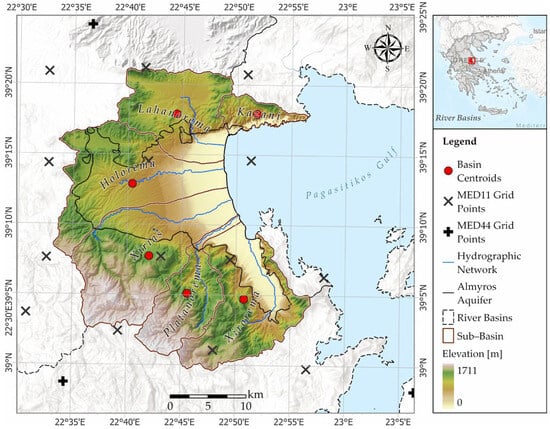
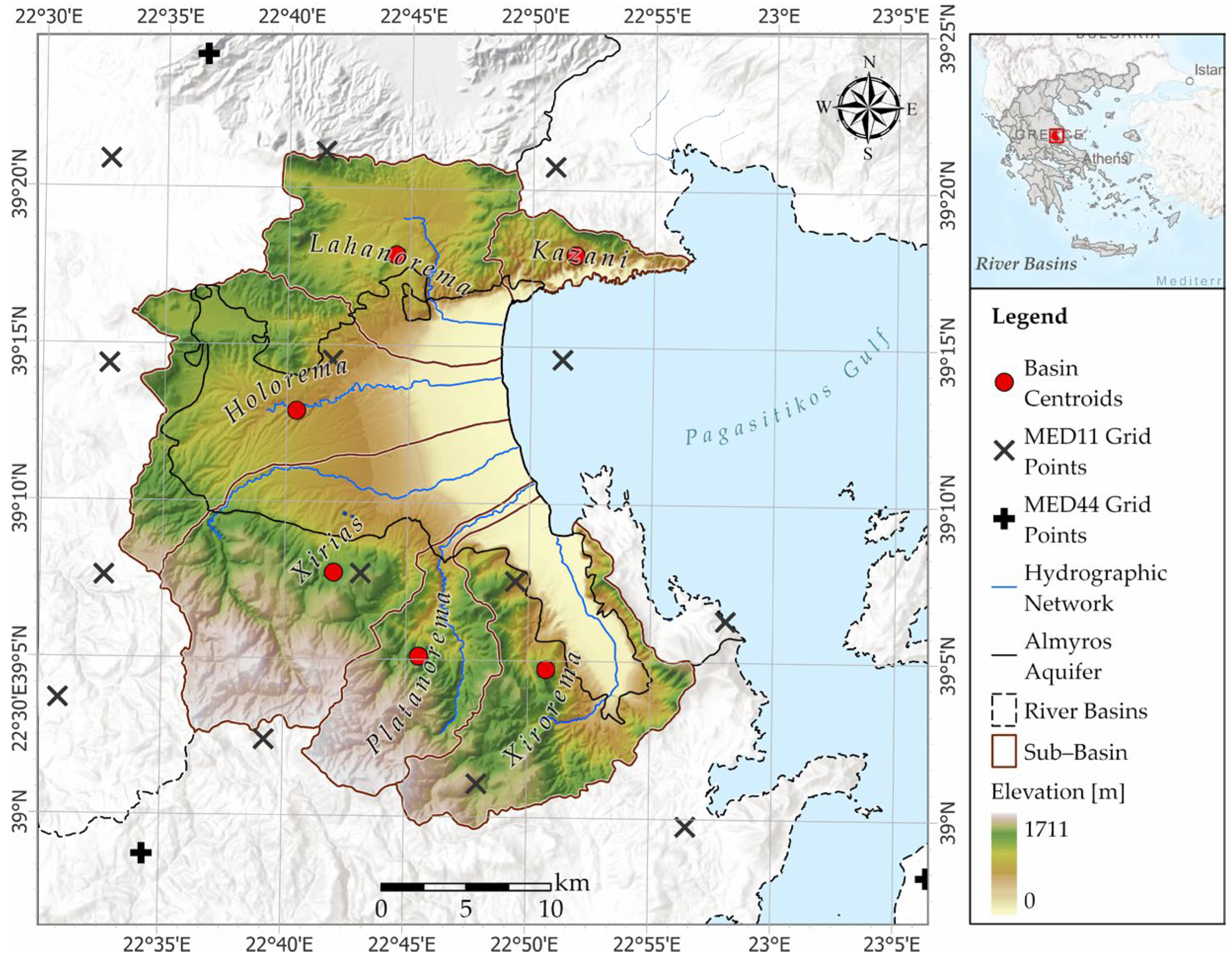
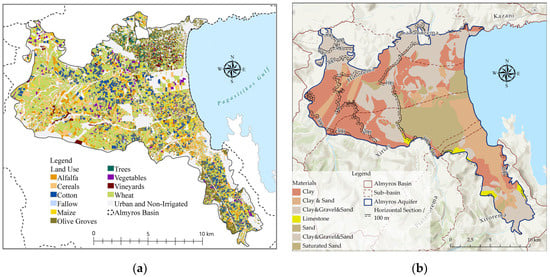
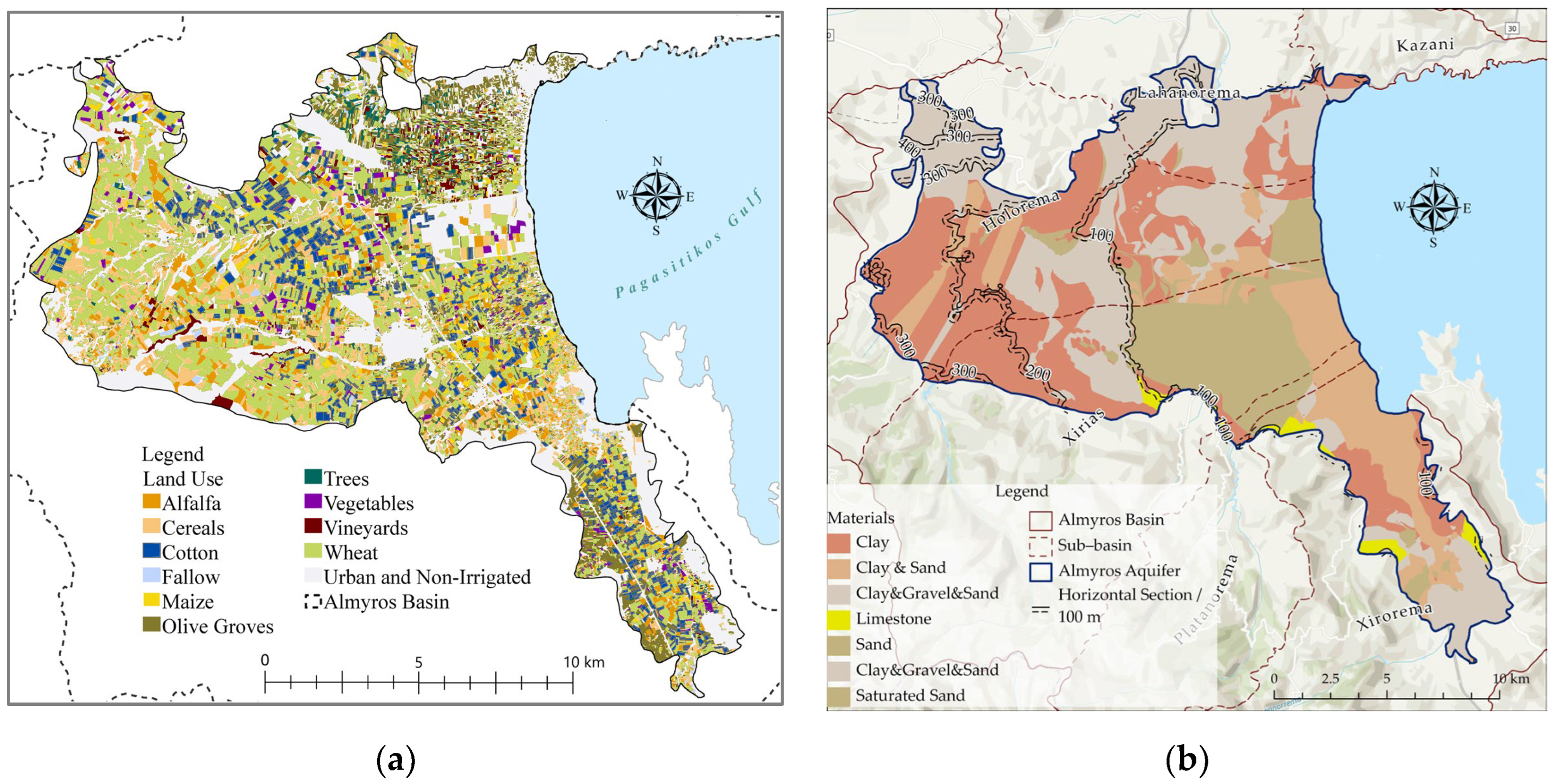
The study area is the Almyros Basin, an agriculturally intensive region in Greece, situated along the coast with a typical semi–arid Mediterranean climate (Figure 1). The basin is divided into six main sub-watersheds that drain toward the Pagasitikos Gulf, and an underlying aquifer system that supports the water uses of the area. The region receives an average annual precipitation of around 570 mm, with a mean annual temperature of 15 °C. Surface water resources are limited, as no perennial rivers exist, making groundwater the principal source for irrigation and municipal supply. The study focuses on the Almyros Aquifer System, which spans over 293 km2. Groundwater use sustains a variety of irrigated land uses like alfalfa, cereals, cotton, maize, olives, and vineyards, which contribute significantly to the local economy (Figure 2a). Geologically, the Almyros aquifer system comprises Neogene and Quaternary deposits, including clay, clay–gravel–sand, and clay–sand units, locally interbedded with limestone formations that create karstic conduits directly connected to the sea (Figure 2b). The aquifer is largely unconfined, while the western boundary is not hydraulically connected to other aquifers, the eastern boundary is hydraulically connected to the Pagasitikos Gulf, making it highly susceptible to seawater intrusion. Between 1991 and 2018, groundwater abstraction was estimated at 30 hm3 yr−1, leading to chronic deficits. This over-extraction has induced nitrate contamination and seawater intrusion, both of which have been documented in previous assessments of the basin [13,14]. These issues highlight the urgent need for future–focused water resource management to ensure sustainability for the area’s groundwater system.
Figure 1.
Map of the Almyros study area.
Figure 2.
Schemes follow another format. If there are multiple panels, they should be listed as: (a) Map of land uses in Almyros basin; (b) geological map of the Almyros aquifer adjusted from [13].
2.2. Climate Change Scenario & Models & IMS
Future climate projections for the Almyros Basin were derived from eleven Regional Climate Models (RCMs) of the MED-CORDEX ensemble, each driven by a different General Circulation Model (GCM) and operating at spatial resolutions between 50 km (MED11) and 12 km (MED44 and MED44i) (Table 1). The study focuses on the high-emission RCP8.5 pathway, which represents the upper-bound stress scenario commonly adopted for regional impact assessments in Mediterranean semi-arid environments. This choice allows the exploration of the most adverse but plausible climatic forcing conditions expected during the twenty-first century, in line with the recommendations of the IPCC (2022) [2] for water resource analysis. Subsequently, temperature and precipitation data from each MED-CORDEX regional climate model were extracted from the grid points covering the Almyros Basin, as shown in Figure 1.
Table 1.
Bias-corrected climatic models used in the study [13].
To obtain representative basin-scale inputs for the hydrological model, the data from these grid points were spatially interpolated to each basin centroid using the Inverse Distance Weighting (IDW) method. The interpolated series were bias-corrected using the Empirical Quantile Mapping method (EQM) [9] against monthly areal precipitation and temperature for the observed baseline and future periods, ensuring consistency with local climatic conditions. The performance of the bias correction was evaluated through standard validation statistics in a previous study [13]. The bias-corrected temperature and precipitation were then used as input to the Integrated Modelling System (IMS) that couples the UTHBAL model for surface hydrology with MODFLOW for groundwater flow, and the simulations were performed on a monthly time step. The IMS operates in a semi-distributed configuration for surface hydrology and a fully distributed configuration for groundwater flow.
Each of the 11 MED-CORDEX bias-corrected climate projections (RCP8.5) were introduced into UTHBAL to compute runoff and groundwater recharge at the sub-basin scale. Recharge was refined by adding irrigation return flow, weighted by crop type and sub-watershed extent. The distributed recharge estimates, together with sea-level rise and shoreline conductance, were used as inflow boundary conditions for MODFLOW, while groundwater abstractions were assigned as monthly well discharges according to agricultural and urban water demands. While the configuration also incorporates the SEAWAT module to enable density-dependent flow, in this study, however, the focus is on water quantity components. The main parameters of the groundwater configuration include the hydraulic conductivity values to range from 0.1 to 18.7 m d−1 (mean ≈ 2.3 m d−1), reflecting pronounced heterogeneity and permeability [14]. Transmissivity and storage coefficients also vary spatially across aquifer zones. For completeness of variable-density effects, freshwater and seawater densities were defined as 1000 kg m−3 and 1025 kg m−3, respectively, with a density–concentration slope of 0.7143 × 10⁻⁶ kg m−3 ppm−1 [14]. The longitudinal dispersivity ranges from 0.07 m in fine sediments to 30 m in coarse formations, averaging about 3.5 m [14]. Each climate model projection generated a distinct sequence of groundwater-recharge estimates, which was subsequently used to drive the corresponding groundwater simulations. This procedure produced eleven realizations of future hydrological states, enabling the evaluation of the climate-driven variability into groundwater responses [13]. To quantify ensemble spread and central tendency, monthly outputs from the eleven MED-CORDEX models were statistically summarized transversely. The ensemble mean, median, and standard deviation (SD) were computed across models. A 95% margin of error (ME) was calculated as:
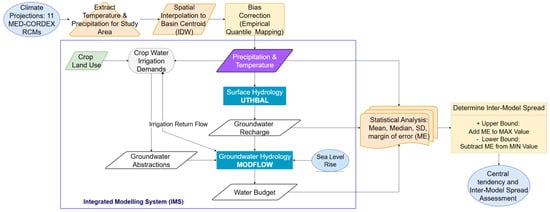
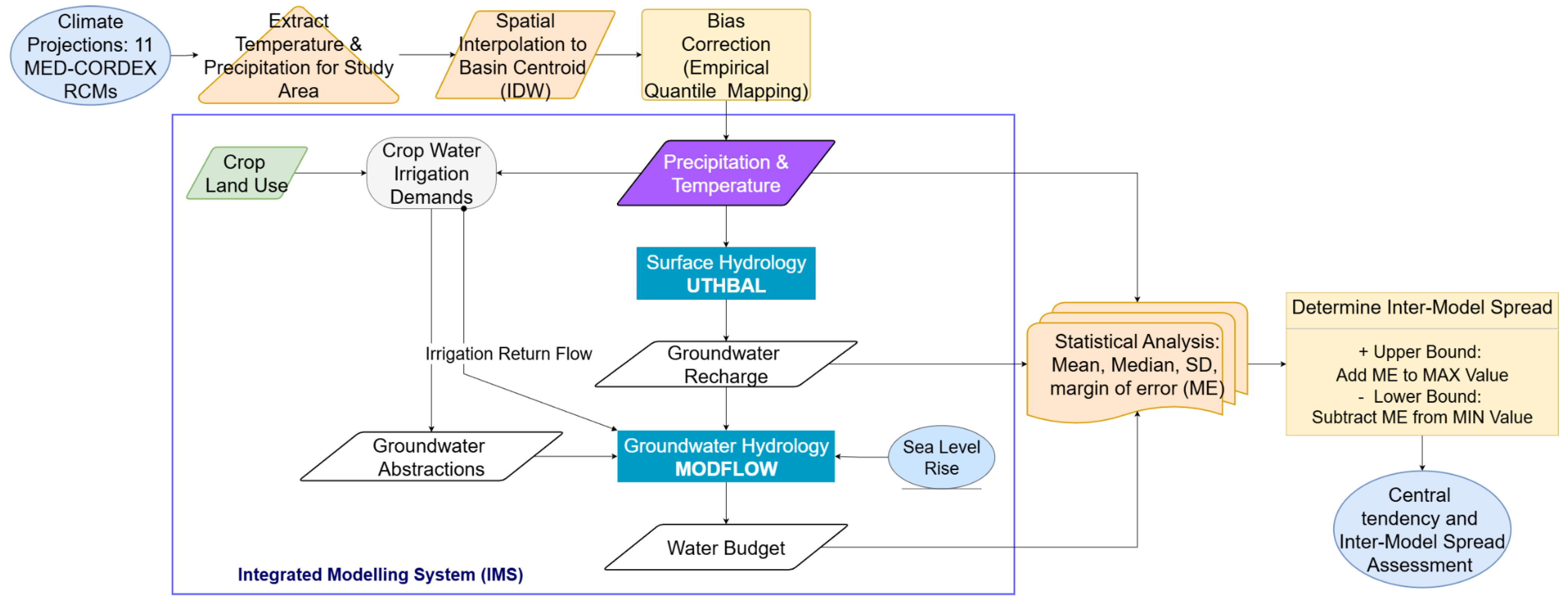
where n = count of climate models. To represent the full range of inter-model variability, upper and lower bounds were defined as the maximum and minimum ensemble values of mean, respectively, each adjusted by the corresponding margin of error. These bounds describe the spread of model projections across the ensemble rather than temporal extremes or formal confidence intervals, providing a practical depiction of climate-model variability in simulated groundwater conditions. The modelling workflow, from climate input and bias correction through surface-water simulation, groundwater modelling, and ensemble post-processing, is summarized in Figure 3.
Figure 3.
Flowchart of Applied Methodology.
3. Results
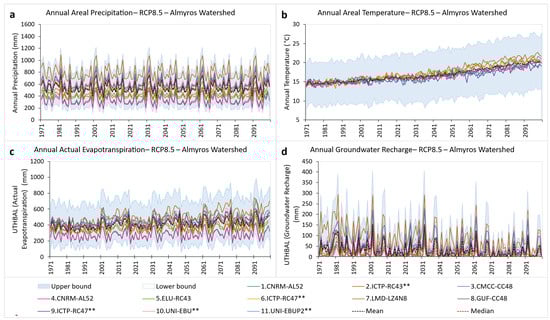
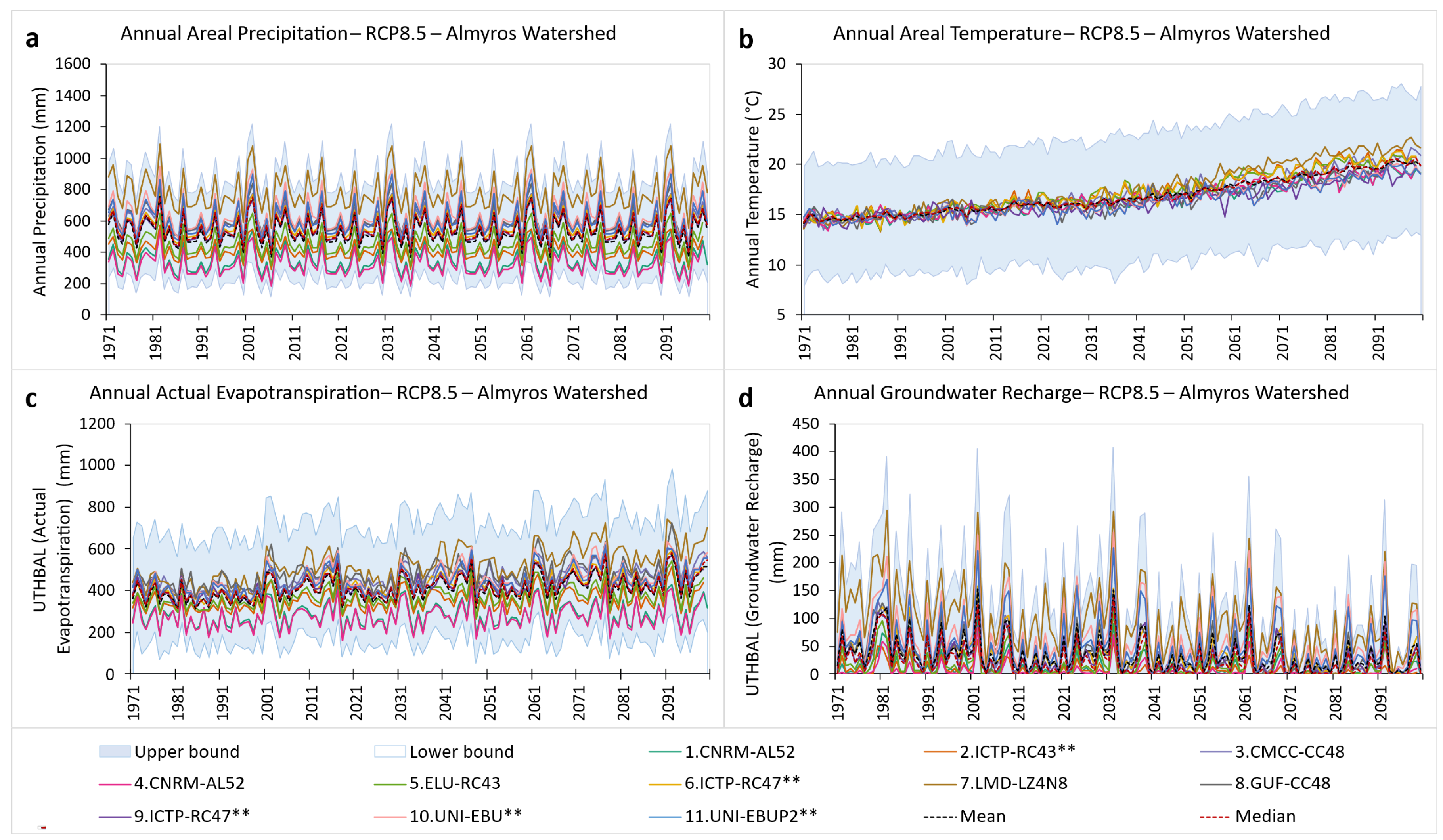
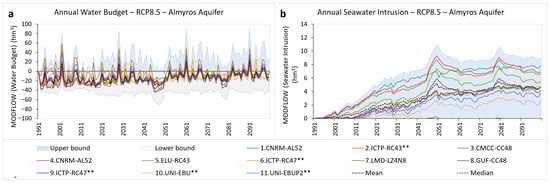
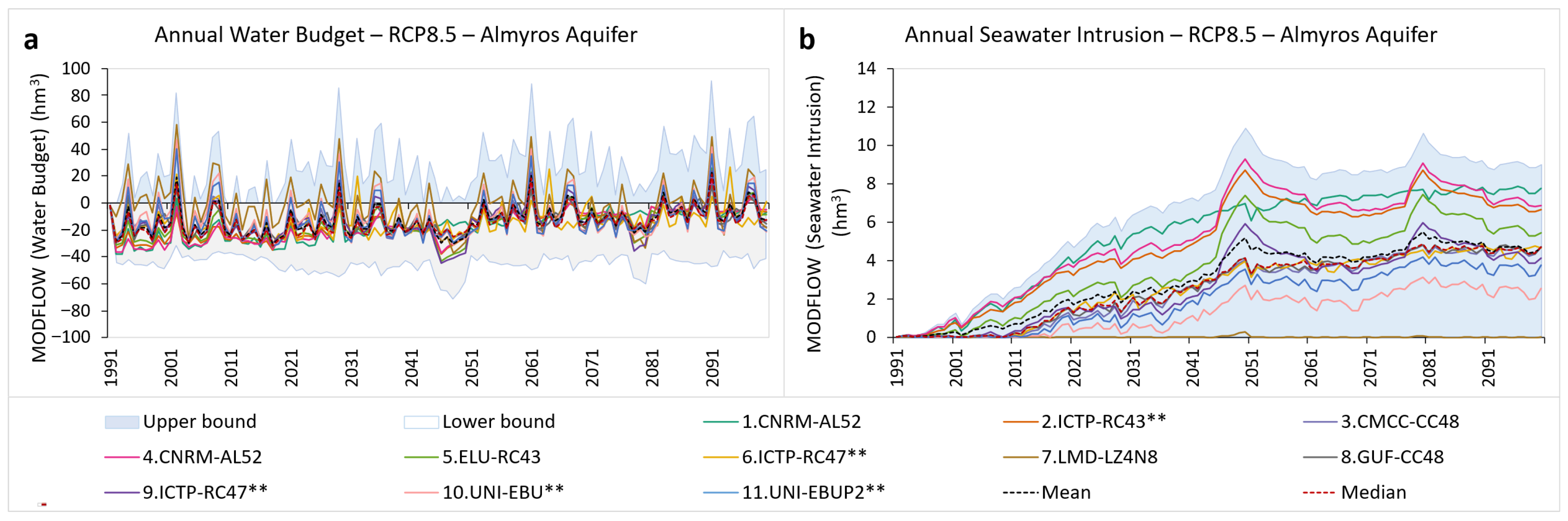
Using the Integrated Modelling System (IMS) under the RCP8.5 scenario, climate model variability was propagated to the Almyros coastal aquifer, affecting precipitation, temperature, evapotranspiration, groundwater recharge, water balance, and seawater intrusion. The results quantify both central tendencies and inter-model variability, highlighting the uncertainties that climate projections introduce to the coastal groundwater system of the Almyros Basin. Model spread was defined as the 90% ensemble range (P5–P95), capturing the main body of inter-model variability. Figure 4a illustrates the annual precipitation, showing that the inter-model spread and tendencies in annual precipitation remain relatively stable over time but gradually widen, reflecting increasing uncertainty among the eleven MED-CORDEX models. Respectively, in Figure 4b the spread of annual average temperature increases over time. A significant warming trend is evident, with mean annual temperatures increasing from 15.4 °C in 1991–2018 to 19.8 °C by 2081–2100 (+28.6%). The ensemble spread grows moderately, while a general agreement is observed among models on warming trend. The response of actual evapotranspiration (AET), shown in Figure 4c, mirrors precisely the temperature trends. AET rises steadily by 12.4% over the simulation horizon, but the inter-model variability gradually widens showing increasing uncertainty. Groundwater recharge, presented in Figure 4d, declines over time, dropping from 41.3 mm in the baseline period to 24.8 mm by 2081–2100 (−40%). The groundwater recharge spread is initially large but narrows progressively while keeping some spikes, indicating the reduced future availability. Figure 5a shows the simulated annual water budget across the ensemble. Although the mean deficit decreases from −17.4 hm3 to −4 hm3 by 2100, the uncertainty range expands substantially from 59 hm3 to 121 hm3, indicating that some models project severe deficits while others add to more surplus conditions. Figure 5b illustrates the volume of seawater intrusion, which increases profoundly from 0.5 hm3 in 1991–2018 to 4.8 hm3 by 2081–2100 (+860%). The widening ensemble spread emphasizes that reduced recharge combined with ongoing groundwater abstraction will exacerbate salinization of the Almyros aquifer.
Figure 4.
Annual projections of key hydrological variables for the Almyros Basin under RCP8.5: (a) Precipitation; (b) Temperature; (c) Actual Evapotranspiration; (d) Groundwater Recharge. Shaded areas show inter-model variability (** only available for RCP8.5.).
Figure 5.
Annual projections of (a) Water Budget and (b) Seawater Intrusion volume in the Almyros aquifer under RCP8.5. Shaded areas show inter-model variability. (** only available for RCP8.5.).
The ensemble statistics for the main hydrological variables under the RCP8.5 scenario are summarized in Table 2, which combines both central tendency (mean change and percent difference from baseline, Δ%) and inter-model variability (spread, P5–P95) across the simulation periods. Precipitation shows only minor changes relative to the baseline, with projected variations within 2%, indicating that the decline in groundwater recharge is not primarily driven by rainfall reductions. In contrast, temperature exhibits a strong increasing trend, nearly 29% by the end of the century, which drives the increase in actual evapotranspiration. Groundwater recharge declines sharply, with reductions of up to 40% by 2081–2100, despite the small changes in precipitation. The recharge spread remains wide, particularly in the near-future periods (85% for 2019–2050), indicating significant uncertainty propagated from climate models. The water balance remains deficit across all periods and the growing spread (up to 121%) emphasizes the combined effect of climatic model variability that is carried to groundwater simulations and widens the range of aquifer variability responses.
Table 2.
Statistics of key hydrological and climatic variables in the Almyros Basin under bias-corrected MED-CORDEX RCP8.5 projections.
Significantly, seawater intrusion increases up to 860% relative to the baseline fluxes, and the subsequent lower spread of 511% by 2081–2100, reveals the sensitivity of groundwater balance to the inter-model variability of local climate patterns. In essence, these results show that precipitation and temperature-driven evapotranspiration are the dominant controls on groundwater balance through groundwater recharge.
4. Conclusions
In conclusion, the Almyros Basin is facing significant challenges in managing its groundwater resources. The analysis of this study showed that climate model variability significantly affects coastal groundwater systems’ simulations. The results demonstrate that climate change will significantly impact the Almyros coastal aquifer, primarily through groundwater recharge, and the combined effect of precipitation and temperature-driven evapotranspiration. Groundwater recharge is projected to decline significantly, reducing aquifer replenishment by up to 40% by the end of the century, while seawater intrusion intensifies, highlighting the vulnerability of coastal groundwater balance. The ensemble approach reveals substantial inter-model variability, particularly for groundwater recharge, groundwater balance and seawater intrusion, deepening the critical role of climate-model uncertainty in assessing future water resource conditions. Persistent water balance deficits confirm ongoing stress on the Almyros aquifer, which escalate the importance of integrating climate projections with water demand planning, and hydro-economic impacts, such as irrigation costs, crop yield reductions, and water allocation trade-offs, into future management strategies.
Author Contributions
Conceptualization, A.L. (Aikaterini Lyra), A.L. (Athanasios Loukas), P.S. and N.M.; methodology, A.L. (Aikaterini Lyra), A.L. (Athanasios Loukas), P.S. and N.M.; software, A.L. (Aikaterini Lyra); formal analysis, A.L. (Aikaterini Lyra); investigation, A.L. (Aikaterini Lyra); data curation, A.L. (Aikaterini Lyra); writing—original draft preparation, A.L. (Aikaterini Lyra), A.L. (Athanasios Loukas), P.S. and N.M.; writing—review and editing, A.L. (Aikaterini Lyra), A.L. (Athanasios Loukas), P.S. and N.M.; supervision, A.L. (Athanasios Loukas), P.S. and N.M. All authors have read and agreed to the published version of the manuscript.
Funding
This research is co-financed by Greece and the European Union (European Social Fund- ESF) through the Operational Programme «Human Resources Development, Education and Lifelong Learning» in the context of the project “Strengthening Human Resources Research Potential via Doctorate Research” (MIS-5000432), implemented by the State Scholarships Foundation (ΙΚΥ).
Institutional Review Board Statement
Not applicable.
Informed Consent Statement
Not applicable.
Data Availability Statement
The tools developed and applied during this study are available at: https://github.com/waterhy (accessed on 1 December 2024).
Conflicts of Interest
The authors declare no conflicts of interest. The funders had no involvement in the study design, data collection, analysis, or interpretation; in the manuscript writing; or in the decision to publish the findings.
References
- Alfarrah, N.; Walraevens, K. Groundwater Overexploitation and Seawater Intrusion in Coastal Areas of Arid and Semi-Arid Regions. Water 2018, 10, 143. [Google Scholar] [CrossRef] [Scilit]
- Caretta, M.A.; Mukherji, A.; Arfanuzzaman, M.; Betts, R.A.; Gelfan, A.; Hirabayashi, Y.; Lissner, T.K.; Lopez Gunn, E.; Liu, J.; Morgan, R.; et al. Water. In Climate Change 2022: Impacts, Adaptation and Vulnerability. Contribution of Working Group II to the Sixth Assessment Report of the Intergovernmental Panel on Climate Change; Pörtner, H.-O., Roberts, D.C., Tignor, M.M.B., Poloczanska, E.S., Mintenbeck, K., Alegría, A., Craig, M., Langsdorf, S., Löschke, S., Möller, V., et al., Eds.; Cambridge University Press: Cambridge, UK, 2022. [Google Scholar]
- Dehghani, S.; Massah Bavani, A.R.; Roozbahani, A.; Gohari, A.; Berndtsson, R. Towards an Integrated System Modeling of Water Scarcity with Projected Changes in Climate and Socioeconomic Conditions. Sustain. Prod. Consum. 2022, 33, 543–556. [Google Scholar] [CrossRef] [Scilit]
- Jain, H.; Dhupper, R.; Shrivastava, A.; Kumar, D.; Kumari, M. AI-Enabled Strategies for Climate Change Adaptation: Protecting Communities, Infrastructure, and Businesses from the Impacts of Climate Change. Comput. Urban Sci. 2023, 3, 25. [Google Scholar] [CrossRef] [Scilit]
- Europe’s State of Water 2024: The Need for Improved Water Resilience. Available online: https://www.eea.europa.eu/en/analysis/publications/europes-state-of-water-2024 (accessed on 7 November 2025).
- Chiew, F.H.S. Climate Change and Water Resources: Munro Oration, Hydrology and Water Resources Symposium Sydney, 13 November 2023. Australas. J. Water Resour. 2024, 28, 6–17. [Google Scholar] [CrossRef] [Scilit]
- Wang, H.-M.; Chen, J.; Xu, C.-Y.; Zhang, J.; Chen, H. A Framework to Quantify the Uncertainty Contribution of GCMs Over Multiple Sources in Hydrological Impacts of Climate Change. Earth’s Future 2020, 8, e2020EF001602. [Google Scholar] [CrossRef] [Scilit]
- Pulido-Velazquez, D.; Collados-Lara, A.-J.; Alcalá, F.J. Assessing Impacts of Future Potential Climate Change Scenarios on Aquifer Recharge in Continental Spain. J. Hydrol. 2018, 567, 803–819. [Google Scholar] [CrossRef] [Scilit]
- Gudmundsson, L.; Bremnes, J.B.; Haugen, J.E.; Engen-Skaugen, T. Technical Note: Downscaling RCM Precipitation to the Station Scale Using Statistical Transformations—A Comparison of Methods. Hydrol. Earth Syst. Sci. 2012, 16, 3383–3390. [Google Scholar] [CrossRef] [Scilit]
- Adams, K.H.; Reager, J.T.; Buzzanga, B.A.; David, C.H.; Sawyer, A.H.; Hamlington, B.D. Climate-Induced Saltwater Intrusion in 2100: Recharge-Driven Severity, Sea Level-Driven Prevalence. Geophys. Res. Lett. 2024, 51, e2024GL110359. [Google Scholar] [CrossRef] [Scilit] [PubMed]
- Bennour, A.; Jia, L.; Menenti, M.; Zheng, C.; Zeng, Y.; Barnieh, B.A.; Jiang, M. Assessing Impacts of Climate Variability and Land Use/Land Cover Change on the Water Balance Components in the Sahel Using Earth Observations and Hydrological Modelling. J. Hydrol. Reg. Stud. 2023, 47, 101370. [Google Scholar] [CrossRef] [Scilit]
- Lam, Q.D.; Meon, G.; Pätsch, M. Coupled Modelling Approach to Assess Effects of Climate Change on a Coastal Groundwater System. Groundw. Sustain. Dev. 2021, 14, 100633. [Google Scholar] [CrossRef] [Scilit]
- Lyra, A.; Loukas, A.; Sidiropoulos, P.; Vasiliades, L. Climate Change Impacts on Nitrate Leaching and Groundwater Nitrate Dynamics Using a Holistic Approach and Med-CORDEX Climatic Models. Water 2024, 16, 465. [Google Scholar] [CrossRef] [Scilit]
- Lyra, A.; Loukas, A.; Sidiropoulos, P.; Tziatzios, G.; Mylopoulos, N. An Integrated Modeling System for the Evaluation of Water Resources in Coastal Agricultural Watersheds: Application in Almyros Basin, Thessaly, Greece. Water 2021, 13, 268. [Google Scholar] [CrossRef] [Scilit]

Disclaimer/Publisher’s Note: The statements, opinions and data contained in all publications are solely those of the individual author(s) and contributor(s) and not of MDPI and/or the editor(s). MDPI and/or the editor(s) disclaim responsibility for any injury to people or property resulting from any ideas, methods, instructions or products referred to in the content. |
© 2025 by the authors. Licensee MDPI, Basel, Switzerland. This article is an open access article distributed under the terms and conditions of the Creative Commons Attribution (CC BY) license.