
Early Detection of Alzheimer’s Disease via Amyloid Aggregates: A Systematic Review of Plasma Spectral Biomarkers and Machine Learning Approaches


Abstract
1. Introduction
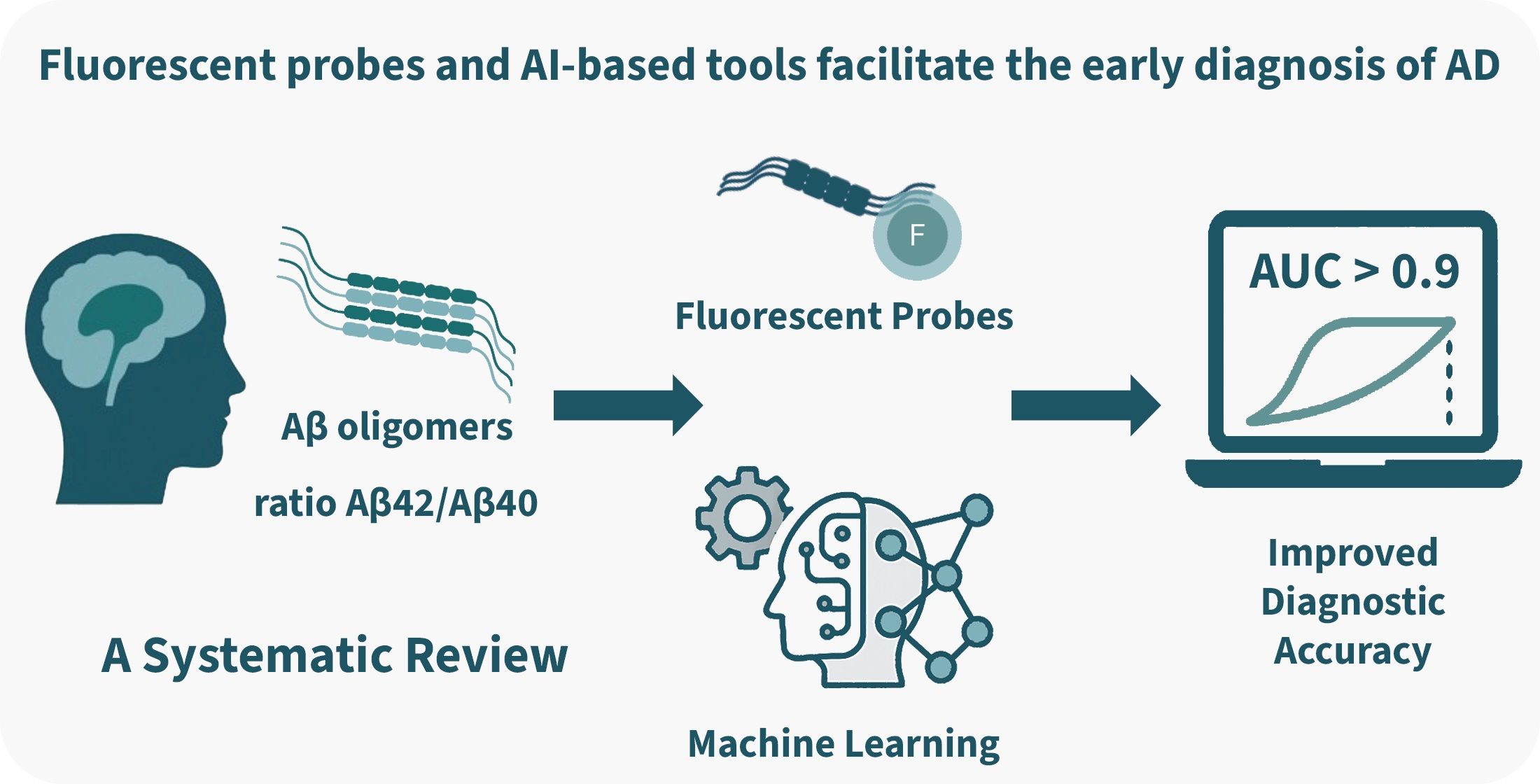
How can fluorescent probes and AI-based tools facilitate the early diagnosis of Alzheimer’s disease by identifying -amyloid aggregates and assessing the A42/A40 ratio in body fluids?
- How accurately can measurement of A42/40 in plasma detect AD compared to PET imaging?
- Biomarkers: What specific biomarkers have shown efficacy in the early detection of -amyloid aggregates?
- Which ML techniques have contributed to the detection of A aggregates and biomarkers in early-stage AD?
2. Methods
2.1. Search Strategy
| (biomarker* OR spectroscop* OR fluorescen* OR “biosensor”) |
| AND |
| (“machine learning” OR “deep learning” OR “data science” OR “artificial intelligence” OR spectr* analys*) |
| AND |
| (amyloid* aggregate OR amyloid* plaques OR amyloid* fibril* OR “abeta42/abeta40” OR amyloid* autofluorescence OR “early diagnosis” OR “Alzheimer” OR “A42/40”) |
| AND |
| (“blood” OR “plasma” OR “CSF” OR “biological sample” OR “serum” OR “cerebrospinal fluid”) |
| NOT |
| (nanoparticl* OR “nanocluster” OR tumor* OR “cancer” OR “cholesterol”) |
2.2. Eligibility Criteria
2.2.1. Inclusion Criteria
- Research that investigates the relationship between amyloid aggregation and diagnostic outcomes for AD using A42/40.
- Studies focused on early diagnosis of AD using biomarkers for the A aggregates, such as autofluorescence of the amyloid, or other plasma or CSF biomarkers.
- Studies that provide quantitative data on biomarkers or other diagnostic tests associated with AD.
- Studies that combine AI and ML with spectral measurements for analytic determination, regardless of whether the biomarker is directly related to amyloid.
2.2.2. Exclusion Criteria
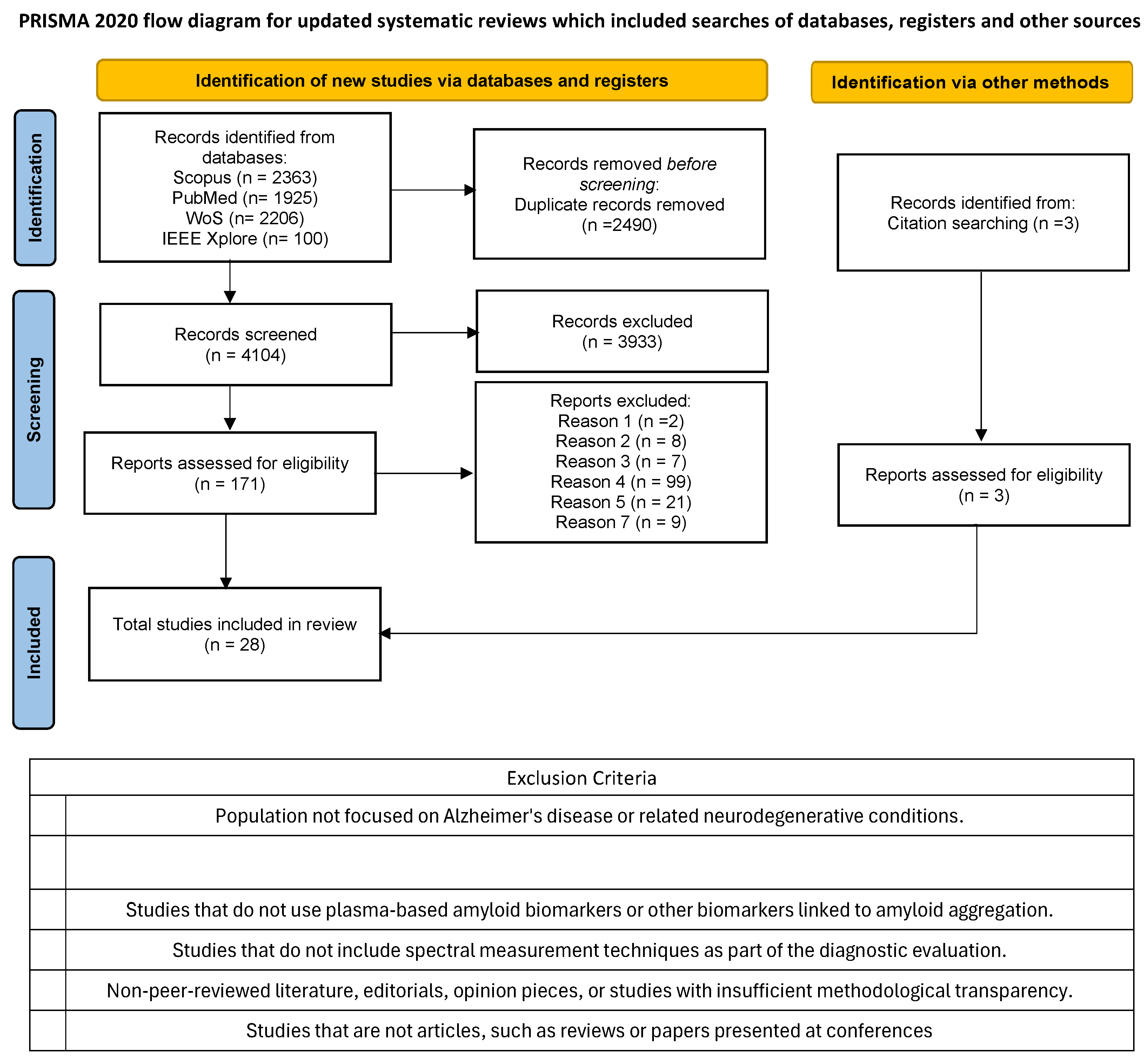
- Population not focused on AD or related neurodegenerative conditions.
- Studies not addressing early diagnosis or studies that are focused on treatment clinical management, or late-stage disease.
- Studies that do not use plasma-based amyloid biomarkers or other biomarkers linked to amyloid aggregation.
- Studies that do not include spectroscopic techniques as part of the diagnostic evaluation.
- Non-peer-reviewed literature, editorials, opinion pieces, or studies with insufficient methodological transparency.
- Studies that do not apply AI or ML techniques for spectral data analysis or diagnostic purposes.
- Studies that are not articles, such as reviews or papers presented at conferences.
2.3. Diagnostic Evaluation Metrics
3. Results
4. Discussion
4.1. Analysis of Plasma and CSF A42/40 Across Studies and Its Relationship to PET Diagnosis
4.2. Fluorescence-Based Amyloid Detection Methods
4.3. Analytical Comparison of AI-Based Methods for Detecting AD Biomarkers
4.4. Limitations
5. Conclusions
5.1. A42/40 Detection in Plasma
5.2. Fluorescent Probes
5.3. AI for AD Detection
5.4. Answer to the Primary Research Question
5.5. Implications for Clinical Application
5.6. Synthesis and Future Directions
Author Contributions
Funding
Data Availability Statement
Conflicts of Interest
References
- Fandos, N.; Pérez-Grijalba, V.; Pesini, P.; Olmos, S.; Bossa, M.; Villemagne, V.L.; Doecke, J.; Fowler, C.; Masters, C.L.; Sarasa, M.; et al. Plasma amyloid β 42/40 ratios as biomarkers for amyloid β cerebral deposition in cognitively normal individuals. Alzheimer’s Dement. Diagn. Assess. Dis. Monit. 2017, 8, 179–187. [Google Scholar] [CrossRef]
- Lansbury, P.T.; Lashuel, H.A. A century-old debate on protein aggregation and neurodegeneration enters the clinic. Nature 2006, 443, 774–779. [Google Scholar] [CrossRef]
- Hardy, J.; Selkoe, D.J. The amyloid hypothesis of Alzheimer’s disease: Progress and problems on the road to therapeutics. Science 2002, 297, 353–356. [Google Scholar] [CrossRef] [PubMed]
- Hardy, J.; Bogdanovic, N.; Winblad, B.; Portelius, E.; Andreasen, N.; Cedazo-Minguez, A.; Zetterberg, H. Pathways to Alzheimer’s disease. J. Intern. Med. 2014, 275, 296–303. [Google Scholar] [CrossRef] [PubMed]
- Kepp, K.P.; Robakis, N.K.; Høilund-Carlsen, P.F.; Sensi, S.L.; Vissel, B. The amyloid cascade hypothesis: An updated critical review. Brain 2023, 146, 3969–3990. [Google Scholar] [CrossRef]
- Long, J.M.; Holtzman, D.M. Alzheimer Disease: An Update on Pathobiology and Treatment Strategies. Cell 2019, 179, 312–339. [Google Scholar] [CrossRef]
- Bilgel, M.; An, Y.; Walker, K.A.; Moghekar, A.R.; Ashton, N.J.; Kac, P.R.; Karikari, T.K.; Blennow, K.; Zetterberg, H.; Jedynak, B.M.; et al. Longitudinal changes in Alzheimer’s-related plasma biomarkers and brain amyloid. Alzheimer’s Dement. J. Alzheimer’s Assoc. 2023, 19, 4335–4345. [Google Scholar] [CrossRef]
- Lee, S.J.C.; Nam, E.; Lee, H.J.; Savelieff, M.G.; Lim, M.H. Towards an understanding of amyloid-β oligomers: Characterization, toxicity mechanisms, and inhibitors. Chem. Soc. Rev. 2017, 46, 310–323. [Google Scholar] [CrossRef]
- Hampel, H.; Hardy, J.; Blennow, K.; Chen, C.; Perry, G.; Kim, S.H.; Villemagne, V.L.; Aisen, P.; Vendruscolo, M.; Iwatsubo, T.; et al. The Amyloid-β Pathway in Alzheimer’s Disease. Mol. Psychiatry 2021, 26, 5481–5503. [Google Scholar] [CrossRef]
- Viola, K.L.; Bicca, M.A.; Bebenek, A.M.; Kranz, D.L.; Nandwana, V.; Waters, E.A.; Haney, C.R.; Lee, M.; Gupta, A.; Brahmbhatt, Z.; et al. The Therapeutic and Diagnostic Potential of Amyloid β Oligomers Selective Antibodies to Treat Alzheimer’s Disease. Front. Neurosci. 2022, 15, 768646. [Google Scholar] [CrossRef]
- Cline, E.N.; Bicca, M.A.; Viola, K.L.; Klein, W.L.; Perry, G.; Avila, J.; Moreira, P.; Sorensen, A.; Tabaton, M. The Amyloid-β Oligomer Hypothesis: Beginning of the Third Decade. J. Alzheimer’s Dis. 2018, 64, S567–S610. [Google Scholar] [CrossRef] [PubMed]
- Allué, J.A.; Pascual-Lucas, M.; Sarasa, L.; Castillo, S.; Sarasa, M.; Sáez, M.E.; Abdel-Latif, S.; Rissman, R.A.; Terencio, J. Clinical utility of an antibody-free LC-MS method to detect brain amyloid deposition in cognitively unimpaired individuals from the screening visit of the A4 Study. Alzheimer’s Dement. Diagn. Assess. Dis. Monit. 2023, 15, e12451. [Google Scholar] [CrossRef] [PubMed]
- Pascual-Lucas, M.; Allué, J.A.; Sarasa, L.; Fandos, N.; Castillo, S.; Terencio, J.; Sarasa, M.; Tartari, J.P.; Sanabria, Á.; Tárraga, L.; et al. Clinical performance of an antibody-free assay for plasma Aβ42/Aβ40 to detect early alterations of Alzheimer’s disease in individuals with subjective cognitive decline. Alzheimer’s Res. Ther. 2023, 15, 2. [Google Scholar] [CrossRef]
- Udeh-Momoh, C.; Zheng, B.; Sandebring-Matton, A.; Novak, G.; Kivipelto, M.; Jönsson, L.; Middleton, L. Blood Derived Amyloid Biomarkers for Alzheimer’s Disease Prevention. J. Prev. Alzheimer’s Dis. 2022, 9, 12–21. [Google Scholar] [CrossRef]
- Gao, F.; Lv, X.; Dai, L.; Wang, Q.; Wang, P.; Cheng, Z.; Xie, Q.; Ni, M.; Wu, Y.; Chai, X.; et al. A combination model of AD biomarkers revealed by machine learning precisely predicts Alzheimer’s dementia: China Aging and Neurodegenerative Initiative (CANDI) study. Alzheimer’s Dement. J. Alzheimer’s Assoc. 2022, 19, 749–760. [Google Scholar] [CrossRef]
- Weber, D.M.; Taylor, S.W.; Lagier, R.J.; Kim, J.C.; Goldman, S.M.; Clarke, N.J.; Vaillancourt, D.E.; Duara, R.; McFarland, K.N.; Wang, W.E.; et al. Clinical utility of plasma Aβ42/40 ratio by LC-MS/MS in Alzheimer’s disease assessment. Front. Neurol. 2024, 15, 1364658. [Google Scholar] [CrossRef]
- Meyer, M.R.; Kirmess, K.M.; Eastwood, S.; Wente-Roth, T.; Irvin, F.; Holubasch, M.S.; Venkatesh, V.; Fogelman, I.; Monane, M.; Hanna, L.; et al. Clinical validation of the PrecivityAD2 blood test: A mass spectrometry-based test with algorithm combining %p-tau217 and Aβ42/40 ratio to identify presence of brain amyloid. Alzheimer’s Dement. 2024, 20, 3179–3192. [Google Scholar] [CrossRef]
- Zicha, S.; Bateman, R.J.; Shaw, L.M.; Zetterberg, H.; Bannon, A.W.; Horton, W.A.; Baratta, M.; Kolb, H.C.; Dobler, I.; Mordashova, Y.; et al. Comparative analytical performance of multiple plasma Aβ42 and Aβ40 assays and their ability to predict positron emission tomography amyloid positivity. Alzheimer’s Dement. J. Alzheimer’s Assoc. 2022, 19, 956–966. [Google Scholar] [CrossRef]
- Schindler, S.E.; Bollinger, J.G.; Ovod, V.; Mawuenyega, K.G.; Li, Y.; Gordon, B.A.; Holtzman, D.M.; Morris, J.C.; Benzinger, T.L.S.; Xiong, C.; et al. High-precision plasma β-amyloid 42/40 predicts current and future brain amyloidosis. Neurology 2019, 93, E1647–E1659. [Google Scholar] [CrossRef]
- Wisch, J.K.; Gordon, B.A.; Boerwinkle, A.H.; Luckett, P.H.; Bollinger, J.G.; Ovod, V.; Li, Y.; Henson, R.L.; West, T.; Meyer, M.R.; et al. Predicting continuous amyloid PET values with CSF and plasma Aβ42/Aβ40. Alzheimer’s Dement. 2023, 15, e12405. [Google Scholar] [CrossRef]
- Li, Y.; Schindler, S.E.; Bollinger, J.G.; Ovod, V.; Mawuenyega, K.G.; Weiner, M.W.; Shaw, L.M.; Masters, C.L.; Fowler, C.J.; Trojanowski, J.Q.; et al. Validation of Plasma Amyloid-β 42/40 for Detecting Alzheimer Disease Amyloid Plaques. Neurology 2022, 98, E688–E699. [Google Scholar] [CrossRef]
- West, T.; Kirmess, K.M.; Meyer, M.R.; Holubasch, M.S.; Knapik, S.S.; Hu, Y.; Contois, J.H.; Jackson, E.N.; Harpstrite, S.E.; Bateman, R.J.; et al. A blood-based diagnostic test incorporating plasma Aβ42/40 ratio, ApoE proteotype, and age accurately identifies brain amyloid status: Findings from a multi cohort validity analysis. Mol. Neurodegener. 2021, 16, 30. [Google Scholar] [CrossRef]
- Aliyan, A.; Cook, N.P.; Martí, A.A. Interrogating Amyloid Aggregates using Fluorescent Probes. Chem. Rev. 2019, 119, 11819–11856. [Google Scholar] [CrossRef]
- Li, C.; Yang, L.; Han, Y.; Wang, X. A simple approach to quantitative determination of soluble amyloid-β peptides using a ratiometric fluorescence probe. Biosens. Bioelectron. 2019, 142, 111518. [Google Scholar] [CrossRef]
- Du, J.Q.; Luo, W.C.; Zhang, J.T.; Li, Q.Y.; Bao, L.N.; Jiang, M.; Yu, X.; Xu, L. Machine learning-assisted fluorescence/fluorescence colorimetric sensor array for discriminating amyloid fibrils. Sens. Actuators B-Chem. 2024, 417, 136173. [Google Scholar] [CrossRef]
- Dos Santos, R.F.; Paraskevaidi, M.; Mann, D.M.A.; Allsop, D.; Santos, M.C.D.; Morais, C.L.M.; Lima, K.M.G. Alzheimer’s disease diagnosis by blood plasma molecular fluorescence spectroscopy (EEM). Sci. Rep. 2022, 12, 16199. [Google Scholar] [CrossRef] [PubMed]
- Han, L.Y.; Chen, X.; Wang, Y.; Zhang, R.J.; Zhao, T.; Pu, L.Y.; Huang, Y.; Sun, H.P. A machine learning algorithm based on circulating metabolic biomarkers offers improved predictions of neurological diseases. Clin. Chim. Acta 2024, 558, 119671. [Google Scholar] [CrossRef]
- Karaglani, M.; Gourlia, K.; Tsamardinos, I.; Chatzaki, E. Accurate Blood-Based Diagnostic Biosignatures for Alzheimer’s Disease via Automated Machine Learning. J. Clin. Med. 2020, 9, 3016. [Google Scholar] [CrossRef]
- Xu, A.; Kouznetsova, V.L.; Tsigelny, I.F. Alzheimer’s Disease Diagnostics Using miRNA Biomarkers and Machine Learning. J. Alzheimer’s Dis. JAD 2022, 86, 841–859. [Google Scholar] [CrossRef]
- Klunk, W.E.; Koeppe, R.A.; Price, J.C.; Benzinger, T.L.; Devous, M.D.; Jagust, W.J.; Johnson, K.A.; Mathis, C.A.; Minhas, D.; Pontecorvo, M.J.; et al. The Centiloid Project: Standardizing quantitative amyloid plaque estimation by PET. Alzheimer’s Dement. 2015, 11, 1–15. [Google Scholar] [CrossRef]
- Banack, S.A.; Stark, A.C.; Cox, P.A. A possible blood plasma biomarker for early-stage Alzheimer’s disease. PLoS ONE 2022, 17, e0267407. [Google Scholar] [CrossRef]
- Telpoukhovskaia, M.A.; Cawthray, J.F.; Rodríguez-Rodríguez, C.; Scott, L.E.; Page, B.D.G.; Patrick, B.O.; Orvig, C. 3-Hydroxy-4-pyridinone derivatives designed for fluorescence studies to determine interaction with amyloid protein as well as cell permeability. Bioorg. Med. Chem. Lett. 2015, 25, 3654–3657. [Google Scholar] [CrossRef]
- Li, F.; Zhou, L.; Gao, X.; Ni, W.; Hu, J.; Wu, M.; Chen, S.; Han, J.; Wu, J. A Multichannel Fluorescent Tongue for Amyloid-β Aggregates Detection. Int. J. Mol. Sci. 2022, 23, 14562. [Google Scholar] [CrossRef] [PubMed]
- Lv, G.; Sun, A.; Wei, P.; Zhang, N.; Lan, H.; Yi, T. A spiropyran-based fluorescent probe for the specific detection of β-amyloid peptide oligomers in Alzheimer’s disease. Chem. Commun. 2016, 52, 8865–8868. [Google Scholar] [CrossRef] [PubMed]
- Nabers, A.; Ollesch, J.; Schartner, J.; Kötting, C.; Genius, J.; Hafermann, H.; Klafki, H.; Gerwert, K.; Wiltfang, J. Amyloid-β-Secondary Structure Distribution in Cerebrospinal Fluid and Blood Measured by an Immuno-Infrared-Sensor: A Biomarker Candidate for Alzheimer’s Disease. Anal. Chem. 2016, 88, 2755–2762. [Google Scholar] [CrossRef]
- Mora, A.K.; Murudkar, S.; Alamelu, A.; Singh, P.K.; Chattopadhyay, S.; Nath, S. Benzothiazole-Based Neutral Ratiometric Fluorescence Sensor for Amyloid Fibrils. Chemistry 2016, 22, 16505–16512. [Google Scholar] [CrossRef]
- Ran, K.; Yang, J.; Nair, A.V.; Zhu, B.; Ran, C. CRANAD-28: A Robust Fluorescent Compound for Visualization of Amyloid Beta Plaques. Molecules 2020, 25, 863. [Google Scholar] [CrossRef]
- Zhou, K.; Yuan, C.; Dai, B.; Wang, K.; Chen, Y.; Ma, D.; Dai, J.; Liang, Y.; Tan, H.; Cui, M. Environment-Sensitive Near-Infrared Probe for Fluorescent Discrimination of Aβ and Tau Fibrils in AD Brain. J. Med. Chem. 2019, 62, 6694–6704. [Google Scholar] [CrossRef]
- Chen, C.H.; Jong, Y.J.; Chao, Y.Y.; Wang, C.C.; Chen, Y.L. Fluorescent aptasensor based on conformational switch-induced hybridization for facile detection of β-amyloid oligomers. Anal. Bioanal. Chem. 2022, 414, 8155–8165. [Google Scholar] [CrossRef]
- Freire, S.; De Araujo, M.H.; Al-Soufi, W.; Novo, M. Photophysical study of Thioflavin T as fluorescence marker of amyloid fibrils. Dye. Pigment. 2014, 110, 97–105. [Google Scholar] [CrossRef]
- Xue, C.; Lin, T.Y.; Chang, D.; Guo, Z. Thioflavin T as an amyloid dye: Fibril quantification, optimal concentration and effect on aggregation. R. Soc. Open Sci. 2017, 4, 160696. [Google Scholar] [CrossRef] [PubMed]
- National Institute on Aging. Alzheimer’s Disease Genetics Fact Sheet. 2023. Available online: https://www.nia.nih.gov/health/alzheimers-causes-and-risk-factors/alzheimers-disease-genetics-fact-sheet (accessed on 15 April 2025).
- Petit, D.; Fernández, S.G.; Zoltowska, K.M.; Enzlein, T.; Ryan, N.S.; O’Connor, A.; Szaruga, M.; Hill, E.; Vandenberghe, R.; Fox, N.C.; et al. Aβ profiles generated by Alzheimer’s disease causing PSEN1 variants determine the pathogenicity of the mutation and predict age at disease onset. Mol. Psychiatry 2022, 27, 2821–2832. [Google Scholar] [CrossRef] [PubMed]
- Potter, R.R., III; Long, A.P.; Lichtenstein, M.L. Population prevalence of autosomal dominant Alzheimer’s disease: A systematic review. Alzheimer’s Dement. 2020, 16, e037129. [Google Scholar] [CrossRef]
- Yuyama, K.; Sun, H.; Mitsutake, S.; Igarashi, Y. Sphingolipid-modulated exosome secretion promotes clearance of amyloid-β by microglia. J. Biol. Chem. 2012, 287, 10977–10989. [Google Scholar] [CrossRef]
- Sardar Sinha, M.; Ansell-Schultz, A.; Civitelli, L.; Hildesjö, C.; Larsson, M.; Lannfelt, L.; Ingelsson, M.; Hallbeck, M. Alzheimer’s disease pathology propagation by exosomes containing toxic amyloid-beta oligomers. Acta Neuropathol. 2018, 136, 41–56. [Google Scholar] [CrossRef]
- Ovod, V.; Ramsey, K.N.; Mawuenyega, K.G.; Bollinger, J.G.; Hicks, T.; Schneider, T.; Sullivan, M.; Paumier, K.; Holtzman, D.M.; Morris, J.C.; et al. Amyloid β concentrations and stable isotope labeling kinetics of human plasma specific to central nervous system amyloidosis. Alzheimer’s Dement. J. Alzheimer’s Assoc. 2017, 13, 841–849. [Google Scholar] [CrossRef]
- Delaby, C.; Estellés, T.; Zhu, N.; Arranz, J.; Barroeta, I.; Carmona-Iragui, M.; Illán-Gala, I.; Santos-Santos, M.Á.; Altuna, M.; Sala, I.; et al. The Aβ1–42/Aβ1–40 ratio in CSF is more strongly associated to tau markers and clinical progression than Aβ1–42 alone. Alzheimer’s Res. Ther. 2022, 14, 20. [Google Scholar] [CrossRef]
- Janelidze, S.; Palmqvist, S.; Leuzy, A.; Stomrud, E.; Verberk, I.M.W.; Zetterberg, H.; Ashton, N.J.; Pesini, P.; Sarasa, L.; Allué, J.A.; et al. Detecting amyloid positivity in early Alzheimer’s disease using combinations of plasma Aβ42/Aβ40 and p-tau. Alzheimer’s Dement. 2022, 18, 283–293. [Google Scholar] [CrossRef]
- Ashton, N.J.; Janelidze, S.; Mattsson-Carlgren, N.; Binette, A.P.; Strandberg, O.; Brum, W.S.; Karikari, T.K.; González-Ortiz, F.; Di Molfetta, G.; Meda, F.J.; et al. Differential roles of Aβ42/40, p-tau231 and p-tau217 for Alzheimer’s trial selection and disease monitoring. Nat. Med. 2022, 28, 2555–2562. [Google Scholar] [CrossRef]
- Ingannato, A.; Bagnoli, S.; Mazzeo, S.; Giacomucci, G.; Bessi, V.; Ferrari, C.; Sorbi, S.; Nacmias, B. Plasma GFAP, NfL and pTau 181 detect preclinical stages of dementia. Front. Endocrinol. 2024, 15, 1375302. [Google Scholar] [CrossRef]
- Chatterjee, P.; Pedrini, S.; Stoops, E.; Goozee, K.; Villemagne, V.L.; Asih, P.R.; Verberk, I.M.W.; Dave, P.; Taddei, K.; Sohrabi, H.R.; et al. Plasma glial fibrillary acidic protein is elevated in cognitively normal older adults at risk of Alzheimer’s disease. Transl. Psychiatry 2021, 11, 27. [Google Scholar] [CrossRef]
- Li, Y.; Xu, D.; Sun, A.; Ho, S.L.; Poon, C.Y.; Chan, H.N.; Ng, O.T.W.; Yung, K.K.L.; Yan, H.; Li, H.W.; et al. Fluoro-substituted cyanine for reliable in vivo labelling of amyloid-β oligomers and neuroprotection against amyloid-β induced toxicity. Chem. Sci. 2017, 8, 8279–8284. [Google Scholar] [CrossRef]
- Novo, M.; Illodo, S.; Seijas, J.; Hernández, S.; Rodríguez-Prieto, F.; Al-Soufi, W. Intrinsic visible emission of amyloid-β oligomers: A potential tool for early alzheimer’s diagnosis. Phys. Chem. Chem. Phys. 2025, 27, 16733–16737. [Google Scholar] [CrossRef]
- Balasco, N.; Diaferia, C.; Rosa, E.; Monti, A.; Ruvo, M.; Doti, N.; Vitagliano, L. A Comprehensive Analysis of the Intrinsic Visible Fluorescence Emitted by Peptide/Protein Amyloid-like Assemblies. Int. J. Mol. Sci. 2023, 24, 8372. [Google Scholar] [CrossRef]
- Tran, K.A.; Kondrashova, O.; Bradley, A.; Williams, E.D.; Pearson, J.V.; Waddell, N. Deep learning in cancer diagnosis, prognosis and treatment selection. Genome Med. 2021, 13, 152. [Google Scholar] [CrossRef]
- Alzubaidi, A.; Tepper, J.; Lotfi, A. A novel deep mining model for effective knowledge discovery from omics data. Artif. Intell. Med. 2020, 104, 101821. [Google Scholar] [CrossRef]


| Reference | Study Title | Medium | Measurement Method | Aβ42/40 (vs. PET) | AUC (95% CI) | Reference Standard | Notes |
|---|---|---|---|---|---|---|---|
| West et al. (2021) [22] | A blood-based diagnostic test incorporating plasma A42/40 ratio, ApoE proteotype, and age accurately identifies brain amyloid status: findings from a multi-cohort validation | Plasma | Plasma A quantification using LC-MS/MS | Plasma A42/40 was significantly lower in amyloid-positive (PET+). Plasma A42/40 was, on average, 11.4% lower in the amyloid-positive group than in the amyloid-negative group | Plasma A42/40: 0.86 | CSF and PET | False positives may reflect an earlier stage of amyloid pathology before PET scans can detect plaques |
| Gao et al. (2022) [15] | A combination model of AD biomarkers revealed by machine learning precisely predicts Alzheimer’s dementia: China Aging and Neurodegenerative Initiative (CANDI) study | Plasma | A40, A42, phosphorylated tau (p-tau), and total tau (t-tau) were measured using the Single Molecule Array (Simoa) technology | Plasma A42/40 was significantly lower in PET-positive (PET+) individuals | Plasma A42/40 AUC (CI: 95%) for identifying brain amyloid positivity: AUC = 0.718 - Compare to PET AUC = 0.738 - Compare to CSF | CSF and PET | - |
| Udeh-Momoh et al. (2022) [14] | Blood derived amyloid biomarkers for Alzheimer’s disease prevention | Plasma | Six different plasma A42/40 measurement platforms were tested: Immunoassays (IA): Roche, Quanterix, ADx Neurosciences Mass spectrometry (MS): WashU, Shimadzu, Gothenburg | Plasma A42/40 was 7–12% lower in PET+ individuals than in PET- individuals | Discriminative power for detecting PET amyloid positivity in cognitively unimpaired (CU) individuals: WashU (MS-based): AUC = 0.753 (0.601–0.905) (p = 0.003): Best performer Roche (IA-based): AUC = 0.737 (0.597–0.877) (p = 0.006): Second-best Shimadzu (MS-based): AUC = 0.695 (0.545–0.845) (p = 0.023) Quanterix (IA-based): AUC = 0.693 (0.540–0.847) (p = 0.025) | PET | WashU (MS) and Roche (IA) were the most effective assays, supporting their potential clinical utility |
| Pascual-Lucas et al. (2023) [13] | Clinical performance of an antibody-free assay for plasma A42/40 to detect early alterations of Alzheimer’s disease in individuals with subjective cognitive decline | Plasma | ABtest-MS: A novel antibody-free mass spectrometry (MS)-based method. Uses liquid chromatography-differential mobility spectrometry-triple quadrupole mass spectrometry (HPLC-DMS-MS/MS) | Plasma A42/40 was 18% lower in PET+ individuals than in PET- individuals | PET | Plasma A42/40 measured by ABtest-MS showed strong potential as a biomarker for early AD detection | - |
| Allué et al. (2023) [12] | Clinical utility of an antibody-free LC-MS method to detect brain amyloid deposition in cognitively unimpaired individuals from the screening visit of the A4 study | Plasma | Plasma A40 and A42 concentrations were measured using ABtestMS, an antibody-free HPLC-differential mobility spectrometry-triple quadrupole mass-spectrometry (HPLC-DMS-MS/MS) method | Plasma A42/40 was 13.3% lower in PET+ individuals (p < 0.001) | Plasma A42/40 alone: AUC = 0.78 (95% CI: 0.75–0.82) | PET | Plasma A42/40 declines before PET detects amyloid plaques, suggesting it may serve as an earlier biomarker |
| Weber et al. (2024) [16] | Clinical utility of plasma A42/40 ratio by LC-MS/MS in Alzheimer’s disease assessment | Plasma | Immunoprecipitation (IP)-LC-MS/MS. A42 and A40 were immunoprecipitated and enzymatically digested using Lys-C | Plasma A42/40 was 18% lower in PET+ individuals than in PET- individuals | Plasma A42/40 alone: AUC = 0.84 (95% CI: 0.79–0.89) | PET | Plasma A42/40 measured by IP-LC-MS/MS showed strong potential as a biomarker for early AD detection |
| Meyer et al. (2024) [17] | Clinical validation of the PrecivityAD2 blood test: A mass spectrometry-based test with algorithm combining %p-tau217 and A42/40 ratio to identify presence of brain amyloid | Plasma | Plasma A42 and A40 were quantified using an immunoprecipitation-based LC-MS/MS assay | A42/40 was 12% lower in PET+ individuals | Plasma A42/40 alone: AUC = 0.75 (95% CI: 0.71–0.79, p < 0.001)) | PET | The combination of % p-tau217 and A42/40 in PrecivityAD2 significantly improves diagnostic accuracy |
| Zicha et al. (2022) [18] | Comparative analytical performance of multiple plasma A42 and A40 assays and their ability to predict positron emission tomography amyloid positivity | Plasma | Six different A42/40 assays were tested: Three ligand-binding (immunoassays) Three mass spectrometry-based (MS) assays | Lower plasma A42/40 in PET+ individuals compared to PET- individuals | Washington University IP-LC-MS/MS: AUC = 0.814 (95% CI: 0.736–0.892) Roche Elecsys Cobas e601: AUC = 0.710 (95% CI: 0.617–0.803) Shimadzu IP-MALDI-TOF-MS: AUC = 0.715 (95% CI: 0.625–0.805) | PET | A42/40 outperformed A42 or A40 alone for detecting PET amyloid positivity |
| Schindler et al. (2019) [19] | High-precision plasma -amyloid 42/40 predicts current and future brain amyloidosis | Plasma and CSF | Plasma A40 and A42: Immunoprecipitation and liquid chromatography–mass spectrometry (IP-LC-MS/MS). CSF A42, t-tau, and p-tau181 were measured using Roche Elecsys immunoassays | Plasma A42/40 was 11% lower in PET+ individuals | Plasma A42/40 alone: AUC = 0.88 (95% CI: 0.82–0.93). CSF A42/40 alone: AUC = 0.98 (95% CI: 0.95–0.99) (Both compare with PET) | PET | Plasma A42/40 measured by IP-LC-MS/MS demonstrated high accuracy for predicting amyloid PET status |
| Fandos et al. (2017) [1] | Plasma amyloid 42/40 ratios as biomarkers for amyloid cerebral deposition in cognitively normal individuals | Plasma | Ratio measurement by enzyme-linked immunosorbent assays (ELISAs). A40 and A42 peptides were quantified using A test40 and A test42, respectively (Araclon Biotech Ltd. Zaragoza, Spain) | Lower plasma A42/40 in PET+ individuals compared to PET- individuals | Total A42/40 (TP42/40) model: AUC = 0.79 | PET | Plasma A42/40 strongly correlates with amyloid PET SUVR and is a promising pre-screening biomarker for clinical trials. Plasma A42/40 changes before amyloid PET detects amyloid positivity, supporting its role as an early biomarker for AD Different fractions of A (total, bound, free) all showed predictive ability, but total A42/40 (TP42/40) had the strongest performance |
| Wisch et al. (2023) [20] | Predicting continuous amyloid PET values with CSF and plasma A42/40 | Plasma and CSF | CSF A42/40 measured using automated chemiluminescent enzyme immunoassays (Fujirebio LUMIPULSE G1200) Plasma A42/40 measured using an immunoprecipitation-mass spectrometry assay (C2N Diagnostics) | Plasma A42/40 correlated with PET amyloid load (Spearman = −0.56), but CSF A42/40 had a stronger correlation ( = −0.73) | - | PET | CSF A42/40 was a better predictor of continuous amyloid burden than plasma A42/40. ML models improved amyloid PET prediction, with CSF-based models outperforming plasma-based models |
| Li et al. (2022) [21] | Validation of plasma amyloid- 42/40 for detecting Alzheimer disease amyloid plaques | Plasma | Measurement Methods: Immunoprecipitation-mass spectrometry (IP-MS) assay developed by C2N Diagnostics | - | Plasma A42/40 alone: AUC = 0.84 (95% CI: 0.80–0.87) | PET | Plasma A42/40 reliably detects amyloid positivity, but CSF A42/40 remains a stronger predictor Plasma A42/40 is more useful as a dichotomous marker (PET+ vs. PET-) than a continuous predictor of amyloid burden |
| Reference | Study Title | Biomarker | Aβ | Buffer | Affinity Constant | Fluorescence Change | [Aβ] | Notes | ||
|---|---|---|---|---|---|---|---|---|---|---|
| Telpoukhovskaia et al. (2015) [32] | 3-Hydroxy-4-pyridinone derivatives designed for fluorescence studies to determine interaction with amyloid protein as well as cell permeability. | HL22 | A40 | 10 mM sodium buffer with 1 mM EDTA at pH 7.4. | 310 nm | 420 nm | - | 50% fluorescence increase in presence of amyloid | 230 μM | The % fluorescence increase is after 3 h incubation fibrils |
| Li et al. (2022) [33] | A multichannel fluorescent tongue for amyloid- aggregates detection. | Cationic PPE; Thioflavin T (ThT); Nile Red (NR) and Vitoria Blue B (VBB) + Graphene oxide | A40 and A42 | PBS and Serum | 400, 415, 550, 620 nm | 445, 490, 635, 700 nm | - | - | 1 μM | 100% detection accuracy (PBS) and 91.7% in Serum |
| Li et al. (2019) [24] | A simple approach to quantitative determination of soluble amyloid- peptides using a ratiometric fluorescence probe. | Ratiometric fluorescence probe, BPNS-Zn2+ complex | A40 | 20 mM Tris-HCl, 150 mM NaCl, 5% v/v MeOH, pH 7.4 | 332 nm | 505 nm (decrease), 423 nm (increase) | BPNS-Zn2+: in 10 mM Tris buffer | Upon addition of A40, the quenched fluorescence at 505 nm was recovered, and the peak at 423 nm diminished. The quantum yield increased from 0.060 (BPNS-Zn2+) to 0.160 upon binding to A40. The ratiometric fluorescence ratio (F505/F423) increased in a concentration-dependent manner for A40 monomers. A40 monomers induced a much stronger fluorescence change than protofibrils and fibrils, confirming the stronger affinity of Zn2+ for soluble A species. | A40 monomer concentration range was 0–7 μM for fluorescence titration experiments, with a detection limit of 390 nM. The fluorescence assay was calibrated in the range of 0–100 μM | Ratiometric IF505/IF423 measurement. Possible interference of other proteins was checked. |
| Lv et al. (2016) [34] | A spiropyran-based fluorescent probe for the specific detection of -amyloid peptide oligomers in Alzheimer’s disease. | AN-SP | A42 | PBS (pH 7.31) | 430 nm | 557 nm (ANCA unit fluorescence); 701 nm (slightly open form of AN-SP in PBS) | 1.7 μM - Kd AN-SP for A oligomers | Upon binding to A oligomers, the fluorescence at 540 nm increased by a factor of 9.4. The quantum yield increased significantly: From 0.98% (free AN-SP) to 16.3% (A oligomer-bound). | A oligomers were used at 5 μM. The linear detection range for A oligomers was 0–12 μM, with a high correlation (R2 = 0.988) | AN-SP demonstrated high selectivity for A oligomers over other amyloidogenic proteins, including: Amylin Prion protein fragments (PrP 106–126). AN-SP penetrates the blood-brain barrier (BBB) and specifically labels A oligomers in the brains of AD transgenic mice. AN-SP fluorescence colocalized with A oligomer-specific antibodies, confirming its specificity in both in vitro and in vivo studies. AN-SP was non-toxic (cell viability remained >90% at 1–100 μM concentrations in MTT assays). |
| Nabers et al. (2016) [35] | Amyloid--secondary structure distribution in cerebrospinal fluid and blood measured by an immuno-Infrared-Sensor: A biomarker candidate for Alzheimer’s disease | The method monitored the secondary structure distribution of A in CSF and blood plasma. The immuno-infrared sensor detects -sheet-rich A conformations, which are associated with misfolded and aggregated forms of A in AD patients. | A40 and A42 | CSF and EDTA blood plasma samples were analyzed directly without additional buffers. | - | - | - | - | - | The amide I band (1700–1600 cm−1) was analyzed to assess the secondary structure of A peptides. the amide I band shift was used as a diagnostic marker: CSF samples from DAT patients showed an amide I band shift to lower wavenumbers (∼1640 cm−1), indicating increased -sheet content. Blood plasma samples exhibited a similar but less pronounced shift (∼1642 cm−1). |
| Mora et al. (2016) [36] | Benzothiazole-Based Neutral Ratiometric Fluorescence Sensor for Amyloid Fibrils | 2Me-DABT | Insulin amyloid fibrils were prepared by incubating 2 mg/mL insulin in 25 mM HCl, 100 mM NaCl (pH 1.6) at 65 °C for 4 h | Amyloid fibrils were initially prepared in an acidic medium (pH 1.6, 25 mM HCl, 100 mM NaCl). Fibrillar solutions were then diluted 12-fold with Tris-HCl buffer and adjusted to pH 7.4 using NaOH before fluorescence measurements | 340 nm | 500 nm (free 2Me-DABT in aqueous solution) 445 nm (2Me-DABT bound to amyloid fibrils) | Two distinct binding modes were observed, leading to two different binding constants: Strong binding mode: M−1; Weaker binding mode: M−1; | Emission intensity increased ∼65× upon binding to amyloid fibrils. Large hypsochromic (blue) shift from 500 nm to 445 nm occurred upon amyloid binding. Quantum yield increased from 0.02 (free) to 0.68 (bound to fibrils). Time-resolved fluorescence measurements showed an increase in the average fluorescence lifetime from 2.9 ns (free) to 4.3 ns (bound). Unlike ThT, 2Me-DABT fluorescence shift allows ratiometric detection, reducing background noise in imaging applications | Insulin amyloid fibrils were used at concentrations of 0–30 μM for fluorescence titration experiments | - |
| Ran et al. (2020) [37] | CRANAD-28: A robust fluorescent compound for visualization of amyloid beta plaques | CRANAD-28 | A peptides targeted: A monomers A dimers A oligomers A plaques (in ex vivo and in vivo imaging) | PBS (pH 7.4) | 498 nm | 578 nm | - | CRANAD-28 fluorescence intensity increased significantly upon binding A plaques, resulting in higher signal-to-noise ratio (SNR = 5.54) compared to Thioflavin S (SNR = 4.27) | - | CRANAD-28 has the excitation/emision peak on 498/578 nm in PBS solution |
| Zhou et al. (2019) [38] | Environment-sensitive near-infrared probe for fluorescent discrimination of A and tau fibrils in AD brain | 3 different dyes “16; 17 and 18” | A42 | PBS (phosphate-buffered saline, pH 7.4) with 10% ethanol (EtOH) was used for spectral measurements | 16: 568 nm without Amyloid - 560 nm with Amyloid; 17: 570 nm without Amyloid - 564 nm with Amyloid; 18: 572 nm without Amyloid - 582 nm with Amyloid | 16: 646 nm without Amyloid - 583 nm with Amyloid; 17: 695 nm without Amyloid - 618 nm with Amyloid; 18: 762 nm without Amyloid - 650 nm with Amyloid | 16: 182.2 nM; 17: 131.1 nM; 18: 43.1 nM | Fluorescence enhancement fold upon interaction with the A42: 16: 21.7; 17: 33.5; 18: 222.6 | 1.95 μM | - |
| Chen et al. (2022) [39] | Fluorescent aptasensor based on conformational switch–induced hybridization for facile detection of -amyloid oligomers | Fluorophore-labeled aptamer (FAM-Apt) specifically binds A oligomers (AO) | Phospate buffer (pH 7.4) | 488 nm | 520 nm | The aptamer (Apt) used in the study has a Kd = 25 nM for AO (previously reported by Tsukakoshi et al.) | Fluorescence decreases upon AO binding The aptamer undergoes a conformational switch (G-quadruplex → Apt-AO binding complex) This increases hybridization efficiency with complementary DNA-magnetic beads (cDNA-MBs), which reduces fluorescence intensity Fluorescence intensity vs. AO concentration follows a linear inverse relationship | Final concentration range: 1.7 ng/mL–85.1 ng/mL Limit of detection (LOD): 0.87 ng/mL Linear detection range: 1.7 ng/mL–85.1 ng/mL (R2 = 0.9977) | Highly selective for AO: Negligible response to monomeric or fibrillar A Minimal interference from plasma proteins (HSA, BSA) | |
| Du et al. (2024) [25] | Machine learning-assisted fluorescence/fluorescence colorimetric sensor array for discriminating amyloid fibrils | Thioflavin T (ThT); Congo Red (CR); 8-anilino-1-naphthalenesulfonic acid (ANS); Safranine T (ST), berberine (BBR) and coptisine (Cs) | A42 | NaOH-PBS buffer for A42 fibrils | Tht: 432 nm without Amyloid/436 nm with Amyloid; CR: 507 nm without Amyloid - 500 nm with Amyloid; ANS: 359 nm without Amyloid - 370 nm with Amyloid; ST: 554 nm without Amyloid - 555 nm with Amyloid; BBR: 348 nm without Amyloid - 356 nm with Amyloid; Cs: 357 nm without Amyloid - 357 nm with Amyloid | Tht: 488 nm without Amyloid/484 nm with Amyloid; CR: 612 nm without Amyloid - 600 nm with Amyloid; ANS: 526 nm without Amyloid - 493 nm with Amyloid; ST: 577 nm without Amyloid - 577 nm with Amyloid; BBR: 530 nm without Amyloid - 522 nm with Amyloid; Cs: 548 nm without Amyloid - 546 nm with Amyloid | - | Fluorescence response factor (F/F0): ThT: 7.38; CR: 3.15; ANS: 1.79; ST: 2.63; BBR: 2.84; Cs: 1.07 | The quantification range for individual amyloid fibrils was: Fluorescence sensor array: 0.05–5 μM; Fluorescence colorimetric array: 0.5–10 μM | LOD for A42 fibrils (A-F): 14.57 nM |
| Freire et al. (2014) [40] | Photophysical study of Thioflavin T as fluorescence marker of amyloid fibrils | Thioflavin T | A42 | Phosphate-buffered saline (PBS), pH 7.2, with 150 mM NaCl was used for preparing amyloid samples | 350; 375 and 410 nm | 402 nm (excitation at 350 nm); 472–482 nm (excitation at 375–410 nm) | M−1 | Fluorescence quantum yield: 0.00033 in buffer (free form) 0.31 when bound to A fibrils | A1–42 fibril concentration: 138 μM. ThT concentrations tested: 1.1 μM and 7.0 μM (fluorescence experiments) 244 μM (absorption measurements) | - |
| Xue et al. (2017) [41] | Thioflavin T as an Amyloid Dye: Fibril Quantification, Optimal Concentration, and Effect on Aggregation | Thioflavin T | A40 and A42 | PBS | 450 nm | 490 nm | - | - | A40: 40 μM A42: 15 μM | Maximum fluorescence observed at ThT concentrations of 20–50 μM. At concentrations μM, ThT exhibits self-fluorescence due to micelle formation |
| Dos Santos et al. (2022) [26] | Alzheimer’s disease diagnosis by blood plasma molecular fluorescence spectroscopy (EEM) | NADH (Nicotinamide Adenine Dinucleotide); Tyrosine residues in A1–40 aggregates Glycated A amyloid (AGE-A) | A | - | 250, 260, 340 nm | 399, 470 nm | - | - | - | A noticeable decrease in fluorescence intensity was observed between 360 and 470 nm in AD patients. Possible reasons for fluorescence change: Mitochondrial dysfunction affecting NADH fluorescence; Tyrosine fluorescence shifts associated with A1–40 aggregates; Decreased fluorescence due to protein glycation and oxidative stress. Key Observations: NADH fluorescence (250–260 nm excitation, 470 nm emission) was altered in AD plasma. Tyrosine fluorescence (340 nm excitation, 399 nm emission) linked to A1–40 and AGE-A. The fluorescence intensity differences between AD and controls were significant enough for 94.12% classification accuracy using ML models. |
| Reference | Study Title | AI/ML Method Used | % Training Set and % of Test Set | Data Type | Performance Metrics | Key Findings |
|---|---|---|---|---|---|---|
| Han et al. (2024) [27] | A machine learning algorithm based on circulating metabolic biomarkers offers improved predictions of neurological diseases | eXtreme Gradient Boosting (XGBoost) Random Forest Logistic Regression 10-fold Cross-Validation was used for model training and validation | 70% and 30% | Circulating metabolic biomarkers (NMR spectroscopy-detected). Clinical risk factors (age, sex, education, BMI, alcohol consumption, work status, frequency of social visits, blood pressure, history of hypertension, diabetes); Neurological disease data (Dementia, Parkinson’s disease (PD), and AD) UK Biobank dataset with 62,393 participants | AUC: Dementia: 0.841 (Metabolic model), 0.823 (Clinical model), 0.940 (Combined model) AD: 0.928 (Metabolic model), 0.880 (Clinical model), 0.948 (Combined model) PD: 0.902 (Metabolic model), 0.826 (Clinical model), 0.913 (Combined model) Net Reclassification Improvement (NRI): Dementia: 0.159 AD: 0.113 PD: 0.201 Integrated Discrimination Improvement (IDI): Dementia: 0.098 AD: 0.070 PD: 0.085 | XGBoost outperformed Random Forest and Logistic Regression for predicting neurological diseases. Metabolic biomarkers significantly improved the predictive power over clinical models alone. Combining metabolic biomarkers with clinical data provided the highest predictive accuracy for all three neurological diseases |
| Karaglani et al. (2020) [28] | Accurate blood-based diagnostic biosignatures for Alzheimer’s disease via automated machine learning | Automated Machine Learning (AutoML) via Just Add Data Bio (JADBIO); Support Vector Machines (SVM); Random Forest; Ridge Logistic Regression; Bootstrap Bias Corrected Cross-Validation (BBC-CV) for performance estimation | 70% and 30% | Blood-based multi-omics data (miRNA, mRNA, and proteomic datasets) Publicly available datasets (BioDataome, Metabolomics Workbench, GEO repositories) Patients: AD and age/sex-matched cognitively healthy individuals | miRNA-Based Model (SVM) AUC: 0.975 (95% CI: 0.906–1.000) Features: 3 miRNA predictors mRNA-Based Model (Random Forest) AUC: 0.846 (95% CI: 0.778–0.905) Features: 25 mRNA predictors Protein-Based Model (Ridge Logistic Regression) AUC: 0.921 (95% CI: 0.849–0.972) Features: 7 protein predictors | AutoML identified the most predictive biosignatures from miRNA, mRNA, and proteomic data. The miRNA-based model had the highest accuracy (AUC: 0.975) and required only 3 feature. Findings suggest that blood-based biomarkers can be used for minimally invasive AD diagnosis. AutoML helped reduce dimensionality while preserving accuracy, making the biomarkers more clinically feasible |
| Xu et al. (2022) [29] | Alzheimer’s disease diagnostics using miRNA biomarkers and machine learning | Multilayer Perceptron (MLP) Random Forest (RF) Random Tree (RT) Naïve Bayes (NB) Bootstrap Bias Corrected Cross-Validation (BBC-CV) for performance estimation | 70% and 30% | miRNA biomarkers from blood samples (serum and plasma) Dataset based on dysregulated miRNA associated with AD miRNA expression profiles from published datasets Genomic attributes (target genes) and pathway attributes (biological pathways) used as ML feature | Serum-Based Model (MLP Classifier) Accuracy: 92.0% Features: 704 filtered miRNA descriptors Plasma-Based Model (RF Classifier) Accuracy: 90.9% Features: 54 filtered miRNA descriptors. Additional Validation with Independent Testing Sets: Serum Model (with MLP): “Clean” test set accuracy: 83.3% “Natural” test set accuracy: 88.9% Plasma Model (with RF): “Clean” test set accuracy: 78.6% “Natural” test set accuracy: 85.7% | ML models using miRNA biomarkers successfully differentiated AD from healthy individuals with high accuracy. Serum and plasma miRNA datasets performed similarly but required separate models due to different molecular compositions. miRNA profiling allowed for a non-invasive approach to AD diagnosis, outperforming many traditional methods. Feature selection using genomic targets and pathway attributes improved classification accuracy |
| Dos Santos et al. (2022) [26] | Alzheimer’s disease diagnosis by blood plasma molecular fluorescence spectroscopy (EEM) | Parallel Factor Analysis with Quadratic Discriminant Analysis (PARAFAC-QDA) Tucker3 with Quadratic Discriminant Analysis (Tucker3-QDA) Multivariate Analysis of Excitation-Emission Matrix (EEM) fluorescence spectroscopy | PARAFAC-QDA: Training: 91.52% | Fluorescence spectroscopy data from blood plasma samples 230 individuals (83 AD patients, 147 healthy controls) Excitation-Emission Matrix (EEM) Fluorescence Spectroscopy | PARAFAC-QDA Model: Accuracy: 94.12% Sensitivity: 83.33% Specificity: 100% Precision: 100% F2-score: 86.21% Matthews Correlation Coefficient (MCC): 0.87 Test Effectiveness (): ∞ (very high discrimination power) Tucker3-QDA Model: Accuracy: 94.12% Sensitivity: 91.67% Specificity: 95.45% Precision: 91.67% F2-score: 91.67% MCC: 0.87 Test Effectiveness (): 3.00 (high discrimination power) | Fluorescence spectroscopy combined with ML successfully differentiated AD patients from healthy controls. EEM fluorescence detected spectral changes in NADH, tyrosine residues in amyloid-beta (A), and mitochondrial dysfunction. Tucker3-QDA slightly outperformed PARAFAC-QDA in sensitivity, making it more effective at detecting AD cases. PARAFAC-QDA exhibited higher specificity and discrimination power, minimizing false positives. Feature selection using fluorescence excitation and emission wavelengths improved model interpretability. This method provides a rapid, cost-effective, and minimally invasive alternative to traditional AD diagnostics |
| Du et al. (2024) [25] | Machine learning-assisted fluorescence/fluorescence colorimetric sensor array for discriminating amyloid fibrils | Linear Discriminant Analysis (LDA) Principal Component Analysis (PCA) Hierarchical Cluster Analysis (HCA) ML-assisted Fluorescence/Fluorescence Colorimetric Sensor Array | - | Fluorescence and fluorescence colorimetric sensor array. Amyloid fibril detection from biological fluids | Fluorescence Sensor Array (Array B - LDA) Accuracy: 100% (amyloid fibrils correctly identified). Fluorescence Colorimetric Sensor Array (Array D - LDA) Accuracy: 96–100% (high selectivity for amyloid fibrils) | ML-enhanced fluorescence sensor array successfully identified amyloid fibrils with high sensitivity. Fluorescence intensity (Array B) and fluorescence colorimetric changes (Array D) provided complementary detection methods. Array B exhibited superior sensitivity and selectivity, detecting amyloid fibrils at sub-nanomolar concentrations. Array D enabled rapid, smartphone-based visual detection for practical, low-cost diagnostics. Dimensionality reduction using PCA optimized the sensor arrays while maintaining high discrimination accuracy. Validated in biological matrices (diluted human plasma and aCSF), showing real-world applicability. Potential for early Alzheimer’s disease diagnosis through A detection. Capability to differentiate binary amyloid fibril mixtures, relevant for mixed proteinopathie |
| Li et al. (2022) [33] | A multichannel fluorescent tongue for amyloid- aggregates detection | Linear Discriminant Analysis (LDA) Principal Component Analysis (PCA) for feature selection K-Nearest Neighbors (KNN) Random Forest (RF) Logistic Regression (LR) Generalized Predictive Control (GPC) Branch and Bound (BnB) 10-fold Cross-Validation for performance estimation | 60% and 40% | Multichannel Fluorescence Sensor Array Detection of A aggregates in PBS and serum | Different ML Methods: Best in PBS samples: LDA & RF (accuracy 97.2%) Best in Serum samples: KNN (accuracy 95.8%) | Multichannel fluorescence sensor array successfully discriminated A42/A40 aggregates. Feature reduction with PCA led to a 6-channel optimized array, maintaining high accuracy. ML optimized the detection system, with RF and KNN yielding the best accuracy |
| Reference | Cohort |
|---|---|
| West et al. (2021) [22] | 414 plasma sample, where: 253 was PET- (79.8% CDR = 0) 161 PET+ (32% CDR = 0) |
| Gao et al. (2022) [15] | 326 participants: 96 CN 94 MCI 107 EOAD 66 LOAD 48 non Alzheimer’s dementia |
| Udeh-Momoh et al. (2022) [14] | 115 participants. AUC and cut-off calculated for CU individuals |
| Pascual-Lucas et al. (2023) [13] | 200 healthy individuals with SCD, of wich 36 (18%) were PET+ |
| Allué et al. (2023) [12] | CU individuals |
| Weber et al. (2024) [16] | 250 participants: 72 HC (5 PET+ and 67 PET-) 124 MCI (42 PET+ and 82 PET-) 54 AD (all PET+) |
| Meyer et al. (2024) [17] | 583 samples: 476 MCI (81.6%) 107 Dementia (18.4%) |
| Zicha et al. (2022) [18] | 121 individuals (60 PET+ and 61 PET-) 49 CN (18 PET+ and 31 PET-) 54 MCI (26 PET+ and 28 PET-) 18 AD (16 PET+ and 2 PET-) |
| Schindler et al. (2019) [19] | 158 participants mostly CN (43 PET+ and 115 PET-): 94% CDR = 0 |
| Fandos et al. (2017) [1] | All CN |
| Wisch et al. (2023) [20] | 491 individuals (157 PET+ and 334 PET-): 87% CDR = 0 |
| Li et al. (2022) [21] | 465 participants 170 CN 46 SMC or SCD 203 MCI 46 AD |
| Reference | Mean Aβ42/40 in Plasma | % Amyloid Positive | Cut-Off Value * | |||
|---|---|---|---|---|---|---|
| Comment | One group | CN/CU | AD | |||
| West et al. (2021) [22] | 0.097 ± 0.011 | 39 | Plasma A42/40 cutoff value: 0.0975 | |||
| Gao et al. (2022) [15] | 0.07 ± 0.02 | 0.05 ± 0.02 | Cut-off only for CSF A42/40: 0.0642 | |||
| Udeh-Momoh et al. (2022) [14] | IP-MS: WashU | 0.313 ± 0.009 | 0.199 ± 0.006 | 91.7 for AD individuals | Cut-off values for PET positivity based on Youden index | |
| IP-MALDI-TOF-MS-Shimadzu | 0.043 ± 0.008 | 0.035 ± 0.005 | Shimadzu (MS-based): 0.040 (sensitivity = 73.7%, specificity = 58.6%) | |||
| IP-MS:Gothenburg | 0.074 ± 0.019 | 0.066 ± 0.016 | WashU (MS-based): 0.125 (sensitivity = 68.4%, specificity = 82.8%) | |||
| IA: ADx | 0.050 ± 0.010 | 0.046 ± 0.008 | ||||
| IA: Quanterix | 0.041 ± 0.006 | 0.036 ± 0.004 | Quanterix (IA-based): 0.038 (sensitivity = 68.4%, specificity = 72.4%) | |||
| IA: Roche | 0.0171 ± 0.020 | 0.163 ± 0.029 | Roche (IA-based): 0.168 (sensitivity = 84.2%, specificity = 58.6%) | |||
| A PET- | A PET+ | |||||
| Pascual-Lucas et al. (2023) [13] | 0.261 (0.244–0.279) | 0.215 (0.203–0.236) | Cut-off for PET positivity based on Youden index: A42/40 = 0.241 | |||
| Allué et al. (2023) [12] | 0.30 (0.27–0.33) | 0.26 (0.23–0.28) | Optimal cut-off for PET positivity based on Youden index: A42/40 = 0.303 | |||
| Weber et al. (2024) [16] | 0.173 ± 0.029 | 0.141 ± 0.017 | Optimal cut-off for PET positivity based on Youden index: A42/40 = 0.160 | |||
| Meyer et al. (2024) [17] | 0.1001 ± 0.0150 | 0.0878 ± 0.0101 | A42/40 cut-off: Optimal cut-off = 0.094 (slightly higher than previous studies: 0.089 | |||
| Zicha et al. (2022) [18] | Washington University | 0.133 ± 0.010 | 0.123 ± 0.008 | A42/40 cut-offs varied by assay: Washington University (MS): 0.133 (PET-) vs. 0.123 (PET+) | ||
| Scimadzu | 0.042 ± 0.007 | 0.037 ± 0.005 | Shimadzu (MS): 0.042 (PET-) vs. 0.037 (PET+) | |||
| Roche | 0.168 ± 0.022 | 0.153 ± 0.022 | Roche (IA): 0.168 (PET-) vs. 0.153 (PET+) | |||
| University of Gothenburg | 0.072 ± 0.017 | 0.064 ± 0.023 | University of Gothenburg (MS): 0.072 (PET-) vs. 0.064 (PET+) | |||
| ADx NeuroSciences | 0.049 ± 0.010 | 0.044 ± 0.007 | ADx NeuroSciences (IA): 0.049 (PET-) vs. 0.044 (PET+) | |||
| Quanterix | 0.040 ± 0.006 | 0.038 ± 0.004 | Quanterix (IA): 0.040 (PET-) vs. 0.038 (PET+) | |||
| Schindler et al. (2019) [19] | 0.128 ± 0.009 | 0.115 ± 0.006 | Optimal cut-off for PET positivity: Plasma A42/40 < 0.1218 Alternative reference cut-off for CSF A42/40: CSF A42/40 < 0.1094 | |||
| Fandos et al. (2017) [1] | m18 | 0.083 ± 0.028 | 0.068 ± 0.020 | Plasma A42/40 cut-off for PET positivity: TP42/40 (Total Plasma A42/40) < 0.068 | ||
| m36 | 0.088 ± 0.024 | 0.071 ± 0.027 | BP42/40 (Bound Plasma A42/40) < 0.067 | |||
| m54 | 0.085 ± 0.034 | 0.067 ± 0.015 | FP42/40 (Free Plasma A42/40) < 0.066. For m18, 18 month visit | |||
| Wisch et al. (2023) [20] | 0.104 ± 0.008 | 0.094 ± 0.007 | Plasma A42/40 cut-off for PET positivity: Optimal cut-off = 0.094 CSF A42/40 cut-off for PET positivity: Optimal cut-off = 0.046 | |||
| Li et al. (2022) [21] | 0.131 ± 0.011 | 0.118 ± 0.009 | Plasma: 0.123 for AIBL and BioFINDER to 0.125 for ADNI | |||
Disclaimer/Publisher’s Note: The statements, opinions and data contained in all publications are solely those of the individual author(s) and contributor(s) and not of MDPI and/or the editor(s). MDPI and/or the editor(s) disclaim responsibility for any injury to people or property resulting from any ideas, methods, instructions or products referred to in the content. |
© 2025 by the authors. Licensee MDPI, Basel, Switzerland. This article is an open access article distributed under the terms and conditions of the Creative Commons Attribution (CC BY) license (https://creativecommons.org/licenses/by/4.0/).
Share and Cite
Hernández, S.; Valladares-Rodríguez, S.M.; Novo, M.; Al-Soufi, W. Early Detection of Alzheimer’s Disease via Amyloid Aggregates: A Systematic Review of Plasma Spectral Biomarkers and Machine Learning Approaches. J. Dement. Alzheimer's Dis. 2025, 2, 38. https://doi.org/10.3390/jdad2040038
Hernández S, Valladares-Rodríguez SM, Novo M, Al-Soufi W. Early Detection of Alzheimer’s Disease via Amyloid Aggregates: A Systematic Review of Plasma Spectral Biomarkers and Machine Learning Approaches. Journal of Dementia and Alzheimer's Disease. 2025; 2(4):38. https://doi.org/10.3390/jdad2040038
Chicago/Turabian StyleHernández, Stella, Sonia M. Valladares-Rodríguez, Mercedes Novo, and Wajih Al-Soufi. 2025. "Early Detection of Alzheimer’s Disease via Amyloid Aggregates: A Systematic Review of Plasma Spectral Biomarkers and Machine Learning Approaches" Journal of Dementia and Alzheimer's Disease 2, no. 4: 38. https://doi.org/10.3390/jdad2040038
APA StyleHernández, S., Valladares-Rodríguez, S. M., Novo, M., & Al-Soufi, W. (2025). Early Detection of Alzheimer’s Disease via Amyloid Aggregates: A Systematic Review of Plasma Spectral Biomarkers and Machine Learning Approaches. Journal of Dementia and Alzheimer's Disease, 2(4), 38. https://doi.org/10.3390/jdad2040038