Skip to Content
Psychology InternationalPsychology International
  • Article
  • Open Access

4 March 2026

When More Is Less: Information Overload and the Psychology of Decision-Making in Cryptocurrency Investment


Business Department, University of Minnesota Crookston, Crookston, MN 56716, USA

Abstract

The rapid rise in cryptocurrencies has created an investment environment marked by unprecedented levels of information volume, fragmentation, and volatility. While prior research has examined drivers of trust and adoption in crypto markets, far less is known about the psychological consequences of information overload on investor decision-making. This study addresses this gap through nineteen semi-structured interviews with individual cryptocurrency investors, analyzed using an inductive, manually conducted thematic approach. Findings reveal four interconnected dynamics: decision fatigue and paralysis, heuristic reliance on influencers and peers, emotional strain characterized by anxiety and fear of missing out (FOMO), and diverse coping strategies ranging from selective filtering to withdrawal. These results demonstrate that crypto investing is not only a financial process but also a cognitively and emotionally taxing experience. By linking investor narratives to broader theories of decision fatigue, bounded rationality, and consumer vulnerability, the study contributes to interdisciplinary debates in marketing, behavioral finance, and consumer psychology. Practically, the findings highlight the need for clearer communication strategies, supportive platform design, and financial education initiatives that help investors manage cognitive strain and decision fatigue. In a market where credibility is fluid and decisions are often made under conditions of overload, understanding the psychological dimensions of investment behavior is essential.

1. Introduction

The emergence of cryptocurrencies has disrupted conventional paradigms of financial exchange and investment. Cryptocurrencies were originally designed as a decentralized alternative to state-backed currency systems, and they have since evolved into a global phenomenon that attracts diverse investor groups, from speculative traders to ideologically motivated adopters. This evolution, however, has not been accompanied by a comparable maturation on in the informational landscape. Unlike traditional financial markets, where data is often standardized and regulated (Biddle et al., 2009), the cryptocurrency domain is characterized by fragmented, unverified, and often contradictory sources of information (Qi et al., 2025; Vidal-Tomás, 2022). These conditions also reflect pronounced information asymmetries, as access to timely and credible information is unevenly distributed across participants. Prior research has shown that social sentiment can contribute to such asymmetries in cryptocurrency trading, while offering information of uneven and often limited quality (Kim & Daidj, 2021). This asymmetry poses significant challenges for both novice and seasoned investors, particularly in terms of making informed, timely, and psychologically sustainable decisions (Al-Fattal et al., 2025a). As the market continues to expand in visibility and volatility, the capacity to navigate its informational terrain becomes not just a technical skill, but a psychological necessity, which is a point that motivates the present inquiry.
Information overload occurs when the volume or complexity of available data exceeds an individual’s cognitive processing capacity, leading to reduced decision-making quality and psychological strain (Eppler & Mengis, 2004; Malhotra, 1982; Phillips-Wren & Adya, 2020). Within consumer behavior literature, this phenomenon has been shown to diminish confidence, delay action, and increase reliance on heuristics or external cues (Chen et al., 2009; Jabr & Rahman, 2022; Kaur, 2024). In the context of cryptocurrency markets, where information flows are not only voluminous but also decentralized, unregulated, and algorithmically amplified, investors are routinely exposed to a glut of content that includes news alerts, market analyses, social media commentary, and influencer predictions or recommendations. Unlike traditional financial decision environments, the crypto space lacks consistent benchmarks for accuracy or authority. Consequently, the investor is placed in a cognitively demanding situation that requires continual appraisal of source credibility, content relevance, and market timing (Saeedi & Al-Fattal, 2025a). This heightened information density can lead to paralysis, disengagement, or impulsive behavior driven more by fatigue than strategy. In this paper, ‘information overload’ refers to exposure exceeding processing capacity, ‘decision fatigue’ refers to depleted decision energy after sustained evaluative effort, and ‘emotional strain’ refers to affective responses such as anxiety and FOMO that arise under prolonged overload.
The existing body of research on cryptocurrency investor behavior has largely focused on systemic variables such as price volatility (Sayim & My, 2023; Smales, 2022), regulatory ambiguity (Skwarek, 2025), and the ideological appeal of decentralized finance facilitated through blockchain technologies (Almeida & Gonçalves, 2023; Obreja, 2022). These studies have provided valuable insight into the macro-structural forces shaping market dynamics and investor engagement. Such macro-level analyses have been particularly effective in capturing the early volatility of the market and the disruptive nature of cryptocurrencies as both financial and technological innovations. However, as the investor profile has diversified from early adopters and tech enthusiasts to more mainstream and cautious retail participants, there is a growing imperative to understand how individuals process risk, evaluate information, and make decisions under conditions of uncertainty. The maturation of the crypto ecosystem has not merely introduced new financial instruments; it has transformed the investor experience into one marked by psychological strain, emotional ambivalence, and cognitive strain (Luo et al., 2024). As such, exploring the micro-level, human-centered dimensions of crypto participation, particularly how individual investors interpret, internalize, and act upon information, is not only timely but also necessary for advancing a more comprehensive understanding of behavior in this space.
My prior investigations, including a structural equation modelling study (Saeedi & Al-Fattal, 2025a) and two qualitative inquiries (Al-Fattal et al., 2025a; Saeedi & Al-Fattal, 2025c), examined the psychological underpinnings of trust and credibility in cryptocurrency investment. These studies collectively demonstrate that trust is not merely a function of technological infrastructure or market maturity but is significantly shaped by subjective perceptions and social cues. In the SEM study, perceived platform integrity, security, and transparency were found to significantly influence investor trust, echoing prior findings in digital commerce and fintech contexts (Alharbey & Van Hemmen, 2021; Rizwan & Mustafa, 2022). Meanwhile, the qualitative analyses revealed that trust formation in the crypto space often bypasses institutional gatekeeping and instead flows through peer-driven validation mechanisms, such as Reddit forums, YouTube influencers, and Discord groups. These informal channels function as amplifiers of market sentiment and as substitutes for traditional financial advice, an observation that aligns with recent studies on the role of parasocial relationships and social proof in online investment communities (Kadous et al., 2025; Wang et al., 2024). Moreover, these studies highlight how perceived expertise, source relatability, and emotional resonance play critical roles in determining what information is deemed credible. Unlike conventional financial markets, where regulatory bodies and institutional reputations anchor informational trust, the crypto landscape remains diffused and largely unregulated. As a result, the burden of discernment falls more heavily on the individual investor. This dynamic introduces significant cognitive strain, as investors must continually evaluate the trustworthiness, consistency, and relevance of incoming information, often in real time and under conditions of market volatility. It is within this cognitively demanding context that the phenomenon of information overload becomes particularly salient. This study extends existing perspectives on bounded rationality and decision fatigue by showing how cognitive limits are shaped by structurally noisy informational environments characterized by fragmentation, contradiction, and algorithmic amplification. While trust and credibility shape how investors evaluate information sources, the present study shifts attention away from trust formation itself and instead examines how investors cognitively and emotionally respond to the volume, fragmentation, and intensity of information they encounter.
Despite recognizing the fragmented and often contradictory nature of information in the cryptocurrency space and blockchain-based environments (Alkhudary, 2024), most scholarship has not systematically examined the effects of information volume and complexity on investor behavior in the cryptocurrency markets. In marketing literature, the concept of information overload has long been associated with reduced decision quality, consumer fatigue, and choice deferral (Eppler & Mengis, 2004; Malhotra, 1982; Phillips-Wren & Adya, 2020). Similarly, consumer research has shown that when confronted with excessive or ambiguous data, individuals tend to resort to heuristic-based decisions, delay action, or disengage entirely (Chen et al., 2009; Jabr & Rahman, 2022; Kaur, 2024). In the context of cryptocurrency, where the rapidity of change, lack of standardization, and decentralized communication channels are normative, these cognitive and emotional challenges are likely to be intensified. However, the specific psychological mechanisms by which information overload manifests in this market remain underexplored. This study therefore seeks to bridge this gap by situating the lived experiences of crypto investors within broader theories of decision fatigue and behavioral response under cognitive stress. In doing so, it moves beyond trust formation to examine how investors cope with informational excess, and how this influences both the timing and quality of their investment decisions.
Drawing on semi-structured interviews with crypto investors, the inquiry examines cognitive strain, decision fatigue, and behavioral coping strategies. The central research question is: How do retail investors in the cryptocurrency market experience and navigate information overload? Sub-questions include (1) What cognitive and emotional responses are associated with information overload in this context? (2) How does perceived information overload influence investor behavior, including action, inaction, or reliance on heuristics? Accordingly, the contribution of this study is primarily empirical, documenting the specific cognitive, emotional, and behavioral mechanisms through which information overload is experienced in cryptocurrency markets, while also offering a conceptual reframing of these dynamics as an informational “ecology of noise.”
By foregrounding the psychological consequences of information overload, this study offers a novel contribution to the interdisciplinary discourse on cryptocurrency investment behavior. It advances existing research by shifting attention from what investors trust or believe, to how they psychologically process and respond to the volume, fragmentation, and volatility of information within this high-risk environment. In doing so, it responds to calls within marketing and consumer behavior literature to better understand decision-making under conditions of uncertainty and complexity (Arenas-Gaitán et al., 2019; Chen et al., 2009; Kaur, 2024).
From a practical standpoint, the study holds relevance for marketers, platform designers, and financial educators aiming to engage crypto investors more effectively. Insights into the lived experience of informational saturation can inform clearer communication strategies, reduce cognitive load, and enhance consumer confidence. In a market where credibility is fluid and decision fatigue is prevalent, addressing the psychological dimension of information design is both timely and necessary.

Literature Review

The rapid growth of cryptocurrencies has been accompanied by an expanding body of scholarship examining investor behavior in this emerging domain. Much of this work has been situated at the intersection of finance, psychology, and marketing, reflecting the complexity of decision-making in high-risk and information-rich environments(Almeida & Gonçalves, 2023; Murugappan et al., 2023; Obreja, 2022; Saeedi & Al-Fattal, 2025b; Sousa et al., 2022). While traditional studies of investor behavior in financial markets have emphasized the role of information quality and reporting standards in shaping efficiency and trust (Biddle et al., 2009), the cryptocurrency space presents distinctive challenges. Here, information is often unregulated, socially mediated, and amplified through digital platforms (Smales, 2022; Vidal-Tomás, 2022). As such, the task for investors is not only to access information but also to navigate its credibility, volume, and interpretive complexity. This review therefore synthesizes existing research on information overload, consumer behavior, and cryptocurrency investment to situate the present study within this interdisciplinary discourse.
The concept of information overload has long occupied a central position in marketing and consumer behavior research. Early studies defined overload as the point at which the quantity or complexity of information exceeds an individual’s cognitive capacity to process it effectively (Bawden & Robinson, 2020; Malhotra, 1982). Under such conditions, decision quality deteriorates, satisfaction declines, and individuals often defer choices altogether. Subsequent reviews have reinforced this observation, showing that overload impairs not only rational evaluation but also emotional well-being, thereby reducing the efficiency of consumer markets (Eppler & Mengis, 2004). In digital environments, the risks of overload are heightened. As Chen et al. (2009) demonstrate in the context of online shopping, consumers exposed to excessive or conflicting data report confusion, diminished confidence, and lower purchase intention. More recently, Jabr and Rahman (2022) have shown that even when information is curated, such as in the ranking of online reviews, the sheer abundance of signals can create selective attention patterns that bias judgment. These findings resonate with broader work on decision-making under stress, where complexity, time pressure, and uncertainty amplify the cognitive and emotional burden on individuals (Nitsch & Plassmann, 2024; Phillips-Wren & Adya, 2020).
In consumer psychology, overload is often linked to decision fatigue and bounded rationality, concepts that suggest individuals adapt by relying on heuristics or by simplifying their choice sets (Kaur, 2024; Reutskaja et al., 2020). Iyengar and Lepper’s (2000) influential study further demonstrated that when faced with too many options, consumers are paradoxically less likely to choose at all, a phenomenon widely referred to as the “paradox of choice” (Schwartz, 2016). This body of work underscores that more information does not equate to better decisions; rather, beyond a threshold, it undermines clarity and action. From a marketing perspective, this raises significant concerns about consumer vulnerability in environments where information is abundant but unstructured. Arenas-Gaitán et al. (2019) argue that understanding consumer behavior in such contexts requires attention to both cognitive and affective processing, since overload produces not only rational confusion but also emotional strain. For investors navigating digital financial products, the stakes are amplified: decisions must often be made rapidly, under volatile conditions, and with incomplete knowledge. In such settings, the risk extends beyond indecision to impulsivity, as individuals seek relief from cognitive pressure by acting on salient but unreliable cues.
Research on tokens and cryptocurrency investor behavior has expanded rapidly over the past decade, reflecting the increasing integration of digital assets into both financial discourse and consumer practice (Alkhudary et al., 2025). Early studies emphasized macro-level variables such as price volatility (Sayim & My, 2023), speculative bubbles (Smales, 2022), and the systemic risks associated with unregulated markets (Almeida & Gonçalves, 2023). Alongside these perspectives, a substantial stream of research has relied on technology adoption and acceptance models to explain why individuals are willing to engage with cryptocurrencies as innovative financial products, as discussed by Lai (2017), Albayati et al. (2020), and Shahzad et al. (2024). Such models often overlook the psychological and behavioral dynamics that emerge after adoption, particularly how investors engage with information, perceive risk, and make speculative decisions under conditions of uncertainty. As the crypto market has matured, this gap has become more pronounced, underscoring the need to move beyond adoption frameworks toward a more detailed understanding of the lived investor experience.
Building on broader behavioral finance, scholars have begun to examine how trust, social influence, and cognitive biases intersect with investment practices in cryptocurrency. Saeedi and Al-Fattal (2025a, 2025c) showed that trust in crypto platforms is not simply a function of technological reliability but is mediated by perceived transparency, integrity, and security. In a related study, Al-Fattal et al. (2025a) highlighted that information credibility is frequently assessed through social validation and peer-driven mechanisms rather than institutional authority. These findings resonate with evidence from fintech and crowdfunding research, where investor trust has been shown to hinge on both interpersonal and platform-level cues (Alharbey & Van Hemmen, 2021; Rizwan & Mustafa, 2022). Such work demonstrates that in the absence of established regulatory frameworks, psychological and relational dynamics often substitute for traditional safeguards.
Another stream of research has explored the role of social media and online communities in shaping crypto investor perceptions and behaviors. Platforms such as Reddit, YouTube, and Discord have emerged as key channels through which retail investors acquire information, form expectations, and coordinate action (Wang et al., 2024). Studies of parasocial relationships further suggest that investors often attribute authority to influencers, whose perceived expertise and relatability drive patterns of trust and imitation (Kadous et al., 2025; Su et al., 2021; Yuan & Lou, 2020). Obreja (2022) demonstrated how ideological narratives within social media groups reinforce commitment to cryptocurrencies, illustrating that investment decisions are embedded within broader social and cultural identities. This phenomenon underscores the blurred boundaries between financial decision-making and community belonging, where informational cues are entangled with identity-driven motivations.
Recent empirical work has highlighted the heterogeneity of crypto investors. Luo et al. (2024) identified personality traits, such as openness to experience and risk tolerance, that influence both cryptocurrency and NFT investment. Skwarek (2025) further argued that investor irrationality in emerging markets can be explained by heightened emotional reactivity and susceptibility to cognitive biases. These studies suggest that the crypto market is not merely a financial arena but also a psychological and social space where individual dispositions, cultural frames, and networked interactions converge. Despite this growing body of research, a notable gap persists: few studies have examined the impact of information volume and complexity on crypto investor behavior. While attention has been given to trust, sentiment, and social influence, the phenomenon of information overload remains underexplored within cryptocurrency markets. This gap is particularly striking given the fragmented, contradictory, and algorithmically amplified nature of crypto information environments (Vidal-Tomás, 2022). Addressing this omission requires closer attention to investors as they process information under conditions of uncertainty.
While information overload has long been recognized as a challenge in consumer decision-making, its psychological consequences become particularly salient in high-stakes financial environments such as cryptocurrency markets. Overload not only disrupts rational evaluation but also produces measurable cognitive strain, emotional stress, and maladaptive decision strategies (Chen et al., 2009; Phillips-Wren & Adya, 2020). Within consumer behavior theory, these outcomes are often framed through concepts such as decision fatigue, cognitive avoidance, and bounded rationality, each of which illuminates how excess information can impair choice quality. Decision fatigue, for instance, refers to the decline in decision-making capacity after prolonged exposure to complex or detailed choices. In consumer contexts, this manifests as delayed purchasing, reduced satisfaction, or reliance on default options (Iyengar & Lepper, 2000; Schwartz, 2016). In investment settings, however, the stakes are higher: fatigue can lead to hesitation in moments of market volatility or, conversely, to impulsive trading based on salient but unreliable cues. The paradox is that while information is sought to reduce uncertainty, its overabundance can exacerbate risk by eroding cognitive control (Hills, 2019).
Another psychological response to overload is heuristic reliance. Investors under strain often default to shortcuts such as anchoring on recent price movements, following herd behavior, or privileging vivid anecdotal evidence over systematic analysis (Kaur, 2024; Rehman et al., 2025) demonstrated experimentally that investors exposed to social media platforms are more likely to rely on low-quality advice when information is abundant but difficult to parse. In the crypto context, this dynamic is intensified by algorithmically amplified feeds, where influencers and peer communities provide simplified narratives that substitute for deeper analysis (Su et al., 2021; Wang et al., 2024). Emotional consequences are equally critical. Information excess frequently evokes anxiety, FOMO, or even paralysis, distorting rational evaluation. Obreja (2022) observed that ideological narratives within online groups often provide psychological refuge by offering coherence amid informational chaos, but this coherence can reinforce bias rather than reduce it. Similarly, Sayim and My (2023) found that investor sentiment significantly influences crypto returns and volatility, suggesting that collective emotional responses to overload may directly shape market dynamics. Skwarek (2025) extends this argument by linking irrational investor behavior in emerging markets to heightened emotional reactivity triggered by informational uncertainty. These dynamics also intersect with broader debates in marketing on consumer empowerment versus vulnerability. While access to abundant information is often framed as enhancing consumer sovereignty, studies in digital commerce suggest that overload creates vulnerability by reducing confidence and agency (Arenas-Gaitán et al., 2019; Jabr & Rahman, 2022). In cryptocurrency markets, where informational environments are fragmented, contradictory, and unregulated (Vidal-Tomás, 2022), such vulnerabilities are magnified. Investors face not only the risk of poor decisions but also the psychological burden of navigating constant uncertainty without institutional safeguards.
Across marketing, consumer psychology, and behavioral finance, there is broad consensus that excessive or complex information can undermine decision quality, reduce confidence, and elevate reliance on heuristics (Chen et al., 2009; Eppler & Mengis, 2004; Malhotra, 1982). This body of work has provided compelling evidence that information overload is not merely an inconvenience but a structural feature of decision environments that shapes both cognitive outcomes and emotional experiences. In parallel, research on cryptocurrency investment has highlighted the distinctive challenges of this market, including high volatility, regulatory ambiguity, and the predominance of socially mediated information channels (Almeida & Gonçalves, 2023; Obreja, 2022; Vidal-Tomás, 2022). These studies suggest that crypto investors operate under conditions uniquely conducive to overload: information is abundant, contradictory, and unregulated, while decisions must often be made under time pressure and heightened uncertainty. Nonetheless, limited attention has been given to the direct psychological consequences of informational excess in cryptocurrency markets. While prior work has advanced understanding of trust, credibility, and investor sentiment, less is known about how overload itself shapes cognition, emotion, and behavior. This study addresses this gap by drawing on qualitative interviews with crypto investors and situating their lived experiences within theories of decision fatigue, heuristic reliance, and consumer vulnerability, thereby advancing a more detailed understanding of cryptocurrency investment as both a financial and psychological process.

2. Materials and Methods

This study adopts a qualitative, exploratory research design to investigate how cryptocurrency investors experience and navigate information overload in their decision-making processes. Qualitative inquiry is particularly well suited for contexts where theory is still emerging, and where the goal is to capture the richness and complexity of lived experience (Creswell & Poth, 2018). Rather than seeking statistical generalization, the emphasis is on producing insights that are conceptually transferable and that deepen understanding of how psychological processes unfold in high-uncertainty financial environments (Lincoln & Guba, 1985). The study is informed by an interpretivist orientation, which assumes that investor experiences are socially constructed and best understood through participants’ own accounts experience (Creswell & Poth, 2018). Semi-structured interviews were selected as the primary method of data collection, a design that balances consistency across participants with flexibility to pursue emergent themes (Brinkmann & Kvale, 2015). This approach is widely recognized in consumer and behavioral research as a means of eliciting both descriptive detail and reflective meaning, especially when exploring how individuals make sense of complex or ambiguous decision environments (Al-Fattal, 2025). By situating the research within an exploratory, interpretivist framework, the study is able to extend established theories of information overload, decision fatigue, and consumer vulnerability into the underexamined context of cryptocurrency markets. In this way, the methodological design is not only appropriate to the research questions but also necessary for capturing the detailed and psychologically layered experiences of investors.

2.1. Sampling and Participants

Nineteen cryptocurrency investors participated in this study. Participants were recruited using snowball sampling, beginning with two initial contacts from the researcher’s professional and personal networks who then referred additional participants. Snowball sampling was deemed appropriate given the difficulty of identifying cryptocurrency investors through formal registries and the importance of accessing participants embedded in specialized communities (Noy, 2008). The snowball approach may have favored participants who were more engaged with cryptocurrency markets, a limitation that was considered when interpreting the results. The inclusion criterion was straightforward: participants were required to be active investors in cryptocurrencies, either currently or in the recent past. The sample reflected a heterogeneous group in terms of demographic background, investment experience, and geographic location. While the majority of participants were based in Western contexts, several came from international backgrounds, offering a range of cultural perspectives on cryptocurrency adoption and use. Heterogeneity of this kind is considered valuable in qualitative research, as it enables the identification of both shared patterns and context-specific variations (Ritchie, 2014).

2.2. Data Collection

Semi-structured interviews were employed as the method of data collection. This approach balances the comparability of responses across cases with the flexibility to explore emerging issues in depth (Brinkmann & Kvale, 2015). Interviews were conducted online via video conferencing platforms, a medium increasingly recognized for its effectiveness in reaching geographically dispersed participants while maintaining conversational depth (Al-Fattal et al., 2025b; Gray, 2018). The interview guide included seven open-ended questions which were developed by drawing on prior literature in behavioral finance and consumer decision-making (Chen et al., 2009; Eppler & Mengis, 2004; Malhotra, 1982). The questions were designed to elicit participants’ experiences with cryptocurrency investment, their perceptions of risk, their strategies for collecting and processing information, and the challenges they encountered when engaging with diverse and often conflicting information sources. While the interview guide was broadly oriented toward investment experiences, information use, and perceived challenges, several questions explicitly probed informational strain and coping. For example, participants were asked how they felt when confronted with large volumes of cryptocurrency-related information, whether they experienced fatigue or difficulty making decisions, and what strategies they used to manage or filter information when it became overwhelming. The interview guide is available from the author upon request. Interviews varied in length but were sufficiently extensive to generate in-depth discussion of the central topics. Ethical protocols were observed throughout the study. Participants were informed of the purpose of the research, provided consent, and assured anonymity in reporting. Institutional approval was obtained prior to data collection, and all data were handled in line with established ethical standards for qualitative research.

2.3. Data Analysis

The interviews were analyzed using the qualitative analytic framework proposed by Miles et al. (2020), which involves three iterative stages: (1) data reduction, (2) data display, and (3) conclusion drawing/verification. This model provides a structured yet flexible means of organizing qualitative material and identifying both explicit and latent themes. In the data reduction stage, transcripts and notes were segmented into meaningful units. Manual coding techniques, including color-coding and margin annotations, were employed to highlight recurring concepts and patterns, a strategy shown to be effective for complex qualitative data (Al-Fattal, 2017). Although initial coding was informed by prior work on trust and credibility, themes related to information complexity, contradictory signals, fatigue, and coping emerged inductively and became the analytic focus of the present study, distinguishing it from earlier trust-centered analyses. During data display, coded material was arranged in visual matrices and thematic charts, enabling systematic comparison across participants and the recognition of both convergent and divergent perspectives (Miles et al., 2020). Finally, conclusion drawing and verification were achieved through iterative engagement with the data to refine interpretations and ensure they were grounded in participant accounts (Gray, 2018). Themes were developed through an iterative process of repeated reading, reflexive memoing, and ongoing comparison across transcripts, with analytic decisions refined as patterns became clearer over time. Reflexive memo-writing and iterative review supported transparency in analytic decisions. All coding was conducted by a single researcher. This approach is consistent with qualitative studies that adopt an interpretive and reflexive analytic stance, where depth of engagement with the data is prioritized (Miles et al., 2020). Analytic saturation was assessed inductively and was considered reached when no substantively new themes or dimensions emerged from successive transcripts and existing themes were consistently reinforced.

2.4. Rigor and Ethical Considerations

The study followed established criteria for trustworthiness in qualitative research to establish rigor (Ritchie, 2014). Credibility was supported through close alignment between analytic categories and participants’ accounts, with transparency enhanced by coding notes and analytic memos (Brinkmann & Kvale, 2015). Transferability was addressed by providing detailed descriptions of participants’ contexts and informational environments (Ritchie, 2014), while dependability was strengthened through systematic application of Miles et al.’s (2020) analytic framework. Confirmability was achieved through reflexive engagement with the data and careful consideration of how personal assumptions might shape interpretation (Berger, 2015). As the primary data collector, I occupied both insider and outsider roles: insider in my familiarity with financial and marketing discourses, and outsider in relation to participants’ specific investment practices. This positioning facilitated access while requiring reflexive awareness of bias, thereby minimizing interpretive distortion and foregrounding participants’ voices. These strategies established a solid foundation of trustworthiness from which the study’s findings could be generated and presented.

3. Results

Analysis of the nineteen interviews revealed that cryptocurrency investors consistently framed their experiences around the psychological challenges of navigating excessive and contradictory information. While participants differed in investment style, expertise, and geographic context, their accounts converged around a shared sense of cognitive strain. Four interconnected themes emerged from the data: (1) decision fatigue and paralysis, where informational excess depleted confidence and led to hesitation or disengagement; (2) heuristic reliance and shortcuts, whereby investors turned to simplified cues such as influencer advice or peer imitation; (3) emotional strain, marked by anxiety, stress, and FOMO; and (4) coping strategies, which included both adaptive practices like selective filtering and maladaptive responses such as over-reliance on charismatic figures. These themes illustrate how information overload shapes investor cognition, emotions, and behavior, transforming cryptocurrency participation into not only a financial activity but also a demanding psychological process. While issues related to trust and credibility emerged in the interviews and have been reported elsewhere, the present analysis focuses specifically on themes related to information overload, fatigue, heuristics, emotional strain, and coping strategies. Consistent with the exploratory purpose of the study, these characteristics were treated as contextual background rather than as analytic categories for systematic comparison. To enhance clarity and transparency, Table 1 presents representative illustrative quotations aligned with each theme.
Table 1. Representative illustrative quotations.
The participants reflected a heterogeneous mix of backgrounds and experiences. They ranged in age from their early twenties to late fifties and included both men and women drawn from North America, Europe, Asia, the Middle East, South America, and Africa. Investment experience varied from novices in their first year of trading to seasoned investors with more than a decade of engagement. Their informational practices were equally diverse: some relied primarily on social media channels such as Reddit, YouTube, TikTok, and Telegram, while others drew on financial news outlets, podcasts, or professional networks. This diversity allowed the study to capture both recurring patterns of informational strain and differences shaped by demographic, cultural, and experiential factors.

3.1. Theme 1: Decision Fatigue and Paralysis

A central theme emerging from participant accounts was the experience of decision fatigue, a state in which prolonged engagement with large volumes of information eroded cognitive clarity and confidence in decision-making. This theme primarily addresses the cognitive dimension of information overload, responding to the first sub-question concerning cognitive responses to information overload. Across the sample, Many participants (sixteen) described feeling mentally exhausted after extended exposure to cryptocurrency updates, technical analyses, and online discussions. They referred to the market as a space of “constant noise” (P3), where news alerts and opinionated commentaries arrived too quickly to process. For these investors, information that was initially perceived as empowering gradually became overwhelming, reducing their ability to think clearly and act decisively. The consequences of this fatigue were often expressed as hesitation or paralysis. Participants (thirteen) recounted instances where they delayed trading decisions because they encountered contradictory predictions, one source urging them to buy while another advised selling. In these cases, the sheer difficulty of reconciling competing signals led them to defer action. As participant 17 explained: “By the time I finished reading all the opinions… I was too drained to make a move. I just closed the app and walked away.” Paralysis was not confined to beginners. Some participants (seven) with more than five years of trading experience acknowledged that fatigue sometimes left them uncertain and unable to act. A long-term trader described: “I’ve been doing this for years, but when you have Twitter saying one thing, YouTube another, and the charts pointing in different directions, you start doubting yourself. Sometimes it feels safer to do nothing.” This observation illustrates how fatigue was not the result of inexperience but of the ongoing struggle to navigate fragmented and often conflicting information.
For some, withdrawal became part of their routine response. Some participants (seven) admitted to intentionally disengaging from the market for several days or weeks at a time, using inactivity as a way to recover clarity. Others described patterns of “analysis paralysis,” where the search for the “right” piece of information extended indefinitely and led to missed opportunities (P1). Participant 11 reflected: “I kept digging for more data, thinking the answer was out there, but the more I read especially with whitepaper stuff, the less I trusted my judgment… In the end… I did nothing.” Across these accounts, decision fatigue and paralysis were presented not as isolated experiences but as recurring challenges of cryptocurrency participation. Investors at different stages of experience described how the unrelenting flow of information gradually depleted their cognitive energy, leaving them uncertain, hesitant, and often immobilized.

3.2. Theme 2: Heuristic Reliance and Shortcuts

Another prominent theme was the tendency of investors to rely on simplified cues and heuristics when confronted with overwhelming streams of information. This theme relates to how perceived information excess shapes investor behavior, particularly reliance on heuristics. Across the sample, participants (fourteen) acknowledged that in moments of overload they shifted away from detailed analysis and instead depended on shortcuts to guide their choices. These shortcuts included following price momentum, imitating peers, or relying on the opinions of influencers and commentators. participants (ten) admitted to using social media figures as proxies for decision-making. These individuals, often YouTube personalities, Twitter/X traders, or Telegram channel leaders, were perceived as having the expertise or confidence that participants themselves felt they lacked in moments of fatigue. Participant 6 explained: “I know it’s risky… but when one of the guys I follow (a social media figure) makes a call, it saves me hours of research. I just go with it.” Participant 18 added: “Even if I don’t fully trust them, it feels easier to act when someone else is pointing the way.
Other participants (eleven) described herd behavior as a common response to overload, noting that the collective momentum of online groups offered a sense of security. Participant 9 shared: “If my group on Discord is moving in one direction, I usually follow. It feels safer to be with the crowd than on my own.” Similarly, Participant 12 recalled: “When everyone in my chat was selling, I panicked and did the same… I didn’t want to be the only one left holding.” Seven participants reported defaulting to price-based signals, such as recent upward or downward streaks, rather than deeper technical analysis. For them, visible patterns on the screen became a stand-in for more complex evaluation. Participant 13 explained: “Sometimes I just look at whether the coin has been green or red for a few days. That’s enough for me to decide.”
Even seasoned investors described moments where they abandoned deliberate strategies in favor of instinct or imitation. Participant 2, who had more than eight years of trading experience, reflected: “I can do the analysis, but it takes time and energy. When there’s too much information, I just go with my gut or copy someone I trust.” While heuristics helped reduce immediate strain, they also led to regret. Five participants acknowledged that decisions made this way often produced losses or frustration. Participant 15 remarked: “Following others makes life easier in the moment, but later I realized… I wasn’t really making my own decisions.” For others, reliance on shortcuts raised doubts about their competence as investors. Participant 7 admitted: “It’s like outsourcing my brain. At the end of the day, I’m not sure if I’m learning anything or just copying.

3.3. Theme 3: Emotional Strain

Alongside fatigue and reliance on shortcuts, emotional strain was a recurring theme in the interviews. This theme addresses the emotional responses associated with information overload, including anxiety and fear of missing out. Most participants (fifteen) described experiencing anxiety, frustration, or fear when engaging with the cryptocurrency market, particularly when they were unable to process the volume of available information. For many, the sheer pace of updates created a sense of being “constantly behind,” where decisions always felt rushed or incomplete. Participant 4 explained: “Every time I opened my phone… there was new news, new predictions… It felt like I was always late, and that made me anxious… It is like a full-time job to do well there” Others described the market as emotionally draining, not only because of financial risk but also because of the pressure to keep up with endless streams of commentary. Participant 11 noted: “It’s not just about losing money. It’s the constant stress of trying to follow everything… It wears you down… maybe emotional and financially”.
A significant part of this emotional strain was linked to the FOMO. Some participants (nine) recounted instances where they felt compelled to act quickly because they feared being left behind by market shifts or peer decisions. Participant 7 stated: “When everyone around me was talking about the money they made, I felt like I had to jump in, even when I wasn’t ready… you will never actually be ready” Similarly, Participant 10 explained: “I bought into coins just because they were trending. I didn’t want to be the only one who missed out.” For some, FOMO was described as more powerful than rational analysis, driving decisions even when investors doubted the credibility of the information. This sense of urgency often left participants with regret afterward, as rapid choices made under emotional pressure frequently failed to deliver expected results.
For others, emotional strain manifested as paralysis or defensive withdrawal. Some participants (six) described avoiding trading altogether when they felt emotionally overwhelmed, framing disengagement as a way to protect themselves from impulsive or fear-driven mistakes. Participant 2 recalled: “I would close everything down and just step away, because I knew I wasn’t thinking clearly anymore.” Participant 8 expressed a similar sentiment: “It wasn’t just that I couldn’t decide. It was that I felt too nervous to do anything at all.” These accounts highlight how overload was not only a cognitive challenge but also an affective burden that shaped behavior in direct ways. Rather than producing confidence, the flood of information often created cycles of anxiety, compulsion, and withdrawal that left investors emotionally drained and uncertain about their ability to act.

3.4. Theme 4: Coping Strategies

Despite the challenges of overload, participants also described a range of coping strategies that helped them navigate the constant flow of information. This theme addresses how investors respond behaviorally to information overload by developing strategies to manage, filter, or disengage from excessive information. Several participants (thirteen) reported using selective filtering to manage the volume of inputs. This involved curating news feeds, muting social media accounts, or following only a handful of trusted sources. Participant 5 explained: “I cut out most of that… I follow just two guys whose style makes sense to me, and I ignore the rest.” Others developed personal rules, such as checking the market only at set times of the day or limiting screen time during high-volatility periods. Participant 19 reflected: “I had to create boundaries. Otherwise, I would just keep scrolling all night.” For many, these adjustments were framed as necessary to preserve both focus and mental well-being.
Another common coping mechanism was reliance on peer communities and support networks. Ten participants emphasized that online groups on Reddit, Discord, WhatsApp, or Telegram not only provided information but also offered a sense of solidarity. Participant 8 noted: “Even if the advice isn’t always perfect, being in a group makes me feel less alone in the decision-making… We send alerts when a coin is making major losses.” Others described how peer discussions functioned as a filtering mechanism, where collective debate helped identify credible signals from unreliable ones. Participant 14 remarked: “I don’t have time to check everything myself, so I see what people in my group are saying. If several agree, I take it more seriously.” While these practices reduced individual workload, they also tied decision-making closely to group dynamics, sometimes blurring the line between community support and herd behavior.
In contrast, some participants (seven) described coping strategies that involved complete disengagement from the market for short periods. These investors stepped back when they felt overloaded, using breaks to regain perspective and avoid impulsive mistakes. Participant 11 explained: “Sometimes I just log off for a week… When I come back, I feel clearer and more confident… For sometimes, I have to break that rule, of course… like when something major is happening out there in the market”. Participant 10, who had over eight years of experience, admitted: “Taking time away is the only way I reset. Otherwise, I get stuck in the cycle of reading and doubting myself.” While disengagement provided relief, it also meant missing opportunities, leaving some participants conflicted about the trade-off. Collectively, these accounts show that coping strategies ranged from selective filtering to withdrawal, each reflecting attempts to regain control in an environment where the flow of information often felt unmanageable.
The four themes, decision fatigue, heuristic reliance, emotional strain, and coping strategies show how investors experience the cryptocurrency market as both a financial and psychological environment. Rather than providing clarity, the abundance of information often created cycles of exhaustion, doubt, and reactive behavior, with participants adopting various strategies to manage the pressure. These findings highlight the complexity of navigating crypto investments and set the stage for a discussion of their broader implications for consumer behavior, marketing, and financial decision-making.

4. Discussion

The findings of this study demonstrate that participation in the cryptocurrency market is experienced not only as a financial pursuit but also as a psychological process shaped by cognitive strain, emotional pressure, and social dependence. Investors consistently described the informational environment as saturated with signals that were excessive, fragmented, and often contradictory, leading to decision fatigue, paralysis, reliance on shortcuts, and cycles of withdrawal and re-engagement. These experiences move beyond the classic understanding of information overload as a problem of “too much data” (Bawden & Robinson, 2020; Eppler & Mengis, 2004; Malhotra, 1982) and instead point toward a more complex condition where the very structure of information becomes destabilizing (Hills, 2019). Rather than simply reaffirming bounded rationality or decision fatigue, the findings clarify what is distinctive about cryptocurrency contexts: overload is experienced as a structurally noisy environment shaped by fragmentation, contradiction, and algorithmic amplification, which in turn produces decision fatigue, heuristic dependence, and emotional strain. In this sense, the market is less a neutral field for rational choice and more a noisy ecology in which investors must find ways to survive (Murugappan et al., 2023). This framing underscores that overload is a systemic feature of the market itself, amplified by algorithmic feeds, influencer commentary, and the volatility of digital assets (Smales, 2022; Vidal-Tomás, 2022). By approaching the phenomenon, the discussion shifts attention from what investors fail to do under overload to how they adapt and endure under sustained cognitive and emotional strain. The four interrelated dimensions through which information overload shapes investor experience are summarized in Table 2.
Table 2. Thematic synthesis of information overload in cryptocurrency investing.
Classical accounts of information overload describe the problem as one of scale: when the volume of data exceeds cognitive capacity, decision quality deteriorates and confidence declines (Eppler & Mengis, 2004; Phillips-Wren & Adya, 2020). While this framing remains useful, this study suggests that the challenge in cryptocurrency markets is not simply the quantity of available information but its unstable, contradictory, and often distorted character. Participants repeatedly described their exposure to a constant stream of news alerts, price predictions, and social media commentary that did not converge into clarity but instead produced ongoing uncertainty. Information arrived too quickly, from too many sources, and with little verification (Al-Fattal et al., 2025a; Vidal-Tomás, 2022). In this respect, what investors faced was less a flood of information and more a field of noise, where signals clashed, overlapped, and canceled one another out. Algorithmic amplification on social platforms intensifies this noise by rewarding emotional, dramatic, or polarizing content (Smales, 2022; Sousa et al., 2022), which further destabilizes the informational terrain. The problem, therefore, is not simply data abundance but the ecology of noise in which investors must operate, a condition that complicates rational evaluation and continually erodes the possibility of certainty. The findings invite a reconceptualization of consumer decision-making in environments where information is not just plentiful but persistently incoherent.
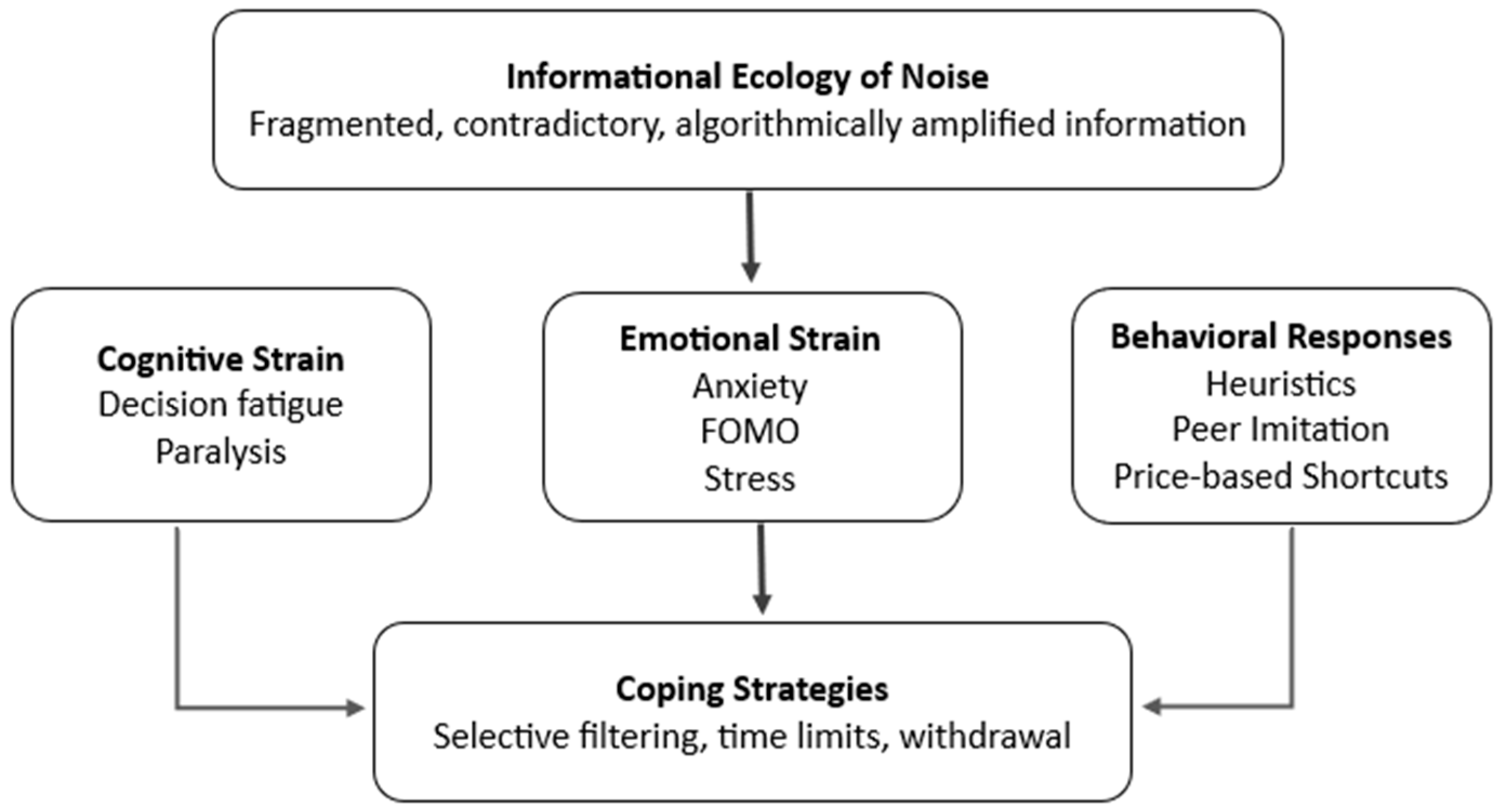
Figure 1 synthesizes the study’s core findings by conceptualizing information overload as an informational ecology of noise. Rather than depicting a linear causal chain, the model illustrates how fragmented and algorithmically amplified information environments generate cognitive strain, emotional strain, and behavioral responses, which together give rise to coping strategies aimed at managing exposure and preserving psychological stability.
Figure 1. Conceptual model of information overload as an informational ecology of noise in cryptocurrency investing.
Within this ecology of noise, investors did not simply collapse under the weight of overload; they developed adaptive strategies that allowed them to remain engaged, even if imperfectly. The four themes identified in the findings can be understood as forms of adaptation rather than evidence of irrationality or weakness. Decision fatigue and paralysis functioned as withdrawal behaviors, where disengagement provided temporary relief from cognitive exhaustion under conditions of persistent informational strain (Iyengar & Lepper, 2000; Reutskaja et al., 2020; Schwartz, 2016). Heuristics and shortcuts, whether following influencers, imitating peers, or relying on price momentum, operated as filtering mechanisms that simplified complexity, allowing investors to act despite uncertainty (Kadous et al., 2025; Rehman et al., 2025). Emotional strain, though burdensome, reflected the stress responses triggered by unstable environments (Nitsch & Plassmann, 2024); FOMO and anxiety were not random emotions but patterned reactions to volatility and contradiction (Sayim & My, 2023; Skwarek, 2025). Coping strategies, such as selective filtering or time-bound engagement, represented ecological niches in which investors carved out more sustainable ways to participate (Al-Fattal et al., 2025a). These adaptations underscore that investors were not passive victims of overload but active agents seeking to manage exposure and preserve psychological stability. Yet, the adaptations also came at a cost: reliance on social cues and emotional triggers left many investors vulnerable to herd dynamics, impulsive behavior, and cycles of withdrawal and re-entry.
The ecology of noise does not affect all investors equally. Newer investors, often with fewer established routines or analytic skills, were more likely to report paralysis, overreliance on influencers, or reactive behaviors driven by FOMO. For these participants, the absence of institutional safeguards or trusted regulatory authorities left them heavily dependent on peer communities and charismatic figures (Saeedi & Al-Fattal, 2025b; Su et al., 2021; Yuan & Lou, 2020), whose advice was not always reliable. Yet even seasoned investors admitted that prolonged exposure to contradictory signals eroded confidence, suggesting that experience alone does not provide immunity from the effects of noise (Almeida & Gonçalves, 2023). In this sense, vulnerability is not simply a matter of individual competence but a structural condition of the cryptocurrency market. Platforms and algorithms play a central role in amplifying sensational or polarizing content (Smales, 2022), while cultural norms of immediacy and hype create social pressure to act quickly, often against one’s better judgment (Obreja, 2022). This reframing shifts attention away from investor rationality as the primary problem and instead positions informational noise as an environmental risk. Recognizing vulnerability as structurally generated is essential for developing both theoretical models of consumer behavior in digital markets and practical interventions that address the systemic nature of overload (Rizwan & Mustafa, 2022).
The patterns observed in this study suggest the need for a broader theoretical framework that conceptualizes decision-making not solely as an individual cognitive process but as interaction with informational environments. Traditional research on information overload has emphasized cognitive limits and decision biases (Bawden & Robinson, 2020; Eppler & Mengis, 2004), yet the experiences of cryptocurrency investors reveal that overload is inseparable from the structural and cultural conditions in which information circulates. By framing the crypto market as an ecology of noise, this study advances the view that consumer behavior must be understood within environments shaped by algorithmic amplification, fragmented authority, and socially mediated cues (Kadous et al., 2025; Saeedi & Al-Fattal, 2025a; Wang et al., 2024). In such environments, decision-making is less about optimizing choices and more about managing exposure, preserving emotional stability, and adapting to contradictory signals (Nitsch & Plassmann, 2024; Reutskaja et al., 2020). This perspective extends consumer behavior theory by highlighting how cognition, emotion, and social influence converge within volatile informational landscapes (Arenas-Gaitán et al., 2019). More broadly, it suggests the value of developing a theory of informational environments that accounts for how individuals navigate markets characterized by speed, saturation, and instability. While the cryptocurrency market represents an extreme case, similar dynamics can be observed in other fintech domains such as stock trading forums, decentralized finance platforms, and even online retail environments (Albayati et al., 2020; Shahzad et al., 2024).
By situating decision-making within informational ecologies, scholars can better capture the lived complexity of consumer experience in the digital age, moving beyond models that assume stable information and rational calculation. These findings contribute to information-overload and decision fatigue research by showing that overload in cryptocurrency investing cannot be understood solely as an individual cognitive limitation. Instead, the study highlights how overload emerges through interaction with informational environments marked by volatility, continuous circulation of signals, and fragmented authority. By emphasizing how investors manage exposure, emotional strain, and disengagement rather than optimize among stable alternatives, this study extends existing consumer decision-making frameworks to digitally saturated and unstable market settings. In this sense, the cryptocurrency market is not treated as an exceptional case, but as a theoretically generative context for examining decision-making under contemporary conditions of informational instability.

5. Conclusions

This study investigated how cryptocurrency investors experience and respond to information overload, with particular attention to its cognitive, emotional, and behavioral consequences. While prior research has examined adoption patterns (Albayati et al., 2020; Lai, 2017; Shahzad et al., 2024), trust (Saeedi & Al-Fattal, 2025a, 2025c), and sentiment dynamics (Sayim & My, 2023; Smales, 2022), relatively little has focused on the psychological toll of excessive and contradictory information flows. By analyzing nineteen in-depth interviews with retail investors, this study illuminates how overload is not simply a background condition of digital markets but a central force shaping investment behavior. In doing so, it extends consumer behavior scholarship by shifting attention from adoption and intention to the lived challenges of decision-making under cognitive strain.
The findings revealed four interrelated themes that together capture the experiential reality of navigating the cryptocurrency market: decision fatigue and paralysis, heuristic reliance and shortcuts, emotional strain, and coping strategies. Investors described how constant streams of alerts, predictions, and analyses produced exhaustion and hesitation, often leading them to delay action or withdraw entirely. In moments of fatigue, many defaulted to heuristics, such as imitating peers, following influencers, or anchoring on recent price patterns. These shortcuts offered temporary relief but frequently undermined confidence and, in some cases, produced regret. Emotional strain was another prominent dimension, as anxiety, stress, and FOMO shaped behavior as much as rational calculation. Finally, investors adopted coping mechanisms ranging from selective filtering of sources to complete disengagement, strategies that highlight attempts to regain agency in environments perceived as unmanageable. These findings depict cryptocurrency participation as both a financial and psychological endeavor, where the abundance of information creates cycles of fatigue, reactivity, and adaptation.
Theoretically, this study contributes to consumer behavior and decision-making research by advancing the notion of informational ecologies. Prior work has often conceptualized overload in terms of sheer volume, where performance declines once data exceeds cognitive limits (Bawden & Robinson, 2020; Malhotra, 1982). The present findings suggest that in the context of cryptocurrency, overload arises not only from volume but also from fragmentation, contradiction, and algorithmic amplification. Investors are not merely exposed to “too much” information, but to competing, incongruent, and socially mediated streams of information that demand constant adjudication. This reframes overload as a structural feature of digital financial markets, where bounded rationality (Reutskaja et al., 2020) intersects with socially constructed uncertainty (Obreja, 2022). By foregrounding these dynamics, the study deepens theoretical understandings of consumer vulnerability in high-risk, unregulated environments.
The findings also generate practical implications across three applied domains: marketing communication, platform and information design, and financial education and policy. For marketers, they underscore the value of clarity, consistency, and simplicity in communication. In markets where consumers are overwhelmed, straightforward messaging may not only enhance engagement but also reduce decision fatigue (Kaur, 2024). For platform designers, the results highlight the need for features that help investors filter, prioritize, and evaluate information, reducing cognitive burden while preserving autonomy. Selective filtering, already practiced informally by participants, could be supported through more transparent curation tools. For regulators and policymakers, the study raises awareness of the psychological costs of unregulated information flows. Just as financial reporting standards improve efficiency and trust in traditional markets (Biddle et al., 2009), establishing guidelines for crypto-related communication could protect retail investors from misinformation and overload-induced mistakes.
Despite its contributions, the qualitative design limits generalizability, despite offering depth and details. The sample of nineteen participants, recruited primarily through snowball sampling, was diverse in background but not representative of the global investor population. This approach may have favored more engaged or relatively successful investors, potentially underrepresenting those who exited the market after negative experiences. Future studies could mitigate these limitations by combining purposive or stratified sampling with recruitment through platforms that reach disengaged or former investors. Cross-cultural differences, for instance, were not explored in systematic depth, even though prior research suggests that cultural norms influence both trust and risk perception (Saeedi & Al-Fattal, 2025b). Future research could build on these findings through comparative studies across regions, longitudinal designs that track how overload evolves with market maturity, or experimental methods that isolate causal links between overload, fatigue, and decision outcomes. Quantitative measures of investor strain, such as indices of decision fatigue, FOMO, or heuristic reliance, could also enrich the evidence base. Moreover, as algorithmic curation and AI-driven financial tools become increasingly embedded in investment platforms, further work is needed to explore how these technologies amplify or mitigate the experience of overload.

Funding

This research received no external funding.

Institutional Review Board Statement

The study was conducted in accordance with the Declaration of Helsinki, and the ethical approval was waived by the Ethics Committee of University of Minnesota due to this study met the following category for exemption: (2) Research that only includes interactions involving educational tests (cognitive, diagnostic, aptitude, achievement), survey procedures, interview procedures, or observation of public behavior (including visual or auditory recording) if at least one of the following criteria is met: (ii) Any disclosure of the human subjects’ responses outside the research would not reasonably place the subjects at risk of criminal or civil liability or be damaging to the subjects’ financial standing, employability, educational advancement, or reputation.

Data Availability Statement

Data is not available due to ethical restrictions.

Conflicts of Interest

The author declares no conflicts of interest.

References

  1. Albayati, H., Kim, S. K., & Rho, J. J. (2020). Accepting financial transactions using blockchain technology and cryptocurrency: A customer perspective approach. Technology in Society, 62, 101320. [Google Scholar] [CrossRef]
  2. Al-Fattal, A. (2017). Faculty Performance Evaluation and Appraisal: A Case from Syria. In S. Hidri, & C. Coombe (Eds.), Evaluation in foreign language education in the Middle East and North Africa (pp. 43–56). Springer International Publishing. [Google Scholar] [CrossRef]
  3. Al-Fattal, A. (2025). Marketing across cultures: Insights and implications from a COIL initiative on consumer behavior education. In K. Chapman, & D. Beard (Eds.), Power of one: Theories, strategies and case studies in internationalizing the student experience. University of Minnesota Libraries Publishing. [Google Scholar] [CrossRef]
  4. Al-Fattal, A., Lundbohm, R., & Bergman, C. (2025a). Navigating the crypto landscape: Exploring sources of information for informed investment decisions. In A. Saeedi, & A. Al-Fattal (Eds.), The cryptocurrency market (pp. 37–68). Springer Nature. [Google Scholar] [CrossRef]
  5. Al-Fattal, A., Sisavath, S., & Singh, J. K. N. (2025b). Virtual mentorship in academia: A collaborative autoethnography of cross-border academics. The Australian Educational Researcher, 52(3), 1975–1996. [Google Scholar] [CrossRef]
  6. Alharbey, M., & Van Hemmen, S. (2021). Investor intention in equity crowdfunding. Does trust matter? Journal of Risk and Financial Management, 14(2), 53. [Google Scholar] [CrossRef]
  7. Alkhudary, R. (2024). Is blockchain truly improving supply chain information quality? A positivist case study research. International Journal of Logistics Management, 36(4), 1039–1062. [Google Scholar] [CrossRef]
  8. Alkhudary, R., Treiblmaier, H., & Kshetri, N. (2025). Using non-fungible tokens for corporate strategic objectives. Management Decision. [Google Scholar] [CrossRef]
  9. Almeida, J., & Gonçalves, T. C. (2023). A systematic literature review of investor behavior in the cryptocurrency markets. Journal of Behavioral and Experimental Finance, 37, 100785. [Google Scholar] [CrossRef]
  10. Arenas-Gaitán, J., Sanz-Altamira, B., & Ramírez-Correa, P. E. (2019). Complexity of understanding consumer behavior from the marketing perspective. Complexity, 2019(1), 2837938. [Google Scholar] [CrossRef]
  11. Bawden, D., & Robinson, L. (Eds.). (2020). Information overload: An introduction. In Oxford research encyclopedia of politics. Oxford University Press. [Google Scholar] [CrossRef]
  12. Berger, R. (2015). Now I see it, now I don’t: Researcher’s position and reflexivity in qualitative research. Qualitative Research, 15(2), 219–234. [Google Scholar] [CrossRef]
  13. Biddle, G. C., Hilary, G., & Verdi, R. S. (2009). How does financial reporting quality relate to investment efficiency? Journal of Accounting and Economics, 48(2–3), 112–131. [Google Scholar] [CrossRef]
  14. Brinkmann, S., & Kvale, S. (2015). InterViews: Learning the craft of qualitative research interviewing (3rd ed.). Sage. [Google Scholar]
  15. Chen, Y.-C., Shang, R.-A., & Kao, C.-Y. (2009). The effects of information overload on consumers’ subjective state towards buying decision in the internet shopping environment. Electronic Commerce Research and Applications, 8(1), 48–58. [Google Scholar] [CrossRef]
  16. Creswell, J. W., & Poth, C. N. (2018). Qualitative inquiry and research design (4th ed.). SAGE. [Google Scholar]
  17. Eppler, M. J., & Mengis, J. (2004). The concept of information overload: A review of literature from organization science, accounting, marketing, MIS, and related disciplines. The Information Society, 20(5), 325–344. [Google Scholar] [CrossRef]
  18. Gray, D. E. (2018). Doing research in the real world (4th ed.). Sage. [Google Scholar]
  19. Hills, T. T. (2019). The dark side of information proliferation. Perspectives on Psychological Science, 14(3), 323–330. [Google Scholar] [CrossRef]
  20. Iyengar, S. S., & Lepper, M. R. (2000). When choice is demotivating: Can one desire too much of a good thing? Journal of Personality and Social Psychology, 79(6), 995–1006. [Google Scholar] [CrossRef]
  21. Jabr, W., & Rahman, M. S. (2022). Online reviews and information overload: The role of selective, parsimonious, and concordant top reviews. MIS Quarterly, 46(3), 1517–1550. [Google Scholar] [CrossRef]
  22. Kadous, K., Mercer, M., & Zhou, Y. (2025). Why do investors rely on low-quality investment advice? Experimental evidence from social media platforms. Behavioral Research in Accounting, 37(1), 97–115. [Google Scholar] [CrossRef]
  23. Kaur, H. (2024). Consumer decision-making in the era of information overload. Universal Research Reports, 11(2), 27–31. [Google Scholar] [CrossRef]
  24. Kim, K., & Daidj, N. (2021). Information asymmetry on cryptocurrency trading: The spillover effect and quality of social sentiment. Available online: https://aisel.aisnet.org/amcis2021/social_computing/social_computing/6 (accessed on 14 November 2025).
  25. Lai, P. (2017). The literature review of technology adoption models and theories for the novelty technology. Journal of Information Systems and Technology Management, 14(1), 21–38. [Google Scholar] [CrossRef]
  26. Lincoln, Y. S., & Guba, E. G. (1985). Naturalistic inquiry. Nachdr. Sage. [Google Scholar]
  27. Luo, J., Cao, Q., & Zhang, S. (2024). How do personality traits affect investors’ decision on crypto market including cryptocurrencies and NFTs? Review of Behavioral Finance, 16(4), 600–619. [Google Scholar] [CrossRef]
  28. Malhotra, N. K. (1982). Information load and consumer decision making. Journal of Consumer Research, 8(4), 419. [Google Scholar] [CrossRef]
  29. Miles, M. B., Huberman, A. M., & Saldaña, J. (2020). Qualitative data analysis: A methods sourcebook (4th ed.). Sage. [Google Scholar]
  30. Murugappan, M., Nair, R., & Krishnan, S. (2023). Global market perceptions of cryptocurrency and the use of cryptocurrency by consumers: A pilot study. Journal of Theoretical and Applied Electronic Commerce Research, 18(4), 1955–1970. [Google Scholar] [CrossRef]
  31. Nitsch, F. J., & Plassmann, H. (2024). Understanding the intersections of stress and the marketplace to improve consumer well-being. SSRN Electronic Journal. [Google Scholar] [CrossRef]
  32. Noy, C. (2008). Sampling knowledge: The hermeneutics of snowball sampling in qualitative research. International Journal of Social Research Methodology, 11(4), 327–344. [Google Scholar] [CrossRef]
  33. Obreja, D. M. (2022). The social side of cryptocurrency: Exploring the investors’ ideological realities from Romanian Facebook groups. New Media & Society, 26(5), 2748–2765. [Google Scholar] [CrossRef]
  34. Phillips-Wren, G., & Adya, M. (2020). Decision making under stress: The role of information overload, time pressure, complexity, and uncertainty. Journal of Decision Systems, 29(sup1), 213–225. [Google Scholar] [CrossRef]
  35. Qi, J., Zhang, Y., & Ouyang, C. (2025). Cryptocurrency investments: The role of advisory sources, investor confidence, and risk perception in shaping behaviors and intentions. Journal of Risk and Financial Management, 18(2), 57. [Google Scholar] [CrossRef]
  36. Rehman, M. A., Finance, M. H., Ali, M., & Ahmad, M. (2025). Behavioral finance and market inefficiencies: Analyzing the influence of investor psychology, heuristics, and biases on stock market anomalies and investment decision-making. Advance Journal of Econometrics and Finance, 3(2), 54–67. [Google Scholar] [CrossRef]
  37. Reutskaja, E., Iyengar, S., Fasolo, B., & Misuraca, R. (2020). Cognitive and affective consequences of information and choice overload. In R. Viale (Ed.), Routledge handbook of bounded rationality (1st ed., pp. 637–649). Routledge. [Google Scholar] [CrossRef]
  38. Ritchie, J. (Ed.). (2014). Qualitative research practice: A guide for social science students and researchers (2nd ed.). Sage. [Google Scholar]
  39. Rizwan, A., & Mustafa, F. (2022). Fintech attaining sustainable development: An investor perspective of crowdfunding platforms in a developing country. Sustainability, 14(12), 7114. [Google Scholar] [CrossRef]
  40. Saeedi, A., & Al-Fattal, A. (2025a). Examining trust in cryptocurrency investment: Insights from the structural equation modeling. Technological Forecasting and Social Change, 210, 123882. [Google Scholar] [CrossRef]
  41. Saeedi, A., & Al-Fattal, A. (Eds.). (2025b). The cryptocurrency market: Investigating trust, technology, and regulations. Springer Nature. [Google Scholar] [CrossRef]
  42. Saeedi, A., & Al-Fattal, A. (Eds.). (2025c). Trust in cryptocurrency: Investigating the investors’ perceptions. In The cryptocurrency market (pp. 9–35). Springer Nature. [Google Scholar] [CrossRef]
  43. Sayim, M., & My, N. Q. (2023). An analysis of the U.S. individual investor sentiment influence on cryptocurrency returns and volatility. Annals of Financial Economics, 18(02), 2242001. [Google Scholar] [CrossRef]
  44. Schwartz, B. (2016). The paradox of choice: Why more is less (Revised edition). Ecco. [Google Scholar]
  45. Shahzad, M. F., Xu, S., Lim, W. M., Hasnain, M. F., & Nusrat, S. (2024). Cryptocurrency awareness, acceptance, and adoption: The role of trust as a cornerstone. Humanities and Social Sciences Communications, 11(1), 4. [Google Scholar] [CrossRef]
  46. Skwarek, M. (2025). Why do investors behave irrationally in the cryptocurrency and emerging stock markets? SAGE Open, 15(3), 21582440251361212. [Google Scholar] [CrossRef]
  47. Smales, L. A. (2022). Investor attention in cryptocurrency markets. International Review of Financial Analysis, 79, 101972. [Google Scholar] [CrossRef]
  48. Sousa, A., Calçada, E., Rodrigues, P., & Pinto Borges, A. (2022). Cryptocurrency adoption: A systematic literature review and bibliometric analysis. EuroMed Journal of Business, 17(3), 374–390. [Google Scholar] [CrossRef]
  49. Su, B.-C., Wu, L.-W., Chang, Y.-Y.-C., & Hong, R.-H. (2021). Influencers on social media as references: Understanding the importance of parasocial relationships. Sustainability, 13(19), 10919. [Google Scholar] [CrossRef]
  50. Vidal-Tomás, D. (2022). Which cryptocurrency data sources should scholars use? International Review of Financial Analysis, 81, 102061. [Google Scholar] [CrossRef]
  51. Wang, K., Wong, B., Khoshkholghi, M. A., Shah, P., Naha, R., Mahanti, A., & Kim, J.-K. (2024). Dissecting the hype: A study of WallStreetBets’ sentiment and network correlation on financial markets. In L. Barolli (Ed.), Advanced information networking and applications (Vol. 200, pp. 263–273). Springer Nature. [Google Scholar] [CrossRef]
  52. Yuan, S., & Lou, C. (2020). How social media influencers foster relationships with followers: The roles of source credibility and fairness in parasocial relationship and product interest. Journal of Interactive Advertising, 20(2), 133–147. [Google Scholar] [CrossRef]
Disclaimer/Publisher’s Note: The statements, opinions and data contained in all publications are solely those of the individual author(s) and contributor(s) and not of MDPI and/or the editor(s). MDPI and/or the editor(s) disclaim responsibility for any injury to people or property resulting from any ideas, methods, instructions or products referred to in the content.

Article Metrics

Citations

Article Access Statistics

Multiple requests from the same IP address are counted as one view.