
Skip to Content
Psychology InternationalPsychology International
  • Article
  • Open Access

2 March 2026

Psychosocial Mechanisms of Exercise–Eating Behavior Change Coaction Processes Within Community-Based Obesity-Reduction Programs

Kinesiology Department, School of Health Sciences and Human Services, California State University, Monterey Bay, Seaside, CA 93955, USA

Abstract

Coaction theory suggests improvement in one health behavior carries over to advancements in other health behaviors. There is evidence of increased exercise leading to improved eating; however, data on its psychosocial mechanisms required to adequately inform behavioral weight-management interventions are lacking. Theory suggests that self-regulation, and the relationship of self-regulation to self-efficacy, promote such carry-over processes. Participants in a community-based obesity program who completed no/minimal weekly exercise at baseline were randomized by participating facility using computer-generated random numbers into 6-month treatments emphasizing either weight loss education (n = 39) or self-regulation/self-efficacy (SR/SE) methods (n = 90). Improvements in exercise outputs, exercise- and eating-related self-regulation and self-efficacy, negative mood, dietary behaviors, and weight were significant overall, and significantly greater in the SR/SE group. Carry-over of increased exercise to improved dietary behaviors was suggested. Paths from the treatment group to dietary changes at 6 and 12 months were significantly mediated by associations of changes in (a) exercise-related self-regulation leading to eating-related self-regulation, (b) exercise-related self-efficacy leading to eating-related self-efficacy, and (c) exercise leading to improved mood. Identified relationships between self-regulation and self-efficacy changes were particularly relevant in the dietary-change context. Weight losses over 6, 12, and 24 months, associated with exercise and dietary changes, were 2.2×–2.7× greater in the SR/SE group than in the weight loss education group (−6.0% vs. −2.6%; −5.6% vs. −2.5%; and −5.1% vs. −1.9%, respectively). Advantages of treatment foci on self-regulatory skills and self-efficacy over typical weight loss education were supported. Clarification of psychosocial mechanisms of the increased exercise → improved eating-behavior relationship, including effects of increased exercise on mood, informed continued advancements in theory-driven obesity treatments.

1. Introduction

In the United States (U.S.), obesity (defined as body mass index (BMI) ≥ 30 kg/m2) among women aged 25 years or older is currently 46% and is predicted to rise to approximately 60% by 2050 (GBD 2021 Adult BMI Collaborators, 2025). Improving rates of obesity will reduce co-morbid medical issues such as Type 2 diabetes mellitus, kidney and liver disease, various types of cancer, heart disease, depression, and sleep apnea (Bray et al., 2017); and lessen burdens on healthcare systems (Massie et al., 2022). Although exercise and controlled eating will reliably reduce weight in almost all adults with obesity, for many decades, these behaviors have proven extremely difficult to maintain long-term (Dombrowski et al., 2014; MacLean et al., 2015). The U.S. Preventive Services Task Force concluded with “moderate certainty” that intensive lifestyle interventions have some benefit (Jin, 2018). There is a clear gap in how to best leverage behavioral theory to improve their limited effects that have persisted (Jeffery et al., 2000; MacLean et al., 2015; Mann et al., 2007; Teixeira & Marques, 2017), which includes an improved understanding of the interaction of exercise and controlled eating through psychosocial pathways.
The most common mode of behavioral obesity treatment is through education on controlled eating and exercise (MacLean et al., 2015; Mann et al., 2007). Although the health belief model (Champion & Skinner, 2015; E. C. Green et al., 2020) is a paradigm that primarily supports a relationship between education and behavior change, it has demonstrated increased viability only when self-efficacy (i.e., feelings of ability/mastery; SE)—already a central construct in Bandura’s earlier theoretical work (Bandura, 1977)—was added into analyses of treatment effects (Alyafei & Easton-Carr, 2024; Orji et al., 2012). Rather than continue to expect success through educational approaches after their results in managing obesity have consistently been marginal (Dombrowski et al., 2014; MacLean et al., 2015; Mann et al., 2007), some research suggests that behavioral (non-surgical/non-pharmacologic) interventions should, instead, incorporate enhanced understandings of theory-driven psychosocial correlates of requisite weight loss behaviors (Hawkins et al., 2024; Maisano et al., 2020; Teixeira & Marques, 2017).
As an example of those suggestions, it was proposed that a primary treatment focus on empowering participants with the self-regulatory (SR) skills needed to overcome lifestyle barriers and challenges is advantageous (Annesi et al., 2015; Hawkins et al., 2024; Teixeira et al., 2015). That premise follows from key tenets of social cognitive theory (Bandura, 1986) and self-regulation theory (Vohs & Baumeister, 2017). It was also posited that, consistent with self-efficacy theory (Bandura, 1977, 1997), participants’ increased ability to persevere through challenges by leveraging their newly acquired SR skills will foster feelings of ability (SE), further increasing their persistence (i.e., through “mastery experience;” Kleppang et al., 2023). Exercise-associated reduction in negative mood (Arent et al., 2020) might also enhance dietary changes, as adverse mood is associated with excessive and poor eating behaviors (as with emotional eating; Frayn & Knäuper, 2018). Self-efficacy theory (Bandura, 1997) similarly suggests that positive emotions are associated with SE and improvements in weight loss behaviors.
Coaction theory proposes that an improvement in one health behavior will carry over to advancements in other health behaviors (Johnson et al., 2014; Paiva et al., 2012). Coaction, first articulated in 2008 (Prochaska, 2008), posits a generalization of psychological processes that function in advancing improvements in multiple health behaviors during similar time frames. Research indicates that increased exercise fosters better control over both food selections and overall energy intake (Heredia et al., 2020; Oaten & Cheng, 2006). However, specific psychosocial mechanisms of such a relationship are unclear, as are their implications for treatment content to best foster reliable behavioral changes. This gap in understanding represents a research shortcoming requiring resolution. To extend what is currently known about applying coaction theory within health promotion efforts, it was hoped that increased knowledge of how changes in SR and SE, developed via increased exercise, both carry over to improved dietary behaviors and are related to one another within those contexts (e.g., eating-related SR in advance of eating-related SE). In addition to accounting for exercise-associated mood change (Arent et al., 2020), it was hoped that findings on (a) effects of treatment modality (e.g., education vs. an SR/SE emphasis) on dietary change, (b) psychosocial mediators of the treatment type-dietary behavior relationship, and (c) associations of changes in SR and SE can inform improved treatments of obesity through behavioral means. Because psychosocial factors related to weight control, such as emotional eating and dietary self-control, have been significantly different between women and men (Smith et al., 2020), the present field-based research incorporated only women with obesity who completed either no or minimal exercise at treatment start.
Thus, to ultimately improve behavioral obesity treatments, the aims of this research were to clarify associations between exercise and eating behavior changes suggested by coaction theory (Johnson et al., 2014; Paiva et al., 2012) via changes in SR and SE suggested by social cognitive theory (Bandura, 1986), self-efficacy theory (Bandura, 1997), and self-regulation theory (Vohs & Baumeister, 2017). Also consistent with those theories, behavior-change potentials associated with exercise-associated mood change were additionally accounted for.
Hypothesis 1.
There will be significant improvements in all psychosocial, behavioral, and weight outcomes, with effects more pronounced in the treatment emphasizing SR and SE than in the treatment emphasizing weight loss education.
Hypothesis 2.
Consistent with coaction theory, a short-term increase in exercise will be significantly associated with carried-over improvement in dietary behaviors.
Hypothesis 3.
Paths from group membership to dietary improvement will be significantly mediated by (a) increased exercise-related SR, leading to eating-related SR increase; (b) increased exercise-related SE, leading to eating-related SE increase; and (c) increased exercise, leading to a greater reduction in negative mood.
Hypothesis 4.
Increased SR will significantly predict SE increase in both exercise and dietary-change contexts, and each of those behavioral improvements will significantly contribute to the explained variance in lost weight.

2. Materials and Methods

2.1. Participants

Participant data were from continuing field-based research with a primary focus on contrasting weight loss outcomes of various methods administered within community centers in the United States. Thus, the aims of this investigation are specific to this report. Recruitment was through advertisements in local newspapers and on social media. There was no cost or compensation for participating. Cluster randomization was performed using computer-generated random numbers centered on six participating facilities (out of the seven initially contacted within a single geographic area where available space was appropriate for the planned sessions). Each facility primarily served individuals in the lower to middle socioeconomic strata. There was a 2:1 oversampling in favor of the more novel SR/SE methods. More specifically, four of the participating facilities were randomly allocated to the SR/SE method condition, and two were randomly allocated to the education method condition. Those proportions were assigned a priori in the event of follow-up analyses on the SR/SE method condition alone.
To participate, women volunteers of at least 21 years of age with obesity were required to have (a) a physical condition enabling safe participation; (b) reported no current/soon-planned pregnancy; (c) reported no change in psychotropic medication/dosage within the previous 12 months; (d) no weight-management program participation, including self-help programming, within the previous 12 months; and (e) a baseline exercise amount self-reported as <5 mild- to moderate-intensity bouts/week. Each participant’s prior self-reported obesity was confirmed by the study staff’s calculation of their BMI at baseline.
There was no significant group difference between the education method (n = 39) and SR/SE method (n = 90) groups on age (overall M = 46.8 years, SD = 9.0), BMI (overall M = 35.2 kg/m2, SD = 3.4), racial/ethnic make-up (overall 78% White, 14% Black, 6% Hispanic, 2% other), or educational level (overall 71% bachelor’s degree or greater, 29% high school or some college). All but one participant self-reported a middle family income of USD50,000–USD140,000/year. Ethical practice directives of the World Medical Association Declaration of Helsinki and the American Psychological Association were maintained throughout. A university institutional review board approved the research protocol. Signed informed consent was required from each participant prior to the start of any study process.

2.2. Procedures

2.2.1. Theoretical Overview of Treatments

Treatment instructors were current staff members of the participating health promotion facilities. Each stated a desire to serve in that role within the research. The instructors were trained by study staff only in their randomly assigned treatment and were kept blinded from the other treatment. Training in each of the standardized protocols lasted 8 h over 2 days. Each treatment condition lasted 6 months, requiring 11–12 total hours from each participant. The contents taught in the education group were consistent with the health education aspect of the health belief model (Champion & Skinner, 2015; E. C. Green et al., 2020), which posits that individuals seeking a goal such as weight loss will improve their control over exercise and dietary behaviors through related education and knowledge of its benefits. Although accounting for SE is also included in the health belief model (Orji et al., 2012), the treatment focus of the education method group within this research was only on education. The SR/SE group contents were guided by tenets of social cognitive theory (Bandura, 1986), self-regulation theory (Vohs & Baumeister, 2017), and self-efficacy theory (Bandura, 1997). Those paradigms emphasize the human potential for goals such as increased exercise, dietary changes, and weight loss to be effectively addressed through attention to interrelations between environmental, psychological, and behavioral factors.

2.2.2. Treatment Contents

In the education method group, a 20 min, one-on-one summary of the treatment was first provided in person to each participant at baseline. Written materials were then supplied every 2 weeks, where each required an estimated 40 min to review. Each of those written materials was followed within 3 days by a one-on-one instructor-based contact of 15 min each, either in person or by phone, or a combination of the two (based on each participant’s preference). Instructional topics included guidance on healthy eating (e.g., “The role of fat in your diet,” “The importance of protein”) and exercise methods (e.g., “Cardiovascular exercise,” “An activity blueprint”).
In the SR/SE method group, increased exercise was first supported primarily through five 45 min sessions of one-on-one in-person instruction in self-regulating through common challenges such as discomfort and time demands. Exercise amounts were adjusted to maximize each participant’s positive feelings using a process that assessed pre- to post-exercise changes using a brief scale (Annesi, 2005). SR skills addressed included goal-setting using SMART (i.e., specific, measured, attainable, recorded, time-based) goals, proximal goal tracking (which highlighted even small degrees of progress), cognitive restructuring, relapse prevention, and dissociation from discomfort. At Month 2, those SR skills were purposefully adapted to help control eating and dietary behaviors, and promote eating-related SE. This occurred via nine small-group sessions (10–15 participants/group) of 50 min each. Role play was incorporated to rehearse SR skills. The group sessions were also delivered in person. There was minimal weight loss education provided; participants were referred to the myplate.gov website if they sought such.

2.2.3. Consistent Features Across Treatment Formats

Contents for both of the treatments were adapted from NIH/National Cancer Institute (2025) programs. Within those, exercise amounts and types were self-selected. Although the recommended 150 min/week of moderate or greater intensity for health benefits (U.S. Department of Health and Human Services & Office of Disease Prevention and Health Promotion, 2023) was mentioned, a uniform goal was to simply increase amounts. Based on research on its favorable effects (Hernández-Reyes et al., 2020), weekly self-weighing was encouraged. While the field nature of this research fostered some possible compromises in internal validity, that was countered by its potential for enabling rapid generalizability of findings to real-world settings (L. W. Green et al., 2013).
Structured fidelity monitoring by non-instructional staff was conducted via in-person observations of 10% of the treatment sessions. A standardized 16-item form enabled the observer to identify deviations by an instructor in their treatment protocol. If a protocol departure was identified, a correction was suggested through an individual consultation with the observed instructor immediately after the session. Strong protocol compliance was detected, requiring only minor adjustments that primarily centered around maintaining the required time limits within sessions. Although total treatment time was matched, participants in the education group had somewhat more one-on-one time with instructors, and participants in the SR/SE group had slightly more overall contact time with instructors. The same non-instructional staff who conducted the fidelity monitoring also administered study measures to participants at the required times (indicated in Table 1) in a private area. They were blinded to the treatment group allocation.
Table 1. Descriptive statistics of study variables and results of time × treatment group contrasts.

2.3. Measures

Brief but well-validated self-report measures were administered to minimize burden to participants and their subsequent inaccuracies linked to responding to an extended battery of instruments (Galesic & Bosnjak, 2009).
Exercise (also, physical activity as a less-structured variation) was measured using the Leisure-Time Physical Activity Questionnaire (Godin, 2011). Bouts of ≥15 min of “mild intensity” (e.g., normal-paced walking), “moderate intensity” (e.g., fast-paced walking), and “strenuous intensity” (e.g., running) during the previous 7 days were recalled and assigned a corresponding value of 3, 5, or 9 metabolic equivalents (METs; a metric of energy expenditure beyond the resting state), respectively. Those scores were summed. Concurrent validity of the Leisure-Time Physical Activity Questionnaire was indicated through its MET-score correspondences with accelerometry, treadmill testing, and body composition results, with 2-week test–retest reliability reported to be 0.74 (Amireault & Godin, 2015; Amireault et al., 2015; Jacobs et al., 1993; Miller et al., 1994; Pereira et al., 1997).
The Exercise-Related Self-Regulation Scale (sample item: “I make formal agreements with myself to be physically active”) and Eating-Related Self-Regulation Scale (sample item: “When I get off-track with my eating plans, I work to quickly get back to my routine”) each had 10 items indicating a respondent’s extent of usage of context-related self-regulatory skills (Annesi & Marti, 2011). Response options ranged from 1 (never) to 4 (often) and were summed. Internal consistencies were reported to be Cronbach’s α = 0.79 and 0.81, respectively (study sample, αs = 0.75 and 0.77), and 2-week test–retest reliabilities were reported to be 0.78 and 0.74, respectively (Annesi & Marti, 2011).
Exercise-related SE was measured using the 5-item Exercise Self-Efficacy Scale (Marcus et al., 1992). A respondent’s confidence in persisting with exercise, even under challenging conditions/stimuli, was assessed (sample item, “I feel I don’t have the time”). Response options ranged from 1 (not at all confident) to 11 (very confident) and were summed. Internal consistencies were reported to range from Cronbach’s α = 0.76 to 0.82 (study sample, α = 0.79), and 2-week test–retest reliabilities were reported to be 0.74–0.78 (Marcus et al., 1992).
Eating-related SE was measured using the 20-item Weight Efficacy Lifestyle Scale (Clark et al., 1991). A respondent’s confidence in their ability to control eating, even under challenging conditions/stimuli, was assessed (sample item: “I can resist eating even when high-calorie foods are available”). Response options ranged from 0 (not confident) to 9 (very confident) and were summed. Internal consistencies were reported to range from Cronbach’s α = 0.70 to 0.90 (Clark et al., 1991) (study sample, α = 0.77).
Overall negative mood was measured using the total mood disturbance scale of the 30-item Profile of Mood States-B (brief form; McNair & Heuchert, 2009). Items (sample items given in parentheses) reflected an aggregate of feelings associated with tension/anxiety (“nervous”), depression/dejection (“sad”), anger/hostility (“annoyed”), fatigue/inertia (“weary”), confusion/bewilderment (“confused”), and vigor/activity (“energetic”). Response options ranged from 0 (not at all) to 4 (extremely), and were summed after reverse-scoring items related to vigor/activity. With women, internal consistencies were reported to range from Cronbach’s α = 0.76 to 0.92 (study sample, αs = 0.87–0.89). The 3-week test–retest reliabilities were reported to be 0.65–0.74 (McNair & Heuchert, 2009).
Dietary behavior was measured using an aggregate food frequency recall. The scale considers the positive effects of fruit/vegetable intake vs. the detrimental effects of sweets (Aljadani et al., 2013; Drewnowski et al., 2004; Te Morenga et al., 2012). Specifically, “during a typical day over the previous 7 days,” respondent-reported portions of fruits (e.g., small pear (118 mL if canned)) and vegetables (e.g., 118 mL lima beans) consumed were first summed, then multiplied by 2. Next, the sum of their reported portions of sweets (e.g., medium-size (59 mL) cookie) consumed was subtracted from that score. Portion sizes and instructions were based on data from U.S. governmental sources (U.S. Department of Agriculture, 2017; U.S. Department of Health and Human Services & U.S. Department of Agriculture, 2015). Instructions accounted for mixed foods (e.g., salads) and large/small portion sizes, as well as directed exclusion of fried vegetables/fruits. If a fruit was combined with a sweet (e.g., caramel-coated apple), it was to be counted as a sweet. A higher overall score indicated healthier dietary behaviors. The 3-week test–retest reliabilities in women with obesity were reported to range from 0.77 to 0.83, and concurrent validity was indicated through correspondences with strongly validated, but lengthier, food recall instruments (e.g., Block Food Frequency Questionnaire; Block et al., 1986; Mares-Perlman et al., 1993).
Body weight was measured using a self-zeroing digital floor scale (Health-o-meter Model 80 kL; McCook, IL, USA). It was calibrated the day of each assessment. Measurements were recorded to the nearest 0.10 kg. Heavy outer-clothing and shoes were removed by participants prior to measurement. Non-instructional study staff completed measurements through Month 12. However, weight at Month 24 was self-reported by each participant due to COVID-19 restrictions for in-person contact. In that case, participants were instructed to self-weigh without any heavy outer clothing or shoes. To enable calculation of BMI at baseline to confirm that the inclusion criterion, height was also measured to the nearest 0.10 cm using a stadiometer (Health-o-meter Portrod; McCook, IL, USA).

2.4. Data Analyses

In reference to the criteria outlined by White et al. (2011), there was no systematic bias in the presence vs. absence of the overall 16% of missing scores; all were missing beyond baseline. This finding was supported by no significant difference (ps > 0.40) between participants with vs. without any missing scores within the tested variables. The missing-at-random condition satisfied a required provision for use of the expectation-maximization (EM) algorithm for imputation (Little & Rubin, 2014; McLachlan & Krishnan, 2008). Thus, the preferred intention-to-treat format was enabled. For the primary regression analyses, a total sample size of 98 was required to detect the expected moderate effect of Cohen’s f2 = 0.15 at the strong power level of 0.90, α < 0.05 (Cohen et al., 2003). This allocation occurred through the 2:1 sampling ratio in favor of the more novel SR/SE method group. The present variance inflation factor scores < 2.0 corresponded to acceptable tolerance values > 0.5. Along with no observed floor or ceiling effects, this suggested satisfactory multicollinearity within the data set.
To address Hypothesis 1, mixed repeated-measures ANOVAs assessed gain (change) scores in exercise output, exercise-related SR, exercise-related SE, eating-related SR, eating-related SE, negative mood, dietary behaviors, and weight—both overall and on their time × treatment group interaction—during their assigned intervals. Effect sizes were calculated using partial eta-squared (partial η2; SSEffect/SSEffect + SSError). Planned follow-up contrasts incorporated the least significant difference method (LSD; no statistical adjustment for multiple tests).
Intercorrelations, incorporating data aggregated across groups, were next calculated. Within those analyses, Hypothesis 2 was addressed to evaluate a central tenet of coaction theory within this investigation. Namely, that was the association of a 6-month change in dietary behaviors with a 3-month change in exercise outputs. Analyses were also extended to control for baseline values. To address Hypothesis 3, regression models were fit where the serial predictions of (a) changes in exercise-related SR → eating-related SR, (b) changes in exercise-related SE → eating-related SE, and (c) changes in exercise → negative mood were entered as mediators within proposed paths from group membership (coded, 0 = education group, 1 = SR/SE group) to dietary behavior change. To evaluate Hypothesis 4 and the proposed SR-SE change relationship, mediations of changes in SE in the SR → behavior change relationships were assessed.
Finally, also addressing Hypothesis 4, sensitivity analyses evaluated weight changes by groupand the relative contribution of changes in exercise and dietary behaviors to 6-, 12-, and 24-month weight change. Statistical significance was set at α < 0.05 (two-tailed). Analyses were completed using SPSS Statistics v28.0.1.0 (IBM, Armonk, NY, USA), incorporating the Process v4.2 macroinstruction Models 4 and 6 with 10,000 percentile-based bootstrapped re-samples (Hayes, 2022). The Transparent Reporting of Evaluations with Non-Randomized Designs (TREND; Des Jarlais et al., 2004) suggestions for reporting the present study type were followed.

3. Results

3.1. Differences in Change, by Group

In concurrence with the first hypothesis, there were significant improvements, overall, on all psychosocial, behavioral, and weight outcomes during the assessed time points, with large effect sizes (ps < 0.001, partial η2-values = 0.15–0.57). Each of those improvements was significantly greater in the SR/SE group (Table 1). Follow-up contrasts indicated that only change terms from baseline (e.g., baseline–Month 3) were significant, and all those were more favorable in the SR/SE group. Although measured, only data applicable to the present analyses are shown in the current table.

3.2. Analyses of Coaction

Intercorrelation data are given in Table 2. Consistent with Hypothesis 2 and coaction theory (Johnson et al., 2014; Paiva et al., 2012), a carry-over of an increase in exercise from baseline to Month 3 to improved dietary behaviors from baseline to Month 6 was supported (r = 0.47, p < 0.001). This relationship was significantly strengthened when controlling for their baseline scores, R2adjusted = 0.21 vs. R2adjusted = 0.43, F(2, 125) = 25.49, p < 0.001.
Table 2. Intercorrelations of study variables (N = 129).
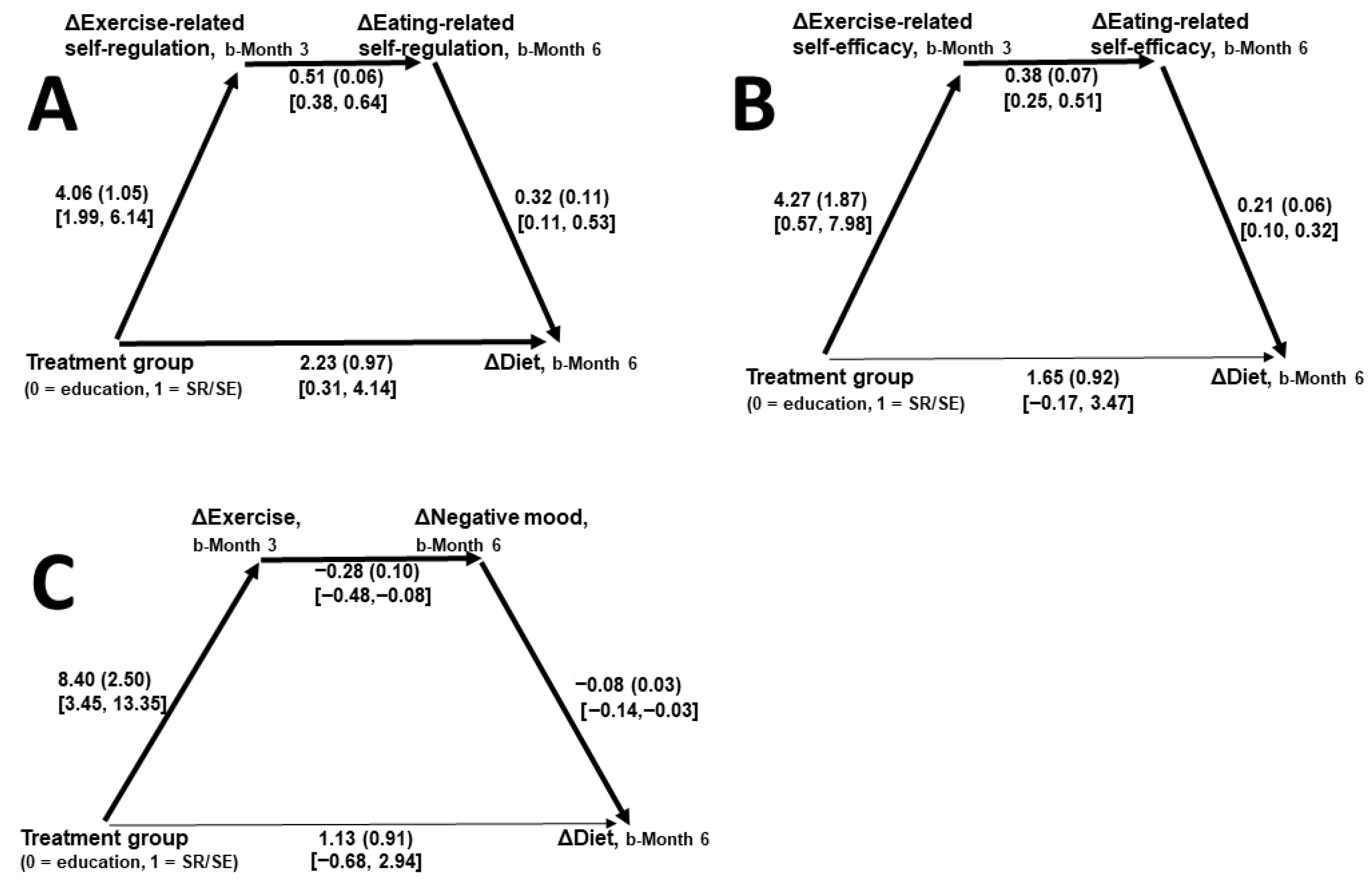
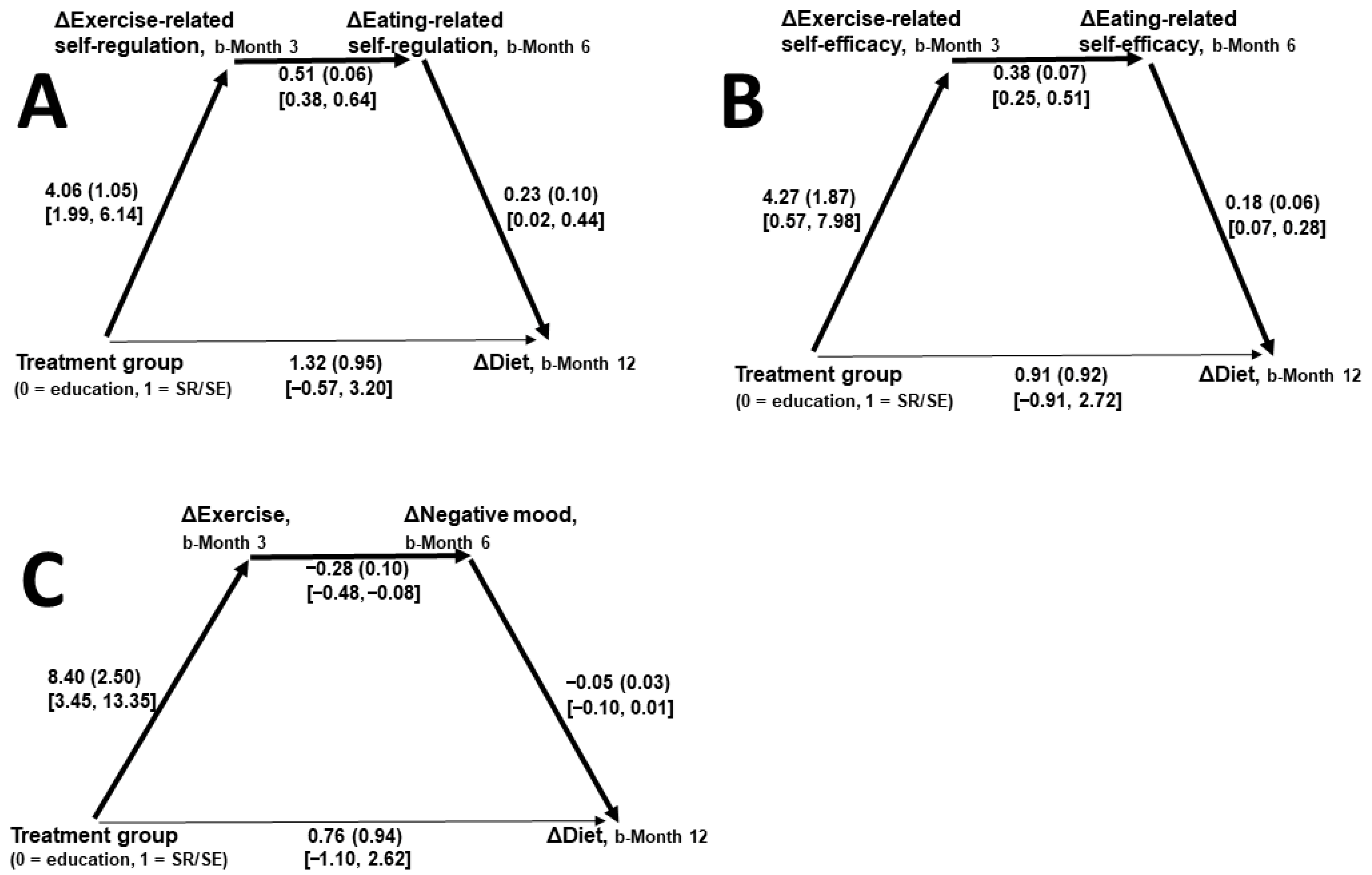
Results indicated that psychosocial correlates of exercise were associated with psychosocial correlates of dietary behavior. Figure 1A displays the significant path from treatment group → 3-month change in exercise-related SR → 6-month change in eating-related SR → change in dietary behaviors both over 6 months, B = 0.65, SEB = 0.35, 95% CI [0.114, 1.478], and, in Figure 2A, over 12 months, B = 0.48, SEB = 0.27, 95% CI [0.074, 1.175]. Those models’ R2s = 0.18 and 0.12, respectively, ps < 0.001. Figure 1B presents the significant path from treatment group → 3-month change in exercise-related SE → 6-month change in eating-related SE → change in dietary behaviors both over 6 months, B = 0.34, SEB = 0.21, 95% CI [0.015, 0.821]; and, in Figure 2B, over 12 months, B = 0.29, SEB = 0.20, 95% CI [0.005, 0.788]. The models’ R2s = 0.26 and 0.19, respectively, ps < 0.001. Figure 1C provides data on the significant path from treatment group → 3-month change in exercise → 6-month change in negative mood → change in dietary behaviors both over 6 months, B = 0.20, SEB = 0.11, 95% CI [0.040, 0.466], and, in Figure 2C, over 12 months, B = 0.11, SEB = 0.08, 95% CI [0.002, 0.321]. The models’ R2s = 0.30 and 0.18, respectively, ps < 0.001.
Figure 1. Paths of the prediction of 6-month change in dietary behaviors by treatment group, through (A) change in exercise-related self-regulation predicting eating-related self-regulation change, (B) change in exercise-related self-efficacy predicting eating-related self-efficacy change, and (C) change in exercise amount predicting negative mood change. Treatment groups are coded as 0 = weight loss education, 1 = self-regulation/self-efficacy (SR/SE), b = baseline, Δ = change over the designated period. Path data are given as unadjusted beta (its associated standard error) and [95% confidence interval]. Significant paths toward change in dietary behavior are given in bold.
Figure 2. Paths of the prediction of 12-month change in dietary behaviors by group, through (A) change in exercise-related self-regulation predicting eating-related self-regulation change, (B) change in exercise-related self-efficacy predicting eating-related self-efficacy change, and (C) change in exercise amount predicting negative mood change. Treatment groups are coded 0 = weight loss education, 1 = self-regulation/self-efficacy (SR/SE), b = baseline, Δ = change over the designated period. Path data are given as unadjusted beta, (its associated standard error), and [95% confidence interval]. Significant paths toward change in dietary behavior are given in bold.

3.3. Self-Regulation Effects on Self-Efficacy

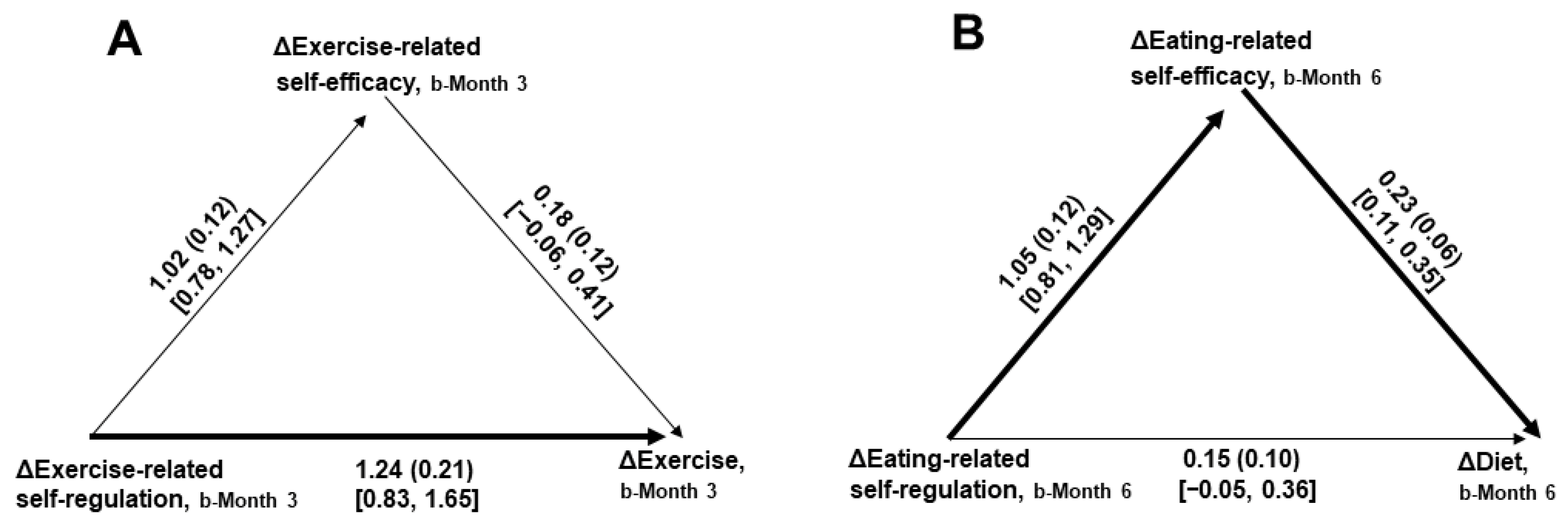
In partial agreement with Hypotheses 3 and 4, the expected significant path from 3-month change in exercise-related SR → exercise-related SE → exercise was not significant, B = 0.18, SEB = 0.15, 95% CI [−0.102, 0.483]. Rather, the direct effect from the change in exercise-related SR → exercise change was significant (Figure 3A). The model R2 = 0.37, p < 0.001. However, the hypothesized path from 6-month changes in eating-related SR → eating-related SE → dietary behaviors was significant, B = 0.24, SEB = 0.07, 95% CI [0.104, 0.401] (Figure 3B). The model R2 was 0.23, p < 0.001. There was no significant direct association of SR change on dietary behavior change within that model, indicating complete mediation.
Figure 3. Paths of the prediction of changes in exercise outputs (A) and dietary behaviors (B) by changes in self-regulation through (mediated by) self-efficacy change, b = baseline, Δ = change over the designated period. Path data are given as unadjusted beta (its associated standard error) and [95% confidence interval]. Significant paths toward the behavioral changes are given in bold.

3.4. Sensitivity Analyses: Behavioral Effects on Weight Loss

Benefits for SR and SE emphases within treatments were suggested. In the education group, mean weight losses from baseline to Months 6, 12, and 24 were −2.6%, −2.5%, and −1.9%, respectively; compared to −6.0%, −5.6%, and −5.1%, in the SR/SE group (all contrasts across temporal periods were statistically significant). Both the baseline–Month 3 change in exercise and the baseline–Month 6 change in dietary behaviors significantly contributed, independently, to the explained variance in changes in weight from baseline to Month 6, R2 = 0.22, p < 0.001, β = −0.34, p < 0.001; and β = −0.20, p = 0.023, respectively; and in changes in weight from baseline to Month 12, R2 = 0.21, p < 0.001, β = −0.34, p < 0.001; and β = −0.20, p = 0.029, respectively. For weight change from baseline to Month 24, the model was significant, R2 = 0.08, p = 0.005; however, no significant independent contribution to the explained variance was detected from either exercise, β = −0.17, p = 0.079, or dietary change, β = −0.16, p = 0.098.

4. Discussion

The present field-based study provided theory- and research-supported data to inform and improve behavioral obesity treatments, where prevention/reduction in the many co-morbid medical issues could be made possible. Regarding Hypothesis 1, the finding that the SR- and SE-focused treatment demonstrated better effects on those targeted psychosocial variables and negative mood, as well as on exercise and dietary behaviors, when contrasted with a more typical treatment of weight loss education, is consistent with previous research (Annesi et al., 2016; Jacob et al., 2018; Teixeira et al., 2015). This result supports social cognitive theory (Bandura, 1986), self-efficacy theory (Bandura, 1997), and self-regulation theory (Vohs & Baumeister, 2017) in that the more explicit attention given to the advancement of SR and SE was expected to increase their presence, improvements in mood, and improvements in the ensuing exercise and dietary behaviors. Given their demonstrated relevance to sustained weight loss, it is suggested that high proportions of program time be allocated away from the usual information-provision pursuits and toward psychosocial changes relevant to improving weight loss behaviors. In support of Hypothesis 2, a short-term increase in exercise was significantly associated with a longer-term improvement in dietary behaviors. This finding is consistent with coaction theory (Johnson et al., 2014; Paiva et al., 2012) and its related research (Heredia et al., 2020; Oaten & Cheng, 2006).
In addressing Hypothesis 3, the existing gap in research concerning the psychosocial mechanisms of behavioral carry-over effects was addressed through the lens of social cognitive theory (Bandura, 1986), self-regulation theory (Vohs & Baumeister, 2017), and self-efficacy theory (Bandura, 1997). The proposed viability of those mechanisms was supported. Treatment implications for the extension of exercise-related SR to eating-related SR involve distinct efforts to adapt already-addressed self-management skills accordingly (e.g., recognizing and adjusting unproductive self-statements [i.e., rationalizations] about the acceptability of missing planned exercise sessions, and carrying over to modifying self-talk concerning the acceptability of unhealthy eating). Implications for the generalization of exercise-related SE to eating-related SE could include highlighting successes with barriers/challenges across contexts. For example, within a group session, participants could be asked to share instances where their newly developed ability (SE) for overcoming time concerns related to exercise was carried over to confidence in facilitating the time needed for healthy food preparation (rather than consuming an unhealthy “fast food” meal). Also, advocating consistency with moderate exercise for its mood-enhancing properties (Arent et al., 2020) rather than challenging adherence if exercise is paired with aversion through overwhelming amounts sought to maximize energy expenditures (“calorie burn”). Although not directly tested here, such exercise–mood enhancement actions, even with moderate exercise amounts, could have positive effects on the common issue of emotional eating (Clum et al., 2014; Frayn & Knäuper, 2018).
In response to Hypothesis 4, SR change’s association with SE change was supported, possibly by enabling better perceptions regarding navigation of food environments, which are often challenging (Nicolaidis, 2019). The finding of those relationships is also consistent with tenets of social cognitive theory (Bandura, 1986) and self-efficacy theory, (Bandura, 1997) in that increased SR can lead to increased confidence in one’s ability (SE) to successfully negotiate barriers and challenges to weight loss behavior changes that were either formidable in the past or expected to be difficult given observations of peers. This premise is also bolstered by the finding that the significant bivariate relationships between SR and behavioral change were significantly mediated by SE change for dietary behaviors, but not for change in exercise. Although explicit testing is required, it is possible that SR might be most directly needed to overcome exercise-related physical discomforts in individuals with obesity, whereas eating behavior might be more linked to affective states and situational prompts to overeat, which would make SE a more direct prerequisite for action (Hagger et al., 2010). Although it is also possible that SE facilitates SR (Bandura, 1992), or there is simply a bi-directional relationship, based on the present theory-driven interpretation, treatments should emphasize participants’ feeling of control and mastery (i.e., SE) over their goal behaviors as a result of their diligent use of acquired SR skills. Also supporting Hypothesis 4, the induced improvements in both exercise and dietary behaviors each significantly contributed to the explained variance in lost weight throughout the 2 tested years. This finding also indirectly supported consistent treatment foci on increases in SR and SE.

4.1. Limitations

Limitations of the present research included (a) a specific volunteer sample of mostly white women of a middle socioeconomic strata from the U.S.; (b) a lack of a passive/true control group that might have better-protected findings from social support, expectation, and other experimental influences; (c) treatments that differed in their formats and time/interaction with instructors; and (d) a high dependence on self-report measurement. Specifically, self-reporting exercises and dietary behavior are particularly prone to biases. Also, the measurement of changes in SR and SE through self-reporting could share variance with self-reported changes in diet/exercise, which, potentially, could inflate the observed relationships. Bias emanating from social desirability might be particularly prevalent across measures, especially in the more intensive SR/SE group. Additionally, the homogeneity of the sample might affect the generalizability of the proposed psychosocial mechanisms of SR and SE to men, individuals from different ethnicities and cultural backgrounds, and those facing socioeconomic adversity. It will be essential that the study is replicated with men to assess the applicability of the findings there. Furthermore, although the utility of estimating sample size requirements for mediation analyses has been questioned by the developer of the Process software that supported those analyses here (Hayes, 2022), other research indicates that the present sample size was smaller than desirable for the established power level (Fritz & MacKinnon, 2007). Therefore, the results of the mediation findings should be interpreted cautiously. Larger sample sizes will also allow further testing that better accounts for additional treatment types and demographics within their analyses. Future research designs could also better establish causality within the relationships of interest through the manipulation of SR and SE in various ways (e.g., using differing training processes/methodologies to induce their changes). Finally, bias related to the self-reporting of weight at Month 24 could have affected analyses that included that temporal point. Addressing each of those limitations will allow for increased confidence in new and revised processes for leveraging exercise to support psychosocial changes that could support better-controlled eating and sustained weight loss.

4.2. Implications of Findings

Even considering those limitations and acknowledgements of a design that did not permit inference of causality within relationships, theory was well-leveraged to help address gaps in the extant research on the use of exercise to induce dietary change through psychosocial processes. Such attention to the behavioral mechanisms of treatment effects has often been requested but rarely carried out to the extent that they might systematically inform treatment improvements (Michaelsen & Esch, 2022; Sheeran et al., 2023). Although exercise is a common component of behavioral obesity treatments, the present research highlighted its effects on dietary behaviors and weight loss through a well-supported psychosocial lens. It is hoped that the current findings will be integrated to improve the lagging results of typical educational weight loss program formats (Dombrowski et al., 2014; MacLean et al., 2015; Mann et al., 2007) and enable changes in the direction of obesity treatment that might redirect (or, at minimum, supplement) the current reliance on pharmacologic and surgical interventions. Behavioral scientists and psychologists, specifically, can play roles in both the direct application of suggested treatment contents, as well as serve in the training and supervision of community health practitioners (to maximize the dissemination of helping methods to many in need). Ultimately, prevention of both the physical and psychosocial adversities associated with obesity (Apovian, 2016) will be made more likely through the incorporation of theory- and evidence-informed behavioral processes. Future implementation research should test the feasibility and cost-effectiveness of integrating the present cognitive–behavioral framework, with its emphases on SR and SE, into existing national health-promotion efforts.

Funding

This research received no external funding.

Institutional Review Board Statement

This study was conducted in accordance with the Declaration of Helsinki, and the protocol was approved by the institutional review board of Kennesaw State University (Study 13173), 7 May 2021.

Data Availability Statement

Based on institutional review requirements for participant anonymity and privacy, the data set supporting the findings within this article will be made available by reasonable request made to the corresponding author.

Acknowledgments

The author expresses gratitude to all who participated in this research.

Conflicts of Interest

The author declares no conflicts of interest.

Abbreviations

SRSelf-regulation
SESelf-efficacy

References

  1. Aljadani, H. M., Patterson, A., Sibbritt, D., Hutchesson, M. J., Jensen, M. E., & Collins, C. E. (2013). Diet quality, measured by fruit and vegetable intake, predicts weight change in young women. Journal of Obesity, 2013, 525161. [Google Scholar] [CrossRef]
  2. Alyafei, A., & Easton-Carr, R. (2024). The health belief model of behavior change. StatPearls Publishing. [Google Scholar]
  3. Amireault, S., & Godin, G. (2015). The Godin-Shephard leisure time physical activity questionnaire: Validity evidence supporting its use for classifying healthy adults into active and insufficiently active categories. Perceptual and Motor Skills, 120(2), 604–622. [Google Scholar] [CrossRef]
  4. Amireault, S., Godin, G., Lacombe, J., & Sabiston, C. M. (2015). Validation of the Godin-Shephard leisure-time physical activity questionnaire classification coding system using accelerometer assessment among breast cancer survivors. Journal of Cancer Survivorship, 9(3), 532–540. [Google Scholar] [CrossRef]
  5. Annesi, J. J. (2005). Relationship between before-to-after-exercise feeling state changes and exercise session attendance over 14 weeks: Testing principles of operant conditioning. European Journal of Sport Science, 5(4), 159–163. [Google Scholar] [CrossRef]
  6. Annesi, J. J., Johnson, P. H., Tennant, G. A., Porter, K. J., & McEwen, K. L. (2016). Weight loss and the prevention of weight regain: Evaluation of a treatment model of exercise self-regulation generalizing to controlled eating. Permanente Journal, 20(3), 4–17. [Google Scholar] [CrossRef]
  7. Annesi, J. J., & Marti, C. N. (2011). Path analysis of exercise treatment-induced changes in psychological factors leading to weight loss. Psychology and Health, 26(8), 1081–1098. [Google Scholar] [CrossRef]
  8. Annesi, J. J., Porter, K. J., & Johnson, P. H. (2015). Carry-over of self-regulation for physical activity to self-regulating eating in women with morbid obesity. Women & Health, 55(3), 314–333. [Google Scholar] [CrossRef]
  9. Apovian, C. M. (2016). Obesity: Definition, comorbidities, causes, and burden. American Journal of Managed Care, 22(Suppl. S7), S176–S185. [Google Scholar] [PubMed]
  10. Arent, S. M., Walker, A. J., & Arent, M. A. (2020). The effects of exercise on anxiety and depression. In G. Tenenbaum, R. C. Eklund, & N. Boiangin (Eds.), Handbook of sport psychology: Exercise, methodologies, and special topics (4th ed., pp. 872–890). Wiley. [Google Scholar]
  11. Bandura, A. (1977). Self-efficacy: Toward a unifying theory of behavioral change. Psychological Review, 84(2), 191–215. [Google Scholar] [CrossRef] [PubMed]
  12. Bandura, A. (1986). Social foundations of thought and action: A social cognitive theory. Prentice Hall. [Google Scholar]
  13. Bandura, A. (1992). Social cognitive theory of self-regulation. Organizational Behavior and Human Decision Processes, 50(2), 248–287. [Google Scholar] [CrossRef]
  14. Bandura, A. (1997). Self-efficacy: The exercise of control. Freeman. [Google Scholar]
  15. Block, G., Hartman, A. M., Dresser, C. M., Carroll, M. D., Gannon, J., & Gardner, L. (1986). A data-based approach to diet questionnaire design and testing. American Journal of Epidemiology, 124(3), 453–469. [Google Scholar] [CrossRef]
  16. Bray, G. A., Kim, K. K., Wilding, J. P. H., & World Obesity Federation. (2017). Obesity: A chronic relapsing progressive disease process. A position statement of the world obesity federation. Obesity Reviews, 18(7), 715–723. [Google Scholar] [CrossRef]
  17. Champion, V. L., & Skinner, C. S. (2015). The health belief model. In K. Glanz, B. K. Rimer, & K. V. Viswanath (Eds.), Health behavior: Theory, research, and practice (5th ed., pp. 45–65). Jossey-Bass/Wiley. [Google Scholar]
  18. Clark, M. M., Abrams, D. B., Niaura, R. S., Eaton, C. A., & Rossi, J. S. (1991). Self-efficacy in weight management. Journal of Consulting and Clinical Psychology, 59(5), 739–744. [Google Scholar] [CrossRef]
  19. Clum, G. A., Rice, J. C., Broussard, M., Johnson, C. C., & Webber, L. S. (2014). Associations between depressive symptoms, self-efficacy, eating styles, exercise and body mass index in women. Journal of Behavioral Medicine, 37(4), 577–586. [Google Scholar] [CrossRef]
  20. Cohen, J., Cohen, P., West, S. G., & Aiken, L. S. (2003). Applied multiple regression/correlation analysis for the behavioral sciences (3rd ed.). Erlbaum. [Google Scholar]
  21. Des Jarlais, D. C., Lyles, C., Crepaz, N., & TREND Group. (2004). Improving the reporting quality of nonrandomized evaluations of behavioral and public health interventions: The TREND statement. American Journal of Public Health, 94(3), 361–366. [Google Scholar] [CrossRef]
  22. Dombrowski, S. U., Knittle, K., Avenell, A., Araújo-Soares, V., & Sniehotta, F. F. (2014). Long term maintenance of weight loss with non-surgical interventions in obese adults: Systematic review and meta-analyses of randomised controlled trials. British Medical Journal, 348, g2646. [Google Scholar] [CrossRef] [PubMed]
  23. Drewnowski, A., Darmon, N., & Briend, A. (2004). Replacing fats and sweets with vegetables and fruits—A question of cost. American Journal of Public Health, 94(9), 1555–1559. [Google Scholar] [CrossRef] [PubMed]
  24. Frayn, M., & Knäuper, B. (2018). Emotional eating and weight in adults: A review. Current Psychology, 37(4), 924–933. [Google Scholar] [CrossRef]
  25. Fritz, M. S., & MacKinnon, D. P. (2007). Required sample size to detect the mediated effect. Psychological Science, 18(3), 233–239. [Google Scholar] [CrossRef]
  26. Galesic, M., & Bosnjak, M. (2009). Effects of questionnaire length on participation and indicators of response quality in a web survey. Public Opinion Quarterly, 73(2), 349–360. [Google Scholar] [CrossRef]
  27. GBD 2021 Adult BMI Collaborators. (2025). Global, regional, and national prevalence of adult overweight and obesity, 1990–2021, with forecasts to 2050: A forecasting study for the global burden of disease study 2021. Lancet, 405(10481), 813–838. [Google Scholar] [CrossRef]
  28. Godin, G. (2011). The Godin-Shephard leisure-time physical activity questionnaire. Health and Fitness Journal of Canada, 4(1), 18–22. [Google Scholar] [CrossRef]
  29. Green, E. C., Murphy, E. M., & Gryboski, K. (2020). Health belief model. In K. Sweeny, M. L. Robbins, & L. M. Cohen (Eds.), The Wiley Blackwell encyclopedia of health, illness, behavior, and society (pp. 766–769). John Wiley. [Google Scholar] [CrossRef]
  30. Green, L. W., Sim, L., & Breiner, H. (Eds.). (2013). Evaluating obesity prevention efforts: A plan for measuring progress. Institute of Medicine of the National Academies. [Google Scholar]
  31. Hagger, M. S., Wood, C. W., Stiff, C., & Chatzisarantis, N. L. D. (2010). Self-regulation and self-control in exercise: The strength-energy model. International Review of Sport and Exercise Psychology, 3(1), 62–86. [Google Scholar] [CrossRef]
  32. Hawkins, L. K., Burns, L., Swancutt, D., Moghadam, S., Pinkney, J., Tarrant, M., & The PROGROUP Programme Team. (2024). Which components of behavioral weight management programs are essential for weight loss in people living with obesity? A rapid review of systematic reviews. Obesity Reviews, 25(10), e13798. [Google Scholar] [CrossRef]
  33. Hayes, A. F. (2022). Introduction to mediation, moderation, and conditional process analysis: A regression-based approach (3rd ed.). Guilford. [Google Scholar]
  34. Heredia, N. I., Fernandez, M. E., van den Berg, A. E., Durand, C. P., Kohl, H. W., III, Reininger, B. M., Hwang, K. O., & McNeill, L. H. (2020). Coaction between physical activity and fruit and vegetable intake in racially diverse, obese adults. American Journal of Health Promotion, 34(3), 238–246. [Google Scholar] [CrossRef] [PubMed]
  35. Hernández-Reyes, A., Cámara-Martos, F., Vidal, Á., Molina-Luque, R., & Moreno-Rojas, R. (2020). Effects of self-weighing during weight loss treatment: A 6-month randomized controlled trial. Frontiers in Psychology, 11, 397. [Google Scholar] [CrossRef] [PubMed]
  36. Jacob, A., Moullec, G., Lavoie, K. L., Laurin, C., Cowan, T., Tisshaw, C., Kazazian, C., Raddatz, C., & Bacon, S. L. (2018). Impact of cognitive-behavioral interventions on weight loss and psychological outcomes: A meta-analysis. Health Psychology, 37(5), 417–432. [Google Scholar] [CrossRef] [PubMed]
  37. Jacobs, D. R., Ainsworth, B. E., Hartman, T. J., & Leon, A. S. (1993). A simultaneous evaluation of 10 commonly used physical activity questionnaires. Medicine and Science in Sports and Exercise, 25(1), 81–91. [Google Scholar] [CrossRef]
  38. Jeffery, R. W., Epstein, L. H., Wilson, G. T., Drewnowski, A., Stunkard, A. J., & Wing, R. R. (2000). Long-term maintenance of weight loss: Current status. Health Psychology, 19(Suppl. 1), 5–16. [Google Scholar] [CrossRef]
  39. Jin, J. (2018). Behavioral interventions for weight loss. Journal of the American Medical Association, 320(11), 1210. [Google Scholar] [CrossRef]
  40. Johnson, S. S., Paiva, A. L., Mauriello, L., Prochaska, J. O., Redding, C., & Velicer, W. F. (2014). Coaction in multiple behavior change interventions: Consistency across multiple studies on weight management and obesity prevention. Health Psychology, 33(5), 475–480. [Google Scholar] [CrossRef]
  41. Kleppang, A. L., Steigen, A. M., & Finbråten, H. S. (2023). Explaining variance in self-efficacy among adolescents: The association between mastery experiences, social support, and self-efficacy. BMC Public Health, 23(1), 1665. [Google Scholar] [CrossRef]
  42. Little, R. J., & Rubin, D. B. (2014). Statistical analysis with missing data (2nd ed.). Wiley. [Google Scholar]
  43. MacLean, P. S., Wing, R. R., Davidson, T., Epstein, L., Goodpaster, B., Hall, K. D., Levin, B. E., Perri, M. G., Rolls, B. J., Rosenbaum, M., Rothman, A. J., & Ryan, D. (2015). NIH working group report: Innovative research to improve maintenance of weight loss. Obesity, 23(1), 7–15. [Google Scholar] [CrossRef]
  44. Maisano, M. S., Shonkoff, E. T., & Folta, S. C. (2020). Multiple health behavior change for weight loss: A scoping review. American Journal of Health Behavior, 44(5), 559–571. [Google Scholar] [CrossRef]
  45. Mann, T., Tomiyama, A. J., Westling, E., Lew, A. M., Samuels, B., & Chatman, J. (2007). Medicare’s search for effective obesity treatments: Diets are not the answer. American Psychologist, 62(3), 220–233. [Google Scholar] [CrossRef]
  46. Marcus, B. H., Selby, V. C., Niaura, R. S., & Rossi, J. S. (1992). Self-efficacy and the stages of exercise behavior change. Research Quarterly for Exercise and Sport, 63(1), 60–66. [Google Scholar] [CrossRef]
  47. Mares-Perlman, J. A., Klein, B. E. K., Klein, R., Ritter, L. L., Fisher, M. R., & Freudenheim, J. L. (1993). A diet history questionnaire ranks nutrient intakes in middle-aged and older men and women similarly to multiple food records. Journal of Nutrition, 123(3), 489–501. [Google Scholar] [CrossRef] [PubMed]
  48. Massie, D. C., Amaro, A., & Kaplan, M. (2022). Patient well-being and the clinical and economic burdens associated with obesity in the United States. American Journal of Managed Care, 28(Suppl. 15), S279–S287. [Google Scholar] [CrossRef] [PubMed]
  49. McLachlan, G. J., & Krishnan, T. (2008). The EM algorithm and extensions (2nd ed.). Wiley. [Google Scholar]
  50. McNair, D. M., & Heuchert, J. W. P. (2009). Profile of mood states technical update. Multi-Health Systems. [Google Scholar]
  51. Michaelsen, M. M., & Esch, T. (2022). Functional mechanisms of health behavior change techniques: A conceptual review. Frontiers in Psychology, 13, 725644. [Google Scholar] [CrossRef] [PubMed]
  52. Miller, D. J., Freedson, P. S., & Kline, G. M. (1994). Comparison of activity levels using Caltrac accelerometer and five questionnaires. Medicine and Science in Sports and Exercise, 26(3), 376–382. [Google Scholar] [CrossRef] [PubMed]
  53. Nicolaidis, S. (2019). Environment and obesity. Metabolism, 100(Suppl.), 153942. [Google Scholar] [CrossRef]
  54. NIH/National Cancer Institute. (2025). Evidence-Based cancer control programs (EBCCP). Available online: https://ebccp.cancercontrol.cancer.gov/index.do (accessed on 14 October 2025).
  55. Oaten, M., & Cheng, K. (2006). Longitudinal gains in self-regulation from regular physical exercise. British Journal of Health Psychology, 11(4), 717–733. [Google Scholar] [CrossRef]
  56. Orji, R., Vassileva, J., & Mandryk, R. (2012). Towards an effective health interventions design: An extension of the health belief model. Online Journal of Public Health Informatics, 4(3), e9. [Google Scholar] [CrossRef]
  57. Paiva, A. L., Prochaska, J. O., Yin, H. Q., Rossi, J. S., Redding, C. A., Blissmer, B., Robbins, M. L., Velicer, W. F., Lipschitz, J., Amoyal, N., Babbin, S. F., Blaney, C. L., Sillice, M. A., Fernandez, A., McGee, H., & Horiuchi, S. (2012). Treated individuals who progress to action or maintenance for one behavior are more likely to make similar progress on another behavior: Coaction results of a pooled data analysis of three trials. Preventive Medicine, 54(5), 331–334. [Google Scholar] [CrossRef] [PubMed]
  58. Pereira, M. A., FitzGerald, S. J., Gregg, E. W., Joswiak, M. L., Ryan, W. J., Suminski, R. R., Utter, A. C., & Zmuda, J. M. (1997). A collection of physical activity questionnaires for health-related research. Medicine and Science in Sports and Exercise, 29(Suppl. S6), S1–S205. [Google Scholar] [PubMed]
  59. Prochaska, J. O. (2008). Multiple health behavior research represents the future of preventive medicine. Preventive Medicine, 46(3), 281–285. [Google Scholar] [CrossRef] [PubMed]
  60. Sheeran, P., Suls, J., Bryan, A., Cameron, L., Ferrer, R. A., Klein, W. M. P., & Rothman, A. J. (2023). Activation versus change as a principle underlying intervention strategies to promote health behaviors. Annals of Behavioral Medicine, 57(3), 205–215. [Google Scholar] [CrossRef]
  61. Smith, J. M., Serier, K. N., Belon, K. E., Sebastian, R. M., & Smith, J. E. (2020). Evaluation of the relationships between dietary restraint, emotional eating, and intuitive eating moderated by sex. Appetite, 155, 104817. [Google Scholar] [CrossRef] [PubMed]
  62. Teixeira, P. J., Carraça, E. V., Marques, M. M., Rutter, H., Oppert, J. M., De Bourdeaudhuij, I., Lakerveld, J., & Brug, J. (2015). Successful behavior change in obesity interventions in adults: A systematic review of self-regulation mediators. BMC Medicine, 13, 84. [Google Scholar] [CrossRef]
  63. Teixeira, P. J., & Marques, M. M. (2017). Health behavior change for obesity management. Obesity Facts, 10(6), 666–673. [Google Scholar] [CrossRef]
  64. Te Morenga, L., Mallard, S., & Mann, J. (2012). Dietary sugars and body weight: Systematic review and meta-analysis of randomized controlled trials and cohort studies. British Medical Journal, 346, e7492. [Google Scholar] [CrossRef] [PubMed]
  65. U.S. Department of Agriculture. (2017). MyPlate and historical food pyramid resources. National Agricultural Library.
  66. U.S. Department of Health and Human Services & Office of Disease Prevention and Health Promotion. (2023). Physical activity guidelines for Americans. Available online: https://odphp.health.gov/our-work/nutrition-physical-activity/physical-activity-guidelines (accessed on 1 June 2025).
  67. U.S. Department of Health and Human Services & U.S. Department of Agriculture. (2015). 2015–2020 dietary guidelines for Americans, 8th ed. Available online: https://odphp.health.gov/our-work/food-nutrition/previous-dietary-guidelines/2015 (accessed on 1 June 2025).
  68. Vohs, K. D., & Baumeister, R. F. (Eds.). (2017). Handbook of self-regulation: Research, theory, and application (3rd ed.). Guilford. [Google Scholar]
  69. White, I. R., Horton, N. J., Carpenter, J., & Pocock, S. J. (2011). Strategy for intention to treat data in randomized trials with missing outcome data. British Medical Journal, 342, d40. [Google Scholar] [CrossRef] [PubMed]
Disclaimer/Publisher’s Note: The statements, opinions and data contained in all publications are solely those of the individual author(s) and contributor(s) and not of MDPI and/or the editor(s). MDPI and/or the editor(s) disclaim responsibility for any injury to people or property resulting from any ideas, methods, instructions or products referred to in the content.

Article Metrics

Citations

Article Access Statistics

Multiple requests from the same IP address are counted as one view.