


Abstract
‘Irregular gout’ is an obsolete term that was used in the past to describe both trivial and serious health issues seemingly related to gouty arthritis. This article looks back at what physicians such as George Cheyne, William Oliver, William Cullen and William Heberden thought about ‘irregular gout’. It examines to what degree the concept is still relevant, knowing what we now know about uric acid and the local and systemic inflammatory effects of urate crystal formation. In parallel, the article traces the trajectory from Cullen’s ‘asthenic gout’ to nineteenth century ‘uric acid poisoning’ and thence to possible hidden consequences of asymptomatic hyperuricaemia. ‘Irregular gout’ in its various guises has greatly influenced both orthodox and unorthodox treatments over the years. Although the term is no longer used, the concept is by no means dead.
1. Introduction
The realization in the 1960s that articular gout is an inflammatory disease driven by the deposition of monosodium urate crystals greatly narrowed previous conceptions of the condition. This review addresses previous thinking about gout as a systemic disease with blurred boundaries, which survives with the persistent hypothesis of uric acid toxicity independent of crystals. As will be explained, such views have had a major influence over the years on both orthodox and unorthodox treatment.
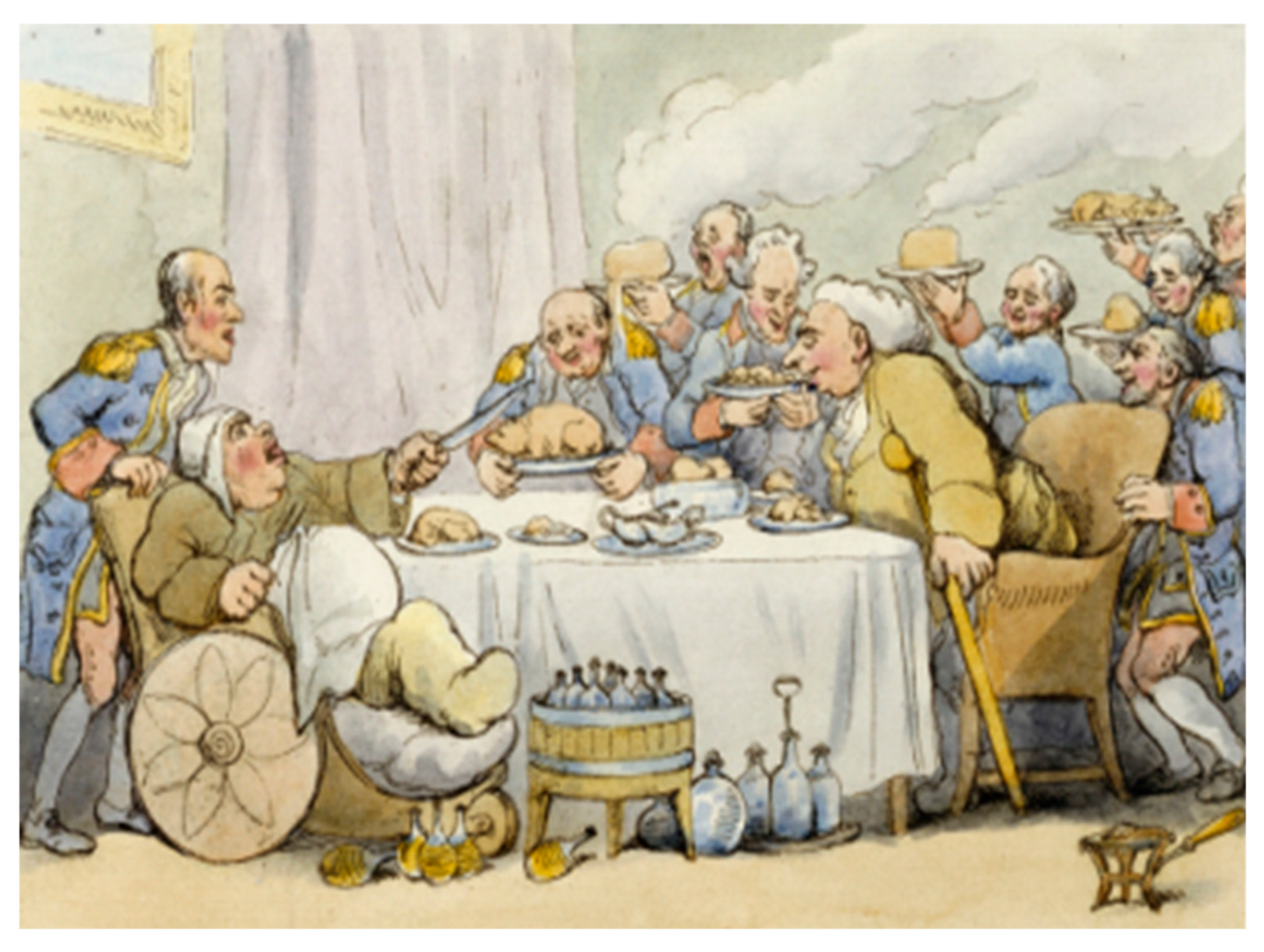
We are led to believe that ‘the Gout’ was epidemic in Britain in the seventeenth to nineteenth centuries, but then disease definition was not what it is today. Certainly, we have plenty of written accounts of what sounds like acute gouty arthritis, and we also have all the bandaged feet in the satirical cartoons of James Gillray, Thomas Rowlandson, George Cruikshank and the like (Figure 1). True gout probably really was common in England back then, at least amongst the upper and middle classes, with the proviso that a ‘regular fit of the gout’ would also have covered some other causes of acute arthritis—the consequences of ‘venery’ being a good example. Also, sciatica was considered to be gout of the hip, and rheumatoid arthritis with subcutaneous nodules might have been diagnosed as gout with ‘concretions’. Scientific understanding and modern diagnostic methodology now make the differentiation of ‘true gout’ relatively straightforward.

Figure 1.
Comforts of Bath: Gouty Gourmands at Dinner by Thomas Rowlandson. Published in 1798, the cartoon depicts two visitors who will have come to Bath for their health. They are being catered to by willing townsfolk, who were probably less concerned with their customers’ health than with their money. The bandaged leg was used by the satirical cartoonists to signify gout and alluded to self-indulgence and excess. The physicians of the gentleman in the Bath chair may well have concluded that he also suffered from ‘irregular gout’, judging from his corpulence and general infirmity. Source: Public domain.
Just as we do today, physicians in the old days saw gout as a systemic problem. Anyone trying to get to grips with the history of the subject soon has to confront what was meant by the obsolete term ‘irregular gout’. Other names included ‘anomalous gout’ and ‘non-articular gout’, and, in France, ‘goutte vague’ and ‘goutte larvée’. Physicians sub-classified these for themselves, but collectively they described nebulous acute and chronic internal problems that were considered to lie within the ill-defined boundaries of ‘the Gout’. I found myself in that position when writing The Gout—a Medical Microcosm in a Changing World [1] (pp. 1–346). In this article I take the opportunity to explore ‘irregular gout’ in more depth. With the premise that the doctors are different, but the biology is probably much the same, I have attempted to square the genuinely held beliefs of yesteryear with what we can now at least partially understand through science rather than speculation. In parallel, I have traced how the changing conception of gout created fashions of orthodox and unorthodox treatment, usually driven by trade. In the interests of practicality and brevity, the review focuses mainly on the English-speaking literature, and the referencing is limited and selective.
2. From Thomas Sydenham to Willam Heberden
Seventeenth century physicians still relied on the ancient texts, such as those of Hippocrates of Kos and Galen of Pergamon. Galen’s physiologic system focused on four cardinal humours: blood, phlegm, black bile and yellow bile. If out of balance, excess humour ‘defluxed’ gravitationally, ending up in the foot, where it discharged as inflammation. Thus, the word gout stems from gutta, the Latin for a drop, and podagra from the Greek πόδοσ (podos, foot) and αγρα (agra, catch). Standard mid-seventeenth century treatment was to evacuate ‘the antecedent matter’ using various techniques such as sweating, cupping, vomiting, purging, applying leeches or bleeding by venesection.
Thomas Sydenham became known as the ‘English Hippocrates’ because he brought medical thinking out of the library to the bedside. His writings are full of astute clinical observations, and his Treatise on the Gout and Dropsy of 1683 is widely regarded as one of the most accurate clinical descriptions of acute gout. His treatise was somewhat autobiographical, as Sydenham lived and then died with his own gout over thirty-four years. He still adhered to the Galenic system and extended this somewhat by teaching of the internal mischief that physicians could do to patients with gout. He particularly warned against intervention because:
‘Nature diverted from her own good and safe method of depositing the peccant matter in the joints, as soon as the humours are solicited towards the intestines, instead of acute pains with little danger, induces sickness, griping, fainting, and other irregular symptoms, which will nearly destroy the patient’[2] (p. 131)
Thus, Sydenham saw acute gout as treating itself. It was a salutary process of humoral dispersal that should be left to its own devices with minimal meddling.
In one sense Sydenham was the first of the new guard, but in another he was the last of the old, as he was not interested in biological mechanisms. George Cheyne adopted a more mechanistic approach. He had studied in Edinburgh under the Newtonian physician Archibald Pitcairn before migrating down to London and then to Bath. In his Observations Concerning the Nature and Due Method of Treating the Gout of 1720, he took an iatromechanical stand in writing that gout was caused by excess salts becoming trapped around joints by small blood vessels which had insufficient calibre and flexibility. However, Cheyne concurred with Sydenham on the overspill of humours:
‘When the original constitution is broken and impaired; the parts subdued and full of gouty salts; the force of the circulation, by age and frequent fits weakened. and continued only through the inosculations of the great vessels; and the humour recoils inwardly upon the bowels…and this is called an irregular Gout’[3] (pp. 63–64)
Cheyne passed his ideas down to the celebrated Bath physician William Oliver, who added ‘deaf gout’ to the ‘irregular gout’ portfolio: ‘After a few twinges in the toe, with a slight redness of the joint, just sufficient to determine the nature of the distemper, the whole foot, and the small of the leg swell, and grow oedematous; no more pain is felt; the part is heavy, and continues in that state for some weeks…’. It would be hard not to recognise this now as describing deep vein thrombosis. Bearing in mind that there was no anti-coagulation, Oliver continued that later ‘the other foot and leg are affected in the same manner’ [4] (pp. 50–51).
Up in Scotland, the great Edinburgh physician William Cullen taught his university students that the distinction between ‘regular gout; and ‘irregular gout’ was as follows:
‘The principle circumstance, in what we term the Regular Gout, is the inflammatory affection of the joints; and, whatever symptoms we can perceive to be connected with, or to depend upon the disposition which produces that inflammatory affection, but without its taking place, or being present at the same time, we name the Irregular Gout.’[5] (p. 368)
Cullen distinguished three types of ‘irregular gout’: ‘retrocedent’, ‘misplaced’ and ‘asthenic’. ‘Retrocedent gout’ described the development of new, more serious symptoms once ‘affections of the joint suddenly and entirely cease’. These were most commonly found in the stomach but could affect the heart and cause syncope, or the head and give rise to apoplexy (i.e., stroke) or palsy [5] (p. 371). Secondly, inflammation might occur in internal organs and cause ‘misplaced gout’, although Cullen considered this very rare [5] (pp. 372–373). Lastly, ‘asthenic gout’ occurred ‘when the gouty diathesis prevails in the system, but, from certain causes, does not produce the inflammatory affection of the joints’ [5] (pp. 369–370). Symptoms that could be attributed to this form included those in the head (headaches, giddiness and paralytic affections), the thorax (palpitations, faintings and asthma) and abdomen (sickness, nausea, vomiting, flatulency, acid eructations and diverse pains).
Not everyone agreed that ‘the Gout’ had such a wide domain. The perceptive William Heberden ushered in the modern era in his Commentaries on the History and Cure of Diseases, published posthumously in 1802, writing: ‘The Gout is indeed a common distemper, but not quite so common as is imagined’ [6] (p. 44).
3. Proprietary Medicines
Eighteenth century gout was considered to be incurable—the ‘Opprobrium Medicorum, the Disgrace of Physicians’. Physicians in those days had something of a public relations problem anyway, and many would have agreed with the satirical poet Ned Ward:
Thither * Physicians fly, to saveThemselves from the devouring Grave;And, to preserve themselves, imbibeMuch safer Draughts than they prescribe.What Doctors or Dispensors careTo take the Physick they prepare?Or, when themselves are out of Order,Will run the Hazard of Self-Murder?But are, it seems, too wise to SportWith Nature, by the Rules of Art.* ie to the tavern[7] (p. 5).
This distrust of physicians, coupled with their expense, fostered a climate of self-help. ‘Irregular gout’ was commercially convenient for the proprietary medicine trade, as the market could be expanded very considerably by claims to cure not just plain arthritis but also ‘gouty habits’ and ‘goutiness’. Popular brand names included Daffy’s Elixir, Dr. James’s Analeptic Pills, Portland Powder and Reverend Caleb Carrington’s Life Pills, amongst many others. The secret formulations often contained senna, rhubarb root and/or other herbal laxatives, and a common denominator was a powerful purge to evacuate the toxic matter. Many also contained opium. Thomas Dover, a pupil of Sydenham’s, added so much opium into his Dover’s Powder that dispensing apothecaries advised patients to settle their affairs. That they did not immediately succumb has been attributed to Dover adding ipecacuanha into the powder as an emetic.
Bearing in mind that the advertised indications for proprietary medicines were often extremely broad, the ‘gouty’ had a wide choice amongst the 550 that by 1812 were subject to the government’s stamp duty [8]. On the positive side, this was around the time that the benefits of Colchicum extracts (containing colchicine) were rediscovered in Britain, disguised in the French proprietary medicine L’Eau Médicinale d’Husson [1] (pp. 93–120).
4. From Carl Scheele to Alfred Garrod
What was needed was a chemical to identify the gouty matter. The first step in gout becoming a biologically based diagnosis took place in the 1780s when the Swedish Pomeranian apothecary Carl Scheele discovered what he called ‘acidum concretum’ in a urinary stone [9] (pp. 199–206). After some name changes, this came to be known as uric acid. It was linked to gout by William Hyde Wollaston, who had set up a provincial practice in Bury St Edmunds, and used what leisure time he had analysing the chemical composition of tophi from his gouty patients. Before Wollaston, tophi were thought to be due to chalk-like matter protruding from bone. However, he concluded that these actually consisted of ‘lithiated soda’—in modern parlance, the sodium salt of uric acid. He communicated his findings to the Royal Society in 1797 [10] and then quit medicine for a highly successful career as a chemist; he discovered, amongst many other things, the elements palladium and rhodium.
Wollaston did not speculate on how the urate he found in tophi came to be there, but his contemporary James Parkinson left very clear and insightful ideas on the subject in his Observations on the Nature and Cure of Gout of 1805. Parkinson realized the limited solubility of uric acid in water; the somewhat greater solubility of its sodium salt; and the likelihood of surplus urate crystallizing in tissues. Whilst suggesting that this could induce gouty inflammation, he still subscribed to the view that inflammation ‘cleared’ the system of the excess. He illustrated failure of adequate clearance leading to internal problems with the case report of ‘a gentleman of the temperament to which gout is supposed most particularly to belong, and whose father had suffered from gout….’. At the age of 38 years the man had a ‘slight’ attack of gout in the foot lasting about a week and then nearly five months later suffered from loin pain that was attributed to urinary gravel. Finally, six months after that he developed paroxysmal nocturnal dyspnoea, and soon after died [11] (p. 62). Parkinson realized that the critical unanswered question was whether uric acid or its sodium salt was present in the blood, but he was not a laboratory man, and that was as far as he could take it. He is of course better known for his Essay on the Shaking Palsy, which he published twelve years later [12].
A coroner’s report in the Wells Journal fifty years later, in 1855, demonstrates the maintained belief of gout involving the viscera:
‘At Weare, on the body of Mr. Henry Vowles, a highly respectable farmer, aged 71. Deceased was in his usual state of health a day previous, and on the following morning died instantly in his servant’s arms. He had been attended by Mr. Wade, surgeon, of Cross, for gout of the stomach some weeks before, but Mr. W. was of opinion that disease of the heart was the cause of his very sudden death. Verdict: “Died by the visitation of God”’[13]
With no pathology, laboratory tests or imaging, what more could the coroner be expected to do? Actually, seven years earlier, the 34-year-old Alfred Garrod had initiated a new phase in the understanding of gout with his seminal discovery that ‘soda of urate’ (i.e., sodium urate) could indeed be found in the blood, at last providing a source for the urate in tophi and the uric acid in urinary stones. In his milestone presentation to the Royal Medical and Chirurgical Society of London (now the Royal Society of Medicine) in 1848, Garrod provided experimental evidence that ‘soda of urate’ could be crystallized spontaneously out of blood serum, and that uric acid crystals precipitated if the serum was acidified. Very much larger amounts came from sera of gout patients compared to sera from those without gout. Whilst he found no such increase in patients with ‘acute rheumatism’ (probably mainly rheumatic fever), he did do so in patients with Bright’s disease (i.e., glomerulonephritis). He attributed the rise in blood urate in gout at least in part to a defect in the ‘uric-acid-excreting’ function of the kidneys [14].
Garrod went to great lengths in his seminal Nature and Treatment of Gout and Rheumatic Gout of 1859 to argue that gouty inflammation was a reaction to urate crystal formation. He catalogued an exhaustive pathological survey of post-mortem tissues from gouty patients, concluding that deposition of urate crystals in and around affected joints was the invariable hallmark of true gouty inflammation, and, of course, of tophi [15]. He showed that the kidneys not infrequently contained interstitial urate deposits, but urate crystal deposition in other internal organs was rare. Not finding crystals in supposedly affected organs, Garrod was circumspect about ‘irregular gout’, writing that ‘if difficulties arise in distinguishing the more regular forms of gout, they are greatly increased when its irregular manifestations require to be discriminated’. He drew short of claiming any systemic pathogenic role for uric acid or urate other than in crystal formation and inflammation.
5. ‘Uric Acid Poisoning’
Knowing what we now know, it is easy to conclude that Garrod’s insights into the role of uric acid and the inflammatory response to urate crystal formation had set new benchmarks, but that was very far from the case. Despite his remarkable observational skills, he offered no experimental evidence supporting his belief that urate crystals were the cause of gouty inflammation. Many took the view that uric acid was an epiphenomenon, an irrelevant companion to gout. For instance, the early rheumatologist and accomplished toxicologist Arthur Luff wrote in the Lancet in 1905:
‘I cannot but think that with our increasing knowledge and experience of the disease uric acid and its salts will in all probability have to be relegated to a position of subsidiary importance in the pathogenesis of gout. The joint manifestations are dependent upon much more general and much larger conditions than a mere excess of uric acid in the blood. The deposition of sodium biurate (i.e., monosodium urate) is merely the sign of the disease, not the essence of it’[16]
On the other hand, there were many others that held a diametrically opposite opinion, seeing uric acid as generally toxic and central to the development of many chronic diseases. Basing his views on experiments in which he raised urate levels in chickens, for exampleby ligation of the ureters, the German physician Wilhelm Ebstein (of Ebstein’s cardiac anomaly) provided a theory of how uric acid acted as a general internal poison. Thus:
‘…the gouty poison first permeates the tissues in a fluid form, damaging them more or less as the conditions present are more or less favourable and that when the injury has reached the highest point, and not till then, the uric acid compounds, which frequently form the sole constituents of gouty deposit, crystallise out of the necrosed tissues’[17] (pp. 92–93)
In Ebstein’s scheme, urate crystals in and around joints were secondary to cell necrosis caused by uric acid and occurred in much the same way as the development of calcification in chronically inflamed tissues. Other tissues were damaged by uric acid—they just did not necrose to the same extent, and hence there was no crystal formation. In Ebstein’s paradigm, uric acid was a cause not just of gout and renal dysfunction but also of ‘atheromatous arteries of gouty subjects’. Furthermore, Ebstein believed that ‘a good portion of the brain symptoms met with in gouty people must be looked upon as secondary’ [17] (pp. 141–142).
The chief advocate telling the general public that uric acid was a systemic irritant was the London physician Alexander Haig. He took the view that fluctuating uric acid excretion caused his migraines. He obsessively measured uric acid levels in urine (mainly his own), and sometimes blood, and concluded that uric acid also caused diabetes, hypertension, cardiovascular disease, depression, epilepsy and cancer. His book Uric Acid as a Factor in the Causation of Disease was influential amongst the public and professionals alike [18].
The claimed systemic harm caused by uric acid was essentially a rebranding of ‘irregular gout’ and stimulated a new generation of proprietary formulations marketed pseudo-scientifically to deal with it. For example, Hulbert Warner, who had made his fortune in the United States manufacturing fire-proof safes for storing valuables, diversified his commercial activity into healthcare with Warner’s Safe Cure (note the pun), each bottle being imprinted with an image of his safe door. His numerous advertisements in the late 1880s informed the public that:
‘uric acid, which is a rank poison, is one of the substances which arise from destructive waste of our body, and must be thrown off daily, or we die…This uric acid, in nine cases out of ten, is responsible for all the ailments from which we suffer: its retention produces serious disorders, and the diseases which it causes may be treated, and formerly were treated, to no avail unless the uric acid is removed.’[19]
Warner’s Safe Cure was presumably intended to remove uric acid by a strong purge, as it contained good old-fashioned senna and rhubarb, with wintergreen extract possibly providing some pain relief. As the latter would have contained salicylate, that might well have been counterproductive because we now know that low-dose salicylate enhances renal urate retention.
Another fashionable means for supposedly clearing uric acid from the system was with lithium. Garrod was at least partly responsible for introducing lithium into medicine, in view of monolithium urate being around five times more soluble in water that monosodium urate and around thirty-six times more soluble than uric acid [20]. Once lithium was detected in the mineral waters of several health spas, albeit at very low concentrations, numerous brands of ‘lithiated water’ were marketed as preventatives against gout, urinary stones and diverse internal problems. The providers of Farmville Lithia Water were typical in claiming, ‘There is no water that will give as prompt and satisfactory results in all diseases of Uric Acid Diathesis’, and in addition to gout these included various other ailments such as ‘torpid liver’, ‘nervous prostration’ and ‘female weakness’. Buffalo Springs Lithia Water from Virginia was marketed as ‘the best natural remedy for excess uric acid in the blood’. The providers were forced to change the name after losing a misbranding and false advertising lawsuit which went as far as the United States Supreme Court in 1917. The court heard that that someone would have to drink over one hundred and fifty thousand gallons of the product to obtain a ‘therapeutic dose’ of lithium [21]. Some companies pivoted on the problem of natural ‘lithia waters’ lacking enough lithium by adding it into their products. Merck’s Index of 1907 listed a staggering 43 different tablets and powders containing lithium [22].
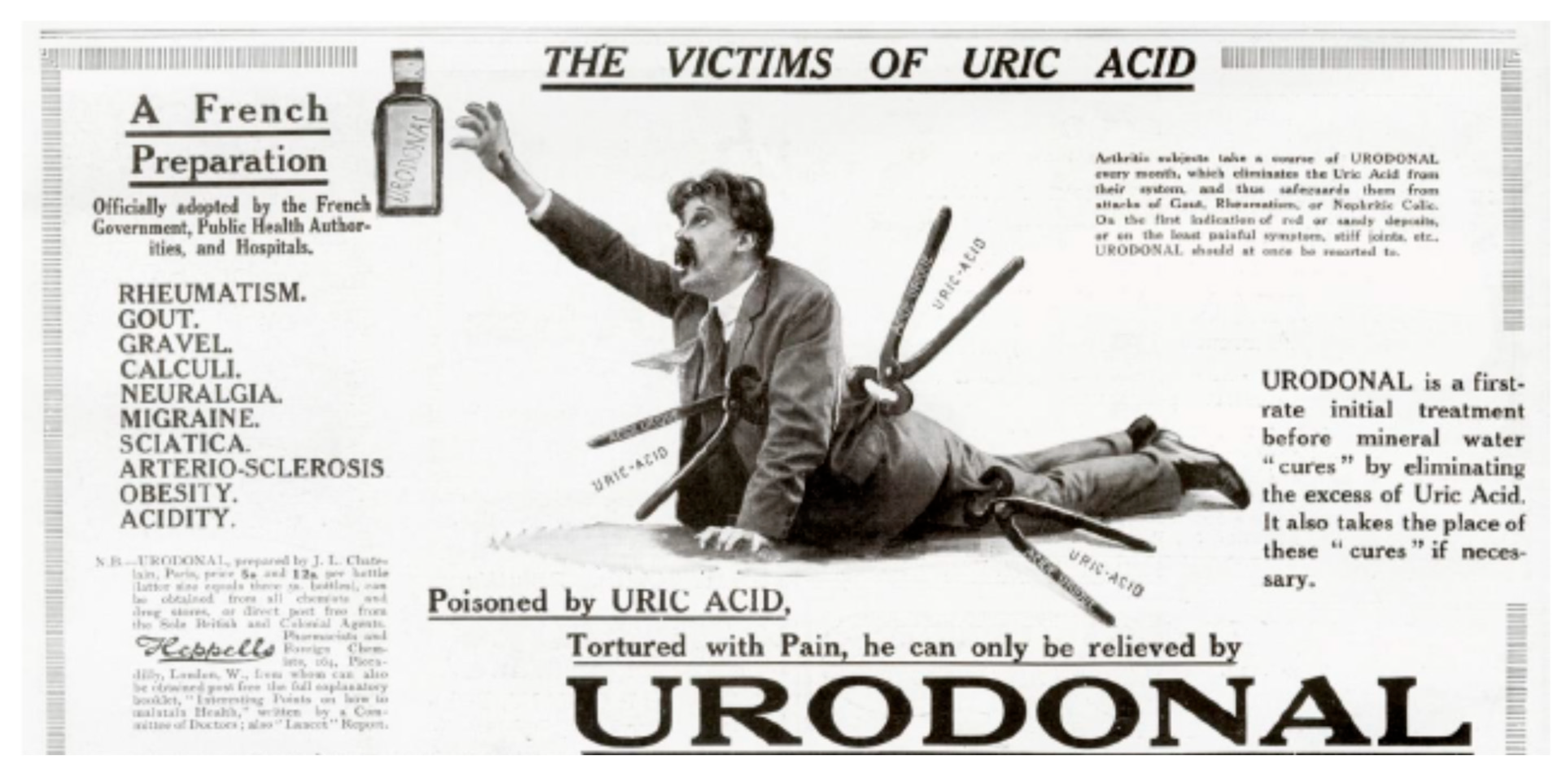
The concept of ‘uric acid diathesis’ also provided a lucrative market for the developing pharmaceutical industry generating new compounds supposedly able to dissolve uric acid. ‘Doctor’s Corner’ in the Newcastle Weekly Chronicle told readers that the Schering Company’s piperazine was the best treatment for the many mental and physical conditions of ill-health linked to that ‘insidious form of blood poisoning—uric acid in the blood’ [23]. In the period from 1880–1920, there appeared a raft of similar compounds, which were marketed alone or in combination to help victims of uric acid toxicity (Figure 2) [1] (pp. 149–170). Few, if any, were put through a formal clinical trial to evaluate efficacy and safety, and none have survived the passage of time.
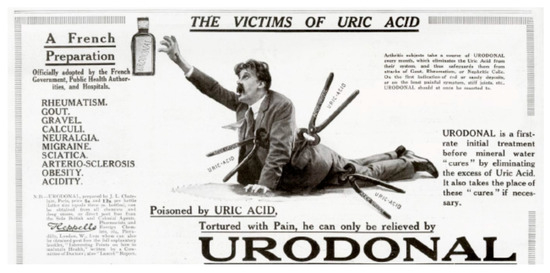
Figure 2.
Advertisement for Urodonal in 1916. Urodonal was a compound formulation containing the supposed uric acid solvents piperazine, lysidine, urotropine and quinate. The advertisement was published in the Illustrated London News, an upmarket magazine likely to have been read in private members’ clubs. These and many similar advertisements kept uric acid alive in the public mind as a poison responsible for a variety of conditions, as listed on the left. Source: under licence @ Illustrated London News/Mary Evans.
6. The Arrival of Urate-Lowering Therapy
The pendulum slowly swung away from uric acid as the driver of more general disease. In 1921, the Bath physician Llewellyn Llewellyn wrote in the preface to his comprehensive monograph:
‘Uric acid has apparently failed us as the causa causans. Neither this substance, not its precursors can be held responsible for the fever, local inflammation and constitutional disturbances in gout, being as they are, practically non-toxic…uric acid must be viewed at its proper perspective as a concomitant or sequel of gouty inflammation, the essential cause of which must be sought elsewhere’[24]
With views such as Llewellyn’s, by the 1940s the pharmaceutical industry had rather dropped uric acid, gout and ‘goutiness’ as important topics for drug discovery. The therapeutic breakthroughs thus came serendipitously. The introduction of penicillin had made a huge difference to the treatment of infected war wounds, but antibiotic resistance soon became a problem. The very fast renal clearance made it hard to achieve the high doses required to successfully treat serious infections. Karl Beyer Junior and colleagues at Sharpe and Dohme Company in Pennsylvania developed probenecid in the 1940s to prevent penicillin loss via renal tubular transport and hence raise blood levels. It was not commercially successful for that, as new antibiotics were emerging, but the drug was found to also prevent the tubular reabsorption of urate and to lower urate levels. The company therefore repurposed the drug for gout. Actually, the idea that a drug might increase the renal excretion of urate was not new, as high-dose salicylate and the E. Schering Company’s cinchophen had both been found to do so. However, neither was practicable, as patients could not tolerate the former for any duration, and the uricosuric effect of cinchophen was relatively short-lived.
7. Crystals as a Cause of Inflammation
In 1951, Ts’ai Fan Yu and Alexander Gutman in New York reported that sustained lowering of uric acid levels with probenecid led to the clearing of tophi [25]. More problematic was concluding that uric acid was responsible for other manifestations of gout, especially as acute attacks occurred once probenecid caused the serum urate level to fall. Acute attacks were also experienced after inhibiting uric acid synthesis with allopurinol, which was introduced about ten years later [26,27]. Gutman thought acute gout might be an allergic phenomenon and stated that there were ‘many reasons to doubt that uric acid per se is immediately concerned with the symptoms of acute gout. From all indications, uric acid is a physiologically inert substance’ [28]. It was not until the 1960s that the central role of urate crystals in inducing gouty inflammation became generally accepted. Two American research groups (James Faires and Daniel McCarty in Philadelphia; and Jay Seegmiller and colleagues at the National Institutes of Health) separately showed that injection of urate crystals in preclinical models and also in human volunteers elicited intense gouty inflammation, whereas urate held in solution was without a similar effect [29,30]. In fact, very similar observations had been published at the end of the nineteenth century by Max Freudweiler, while working in the laboratory of Wilhelm His Jr. (of the Bundle of His) in Leipzig. Freudweiler’s papers had been forgotten, if ever noticed, and McCarty, aided by Joseph Brill, graciously published translations with commentaries once he discovered them later [31,32].
The early days of research into the mechanisms of urate-crystal-induced inflammation focused particularly on humoral factors and the role of neutrophils, the foot soldiers of acute inflammation. Robert Terkeltaub found that the inflammatory potential of urate crystals dropped dramatically once they became coated with plasma proteins [33], and acute attacks with urate-lowering therapy could be explained by the release of these as crystals start dissolving. The discoveries by Gordon Duff and colleagues in Edinburgh in the late 1980s that monocytes react to MSU crystals by releasing interleukin-1 beta (IL-1β) and tumour necrosis factor alpha (TNFα) identified the master cytokines in gout [34,35], of which IL-1β was later found to be the upstream instigator [36,37]. Subsequently, anti-IL-1β antibodies have been shown to both help prevent and to ameliorate acute attacks [38,39].
8. ‘Irregular Gout’ Revisited
Max Freudweiler had particularly stressed the value of polarizing microscopy for detecting urate crystals, and Dan McCarty and Joseph Hollander sealed this as a diagnostic test:
‘Since it is important to make the diagnosis of this most treatable disease in the field of arthritis with some degree of certainty, aspiration of gouty joints with microscopic examination of the synovial fluid for crystals, by a polarizing microscope if possible, should become the standard diagnostic procedure.’[40]
Crystal analysis is now a key component of the American College of Rheumatology/European League Against Rheumatism consensus diagnostic criteria for gout [41]. So now that the ‘regular gout’ is defined by the inflammatory response to monosodium urate crystals, where do we stand with ‘irregular gout’? Were the old physicians just lumping together diseases associated by coincidence (or by unhealthy living), or can we now trace mechanistic links between them? It is relevant to revisit ‘irregular gout’ not just out of historical curiosity but also because there is unfinished business. Does a ‘regular fit of the gout’ really foster internal problems, and does the ‘gouty diathesis’ predispose to problems in the viscera independently of arthritis? I shall revisit each of Cullen’s three categories in turn.
‘Retrocedent gout’ described fever and related systemic symptoms occurring at the time of acute gouty arthritis or soon after. These can now readily be explained by spill-over of IL-1β and/or down-stream cytokines into the circulation [42]. Similarly, the enhanced coagulability of the blood during inflammation makes the connection between gout and deep vein thrombosis that likely constituted Oliver’s ‘deaf gout’, and which has since been statistically confirmed [43,44]. Gout has long been known to convey an increased risk of myocardial infarction, and a recent report suggests that this is indeed greatest soon after an acute gout flare [45,46]. Lastly, sub-clinical crystal-related inflammation in and around joints or tophi might provide a low-intensity systemic drive to atherosclerosis. All this points to the importance of taking the treatment of inflammation due to gout very seriously.
Cullen thought that gouty inflammation in internal organs, his ‘misplaced gout’, was rare. A century later, Garrod concluded from his exhaustive pathological survey of advanced cases, who did not have the benefit of urate-lowering therapy, that urate crystal deposition in internal organs was very unusual with the exception of within the renal interstitium. Notwithstanding, there have been recent reports claiming that urate crystals can be detected in arteries by dual-energy computerised tomography (CT). This is still a controversial issue, as the exact cause of such imaging signals requires validation and distinction from other particulate matter such as cholesterol crystals in atherosclerosis and arterial calcification [47,48]. Garrod himself noted that ‘urate of soda appears to avoid the contiguity of blood vessels’ [15] (p. 203), and deposits in heart valves and atheromatous lesions of the aorta ‘are of different character, consisting either of phosphate and carbonate of lime or of cholesterine and fatty matter’ (i.e., calcium salts, cholesterol and lipids) [15] (p. 511). Given that monosodium urate crystallisation is temperature-dependent, perhaps it would be surprising for deposition to occur in the relative warmth of blood vessels.
‘Asthenic gout’ was a broad grouping. Cullen regarded some cases as hypochondrial, with patients suffering ‘dejection of mind, a constant and anxious attention to the slightest feelings, an imaginary aggravation of these, an apprehension of danger from them’. Together with the physical symptoms listed earlier, these paint a somewhat psychosomatic picture that has little to do with gout today. ‘Asthenic gout’ could often have been the calling card of the wealthy well that kept Bath and other health spas in business, as well profiting the manufacturers of proprietary medicines and health products. There are plenty of equivalents today.
On the other hand, ‘asthenic gout’ included some more serious consequences of the ‘gouty diathesis’. Cullen was not a believer in the humours, writing: ‘The supposition of a morbific matter being the cause of gout, has been hitherto useless, as it has not suggested any successful method of cure’ [5] (p. 379). However, in so far as he was wrong about that, and that the gouty humour is uric acid, does the subsequent concept of ‘uric acid poisoning’ stand up to scrutiny? There have certainly been many studies correlating hyperuricaemia with metabolic syndrome (abdominal obesity, dyslipidaemia, hypertension and type II diabetes) and adverse cardiovascular outcomes, as has been well reviewed previously [49,50,51]. There are also excellent reviews of the pathophysiological means by which uric acid in solution may have deleterious effects independent of crystals, such as by Joosten et al. [52]. Re-reviewing this large literature is beyond the remit of the present article, and the question of whether or not uric acid is causally deleterious in the absence of crystal-induced inflammation remains unresolved. However, two critical lines of evidence curb enthusiasm for asymptomatic hyperuricaemia determining treatment.
First, if uric acid predisposes to diseases other than gout, so should genetic variants linked to hyperuricaemia. Mendelian randomization studies provide little support for that being the case. For example, Keenan and colleagues failed to find genetic evidence for links between urate levels and type II diabetes mellitus, coronary heart disease, ischemic stroke or heart failure (HF), despite a strong positive control signal linking hyperuricaemia to gout [53]. Furthermore, a subsequent umbrella review of genetic studies only upheld causal links between variants associated with a high urate level on the one hand and gout and nephrolithiasis on the other, and failed to find evidence for links to a further 136 health outcomes [54].
Secondly, there is very little evidence that lowering urate levels protects against adverse cardiovascular outcomes. With gout only occurring in a minority of individuals with hyperuricaemia, there is a much-expanded potential market for urate-lowering agents if more benefits could be established with clinical trials. The manufacturers of the urate-lowering agent febuxostat have gone to great lengths with that in mind. In FREED, patients over 65 years of age with hypertension, type II diabetes or cerebral or coronary disease, but without an attack of acute gout for at least a year and without tophi, were randomized to receive febuxostat or usual care. Although febuxostat did lead to a significant reduction in the primary composite endpoint, this was attributed to reduced renal impairment as defined by microalbuminuria or mild proteinuria. There was no evidence that febuxostat reduced cerebrovascular or coronary events [55].
A similar result, albeit without having renal impairment as an end-point, came for the subsequent investigator-led ALL-HEART trial testing allopurinol. This randomized over five thousand patients with ischaemic heart disease but without gout to urate-lowering therapy or usual care. The study failed to show any effect of allopurinol on reduction in non-fatal myocardial infarction, non-fatal stroke or cardiovascular death, or on quality-of-life outcomes [56].
Taken together, these well-performed clinical trials have failed to support the use of urate-lowering therapy to provide secondary prevention against cardiovascular adverse outcomes, although it still remains possible that it could have a role in primary cardiovascular disease prevention, or indeed the prevention of other diseases. With respect to preserving renal function, the evidence for treating asymptomatic hyperuricaemia is still weak [57,58]. Recent clinical practice guidelines issued by ‘Kidney Disease: Improving Global Outcomes’ recommended that patients with symptomatic hyperuricaemia (i.e., arthritis and/or tophi) and chronic kidney disease (CKD) should receive urate-lowering therapy, but that it should not be routinely offered to CKD patients in whom hyperuricaemia is asymptomatic [57,58,59].
9. Conclusions
When reading the writings of past physicians, it helps to remember that they were trying to make sense of clinical observations in the light of very rudimentary biological understanding. In this short review, I have attempted to break down the outdated term ‘irregular gout’ in light of what we know about gout and hyperuricaemia. On the one hand, the systemic manifestations of ‘retrocedent gout’ can readily be explained by the release of inflammatory mediators from acute gouty arthritis. On the other hand, the numerous consequences of ‘asthenic gout’ which did not depend on inflammation remain controversial when translated to the effects of asymptomatic hyperuricaemia. Whether or not the concept of ‘uric acid poisoning’ has any value today is still an open question, with evidence that treating asymptomatic hyperuricaemia protects from diseases beyond ‘regular gout’ remaining insubstantial.
Funding
This review received no external funding.
Data Availability Statement
No new data were created or analyzed in this study.
Conflicts of Interest
The author declares no conflict of interest.
References
- Haskard, D. The Gout—A Medical Microcosm in a Changing World; World Scientific: Singapore, 2025. [Google Scholar]
- Thomas, S. A Treatise on the Gout and Dropsy. In The Works of Thomas Sydenham; Latham, R.G., Ed.; The Sydenham Society: London, UK, 1850; Volume 2. (First published 1683). [Google Scholar]
- Cheyne, G. Observations Concerning the Nature and Due Method of Treating the Gout, Written for My Worthy Friend Richard Tennison, Esq. In Together with an Account of the Nature and Quality of the Bath Waters; George Strahan: London, UK, 1720. [Google Scholar]
- Oliver, W. A Practical Essay on the Use and Abuse of Warm Bathing in Gouty Cases, 2nd ed; Leake, J.; Frederick, W.: Bath, UK, 1753. (First published 1751). [Google Scholar]
- Cullen, W. First Lines in the Practice of Physic; John Murray: London, UK, 1777; Volume 1. [Google Scholar]
- Heberden, W. Commentaries on the History and Cure of Diseases, 3rd ed.; Payne, T.: London, UK, 1806. (First published 1802). [Google Scholar]
- Ward, E. The Delights of the Bottle; or the Compleat Vintner: A Merry Poem; Downing, W.: London, UK, 1720. [Google Scholar]
- Secret Remedies—What They Cost and What They Contain; British Medical Association: London, UK, 1909.
- Scheele, K.W. The Chemical Essays of Charles-William Scheele, Translated by Thomas Beddoes from the Transactions of the Academy of Sciences at Stockholm 1786; John Murray: London, UK, 1901. [Google Scholar]
- Wollaston, W.H. On Gouty and Urinary Concretions. Phil. Trans. 1797, 87, 386. [Google Scholar]
- Parkinson, J. Observations on the Nature and Cure of Gout; Symonds, Murray, Arch and Cox: London, UK, 1805. [Google Scholar]
- Usselman, M.C. Pure Intelligence; University of Chicago Press: Chicago, IL, USA, 2015. [Google Scholar]
- Coroner’s Report. Wells Journal, 10 November 1855.
- Garrod, A.B. Observations on Certain Pathological Conditions of the Blood and Urine, in Gout, Rheumatism, and Bright’s Disease. Med. Chir. Trans. 1848, 31, 83–97. [Google Scholar] [CrossRef] [PubMed]
- Garrod, A.B. The Nature and Treatment of Gout and Rheumatic Gout, 1st ed.; Walton and Maberly: London, UK, 1859. [Google Scholar]
- Luff, A.P. An Address on Some Diseases in Relation to Spa Treatment. Lancet 1905, 166, 1167–1170. [Google Scholar] [CrossRef]
- Ebstein, W. The Nature and Treatment of Gout; Burton, J.E., Ed.; Baillière & Co.: London, UK, 1886. [Google Scholar]
- Haig, A. Uric Acid as a Factor in the Causation of Disease; J. and A. Churchill: London, UK, 1892. [Google Scholar]
- The Microscope. Aberdeen Evening Express, 27 December 1887.
- Garrod, A.B. The Lumleian Lectures on Uric Acid: Its Physiology and Its Relation to Renal Calculi and Gravel (Lecture Ia). BMJ 1883, 1159, 495–497. [Google Scholar] [CrossRef]
- Strobusch, A.D.; Jefferson, J.W. The Checkered History of Lithium in Medicine. Pharm. Hist. 1980, 22, 72–76. [Google Scholar] [PubMed]
- Merck’s 1907 Index; Merck and Co.: New York, NY, USA, 1907.
- The Doctor’s Corner: An Incidious Poison. Newspaper Weekly Chronicle, 25 August 1894.
- Llewellyn, L.J. Gout; C.V.Mosby Co.: London, UK, 1921. [Google Scholar]
- Yu, T.F.; Gutman, A.B. Mobilization of Gouty Tophi by Protracted Use of Uricosuric Agents. Am. J. Med. 1951, 11, 765–769. [Google Scholar] [CrossRef]
- Wyngaarden, J.B.; Rundles, R.W.; Silherman, H.R.; Hunter, S. Control of Hyperuricemia with Hydroxypyrazolopyrimidine, a Purine Analogue Which Inhibits Uric Acid Synthesis. Arthritis Rheum. 1963, 6, 306–307. [Google Scholar]
- Yu, T.F.; Gutman, A.B. Effect of Allopurinol (4-Hydroxypyrazolo-(3,4-D) Pyrimidine) on Serum and Urinary Uric Acid in Primary and Secondary Gout. Am. J. Med. 1964, 37, 885–898. [Google Scholar] [CrossRef] [PubMed]
- Gutman, A.B. Uric Acid Metabolism and Gout. Am. J. Med. 1950, 9, 799–817. [Google Scholar] [CrossRef]
- Faires, J.S.; McCarty, D.J. Acute Arthritis in Man and Dog after Intrasynovial Injection of Sodium Urate Crystals. Lancet 1962, 280, 682–684. [Google Scholar] [CrossRef]
- Seegmiller, J.E.; Howell, R.R.; Malawista, S. The Inflammatory Reaction to Sodium Urate. JAMA 1962, 180, 469–475. [Google Scholar]
- Freudweiler, M. Investigations into the Nature of Gouty Tophi. Ann. Int. Med. 1964, 60, 486–505. (first published 1899). [Google Scholar]
- Freudweiler, M. Experimental Investigations into the Origin of Gouty Tophi. Arthritis Rheum. 1964, 8, 268–285. (first published 1901). [Google Scholar]
- Terkeltaub, R.; Curtiss, L.K.; Tenner, A.J.; Ginsberg, M.H. Lipoproteins Containing Apoprotein B Are a Major Regulator of Neutrophil Responses to Monosodium Urate Crystals. J. Clin. Investig. 1984, 73, 1719–1730. [Google Scholar] [CrossRef] [PubMed]
- Di Giovine, F.S.; Malawista, S.E.; Nuki, G.; Duff, G.W. Interleukin 1 (IL-1) as a Mediator of Crystal Arthritis: Stimulation of T Cell and Synovial Fibroblast Mitogenesis by Urate Crystal-Induced IL-1. J. Immunol. 1987, 138, 3213–3218. [Google Scholar] [CrossRef] [PubMed]
- Di Giovine, F.S.; Malawista, S.E.; Thornton, E.; Duff, G.W. Urate Crystals Stimulate Production of Tumor Necrosis Factor Alpha from Human Blood Monocytes and Synovial Cells. Cytokine mRNA and Protein Kinetics, and Cellular Distribution. J. Clin. Investig. 1991, 87, 1375–1381. [Google Scholar] [CrossRef] [PubMed]
- Chapman, P.T.; Yarwood, H.; Harrison, A.A.; Stocker, C.J.; Jamar, F.; Gundel, R.H.; Peters, A.M.; Haskard, D.O. Endothelial Activation in Monosodium Urate Monohydrate Crystal-Induced Inflammation: In Vitro and in Vivo Studies on the Roles of Tumor Necrosis Factor-Alpha and Interleukin-1. Arthritis Rheum. 1997, 40, 955–965. [Google Scholar] [CrossRef]
- Martinon, F.; Pétrilli, V.; Mayor, A.; Tardivel, A.; Tschopp, J. Gout-Associated Uric Acid Crystals Activate the Nalp3 Inflammasome. Nature 2006, 440, 237–241. [Google Scholar] [CrossRef] [PubMed]
- So, A.; De Smedt, T.; Revaz, S.; Tschopp, J. A Pilot Study of IL-1 Inhibition by Anakinra in Acute Gout. Arthritis Res. Ther. 2007, 9, R28. [Google Scholar] [CrossRef] [PubMed]
- Ridker, P.M.; MacFadyen, J.G.; Thuren, T.; Everett, B.M.; Libby, P.; Glynn, R.J.; Group, C.T. Effect of Interleukin-1beta Inhibition with Canakinumab on Incident Lung Cancer in Patients with Atherosclerosis: Exploratory Results from a Randomised, Double-Blind, Placebo-Controlled Trial. Lancet 2017, 390, 1833–1842. [Google Scholar] [CrossRef]
- McCarty, D.J.; Hollander, J.L. Identification of Urate Crystals in Gouty Synovial Fluid. Ann. Intern. Med. 1961, 54, 452–460. [Google Scholar] [CrossRef] [PubMed]
- Neogi, T.; Jansen, T.L.; Dalbeth, N.; Fransen, J.; Schumacher, H.R.; Berendsen, D.; Brown, M.; Choi, H.; Edwards, N.L.; Janssens, H.J.; et al. 2015 Gout Classification Criteria: An American College of Rheumatology/European League against Rheumatism Collaborative Initiative. Ann. Rheum. Dis. 2015, 74, 1789–1798. [Google Scholar] [CrossRef] [PubMed]
- Malawista, S.E.; Duff, G.W.; Atkins, E.; Cheung, H.S.; McCarty, D.J. Crystal-Induced Endogenous Pyrogen Production. A Further Look at Gouty Inflammation. Arthritis Rheum. 1985, 28, 1039–1046. [Google Scholar] [CrossRef] [PubMed]
- Huang, C.-C.; Huang, P.-H.; Chen, J.-H.; Lan, J.-L.; Tsay, G.J.; Lin, H.-Y.; Tseng, C.-H.; Lin, C.-L.; Hsu, C.-Y. An Independent Risk of Gout on the Development of Deep Vein Thrombosis and Pulmonary Embolism: A Nationwide, Population-Based Cohort Study. Medicine 2015, 94, e2140. [Google Scholar] [CrossRef] [PubMed]
- Chiu, C.-C.; Chen, Y.-T.; Hsu, C.-Y.; Chang, C.-C.; Huang, C.-C.; Leu, H.-B.; Li, S.-Y.; Kuo, S.-C.; Huang, P.-H.; Chen, J.-W.; et al. Association between Previous History of Gout Attack and Risk of Deep Vein Thrombosis—A Nationwide Population-Based Cohort Study. Sci. Rep. 2016, 6, 26541. [Google Scholar] [CrossRef] [PubMed]
- Krishnan, E.; Baker, J.F.; Furst, D.E.; Schumacher, H.R. Gout and the Risk of Acute Myocardial Infarction. Arthritis Rheum. 2006, 54, 2688–2696. [Google Scholar] [CrossRef] [PubMed]
- Cipolletta, E.; Tata, L.J.; Nakafero, G.; Avery, A.J.; Mamas, M.A.; Abhishek, A. Association between Gout Flare and Subsequent Cardiovascular Events among Patients with Gout. JAMA 2022, 328, 440–450. [Google Scholar] [CrossRef]
- Dalbeth, N.; Alhilali, M.; Riordan, P.; Narang, R.; Chhana, A.; McGlashan, S.; Doyle, A.; Andres, M. Vascular Deposition of Monosodium Urate Crystals in Gout: Analysis of Cadaveric Tissue by Dual-Energy Computed Tomography and Compensated Polarizing Light Microscopy. Arthritis Rheumatol. 2022, 74, 1295–1296. [Google Scholar] [CrossRef]
- Pascart, T.; Budzik, J.F. Does Monosodium Urate Crystal Vascular Deposition Exist? Review of the Evidence. Gout Urate Cryst. Depos. Dis. 2023, 1, 208–216. [Google Scholar] [CrossRef]
- Baker, J.F.; Krishnan, E.; Chen, L.; Schumacher, H.R. Serum Uric Acid and Cardiovascular Disease: Recent Developments, and Where Do They Leave Us? Am. J. Med. 2005, 118, 816–826. [Google Scholar] [CrossRef]
- Feig, D.I.; Kang, D.-H.; Johnson, R.J. Uric Acid and Cardiovascular Risk. N. Engl. J. Med. 2008, 359, 1811–1821. [Google Scholar] [CrossRef] [PubMed]
- Raya-Cano, E.; Vaquero-Abellán, M.; Molina-Luque, R.; De Pedro-Jiménez, D.; Molina-Recio, G.; Romero-Saldaña, M. Association between Metabolic Syndrome and Uric Acid: A Systematic Review and Meta-Analysis. Sci. Rep. 2022, 12, 18412. [Google Scholar] [CrossRef]
- Joosten, L.A.B.; Crişan, T.O.; Bjornstad, P.; Johnson, R.J. Asymptomatic Hyperuricaemia: A Silent Activator of the Innate Immune System. Nat. Rev. Rheumatol. 2020, 16, 75–86. [Google Scholar] [CrossRef] [PubMed]
- Keenan, T.; Zhao, W.; Rasheed, A.; Ho, W.K.; Malik, R.; Felix, J.F.; Young, R.; Shah, N.; Samuel, M.; Sheikh, N.; et al. Causal Assessment of Serum Urate Levels in Cardiometabolic Diseases through a Mendelian Randomization Study. JACC 2016, 67, 407–416. [Google Scholar] [CrossRef]
- Li, X.; Meng, X.; Timofeeva, M.; Tzoulaki, I.; Tsilidis, K.K.; Ioannidis, P.A.; Campbell, H.; Theodoratou, E. Serum Uric Acid Levels and Multiple Health Outcomes: Umbrella Review of Evidence from Observational Studies, Randomised Controlled Trials, and Mendelian Randomisation Studies. BMJ 2017, 357, j2376. [Google Scholar] [CrossRef]
- Kojima, S.; Matsui, K.; Hiramitsu, S.; Hisatome, I.; Waki, M.; Uchiyama, K.; Yokota, N.; Tokutake, E.; Wakasa, Y.; Jinnouchi, H.; et al. Febuxostat for Cerebral and Cardiorenovascular Events Prevention Study. Eur. Heart J. 2019, 40, 1778–1786. [Google Scholar] [CrossRef] [PubMed]
- Mackenzie, I.S.; Hawkey, C.J.; Ford, I.; Greenlaw, N.; Pigazzani, F.; Rogers, A.; Struthers, A.D.; Begg, A.G.; Wei, L.; Avery, A.J.; et al. Allopurinol Versus Usual Care in Uk Patients with Ischaemic Heart Disease (All-Heart): A Multicentre, Prospective, Randomised, Open-Label, Blinded-Endpoint Trial. Lancet 2022, 400, 1195–1205. [Google Scholar] [CrossRef] [PubMed]
- Sampson, A.L.; Singer, R.F.; Walters, G.D. Uric Acid Lowering Therapies for Preventing or Delaying the Progression of Chronic Kidney Disease. Cochrane Database Syst. Rev. 2017, 10, CD009460. [Google Scholar] [CrossRef]
- Yu, X.; Gu, M.; Zhu, Y.; Zhang, L.; Kong, W.; Zou, Y. Efficacy of Urate-Lowering Therapy in Patients with Chronic Kidney Disease: A Network Meta-Analysis of Randomized Controlled Trials. Clin. Ther. 2022, 44, 723–735.e6. [Google Scholar] [CrossRef]
- KDIGO 2024 Clinical Practice Guideline for the Evaluation and Management of Chronic Kidney Disease. Kidney Int. 2024, 105, S117–S314. [CrossRef] [PubMed]
Disclaimer/Publisher’s Note: The statements, opinions and data contained in all publications are solely those of the individual author(s) and contributor(s) and not of MDPI and/or the editor(s). MDPI and/or the editor(s) disclaim responsibility for any injury to people or property resulting from any ideas, methods, instructions or products referred to in the content. |
© 2026 by the author. Published by MDPI on behalf of the Gout, Hyperuricemia and Crystal Associated Disease Network. Licensee MDPI, Basel, Switzerland. This article is an open access article distributed under the terms and conditions of the Creative Commons Attribution (CC BY) license.