Skip Content
You are currently on the new version of our website. Access the old version .

Spectroscopy Journal

Spectroscopy Journal is an international, peer-reviewed, open access journal on all aspects of spectroscopy published quarterly online by MDPI.

All Articles (72)

To achieve accurate identification of early subcutaneous bruising regions in fragrant pears, this study developed a detection system based on Structured-Illumination Reflectance Imaging (SIRI) and integrated it with both machine learning and deep learning models. Structured-illumination images were acquired at six spatial frequencies (50, 100, 150, 200, 250, and 300 cycle·m−1) and evaluated after demodulation through both visual assessment and contrast index (CI) analysis. The optimal spatial frequency of 150 cycle·m−1 was selected for subsequent analysis. Texture features were extracted from AC, DC, and RT images based on the gray-level co-occurrence matrix (GLCM), and classification was performed using three machine learning models KNN, PLS-DA, LightGBM and the deep learning Mask R-CNN model. The results showed that the classification performance of RT images was superior to that of AC and DC images. Among them, the PLS-DA model achieved an accuracy of 95.00% on the test set for RT images. The Mask R-CNN model achieved a recognition accuracy of 99.17% on the RT image test set. These results demonstrate that the combination of SIRI and deep learning enables highly sensitive and nondestructive detection of early subcutaneous bruising in Korla pears, providing an efficient and reliable technical approach for fruit quality grading and postharvest intelligent inspection.

6 February 2026
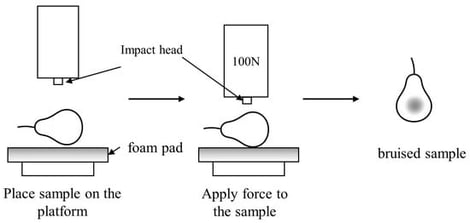
Experimental procedure for producing bruised fragrant pears.

Esquel Meteorite, a Forgotten Argentine Peridot: A Multi Analytical Study

  • Faramarz S. Gard,
  • Rogelio D. Acevedo and
  • Emilia B. Halac
  • + 6 authors

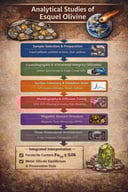
The Esquel pallasite provides a valuable record of metal–silicate interaction in differentiated planetesimals, yet many aspects of its formation and thermal evolution remain uncertain. Here, we present a comprehensive multi-technique characterization of a single Esquel specimen, integrating SC-XRD, Raman spectroscopy, SEM–EDS, XPS, magnetic force microscopy, and X-ray computed tomography. Olivine grains are shown to be structurally pristine, with the first full crystallographic refinement for Esquel confirming a single-domain silicate lattice. XPS demonstrates a stoichiometric silicate surface containing only lattice O2−, Si4+, Mg2+, and Fe2+, indicating that olivine remained chemically unaltered. The Fe–Ni metal preserves diffusion-controlled taenite–kamacite exsolution, compositionally distinct plessite, accessory schreibersite and troilite as resolved by SEM. Quantitative Ni zoning, evaluated through interface-to-center gradients and a width–center-Ni correlation method, yields a self-consistent cooling rate of ~10–20 °C/Myr. MFM reveals microscale magnetic structures that correlate directly with Fe–Ni chemical zoning, providing magnetic confirmation of slow cooling. CT analysis further identifies interconnected metal networks, inclusions, and micro-porosity reflecting melt migration and late-stage modification. These results establish Esquel as an exceptionally well-preserved pallasite and demonstrate the value of integrated, multi-scale analytical workflows for reconstructing early Solar System processes.

6 February 2026

(A) Representative Esquel pallasite fragment and polished-section microstructure. A 1 cm calibration cube is placed adjacent to the sample for scale reference. (B) Reflected-light image of the polished and 2% nital-etched surface showing olivine in contact with Fe–Ni metal. (C,D) Higher-magnification views highlight kamacite, taenite, and plessite revealed by etching and illustrate the characteristic pallasitic metal–silicate interface.

Exploring the Use of Spectral Technologies in Ovine Milk Analysis: A Preliminary Study

  • Aikaterini-Artemis Agiomavriti,
  • Olympiada Saharidi and
  • Athanasios I. Gelasakis
  • + 6 authors

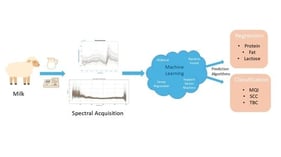
The purpose of this study was to examine the use of portable spectroscopy technologies for rapid milk composition and hygiene quality assessment in ovine milk. Two portable analyzers, namely SmartAnalysis (UV/Vis absorbance) and SpectraPod (NIR transmittance), were used to obtain spectral data of raw milk samples. Additionally, reference values of the milk’s compositional, physical, and hygienic traits were measured. Machine learning algorithms were used to explore the correlations between spectral data and milk traits. The initial results indicated a promising potential of utilizing spectral technologies to predict milk quality and hygienic parameters. Regression models presented a moderate predictive accuracy, with R2 values between 0.55 and 0.34, respectively, regarding fat (RF-NIR) and protein (LR-UV/Vis). Classification models indicated high accuracy for hygienic parameters, with the highest accuracy and AUC values up to 0.87 and 0.83, respectively, predicting increased levels of total bacterial count (TBC), while somatic cell count (SCC) level was less accurately predicted by the model, with AUC values lower than 0.70. The results demonstrate the applicability potential of UV/Vis and NIR portable devices in milk quality assessment, enabling its rapid evaluation, including milk composition and hygiene parameters at the point of service.

30 January 2026

(a) SmartAnalysis (DNAPhone, Padova, Italy), and (b) SpectraPod (MantiSpectra, Eindhoven, the Netherlands).

Portable X-Ray Fluorescence as a Proxy for Aerinite in Pigments of Medieval Alto Aragón Cultural Heritage

  • José Antonio Manso-Alonso,
  • María Puértolas-Clavero and
  • José Antonio Cuchí-Oterino
  • + 2 authors

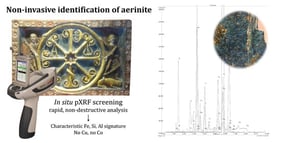
Aerinite is a rare blue aluminosilicate mineral whose identification as a pigment in Pyrenean medieval artworks typically requires invasive microsampling. This study evaluates portable X-ray fluorescence spectroscopy (pXRF) as a noninvasive screening tool for aerinite in Alto Aragón (Spain) cultural heritage. Elemental compositions of aerinite and lapis lazuli references, ceramics, polychromed capitals, and thirteenth- to fifteenth-century painted panels were measured with a Niton XL3t GOLDD+ spectrometer. Data were analyzed using log-ratio linear discriminant analysis (LDA), with silicon as an internal normalizer. Aerinite references showed Cu and Co levels below instrumental detection limits, along with Fe (6.99 ± 1.04 wt%), Al (4.91 ± 1.38 wt%), and Si (15.95 ± 1.60 wt%). High-confidence aerinite classifications were obtained for Cu-free and Co-free blue pigments in the Barbastro Chrismon, the Buira altar frontal, and other panels. Extension of the protocol to green pigments revealed that two samples—from the Saint Anthony Abbot panel and Portaspana retable—were also classified as aerinite, providing the analytical evidence for “verde de Juseu” as a naturally occurring greenish aerinite variety. Despite known pXRF limitations, this technique effectively screens candidate aerinite-containing passages for subsequent microanalytical confirmation.

3 January 2026

(Left) Aerinite in ophite joints. Estopiñán. Museum of Natural Sciences of the University of Zaragoza. (Right) Afghan lapis lazuli. The metallic band in the lower area is pyrite. Note the intense blue color of the reflected light.

News & Conferences

Issues

Open for Submission

Editor's Choice

Get Alerted

Add your email address to receive forthcoming issues of this journal.

XFacebookLinkedIn
Spectrosc. J. - ISSN 2813-446X