Article

Esquel Meteorite, a Forgotten Argentine Peridot: A Multi Analytical Study

1
Gerencia de Materiales, Centro Atómico Constituyentes, Comisión Nacional de Energía Atómica (CNEA), Av. Gral. Paz 1499, Villa Maipú B1650, Provincia de Buenos Aires, Argentina
2
Centro Austral de Investigaciones Científicas del Consejo Nacional de Investigaciones Científicas y Técnicas (CADIC-CONICET), Houssay 200, Ushuaia V9410, Tierra del Fuego, Argentina
3
Departamento de Física de la Materia Condensada, Centro Atómico Constituyentes, Comisión Nacional de Energía Atómica (CAC, CNEA), Av. Gral. Paz 1499, Villa Maipú B1650, Provincia de Buenos Aires, Argentina
4
Laboratorio de Microscopía Electrónica, Gerencia de Materiales, Centro Atómico Constituyentes, Comisión Nacional de Energía Atómica (CAC, CNEA), Av. Gral. Paz 1499, Villa Maipú B1650, Provincia de Buenos Aires, Argentina
5
Instituto de Nanociencia y Nanotecnología (INN), Centro Atómico Constituyentes, Comisión Nacional de Energía Atómica (CNEA), Av. Gral. Paz 1499, Villa Maipú B1650, Provincia de Buenos Aires, Argentina
6
Laboratorio Argentino de Haces de Neutrones (LAHN), Comisión Nacional de Energía Atómica (CNEA), Av. Gral. Paz 1499, Villa Maipú B1650, Provincia de Buenos Aires, Argentina
7
Gerencia de Investigación, Centro Atómico Constituyentes, Comisión Nacional de Energía Atómica (CNEA), Av. Gral. Paz 1499, Villa Maipú B1650, Provincia de Buenos Aires, Argentina
*
Author to whom correspondence should be addressed.
Spectrosc. J. 2026, 4(1), 3; https://doi.org/10.3390/spectroscj4010003
Submission received: 2 December 2025 / Revised: 23 January 2026 / Accepted: 4 February 2026 / Published: 6 February 2026

Abstract

The Esquel pallasite provides a valuable record of metal–silicate interaction in differentiated planetesimals, yet many aspects of its formation and thermal evolution remain uncertain. Here, we present a comprehensive multi-technique characterization of a single Esquel specimen, integrating SC-XRD, Raman spectroscopy, SEM–EDS, XPS, magnetic force microscopy, and X-ray computed tomography. Olivine grains are shown to be structurally pristine, with the first full crystallographic refinement for Esquel confirming a single-domain silicate lattice. XPS demonstrates a stoichiometric silicate surface containing only lattice O2−, Si4+, Mg2+, and Fe2+, indicating that olivine remained chemically unaltered. The Fe–Ni metal preserves diffusion-controlled taenite–kamacite exsolution, compositionally distinct plessite, accessory schreibersite and troilite as resolved by SEM. Quantitative Ni zoning, evaluated through interface-to-center gradients and a width–center-Ni correlation method, yields a self-consistent cooling rate of ~10–20 °C/Myr. MFM reveals microscale magnetic structures that correlate directly with Fe–Ni chemical zoning, providing magnetic confirmation of slow cooling. CT analysis further identifies interconnected metal networks, inclusions, and micro-porosity reflecting melt migration and late-stage modification. These results establish Esquel as an exceptionally well-preserved pallasite and demonstrate the value of integrated, multi-scale analytical workflows for reconstructing early Solar System processes.

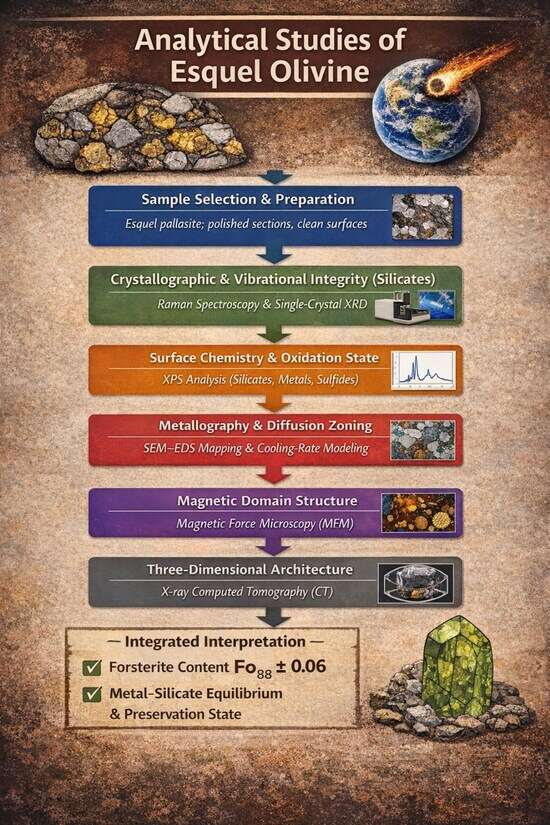
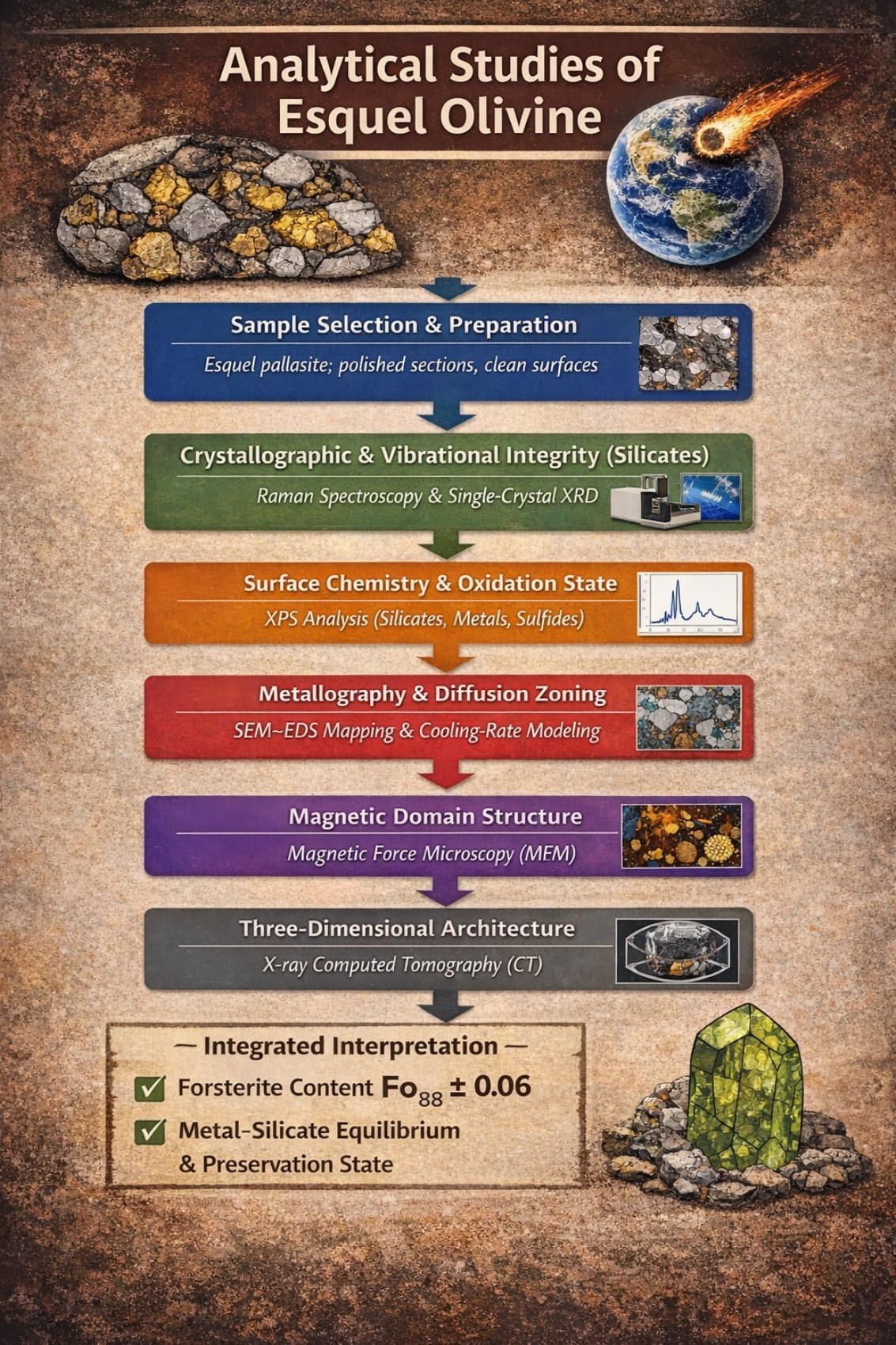
Graphical Abstract

1. Introduction

Pallasite meteorites are a particularly distinctive class of stony–iron meteorites that contain a unique mixture of metallic Fe-Ni and silicate minerals, particularly olivine (Mg-Fe)2SiO4. These meteorites are composed of gem-like olivine (peridot) crystals embedded in a metallic matrix of iron and nickel. Forsterite (Mg2SiO4) and fayalite (Fe2SiO4) are the magnesium-rich and iron-rich end-members, respectively, of the olivine mineral series. They form a solid solution series, meaning that they can mix in any proportion to form a continuous range of compositions known as olivine. They can vary in color from green to yellow, depending on the magnesium (Mg) and iron (Fe) content. Among the well-known pallasites one can mention Imilac (Chile) [1], Brenham (USA) [2] and Esquel (Argentina). These pallasites belong to the Main Group Pallasites (MGPs). They share closely similar oxygen-isotope signatures, metal trace-element systems, and olivine compositions, indicating derivation from a common parent body, likely formed near the core–mantle boundary of a differentiated asteroid. In contrast, non-main-group pallasites exhibit distinct isotopic and mineralogical characteristics, implying different parent bodies [3,4,5,6,7].
The origin of pallasites, such as the Esquel meteorite, has been the subject of various scientific theories, each attempting to explain how these stony-iron meteorites—with their distinctive mixture of olivine crystals and metal—were formed. The primary theories focus on their origin in the core-mantle boundary of differentiated asteroidal. According to this theory, as planetesimals undergo differentiation due to heating, heavier materials like nickel and iron sink to form a core, while lighter silicate materials rise to form a mantle. Pallasites are thought to be the result of partial mixing at this boundary, where molten iron-nickel from the core combines with olivine from the mantle by an impact-induced intermixing. This theory is mainly based on the isotopic and metallic composition similarities between the main group of pallasites and IIIAB iron meteorites. This suggests that IIIAB iron meteorites and the main group of pallasites may have formed within the same or similar parent asteroids. The IIIAB meteorites could represent core material, while the pallasites might originate from the core–mantle boundary. However, a comparison of cooling rates (2.5–20) K/Myr for main group pallasites versus (50–350) K/Myr for IIIAB meteorites contradicts this theory. The wide variation in cooling rates among the main-group of pallasites indicates that they did not cool at the core–mantle boundary of a single parent body, as this would have resulted in uniform cooling rates. Instead, the main-group pallasites, along with several groups of iron meteorites, seem to have cooled within new bodies formed after their original differentiated parent bodies were fragmented by glancing collisions with larger objects. Pallasites, iron meteorites, and their parent asteroids are remnants of a once extensive population of differentiated bodies that experienced a turbulent history of early impacts [4,8,9,10].
Even though the Esquel meteorite, based on limited studies, is recognized as a member of the main-group pallasites [11,12], further comprehensive research could provide valuable insights into crystal formation and metal-silicate interactions. Such studies are essential for understanding the conditions that preserved olivine crystals and the processes behind their formation. Additionally, examining the relationship between the nickel–iron matrix and the embedded silicates could reveal critical information about early planetary differentiation and the dynamics of core–mantle interactions in the early solar system. A deeper investigation of the Esquel meteorite could help reconstruct the history of impacts and fragmentation in the early solar system, offering clues about the size, composition, and structure of its original parent body.
In this study, for the first time, we present a comprehensive, multi-technique investigation of the Esquel pallasite aimed at refining our understanding of its mineralogical complexity, thermal evolution, and post-terrestrial alteration. To achieve this, we combine a broad suite of complementary analytical methods that probe the specimen across multiple length scales. Spectroscopic techniques, including Raman spectroscopy and X-ray photoelectron spectroscopy (XPS), provide fundamental insights into vibrational properties, chemical bonding, and oxidation states of both silicate and metallic phases. Surface and microstructural analyses using scanning electron microscopy (SEM) and magnetic force microscopy (MFM) reveal textural relationships, microstructural features, and microscale magnetic domains within the Fe–Ni metal. Single-crystal X-ray diffraction (SC-XRD) delivers high-precision crystallographic information for the olivine phase, while X-ray computed microtomography (micro-CT) offers a nondestructive three-dimensional view of the internal architecture, including the distribution of metal, silicate, fracture networks.
By integrating these techniques, we obtain a panoramic and internally consistent dataset that spans atomic-scale structure, microscale chemistry, and macroscale geometry. This multi-modal approach provides a robust foundation for reconstructing the cooling history, redox environment, and alteration pathways of Esquel, and contributes to a broader understanding of the processes shaping pallasitic meteorites within their parent bodies and upon exposure to Earth’s surface.

2. Materials and Methods

2.1. History of the Discovery of the Esquel Meteorite

The Esquel meteorite was discovered in 1951 near the city of Esquel, in the province of Chubut, Argentina, when a rural worker, while excavating a pit for the installation of a water tank, found a partially buried metallic mass of great hardness. Its extraterrestrial nature was not formally identified until many years later.
Subsequent specialized analyses [11] confirmed that it is a pallasite-type meteorite, an extremely rare class representing less than 1% of all known meteorites. The main mass of the meteorite was acquired in 1992 by the American collector Robert Haag and transported to the United States, where it was sectioned and distributed among museums, academic institutions, and private collections.

2.2. Raman Spectroscopy

Raman microscopy analyses were performed on a LabRAM HR Raman system (Horiba Jobin Yvon), France equipped with two monochromator gratings and a charge-coupled device detector (CCD). An 800 grooves/mm grating and 100 μm aperture resulted in a 1.5 cm−1 spectral resolution. A He-Ne laser line at 632.8 nm was used as an excitation source. Laser power was adjusted in order to avoid overheating on the sample (around 3 mW). The spectrograph is coupled to an imaging microscope with 10×, 50×, and 100× magnifications. Typically, the laser spot on the sample was about 10 and 3 μm diameter for a 10× and 50× magnification, respectively. An advantage of the microscopic facility is the possibility of analyzing different regions on the seeds.

2.3. X-Ray Photoemission Spectroscopy (XPS)

XPS measurements were carried out using a PHI 5000 VersaProbe II system equipped with a monochromatic aluminum Kα X-ray source (1486.6 eV) and a spherical capacitor analyzer. The analysis chamber was maintained at a base pressure in the lower range of 10−10 Torr. Experimental parameters for the X-ray source included a spot size of 200 μm, X-ray power set at 50 W, and a bias voltage of 15 kV. Prior to sample analysis, the resolution of the system was verified using an Ar-etched, polished fine-grained silver sample, with the full width at half maximum (FWHM) of the Ag 3d5/2 peak measured at 0.69 eV. Data analysis was performed using CasaXPS software version 2.3.18.
Due to the insulating nature of the samples, charging effects were observed during the XPS measurements. The widespread practice to overcome the complication associated with the charging effect is using an electron flood gun; however, the traditional method of electron flood gun charge neutralization proved to be ineffective in neutralizing the localized positive charge induced by the X-ray beam, as the static charge of the sample interfered with the low-energy electron beam. Instead, a dual beam charge neutralization method patented by PHI was utilized. This method combines a low-energy Ar+ ion beam and a low-energy electron beam to effectively neutralize the localized positive charge caused by the X-ray beam. Additionally, the dominant component of adventitious carbon (AdC), specifically (C-C/C-H) in the C 1s energy region at 285 eV, served as a reference point for energy calibration of the XPS spectra.

2.4. Scanning Electron Microscopy (SEM)

SEM-EDS measurements and BS imaging in this study were conducted using an FEI Quanta 200 SEM, Thermo-Fisher, operated in low vacuum mode. The system is equipped with Everhardt–Thornley and solid-state detectors. The samples were not coated with any conducting thin film; however, the low-vacuum SEM capabilities allowed for charge-free imaging and analysis of the uncoated samples. Spectral data were analyzed using Edax Genesis Apollo X software version 6.5 under standard less approximation, indicating that the chemical composition measurements should be considered as semi-quantitative.

2.5. Magnetic Force Microscopy (MFM)

Measurements were performed using a Nanosurf Drive AFM operated in dual-pass tapping-based mode. In this configuration, the scanning tip moves over the surface in two distinct passes. In the first pass, the tip oscillates slightly—touching and retracting from the surface—to map topography. In the second pass, the tip is lifted to measure magnetic interactions. This technique, based on detecting force gradients between the magnetized tip and the sample, enables the visualization of surface magnetization variations with nanometric resolution. The tip used was an MESP probe with a tip radius of approximately 35 nm and a Co/Cr magnetic coating. The hard cobalt–chromium coating provides highly sensitive magnetic contrast, with a nominal coercivity of 400 Oe and a magnetic moment of 1 × 10⁻¹³ emu.

2.6. Single Crystal X-Ray Diffraction (SC-XRD)

The equipment used is a Bruker D8 Quest Eco, which is equipped with a sealed X-ray tube featuring a Molybdenum anode (λ = 0.71073 Å) as the X-ray source. It operates at 50 kV between the anode and cathode, with a tungsten filament heated to incandescence by a 20 mA current. The system includes a CMOS Photon II detector. Diffraction images are processed using the manufacturer’s software, APEX4 (v2023.3-0, Bruker AXS). This step generates a file containing the hhh, kkk, and lll indices along with their respective intensities. An initial structural model is derived using the intrinsic phasing method implemented in the SHELXT program [13,14]. The structural model is then refined using the SHELXL program [14].

2.7. X-Ray Computed Tomography (CT)

Three-dimensional, non-destructive characterization of the sample was performed using high-resolution X-ray computed tomography (CT) on a Nikon Metrology XTH 225 ST system. The scan employed a microfocus X-ray tube with a tungsten filament and cathode operated at 95 kV and up to 40 µA, with a 0.5mm Al filter, yielding an isotropic voxel size of 2.8 µm. A total of 700 projections were acquired. Acquisition parameters were optimized to enhance contrast between metallic (Fe–Ni) and silicate (olivine) phases while minimizing differential attenuation artifacts. Reconstruction of the raw data was performed using CT Pro 3D (Nikon Metrology, Tokyo, Japan).

3. Results

To provide a coherent framework for the presentation of the results, Table 1 summarizes the analytical workflow adopted in this study and the specific information derived from each technique. The methods are ordered to reflect a progression from petrographic context and crystallographic characterization to surface chemistry, metallurgical evolution, magnetic properties, and three-dimensional internal architecture. This integrated approach allows the results from individual techniques to be interpreted consistently and in direct relation to one another, forming the basis for a robust reconstruction of the thermal history, preservation state, and alteration processes recorded by the Esquel pallasite.

3.1. Petrography

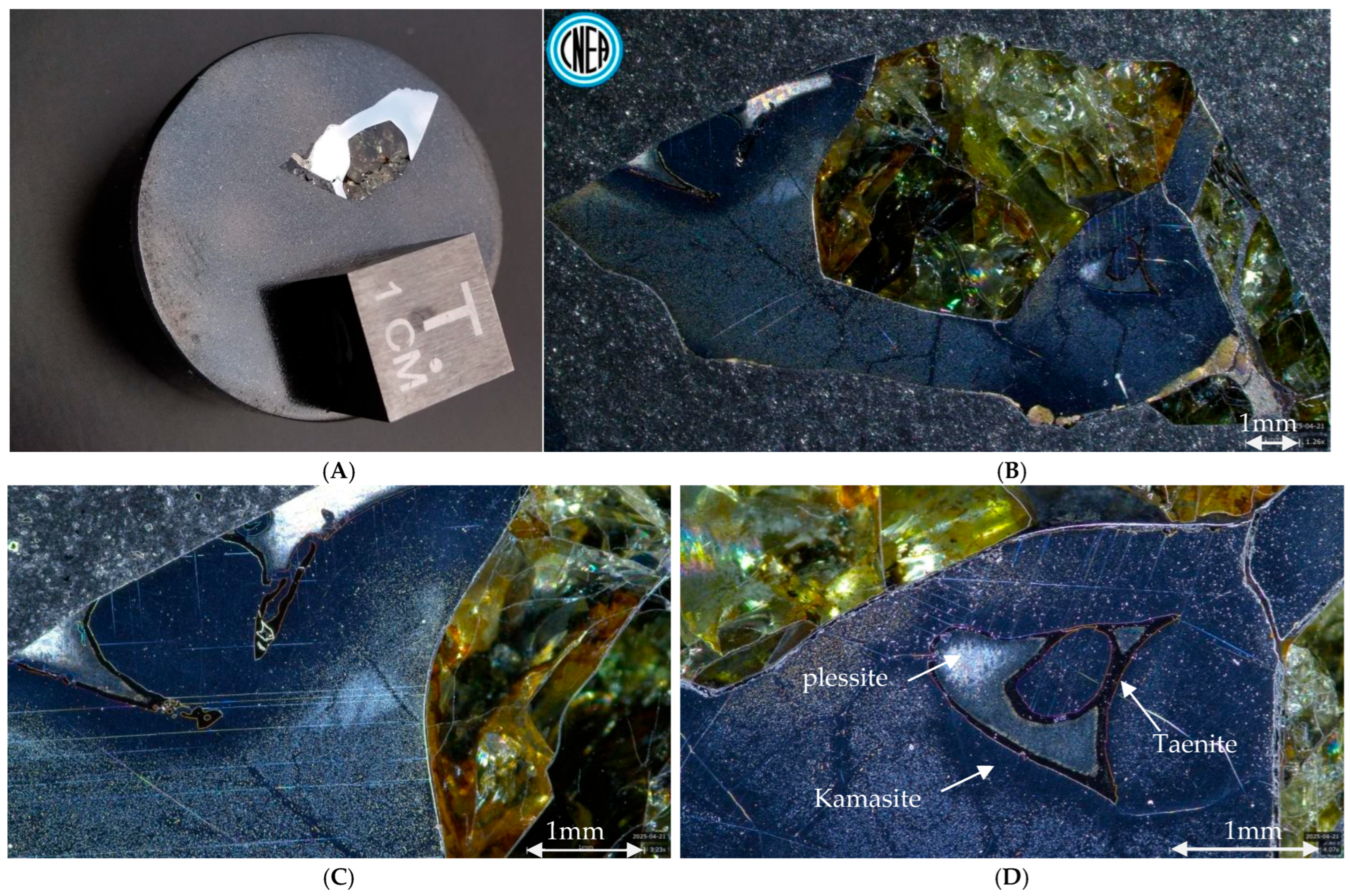
A representative fragment of the Esquel pallasite meteorite, Figure 1A, was prepared for microscopic and compositional analysis. The selected fragment, containing both metallic and silicate regions, was first cleaned with ethanol to remove surface contaminants and subsequently embedded in a thermosetting epoxy resin to facilitate handling and surface preparation. After curing at room temperature, the mounted sample was ground sequentially using silicon carbide (SiC) abrasive papers of decreasing grit size (1200, 800, 400, 240) under running water until a flat, uniform surface was obtained. The specimen was then polished using diamond suspensions of 6 µm, 3 µm, and 1 µm particle sizes on cloth pads to achieve a mirror-like finish suitable for metallographic and microstructural examination.
The polished surface was chemically etched using a 2% nital solution (2% nitric acid in ethanol) to selectively reveal the metallic microstructure. This mild acid etchant preferentially attacked the Fe–Ni alloy phases, enhancing the contrast between kamacite and taenite lamellae and enabling visualization of the characteristic Widmanstätten-type pattern typical of pallasitic iron meteorites. Following etching, the specimen was thoroughly rinsed with deionized water, cleaned with ethanol, and air-dried to prevent surface oxidation or corrosion. The preparation yielded a stable and high-quality surface suitable for subsequent microscopic, spectroscopic, and elemental analyses. Figure 1B presents the entire polished and 2% nital-etched fragment of the Esquel meteorite observed under a reflected light optical microscope. The image reveals a large, fractured olivine (forsterite–fayalite) crystal displaying yellowish-green to brownish hues, typical of silicate phases in pallasitic meteorites. Surrounding the crystal, a bluish-gray metallic Fe–Ni phase forms a discontinuous ring-like feature that partially envelops the silicate grain. This metallic region corresponds to the etched alloy matrix, where kamacite–taenite intergrowths are faintly visible. The remaining dark background represents the epoxy resin mount, not part of the meteorite itself. Fine cracks observed across both silicate and metallic areas likely originated from shock-induced processes. The microstructure illustrates the typical metal–silicate interface of the Esquel pallasite, highlighting the intimate contact between olivine and Fe–Ni alloy phases.
Figure 1C,D present zoom-in reflected light micrographs of the metallic region within the fragments, showing the detailed relationships among the Fe–Ni phases revealed after etching with 2% nital. The images correspond to a magnified area of the metallic rim surrounding the olivine crystal. Three distinct metallic regions can be distinguished based on contrast and texture: kamacite, taenite, and plessite.
The kamacite phase appears as dark bluish-gray regions with a relatively coarse, homogeneous texture. Kamacite represents the low-nickel α-Fe(Ni) phase and forms the dominant metallic matrix in this portion of the meteorite. Embedded within or along the boundaries of kamacite, taenite is visible as darker, reflective lamellae or irregular bands. Taenite corresponds to the high-nickel γ-Fe(Ni) phase and typically exhibits a smoother, more reflective surface after etching. The plessite area, located between taenite and kamacite, appears as a fine intergrowth zone with intermediate contrast. This region represents a submicron mixture of kamacite and taenite formed by solid-state transformation during slow cooling of the parent body. The plessite region reacts strongly with the 2% nital etchant, resulting in pronounced chemical attack and the development of a rough surface texture. This enhanced reactivity reflects the fine intergrowth of taenite and kamacite within plessite, which etch at different rates due to their distinct compositions and microstructures. As a result, the plessitic areas appear more corroded and uneven compared to the surrounding metallic phases after etching.
The close spatial association of these three phases reflects the characteristic Widmanstätten-type microstructure of Fe–Ni metal in pallasitic meteorites. The contact between the metallic region and adjacent olivine crystals (visible at the upper edge of the image) marks the metal–silicate interface typical of Esquel.

3.2. Raman Spectroscopy Results

Magnesium iron silicate (olivine), with the chemical formula (Mg, Fe)2SiO4, is the primary mineral in the Earth’s upper mantle, and it has been reported in extraterrestrial bodies, including meteorites [15,16,17,18]. The ratio of Mg to Fe varies between the two endmembers of the solid solution series: forsterite (Mg-endmember: Mg2SiO4) and fayalite (Fe-endmember: Fe2SiO4).
McKeown et al. [19] used density functional perturbation theory to calculate the Raman spectrum for the Mg end-member of the olivine solid-solution series, namely forsterite (Mg2SiO4). They concluded that the modes with frequencies above 500 cm−1 consist primarily of internal motions of SiO4-tetrahedral, while those below 500 cm−1 are dominated by Mg2 displacements mixed with SiO4 translations and rotations. An equivalent set of Raman spectra was also predicted theoretically for the Fe end-member of the olivine solid-solution series, fayalite (Fe2SiO4) [20,21].
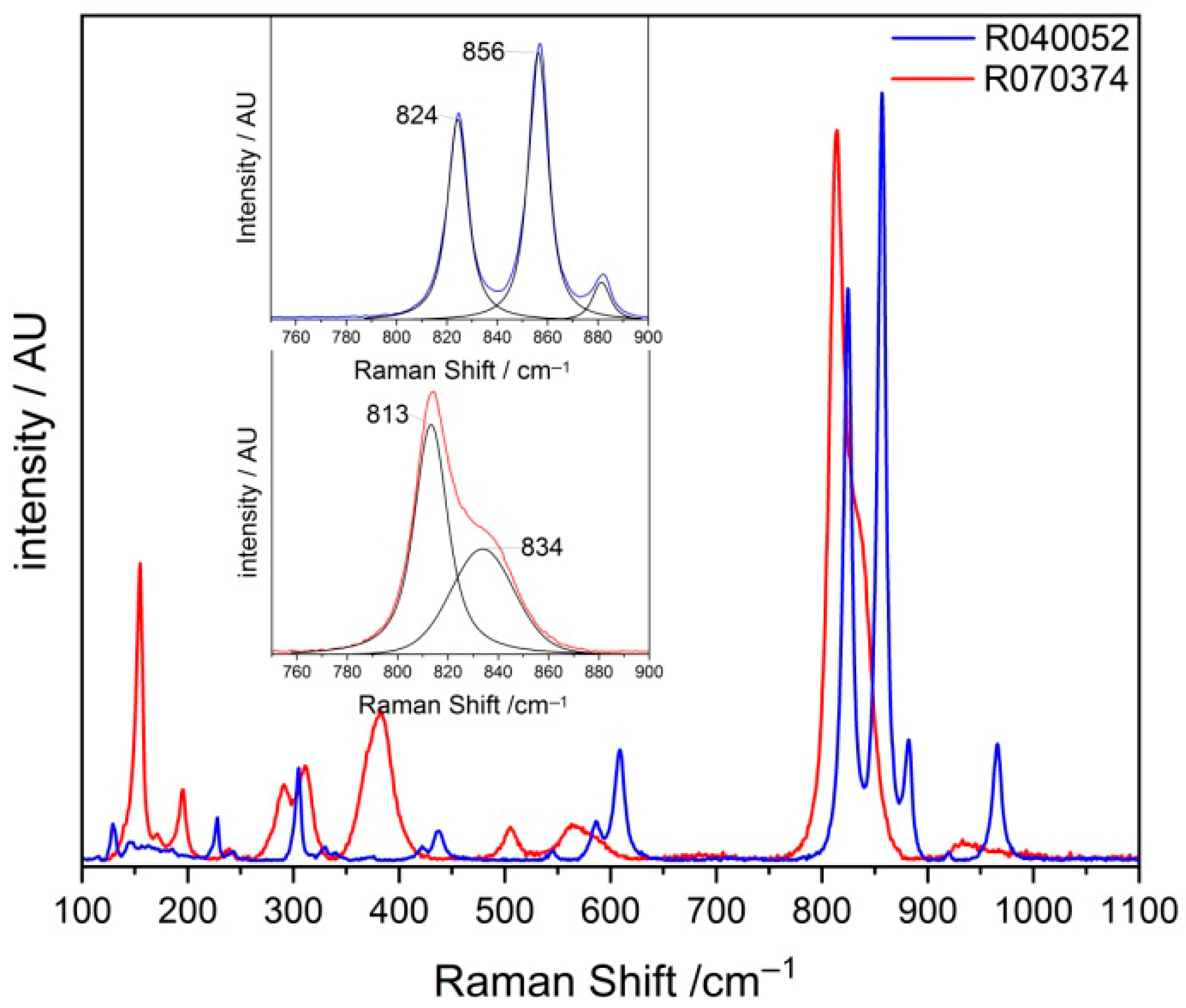
According to the factor group analysis [22], olivine crystals (forsterite and fayalite) have 84 vibrational modes, of which 36 are Raman active (11Ag + 11B1g + 7B2g + 7B3g). The most characteristic among them are two intense lines, one near 838–857 cm−1, belonging to a Ag(Si-O) asymmetric stretching band, and another one around 815–825 cm−1, ascribed to a Ag(Si-O) symmetric stretching band [23]. Figure 2 shows Raman spectra of the olivine end-members forsterite (Mg2SiO4; R040052, blue) and fayalite (Fe2SiO4; R070374, red), reproduced from the RRUFF database [24] and plotted over the range~100–1100 cm−1. Both spectra are dominated by bands associated with SiO4 tetrahedral vibrations, with the most intense features occurring in the 800–900 cm−1 region and corresponding to symmetric and asymmetric Si–O stretching modes. The inset panels highlight the principal high-frequency bands and their fitted components, showing that forsterite displays two sharp and well-resolved peaks at approximately 824 and 856 cm−1, whereas fayalite is characterized by broader bands centered at lower wavenumbers, with dominant peaks near 813 and 834 cm−1. A systematic downshift of Raman peak centroids is therefore observed with decreasing forsterite content, amounting to approximately 15–25 cm−1 between the Mg-rich and Fe-rich end-members, accompanied by noticeable peak broadening in fayalite. This shift reflects the substitution of lighter Mg2+ by heavier Fe2+ in the olivine M sites, which increases the reduced mass of lattice vibrations and modifies octahedral–tetrahedral coupling, leading to lower vibrational frequencies and slight Si–O bond lengthening. Consequently, the Raman peak positions in the 800–900 cm−1 region provide a sensitive and robustproxy for tracking Mg–Fe solid solution and Fo–Fa composition in olivine [19,25]. Some previous works have used the changes in the peak position to predict olivine composition (Fo-Fa) [19,22,23,26,27].
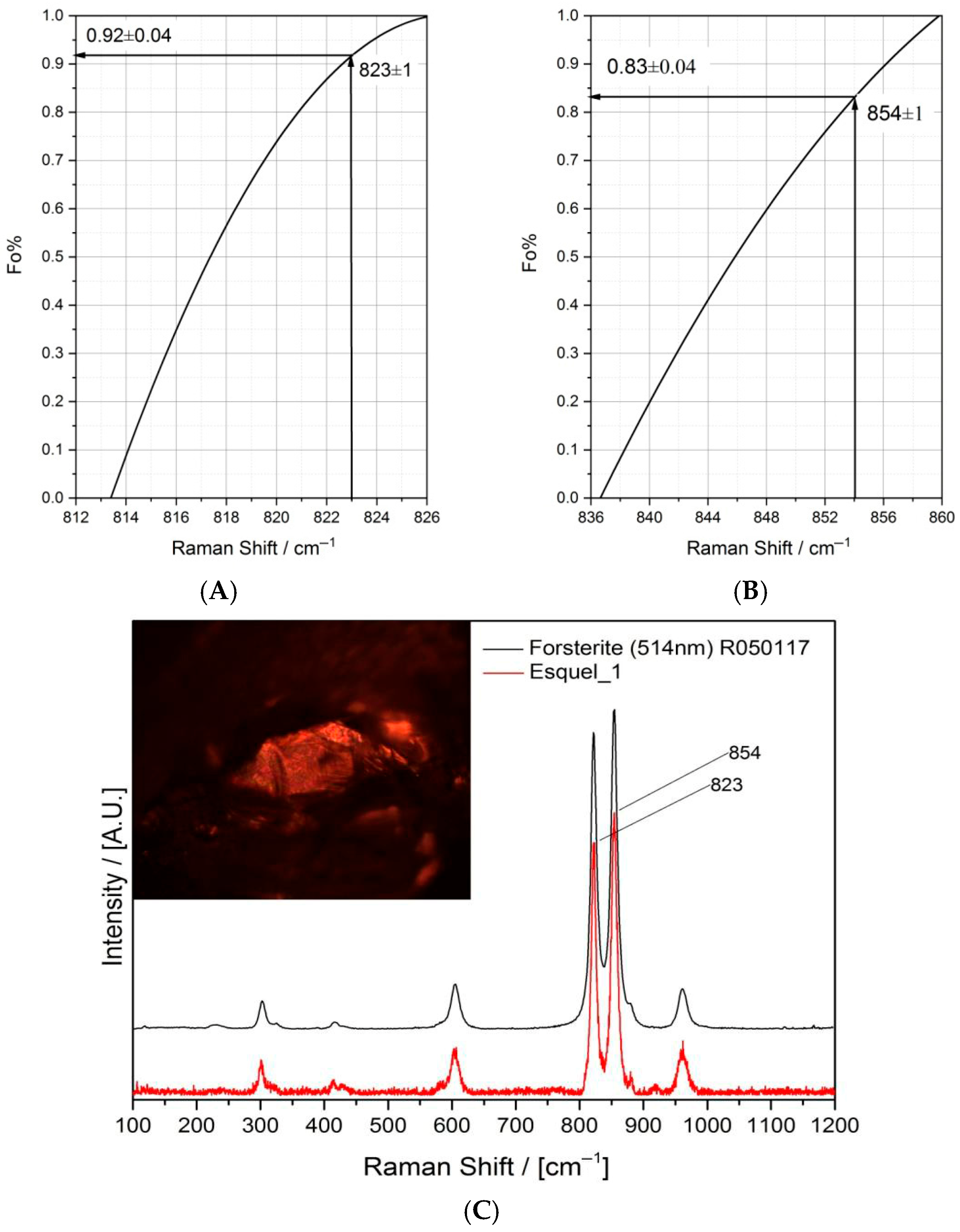
A quantitative estimate of the forsterite content of olivine can be obtained using empirical polynomial regressions that relate the positions of Raman-active Si–O stretching modes to olivine composition. The molar percentage of forsterite (%Fo) can be calculated from either the position of the Ag(Si–O) symmetric stretching band in the range of 815–825 cm−1 (xsym) or the Ag(Si–O) asymmetric stretching band in the range of 840–860 cm−1 (xasym) using the following second-order polynomial equations [27]:
% F o = 0.00079869 x s y m 2 + 1.3981 x s y m 610.65 ,
% F o = 0.0054348 x a s y m 2 + 8.9889 x a s y m 3715.8 ,
Both equations are plotted in Figure 3A,B, respectively, whereas Figure 3C shows a typical Raman spectrum of a silicate inclusion within the Esquel meteorite (red curve) compared with a reference spectrum of pure forsterite (Mg2SiO4; black curve, RRUFF ID: R050117). Both spectra exhibit the characteristic doublet of olivine near 823 cm−1 and 854 cm−1, corresponding to the symmetric and asymmetric Si–O stretching vibrations of isolated SiO4 tetrahedra. The Esquel spectrum closely matches that of forsterite reference, with no significant band broadening or shift, indicating a crystalline olivine phase with minimal Fe substitution. Additional minor peaks observed at lower wavenumbers (200–600 cm−1) are also consistent with internal Si–O–Si bending and lattice vibrations of the olivine structure [28,29]. A statistical analysis of the positions of the main features of forsterite spectra, obtained from 10 different points on the sample, yields the positions of the Ag(Si–O) symmetric stretching band peak and that of the Ag(Si–O) asymmetric stretching band peak to be equal to (823 ± 1) cm−1 and (854 ± 1) cm−1, respectively. These values give a composition of olivine Fo = (0.92 ± 0.04) and Fo = (0.83 ± 0.04).Using the second-order polynomials suggested by [27], the average forsterite content of the olivine is therefore Fo = (0.88 ± 0.03). This implies a high forsterite content and a Mg-rich composition. This is consistent with the typical olivine composition found in pallasite meteorites, reflecting formation under highly reducing conditions and equilibration with Fe–Ni metal phases [4,30]. These results are in good agreement with the modal mineralogy carried out by SEM-EDX, Supplementary Materials 1.

3.3. SEM Results

3.3.1. Kamacite and Taenite

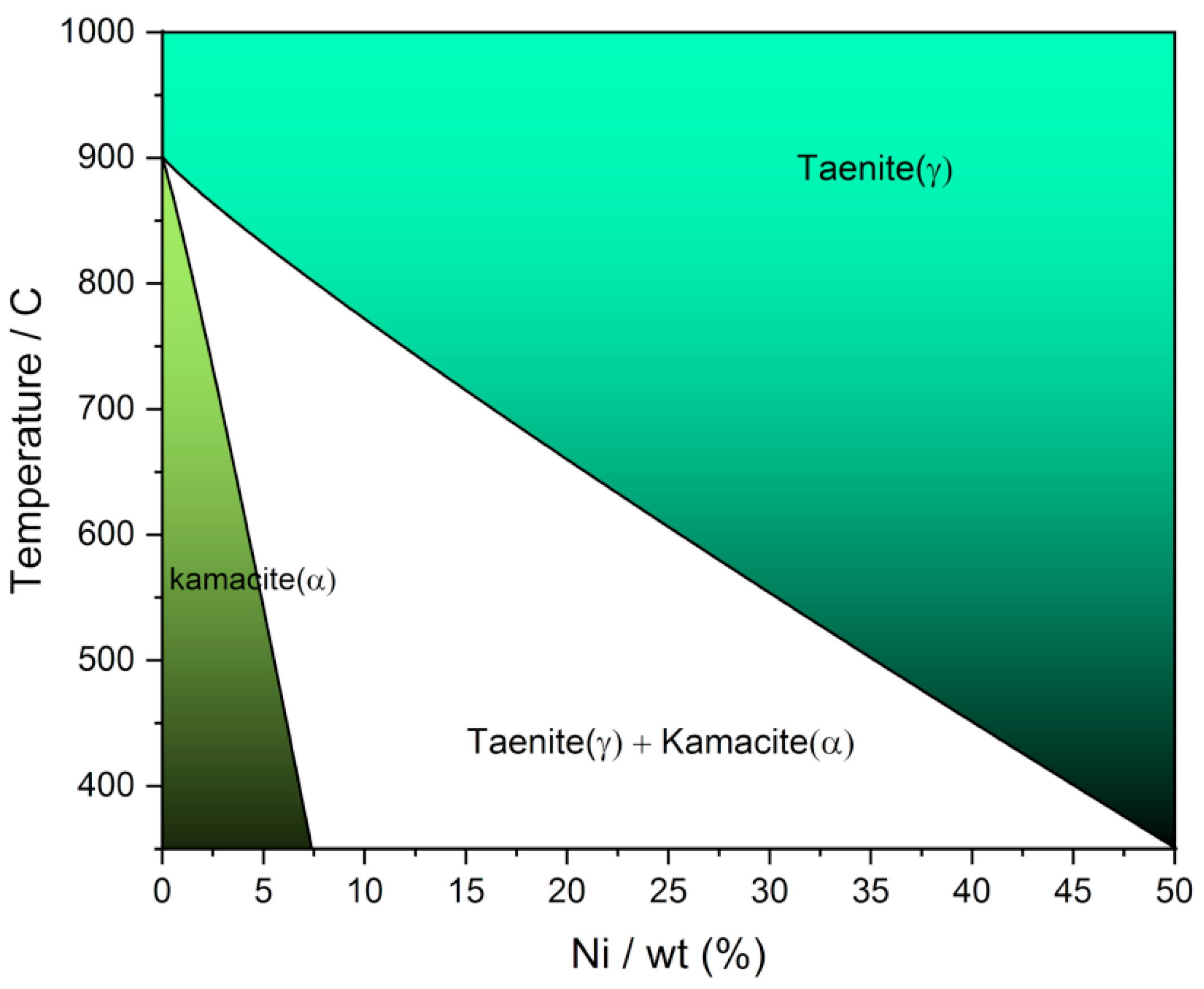
The Fe–Ni metal in the Esquel pallasite records its thermal history through subsolidus transformations that occur as taenite (γ, FCC) cools into the two-phase (α + γ) stability field of the Fe–Ni phase diagram. Figure 4 presents a schematic Fe–Ni phase diagram illustrating the stability fields of taenite (γ, face-centered cubic Fe–Ni) and kamacite (α, body-centered cubic Fe–Ni) as a function of temperature and nickel concentration. The actual Fe–Ni phase diagram is not presented, as it is beyond the scope of the current work. At high temperatures (>900 °C), the metallic phase exists entirely as taenite (γ–Fe, ~8–10% Ni), a solid solution of Fe and Ni. As the system cools, the γ-phase becomes unstable at low Ni concentrations. The boundary between the γ field and the two-phase (α + γ) region marks the onset of kamacite [31,32,33,34].
Within the α + γ region, kamacite (α) starts to nucleate along taenite grain boundaries. As diffusion continues during prolonged cooling (over millions of years), Ni redistributes, producing a composition gradient. The remaining taenite becomes progressively Ni-enriched, and the diffusion fronts create the characteristic taenite bands separating kamacite lamellae in the Widmanstätten pattern, for metallic meteorite. At lower temperatures (<400 °C), diffusion slows dramatically, preserving these Ni concentration profiles (M-shape) between kamacite regions. The resulting Ni concentration profile across the kamacite–taenite boundary records the extent of diffusion and is directly linked to the cooling rate. Faster cooling preserves steep gradients and narrow taenite bands, while slower cooling allows for broader taenite zones with smoother Ni profiles [34,35,36].
In other words, the final Ni distribution preserved within these lamellae is not a simple equilibrium signature; instead, it reflects a diffusion process that gradually slows as temperature decreases, eventually “freezing in” a compositional pattern that directly encodes the cooling rate of the parent body. Thus, a detailed study of Ni gradients—both across and along taenite bands—provides a powerful quantitative constraint on thermal evolution.
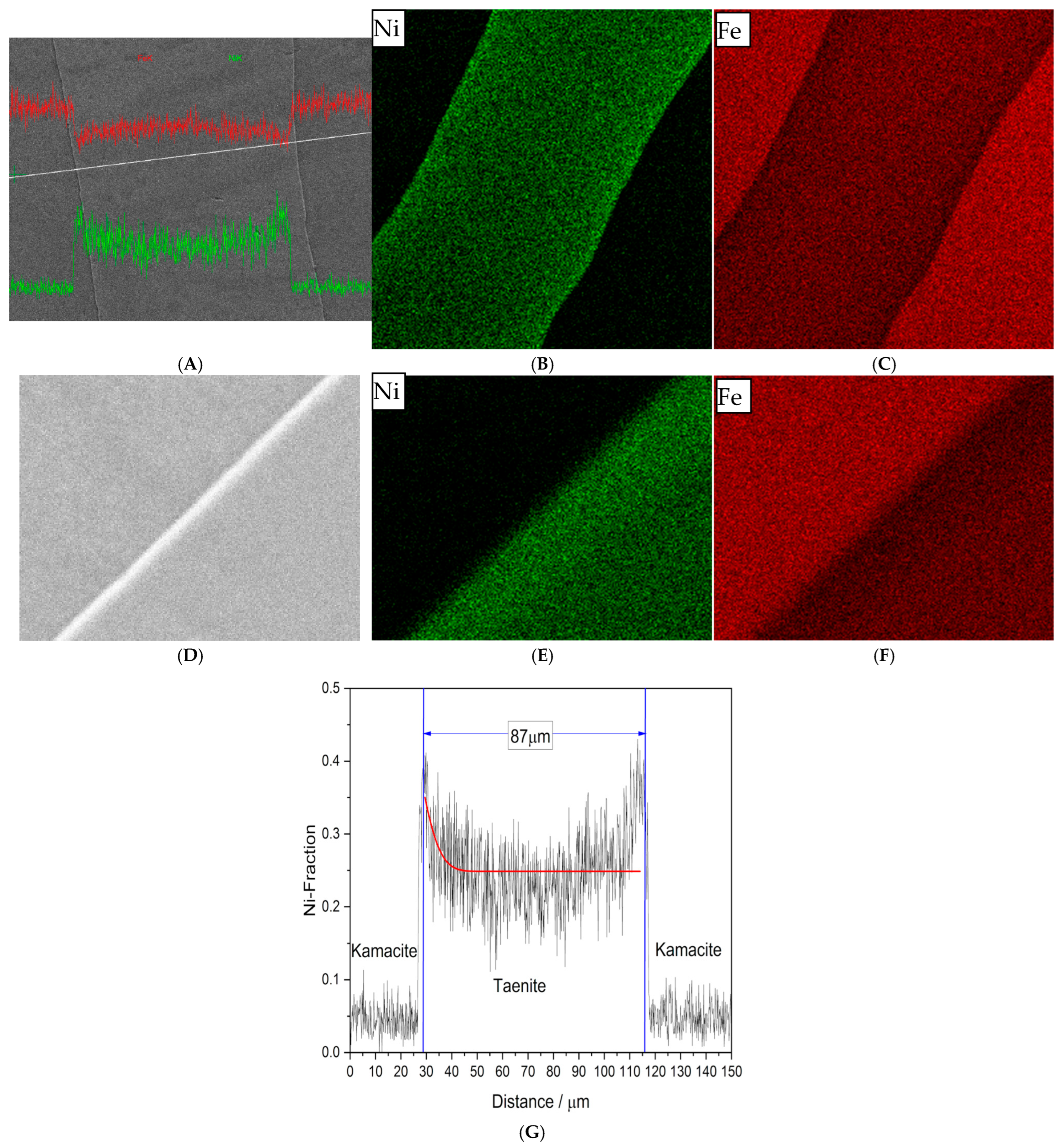
Figure 5 shows SEM chemical mapping of a taenite strip together with a quantitative line scan across the interface. The secondary-electron (SE) image (grayscale) (panel A) delineates the taenite band and the adjacent kamacite. Color-coded element maps reveal the nickel-rich region, the taenite (panel B, green) and iron dominating region, and the kamacite (panel C, red). The zoomed-in view highlights fine-scale chemical heterogeneities and intergrowths within the metallic phase, implying incomplete chemical equilibration (panels D–F).
A quantitative line scan (panel G) across a taenite band of width ~87 μm within the Fe–Ni metallic matrix Kamacite was analyzed to determine the spatial distribution of Ni concentration. The line profile extracted along the strip shows the Ni concentration rising steeply to a maximum of approximately 45 at.% at the edge of the taenite strip and decreasing to about 6 at.% in the adjacent kamacite region outside the strip. This large compositional contrast (≈40 at.% Ni difference) over a short distance indicates strong partitioning between taenite and kamacite and is diagnostic of subsolidus exsolution and diffusion-controlled redistribution of Ni and Fe.
The measured Ni profile shows a clear decreasing trend from the Ni-enriched region near the taenite–kamacite interfaces toward the band center. This trend reflects the redistribution of Ni by solid-state diffusion during the slow cooling of the Esquel pallasite, which can be used to measure cooling rate of the pallasite [37].
To characterize the diffusion process across the Taenite band, the Ni concentration was fitted as a function of distance (x) from the taenite–kamacite interface using an error-function solution to Fick’s second law [38,39]:
N i x = A + B × e r f c x x 0 2 L e f f
where (A) and (B) are fitting constants, (x0) represents the interface position, and Leff is an effective diffusion-length parameter. The best fit to the SEM–EDS line-scan data yielded L e f f 5.2   μ m , indicating that Ni concentration decreases smoothly from the interface to the center of the taenite band. The fitted diffusion length was then related to the characteristic diffusion time (t) through the expression L 2 D t , where L is the diffusion length and (D) is the temperature-dependent diffusion coefficient for Ni in taenite, which typically follows an Arrhenius relation [40]:
D = D 0 e x p Q R T
where D0 is the pre-exponential factor, Q is the activation energy, R is the gas constant 8.314 Jmol−1K−1, and T is the temperature in Kelvin. Using published diffusion data for Ni in γ-Fe-Ni D 0 = 1.6 × 10 4 m2s−1 and Q = 250 kJ mol−1, diffusion coefficients were calculated for the temperature range 400–900 °C.
Assuming that Ni redistribution occurred predominantly between 500 °C and 600 °C—the range in which diffusion is still active but begins to “freeze in”—the corresponding diffusion timescales are on the order of 106–107 years. Given a temperature interval of approximately 400 °C across which taenite exsolved and re-equilibrated, the metallographic cooling rate is estimated between almost 1 and 40 °C Myr−1, consistent with previously reported values for the Esquel pallasite and indicative of extremely slow deep-seated cooling within its parent body [41].
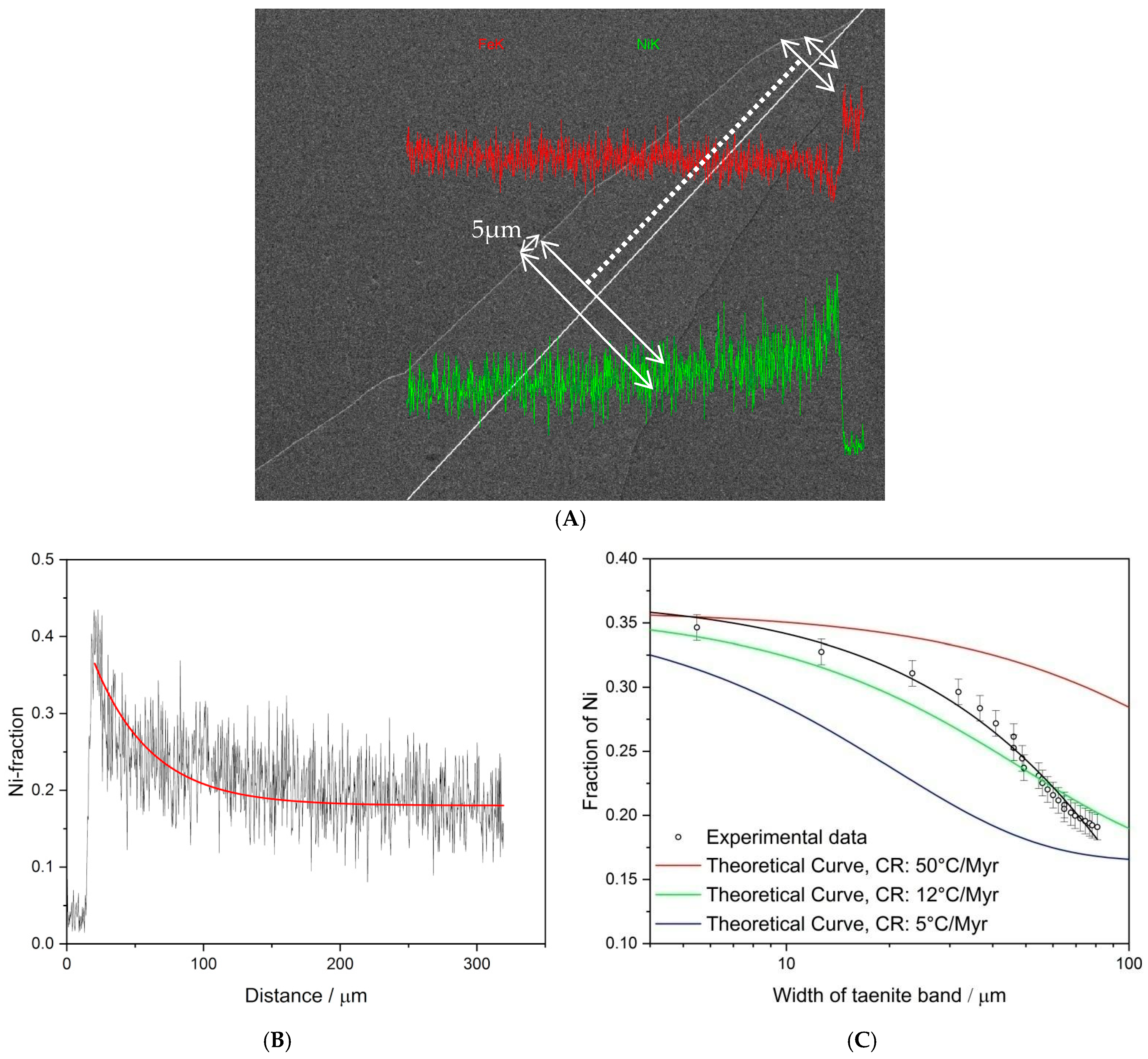
While single-band diffusion profiles provide diffusion lengths, the variation in Ni concentration with taenite-band width supplies an independent, integrated constraint on cooling [9]. Due to the lack of taenite bands with different widths, we instead measured the Ni concentration at the geometric center of a single taenite band with a different width; see Figure 6. It demonstrates a clear and systematic relationship between the Ni-fraction and the band width. The Ni concentration was probed along the center of a taenite band with a varying width of 0 to 100 μm. Figure 6A shows the backscattered-electron image of the taenite band with the overlaid SEM–EDS line scan (white line) and element traces (Fe Kα in red, Ni Kα in green). The corresponding Ni concentration profile, Figure 6B, is plotted as the Ni-fraction versus distance along the scan path; an exponential curve (red) was fitted to the data to enable interpolation of the Ni content at positions of interest.
The Ni concentration measured at the geometric center of the band depends on band thickness: narrow taenite bands retain relatively high (about 45%) at their centers, while wider bands show progressively lower central Ni concentration values, decreasing to approximately 0.20 Ni-fraction (about 20 wt%) in the widest regions of the taenite band. The width of the taenite band was measured directly from SEM micrographs using ImageJ software, 1.52 a, calibrated against the scale bar in the backscattered electron (BSE) image to ensure micrometer-scale accuracy. The measured boundary-to-boundary distances at 5 µm intervals were then correlated with the corresponding Ni concentrations determined at the center of the taenite bands. It provides a consistent empirical trend between the Niconcentration at the center and the width of the taenite band, which would support a diffusion-controlled growth mechanism for taenite and provide a quantitative framework for estimating the metallographic cooling rate of the Esquel pallasite.
This systematic decrease in central Ni with increasing band width is consistent with diffusion-controlled re-equilibration during slow cooling. As kamacite nucleates and grows, it rejects Ni into the bordering taenite; consequently, Ni is concentrated at the taenite–kamacite interfaces. In narrow taenite lamellae, the Ni-enriched diffusion zones from opposite interfaces overlap and raise the central Ni concentration. In wider lamellae, the enrichment fronts do not reach the geometric center, so the center remains relatively depleted.
Figure 6C shows the relationship between the Ni concentration measured at the geometric center of the taenite band at 5 µm intervals. The data exhibit the characteristic inverse correlation predicted for diffusion-controlled Ni redistribution during slow cooling of Fe–Ni metal. Narrow regions (≤10 µm) display high central Ni contents of ~0.33–0.35, whereas wider regions (≥80 µm) show significantly lower values (~0.19–0.21). To quantify the cooling rate, the measured Ni–width data were compared with theoretical diffusion profiles derived from Fe–Ni taenite–kamacite growth models [42,43].
The synthetic model curves corresponding to a range of candidate cooling rates (5, 12, and 50 °C/Myr) were then generated and overplotted with the measured data. We reconstructed the central Ni evolution using an exponential diffusion-proxy function of the form Y w = y + A · e x p ( k w ) , where (w) is the taenite-band width and (k) is an effective diffusion parameter inversely proportional to cooling rate. The model parameters were fitted to the empirical data, and the resulting diffusion parameter (k) was calibrated against published Ni-diffusion cooling curves for Fe–Ni systems. The observed Ni-concentration and the width of the band matchmost closely the theoretical curve corresponding to cooling at approximately 10–20 °C/Myr. The best-fit value is ~12 ± 3 °C/Myr through the 400–600 °C interval, where kamacite growth and Ni redistribution are most sensitive to cooling rate. Cooling at significantly slower rates (<5 °C/Myr, blue curve) would produce center-Ni values that remain too high at widths >50 µm, while more rapid cooling (>50 °C/Myr, red curve) would generate steeper Ni gradients than those observed. The derived cooling rate is fully consistent with metal crystallization in the deep interior of a differentiated parent body, at depths of several to tens of kilometers, where thermal gradients and conductive heat loss lead to cooling rates of the order of 1–50 °C/Myr. This is consistent with the value we obtained by analyzing a single taenite band of width 87 μm.

3.3.2. Troilite

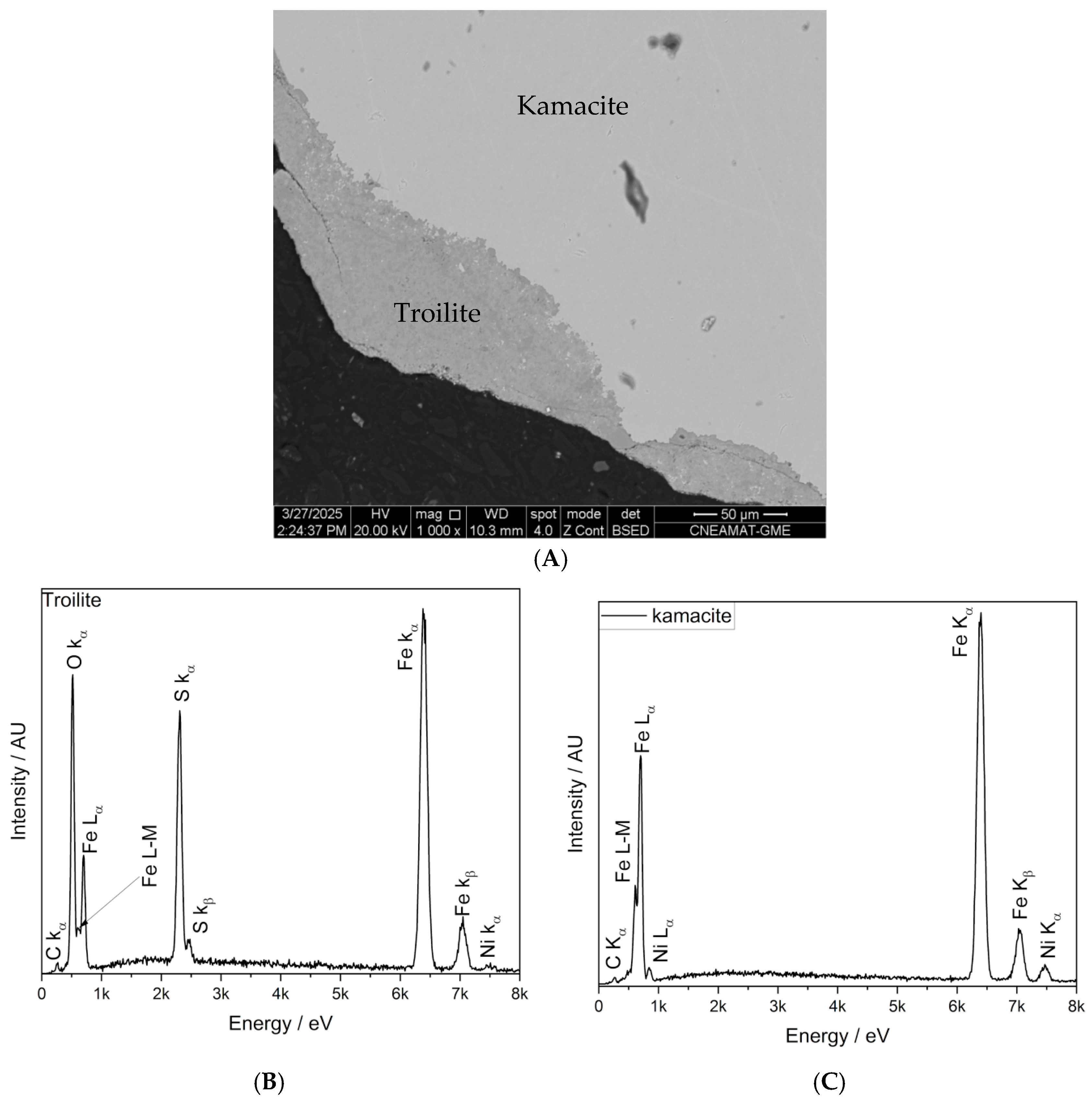
Presence of troilite (FeS) has been reported in pallasites [44,45,46]. It is a minor mineral in pallasites, where it is found within the iron–nickel metal matrix alongside large olivine crystals. It is often associated with kamacite and schreibersite ((Fe,Ni)3P) and is a product of the molten metal that formed during the pallasite’s formation. In the sample analyzed here, we detected an Fe–O–S–bearing phase that occurs along the margins of metallic grains and within narrow fractures extending into the silicate matrix. Figure 7 shows a backscattered-electron SEM image of a sulfide-bearing region at the edge of the fragment, adjacent to kamacite. Representative SEM–EDX spectra acquired from both the troilite and kamacite regions are also provided. SEM–EDX analyses of this region show a composition dominated by Fe (≈65–70 wt%), accompanied by moderate O (≈15–20 wt%) and S (≈10–20 wt%). These proportions indicate the intimate intergrowth of an Fe–S phase with an Fe–O phase. The measured S/Fe ratios are consistent with a primary sulfide—most plausibly troilite (FeS) or pyrrhotite (Fe1−xS)—whereas the O/Fe ratios and elevated O contents suggest the presence of a secondary Fe–oxide such as magnetite [47], which is confirmed by Raman spectroscopy, Supplementary Materials 1, Figure S1.
The microstructural relations between sulfide and oxide indicate partial oxidation of troilite, manifested as a thin oxide rim or as a finely intermixed sulfide–oxide aggregate. Similar alteration textures have been reported in other pallasites and are typically attributed to low-temperature terrestrial weathering under oxidizing conditions. The coexistence of Fe–S and Fe–O phases in Esquel therefore records the early stages of sulfide alteration following the meteorite’s residence in Earth’s near-surface environment. This is also confirmed by XPS measurement (Section 3.4).

3.3.3. Schreibersite

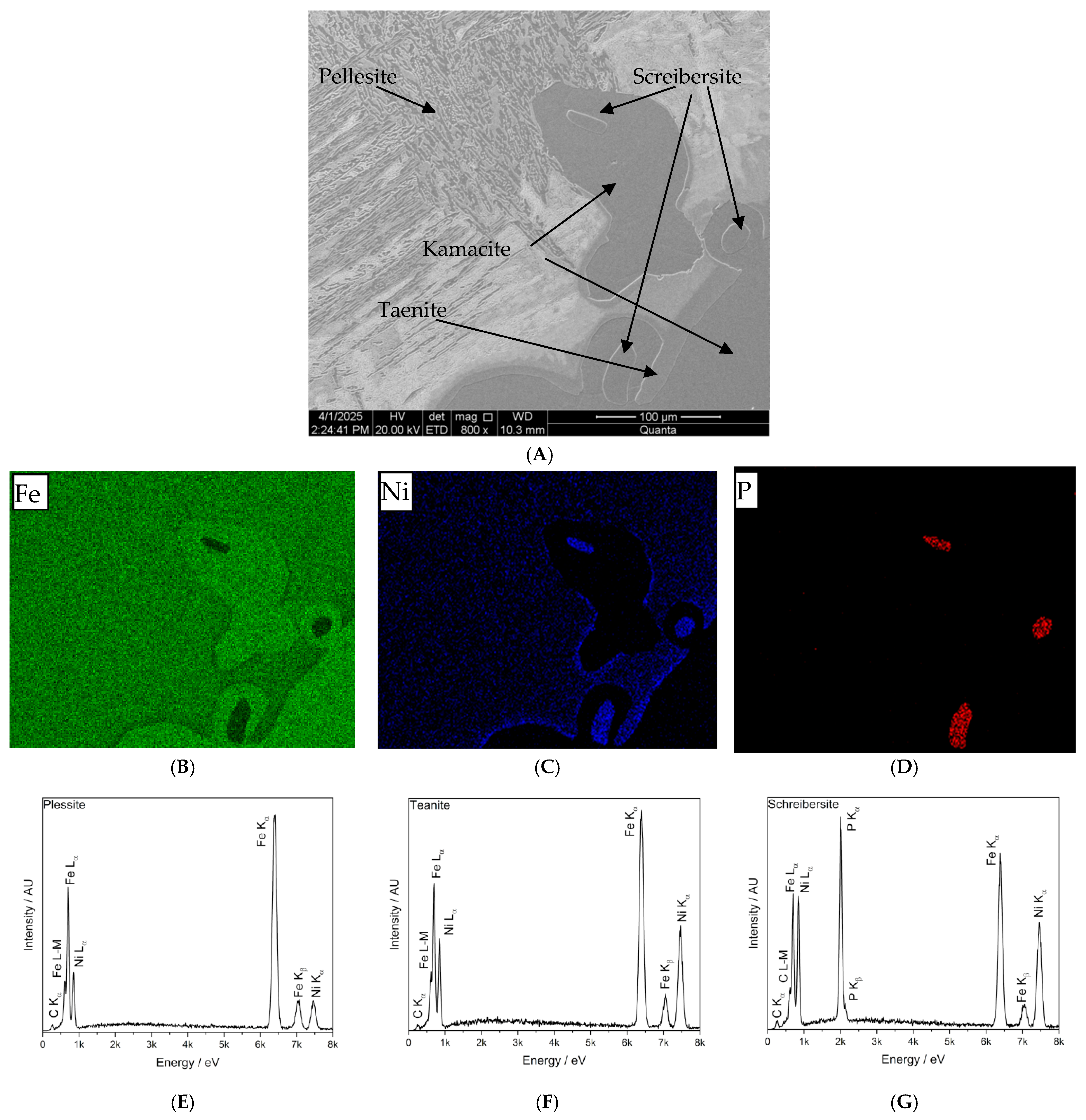
Schreibersite was also reported in pallasites [46]. Figure 8 presents a back-scattered electron (BSE) image of a metallic region of the specimen analyzed in this study, containing three small schreibersite grains associated with plessite, taenite, and kamacite. Corresponding SEM elemental maps (Fe Kα, Ni Kα, P Kα) and representative SEM–EDX spectra for the various phases are shown alongside it. Quantitative SEM–EDX analyses of this region yielded average atomic proportions of Ni ≈ 37 at%, Fe ≈ 38 at%, and P ≈ 25 at%. The resulting metal-to-phosphorus ratio (Fe + Ni:P ≈ 3:1), together with the nearly equal Fe and Ni abundances, is fully consistent with the stoichiometry of the Fe–Ni phosphide, schreibersite, (Fe,Ni)3P. In the Esquel meteorite, schreibersite occurs as small inclusions or lamellae hosted within the Fe–Ni metal and represents the primary repository of phosphorus in the metallic fraction. Its occurrence is indicative of the slow cooling rates and moderately reducing conditions characteristic of pallasitic metal crystallization.

3.4. XPS Results

3.4.1. Metallic Fe-Ni Region

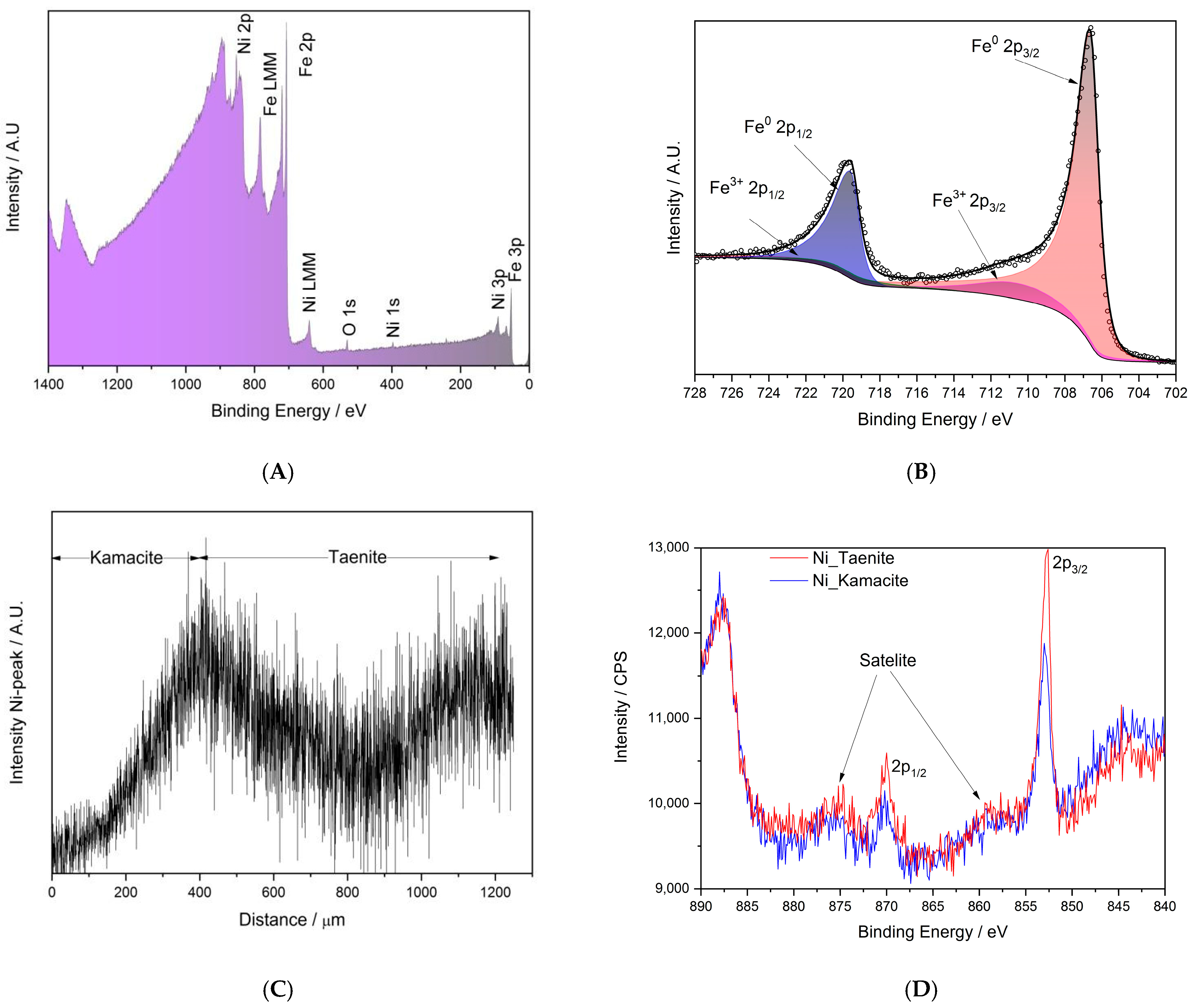
High-resolution XPS was acquired from the metallic Fe–Ni phase of the Esquel pallasite after in situ cleaning by 2 keV Ar+ sputtering for 2 min. The survey spectrum (Figure 9A) shows a clean metallic surface dominated by Fe and Ni photoemission features, with no measurable C 1s, OH-related O 1s components, or other contaminants. The residual O 1s intensity is low and consistent with sub-nanometric Fe-oxide remnants that typically persist after moderate-energy sputtering of meteoritic metal.
In the Fe 2p region (Figure 9B), the Fe 2p3/2 peak is centered at the expected binding energy for metallic Fe0 (706.7 ± 0.1) eV, accompanied by a minor high-binding-energy shoulder and weak structure between 710 and 714 eV. These secondary features indicate the presence of a thin, partially reduced FeO surface layer that was not fully removed by the limited sputter duration. The Fe 2p1/2 component exhibits a corresponding weak oxide contribution. No measurable Fe3+ multiplet structure is observed, suggesting that any oxide predominantly Fe2+ or mixed-valence is removed by Ar-ion cleaning [48].
A lateral line scan across a taenite band (Figure 9C) reveals systematic variations in Ni and Fe intensities across the kamacite–taenite interface. Ni concentration increases toward the taenite, consistent with compositional zoning inferred from electron microprobe analyses. However, the gradient is significantly smoother than in SEM–EDS line profiles. This is inherent to the large XPS analytical footprint (~200 µm × 200 µm), the finite escape depth of Ni 2p electrons (~1–3 nm), and spatial averaging over submicron compositional heterogeneity within plessitic textures.
Comparison of high-resolution Ni 2p spectra collected from representative kamacite and taenite domains (Figure 9D) confirms this zoning. The Ni 2p3/2 peak is centered at (852.6 ± 0.1) eV in both cases, consistent with metallic Ni in Fe–Ni alloys. The taenite region exhibits significantly higher peak intensity, reflecting its higher bulk Ni concentration. The satellite peaks at ~860 eV are observed, demonstrating the presence of NiO or Ni(OH)2 contributions [49].

3.4.2. Troilite Containing Region

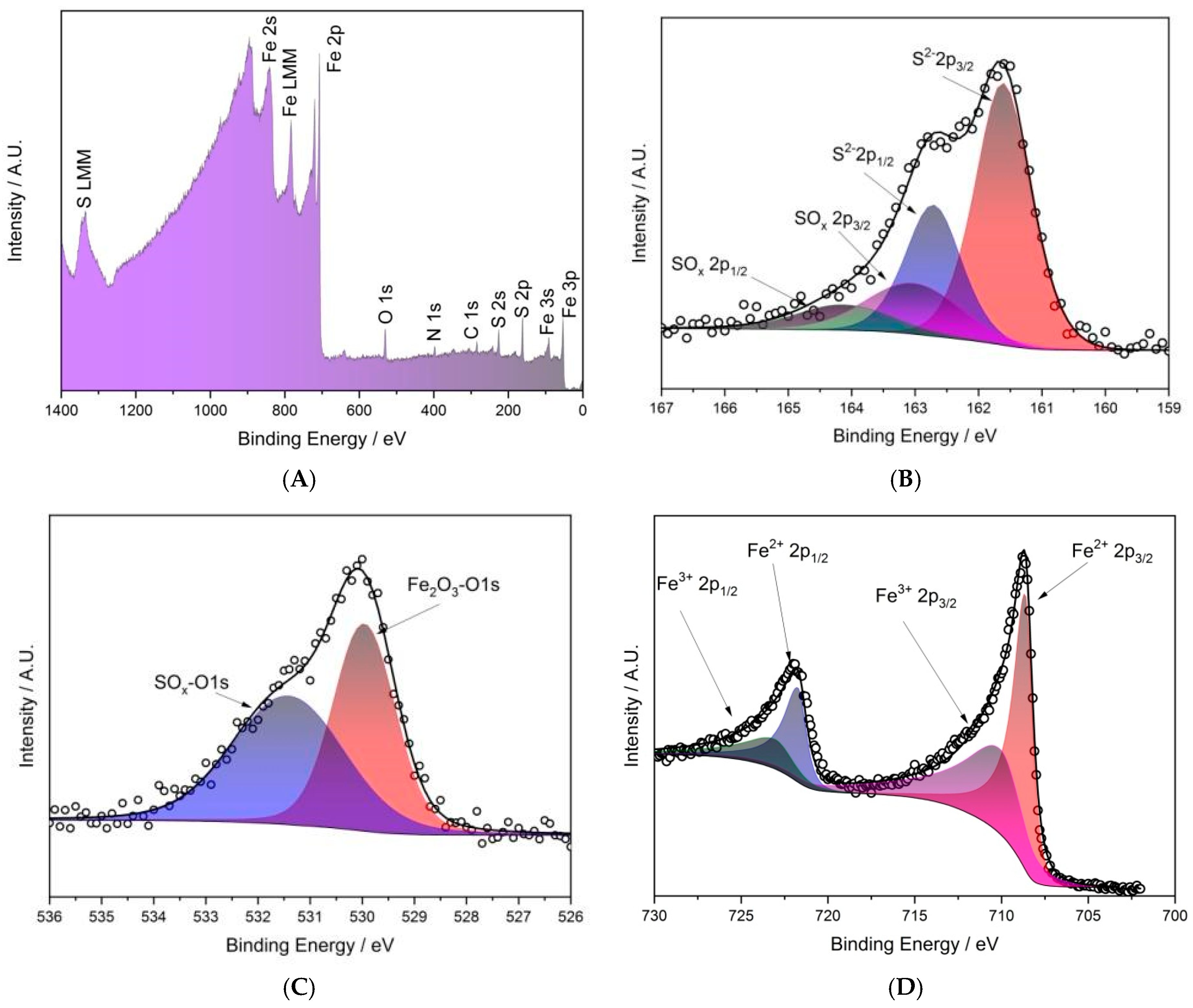
X-ray photoelectron spectroscopy of the FeS regions (Figure 10) reveals a surface composition dominated by troilite but exhibiting clear evidence of post-formational oxidation. The survey spectrum shows Fe, S, O, C and a measurable N 1s signal. The appearance of nitrogen at 400.0 ± 0.2 eV is noteworthy, as SEM-EDX is unable to resolve N owing to the overlap of the N Kα line with the adjacent C and O peaks. Its presence in XPS therefore reflects either weakly bound adsorbates or low-level contamination introduced during terrestrial residence or handling.
The S 2p doublet is dominated by the troilite component, with the S 2p3/2peak located at 161.9 ± 0.1 eV and the S 2p1/2 partner at 163.1 ± 0.1 eV, fully consistent with S2− in FeS. In addition to this primary sulfide signature, a distinct high-binding-energy doublet is present, with the S 2p3/2 peak at 168.7 ± 0.1 eV, indicative of oxidized sulfur species such as sulfate [50]. The coexistence of reduced and oxidized sulfur at the extreme surface suggests a thin oxidative alteration layer produced after the meteorite’s arrival on Earth.
The Fe 2p high-resolution spectrum confirms the same alteration behavior. The Fe 2p3/2 peak associated with sulfide-bound Fe occurs at (708.7 ± 0.1) eV, characteristic of troilite. Superimposed on this is a broader envelope centered at (710.5 ± 0.1) eV, which is diagnostic of mixed Fe3+ oxides and hydroxides. The O 1s region contains a strong oxide-related component at (529.8 ± 0.1) eV, together with a higher-energy peak at (531.4 ± 0.1) eV attributable to iron oxide and sulfur oxide, respectively.
These spectral features collectively indicate that while the subsurface maintains the chemistry of stoichiometric troilite, the outermost layer has undergone oxidation. Such thin alteration layers are typical of meteoritic sulfides due to their strong reactivity toward oxygen and water at low temperature.
From a petrologic perspective, the XPS results reinforce the interpretation that the troilite itself remains unmetamorphosed at the crystal-chemical level and preserves its primary FeS composition, in agreement with the low-temperature thermal history inferred for Esquel. The observed oxidized sulfur and iron species therefore do not reflect parent-body metamorphism; instead, they represent a terrestrial overprint superimposed on an otherwise unaltered sulfide. This is consistent with the low diffusion mobility of S and Fe in troilite at the modest metamorphic temperatures experienced by pallasites, and the high susceptibility of FeS surfaces to rapid oxidation when exposed to Earth’s atmosphere. Accordingly, the XPS data support the broader conclusion that the Esquel meteorite preserves a largely pristine record of its parent-body processes, with surface oxidation representing only a late, minor alteration restricted to the outermost molecular layers.

3.4.3. Olivine Region

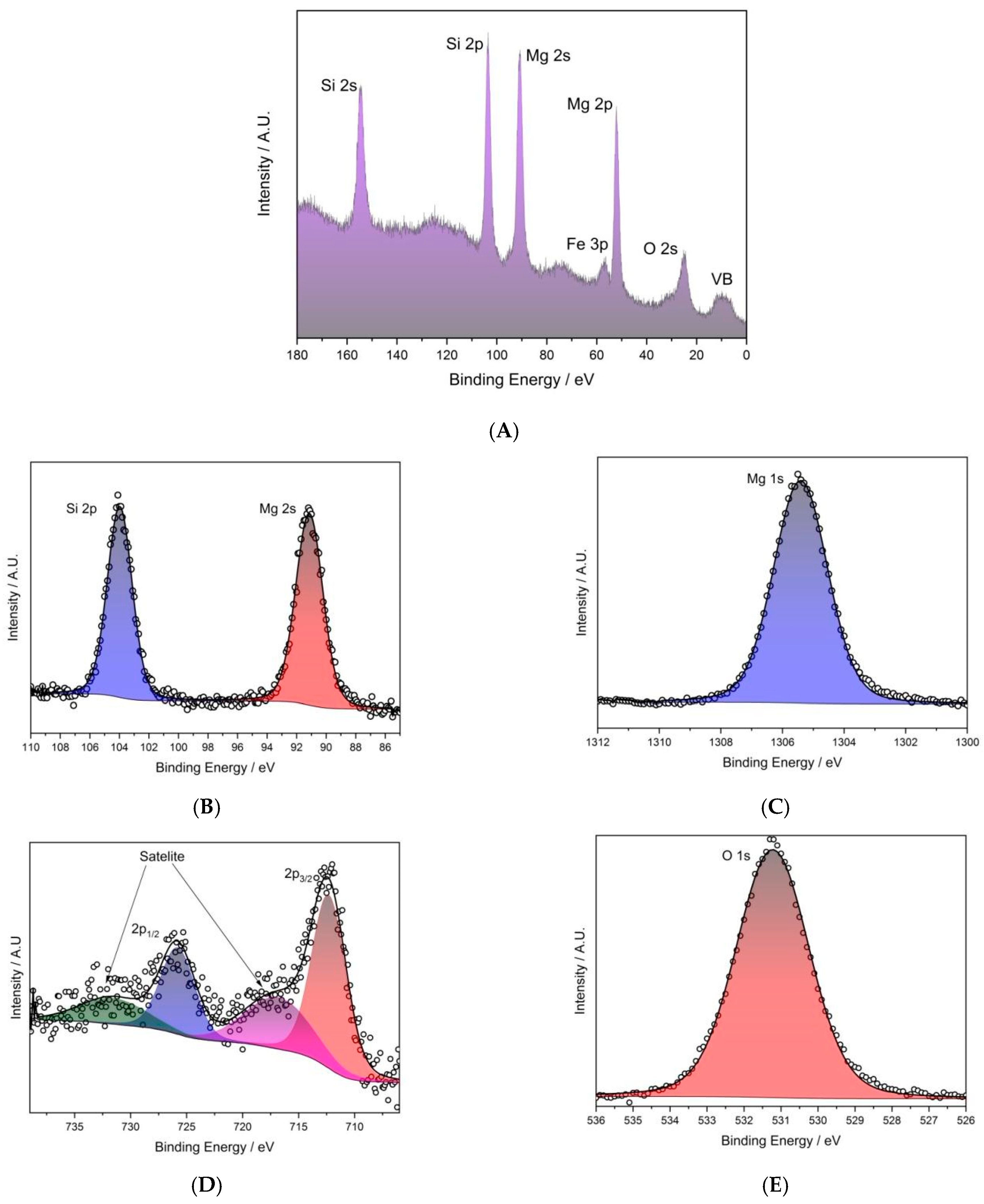
X-ray photoelectron spectroscopy (XPS) was conducted on the olivine phase to determine its intrinsic surface chemical state. Prior to high-resolution acquisition, the analyzed area was sputter-cleaned using 2 keV Ar+ ions for 2 min, a procedure sufficient to remove the outermost layer affected by polishing residues or atmospheric exposure. After sputtering, the survey spectrum displayed no detectable carbon, confirming complete removal of adventitious surface films. Likewise, no signals attributable to metal oxides, hydroxides, or other contaminants were present, indicating that the probed surface represented pristine olivine rather than altered material. The wide-scan (0–180) eV spectrum (Figure 11A) shows a surface dominated by O, Si, Mg, and Fe signals. No additional components are attributed to carbon hydroxides, since the sample was sputtered by Ar+-ions (2 keV), for 2 min.
The Si 2p region (Figure 11B) presents a well-defined peak at (103.8 ± 0.1) eV, characteristic of Si4+ in stoichiometric olivine, with no evidence of silicate polymerization or suboxide formation. Mg 1s appears at (1305.2 ± 0.1) eV, consistent with Mg2+ in octahedral coordination (Figure 11C), while the Fe 2p signal shows (Figure 11D) a single Fe2+ component near (712 ± 0.1) eV, incorporated in the olivine M1 and M2 sites. The Fe3+ structure is removed by Ar-ion cleaning. The high-resolution O 1s spectrum consists solely of a single, sharp peak at (531.2 ± 0.1) eV, corresponding to lattice O2− within the SiO4 tetrahedral framework. The absence of components at higher binding energy confirms that hydroxyl groups or adsorbed molecular species were fully removed during sputtering.

3.5. MFM Results

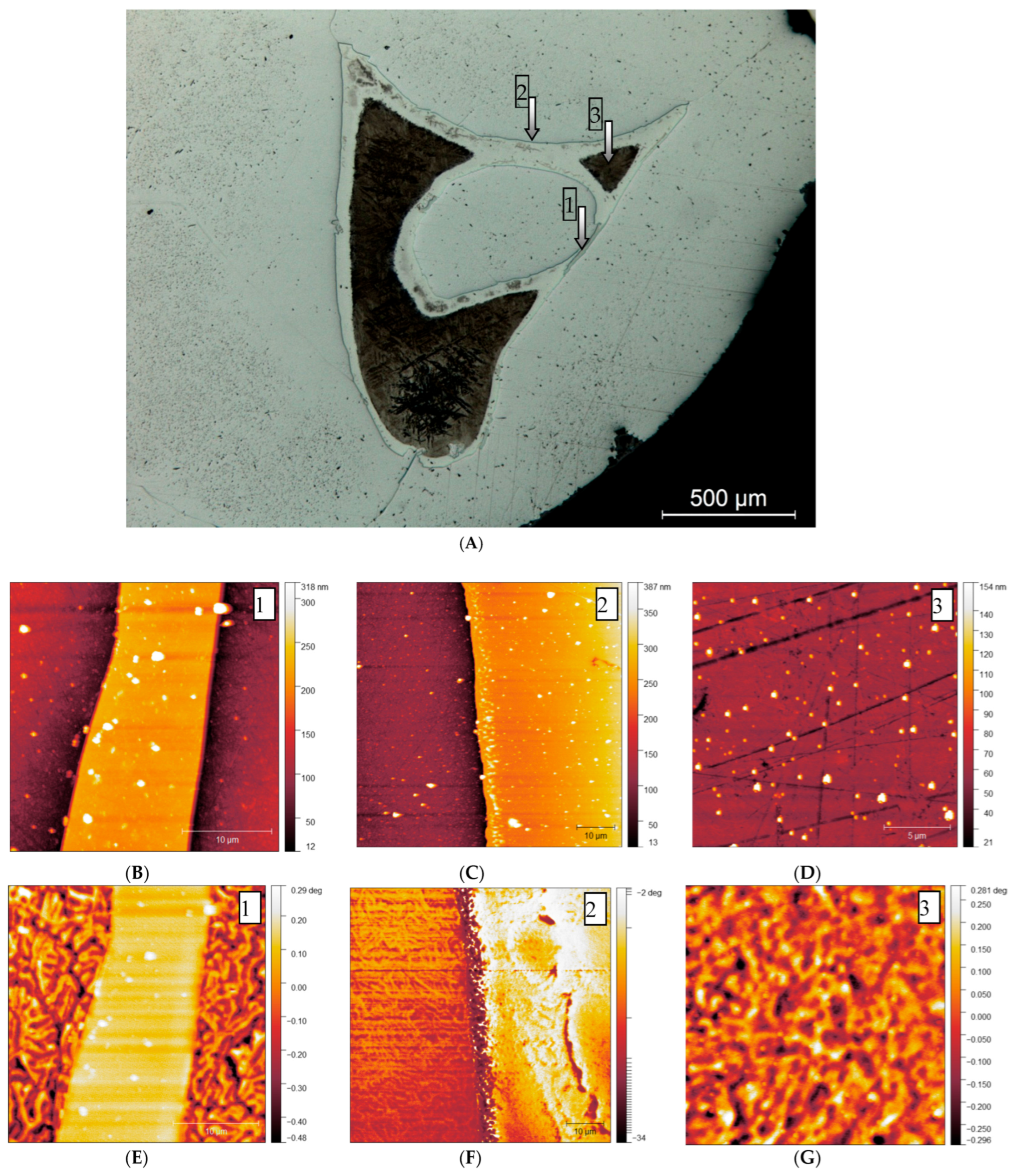
A few studies reported the magnetic properties of the metallic region of pallasites [34,51,52]. In the current study, magnetic force microscopy was performed at three locations on the polished Fe–Ni metal of the Esquel pallasite in order to resolve the spatial distribution of magnetic domains and relate these patterns to the underlying phase heterogeneity. An overview of the analyzed region is shown in Figure 12A, with AFM topography presented in Figure 12B–D and corresponding MFM phase-shift images in Figure 12E–G.

3.5.1. Point 1: Taenite–Plessite Transition

The topographic map at Point 1 (Figure 12B) reveals two adjacent metallic regions distinguished by both relief and surface texture. The taenite lamella is elevated by ~120 nm relative to the surrounding plessite. This relief likely reflects mechanical hardness differences during polishing, and may be enhanced by minor preferential etching from the earlier Nital treatment. Plessitic material occurs along the margins of the taenite band.
The MFM phase image (Figure 12F) shows a strong dependence of magnetic contrast on Fe–Ni composition. The taenite interior produces little to no measurable magnetic signal, which is expected for Ni-rich taenite (~30 wt% Ni) at ambient conditions. The plessitic region displays a heterogeneous, intermediate contrast, reflecting its fine-scale intergrowths of low-Ni (ferromagnetic) and high-Ni (weakly magnetic) components. Because all measurements were acquired in remanence, these contrasts represent the natural magnetization states of the phases.

3.5.2. Point 2: Kamacite–Taenite Interface

The boundary between kamacite and taenite at Point 2 (Figure 12C) is presented topographically as a sharp step (~120 nm). Along the taenite side of the interface, a chain of nanometer-scale protrusions (40–70 nm high) extends over several micrometers. These features coincide with a Ni-enriched fringe observed independently by SEM-EDS and are consistent with decomposition textures known from slowly cooled Fe–Ni metal.
In the corresponding MFM image, the interface produces a localized dark contrast band. This may arise from magnetic variations associated with the Fe-poor transformation of the metallic products. Away from the interface, kamacite retains a clear domain structure, whereas the taenite interior remains magnetically quiet.

3.5.3. Point 3: Plessite-Dominated Region

The region examined at Point 3 (Figure 12D) consists almost entirely of plessite. The AFM topography shows an irregular surface composed of sub-micrometer intergrowths. The MFM phase image (Figure 12G) exhibits a fine, spatially variable magnetic signal, lacking the long, coherent domains observed in massive kamacite. This behavior is consistent with a mixed assemblage of low-Ni and high-Ni phases on the sub-micron scale, which collectively produce a fragmented domain structure.
Across all three locations, the combined AFM/MFM measurements demonstrate that magnetic behavior in the Esquel metal is strongly controlled by local Fe–Ni composition. Kamacite retains stable remanent domains, whereas Ni-rich taenite contributes little magnetic signal at room temperature. Plessite displays intermediate or mixed responses reflecting its heterogeneous mineralogy. The domain-scale magnetic variations are consistent with the compositional gradients resolved by SEM-EDS and are compatible with slow cooling through the Fe–Ni miscibility gap.
The magnetic patterns observed by MFM, which reflect underlying compositional zoning, motivate a more detailed examination of the silicate crystal structure. Accordingly, we performed SC-XRD to determine whether the olivine lattice preserves the structural integrity suggested by the Raman features.

3.6. Single-Crystal XRD Results

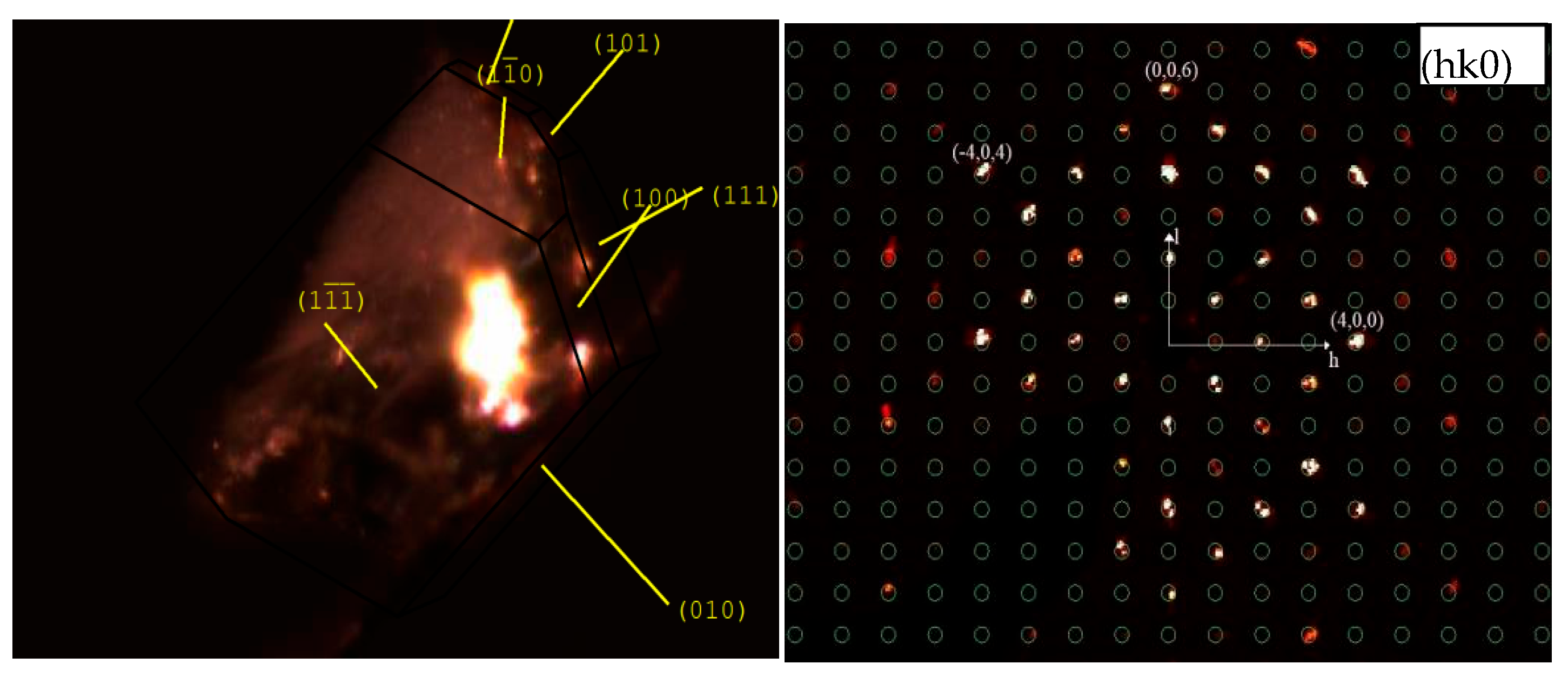
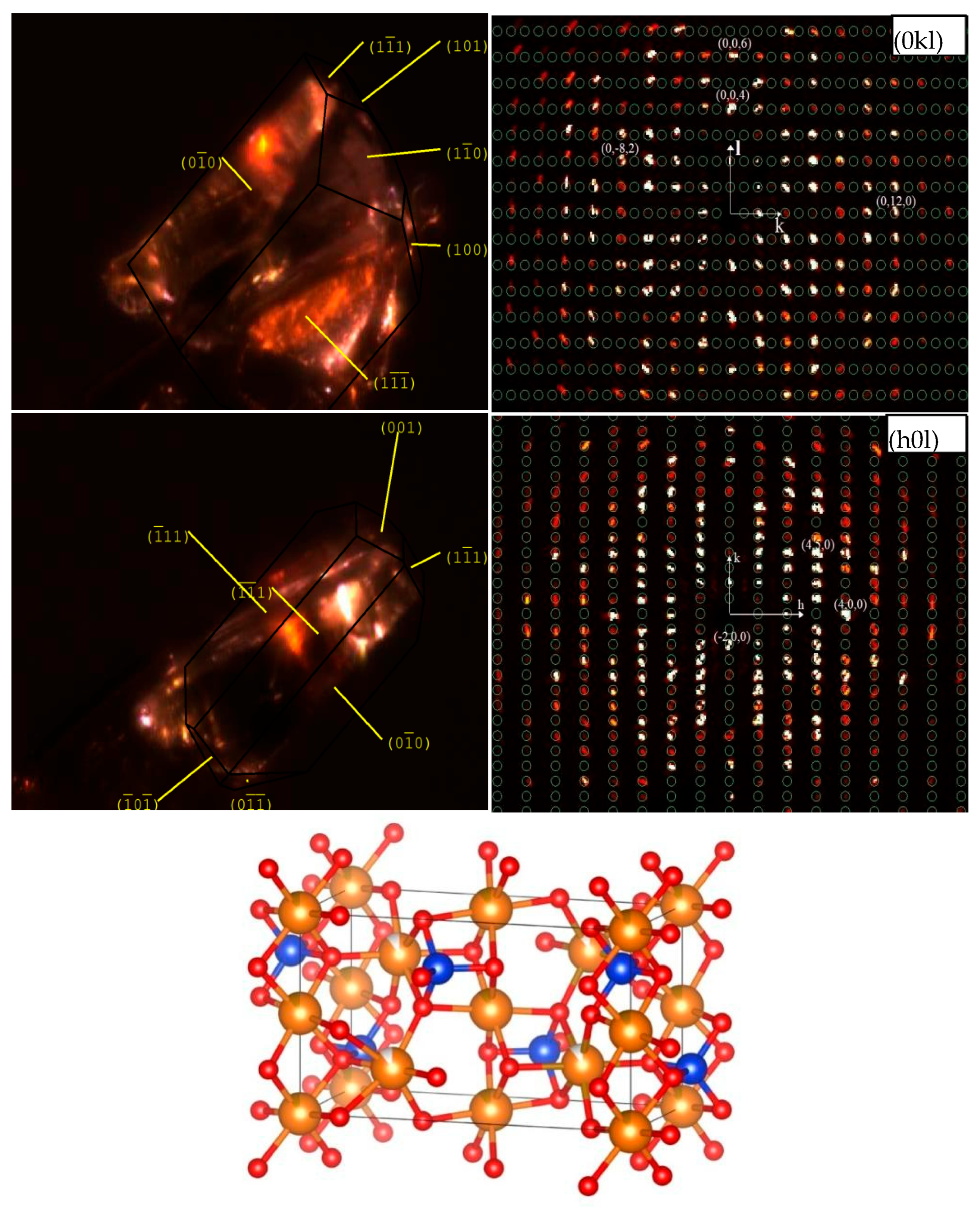
Even though the Raman spectroscopy provided information about the type of olivine, we have carried out single-crystal X-ray diffraction (SC-XRD) from a ~300 µm silicate fragment of the Esquel meteorite using φ- and ω-scan modes, (Figure 13). The resulting diffraction images display sharp, well-resolved reflections arranged in symmetric patterns across all measured orientations, confirming the high crystallinity and single-domain character of the fragment. The refinement required an extinction correction, further indicating a well-ordered crystal with minimal internal scattering defects.While the XRD technique is often used to study meteorite [53,54,55], to thebest of our knowledge, this technique has never been used to determine the type of olivine from a pallasite.
In the (hk0) layer, reflections are uniformly distributed and show no evidence of streaking, splitting, or diffuse scattering, implying low lattice strain within the basal plane. The (0kl) and (h0l) layers likewise exhibit dense, sharp, and symmetrically arranged spots, consistent with excellent structural coherence along all principal axes and the absence of twinning or significant mosaic spread. The mosaicity determined using the APEX software is 1.07°, in agreement with the observed diffraction quality. The overall symmetry and reflection periodicity are diagnostic of an orthorhombic olivine-type lattice, consistent with a forsterite–fayalite solid solution.
Optical micrographs of the mounted crystal, recorded at different goniometer positions aligned with the (hk0), (0kl), and (h0l) orientations, are shown in the left panels of Figure 11, with the corresponding reciprocal-lattice sections displayed on the right. The fragment exhibits a prismatic habit with well-defined faces and a transparent appearance, indicative of high structural integrity and the absence of visible inclusions or fractures. A video documenting sample rotation during data acquisition is provided as Supplementary Material 2. The precisely indexed orientations ensured accurate alignment of the reciprocal-space sections and unambiguous identification of the major symmetry planes [13].
The refined crystal structure of the Esquel silicate is presented in the bottom panel of Figure 13. The model corresponds to an olivine-type orthorhombic structure (Pnma), illustrated using a polyhedral representation. Octahedrally coordinated M-site cations (Mg, Fe) are shown as orange spheres, SiO4 tetrahedra as blue polyhedra, and oxygen atoms as red spheres. The structure consists of corner-sharing SiO4 tetrahedra linked to distorted MO6 octahedra forming zigzag chains parallel to [001]. Cross-linking through shared oxygen atoms yields the dense, framework-like arrangement characteristic of olivine. The two crystallographically distinct M sites (M1 at 0.5,0.5,0 Wyckoff site b and M2 at 0.277739, 0.25, 0.489400 Wyckoff site c) display similar coordination environments, consistent with partial Fe substitution in an Mg-rich (Fo90) matrix, in agreement with the Raman spectroscopy result. The refined unit-cell parameters—a = 10.208(2) Å, b = 5.9942(12) Å, c = 4.7642(9) Å—agree with values typical for high-forsterite olivine and match the high quality of the diffraction data, which show no indication of structural disorder. A detailed crystal information is provided in the Appendix A.
Although SC-XRD characterizes the atomic-scale structure of the silicate, reconstructing the meteorite’s three-dimensional architecture requires a volumetric approach. Therefore, we turn to X-ray computed tomography to visualize the spatial arrangement of metal, silicate, inclusions, and voids within the sample.

3.7. X-Ray CT-Scan Results

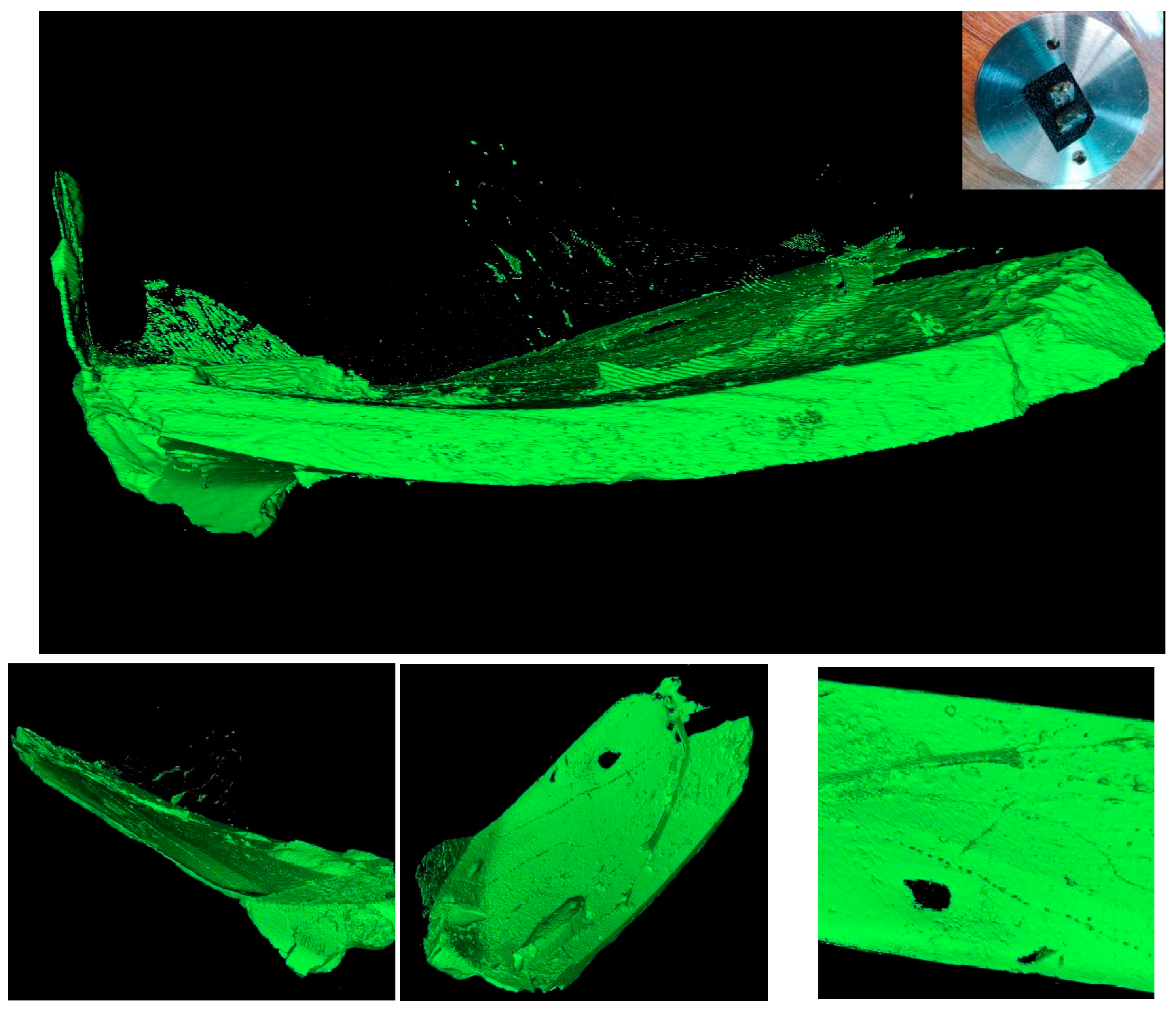
Very few studies reported using X-ray Ct scan to study meteorites [56]. Figure 14 shows X-ray computed tomography (CT) reconstruction from different angles. The X-ray computed tomography (CT) reconstruction provides a detailed three-dimensional view of the internal architecture of a ~2–3 mm fragment (inset photo in Figure 14 top panel) of the Esquel pallasite, with particular emphasis on the Fe–Ni metallic component. Because of the relatively low X-ray attenuation of olivine, the silicate portion of the fragment appears as a dark, low-density matrix, allowing the metallic regions to be visualized with high contrast.
The principal metallic mass forms a compact, coherent body with clearly defined boundaries. Subtle internal variations in grayscale intensity reflect compositional heterogeneities within the metal, corresponding to the coexistence of Fe-rich kamacite and Ni-rich taenite domains. In the upper portion of the volume, numerous bright, micron-sized inclusions are observed dispersed within the darker olivine host. These features represent fine metallic blebs that penetrate into adjacent silicate grains during subsolidus metal–silicate equilibration. Such interpenetration is characteristic of slow-cooling pallasites, where prolonged thermal histories permit the diffusion of metallic components into the silicate framework and promote the development of chemically graded interfaces [4,16].
The CT data also reveal several small cavities and irregular voids within the metallic mass. These may represent shrinkage pores formed during the final stages of metal solidification, or the former sites of non-metallic inclusions—such as troilite or schreibersite—that have since been altered or removed through oxidative weathering. Their presence, together with the diffusion-related metallic micro-inclusions, documents a complex thermal and chemical evolution involving subsolidus interdiffusion, recrystallization, and post-terrestrial alteration.
Overall, the CT analysis offers a nondestructive three-dimensional perspective on the distribution, connectivity, and internal heterogeneity of the Fe–Ni metal, as well as its interface with the surrounding olivine. This volumetric information provides crucial context for interpreting the textural, chemical, and magnetic properties of the Esquel meteorite. A 3-D video is presented as the Supplementary Material 3, https://youtu.be/wGbj8W0x3uU (accessed on 3 February 2026).

4. Discussion

The multi-technique investigation carried out in this study provides a coherent and internally consistent picture of the structural, chemical, magnetic, and three-dimensional characteristics of the Esquel pallasite, allowing a robust evaluation of its preservation state, thermal evolution, and post-terrestrial alteration history. The combined dataset demonstrates that both the silicate and metallic components retain exceptionally pristine primary features, consistent with slow cooling within a differentiated parent body and only limited modification during terrestrial residence. In this respect, Esquel conforms to the established characteristics of main-group pallasites, while at the same time representing one of the most structurally and chemically well-preserved examples of this class [6,9,30,57].
Raman spectroscopy shows that the olivine crystals are compositionally homogeneous and strongly Mg-rich, with high-frequency Si–O stretching modes indistinguishable from those of nearly pure forsterite. The absence of measurable peak shifts or band broadening indicates minimal Fe substitution, negligible shock-related lattice disorder, and a lack of structural damage at the micron scale. These observations are fully supported by the single-crystal XRD results, which reveal sharp, well-definedreflections in all measured orientations, low mosaicity, and an orthorhombic Pnmastructure with lattice parameters characteristic of high-forsterite olivine. Together, these data demonstrate that the silicate phase preserves a structurally coherent and essentially unaltered olivine lattice, extending earlier compositional inferences for Esquel by directly constraining crystallographic integrity [30,57].
Surface-sensitive chemical analyses further reinforce this conclusion. XPS measurements on sputter-cleaned olivine detect only lattice O2−, Si4+, Mg2+, and Fe2+, with no evidence for hydroxylation, carbonaceous contamination, Fe3+, or secondary alteration products. The single-component O 1s peak and the exclusive presence of Fe2+ indicate that the olivine surfaces have been minimally affected by terrestrial weathering, consistent with the Raman and XRD results. While variable degrees of silicate alteration and oxidation have been documented in other pallasites, often related to shock or prolonged terrestrial exposure [45], Esquel stands out as a benchmark sample in which primary silicate chemistry and lattice structure are preserved with minimal overprinting.
In contrast to the silicate phase, the metallic and sulfide components show subtle but detectable evidence of terrestrial modification confined to their outermost surfaces. XPS analyses of Fe–Ni metal reveal predominantly metallic Fe0 and Ni0, with only minor FeO-like contributions persisting after brief sputtering. Troilite exhibits a dominant FeS signature together with a thin oxidized surface layer containing sulfate species and Fe3+-bearing oxyhydroxides. These features are characteristic of near-surface weathering processes and do not reflect parent-body redox conditions, indicating that both metal and sulfide phases remain chemically intact at depth, in agreement with classical metallographic observations.
SEM–EDS mapping and line-scan analyses document well-developed kamacite–taenite intergrowths, plessitic regions, and accessory schreibersite with stoichiometry consistent with (Fe,Ni)3P. The taenite bands display pronounced Ni gradients at their margins and systematic decreases in center-Ni content with increasing band width. Cooling-rate estimates derived independently from an error-function diffusion model applied to an 87 μm taenite band and from empirical Ni–width correlations converge on values of approximately 10–20 °C/Myr. These rates fall squarely within the range reported for main-group pallasites and are consistent with slow, diffusion-controlled metal exsolution within the interior of a large, differentiated parent body [9,58].
Magnetic force microscopy provides an independent and complementary perspective on this metallurgical evolution. Kamacite exhibits stable magnetic domain structures, taenite is magnetically inactive, and plessite displays heterogeneous magnetic behavior, reflecting its mixed-phase nature. These contrasts closely mirror the compositional zoning observed by SEM–EDS and are consistent with magnetization acquired during slow cooling through the Fe–Ni miscibility gap. The strong agreement among MFM observations, chemical zoning, and diffusion-based cooling models demonstrates that the magnetic microstructure of Esquel faithfully records its metallographic development, an aspect rarely documented in earlier pallasite studies.
X-ray computed tomography adds a critical three-dimensional context to these microanalytical observations. The CT data reveal interconnected metallic networks, silicate pockets, fractures, and internal porosity that closely correspond to petrographic features observed in section, while showing no evidence for large-scale deformation or disruption. This supports the interpretation that Esquel experienced limited shock and preserved its original metal–silicate architecture. Moreover, the CT results clarify the spatial relationship between alteration and primary structure, showing that oxidation is volumetrically insignificant within the silicate host and largely confined to external surfaces and fracture-accessible regions of the metal network.
Taken together, these integrated observations demonstrate that Esquel preserves a remarkably complete and minimally overprinted record of metal–silicate equilibrium, slow thermal evolution, and silicate crystallinity. While earlier studies established Esquel as a representative main-group pallasite, the present work shows that it is also an exceptionally informative reference sample, in which diffusion profiles, oxidation states, magnetic signatures, and three-dimensional architecture can be examined in concert. The consistency across Raman, XPS, XRD, SEM, MFM, and CT highlights the power of a multi-scale, multi-technique analytical framework and establishes a benchmark approach for future investigations of pallasitic meteorites and other complex planetary materials.

5. Conclusions

This study presents a comprehensive, multi-technique characterization of a single fragment of the Esquel pallasite, integrating structural, chemical, magnetic, and three-dimensional imaging methods. Raman spectroscopy and SC-XRD demonstrate that the olivine crystals are highly pristine, Mg-rich (Fo88–92), and structurally coherent, with no evidence of shock deformation or chemical alteration. XPS confirms that the silicate surface contains only lattice-bound O2−, Si4+, Mg2+, and Fe2+, reflecting an unaltered olivine composition, while the Fe–Ni metal exhibits primarily metallic bonding with only minimal surface oxidation.
SEM–EDS analyses reveal well-defined kamacite–taenite intergrowths, plessite regions, and schreibersite inclusions consistent with primary pallasitic metal assemblages. Quantitative Ni zoning, evaluated through both diffusion-profile fitting and band-width–center-Ni correlations, yields a self-consistent cooling rate of ~10–20 °C/Myr, in agreement with published values for main-group pallasites. MFM imaging of magnetic domains corroborates the metal-phase zoning and confirms the preservation of slow-cooling magnetic structures. CT imaging further illuminates the internal metal–silicate architecture and reveals fractures, inclusions, and porosity consistent with limited shock and late-stage modification.
Overall, the Esquel pallasite appears to be exceptionally well preserved, retaining key mineralogical and metallographic features that record slow thermal evolution within a differentiated parent body. This work demonstrates the value of applying an integrated suite of multi-scale analytical tools to unravel the formation and post-terrestrial history of stony-iron meteorites.

Supplementary Materials

The following supporting information can be downloaded at https://www.mdpi.com/article/10.3390/spectroscj4010003/s1, Video S1: Silicato_Meteorito title. Table S1: SEM–EDS spot analyses of olivine (wt.% oxides); Table S2: Olivine compositions recalculated to apfu (O = 4); Table S3: Average olivine composition with expanded SEM–EDS uncertainty; Figure S1: Representative Raman spectra obtained from the troilite-bearing region of the Esquel meteorite. The spectra are dominated by diagnostic bands of magnetite, interpreted as the product of laser-induced oxidation of troilite during Raman analysis. Additional spectra from adjacent forsterite–magnetite regions are shown for comparison. A possible region where troilite-related peaks may occur is indicated.

Author Contributions

Conceptualization, F.S.G., E.B.H. and R.D.A.; methodology, F.S.G., E.B.H. and R.D.A.; formal analysis, F.S.G., E.B.H., P.G., P.N.A., L.M.S., G.P. and N.V.; investigation, F.S.G. and E.B.H.; data curation, F.S.G., E.B.H., P.G., P.N.A., L.M.S., G.Z. and N.V.; writing—original draft preparation, F.S.G.; writing—review and editing, F.S.G., E.B.H., P.G., P.N.A., L.M.S., G.Z. and N.V.; supervision, F.S.G. All authors have read and agreed to the published version of the manuscript.

Funding

This research received no external funding.

Institutional Review Board Statement

Not applicable.

Informed Consent Statement

Not applicable.

Data Availability Statement

The data presented in this study are available on request from the corresponding author.

Conflicts of Interest

The authors declare no conflicts of interest.

Appendix A

Key crystallographic and refinement numbers
  • Unit cell: a = 4.7648(9) Å, b = 10.209(2) Å, c = 5.9948(12) Å
  • Angles: α = β = γ = 90° (orthorhombic)
  • Volume: 291.52(10) Å3; Z = 4
  • Chemical formula (refined): Fe0.21 Mg1.79 O4 Si
  • Refinement: reflections 1876 (1785 I > 2σ), parameters 42
  • R1 (I > 2σ): 0.026; R1 (all): 0.028
  • wR2 (ref): 0.092; GOF ≈ 0.93
Site occupancies and composition (summary)
  • Two M sites (M1 at 0.5,0.5,0; M2 at ≈ 0.27739,0.25,0.489400) are refined as mixed Mg/Fe sites.
  • Mg occupancy (each site) ≈ 0.895(3)
  • Fe occupancy (each site) ≈ 0.105(3)
  • Interpreted bulk Fe/(Mg + Fe) ≈ 0.105 → ~10.5 mol% Fe → approximate olivine composition Fo90.
Selected bond distances (from the refined coordinates; minimum-image periodic distances)
  • Si1–O: 1.6153(6) Å, 1.6359(4) Å, 1.6528(6) Å (three unique Si–O nearest neighbors)
  • M1 (0.5,0.5,0)—O (nearest): ~2.0742(4) Å, 2.0895(4) Å, 2.1405(5) Å
  • M2 (~0.28,0.25, ~0.49)—O (nearest): ~2.0561(6) Å, 2.1405(5) Å, 2.1780(7) Å
(These distances are the nearest M–O and Si–O separations computed from the CIF fractional coordinates and the orthorhombic cell parameters; they fall into the expected ranges for olivine-like silicates.)

References

  1. Franza, A.; Pratesi, G. Meteorites as a scientific heritage. Conserv. Patrim. 2021, 36, 106–121. [Google Scholar] [CrossRef]
  2. Honda, M.; Caffee, M.W.; Miura, Y.N.; Nagai, H.; Nagao, K.; Nishiizumi, K. Cosmogenic nuclides in the Brenham pallasite. Meteorit. Planet. Sci. 2010, 37, 1711–1728. [Google Scholar] [CrossRef]
  3. Mittlefehldt, D.W. Geochmistry of pallasite olivine and the oirigin pf pallasites. Geochim. Cosmochim. Acta 2024, 383, 92–107. [Google Scholar] [CrossRef]
  4. Windmill, R.J.; A Franchi, I.; Hellmann, J.L.; Schneider, J.M.; Spitzer, F.; Kleine, T.; Greenwood, R.C.; Anand, M. Isotopic evidence for pallasite formation by impact mixing of olivine and metal during the first 10 million years of the Solar System. PNAS Nexus 2022, 1, pgac015. [Google Scholar] [CrossRef]
  5. Yang, J.; Goldstein, J.I.; Scott, E.R.D. Iron meteorite evidence for early formation and catastrophic disruption of protoplanets. Nature 2007, 446, 888–891. [Google Scholar] [CrossRef]
  6. Scott, E.; Goldstein, J.; Yang, J. Formation of Stony-Iron Meteorites in Early Giant Impacts. In Planetary Science Research Discoveries Report; University of Hawaii System: Honolulu, HI, USA, 2010; p. 148. [Google Scholar]
  7. Bennett, N.R.; Sio, C.K.; Schauble, E.; Lesher, C.E.; Wimpenny, J.; Shahar, A. Iron isotope evidence of an impact origin for main-group pallasites. Geochem. Perspect. Lett. 2022, 23, 6. [Google Scholar] [CrossRef]
  8. Yang, J.; Goldstein, J.I.; Michael, J.R.; Kotula, P.G.; Scott, E.R. Thermal history and origin of the IVB iron meteorites and their parent body. Geochim. Cosmochim. Acta 2010, 74, 4493–4506. [Google Scholar] [CrossRef]
  9. Yang, J.; Goldstein, J.I.; Scott, E.R. Main-group pallasites: Thermal history, relationship to IIIAB irons, and origin. Geochim. Cosmochim. Acta 2010, 74, 4471–4492. [Google Scholar] [CrossRef]
  10. Quinlan, M.M.; Walker, A.; Davies, C. Reconciling fast and slow cooling during planetary formation as recorded in the main group pallasites. Earth Planet. Sci. Lett. 2023, 618, 118284. [Google Scholar] [CrossRef]
  11. Ulff-Møller, F.; Choi, B.; Rubin, A.E.; Tran, J.; Wasson, J.T. Paucity of sulfide in a large slab of Esquel: New perspectives on pallasite formation. Meteorit. Planet. Sci. 1998, 33, 221–227. [Google Scholar] [CrossRef]
  12. Blukis, R.; Rüffer, R.; Chumakov, A.I.; Harrison, R.J. A high spatial resolution synchrotron Mössbauer study of the Tazewell IIICD and Esquel pallasite meteorites. Meteorit. Planet. Sci. 2017, 52, 925–936. [Google Scholar] [CrossRef] [PubMed]
  13. Sheldrick, G.M. SHELXT—Integrated space-group and crystal-structure determination. Acta Crystallogr. Sect. A Found. Crystallogr. 2015, 71, 3–8. [Google Scholar] [CrossRef] [PubMed]
  14. Sheldrick, G.M. Crystal structure refinement with SHELXL. Acta Crystallogr. Sect. C Struct. Chem. 2015, 71, 3–8. [Google Scholar] [CrossRef] [PubMed]
  15. Malherbe, C.; Hutchinson, I.B.; Lerman, H.N.; McHugh, M.; Eppe, G. Characterising the Composition of Olivine and Iron Oxides in a Sample of the Sericho Meteorite by Raman Spectroscopy Using Principal Component Analysis. J. Raman Spectrosc. 2025, 56, 1345–1352. [Google Scholar] [CrossRef]
  16. Wang, H.; Fang, P.; Wang, Y.; Xin, Y.; Xiong, S.; Liu, S.; Xue, Y.; Zhang, L.; Wan, X. Rapid Determination of Meteorolite Composition Based on X-ray Phase Contrast Imaging-Assisted Raman Spectroscopy. Chemosensors 2023, 11, 563. [Google Scholar] [CrossRef]
  17. Maksimova, A.; Chukin, A.V.; Felner, I.; Oshtrakh, M.I. Spinels in meteorites: Observation using Mössbauer spectroscopy. Minerals 2019, 9, 42. [Google Scholar] [CrossRef]
  18. Maksimova, A.; Goryunov, M.V.; Oshtrakh, M.I. Applications of mössbauer spectroscopy in meteoritical and planetary science, part ii: Differentiated meteorites, moon, and mars. Minerals 2021, 11, 614. [Google Scholar] [CrossRef]
  19. McKeown, D.A.; Bell, M.I.; Caracas, R. Theoretical determination of the Raman spectra of single-crystal forsterite (Mg2MSiO4). Am. Mineral. 2010, 95, 980–986. [Google Scholar] [CrossRef]
  20. Chopelas, A. Single crystal Raman spectra of forsterite, fayalite, and monticellite. Am. Mineral. 1991, 76, 1101. [Google Scholar]
  21. do Nascimento-Dias, B.L. Overview about Raman spectroscopy of types of olivine group minerals: A brief review. J. Raman Spectrosc. 2022, 53, 1942–1946. [Google Scholar] [CrossRef]
  22. Guyot, F.; Boyer, H.; Madon, M.; Velde, B.; Poirier, J.P. Comparison of the raman microprobe spectra of (Mg, Fe)2SiO4 and Mg2GeO4 with olivine and spinel structures. Phys. Chem. Miner. 1986, 13, 91–95. [Google Scholar] [CrossRef]
  23. Kolesov, B.A.; Geiger, C.A. A Raman spectroscopic study of Fe-Mg olivines. Phys. Chem. Miner. 2004, 31, 142–154. [Google Scholar] [CrossRef]
  24. Lafuente, B.; Downs, R.T.; Yang, H.; Stone, N. The Power of Databases: The RRUFF Project. In Highlights in Mineralogical Crytallography; Armbruster, T., Danisi, R.M., Eds.; W. De Gruyter: Berlin, Germany, 2015; pp. 1–35. [Google Scholar]
  25. Breitenfeld, L.B.; Dyar, M.D.; Carey, C.; Tague, T.J.; Wang, P.; Mullen, T.; Parente, M. Predicting olivine composition using Raman spectroscopy through band shift and multivariate analyses. Am. Mineral. 2018, 103, 1827–1836. [Google Scholar] [CrossRef]
  26. Gaisler, S.V.; Kolesov, B.A. Raman spectra of olivine solid solutions (FexMg1−x)2SiO4 and spin-vibration interaction. J. Struct. Chem. 2007, 48, 61–65. [Google Scholar] [CrossRef]
  27. Mouri, T.; Enami, M. Raman spectroscopic study of olivine-group minerals. J. Mineral. Petrol. Sci. 2008, 103, 100–104. [Google Scholar] [CrossRef]
  28. Kuebler, K.E.; Jolliff, B.L.; Wang, A.; Haskin, L.A. Extracting olivine (Fo-Fa) compositions from Raman spectral peak positions. Geochim. Cosmochim. Acta 2006, 70, 6201–6222. [Google Scholar] [CrossRef]
  29. Wang, A.; Kuebler, K.; Jolliff, B.; Haskin, L.A. Mineralogy of a Martian meteorite as determined by Raman spectroscopy. J. Raman Spectrosc. 2004, 35, 504–514. [Google Scholar] [CrossRef]
  30. Buseck, P.R. Pallasite meteorites-mineralogy, petrology and geochemistry. Geochim. Cosmochim. Acta 1977, 41, 711–740. [Google Scholar] [CrossRef]
  31. Goryunov, M.V.; Maksimova, A.A.; Oshtrakh, M.I. Advances in Analysis of the Fe-Ni-Co Alloy and Iron-Bearing Minerals in Meteorites by Mössbauer Spectroscopy with a High Velocity Resolution. Minerals 2023, 13, 1126. [Google Scholar] [CrossRef]
  32. Goldstein, J.I.; Ogilvie, R.E. The growth of the Widmanstätten pattern in metallic meteorites. Geochim. Cosmochim. Acta 1965, 29, 893–920. [Google Scholar] [CrossRef]
  33. Saikumar, V.; Goldstein, J. An evaluation of the methods to determine the cooling rates of iron meteorites. Geochim. Cosmochim. Acta 1988, 52, 715–726. [Google Scholar] [CrossRef]
  34. Nichols, C.I.O.; Bryson, J.F.J.; Blukis, R.; Herrero-Albillos, J.; Kronast, F.; Rüffer, R.; Chumakov, A.I.; Harrison, R.J. Variations in the Magnetic Properties of Meteoritic Cloudy Zone. Geochem. Geophys. Geosyst. 2020, 21, e2019GC008798. [Google Scholar] [CrossRef]
  35. Goldstein, J.I.; Yang, J.; Kotula, P.G.; Michael, J.R.; Scott, E.R.D. Thermal histories of IVA iron meteorites from transmission electron microscopy of the cloudy zone microstructure. Meteorit. Planet. Sci. 2009, 44, 343–358. [Google Scholar] [CrossRef]
  36. Wasson, J.T.; Hoppe, P. Co/Ni ratios at taenite/kamacite interfaces and relative cooling rates in iron meteorites. Geochim. Cosmochim. Acta 2012, 84, 508–524. [Google Scholar] [CrossRef]
  37. Yang, W.; Williams, D.B.; Goldstein, J.I. A new empirical cooling rate indicator for meteorites based on the size of the cloudy zone of the metallic phases. Meteorit. Planet. Sci. 2010, 32, 423–429. [Google Scholar] [CrossRef]
  38. Nelson, W.; Hammer, J.; Shea, T. Geochimica et Cosmochimica Acta Re-evaluating the diffusivity of phosphorus in olivine: Implications of low diffusive mobility for thermochronology. Geochim. Cosmochim. Acta 2024, 386, 74–83. [Google Scholar] [CrossRef]
  39. Maurel, C.; Weiss, B.P.; Bryson, J.F. Meteorite cloudy zone formation as a quantitative indicator of paleomagnetic field intensities and cooling rates on planetesimals. Earth Planet. Sci. Lett. 2019, 513, 166–175. [Google Scholar] [CrossRef]
  40. Dean, D.C.; Goldstein, J.I. Determination of the Interdiffusion Coefficients in the Fe-Ni and Fe-Ni-P Systems below 900 °C. Met. Trans. A 1986, 17, 1131–1138. [Google Scholar] [CrossRef]
  41. Nichols, C.I.; Bryson, J.F.; Herrero-Albillos, J.; Kronast, F.; Nimmo, F.; Harrison, R.J. Pallasite paleomagnetism: Quiescence of a core dynamo. Earth Planet. Sci. Lett. 2016, 441, 103–112. [Google Scholar] [CrossRef]
  42. Watson, H.C.; Richter, F.; Liu, A.; Huss, G.R. Iron and nickel isotope fractionation by diffusion, with applications to iron meteorites. Earth Planet. Sci. Lett. 2016, 451, 159–167. [Google Scholar] [CrossRef]
  43. Hopfe, W.D.; Goldstein, J.I. The metallographic cooling rate method revised: Application to iron meteorites and mesosiderites. Meteorit. Planet. Sci. 2001, 36, 135–154. [Google Scholar] [CrossRef]
  44. Walte, N.P.; Solferino, G.F.; Golabek, G.J.; Souza, D.S.; Bouvier, A. Two-stage formation of pallasites and the evolution of their parent bodies revealed by deformation experiments. Earth Planet. Sci. Lett. 2020, 546, 116419. [Google Scholar] [CrossRef]
  45. Walte, N.P.; Golabek, G.J. Olivine aggregates reveal a complex collisional of the main group pallasite parent body. Meteorit. Planet. Sci. 2022, 57, 1098–1115. [Google Scholar] [CrossRef]
  46. McKibbin, S.J.; Pittarello, L.; Makarona, C.; Hamann, C.; Hecht, L.; Chernonozhkin, S.M.; Goderis, S.; Claeys, P. Petrogenesis of main group pallasite meteorites based on relationships among texture, mineralogy, and geochemistry. Meteorit. Planet. Sci. 2019, 54, 2814–2844. [Google Scholar] [CrossRef]
  47. Li, X.; Chen, Y.; Tang, X.; Gu, L.; Yuan, J.; Su, W.; Tian, H.; Luo, H.; Cai, S.; Komarneni, S. Thermally induced phase transition of troilite during Micro-Raman spectroscopy analysis. Icarus 2023, 390, 115299. [Google Scholar] [CrossRef]
  48. Yamashita, T.; Hayes, P. Analysis of XPS spectra of Fe2+ and Fe3+ ions in oxide materials. Appl. Surf. Sci. 2008, 254, 2441–2449, Erratum in Appl. Surf. Sci. 2009, 255, 8194. [Google Scholar] [CrossRef]
  49. Grosvenor, A.P.; Biesinger, M.C.; Smart, R.S.C.; McIntyre, N.S. New interpretations of XPS spectra of nickel metal and oxides. Surf. Sci. 2006, 600, 1771–1779. [Google Scholar] [CrossRef]
  50. Christoph, J.M.; Minesinger, G.M.; Bu, C.; Dukes, C.A.; Elkins-Tanton, L.T. Space Weathering Effects in Troilite by Simulated Solar-Wind Hydrogen and Helium Ion Irradiation. J. Geophys. Res. Planets 2022, 127, e2021JE006916. [Google Scholar] [CrossRef]
  51. Bryson, J.F.J.; Nichols, C.I.O.; Herrero-Albillos, J.; Kronast, F.; Kasama, T.; Alimadadi, H.; van der Laan, G.; Nimmo, F.; Harrison, R.J. Long-lived magnetism from solidification-driven convection on the pallasite parent body. Nature 2015, 517, 472–475. [Google Scholar] [CrossRef]
  52. Harrison, R.; Bryson, J.; Nichols, C.; Herrero-Albillos, J.; Kronast, F.; Einsle, J.; Midgley, P. Magnetic microscopy of metallic meteorites: Probing the magnetic state of the early solar system. In Proceedings of the European Microscopy Congress 2016: Proceedings, Lyon, France, 28 August–2 September 2016; Volume 237, p. 1170. [Google Scholar]
  53. Jenkins, L.E.; King, A.J.; Lee, M.R.; Daly, L.; Thompson, S.P.; Day, S.J.; Saunders, L.; Martin, P.-E.; Bintang, F. A high—Resolution in situ X-Ray diffraction study of mineral transitions due to post—Hydration heating in CM chondrite meteorites. Earth Planets Space 2024, 76, 172. [Google Scholar] [CrossRef]
  54. Bland, P.A.; Cressey, G.; Menzies, O.N. Modal mineralogies of carbonaceous chondrites by X-ray diffraction and Mossbauer spectroscopy. Meteorit. Planet. Sci. 2004, 39, 3–16. [Google Scholar] [CrossRef]
  55. Howard, K.; Benedix, G.; Bland, P.; Cressey, G. Modal mineralogy of CM2 chondrites by X-ray diffraction (PSD-XRD). Part 1: Total phyllosilicate abundance and the degree of aqueous alteration. Geochim. Cosmochim. Acta 2009, 73, 4576–4589. [Google Scholar] [CrossRef]
  56. Sears, D.W.; Sears, H.; Ebel, D.S.; Wallace, S.; Friedrich, J.M. Report X-ray computed tomography imaging: A not-so-nondestructive technique. Meteorit. Planet. Sci. 2016, 51, 833–838. [Google Scholar] [CrossRef]
  57. Scott, E.R. Pallasites-metal composition, classification and relationships with iron meteorites. Geochim. Cosmochim. Acta 1977, 41, 349–360. [Google Scholar] [CrossRef]
  58. Fricker, P.; Goldstein, J.; Summers, A. Cooling rates and thermal histories of iron and stony-iron. Geochim. Cosmochim. Acta 1970, 34, 475–491. [Google Scholar] [CrossRef]
Figure 1. (A) Representative Esquel pallasite fragment and polished-section microstructure. A 1 cm calibration cube is placed adjacent to the sample for scale reference. (B) Reflected-light image of the polished and 2% nital-etched surface showing olivine in contact with Fe–Ni metal. (C,D) Higher-magnification views highlight kamacite, taenite, and plessite revealed by etching and illustrate the characteristic pallasitic metal–silicate interface.
Spectroscj 04 00003 g001
Figure 2. Typical Raman spectra of fayalite (R070374) and forsterite (R040052), taken from the RRUFF database.
Spectroscj 04 00003 g002
Figure 3. (A,B) Second-order calibration curves of Ag(Si–O) sym and Ag(Si–O) asym stretching bands, respectively [27]. Raman spectrum of a silicate inclusion from the Esquel pallasite (red) compared with a reference forsterite spectrum (black; RRUFF ID R050117). The inset shows the analyzed crystal under the optical microscope, highlighting the Raman measurement area.
Spectroscj 04 00003 g003
Figure 4. Schematic phase diagram of Fe-Ni alloy.
Spectroscj 04 00003 g004
Figure 5. SEM characterization of a taenite band within Esquel metal. (A) Secondaryelectron (SE) image showing the taenite lamella enclosed by kamacite. (B) Ni Kα elemental map highlighting Ni-enriched taenite; (C) Fe Kα map showing Fe-rich kamacite. (DF) Zoomed-in views revealing fine-scale chemical heterogeneity within the metallic phase. (G) Quantitative EDX line scan across an ~87 µm taenite band, which shows the Ni/(Ni + Fe) as distance.
Spectroscj 04 00003 g005
Figure 6. SEM–EDS characterization of Ni distribution within a taenite band of the Esquel pallasite. (A) Backscattered-electron (BSE) image showing the analyzed taenite lamella enclosed by Fe-rich kamacite; the white line indicates the SEM–EDS scan transect. (B) Ni concentration profile obtained along the scan path. (C) Relationship between the Ni concentration measured at the geometric center of taenite bands and their corresponding widths.
Spectroscj 04 00003 g006
Figure 7. (A) SEM backscattered-electron image showing Fe–O–S–bearing phases. Troilite (FeS) occurs along the margins of the kamacite (α–Fe–Ni) region. (B) SEM-EDX obtained from Troilte region, (C) SEM-EDX obtained from Kamacite region.
Spectroscj 04 00003 g007
Figure 8. (A) BSE image and SEM–EDS maps of schreibersite (Fe,Ni)3P, plessite and taenite within the Fe–Ni metal. Phosphide grains occur alongside kamacite, taenite, and plessite. (BD) Elemental maps (Fe, Ni, P), respectively. (EG) SEM-EDS spectra from plessite, taenite and schreibersite regions, respectively, which confirms a ~3:1 (Fe + Ni):P stoichiometry consistent with schreibersite.
Spectroscj 04 00003 g008
Figure 9. XPS analysis of the metallic Fe–Ni phase. (A) Survey spectrum predominantly showing Fe and Ni signals. (B) High-resolution Fe 2p region. (C) XPS line scan across a taenite band. (D) Comparison of Ni 2p spectra from kamacite and taenite.
Spectroscj 04 00003 g009
Figure 10. X-ray photoelectron spectroscopy (XPS) of the troilite (FeS) region. (A) Survey spectrum showing Fe, S, O, C, and a detectable N 1s signal. (B) S 2p region with a primary troilite doublet at ~162 eV and a secondary oxidized sulfur component near ~169 eV. (C) O 1s spectrum. (D) Fe 2p region showing sulfide-bound Fe at ~707 eV and higher-energy iron oxide peaks.
Spectroscj 04 00003 g010
Figure 11. XPS spectra of the olivine phase from. (A) Wide scan (0–180) eV spectrum, (B) Si 2p and Mg 2s region. (C) Mg 1s region. (D) Fe 2p region. (E) O 1s peak region obtained from olivine.
Spectroscj 04 00003 g011
Figure 12. Overview of the analyzed region (A) with AFM topography (BD) and MFM phase-shift images (EG) for three points on the Esquel metal. Magnetic contrast correlates with Fe–Ni composition: kamacite displays clear domains, taenite shows little to no signal, and plessite reveals heterogeneous, fine-scale magnetic patterns.
Spectroscj 04 00003 g012
Figure 13. Optical micrographs and single-crystal XRD results for the ~300 µm Esquel silicate fragment. Left panels: crystal mounted at orientations corresponding to the (hk0), (0kl), and (h0l) reciprocal-lattice sections. Right panels: corresponding X-ray diffraction layers showing sharp, well-defined reflections consistent with an olivine-type single crystal. Bottom panel: refined crystal structure (Pnma) illustrating SiO4 tetrahedra and M-site octahedra characteristic of the olivine framework.
Spectroscj 04 00003 g013aSpectroscj 04 00003 g013b
Figure 14. X-ray computed tomography (CT) reconstruction of a ~2–3 mm Esquel pallasite fragment. Bright regions correspond to the Fe–Ni metallic phase embedded within the low-attenuation olivine matrix.
Spectroscj 04 00003 g014
Table 1. Analytical workflow and techniques applied in this study.
Workflow StepAnalytical TechniqueTarget Phase/ScaleInformation Obtained
Sample PreparationCutting, polishing, cleaningBulk specimenRepresentative sections and contamination-free surfaces
Petrographic ContextOptical microscopy, SEM imagingSilicate–metal texturesPhase identification, textural relationships
Silicate StructureRaman spectroscopy, SC-XRDOlivine crystalsComposition, lattice integrity, crystallography
Surface ChemistryXPSSilicates, metals, sulfidesOxidation states, surface alteration
Metal ZoningSEM–EDS mapping and line scansFe–Ni metalNi diffusion profiles, cooling rates
Magnetic PropertiesMagnetic force microscopy (MFM)Metallic phasesMagnetic domains, phase-dependent magnetization
3D ArchitectureX-ray computed tomography (CT)Bulk internal structureMetal–silicate connectivity, porosity
Disclaimer/Publisher’s Note: The statements, opinions and data contained in all publications are solely those of the individual author(s) and contributor(s) and not of MDPI and/or the editor(s). MDPI and/or the editor(s) disclaim responsibility for any injury to people or property resulting from any ideas, methods, instructions or products referred to in the content.