Abstract
In this study, an innovative prospective analysis approach is applied to support the characterisation of strategic performance measures in higher education institutions (HEIs) and to assess their efficiency. To achieve this objective, relevant input and output indicators identified in the literature are systematised and then validated through a field study involving semi-structured interviews with key stakeholders and practitioners. Subsequently, a cross-impact matrix is developed, and a prospective analysis is performed using the MICMAC method (Matrix of Cross-Impact Multiplications Applied to Classification). This process enables the identification of the most influential input and output factors shaping the performance of Portuguese HEIs. The resulting strategic input–output prospective map highlights that future strategies should prioritise inputs related to research and development (R&D), the sociocultural environment of HEIs, and internationalisation, particularly in relation to global student mobility. The analysis further shows that outputs associated with regional human capital development and sociocultural dynamics play a critical role, especially through the strengthening of partnerships with regional authorities, municipalities, and companies.
1. Introduction
Higher education institutions (HEIs) seek to differentiate strategically by adopting performance monitoring and evaluation practices, which are essential given their social responsibility [1,2]. Strategic performance measures are key tools for translating strategies into measurable objectives, aligning decisions with organisational goals, and promoting institutional efficiency [3,4]. This growing emphasis on efficiency has driven the combined use of internal and external evaluations, with multiple approaches and distinct results shown in the literature due to different combinations of inputs and outputs [5,6,7]. Therefore, it is essential to create indicators that support internal management and the exploration of future scenarios.
Budgetary constraints, structural changes, and unpredictability in HEIs have encouraged the use of forward-looking methods grounded in the French school, particularly the contributions of Godet [8], Berger [9] and De-Jouvenel and Medina Vásquez [10]. The prospective approach values long-term thinking and reflection on alternative trajectories [11,12,13], providing a complementary framework to traditional strategic planning. Accuracy in measuring efficiency depends on careful selection of input and output variables, given that different methodologies produce divergent results [14]. However, existing research still pays little attention to the application of these methods for estimating institutional efficiency in the HEI context with a strategic vision sustained over time [11,15,16,17]. Most studies are conjunctural and short-term and do not incorporate a sustainable and evolutionary vision matrix.
In this context, this research aims to fill these gaps by integrating three dimensions that are theoretically and empirically disjointed in the existing literature: (i) the efficiency of HEIs, (ii) regional impact, and (iii) the creation of long-term forward-looking indicators. Considering HEIs as organisations that transform inputs into outputs, this study was conducted to develop an innovative operational model to measure the efficiency of Portuguese public HEIs, articulating the systematisation of inputs/outputs incorporating external and regional perspectives, identifying and validating critical indicators through semi-structured interviews with regional stakeholders, and developing a MICMAC (multiplications applied to a classification) matrix of interrelationships and cross-impacts in order to identify variables with greater strategic relevance for the institutional future [12]. The prospective strategic approach assumes a long-term vision, broad and unrestricted reflection on all possible options, and consideration of all stakeholders involved inside and outside the organisation [13]. This method has already been used in some studies in higher education (e.g., [15,16]).
Considering the above, the subject of the study is the efficiency and strategic performance of HEIs, examined through the integration of prospective analysis methods. The object is Portuguese public HEIs, which are analysed as organisational systems that transform inputs (resources, policies, funding, etc.) into outputs (educational, scientific, and regional development results). The decision to study Portuguese public HEIs is justified by the transformations that have occurred recent decades, which have promoted greater equity in access and institutional expansion, especially in inland regions [17]. Reforms between 2006 and 2010 increased public funding and support for low-income students, with impacts also on internationalisation [18]. This reinforcement contributed to the international projection of Portuguese HEIs [19]. Recent crises, such as COVID-19 and the 2008 financial crisis, have posed new sustainability challenges and necessitate strategic reformulation [20]. Thus, there is a clear need to reconfigure Portuguese HEIs’ strategies and internationalisation [21,22] in light of current economic, social, and health changes and to consolidate a long-term, forward-looking vision. The efficiency of higher education institutions (HEIs) in Portugal has been the subject of various studies focusing on different aspects such as sustainability, entrepreneurship, regional development, resource management, and governance (e.g., [17,23,24]). Although these studies are multifaceted, continuous improvement in overall efficiency, supported by effective measurement policies and strategies, is essential for enhancing the overall performance and regional impact of these institutions.
Keeping the above in mind, the main objective of this study was to develop and validate a prospective strategic framework for measuring the efficiency of Portuguese public HEIs, identifying key input and output indicators that can support long-term decision-making and institutional sustainability. This objective has three major tasks: systematise inputs/outputs based on the existing literature and incorporate the external perspective on regional impact; identify and validate key efficiency indicators using a qualitative approach, namely semi-structured interviews with experts from different Portuguese regions; and construct a cross-impact matrix (MICMAC) to conduct a prospective analysis of the most influential long-term efficiency determinants. To this aim, the following research question (RQ) is considered:
RQ: How can a forward-looking and strategic framework be developed and validated to measure the efficiency of Portuguese public higher education institutions, identifying key input and output indicators that support long-term decision-making and institutional sustainability?
To achieve the proposed objective and answer the RQ, the “Methodological Design” is divided into two stages. First, the “field work” involves developing a semi-structured interview script; identifying the main stakeholders to participate in the study, focusing on the selection and definition of indicators to be used in the prospective analysis of HEIs’ efficiency; and selecting and defining the final indicators to be used in the second stage, the “prospective analysis,” in which the MICMAC method is applied.
From a theoretical perspective, this study is innovative because it advances the literature on organisational performance and strategic management in university contexts by proposing a “new generation” of strategic efficiency indicators grounded in the principles of prospective analysis. This proposed approach overcomes the limitations of traditional models based solely on productivity metrics by offering a conceptual framework that articulates efficiency, sustainability, and regional development. In this way, this work furthers the dialogue between neo-institutional theory currents, which are centred on organisational adaptation, and prospective paradigms, which are oriented towards strategic anticipation and the construction of possible futures. The results of this study aim to improve existing knowledge in two ways: firstly, by seeking to establish the importance of monitoring, following up, controlling, and reviewing the efficiency of HEIs in general for the achievement of various results at regional level, presenting a battery of indicators that can be applied in other contexts; and secondly, the strategic plans and broader vision of the impact of the key indicators on the others analysed in this study can benefit not only Portuguese HEIs but other institutions in other countries if similar prospective studies are carried out.
2. Determinants of HEIs’ Efficiency
Several methodologies have been developed to characterise the strategic performance measures of HEIs, reflecting diverse analytical traditions and assumptions (e.g., [2,25,26,27,28]). Although these approaches share the common objective of evaluating institutional effectiveness, they differ significantly in how they conceptualise and operationalise efficiency. Measuring HEIs’ efficiency remains a core yet contested issue, largely due to the methodological complexity of selecting appropriate attributes, inputs, and outputs [28]. This heterogeneity often leads to fragmented analyses that capture technical efficiency but overlook broader strategic or prospective dimensions of institutional performance.
Existing studies demonstrate that HEIs’ efficiency can be assessed using multiple methods and perspectives, depending on the unit of analysis, available data, and institutional context [5]. Despite these differences, the literature converges on a core assumption: higher education activity entails combining critical inputs (resources) to produce socially and economically significant outputs, such as education, research, and knowledge transfer. What remains underexplored, however, is how these inputs and outputs interact dynamically over time or contribute to the long-term strategic positioning of institutions—a conceptual gap that this study seeks to address [7].
Another emerging strand of research approaches HEIs’ efficiency from a regional impact perspective, analysing how institutional activities generate multiplier effects on production, income, employment, and gross domestic product [29]. Here, direct impacts are derived from HEI and student expenditures on intermediate goods and services, while outputs encompass broader knowledge-based effects [30]. Nevertheless, despite these advances, existing models often remain economically deterministic, capturing static relationships between resources and outcomes rather than systemic, evolving interactions between universities and their surrounding regions [31].
Lambooy [32] proposed an economic typology of income and employment effects associated with HEIs, later refined by Pellenbarg [33] into a dual structure that distinguishes demand-side effects (inputs) from supply-side effects (outputs), a distinction also confirmed by Garrido-Yserte and Gallo-Rivera [31]. Demand-side impacts typically refer to the consumption of goods, services, and primary resources such as labour and capital, while supply-side effects reflect the long-term productivity gains from human capital formation [33,34] and broader qualitative benefits associated with higher educational attainment. Although these studies provide an important foundation for understanding the economic footprint of HEIs, their analytical scope remains limited in linking regional impacts with institutional efficiency and strategic foresight.
Synthesising the reviewed literature reveals two dominant but compartmentalised analytical approaches:
- (i)
- Demand-side analysis (inputs) is economically oriented, focusing on value-added measures such as financing, expenditure, and resource use;
- (ii)
- Supply-side analysis (outputs) is centred on knowledge production and human capital outcomes, such as research productivity and graduate performance.
Because the selection of inputs and outputs varies substantially across studies and contexts, there is still no integrated framework that connects institutional efficiency with regional development trajectories and long-term strategic scenarios. To address this gap, this study identifies and systematises the key indicators used most frequently in the literature. Building on this comparative analysis, Table 1 and Table 2 compile the most recurring input/output variables and their measurement indicators, thereby laying the groundwork for a prospective model of HEIs’ strategic efficiency.
Table 1.
Proposed HEI inputs and respective measurement indicators.
Table 2.
Proposed HEI outputs and respective measurement indicators.
3. Methodological Design
The MICMAC method is a hybrid approach. The initial assessment of the relationships between variables is primarily qualitative and conducted by experts, using scales such as weak, medium, and strong. This is followed by matrix multiplication to classify variables by their driving power and dependence, revealing the system’s structure. It is ideal for complex issues related to higher education or strategic issues for which concrete data are scarce, as it combines expert evaluation (qualitative and subjective) with mathematical processing (quantitative and objective) to map key factors [34].
3.1. Field Work
The field work was carried out in two stages: (i) the development of a semi-structured interview script and identification of stakeholders to participate in the study; and (ii) the selection and definition of indicators for prospective analysis.
3.1.1. Face-to-Face and Online Survey
An instrument was built to validate the determined indicators (see Table 1 and Table 2) and gather opinions on the inclusion of other indicators that may be important for this analysis. To this end, a meeting was held with a multidisciplinary group of 11 researchers from the fields of management and economics, education, and psychology. These researchers were familiar with the subject under investigation because they were involved in a project that examined the effectiveness and effects of HEIs on quality of life in the regions in which they are situated.
At this meeting, it was decided that the semi-structured interview script would be administered to 20 Portuguese individuals who were purposively selected for their extensive professional experience and direct or indirect involvement with the phenomenon under study. The sample included mayors of regional authorities and municipalities, presidents of regional business and commercial associations, hospital administrators, active and retired higher education lecturers, presidents of banking institutions, presidents of higher education institutions (HEIs), company administrators and consultants, key cultural stakeholders, and presidents of HEI student associations and alumni organisations.
We used a purposive non-probability sample. Purposive sampling focuses on selecting participants who possess characteristics associated with the research study [35]. This type of sampling facilitates the targeted selection of participants who are particularly knowledgeable or experienced in the area of interest and can therefore provide rich, relevant data [36]. This method is time- and cost-efficient, as it eliminates the need to sample a large number of people at random [37]. The main drawback of this method is its lack of generalisation, since the sample may not be representative of the general population [38]. Following an initial telephone call or email to confirm availability, individual interviews were scheduled in either a face-to-face or online format and conducted between June and December 2019. The sample was 85% men and 15% women, most of whom were aged between 51 and 60 years (45%), followed by participants aged 41–50 years (25%), over 61 years (25%), and 21–30 years (5%).
3.1.2. Indicators: Selection and Definition
The results of the twenty interviews were discussed and analysed at another meeting. The selection of indicators was as follows: First, the interviewees’ classifications of the indicators proposed in the interview script (closed questions) were analysed quantitatively. As a seven-point Likert scale was used, the average, mode, and variance of the 20 responses were calculated. After analysing these measures of central tendency and distribution, it was unanimously decided to remove indicators with a mode no greater than 5. The interviewees’ suggestions for new indicators were then listed after the open-ended questions were qualitatively examined. All researchers agreed to incorporate new indications based on those suggestions.
To identify HEIs’ inputs in order to measure HEIs’ impact on their surrounding region, following Goldstein and Renault [39], Jonkers et al. [40], and Skyrme and Thompson [41], a framework of analysis was defined to classify the inputs proposed by the interviewees in seven categories: the HEI’s economic base (financing and income); the HEI’s expenditure; the HEI’s students; the HEI’s employability and supply of qualified workers; the volume of service provision activities; the HEI’s R&D institutions/centres; the HEI’s social and cultural environment; and the HEI’s students’ expenditures.
To identify the outputs of higher education institutions that can be used to measure their impact on the surrounding region, according Drucker and Goldstein to [42], Kroll and Schubert [43], and Skyrme and Thompson [41], a framework of analysis was defined to classify the results/indicators proposed by the interviewees into four categories: teaching (creation of human capital); economics (investment in capital and sustainability); R&D (creation and transfer of knowledge; infrastructure of knowledge, and technological innovation and entrepreneurship); and social, civic and environmental (local and regional surroundings). The inputs/outputs are presented in Table 3, and the corresponding key indicators are defined.
Table 3.
Determination of inputs and outputs and their key indicators.
3.2. Prospective Analysis: MICMAC Application
This method requires experts to provide subjective evaluations of the relationships among all variables in the form of a matrix of impacts or conditional probabilities [44]. With this approach, the main influencing and dependent variables (or indicators) in a certain system are analysed and transmitted by creating a matrix of the variables (or indicators) previously selected by variety of experts (decision makers) through collective participation [44]. Therefore, from the indicators selected in the previous sub-section (see Table 2), two analysis matrices were developed (one for inputs and another for outputs) based on the MICMAC prospective method.
Completing the matrix requires thorough knowledge of the system analysed and should be performed by more than one actor [45]. The direct impact matrix was created based on a direct influence matrix. A triangulation approach was used, involving the eleven researchers participating in the study, each of whom completed the matrix separately. Each expert classified the indicators’ impacts in a column above the indicators, without allowing an indicator to have an impact on itself. The following scale was used: 0 = no impact; 1 = small impact; 2 = moderate impact; 3 = strong impact; and P = potential impact. To form the two final direct impact matrices (inputs/outputs), the scales used most by the eleven experts were incorporated.
4. Results and Discussion
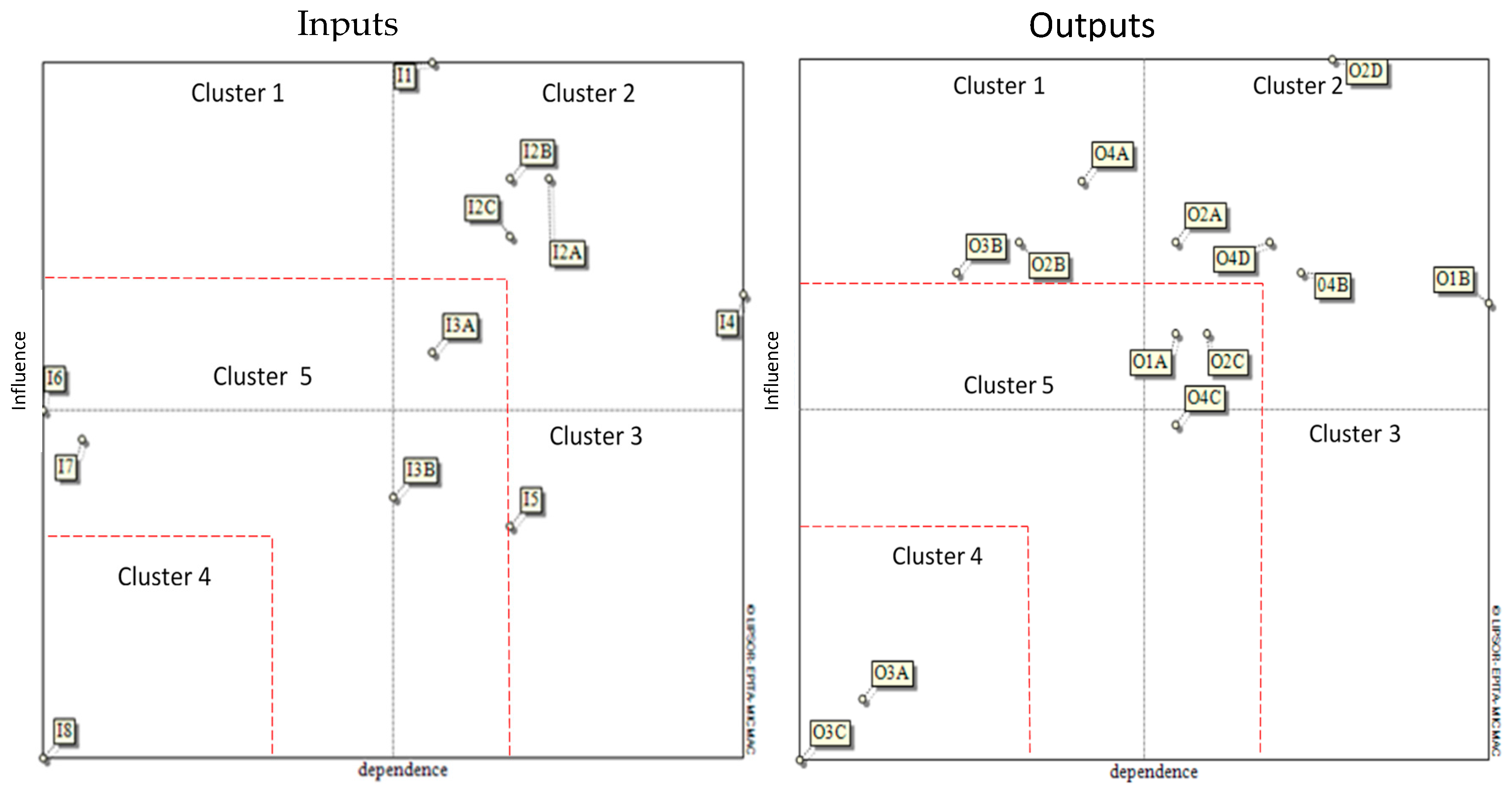
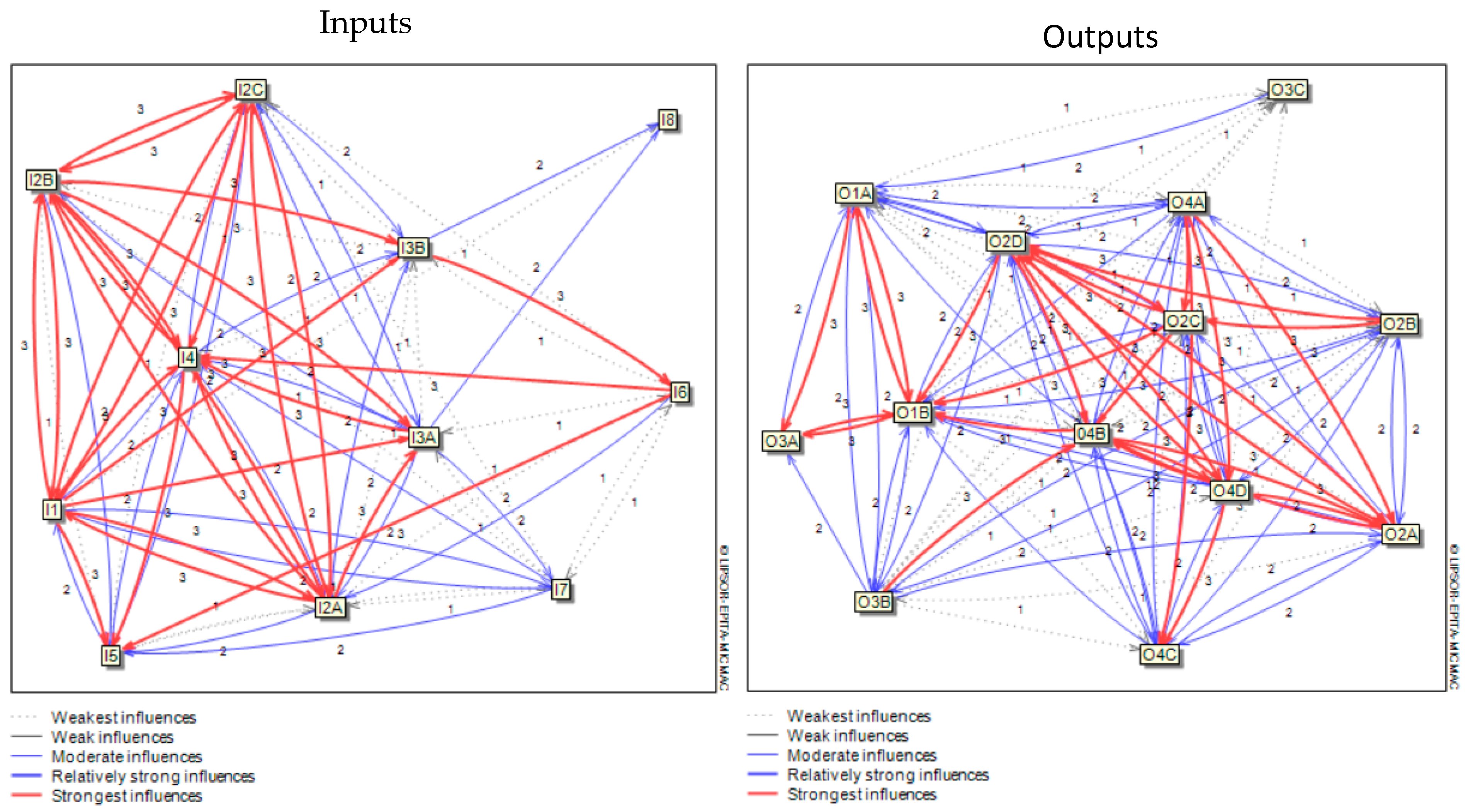
After running the inputs/outputs matrices separately in the MICMAC software V5, four diagrams were analysed. The first two, presented in Figure 1, represent the situation of the respective indicators (inputs and outputs), grouped in clusters, in the four quadrants of the Matrix of Direct Influence/Dependence. Regarding general structure, in both maps, the vertical axis represents the influence of the variables, and the horizontal axis represents the dependence. The other two, which are related to Figure 2, provide a general view of the direct effect of the corresponding indicators (inputs/outputs).
Figure 1.
Plan of direct influence and dependence of indicators on inputs/outputs, grouped in clusters (for Inputs and Outputs legend, see Table 3). Source: Authors’ own elaboration.
Figure 2.
Diagram of the direct influence of indicators (inputs/outputs) on the system (for Inputs and Outputs legend, see Table 3). Source: Authors’ own elaboration.
In Figure 1, Cluster 1 concerns the entry indicators, which are highly influential and show little dependence. Therefore, they are considered explanatory indicators of the system studied and should be subjected to priority action as soon as possible [45]. In the input diagram, this cluster has no items; in the output diagram, we have a cluster formed by O2B, O3B, and O4. Given these results, the indicators in this group should be considered important by HEIs because they will directly influence the behaviour of the groups to which they belong and should be incorporated into successful strategic planning [46].
Cluster 2 contains the linking indicators (also called conflicting indicators). These indicators are simultaneously very influential and very dependent and are therefore unstable. All actions on them will have simultaneous repercussions for other indicators and retroactive effects on themselves. The input diagram includes 5 indicators, I1, I2A, I2B, I2C, and I4, as does the output diagram with O1B, O2A, O2D, O4B, and O4D. The indicators here include the key (or target) indicators in the system. The role of these indicators implies high and medium levels of dependence and strong and medium influence. These indicators represent the strategic objectives that should be planned considering the inputs/outputs identified by the HEI, which are reflected in management plans [46]. These indicators should be monitored permanently.
The result indicators, belonging to Cluster 3, are the product of the interaction of the other variables within the system, showing low influence and high dependence. The impacts of other indicators explain their evolution. However, depending on how they are influenced, the impacts on other indicators can vary; therefore, these should be treated with care [47]. Observation of Figure 1 reveals that only the indicator referring to I5 inputs is in this situation.
Cluster 4, with only one indicator, I8, in the input diagram and O3A and O3C in the output diagram (see Figure 1), contains the exclusion indicators. These indicators, as the name indicates, can be excluded at the outset due to their low level of dependence and influence, mainly on the entry and linking indicators. All the other indicators belong to Cluster 5, which is named the ‘following group indicators’ cluster. These lack defined characteristics regarding influence and dependence, making it impossible to determine their role in the system, and should therefore be considered. Figure 1 shows the input diagrams I3A, I3B, I6, and I7 and the output diagrams O1A, O2C, and O4C. In Figure 2, in the input diagram, the most influential indicators are in Cluster 2, and in the output diagram, the most influential indicators are in Clusters 1 and 2.
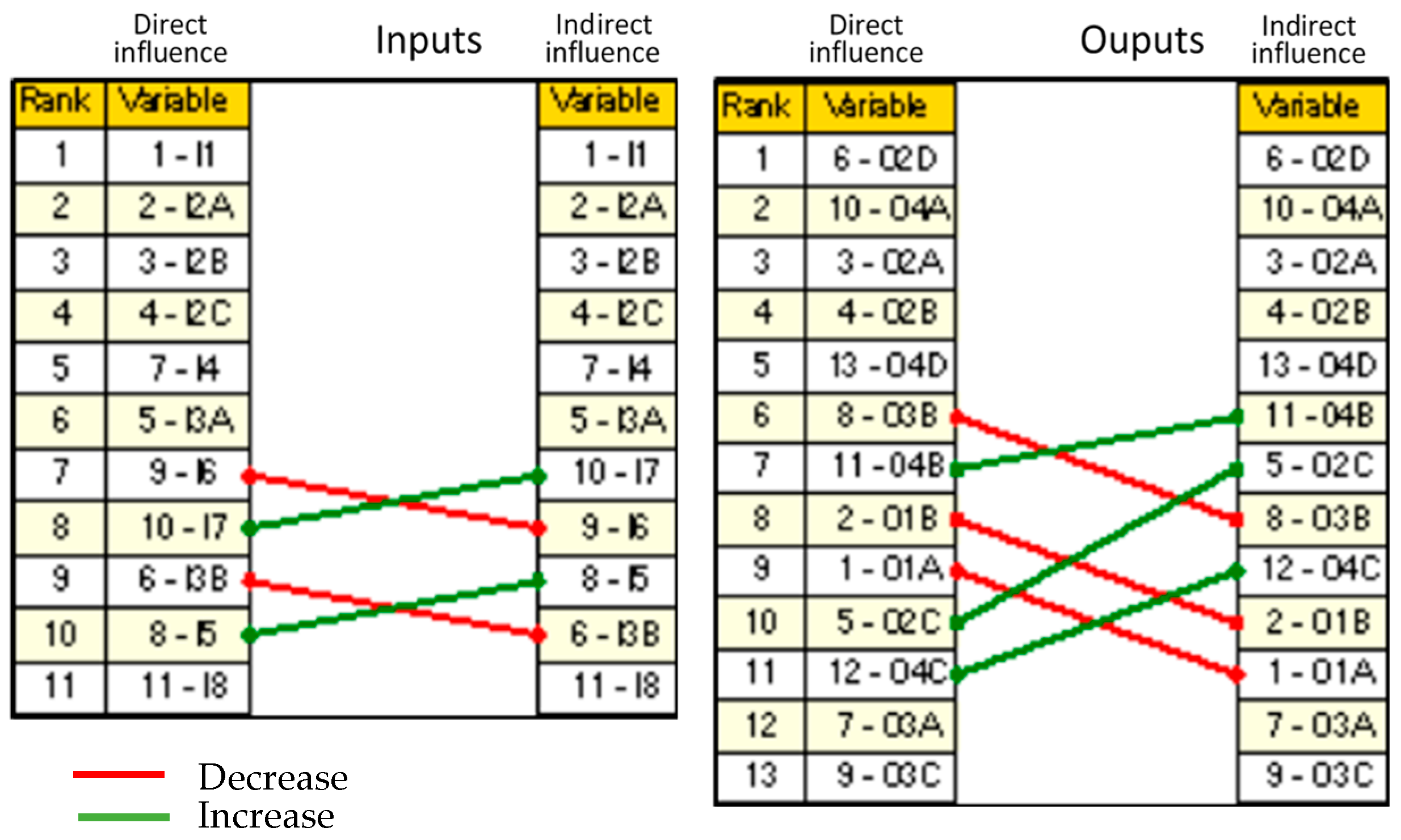
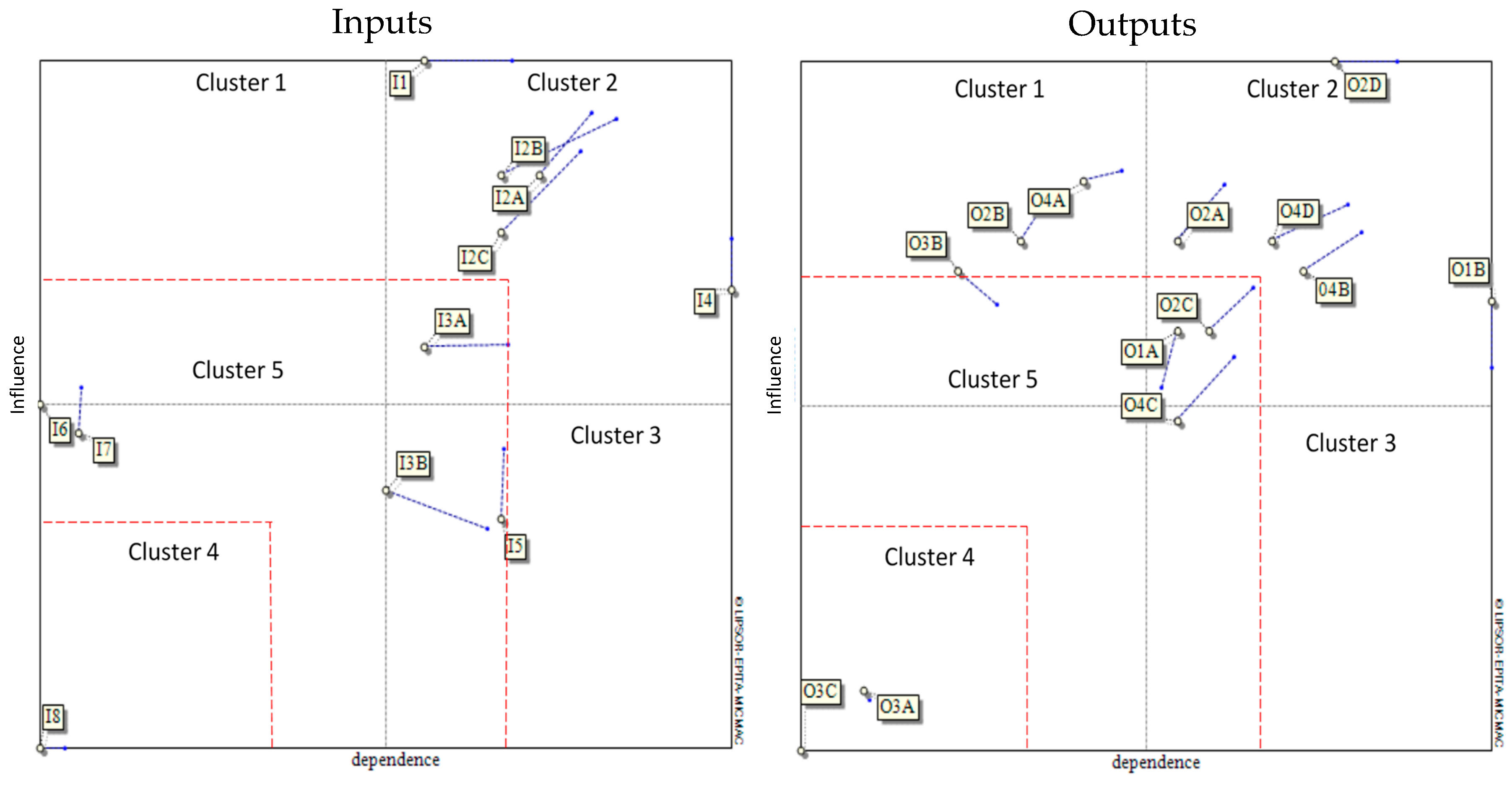
Figure 1 and Figure 2, described above, only show the indicators (inputs/outputs) with the most significant direct influence on the system. According to Godet [8] an exclusive focus on the direct impact is not sufficient to reveal hidden indicators, which can influence the issue under study in a subtle way. The same author also suggests analysing indicators’ indirect impacts, since this can reveal indicators that play an important role through indirect actions. Direct classification results from the interaction of short- and medium-term relations over a period generally corresponding to less than a decade, and indirect classification integrates chain reactions that necessarily extend over a longer period of 10–15 years [48]. Figure 3 and Figure 4 show a map of the direct/indirect movements of the indicators, referring to inputs and outputs, grouped by clusters.
Figure 3.
Classification of indicators (inputs/outputs) by direct/indirect influence (for Inputs and Outputs legend, see Table 3). Source: Authors’ own elaboration.
Figure 4.
Map of direct/indirect movements of the indicators referring to inputs and outputs, grouped by clusters (for Inputs and Outputs legend, see Table 3). Source: Authors’ own elaboration.
Figure 3 shows the ranking of the direct and indirect influence of the input and output variables on the efficiency of HEIs, highlighting which variables gain or lose importance when considering chain effects. On the left are the inputs and on the right are the outputs, each with two ranking columns: direct influence (left) and indirect influence (right). The green and red lines connect the positions of each variable in the two rankings, showing upward (green) or downward (red) movement from direct to indirect influence.
Regarding inputs, the variables at the top of both rankings (e.g., I1, I2A, I2B, I2C) exert strong direct and indirect influences, confirming their role as strategic inputs that structure the system. The red lines indicate inputs that lose weight when indirect effects are considered (e.g., I6, I7), suggesting that their impact is more immediate and propagates less through the network of variables. Among the outputs, there are more green and red intersections, indicating that some results gain importance when indirect relationships are considered (e.g., O2A, O2C, and O1A rise) while others lose prominence (e.g., O3A and O3C fall). This result suggests that specific outputs function as ‘propagation variables’ whose effects spread throughout the system, making them particularly relevant for long-term planning.
Figure 3 is supported by Figure 4. The blue arrows indicate potential shifts in the input hierarchy by indicating an evolution (from short to long term) through which certain factors become more dependent or influential. Following [48], medium- and long-term activities and development plans should take these changes into account.
Furthermore, the changes in the indicator rankings reveal significant dynamics in the influence of HEI inputs and outputs. Among the inputs, only I6, I3B, I5, and I7 changed position, with the first two falling and the latter two rising. Indicator I3A maintained its ranking but moved from Cluster 5 to Cluster 2, indicating a new systemic role. In terms of outputs, most remained stable, although O3B, O1B, and O1A fell, and O4B, O2C, and O4C rose; however, only O3B actually changed clusters (from 1 to 5). These variations reveal “hidden” indicators with strategic influence that should be analysed alongside the direct rankings.
The decline in I3B (“ratio of international students/total students”) and I6 (“ratio of ISI publications/total publications”) indicates two critical areas. The former is associated with reduced international mobility in the context of the pandemic, in line with [24,25], and the latter indicates the need to strengthen research quality. In contrast, the main increases in outputs are linked to human capital indicators (“doctorates in scientific and technological areas per thousand inhabitants”) and regional dynamism (“ratio of company turnover/total”).
Other noteworthy indicators are I3A, due to the growing dependence on first-cycle students, and the “ratio of declared value of services provided/own income” and “rate of scientific, cultural, social and sporting events”, which reinforce the importance of the institutional connection to the territory and the provision of technical and scientific services.
In summary, as they have a significant direct impact along with the capacity to produce systemic impacts, indicators that are well-positioned in both categories should be considered crucial indicators for building the prospective efficiency framework. Variables that are positioned firmly between direct and indirect influence can be classified as contextual or secondary variables that are useful for certain diagnoses but less important for long-term strategic choices.
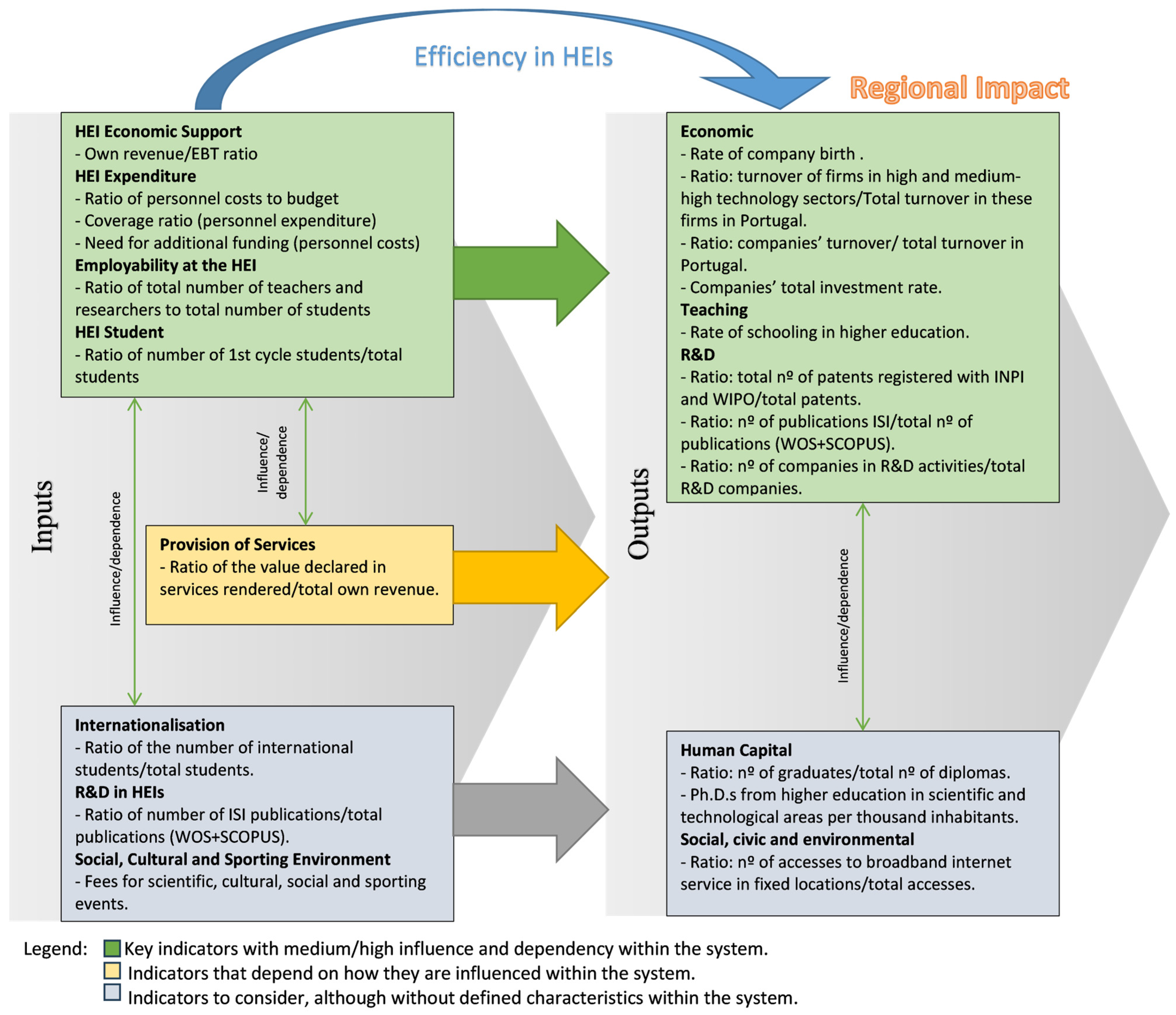
Figure 5 presents the final explanatory scheme of the functioning of the HEIs’ efficiency system, showing the most appropriate inputs/outputs to measure this efficiency and distributing them by area and degree of importance.
Figure 5.
Efficiency in HEIs: a strategic input–output prospective map. Source: Authors’ own elaboration.
Based on the main results of the efficiency measurement, there are two points that must be discussed: (i) evidence-based conclusions, which are statements grounded in data, measured results, or findings derived from our efficiency analysis; and (ii) forward-looking or speculative insights, which are projections, recommendations, or theoretical extensions that interpret evidence with a future orientation, suggesting what HEIs should do or might experience if certain conditions hold.
(i) Evidence-based conclusions: Regarding inputs, the key indicators in HEIs’ efficiency systems in the short term, representing the strategic objectives reflected in management plans [49], are related to HEIs’ economic support, expenditure on staff, the employability and qualifications of teaching staff, and first-cycle students. These key indicators should be continuously managed, observed, and modified when other system indicators change. As for outputs, the key indicators defined are those related to economics, mainly linked to company turnover and investment in the region; education, measured by the rate of schooling; and R&D, reflected in publications, patents, and firms linked to R&D.
(ii) Forward-looking or speculative insights: Long-term strategic plans should also pay special attention to the indicators in Table 3, especially those that transfer to clusters of greater impact, as is the case of the indicator “Ratio of n° of first cycle students/total students”, which moves from Cluster 5 to Cluster 2. In the long term, this indicator could make a difference in HEIs’ efficiency. Indeed, the prospective study by Pedro et al. [17] already noted that indicators related to the number of HEI students could have a greater impact on HEIs’ performance in the future. This finding aligns with Sharifi et al. [2], who emphasise that improving the evaluation of HEIs’ performance can enhance the quality of teaching, contribute to the future growth of the scientific community, and strengthen the country’s knowledge base. The indicators that do not change clusters but show a slight increase in the ranking of direct/indirect influence also need careful monitoring and attention, as their development may be highly relevant in the future. These include the “Ratio of declared value of service provision/total own income” and “Rate of scientific, cultural, social and sporting events”. Regarding inputs that descend from position, special attention should be paid to internationalisation, which, as we know, must be addressed in a different way in the context of the COVID-19 pandemic. Evidence for this is provided in [2], which states that the trend of increasing international student mobility, exchange programs, and internships in HEIs diminished rapidly during the pandemic, and that HEI management is concerned about the future of international student mobility. As a result, they must rethink their teaching and learning activities to adopt hybrid learning systems, which will provide new opportunities to spend some semesters face-to-face and others online, according to the frameworks provided in [25,49], as well as by involving both external and internal stakeholders in the co-creation of open participative programmes based on user-centric approaches [50]. In summary, internationalisation must remain a priority in future strategies, whether or not a pandemic occurs. Regarding outputs, the indicators “PhDs in higher education in scientific and technological areas per thousand inhabitants” and “Ratio: companies’ turnover/total turnover” should be integrated into long-term strategic planning, as their influence/dependence will shape the development of the whole system in the future.
A broader vision of the impact of the key indicators on the others can benefit HEIs’ efficiency in the long term. Therefore, the results of this research are also important for HEI managers, principally concerning the conception and production of future strategic plans for the HEI’s development and growth. These could include developing marketing strategies to attract more students; providing training with a view to improving the teaching staff’s qualifications and/or seeking to hire highly qualified staff; and using the indicators proposed in this study, incorporating the perspective of stakeholders outside the institution, to establish a structure of evaluation and responsibility-sharing with a view to improving the HEI’s outputs that will be subject to annual adjustments via a dynamic contingency approach.
In response to the RQ, the findings of this study identify four crucial factors in the creation and validation of a forward-looking and strategic framework for assessing the effectiveness of Portuguese public HEIs.
- Short-term indicators that have been shown to be enabling drivers of the efficiency system should serve as the foundation for the projected model’s structure: economic support for HEIs, staff expenditure, the employability and qualifications of teaching staff, and the ratio of first-cycle students. These inputs serve as immediate strategic objectives that must be continuously monitored and adjusted as the other indicators in the system evolve. In terms of outputs, the framework should include economic indicators (regional turnover and business investment), higher education enrolment rates, and R&D outcomes (e.g., publications, patents, and R&D-related companies) as central elements, as they reflect the direct impact of HEI efficiency in the region.
- The prospective and long-term dimensions of the model stem from the analysis of the evolution of indicators across clusters of influence/dependence. The fact that the ratio of the “number of first-cycle students/total number of students” moves from an intermediate cluster to a higher impact cluster shows that the structure and recruitment of students are decisive for future efficiency, confirming previous evidence that the weight of indicators linked to the number of students will increase in the performance evaluation of HEIs. Similarly, indicators that rise slightly in the influence ranking, such as the ratio of “declared value of services provided/total own revenue” and the “rate of scientific, cultural, social and sporting events”, should be incorporated as strategic monitoring variables, given their potential relevance in the medium and long term.
- Strategic adjustments and sustainability, with a forward-looking interpretation, allow for the reformulation of policies in areas where indicators are deteriorating, such as internationalisation, which has been severely affected by the COVID-19 pandemic and the decline in international student mobility, requiring hybrid teaching models and new ways of attracting international students. The integration of indicators such as the “number of doctorates in scientific and technological areas per thousand inhabitants” and the “ratio of turnover of companies/total turnover” into long-term planning strengthens the link between HEI efficiency, advanced qualifications, and regional economic dynamism. Thus, the framework is no longer just a monitoring system; it becomes a strategic tool to guide decisions that simultaneously promote internal efficiency and institutional and territorial sustainability.
- Finally, validation and use of the model involve engaging managers and external stakeholders in discussing the indicators and analysing their cross-effects on the efficiency system. The “broad view” of impacts, including strategies to attract more students, improve faculty qualifications, recruit highly qualified staff, and use indicators as the basis for evaluation and responsibility-sharing structures, allows for testing in practice whether the proposed set of inputs and outputs supports more informed and context-adjusted decisions. The framework’s ability to be updated annually, incorporating dynamic and contingent adjustments, is precisely what makes it a forward-looking and strategic tool for sustaining the efficiency and sustainability of Portuguese public HEIs over time.
5. Conclusions
The objective of this study was to develop and validate a strategic framework for measuring the efficiency of Portuguese HEIs and to identify key input and output indicators that support long-term, sustainable decision-making. The process took place in three phases, beginning with the systematisation of inputs and outputs based on the literature and incorporating a regional impact perspective. Efficiency was analysed both on the demand side (inputs)—direct economic impacts such as funding, expenditure and employment—and on the supply side (outputs)—qualitative and lasting effects such as skills, productivity, innovation and graduate returns. In addition, the most commonly used indicators were systematised (see Table 1 and Table 2).
These inputs and outputs, along with their respective key indicators, were validated using a qualitative approach through semi-structured interviews with experts from different regions of Portugal. This phase led to the determination of 11 key indicators for inputs and 13 indicators for outputs (see Table 3) to measure HEIs’ efficiency.
Finally, a cross-impact matrix was constructed using MICMAC software, enabling a prospective analysis of the most influential determinants of long-term efficiency. The indicators were then grouped into clusters according to their importance and influence in the short and long term. This process resulted in a strategic input–output map that identifies, prospectively, the main factors determining the efficiency of HEIs.
6. Contributions and Implications
This study offers an original contribution to the literature on HEI performance by proposing a theoretical and methodological framework that integrates efficiency analysis, regional impact, and strategic foresight. Drawing on the French tradition of prospective and foresight studies, it advances a new generation of strategic performance and efficiency indicators that transcend traditional productivity-based approaches. By reinterpreting HEIs as dynamic systems embedded in regional and temporal contexts, this framework aligns measurement with long-term strategic governance. This study also bridges a conceptual gap between institutional perspectives, which are focused on organisational adaptation, and foresight paradigms, which are concerned with strategic anticipation, sustainability, and the co-design of futures. This contribution strengthens the analytical ability to create resilient, forward-thinking plans for higher education. This set of results provides a strategic roadmap in which the behaviour of the clusters depends on HEIs’ financing and expenditure, the number of students in the first cycle, research carried out, economic activity and the wealth generated in regions, their populations’ education, and the translation of R&D into patents and publications generating innovation and entrepreneurship.
These indicators are directly connected to measurements of HEI efficiency and require monitoring, accompaniment, control, and review. For example, an HEI that is unable to recruit a satisfactory number of students, in relation to the number of places available, needs to review and adjust its strategy to attract new students, since the number of students has a direct or indirect influence on other indicators that should also be considered in future strategic plans. However, a university that already has a large number of students should focus on developing other indicators that create a competitive advantage over similar institutions. These can include R&D and the social, cultural, and sporting environment, both of which may increase in importance in the long term [48].
This type of prospective analysis opens a new path for future explorations of the resources (inputs) that require greater measurement and improvement, as well as the most viable and consistent results (outputs) for achieving greater and more beneficial efficiency [49]. Therefore, if considering Serna [50], prospective exercises and analyses need to be linked to specific actions in systems, with the possible incorporation of strategic management and management control. Considering the proposal of key indicators, there are several suggestions for HEIs’ strategic management: (i) attract public and private funds to support the institution economically and cope more easily with expenditure on staff; (ii) develop institutional marketing campaigns to attract new students; (iii) develop and creating programmes to improve lecturers’ scientific and digital qualifications; hire more and better lecturers; and (iv) develop strategies that minimise the impact of the COVID-19 pandemic on internationalisation. As for outputs, through partnerships with regional authorities, municipalities and companies, it is important to (i) promote firm establishment in the region through academic and organisational start-ups and spin-offs; (ii) promote company development so that there is greater investment in the region, simultaneously stimulating increased turnover and exports; (iii) promote more and better schooling for resident populations by creating specific teaching programmes targeted at first and second cycle students; and finally, (iv) promote the connection between R&D activities and innovation and entrepreneurship initiatives, as well as registering international patents and publications directed towards knowledge transfer from academia to companies and public institutions in particular and society in general.
7. Limitations and Future Studies
The MICMAC method presents some limitations that must be acknowledged. Given its qualitative nature, subjectivity necessarily affects the analysis because there is no clear-cut interpretation of the results, which rely on how participants understand the relationships between variables. In this context, it is also important to consider that the assumptions underlying stakeholders’ assessments, such as contextual factors, may have shaped their opinions. However, it is important to highlight the care taken in selecting participants and interviewees who are directly involved in the management of HEIs and in the direction and administration of regional authorities and municipalities to reinforce the legitimacy of the interpretations obtained.
Another limitation concerns the purposive sampling strategy, which was restricted to the Portuguese context, thus preventing the generalisation of the findings to other populations or higher education systems. Nevertheless, the proposed indicators were based on studies conducted in other countries and international contexts, which opens the door for future research to develop a prospective analysis grounded in a transnational strategic roadmap for HEI efficiency; this would allow the model presented here to be tested for its robustness and transferability.
Author Contributions
E.P.: Conceptualization, methodology, software, validation, formal analysis, investigation, data curation, visualization, supervision, writing—original draft preparation, writing—review and editing; H.A. and J.L.: Conceptualization, methodology, validation, formal analysis, investigation, data curation, visualization, supervision, writing—review and editing; M.P.A., M.R., M.d.L.M.-T. and L.C.: validation, visualisation and supervision. All authors have read and agreed to the published version of the manuscript.
Funding
This research work was supported by NECE and FCT—Fundação para a Ciência e Tecnologia, I.P.: UID/04630/2025 and DOI identifier 10.54499/UID/04630/2025; and CEEC-INST/00016/2021/CP2828/CT0005, CEEC Institutional 2021, DOI: 10.54499/CEECINST/00016/2021/CP2828/CT0005.
Institutional Review Board Statement
Ethical review and approval were waived for this study because it was conducted in accordance with the ethical principles of the World Medical Association Declaration of Helsinki. Formal approval from a research ethics committee was not required because the study did not involve vulnerable populations or the collection of sensitive personal data.
Informed Consent Statement
Informed consent was waived because participation was entirely voluntary, all participants provided informed consent before taking part, and responses were collected anonymously without requesting sensitive personal information.
Data Availability Statement
The data that support the findings of this study are available from the corresponding author upon reasonable request.
Acknowledgments
Generative AI was utilised exclusively to enhance language clarity and grammar. The authors carefully reviewed and revised all content as necessary and accept full accountability for the publication’s final content.
Conflicts of Interest
The authors declare no conflicts of interest.
References
- Kim, B.K.; Hwang, H.; Cho, H.J.; Jang, Y.S. The Rationalization of Korean Universities. Minerva 2019, 57, 501–521. [Google Scholar] [CrossRef]
- Sharifi, N.; Amiri, M.; Olfat, L.; Yousefli, A.; Hashemi-Tabatabaei, M.; Zohrehvandi, S. Data Envelopment Analysis with Fuzzy Inference System to Evaluate the Performance of Higher Education Institutions. Ind. High. Educ. 2025. [Google Scholar] [CrossRef]
- Pollanen, R.; Abdel-Maksoud, A.; Elbanna, S.; Mahama, H. Relationships between Strategic Performance Measures, Strategic Decision-Making, and Organizational Performance: Empirical Evidence from Canadian Public Organizations. Public Manag. Rev. 2017, 19, 725–746. [Google Scholar] [CrossRef]
- Bisbe, J.; Malagueño, R. Using Strategic Performance Measurement Systems for Strategy Formulation: Does It Work in Dynamic Environments? Manag. Account. Res. 2012, 23, 296–311. [Google Scholar] [CrossRef]
- Salas-Velasco, M. The Technical Efficiency Performance of the Higher Education Systems Based on Data Envelopment Analysis with an Illustration for the Spanish Case. Educ. Res. Policy Pract. 2020, 19, 159–180. [Google Scholar] [CrossRef]
- Johnes, G.; Tone, K. The Efficiency of Higher Education Institutions in England Revisited: Comparing Alternative Measures. Tert. Educ. Manag. 2017, 23, 191–205. [Google Scholar] [CrossRef]
- Agasisti, T. Management of Higher Education Institutions and the Evaluation of Their Efficiency and Performance. Tert. Educ. Manag. 2017, 23, 187–190. [Google Scholar] [CrossRef]
- Godet, M. From Anticipation to Action; Coates, J.F., Ed.; UNESCO Publishing: Paris, France, 1994. [Google Scholar]
- Berger, G. La Actitud Prospectiva. Rev. Univ. De Guadalaj. 2003, 26, 33–36. [Google Scholar]
- De-Jouvenel, H.; Medina-Vásquez, J. Sobre La Práctica Prospectiva. Una Breve Guía Metodológica. Cuad. De Adm. 2011, 14, 177. [Google Scholar] [CrossRef]
- Benjmea-Arias, M.; Castañeda, L.; Valencia-Arias, A. Structural Analysis of Strategic Variables through MICMAC Use: Case Study. Mediterr. J. Soc. Sci. MCSER Publ. 2016, 7, 2039–9340. [Google Scholar] [CrossRef]
- Godet, M.; Roubelat, F. Creating the Future: The Use and Misuse of Scenarios. Long Range Plan. 1996, 29, 164–171. [Google Scholar] [CrossRef]
- Brabandere, L.; Iny, A. Scenarios and Creativity: Thinking in New Boxes. Technol. Forecast. Soc. Change 2010, 77, 1506–1512. [Google Scholar] [CrossRef]
- Saavedra-Caballero, F. Recent Graduates in the Labor Market: The Efficiency Frontier of Higher Education Institutions. Res. High. Educ. 2024, 65, 755–774. [Google Scholar] [CrossRef]
- Asadi, S.; Allison, J.; Iranmanesh, M.; Fathi, M.; Safaei, M.; Saeed, F. Determinants of Intention to Use Simulation-Based Learning in Computers and Networking Courses: An ISM and MICMAC Analysis. IEEE Trans. Eng. Manag. 2024, 71, 6015–6030. [Google Scholar] [CrossRef]
- Li, Y.; Liu, X.; Hu, N.; Li, X. Research on the Relationship between Key Risk Factors of University Emergencies Based on ISM-MICMAC. PLoS ONE 2025, 20, e0317656. [Google Scholar] [CrossRef]
- Pedro, E.; Leitão, J.; Alves, H. HEI Efficiency and Quality of Life: Seeding the pro-Sustainability Efficiency. Sustainability 2021, 13, 514. [Google Scholar] [CrossRef]
- Felsenstein, D. The University in the Metropolitan Arena: Impacts and Public Policy Implications. Urban Stud. 1996, 33, 1565–1580. [Google Scholar] [CrossRef]
- Horta, H. The Role of the State in the Internationalization of Universities in Catching-up Countries: An Analysis of the Portuguese Higher Education System. High. Educ. Policy 2010, 23, 63–81. [Google Scholar] [CrossRef]
- Heitor, M.; Horta, H. Democratizing Higher Education and Access to Science: The Portuguese Reform 2006–2010. High. Educ. Policy 2014, 27, 239–257. [Google Scholar] [CrossRef]
- Altbach, P.G.; De Wit, H. COVID-19: The Internationalization Revolution That Isn’t. Int. High. Educ. 2020, 102, 16–18. [Google Scholar]
- Yıldırım, S.; Bostancı, S.H.; Yıldırım, D.Ç.; Erdogan, F. Rethinking Mobility of International University Students during COVID-19 Pandemic. High. Educ. Eval. Dev. 2021, 15, 98–113. [Google Scholar] [CrossRef]
- Serrano, O.M.E.; Miranda González, F.J.; Mourato, J.A.B. Determinants of the Effectiveness of Quality Assurance Systems and Institutional Performance in Higher Education. Cogent Educ. 2025, 12, 2581411. [Google Scholar] [CrossRef]
- Cunha, M.; Rocha, V. On the Efficiency of Public Higher Education Institutions in Portugal: An Exploratory Study. FEP Working Papers 2012, No. 468, 30. Available online: https://ideas.repec.org/p/por/fepwps/468.html (accessed on 5 February 2026).
- Goker, N.; Dursun, M. Performance Evaluation of Higher Education Institutions Employing Analytical Techniques. In Intelligent and Fuzzy Systems. INFUS 2023; Kahraman, C., Sari, I.U., Oztaysi, B., Cebi, S., Cevik Onar, S., Tolga, A.Ç., Eds.; Lecture Notes in Networks and Systems, Vol. 759; Springer: Cham, Switzerland, 2023. [Google Scholar]
- Hashemi Petrudi, S.H.; Ghomi, H.; Mazaheriasad, M. An Integrated Fuzzy Delphi and Best Worst Method (BWM) for Performance Measurement in Higher Education. Decis. Anal. J. 2022, 4, 100121. [Google Scholar] [CrossRef]
- Loganathan, M.; Subrahmanya, M.H.B. Efficiency of Entrepreneurial Universities in India: A Data Envelopment Analysis. J. Knowl. Econ. 2023, 14, 1120–1144. [Google Scholar] [CrossRef]
- Ahmed, J.S.; Chaloob, I.Z.; Chaloob, K.Z.; Muttar, A.K.; Aldulaimi, S.H. Optimizing Management Decision Strategies: A Framework for Sustainable Efficiency. In Proceedings of the 2024 International Conference on Decision Aid Sciences and Applications, DASA, Manama, Bahrain, 11–12 December 2024. [Google Scholar] [CrossRef]
- Zhang, Q.; Larkin, C.; Lucey, B.M. The Economic Impact of Higher Education Institutions in Ireland: Evidence from Disaggregated Input–Output Tables. Stud. High. Educ. 2017, 42, 1601–1623. [Google Scholar] [CrossRef]
- Hermannsson, K.; Lisenkova, K.; McGregor, P.G.; Swales, J.K. The Expenditure Impacts of London’s Higher Education Institutions: The Role of Diverse Income Sources. Stud. High. Educ. 2015, 40, 1641–1659. [Google Scholar] [CrossRef]
- Garrido-yserte, R.; Gallo-rivera, M.T. The Impact of the University upon Local Economy: Three Methods to Estimate Demand-Side Effects. Ann. Reg. Sci. 2010, 44, 39–67. [Google Scholar] [CrossRef]
- Lambooy, J.G. Knowledge Production, Organisation and Agglomeration Economies. GeoJournal 1997, 41, 293–300. [Google Scholar] [CrossRef]
- Pellenbarg, P.H. How To Calculate the Impact of a University on the regional economy. In Proceedings of the Conference on Knowledge and Regional Economic Development, Barcelona, Spain, 9–11 June 2005; pp. 1–22. [Google Scholar]
- Dhirasasna, N.; Suprun, E.; Macaskill, S.; Hafezi, M.; Sahin, O. A Systems Approach to Examining Phd Students’ Well-Being: An Australian Case. Systems 2021, 9, 17. [Google Scholar] [CrossRef]
- Tajik, O.; Golzar, J.; Noor, S. Purposive Sampling. Int. J. Educ. Lang. Stud. 2024, 2, 1–9. [Google Scholar]
- Palinkas, L.A.; Horwitz, S.M.; Green, C.A.; Wisdom, J.P.; Duan, N.; Hoagwood, K. Purposeful Sampling for Qualitative Data Collection and Analysis in Mixed Method Implementation Research. Adm. Policy Ment. Health Ment. Health Serv. Res. 2015, 42, 533–544. [Google Scholar] [CrossRef]
- Etikan, I.; Musa, S.A.; Alkassim, R.S. Comparison of Convenience Sampling and Purposive Sampling. Am. J. Theor. Appl. Stat. 2016, 5, 1. [Google Scholar] [CrossRef]
- Baltar, F.; Brunet, I. Social Research 2.0: Virtual Snowball Sampling Method Using Facebook. Internet Res. 2012, 22, 57–74. [Google Scholar] [CrossRef]
- Goldstein, H.A.; Renault, C.S. Estimating Universities’ Contributions to Regional Economic Development: The Case of the U.S. Interdiscip. Stud. Econ. Manag. 2005, 4, 71–91. [Google Scholar]
- Jonkers, K.; Tijssen, R.; Karvounaraki, A.; Goenaga, X. A Regional Innovation Impact Assessment Framework for Universities; Publications Office of the European Union: Luxembourg, 2018. [Google Scholar] [CrossRef]
- Skyrme, J.; Thompson, J. Measuring the Difference; Viewforth Consulting Ltd.: Manchester, UK, 2018. [Google Scholar]
- Drucker, J.; Goldstein, H. Assessing the Regional Economic Development Impacts of Universities: A Review of Current Approaches. Int. Reg. Sci. Rev. 2007, 30, 20–46. [Google Scholar] [CrossRef]
- Kroll, H.; Schubert, T. On Universities’ Long-Term Effects on Regional Value Creation and Unemployment—The Case of Germany. Working Papers Firms and Region; R1/2014. 2014. Available online: https://www.econstor.eu/handle/10419/93109 (accessed on 5 February 2026).
- Asan, U.; Bozdag, C.E.; Polat, S. A Fuzzy Approach to Qualitative Cross Impact Analysis. Omega 2004, 32, 443–458. [Google Scholar] [CrossRef]
- Godet, M.; Durance, P. A Prospectiva Estratética; DUNOD, Ed.; UNESCO—Ornanização das Nações Unidas para a Educação, a Ciência e a Cultura: Paris, France, 2011. [Google Scholar]
- González-Cabo, V.; Murgueitio, M.; Cruz-Caicedo, L.F.; Burbano-Vallejo, E.L.; Moreno, E. Application of Structural Analysis for Local Development in the Center Region of Valle Del Cauca, Colombia. Int. Rev. Public Nonprofit Mark. 2017, 14, 289–320. [Google Scholar] [CrossRef]
- Tiwari, R.K. Identification of Factors Affecting Reverse Chain Performance in Relation to Customer Satisfaction Using ISM Modelling & MICMAC Analysis. Uncertain Supply Chain Manag. 2013, 1, 237–252. [Google Scholar] [CrossRef]
- Pedro, E.; Leitão, J.; Alves, H. The Intellectual Capital of Higher Education Institutions: Operationalizing Measurement through a Strategic Prospective Lens. J. Intellect. Cap. 2019, 20, 355–381. [Google Scholar] [CrossRef]
- Munar, J.L.S.; Urbina, B.P.; Cortés, C.G. Valoración Prospectiva Del Capital Intelectual de La Universidad de Atacama, Mediante La Técnica Delphi. Ingeniare. Rev. Chil. De Ing. 2014, 22, 567–575. [Google Scholar] [CrossRef]
- Serna, P. Strategic Prospective in Knowledge Management: A Proposal for Research Groups in Colombia. Investig. Desarro. 2013, 21, 259–282. [Google Scholar]
Disclaimer/Publisher’s Note: The statements, opinions and data contained in all publications are solely those of the individual author(s) and contributor(s) and not of MDPI and/or the editor(s). MDPI and/or the editor(s) disclaim responsibility for any injury to people or property resulting from any ideas, methods, instructions or products referred to in the content. |
© 2026 by the authors. Licensee MDPI, Basel, Switzerland. This article is an open access article distributed under the terms and conditions of the Creative Commons Attribution (CC BY) license.