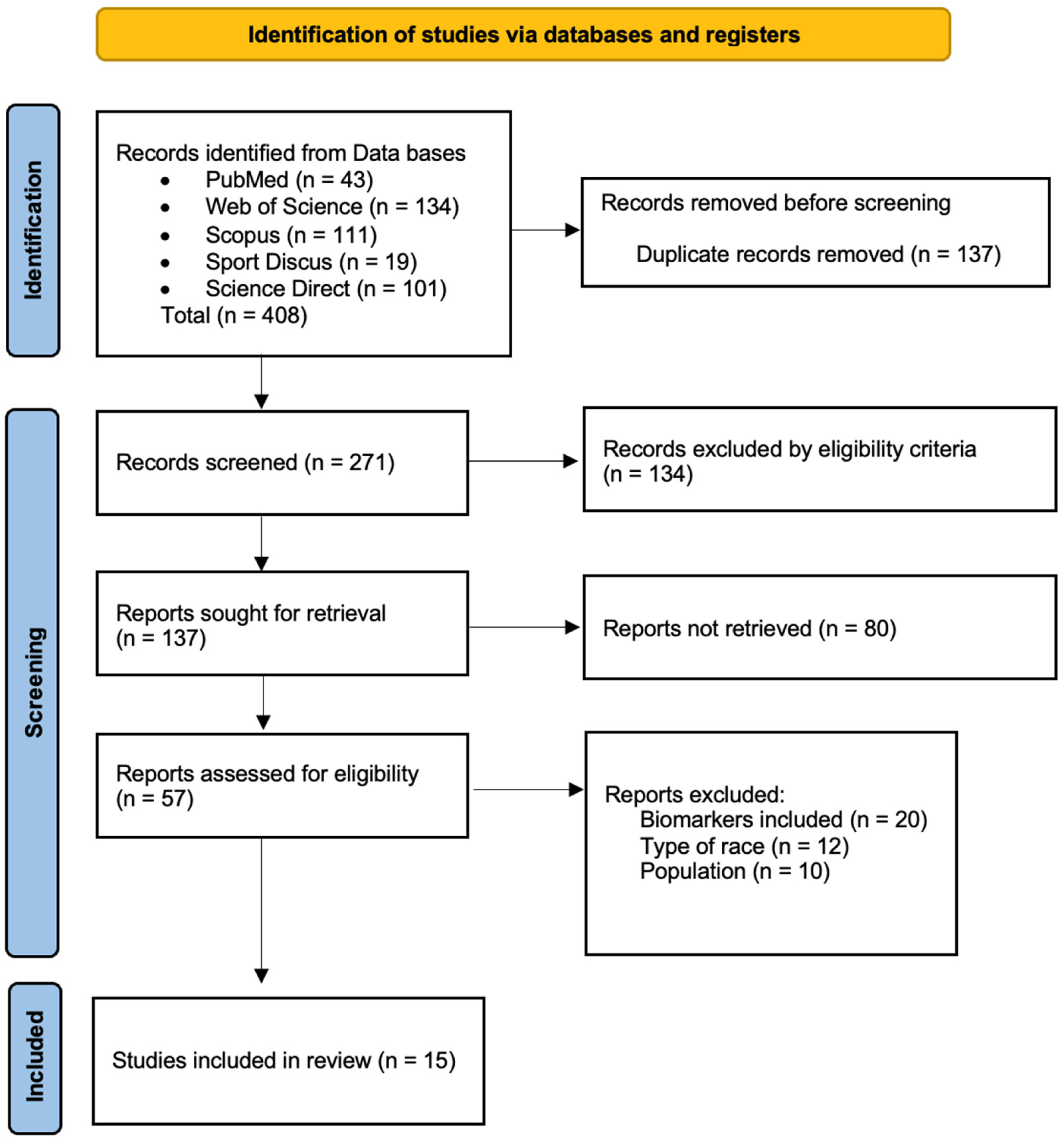


Muscle, Neuromuscular, and Cardiac Damage in Trail Running: A Systematic Review


 ,
,  ,
,  , and
, and
Abstract
1. Introduction
2. Materials and Methods
2.1. Criteria for Study Search and Selection
2.2. Inclusion Criteria
- Case studies, observational studies, longitudinal studies, or prospective designs.
- Adolescent or adult populations of both sexes (>15 years old) without medical conditions or pathology.
- Studies published between 2010 and 2025.
- Studies written in English or Spanish.
- Publications analyzing muscle damage using blood biomarkers such as creatine kinase (CK), lactate dehydrogenase (LDH), or AST/ALT (Aspartato Aminotransferasa/Alanine Aminotransferase); peripheral neuromuscular fatigue evaluated using dynamic tests of lower-limb elastic–explosive strength (SJ, CMJ, ABA) or maximal voluntary isometric contractions (MVIC); and cardiac damage assessed through biomarkers including Pro-BNP, CK-MB, cTnI, high-sensitivity cardiac troponin I (hs-cTnI), and N-terminal pro–brain natriuretic peptide (NT-proBNP).
2.3. Exclusion Criteria
- Studies that did not explicitly refer to trail running;
- Publications that did not address muscle damage or muscle fatigue, defined as contractile force loss or cardiac damage;
- Participants reporting any cardiac pathology or previous muscular injury.
2.4. Data Extraction
2.5. Overall Quality of Included Studies
2.6. Synthesis Methods
2.7. Risk of Bias Assessment and Methodological Quality
2.8. Reporting Bias Assessment
2.9. Certainty of Evidence
3. Results
3.1. Studied Population and Type of Event
3.2. Muscle Damage Markers
3.3. Reporting Bias
4. Discussion
4.1. Muscle Damage Biomarkers
4.2. Neuromuscular Function
4.3. Transient Cardiac Damage
5. Conclusions
Supplementary Materials
Author Contributions
Funding
Institutional Review Board Statement
Informed Consent Statement
Data Availability Statement
Acknowledgments
Conflicts of Interest
Abbreviations
| TR | Trail Running |
| CK | Creatine Kinase |
| LDH | Lactate Dehydrogenase |
| ALT | Alanine Aminotransferase |
| MB | Myoglobin |
| LVEF | Left Ventricular Ejection Fraction |
| HRV | Heart Rate Variability |
| cTn | Cardiac Troponin |
| hs-cTn | High-sensitivity Troponin |
| CK-MB | Creatine Kinase MB isoenzyme |
| NT-proBNP | N-Terminal pro–B-type Natriuretic Peptide |
| PRISMA | Preferred Reporting Items for Systematic Reviews and Meta-Analyses |
| NIHR | National Institute for Health and Care Research |
| PROSPERO | International Prospective Register of Systematic Reviews |
| MeSH | Medical Subject Headings |
| AST | Aspartato Aminotransferasa |
| SJ | Squat Jump |
| CMJ | Counter-Movement Jump |
| ABA | Abalakov Jump |
| MVIC | Maximal Voluntary Isometric Contractions |
| Pro-BNP | Pro–B-type Natriuretic Peptide |
| cTnI | Cardiac Troponin I |
| hs-cTnI | High-sensitivity cardiac Troponin I |
| NT-proBNP | N-terminal pro–Brain Natriuretic Peptide |
| PEDro | Physiotherapy Evidence Database |
| NHLBI | National Heart, Lung, and Blood Institute |
| hs-TnT | Troponin T High Sensitivity |
| FAC | Fractional Area Changes |
| LAVI | Left Atrial Volume Index |
| M | Male |
| F | Female |
| CG | Control Group |
| SD | Standard Deviation |
| A | Amateur |
| HT | Highly Trained |
| P | Professional |
| T | Treadmill |
| U | Ultra Trail |
| S | Speed |
| m | Meters of elevation |
| km/h | Kilometers per hour |
| NR | Not Reported |
| N | Newtons |
| GFWS | Global Free Wall Strain |
| GLS | Global Longitudinal Strain |
| G | Group |
| h | Hours |
| d | Days |
References
- Hamill, J.; Hercksen, J.; Salzano, M.; Udofa, A.; Trudeau, M.B. The prevalence of injuries in trail running: Influence of trails, terrains and footwear. Footwear Sci. 2022, 14, 113–121. [Google Scholar] [CrossRef]
- Jiang, X.; Sárosi, J.; Bíró, I. Characteristics of Lower Limb Running-Related Injuries in Trail Runners: A Systematic Review. Phys. Act. Health 2024, 8, 137–147. [Google Scholar] [CrossRef]
- Andersen, J.J. The State of Trail Running 2022. 2022. Available online: https://runrepeat.com/the-state-of-trail-running-2022 (accessed on 29 November 2025).
- Babí-Lladós, J.; Soler-Prat, S.; Inglés-Yuba, E.; Labrador-Roca, V. History and planning process of trail races in Spain. RICYDE Rev. Int. Cienc. Deport. 2021, 17, 140–159. [Google Scholar] [CrossRef]
- Viljoen, C.T.; van Rensburg, D.C.J.; Verhagen, E.; van Mechelen, W.; Korkie, E.; Botha, T. Epidemiology, clinical characteristics, and risk factors for running-related injuries among south african trail runners. Int. J. Environ. Res. Public Health 2021, 18, 12620. [Google Scholar] [CrossRef]
- Besson, T.; Rossi, J.; Mallouf, T.L.R.; Marechal, M.; Doutreleau, S.; Verges, S.; Millet, G.Y. Fatigue and Recovery after Single-Stage versus Multistage Ultramarathon Running. Med. Sci. Sports Exerc. 2020, 52, 1691–1698. [Google Scholar] [CrossRef]
- Hoffman, M.D.; Pasternak, A.; Rogers, I.R.; Khodaee, M.; Hill, J.C.; Townes, D.A.; Scheer, B.V.; Krabak, B.J.; Basset, P.; Lipman, G.S. Medical services at ultra-endurance foot races in remote environments: Medical issues and consensus guidelines. Sports Med. 2014, 44, 1055–1069. [Google Scholar] [CrossRef]
- Dawadi, S.; Basyal, B.; Subedi, Y. Morbidity Among Athletes Presenting for Medical Care During 3 Iterations of an Ultratrail Race in the Himalayas. Wilderness Environ. Med. 2020, 31, 437–440. [Google Scholar] [CrossRef]
- Scheer, B.V.; Murray, A. Al Andalus Ultra Trail: An observation of medical interventions during a 219-km, 5-day ultramarathon stage race. Clin. J. Sport Med. 2011, 21, 444–446. [Google Scholar] [CrossRef]
- Goodrum, M.; Viljoen, C.; Kaulback, K. Incidence, severity, and risk factors for injuries in female trail runners—A retrospective cross-sectional study. Phys. Ther. Sport 2025, 71, 1–7. [Google Scholar] [CrossRef]
- Tian, A.; Ma, J.; Feng, K.; Liu, Z.; Chen, L.; Jia, H.; Ma, X. Reference markers of bone turnover for prediction of fracture: A meta-analysis. J. Orthop. Surg. Res. 2019, 14, 68. [Google Scholar] [CrossRef]
- Hody, S.; Rogister, B.; Leprince, P.; Wang, F.; Croisier, J.L. Muscle fatigue experienced during maximal eccentric exercise is predictive of the plasma creatine kinase (CK) response. Scand. J. Med. Sci. Sports 2013, 23, 501–507. [Google Scholar] [CrossRef] [PubMed]
- Bontemps, B.; Vercruyssen, F.; Gruet, M.; Louis, J. Downhill Running: What Are the Effects and How Can We Adapt? A Narrative Review. Sports Med. 2020, 50, 2083–2110. [Google Scholar] [CrossRef] [PubMed]
- Coratella, G.; Varesco, G.; Rozand, V.; Cuinet, B.; Sansoni, V.; Lombardi, G.; Vernillo, G.; Mourot, L. Downhill running increases markers of muscle damage and impairs the maximal voluntary force production as well as the late phase of the rate of voluntary force development. Eur. J. Appl. Physiol. 2024, 124, 1875–1883. [Google Scholar] [CrossRef] [PubMed]
- Ehrström, S.; Gruet, M.; Giandolini, M.; Chapuis, S.; Morin, J.B.; Vercruyssen, F. Acute and Delayed Neuromuscular Alterations Induced by Downhill Running in Trained Trail Runners: Beneficial Effects of High-Pressure Compression Garments. Front. Physiol. 2018, 9, 1627. [Google Scholar] [CrossRef]
- Schwiete, C.; Roth, C.; Mester, J.; Broich, H.; Behringer, M. Overlaps of Skeletal Muscle Fatigue and Skeletal Muscle Damage: The Muscle Injury Continuum. Sports Med. Open 2025, 11, 73. [Google Scholar] [CrossRef]
- Muanjai, P.; Mickevicius, M.; Sniečkus, A.; Sipavičienė, S.; Satkunskiene, D.; Kamandulis, S.; Jones, D.A. Low frequency fatigue and changes in muscle fascicle length following eccentric exercise of the knee extensors. Exp. Physiol. 2020, 105, 502–510. [Google Scholar] [CrossRef]
- Scheer, V.; Basset, P.; Giovanelli, N.; Vernillo, G.; Millet, G.P.; Costa, R.J.S. Defining Off-road Running: A Position Statement from the Ultra Sports Science Foundation. Int. J. Sports Med. 2020, 41, 275–284. [Google Scholar] [CrossRef]
- Millet, G.Y.; Martin, V.; Lattier, G.; Ballay, Y. Mechanisms contributing to knee extensor strength loss after prolonged running exercise. J. Appl. Physiol. 2003, 94, 193–198. [Google Scholar] [CrossRef]
- Bernat-Adell, M.D.; Collado-Boira, E.J.; Moles-Julio, P.; Panizo-González, N.; Martínez-Navarro, I.; Hernando-Fuster, B.; Hernando-Domingo, C. Recovery of Inflammation, Cardiac, and Muscle Damage Biomarkers After Running a Marathon. J. Strength Cond. Res. 2021, 35, 626–632. [Google Scholar] [CrossRef]
- Bäcker, H.C.; Richards, J.T.; Kienzle, A.; Cunningham, J.; Braun, K.F. Exertional Rhabdomyolysis in Athletes: Systematic Review and Current Perspectives. Clin. J. Sport Med. 2023, 33, 187–194. Available online: https://journals.lww.com/10.1097/JSM.0000000000001082 (accessed on 29 November 2025). [CrossRef]
- Lima, R.G.F.; Coswig, V.S.; de Oliveira, E.; Farias, D.A. Exercise-induced rhabdomyolysis is not more severe or frequent after Crossfit than after Running or Strength training programs. Rev. Andal. Med. Deport. 2019, 12, 206–209. [Google Scholar] [CrossRef]
- Le Goff, C.; Kaux, J.-F.; Dulgheru, R.; Seidel, L.; Pincemail, J.; Cavalier, E.; Melon, P. The impact of an ultra-trail on the dynamic of cardiac, inflammatory, renal and oxidative stress biological markers correlated with electrocardiogram and echocardiogram. Acta Cardiol. 2020, 76, 739–747. [Google Scholar] [CrossRef] [PubMed]
- Hohl, R.; Nazário de Rezende, F.; Millet, G.Y.; Ribeiro da Mota, G.; Marocolo, M. Blood cardiac biomarkers responses are associated with 24 h ultramarathon performance. Heliyon 2019, 5, e01913. [Google Scholar] [CrossRef] [PubMed]
- Costache, A.-D.; Leon-Constantin, M.-M.; Roca, M.; Maștaleru, A.; Anghel, R.-C.; Zota, I.-M.; Drugescu, A.; Costache, I.-I.; Chetran, A.; Moisă, Ș.-M.; et al. Cardiac Biomarkers in Sports Cardiology. J. Cardiovasc. Dev. Dis. 2022, 9, 453. [Google Scholar] [CrossRef]
- Alexánderson, E.; Jácome, R.; Romero, E.; Peña-Cabral, M.; Meléndez, G.; Kimura-Hayama, E.; Meave, A. La importancia del diagnóstico multi-imagen en cardiología. Arch. Cardiol. Mex. 2011, 81, 154–157. Available online: www.elsevier.com.mx (accessed on 29 November 2025).
- Wilson, M.; O’HAnlon, R.; Prasad, S.; Oxborough, D.; Godfrey, R.; Alpendurada, F.; Smith, G.; Wong, J.; Basavarajaiah, S.; Sharma, S.; et al. Biological markers of cardiac damage are not related to measures of cardiac systolic and diastolic function using cardiovascular magnetic resonance and echocardiography after an acute bout of prolonged endurance exercise. Br. J. Sports Med. 2011, 45, 780–784. [Google Scholar] [CrossRef]
- Nie, J.; Tong, T.K.; George, K.; Fu, F.H.; Lin, H.; Shi, Q. Resting and post-exercise serum biomarkers of cardiac and skeletal muscle damage in adolescent runners. Scand. J. Med. Sci. Sports 2011, 21, 625–629. [Google Scholar] [CrossRef]
- George, K.; Oxborough, D.; Forster, J.; Whyte, G.; Shave, R.; Dawson, E.; Stephenson, C.; Dugdill, L.; Edwards, B.; Gaze, D. Mitral annular myocardial velocity assessment of segmental left ventricular diastolic function after prolonged exercise in humans. J. Physiol. 2005, 569, 305–313. [Google Scholar] [CrossRef]
- Hanssen, H.; Keithahn, A.; Hertel, G.; Drexel, V.; Stern, H.; Schuster, T.; Lorang, D.; Beer, A.J.; Schmidt-Trucksäss, A.; Nickel, T.; et al. Magnetic resonance imaging of myocardial injury and ventricular torsion after marathon running. Clin. Sci. 2011, 120, 143–152. [Google Scholar] [CrossRef]
- Pluim, B.M.; Zwinderman, A.H.; van der Laarse, A.; van der Wall, E.E. The Athlete’s Heart a Meta-Analysis of Cardiac Structure and Function. Circulation 2000, 101, 336–344. [Google Scholar] [CrossRef]
- Claessen, G.; De Bosscher, R.; Janssens, K.; Young, P.; Dausin, C.; Claeys, M.; Claus, P.; Goetschalckx, K.; Bogaert, J.; Mitchell, A.M.; et al. Reduced Ejection Fraction in Elite Endurance Athletes: Clinical and Genetic Overlap with Dilated Cardiomyopathy. Circulation 2024, 149, 1405–1415. [Google Scholar] [CrossRef] [PubMed]
- Gajda, R.; Klisiewicz, A.; Matsibora, V.; Piotrowska-Kownacka, D.; Biernacka, E.K. Heart of the world’s top ultramarathon runner—Not necessarily much different from normal. Diagnostics 2020, 10, 73. [Google Scholar] [CrossRef] [PubMed]
- Calleja-Romero, A.; Vicente-Rodríguez, G.; Garatachea, N. Acute effects of long-distance races on heart rate variability and arterial stiffness: A systematic review and meta-analysis. J. Sports Sci. 2022, 40, 248–270. [Google Scholar] [CrossRef] [PubMed]
- Özgünen, K.; Günaştı, Ö.; Özdemir, Ç.; Korkmaz Eryılmaz, S.; Gezgin, E.; Boyraz, C.; Kılcı, A.; Adaş, Ü.; Kurdak, S.S. The relationship between cardiac damage biomarkers and heart rate variability following 60 min of running. Clin. Auton. Res. 2022, 32, 249–260. [Google Scholar] [CrossRef]
- Jouffroy, R.; Lebreton, X.; Mansencal, N.; Anglicheau, D. Acute kidney injury during an ultra-distance race. PLoS ONE 2019, 14, e0222544. [Google Scholar] [CrossRef]
- Lecina, M.; Castellar, C.; Pradas, F.; López-Laval, I. 768-km Multi-Stage Ultra-Trail Case Study-Muscle Damage, Biochemical Alterations and Strength Loss on Lower Limbs. Int. J. Environ. Res. Public Health 2022, 19, 876. [Google Scholar] [CrossRef]
- Rojas-Valverde, D.; Olcina, G.; Sánchez-Ureña, B.; Pino-Ortega, J.; Martínez-Guardado, I.; Timón, R. Proteinuria and bilirubinuria as potential risk indicators of acute kidney injury during running in outpatient settings. Medicina 2020, 56, 562. [Google Scholar] [CrossRef]
- Minshull, C.; James, L. The effects of hypohydration and fatigue on neuromuscular activation performance. Appl. Physiol. Nutr. Metab. 2013, 38, 21–26. [Google Scholar] [CrossRef]
- Boshielo, P.M.; Jansen van Rensburg, A.; Viljoen, C.; Botha, T.; de Villiers, C.E.; Ramagole, D.; Seyani, L.; Janse van Rensburg, D.C. Illness is more prevalent than injury in trail runners participating in a mountainous ultra trail race. Physician Sportsmed. 2025, 53, 27–35. [Google Scholar] [CrossRef]
- Giovanelli, N.; Lazzer, S.; Cauci, S. Muscle damage and inflammatory status biomarkers after a 3-stage trail running race. J. Sports Med. Phys. Fit. 2020, 60, 1486–1492. [Google Scholar] [CrossRef]
- Esefeld, K.; Geisberger, M.; Dinges, S.M.; Hambrecht, J.; Stegmüller, F.; Rasper, M.; Nadjiri, J.; Roeschenthaler, F.; Holdenrieder, S.; Scharhag, J.; et al. Influence of a 7-day Transalpine Trail Run on cardiac biomarkers and myocardial function. Scand. J. Med. Sci. Sports 2024, 34, e14590. [Google Scholar] [CrossRef]
- Martinez-Navarro, I.; Sánchez-Gómez, J.M.; Collado-Boira, E.J.; Hernando, B.; Panizo, N.; Hernando, C. Cardiac damage biomarkers and heart rate variability following a 118-km mountain race: Relationship with performance and recovery. J. Sports Sci. Med. 2019, 18, 615–622. [Google Scholar]
- Le Goff, C.; Gergelé, L.; Seidel, L.; Cavalier, E.; Kaux, J.F. Mountain Ultra-Marathon (UTMB) Impact on Usual and Emerging Cardiac Biomarkers. Front. Cardiovasc. Med. 2022, 9, 856223. [Google Scholar] [CrossRef] [PubMed]
- Moher, D.; Liberati, A.; Tetzlaff, J.; Altman, D.G. Preferred reporting items for systematic reviews and meta-analyses: The PRISMA statement. J. Clin. Epidemiol. 2009, 62, 1006–1012. [Google Scholar] [CrossRef] [PubMed]
- Moseley, A.M.; Herbert, R.D.; Sherrington, C.; Maher, C.G. Evidence for physiotherapy practice: A survey of the Physiotherapy Evidence Database (PEDro). Aust. J. Physiother. 2002, 48, 43–49. [Google Scholar] [CrossRef] [PubMed]
- Higgins, J.P.T.; Altman, D.G.; Gøtzsche, P.C.; Jüni, P.; Moher, D.; Oxman, A.D.; Savović, J.; Schulz, K.F.; Weeks, L.; Sterne, J.A.C.; et al. The Cochrane Collaboration’s tool for assessing risk of bias in randomised trials. BMJ 2011, 343, d5928. [Google Scholar] [CrossRef]
- Rosenbrand, K.; Van Croonenborg, J.; Wittenberg, J. Guideline development. Stud. Health Technol. Inform. 2008, 139, 3–21. Available online: http://ndl.ethernet.edu.et/bitstream/123456789/2270/1/31.pdf#page=13 (accessed on 29 November 2025).
- Saugy, J.; Place, N.; Millet, G.Y.; Degache, F.; Schena, F.; Millet, G.P. Alterations of Neuromuscular Function after the World’s Most Challenging Mountain Ultra-Marathon. PLoS ONE 2013, 8, e65596. [Google Scholar] [CrossRef]
- Pradas, F.; Falcón, D.; Peñarrubia-Lozano, C.; Toro-Román, V.; Carrasco, L.; Castellar, C. Effects of ultratrail running on neuromuscular function, muscle damage and hydration status. Differences according to training level. Int. J. Environ. Res. Public Health 2021, 18, 5119. [Google Scholar] [CrossRef]
- Belli, T.; Macedo, D.V.; de Araújo, G.G.; dos Reis, I.G.M.; Scariot, P.P.M.; Lazarim, F.L.; Nunes, L.A.S.; Brenzikofer, R.; Gobatto, C.A. Mountain ultramarathon induces early increases of muscle damage, inflammation, and risk for acute renal injury. Front. Physiol. 2018, 9, 1368. [Google Scholar] [CrossRef]
- Rubio-Arias, J.; Ávila-Gandía, V.; López-Román, F.J.; Soto-Méndez, F.; Alcaraz, P.E.; Ramos-Campo, D.J. Muscle damage and inflammation biomarkers after two ultra-endurance mountain races of different distances: 54 km vs. 111 km. Physiol. Behav. 2019, 205, 51–57. [Google Scholar] [CrossRef]
- Kim, Y.-J.; Kim, C.-H.; Shin, K.-A.; Kim, A.-C.; Lee, Y.-H.; Goh, C.-W.; Oh, J.-K.; Nam, H.-S.; Park, Y. Cardiac markers of EIH athletes in ultramarathon. Int. J. Sports Med. 2012, 33, 171–176. [Google Scholar] [CrossRef] [PubMed]
- Klenk, C.; Brunner, H.; Nickel, T.; Sagmeister, F.; Yilmaz, A.; Infanger, D.; Billich, C.; Scharhag, J.; Vogeser, M.; Beer, M.; et al. Cardiac structure and function in response to a multi-stage marathon over 4486 km. Eur. J. Prev. Cardiol. 2021, 28, 1102–1109. [Google Scholar] [CrossRef] [PubMed]
- Vitiello, D.; Rupp, T.; Bussiêre, J.L.; Robach, P.; Polge, A.; Millet, G.Y. Myocardial damages and left and right ventricular strains after an extreme mountain ultra-long duration exercise. Scand. J. Med. Sci. Sports 2014, 24, 18–27. [Google Scholar] [CrossRef] [PubMed]
- Wegberger, C.; Tscharre, M.; Haller, P.M.; Piackova, E.; Vujasin, I.; Gomiscek, A.; Tentzeris, I.; Freynhofer, M.K.; Jäger, B.; Wojta, J.; et al. Impact of ultra-marathon and marathon on biomarkers of myocyte necrosis and cardiac congestion: A prospective observational study. Clin. Res. Cardiol. 2020, 109, 1366–1373. [Google Scholar] [CrossRef]
- Burger, A.L.; Wegberger, C.; Tscharre, M.; Kaufmann, C.C.; Muthspiel, M.; Pogran, E.; Freynhofer, M.K.; Szalay, A.; Huber, K.; Jäger, B. Impact of an Ultra-Endurance Marathon on Cardiac Function in Association with Cardiovascular Biomarkers. Sports Med. Open 2024, 10, 67. [Google Scholar] [CrossRef]
- Birat, A.; Bourdier, P.; Dodu, A.; Grossoeuvre, C.; Blazevich, A.J.; Amiot, V.; Dupont, A.-C.; Nottin, S.; Ratel, S. Effect of Long-Duration Adventure Races on Cardiac Damage Biomarker Release and Muscular Function in Young Athletes. Front. Physiol. 2020, 11, 10. [Google Scholar] [CrossRef]
- Margaritelis, N.V.; Theodorou, A.A.; Chatzinikolaou, P.N.; Kyparos, A.; Nikolaidis, M.G.; Paschalis, V. Eccentric exercise per se does not affect muscle damage biomarkers: Early and late phase adaptations. Eur. J. Appl. Physiol. 2021, 121, 549–559. [Google Scholar] [CrossRef]
- Giovanelli, N.; Taboga, P.; Rejc, E.; Lazzer, S. Effects of strength, explosive and plyometric training on energy cost of running in ultra-endurance athletes. Eur. J. Sport Sci. 2017, 17, 805–813. [Google Scholar] [CrossRef]
- Martinez-Navarro, I.; Montoya-Vieco, A.; Collado, E.; Hernando, B.; Hernando, C. Inspiratory and Lower-Limb Strength Importance in Mountain Ultramarathon Running. Sex Differences and Relationship with Performance. Sports 2020, 8, 134. [Google Scholar] [CrossRef]
- Royer, N.; Nosaka, K.; Doguet, V.; Jubeau, M. Neuromuscular responses to isometric, concentric and eccentric contractions of the knee extensors at the same torque-time integral. Eur. J. Appl. Physiol. 2022, 122, 127–139. [Google Scholar] [CrossRef] [PubMed]
- Hinks, A.; Hess, A.; Debenham, M.I.; Chen, J.; Mazara, N.; Inkol, K.A.; Cervone, D.T.; Spriet, L.L.; Dalton, B.H.; Power, G.A. The torque-frequency relationship is impaired similarly following two bouts of eccentric exercise: No evidence of a protective repeated bout effect. J. Biomech. 2021, 122, 110448. Available online: https://www.sciencedirect.com/science/article/pii/S0021929021002281 (accessed on 12 December 2025). [CrossRef] [PubMed]
- Wang, W.; Xu, S.; Komnik, I.; Viellehner, J.; Zedler, M.; Potthast, W. Biomechanical Changes and the Time Course of Recovery in Lower Extremities of Recreational Runners Following a Simulated Treadmill Half-Marathon. Sports Med. Open 2025, 11, 22. [Google Scholar] [CrossRef] [PubMed]
- Giandolini, M.; Vernillo, G.; Samozino, P.; Horvais, N.; Edwards, W.B.; Morin, J.-B.; Millet, G.Y. Fatigue associated with prolonged graded running. Eur. J. Appl. Physiol. 2016, 116, 1859–1873. [Google Scholar] [CrossRef]
- Runacres, A.; Mackintosh, K.A.; McNarry, M.A. Health Consequences of an Elite Sporting Career: Long-Term Detriment or Long-Term Gain? A Meta-Analysis of 165,000 Former Athletes. Sports Med. 2021, 51, 289–301. [Google Scholar] [CrossRef]
- Picco, J.M.; Wolff, S.; González Dávila, E.; Wolff, D. Fatiga cardíaca en corredores de ultra trail, observada por parámetros de nuevas técnicas ecocardiográficas. Rev. Argent. Cardiol. 2019, 87, 456–461. [Google Scholar] [CrossRef]
- Shave, R.; George, K.; Atkinson, G.; Hart, E.; Middleton, N.; Whyte, G.; Gaze, D.C.; Collinson, P.O. Exercise-induced cardiac troponin T release: A meta-analysis. Med. Sci. Sports Exerc. 2007, 39, 2099–2106. [Google Scholar] [CrossRef]
- Burguera, V.; Rodríguez-Palomares, J.R.; Fernández-Codejón, O.; Tenorio, M.T.; del Rey, J.M.; Liaño, F. Epidemiología de la hiponatremia. Nefrología 2011, 2, 13–20. Available online: https://www.revistanefrologia.com/es-epidemiologia-hiponatremia-articulo-X201375751100025X (accessed on 12 December 2025).
- Park, C.H.; Kim, K.B.; Han, J.; Ji, J.G.; Kwak, Y.S. Cardiac damage biomarkers following a triathlon in elite and non-elite triathletes. Korean J. Physiol. Pharmacol. 2014, 18, 419–423. [Google Scholar] [CrossRef]
- Knebel, F.; Spethmann, S.; Schattke, S.; Dreger, H.; Schroeckh, S.; Schimke, I.; Hättasch, R.; Makauskiene, R.; Kleczka, J.; Sanad, W.; et al. Exercise-induced changes of left ventricular diastolic function in postmenopausal amateur marathon runners: Assessment by echocardiography and cardiac biomarkers. Eur. J. Prev. Cardiol. 2014, 21, 782–790. [Google Scholar] [CrossRef]
- Hoppel, F.; Calabria, E.; Pesta, D.; Kantner-Rumplmair, W.; Gnaiger, E.; Burtscher, M. Physiological and pathophysiological responses to ultramarathon running in non-elite runners. Front. Physiol. 2019, 10, 1300. [Google Scholar] [CrossRef]
- Lecina, M.; Castellar-Otín, C.; López-Laval, I.; Carrasco Páez, L.; Pradas, F. Acute Kidney Injury and Hyponatremia in Ultra-Trail Racing: A Systematic Review. Medicina 2022, 58, 569. Available online: http://www.ncbi.nlm.nih.gov/pubmed/35629986 (accessed on 12 December 2025). [CrossRef]
- Lippi, G.; Schena, F.; Ceriotti, F. Diagnostic biomarkers of muscle injury and exertional rhabdomyolysis. Clin. Chem. Lab. Med. (CCLM) 2018, 57, 175–182. Available online: https://www.degruyter.com/document/doi/10.1515/cclm-2018-0656/html (accessed on 12 December 2025). [CrossRef]
- Rojas-Valverde, D.; Sánchez-Ureña, B.; Crowe, J.; Timón, R.; Olcina, G.J. Exertional rhabdomyolysis and acute kidney injury in endurance sports: A systematic review. Eur. J. Sport Sci. 2020, 21, 261–274. [Google Scholar] [CrossRef]
- Page, M.J.; McKenzie, J.E.; Bossuyt, P.M.; Boutron, I.; Hoffmann, T.C.; Mulrow, C.D.; Shamseer, L.; Tetzlaff, J.M.; Akl, E.A.; Brennan, S.E.; et al. The PRISMA 2020 statement: An updated guideline for reporting systematic reviews. BMJ 2021, 372, n71. [Google Scholar] [CrossRef]

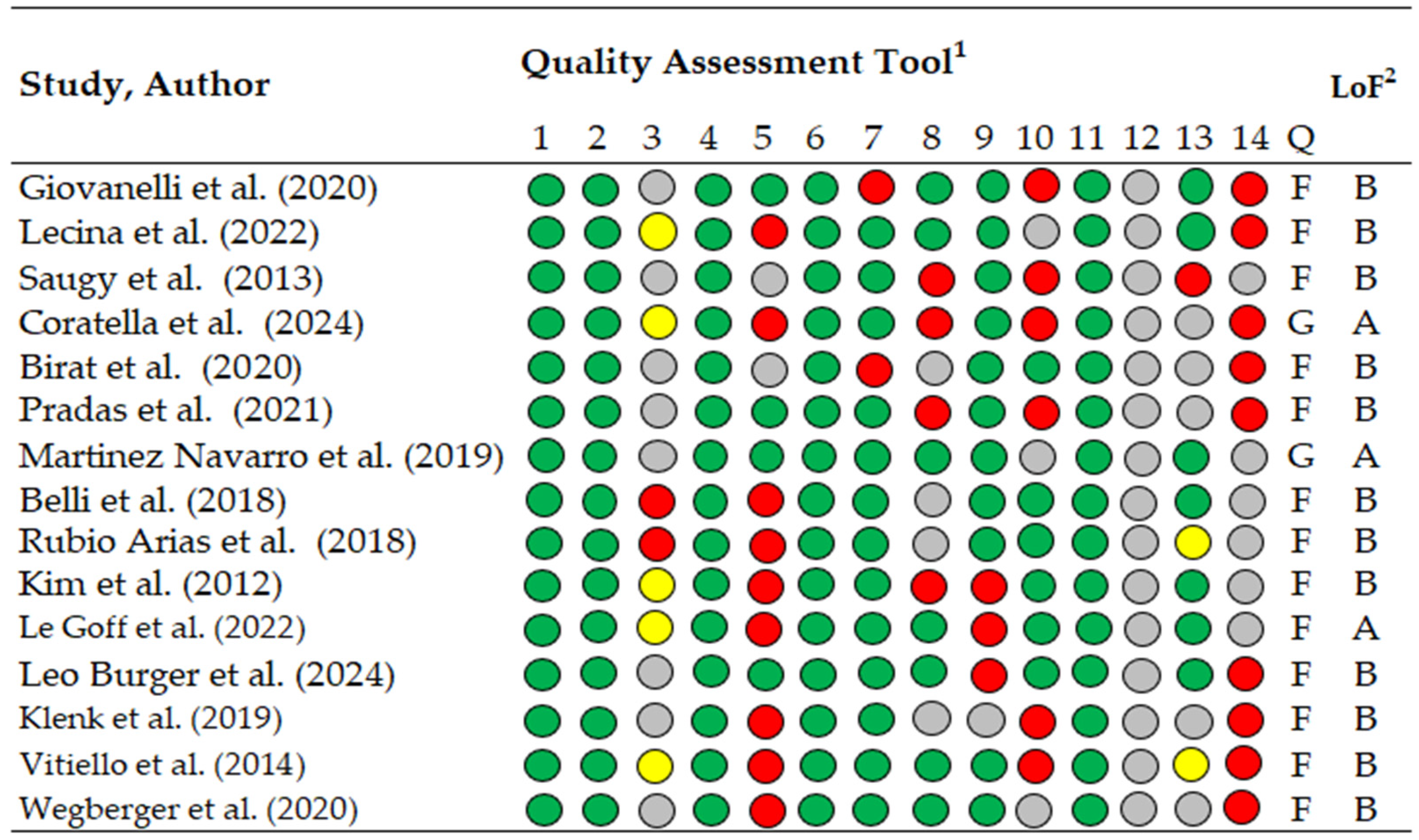

| Author | Participants | Age ± SD (Years) | Level | Race | Distance (km) | Stages | Elevation Gain/Loss |
|---|---|---|---|---|---|---|---|
| Giovanelli et al. (2020) [41] | 10 | 38.2 ± 12.4 | NR | TR | 22.48 and 40 | 3 | NR |
| Lecina et al. (2022) [37] | 4 | 38 ± 4.11 | NR | U | 768 | 11 | 46,865 m+ |
| Saugy et al. (2013) [49] | 9 8 CG | 41.6 ± 13.1 29.3 ± 8.1 | NR | U | 330 | 1 | 24,000 m+ |
| Coratella et al. [14] | 10 | 22 ± 3 | NR | T | 30 (s: 10 km/h) | 1 | −20% |
| Birat et al. (2020) [58] | 12 | 14.40 | NR | U | 48.2 and 66 | 2 | NR |
| Pradas et al. (2021) [50] | 20 | 43.3 ± 4.52 | 10 A 10 HT | U | 108 | 1 | 5800 m+ |
| Martinez-Navarro et al. (2019) [43] | 46 M | 42 ± 7.49 | A | U | 118 | 1 | 5439 m+ 4227 m− |
| Belli et al. (2018) [51] | 6 M | 47 ± 5 | HT | U | 217 | 1 | 12,200 m+ 12,200 m− |
| Rubio-Arias et al. (2019) [52] | 6 M | 30.5 ± 8 | A | U | 111 | 1 | 4474 m+ 4420 m− |
| Kim et al. (2012) [53] | 20 EIH 10 CG | 46.8 ± 1.23 47.5 ± 1.33 | A | U | 100 | 1 | NR |
| Le Goff et al. (2022) [44] | 17 M 11 F | M: 45.3 ± 7.8 F: 43.3 ± 9.8 | A | U | 105 | 1 | 5600 m± |
| Burger et al. (2024) [57] | 14 M | 42.9 ± 8.0 | P | U | 130 | 1 | 1170 m± |
| Klenk et al. (2021) [54] | 18 F 2 M | 47.8 ± 10.4 | P | U | 4486 | 64 | NR |
| Vitiello et al. (2014) [55] | 21 M | 40 ±8 | P | U | 166 | 1 | 9600 m+ |
| Wegberger et al. (2020) [56] | 14 M 1 F | 43 ± 9 | HT | U | 130 | 1 | 1170 m+ |
| Author | Muscular Damage | Neuromuscular Function | Cardiac Parameters | |||
|---|---|---|---|---|---|---|
| Giovanelli et al. (2020) [41] | CK (U∙L−1) Pre: 211.7 ± 164.95 Post: 3637.6 ± 2754.8 | ALT (U∙L−1) Pre: 21.6 ± 5.7 Post: 42.8 ± 14.74 | NR | CK-MB (ng∙L−1) Pre: 4.42 ± 3.96 Post: 50.56 ± 35.99 | cTnI (ng∙mL−1) Pre: 0.01 ± 0.0 Post: 0.02 ± 0.0 | |
| Lecina et al. (2022) [37] | CK (U∙L−1) Pre: 98.51 ± 24.53 Post: 974 ± 402.66 48 h: 474.85 ± 185.70 9 d: 88.0 ± 16.27 | ALT (U∙L−1) Pre: 17.25 ± 3.59 Post: 44.75 ± 12.44 48 h: 316.00 ± 70.88 9 d: 208.00 ± 31.55 | SJ (cm) Pre: 30.68 ± 2.46 Post: 22.05 ± 8.59 | NR | ||
| Saugy et al. (2013) [49] | G CK (U∙L−1) Pre: 112 ± 33 Post: 3719 ± 3045 | CG CK (U∙L−1) Pre: 122.5 ± 41.1 Post: 147.7 ± 32.6 | G KE MVIC (N) Pre: 390 Post: 290 | CG KE MVIC (N) Pre: 370 Post: 320 | NR | |
| Coratella et al. (2024) [14] | CK (pg∙mL−1) Pre: 32.92 ± 23,87 Post: 147.27 ± 55.44 | KE MVIC (N) Pre: 608 ± 156 Post: 500 ± 109 | NR | |||
| Birat et al. (2020) [58] | NR | SJ (cm) Pre: 29.5 ± 4.7 Post: 26.7 ± 4.5 | KE MVIC (N) Pre: 208.1 ± 49.2 Post: 194.9 ± 44.4 | NR | cTnI (ng∙mL−1) Pre: 0.004 ± 0.005 Post: 0.143 ± 0.131 24 h: 0.033 ± 0.030 48 h: 0.013 ± 0.020 | |
| Pradas et al. (2021) [50] | A CK (U∙L−1) Pre: 164.3 ± 69.39 Post: 3251.6 ± 1011.89 | HT CK (U∙L−1) Pre: 193.6 ± 42.11 Post: 4261.5 ± 1469.6 | A SJ (cm) Pre: 25.5 ± 4.38 Post: 16.74 ± 3.91 | HT SJ (cm) Pre: 27.12 ± 5.29 Post: 19.87 ± 4.31 | NR | |
| Martinez-Navarro et al. (2019) [43] | NR | NR | NR | NR | NT-proBNP (ng∙L−1) Pre: 20.9 ± 15.84 Post: 443 ± 280.61 | |
| Belli et al. (2018) [51] | CK (U∙L−1) Pre 132 ± 18 km 84: 3988 ± 1004 km 177: 18,667 ± 10,664 Post 19,157 ± 12,369 | ALT (U∙L−1) Pre 28 ± 3 km 84: 109 ± 13 km 177: 677 ± 406 Post 668 ± 407 | NR | NR | ||
| Rubio-Arias et al. (2019) [52] | 54 km race CK (U∙L−1) Pre: 886.6 ± 2187.9 Post: 2213.8 ± 2354.5 24 h: 1014.9 ± 732.6 48 h: 495.8 ± 358.0 72 h: 309.4 ± 191.6 | 111 km race CK (U∙L−1) Pre: 6174.0 ± 197.9 Post: 8976.0 ± 4327.1 24 h: 2132.5 ± 1399.6 48 h: 1277.7 ± 1368.2 72 h: 604.2 ± 878.3 | NR | NR | ||
| Kim et al. (2012) [53] † | EIH CK (U∙L−1) Pre: ~100 Post: ~3500 | CG CK (U∙L−1) Pre: ~100 Post: ~1500 | NR | EIH CK-MB (U∙L−1) Pre: ~10 Post: ~60 cTnI (ng∙L−1) Pre: ~0.02 Post: ~0.15 NT-proBNP (ng∙L−1) Pre: ~20 Post: ~320 | CG CK-MB (U∙L−1) Pre: ~10 Post: ~30 cTnI (ng∙L−1) Pre: ~0.02 Post: ~0.24 NT-proBNP (ng∙L−1) Pre: ~20 Post: ~180 | |
| Le Goff et al. (2022) [44] | NR | NR | CK-MB (ng∙mL−1) Pre: 2.31 ± 1.25 Post: 91.9 ± 86.2 7 d: 5.15 ± 2.81 | NT-proBNP (ng∙L−1) Pre: 41.7 ± 30.5 Post: 1190 ± 663 7 d: 29.5 ± 20.3 | ||
| Burger et al. (2024) [57] | NR | NR | LVEF (%) Pre: 57.0 ± 6.7 Post: 55.4 ± 5.7 GLS (%) Pre: 19.0 ± 1.8 Post: 19.2 ± 1.9 GFWS (%) Pre: 26.4 ± 2.4 Post: 24.8 ± 2.7 | LAVI (mL∙m−2) Pre: 28.4 ± 7.3 Post: 48.0 ± 4.6 FAC (%) Pre: 48.0 ± 4.6 Post: 46.7 ± 3.8 | ||
| Klenk et al. (2021) [54] | NR | NR | cTnI (ng∙mL−1) Pre: 7 ± 3 km 1735: 17 ± 10 km 3369: 17 ± 10 LVEF (%) Pre: 64 ± 4 km 1735: 65 ± 5 km 3369: 65 ± 6 | NT-proBNP (ng∙L−1) Pre: 30 ± 23 km 1735: 136 ± 178 km 3369: 111 ± 87 RVEF (%) Pre: 57 ± 4 km 1735: 57 ± 5 km 3369: 59 ± 6 | ||
| Vitiello et al. (2014) [55] | NR | NR | cTnI (ng∙L−1) Pre: 0.010 ± 0.001 Post: 0.038 ± 0.055 | LVEF (%) Pre 53.4 ± 4.9 Post 52.0 ± 4.3 | ||
| Wegberger et al. (2020) [56] | CK (U∙L−1) Pre: NR Post: 6992 | NR | cTnI (ng∙L−1) Pre: NR Post: 0.056 | NT-proBNP (ng∙L−1) Pre: NR Post: 723 | ||
Disclaimer/Publisher’s Note: The statements, opinions and data contained in all publications are solely those of the individual author(s) and contributor(s) and not of MDPI and/or the editor(s). MDPI and/or the editor(s) disclaim responsibility for any injury to people or property resulting from any ideas, methods, instructions or products referred to in the content. |
© 2026 by the authors. Licensee MDPI, Basel, Switzerland. This article is an open access article distributed under the terms and conditions of the Creative Commons Attribution (CC BY) license.
Share and Cite
García-Valiente, I.; Pradas, F.; Ortega-Zayas, M.Á.; Castellar-Otín, C.; García-Giménez, A.; Lecina, M. Muscle, Neuromuscular, and Cardiac Damage in Trail Running: A Systematic Review. Muscles 2026, 5, 9. https://doi.org/10.3390/muscles5010009
García-Valiente I, Pradas F, Ortega-Zayas MÁ, Castellar-Otín C, García-Giménez A, Lecina M. Muscle, Neuromuscular, and Cardiac Damage in Trail Running: A Systematic Review. Muscles. 2026; 5(1):9. https://doi.org/10.3390/muscles5010009
Chicago/Turabian StyleGarcía-Valiente, Isabel, Francisco Pradas, Miguel Ángel Ortega-Zayas, Carlos Castellar-Otín, Alejandro García-Giménez, and Miguel Lecina. 2026. "Muscle, Neuromuscular, and Cardiac Damage in Trail Running: A Systematic Review" Muscles 5, no. 1: 9. https://doi.org/10.3390/muscles5010009
APA StyleGarcía-Valiente, I., Pradas, F., Ortega-Zayas, M. Á., Castellar-Otín, C., García-Giménez, A., & Lecina, M. (2026). Muscle, Neuromuscular, and Cardiac Damage in Trail Running: A Systematic Review. Muscles, 5(1), 9. https://doi.org/10.3390/muscles5010009