
You are currently viewing a new version of our website. To view the old version click .
Computer Sciences & Mathematics Forum
  • Proceeding Paper
  • Open Access

17 December 2025

Big Tech and the Sustainable Consumer Practices: A Critical Analysis Using a Mixed Methodology †

,
and
1
Department of Business Management, CDOE, Manipal University Jaipur, Jaipur 303007, Rajasthan, India
2
Department of Mechanical Engineering, Manipal University Jaipur, Jaipur 303007, Rajasthan, India
3
Department of Business Management, Manipal University Jaipur, Jaipur 303007, Rajasthan, India
*
Author to whom correspondence should be addressed.
This article belongs to the Proceedings First International Conference on Computational Intelligence and Soft Computing (CISCom 2025)

Abstract

The research is centered on how India’s top-tier IT companies—the “Big Six” of TCS, Infosys, HCLTech, Wipro, Cognizant, and Tech Mahindra—are integrating sustainability in their digitally driven operations, platforms, and business models. The study employs a mixed methodology, combining critical case study analysis with Fuzzy Delphi validation to assess triangular fuzzy numbers, centroid-based defuzzification, and consensus thresholds. The study explores how AI, big data, analytics, and digital marketing influence environmentally sustainable consumption behaviors within global ecosystems. Results show that, despite limited consumer control, these companies shape sustainability-related behavior indirectly through backend systems, digital platforms, and algorithmic logic—known as “invisible architecture”. This study confirms six main sustainability factors through expert consensus. Noteworthy among those are Digital Infrastructure for Sustainability, Platform Logic for Behavioral Change, and AI-Enabled Analytics and Recommendations. Thematic cross-case results reveal both the promise and ethical challenges of digital sustainability, including the prevalence of greenwashing and risks of overconsumption.

1. Introduction

India’s “Big Six” IT corporations, which include well-known IT businesses like Tata Consultancy Services (TCS), Infosys, HCLTech, Wipro, Cognizant, and Tech Mahindra, occupy a critical position in the global digital economy. Their innovations in cloud systems, consulting, and outsourcing extend beyond economic contributions to influencing environmental and societal outcomes through their worldwide delivery models and platforms [1]. Their technological capacity positions them in a way that could change how people buy things and how things are made [2]. As AI and big data become more deeply integrated into everyday life, Indian IT giants employ algorithmic systems and environmentally friendly software to promote ethical and eco-friendly consumption [2]. Their efforts also encourage social inclusion and job creation, which leads to growth that benefits everyone in all parts of India [2]. Broader societal objectives such as environmental preservation and societal equity are very much connected to technological progress and sustainable practices, which emphasizes the significance of these businesses [3].
It is notably mentioned that post-pandemic, India has digital transformed driven economic growth [3]. Further advanced analytical approaches are needed, because it is hard to figure out how these firms affect sustainability. Fuzzy logic modeling in R provides a reliable means to interpret this complexity, as R is a great tool for dealing with the uncertainty of terminology in expert evaluations of how firms practice sustainability. The findings indicate a dual perspective on corporate responsibility and global influence on how Indian firms integrate sustainability approaches into their operations. In other nations, tech firms’ websites are used to raise awareness of the environment among customers and other interested people [4]. Searches for sustainability reports aims to align economic objectives with social and environmental responsibility, despite significant disparities in different sectors [5]. The many ways of affecting the results of sustainability efforts show how important it is to monitor how business operate and how systems affect sustainability at both the local and global levels.
The “great” in India are very important to making the digital future more sustainable. They are at the crossroads of technology and responsibility, and have a lot of power, since they create challenges and opportunities in the digital age. This document examines these great firms’ influence on sustainability practices, illuminating the essential discourse between technological advancement and ethical problems in the search for a more equitable and sustainable digital economy.
The article investigates the integration of stability principles through a comprehensive mixed-methodology approach to the operations, services, and user platforms of Indian IT giants. The first phase analyzes an important case of a stability practices, while the second phase uses two Fuzzy Delphi functions, including R-based triangular fuzzy number processing, centroid defuse algorithms, and the threshold analysis of consensus, which aims to identify stability and rank firms through expert consensus. This not only considers these firms’ internal stability metrics, but also the influence of their digital technology on the initiatives around the world toward environmental leadership and responsible consumerism. This study looks at the big picture in terms of how large technology firms affect the results of stability through technology systems, digital interaction models, and corporate storytelling. We conducted a multi-verse literature review that includes stability, marketing, and technology to assess to what extent these organizations contribute to or obstruct an egalitarian and durable digital future.

2. Literature Review

2.1. Big Data and Sustainable Consumerism

Analysis of big data is necessary to promote sustainable consumption by enabling businesses to analyze customer behavior and send out sustainable messages and product suggestions [6]. Personalization programs facilitate targeted communication, encouraging consumers to embrace more sustainable behavior. Studies show that big data enables sustainable development in industries by increasing decision-making ability and encouraging responsible consumption [7]. The moral application of these technologies is required to optimize energy use and to align consumer demand with environmental goals [8,9,10]. The moral use of data enables firms to promote stability by achieving commercial goals.

2.2. AI-Driven Engagement and Environmental Action

Artificial intelligence technologies have brought about a revolution in Industry 4.0, affecting decision making, adaptation of resources, and sustainable customer behavior. Artificial intelligence enables firms to analyze comprehensive data sets, obtaining significant insights into customer requirements required for marketing and product development [11,12]. It identifies areas of disability and promotes sustainable practices in health, manufacturing, and other regions [13,14]. AI affects consumers’ preferences for environmentally friendly solutions by personalizing materials to increase awareness [15,16]. Ethical AI applications promote the responsibility to ensure fairness and transparency in automated decisions, meaning that users increasingly trust AI systems [17,18]. Human–computer interactions and anthropomorphism and adaptation of AI solutions [15,19,20] react to immediate reactions and enhance stability by engaging with consumers. As a result, AI improves operational efficiency and promotes sustainable practices in Industry 4.0.

2.3. Digital Technologies and Sustainable Decision Making

Digital technologies are very important to making supply chains more durable. Digital supply chain management (DSCM) uses data analytics, Internet of Things (IOT), and cloud infrastructure to make operations more efficient and cut down on waste. Real-time data improves visibility and effectiveness, which reduces carbon footprints across the life cycles of products. DSCM improves logistics by making inventory management and analytics more accurate, which reduces operational excess and emissions [21,22]. It also helps to reuse and recycle products through smart tracking and digital twins [23]. Cloud platforms bring people together, which encourages openness and teamwork [24,25]. AI makes stability even better by improving energy efficiency and demanding reductions in waste [26]. All these technologies work together to enable data-powered, long-term planning in the supply chain that motivates people to take care of the environment.

2.4. Visual Marketing and Consumer Psychology

When it comes to preparing the brains of consumers and motivating pro-environmental action, visual marketing strategies—especially in the digital environment—such as eco-friendly green packaging and storytelling play an important role. As a result of visual framing, individuals can have a different perception of stability signals. For example, Instagram is one of the platforms that have been successful in motivating people to take action in favor of the environment [27]. Eco-labeled and durable design are examples of appeal-based signs of environmental leadership that strengthen consumer trust and engagement [28,29]. Story-based marketing strengthens affectionate connections, which encourages consumers to stay loyal and shop with a brand. In addition, storytelling can provide a reference to stability, which reduces cognitive inconsistency and highlights the product life cycle [30]. Positive behavior spillover, such as recycling, also causes environmentally conscious consumer behavior [31] due to visual stimuli, which has more impact than marketing efforts in many areas [32]. Marketing that covers both visual stimuli and stories is usually an effective way to encourage customers to make decisions that are more environmentally responsible.

2.5. Corporate Influence and Strategic Integration

Companies are having more and more impact on the discussion about stability by using online marketing techniques that tell people what to do. Influencer marketing, especially, encourages environmental behavior by promoting green products through authentic word of mouth. For small and medium-sized businesses, a combination of green and digital marketing is important for long-term success [33]. Targeted advertisements and algorithms also encourage people to be more environmentally friendly in terms of what they want. The algorithm system also helps the environment to be more visible in search results and recommendations [34]. Integrating corporate social responsibility (CSR) into digital marketing enhances brand reliability and combines stability with brand equity [35]. In influencer marketing, being honest and upfront in your messages is really important for developing trust with customers. Companies use CSR and digital technology to make responsible consumption easier and improve brand equity while also having a good effect on the environment [36]. Therefore, digital marketing is very important for making the digital economy more sustainable.

2.6. Generational Trends and Digital Impact

By utilizing digital platforms to promote environmental awareness and influence patterns of buying, Generation Z is emerging as a powerful force in the online movement to promote sustainability. As a digital natives, the generation actively participates in social media to advocate for causes, meaning that they have an impact on consumption norms that extend across generations [37]. Particularly effective are conversations that occur among peers, with information generated by users affecting the opinion of the general public about stability [33]. Social media platforms facilitate contact with communities that share similar interests which increase knowledge about and attention paid to sustainability. The use of visual messages increases the effectiveness of a message; images strengthen more positive attitudes about objects that are environmentally friendly and emphasize the responsibility of brands [38]. Authenticity has the most important significance because Generation Z is in favor of communication which is honest and moral [39]. When corporate social responsibility (CSR) is included in digital engagement, the brand equity corresponds to green ideals, which in turn promotes consumer confidence and encourages people to buy green products [38]. Finally, the environmental activism of Generation Z is made much stronger by digital techniques, and authenticity and corporate social responsibility (CSR) are important components to achieve permanent brand success in the long run.

2.7. Technology, Urban Systems, and Sustainability

Urban sustainability is more and more influenced by digital technologies as cities become smart, data-driven urban spaces. Big data improves urban management by providing real-time analysis that makes resource allocation and the efficiency of operation in transportation, waste, and energy management better [40]. But data-driven methods could make social and economic differences worse if they leave out or misrepresent marginalized groups [41]. Civic technology (civic tech) solves this problem by encouraging community involvement, transparency, and participatory governance, making sure that digital solutions meet the demands of all urban residents [42]. Since there is a general tendency in smart city projects to put technology and advancement prior to social inclusion, which makes access and equity important issues [41], the dire need is to have a governance model which can combine digital tools with social, environmental, and economic sustainability. To make cities grow in an all-inclusive way, fair usage of digital systems is paramount. It is concluded that to make cities efficient in the long run, IT companies and legislators must make proper use of these technologies.

3. Method

The research adopts a mixed methodology, merging qualitative critical case study inquiry with quantitative Fuzzy Delphi analysis, for which R statistical software is used. The combination of qualitative and quantitative enhances rigor by connecting the explanatory capacity of organizational analysis with the objectivity of expert consensus on variables. Ultimately it integrates sustainability into digital ecosystems. Using triangular fuzzy numbers, the R statistical software can make exact calculations. It achieves defuzzification using the centroid-based defuzzification method and strong consensus analysis, which is difficult in regular computer software.
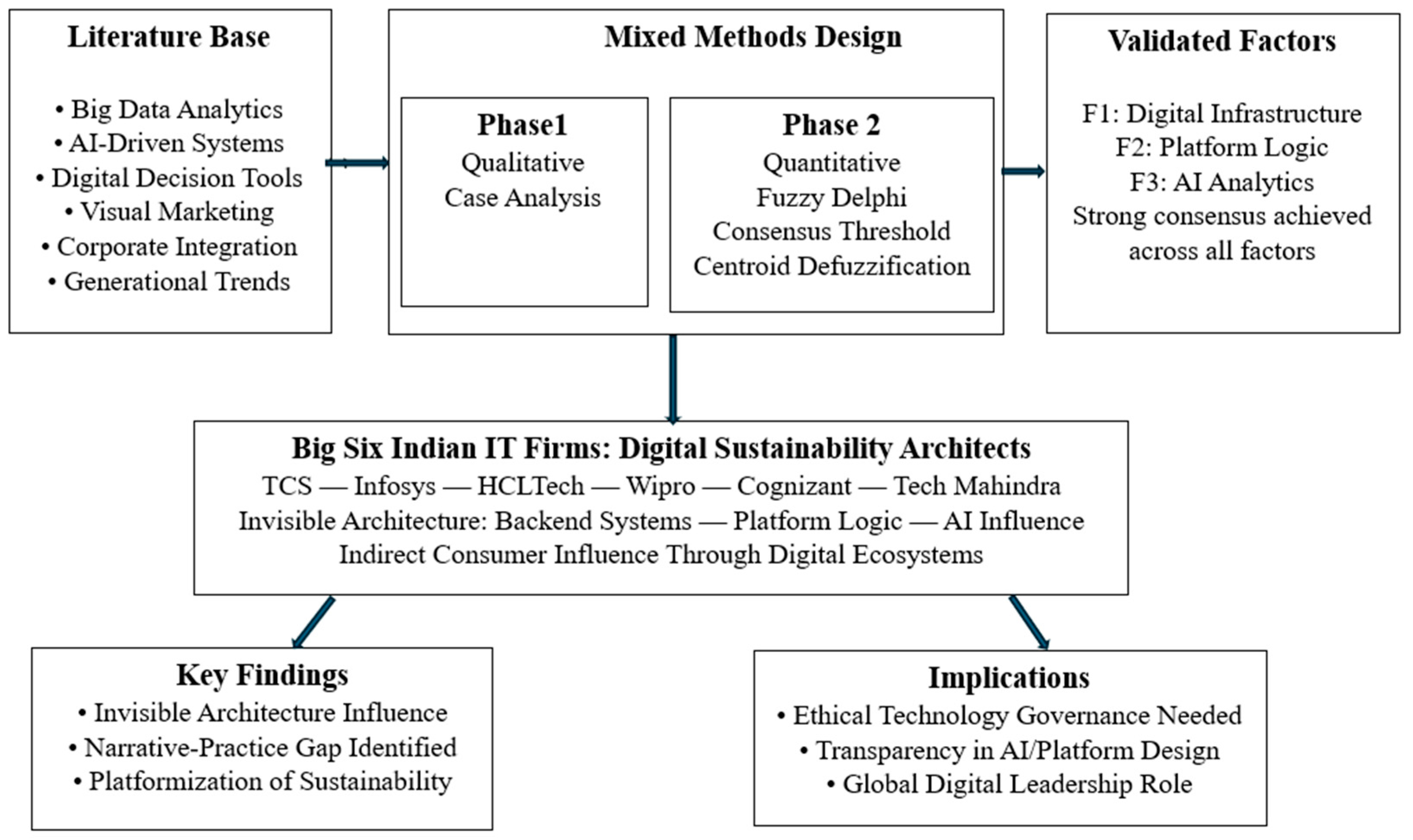
Figure 1 shows the conceptual framework starts from core hypotheses, progressing to methodological execution and finally to verified results and outcomes. The main parts of the literature review, which answer research questions and identify sustainability features, are the bases of the study’s mixed methodology design. It is evident that Indian Big Tech corporations function as digital sustainability architects, shaping consumer choices indirectly through hidden and complex backend technologies. The disparities between sustainability narratives and the actual practice of technological implementation are highlighted in the framework. The framework also reinforces the focal theme of the paper that these corporations function as systemic enablers of sustainable consumption through platform logic, AI-enhanced analytics, and the arrangement of digital infrastructure. Based on the main ideas of studies in the literature, the usage of a mixed-methodology approach answers four research questions and creates thoroughly tested sustainability factors. The framework underscores the major gap between sustainability rhetoric and the tangible practices of technological deployment, reinforcing the paper’s central points that these firms operate as systemic enablers of sustainable consumption through platform logic, AI-driven analytics, and digital-infrastructure design. Further information on the phases is presented below.
Figure 1. Conceptual framework.
Phase 1: Critical Case Study Methodology
A critical case study methodology is employed in this research, and leading Indian IT firm are strategically significant cases because of the kind of impact they are having. These companies are chosen because they are well-known, have global presence, and have a history of working to be more environmentally friendly. The above-stated factors make them excellent parties to learn about how digital innovation and environmental responsibility are connected. A case study approach makes it easy to look into how people talk about and utilize digital technologies in regard to sustainability. The case study provides a practical lens for analyzing how digital transformation interacts with sustainability goals and contributes to global debates on role of Big Tech in steering digital sustainability transitions.
Phase 2: Fuzzy Delphi Expert Assessment
In the second phase, the integration of R-based analysis with the Fuzzy Delphi methodology to perform a full evaluation of triangular fuzzy data is conducted. By merging the traditional Delphi process with fuzzy, the method effectively manages uncertainty and vagueness related to expert opinion. R was the software that made it feasible to conduct more complex tasks like aggregation, defuzzification, and consensus measurement. The Expert Panel was made up of 36 professionals who were chosen because of their work in sustainability, IT industry practices, and digital transformation. The panel included the following participants:
Sustainability number (n) of Leaders from the IT Industry (n = 12; 33.3%; mean years of experience: 10.5);
Academics (n = 12; 33.3%; mean experience: 13.2 years);
Policy and Regulatory Specialists (n = 6; 16.7%; mean experience: 13.3 years);
Technology Consultants (n = 6; 16.7%; mean exp: 9.8 years).
Fuzzy Linguistic Scale
For importance evaluation of different factors, the experts employed a 5-point fuzzy linguistic scale with corresponding triangular fuzzy numbers:
Very Low: (0.1, 0.2, 0.3);
Low: (0.2, 0.3, 0.4);
Medium: (0.4, 0.5, 0.6);
High: (0.6, 0.7, 0.8);
Very High: (0.8, 0.9, 1.0).
The consensus process and R-based analysis included a three-round delink method, and R statistical software was used to perform all fuzzy calculations. We defined the consensus with standard deviation of 10.15, as determined after repeated R-based triangular fuzzy collection using a standard deviation of 10.15, for which we used the following equation:
Aggregated Fuzzy Number = ((Σai)/n, (Σbi)/n, (Σci)/n)
where (ai, bi, ci) represent individual expert triangular fuzzy ratings and n is the number of experts. Centroid defuzzification was performed using the formula μ = (a + b + c)/3, implemented through custom R functions for processing triangular fuzzy numbers. The threshold value of 0.75 was employed based on established fuzzy consensus research, with values above that threshold showing strong agreement between experts while accounting for the inherent uncertainty of language associated with sustainability assessments. Data collection occurred through structured online surveys, and detailed analysis was undertaken using R statistical computing environment version 4.3.2 and other packages, including ‘Fuzzy Numbers’ for triangular fuzzy arithmetic, ‘dplyr’ for data manipulation, and individual R scripts for both the consensus analysis and defuzzification process.

3.1. Research Objective

This research critically explores how sustainability is integrated into the digital frameworks and consumer-facing technologies of Indian Big Tech companies. It also highlights how artificial intelligence (AI), big data, and digital marketing impact eco-conscious consumption and broader sustainability transitions.
This study aims to examine how digital platforms, tools, and practices are utilized to promote sustainable consumption via digital sustainability strategies employed by Indian Big Tech companies. This research aims to achieve the following:
  • Examine how sustainability is embedded into the operational logic, technological systems, and consumer interfaces of leading Indian IT firms.
  • Analyze the strategic use of digital technologies, specifically artificial intelligence (AI), big data analytics, and digital marketing, in shaping environmentally responsible consumer behavior.
  • Evaluate the implications of these strategies for broader sustainability transitions, including the risks of digital overconsumption and ethical contradictions.
  • Identify sustainability factors through expert consensus.

3.2. Research Questions

  • How is sustainability conceptualized and implemented within the digital infrastructure and consumer-facing platforms of leading Indian IT firms?
  • What role do technologies such as AI, big data, and digital marketing play in shaping sustainable consumption practices within the firms’ ecosystems?
  • To what extent do the firms’ public sustainability commitments align with their technological practices and market strategies?
  • What expert consensus emerges regarding the critical factors of digital sustainability integration?

3.3. Critical Case Analysis: Sustainable Consumer Practices in Indian Big Tech

The critical case analysis examines how India’s leading IT enterprises use sustainability within their digital infrastructures and consumer-related interfaces. It identified the influence of artificial intelligence (AI), big data, and digital marketing on sustainable consumption. It focuses on the subtle but powerful methods these organizations employ, as even though they do not operate as direct-to-consumer brands, their digital ecosystems and technological tools substantially impact purchasing patterns across several industries. The analysis followed a thematic framework aligned with the research objectives to extract meaningful insights for digital sustainability transitions.

3.3.1. Tata Consultancy Services (TCS)

Key Themes: Digital Infrastructure for Sustainability, traceability, AI-driven analytics, and platform enablement.
TCS shows how digital operations can be made more sustainable. Especially for manufacturing and retail companies, tools like Envirozone™, blockchain-based traceability, and circular product design help to enable environmental friendly ways of using things. To make logistics and energy use more efficient, TCS uses AI and cloud infrastructure, which fits with its Scope 1–3 emissions reporting and “Green IT” approach. This also aligns internal sustainability principles and outward digital enablement. TCS shows how IT platforms can indirectly encourage sustainable consumer behavior through corporate clients.

3.3.2. Infosys

Key Themes: Net-zero operations, digital twins, ESG consulting, and gamified sustainability engagement.
For both operational and customer-facing framework-related sustainability, Infosys works well. Its initiatives like net-zero emissions, LEED-certified campuses, and solar infrastructure shows its seriousness about this cause. The corporation uses AI and IoT to measure its environmental impact via systems like digital twins and carbon-accounting systems. Also, sustainability-connected loyalty programs and gamified interfaces clearly show how digital marketing principles can lead to environmental consumer engagement by simply incorporating sustainability within everyday digital interactions.

3.3.3. HCLTech

Key Themes: Sustainable engineering, behavioral nudging, and green IT infrastructure.
HCLTech’s backend engineering and energy-efficient systems are all about backend sustainability integration. To show how visualization tools may help people make decisions about what to buy, its SESGA analytical system uses AI to make eco-friendly suggestions. such UI-based nudging plays a key role in promoting sustainable consumption and the company’s goal of providing long-lasting digital user experiences. The concept of “invisible architecture” in sustainability works in tandem with HCL’s vision that backend infrastructure can quietly promote behavior that is good for the environment.

3.3.4. Wipro

Key Themes: Ethical AI, lifecycle transparency, and generational engagement.
Wipro supports customers in making open and honest decisions by focusing on ethical AI, Product Lifecycle Management (PLM) software, and eco-choice interfaces. Projects like “The Earthian Program” which are aimed at students and young people show that people’s values around sustainability change with time. These projects emphasize Wipro’s value-based commitment and inclination toward true sustainability.

3.3.5. Cognizant

Key Themes: ESG analytics, internal sustainability culture, and AI-enabled transparency tools.
Through AI-powered ESG platforms, supply-chain-based certificate systems, and green IT frameworks, Cognizant mainly focuses on changing how businesses make use of their resources. Other initiatives like “Go Green” and employee CSR activities show how getting employees involved is the main method for achieving long-lasting sustainability effects. For connecting internal commitments with exterior effects, organizational culture is important is very important as it helps in building confidence with customers.

3.3.6. Tech Mahindra

Key Themes: Sustainability-as-a-Service, digital decarbonization, and ecosystem resilience.
To help businesses to tackle carbon-related issues, Tech Mahindra’s “Sustainability as a Service” architecture uses AI, IoT, and lifecycle analytics. IT-based solutions like Green Code Refiner and Planet Positive have a major influence on sustainability. Additional initiatives like adopting electric vehicles, building smart data centers, and being water-positive show the company’s all-around plan. This digital transformation can help cities and the environment stay strong as digital infrastructure is connected to system-level sustainability.

3.4. Cross-Case Synthesis: Insights and Implications

  • Digital Enablers, Not Direct Influencers: These organizations do not have direct connection with customers, but rather an indirect effect on consumption through platforms, algorithms, and enterprise systems. As stated in the concept of “invisible architecture”, sustainability technology underscores a structural approach to shaping customer behavior; hence, they align (RQ1, RQ2).
  • Technology Systems as Ethical Intermediaries: This positioning is evident from usage of tools like ESG dashboards, AI-driven suggestions, and gamified sustainability apps that help people make ethical choices. They highlight the role of technology in helping people make ethical choices based on digital behavioral nudges (RQ2).
  • Sustainability Discourse vs. Practice: There is a major difference between the ground reality of ESG, real platform-level features, and discussion about it backed by sustainability reports. This raises lots of questions and makes people wonder about authenticity, greenwashing, and strategic branding (RQ3).
  • Internal Culture as a Strategic Lever: Business culture improves external sustainability outcomes via means like intranet CSR initiatives, staff engagement, and intergenerational educational programs. These impact society along with its stakeholders.
  • Phantomization of Sustainability: To promote sustainability, digital technologies like artificial intelligence, the Internet of Things, and cloud infrastructure are being used. This shows the positioning of sustainability projects at the supply chain and ecosystem levels.
Digital sustainability is happening via digital technologies; this notion is evident from the illustrated cases. By providing backend technologies, data governance, and ethical frameworks, these firms change how businesses and consumers act as part of the digital economy. They do not directly change things; instead, they establish digital venues where sustainability may be performed, watched, and made the norm. This study gives us the information we need to understand how to use digital power in a way that is ethical and includes everyone in order to build a sustainable digital future.

3.5. Fuzzy Delphi Analysis

Factor Validation and Consensus Development

The qualitative case study analysis identified six principal sustainability variables, which were later validated by the R-based Fuzzy Delphi process, utilizing triangular fuzzy aggregation and centroid defuzzification algorithms. Table 1 shows the three rounds of expert consensus, as well as the indications of consensus that were found using fuzzy metrics in R. The data demonstrates that experts generally agreed on the relevance of the factors, with agreement becoming clearer as more people agreed. There was a considerably strong agreement on four of the six elements. Subsequently, the values from the final round were then subjected to importance ranking and defuzzification analysis. Table 2 shows the importance rankings derived from the Round 3 consensus values, showing strong methodological consistency between process convergence and final factor prioritization.
Table 1. Round-wise consensus development.
Table 2. Final factor importance rankings.

4. Discussion

This study critically analyzed the integration of sustainability inside the operations, technologies, and consumer-facing platforms of a prominent cohort of Indian IT corporations known as the Big Six. The results show that these companies do not interact directly with end customers. However, they act as major digital enablers of sustainable behavior across industries. They do this by designing infrastructures, platforms, and algorithms that shape consumption patterns.
For Research Question 1, the analysis shows that sustainability is now seen as both an operational and technological paradigm. This conclusion is supported by the expert validation, as the Digital Infrastructure for Sustainability factor attained the highest consensus rating (centroid: 0.847). This is rightly reflected via cases of companies like Infosys and TCS as they make sustainability a part of both their internal operations (such as measuring emissions and having green campuses) and their outward products (like digital twins and blockchain traceability). These initiatives are based on a two-way outlook as sustainability is not only a way for companies to measure their responsibilities but also a marketable service that is built into digital systems.
For Research Question 2, the central tools enabling sustainable consumption are identified as artificial intelligence, big data, and digital marketing tools. Experts agreed on the importance of AI-Enabled Analytics and Recommendations (centroid: 0.820), which shows that these technologies are important for promoting sustainable consumption. Firms make use of such systems to generate suitable eco-friendly suggestions (HCLTech), measure emissions (Infosys), and design reward programs that promote ethical choices. These cases show how analytics and behavioral nudges align digital systems with sustainability goals.
Research Question 3 confirms the link between sustainability and technological action.
The key result of the R analysis of expert opinions on the importance of factors is consensus, and all of the factors pass the 0.75 verification criterion using six-way triangular fuzzy aggregation. All companies published ESG reports and declared they were leaders in stability, but the way sustainability is built into platform logic is different for each one. This puts the conflict between real sustainability leadership and branding in danger, which is similar to concerns about greenwashing or fake promises in tech-driven stories.
Finally, Research Question 4 provided more in-depth insights into how Indian Big Tech is helping digital sustainability transitions. The expert consensus reached a high level of agreement (0.83), which showed that the identified sustainability considerations were strong. These are the “invisible architecture” of digital systems that shape behavior, the phantoms of sustainability, and the culture of the workplace, which is used to make a difference outside the company. Wipro and Cognizant are two examples of companies that show how CSR and employee engagement programs go beyond only delivering goods and services to clients.

5. Conclusions

The Big Six IT companies in India play a key role in the link between digital innovation and sustainable leadership. This study shows that their impact on sustainable consumption is mostly indirect but nevertheless important in a structural way. This is shown by the fact that experts agree on what makes something sustainable. The thorough study shows that these organizations are digital sustainability architects. They make technology solutions that make it possible to measure and standardize environmentally friendly behaviors in many different fields. These companies mainly rely on AI, big data, IoT, and cloud infrastructure to embed sustainability into digital platforms. They apply these tools through green customer engagement, supply chain efficiency, and ethical platform governance.
Despite many ambitious claims about net-zero goals, ethical AI, and circular digital models, a gap still exists between declarations and actions. So, unless firms integrate ethics, accessibility, and inclusion within their systems, their credibility as sustainable leaders may weaken.
The study concludes that corporate narratives must align with genuine technological accountability. Digitization should go ahead not only to promote productivity but also fairness, along with ecological responsibility. Given their global influence and key roles, Indian IT giants must shift from solution-providers to co-designers of sustainable digital ecosystems.

Author Contributions

Conceptualization, B.S.; methodology, A.P.; validation, A.P.; formal analysis, T.K.; investigation, B.S.; original draft preparation, B.S.; writing—review and editing, B.S. and T.K.; supervision, A.P.; project administration, B.S. All authors have read and agreed to the published version of the manuscript.

Funding

No funds from any agency were received to write the present research piece.

Institutional Review Board Statement

Not applicable.

Data Availability Statement

This paper is based on secondary material, and the second step for this research paper was to use the R statistical environment with the Fuzzy Delphi approach to conduct a thorough TN analysis.

Acknowledgments

My humble gratitude goes to Anand Pandey and Timsy Kakkar, co-authors for their contributions, my family for extending their support constantly, and most importantly, environmental support from my institution, Manipal University Jaipur, in conducting the present research.

Conflicts of Interest

The authors declare no conflict of interest.

References

  1. Singh, N. Information Technology and Its Role in India’s Economic Development: A Review; Working Paperm, No. 718; University of California, Economics Department: Santa Cruz, CA, USA, 2015. [Google Scholar]
  2. Bansal, P. India’s Digital Transformation: Opportunities and Challenges in the Digital Economy. Int. J. Econ. Policy 2024, 4, 53–57. [Google Scholar] [CrossRef]
  3. Swargiary, K. Digital Transformation on Economic Growth in India: A Study of the Post-Pandemic India: A Comprehensive Study. Available online: https://www.researchsquare.com/article/rs-3464759/v2 (accessed on 1 September 2025).
  4. Gupta, K.; Pandey, R. Emerging Design Trends in Social Media and Its Impact on Business Efficiency and Growth in India. Shodhkosh J. Vis. Perform. Arts 2023, 4, 1–7. [Google Scholar] [CrossRef]
  5. Kumar, K.; Prakash, A. Examination of Sustainability Reporting Practices in Indian Banking Sector. Asian J. Sustain. Soc. Responsib. 2019, 4, 2. [Google Scholar] [CrossRef]
  6. Guo, L.; Zhang, B.; Zhao, X. A Consumer Behavior Prediction Model Based on Multivariate Real-Time Sequence Analysis. Math. Probl. Eng. 2021, 2021, 6688750. [Google Scholar] [CrossRef]
  7. Fozooni, A.; Nazari, S.; Jamalpur, A. Prioritizing Big Data Applications in E-Commerce Considering Sustainable Development Indicators. J. Future Sustain. 2024, 4, 169–178. [Google Scholar] [CrossRef]
  8. Liao, F.; Han, T.; Yang, Y.; Jia, L.; Li, T. Design of a User Electricity Consumption Reminder System and Sensitivity Analysis of Credit Ratings Based on Big Data Analytics of Paper. In Proceedings of the Second International Conference on Big Data, Computational Intelligence, and Applications (BDCIA 2024), Huanggang, China, 15–17 November 2024; pp. 227–235. [Google Scholar]
  9. Yi, S.; Liu, X. Machine Learning Based Customer Sentiment Analysis for Recommending Shoppers, Shops Based on Customers’ Review. Complex Intell. Syst. 2020, 6, 621–634. [Google Scholar] [CrossRef]
  10. Khrais, L.T. Role of Artificial Intelligence in Shaping Consumer Demand in E-Commerce. Future Internet 2020, 12, 226. [Google Scholar] [CrossRef]
  11. Ismatullaev, U.V.U.; Kim, S.-H. Review of the Factors Affecting Acceptance of Ai-Infused Systems. Hum. Factors 2024, 66, 126–144. [Google Scholar] [CrossRef] [PubMed]
  12. Geddam, S.M.; Nethravathi, N.; Hussian, A.A. Understanding AI Adoption: The Mediating Role of Attitude in User Acceptance. J. Inform. Educ. Res. 2024, 4, 1664–1672. [Google Scholar]
  13. Lutfi, H.; Glasauer, S.; Spittler, T. The Healthcare Benefits and Impact of Artificial Intelligence Applications on Behaviour of Healthcare Users: A Structured Review of Primary Literature. J. Int. Soc. Telemed. Ehealth 2020, 8, e10. [Google Scholar] [CrossRef]
  14. Paracolli, A.; Arquilla, V. Ux Sustainability: An Overview on the Sustainability Dimension of Ai-Infused Objects Forming Product-Service Ecosystems. In Proceedings of the ServDes 2023 Entanglements and Flows Service Encounters and Meanings, Rio de Janeiro, Brazil, 11–14 July 2023; pp. 1319–1336. [Google Scholar]
  15. Kronemann, B.; Kizgin, H.; Rana, N.K.; Dwivedi, Y. How Ai Encourages Consumers to Share Their Secrets? The Role of Anthropomorphism, Personalisation, and Privacy Concerns and Avenues for Future Research. Span. J. Mark.-ESIC 2023, 27, 3–19. [Google Scholar] [CrossRef]
  16. Zannat, N.; Mahmud, M. Mindful Ux Design in Industry 4.0: Mitigating Addiction and Enhancing User Well-Being Insocial Media and Ai Environments. J. Inf. Syst. Digit. Technol. 2023, 5, 321–344. [Google Scholar] [CrossRef]
  17. Menard, P.; Bott, G.J. Artificial Intelligence Misuse and Concern for Information Privacy: New Construct Validation and Future Directions. Inf. Syst. J. 2025, 35, 322–367. [Google Scholar] [CrossRef]
  18. Rahwan, I.; Cebrian, M.; Obradovich, N.; Bongard, J.; Bonnefon, J.-F.; Breazeal, C.; Crandall, J.W.; Christakis, N.A.; Couzin, I.D.; Jackson, M.O. Machine Behaviour. Nature 2019, 568, 477–486. [Google Scholar] [CrossRef]
  19. Chauhan, K.D.S.; Anupriya. Darker Patterns? Ai-Generated Persuasion and the Regulatory Void in Indian Law. J. Dev. Policy Pract. 2025, 10, 80–95. [Google Scholar] [CrossRef]
  20. Harland, H.; Dazeley, R.; Nakisa, B.; Cruz, F.; Vamplew, P. Ai Apology: Interactive Multi-Objective Reinforcement Learning for Human-Aligned Ai. Neural Comput. Appl. 2023, 35, 16917–16930. [Google Scholar] [CrossRef]
  21. Liu, Q.; Trevisan, A.H.; Yang, M.; Mascarenhas, J. A Framework of Digital Technologies for the Circular Economy: Digital Functions and Mechanisms. Bus. Strategy Environ. 2022, 31, 2171–2192. [Google Scholar] [CrossRef]
  22. Muhammad, A.; Naidu, B.M.; Sundram, V.P.K.; Hussain, M.; Chew, L.L.; Amirrudin, F.A. Sustainable Waste Management in Malaysia: Leveraging Supply Chain Solutions for a Greener Future. Inf. Manag. Bus. Rev. 2023, 15, 147–154. [Google Scholar] [CrossRef] [PubMed]
  23. Bressanelli, G.; Perona, M.; Saccani, N. Challenges in Supply Chain Redesign for the Circular Economy: A Literature Review and a Multiple Case Study. Int. J. Prod. Res. 2019, 57, 7395–7422. [Google Scholar] [CrossRef]
  24. Amaleshwari, U.; Jeevitha, R. Adopting Digital Technology to Overcome Challenges of Circular Economy: A Case Study of Platform-Based Start-up in India. J. Manag. Public Policy 2023, 15, 30–43. [Google Scholar] [CrossRef]
  25. Martínez-Peláez, R.; Ochoa-Brust, A.; Rivera, S.; Félix, V.G.; Ostos, R.; Brito, H.; Félix, R.A.; Mena, L.J. Role of Digital Transformation for Achieving Sustainability: Mediated Role of Stakeholders, Key Capabilities, and Technology. Sustainability 2023, 15, 11221. [Google Scholar] [CrossRef]
  26. Cioffi, R.; Travaglioni, M.; Piscitelli, G.; Petrillo, A.; De Felice, F. Artificial Intelligence and Machine Learning Applications in Smart Production: Progress, Trends, and Directions. Sustainability 2020, 12, 492. [Google Scholar] [CrossRef]
  27. Huang, C.; Zhuang, S.; Li, Z.; Gao, J. Creating a Sincere Sustainable Brand: The Application of Aristotle’s Rhetorical Theory to Green Brand Storytelling. Front. Psychol. 2022, 13, 897281. [Google Scholar] [CrossRef]
  28. Pai, C.Y.; Young, K.Y.; Liska, L.I.; Laverie, D. I Know I Am Ugly, but Please Listen to My Story First: An Examination of How Storytelling Can Impact Consumers’ Valuation of Unattractive Produce. J. Consum. Behav. 2025, 24, 247–266. [Google Scholar] [CrossRef]
  29. Wei, C.F.; Chiang, C.T.; Kou, T.C.; Lee, B.C. Toward Sustainable Livelihoods: Investigating the Drivers of Purchase Behavior for Green Products. Bus. Strategy Environ. 2017, 26, 626–639. [Google Scholar] [CrossRef]
  30. Vilkaite-Vaitone, N. From Likes to Sustainability: How Social Media Influencers Are Changing the Way We Consume. Sustainability 2024, 16, 1393. [Google Scholar] [CrossRef]
  31. Ha, S.; Kwon, S. Spillover from Past Recycling to Green Apparel Shopping Behavior: The Role of Environmental Concern and Anticipated Guilt. Fash. Text. 2016, 3, 16. [Google Scholar] [CrossRef]
  32. Castro Santa, J.; Drews, S.; van den Bergh, J. Behavioral Spillovers from Green Purchases: Comparing Impacts on Consumption and Policy Support. Front. Behav. Econ. 2024, 2, 1283311. [Google Scholar] [CrossRef]
  33. Rachmawati, D.; Wijaya, H.; Pambreni, Y. Analysis of Digital Marketing and Green Marketing Strategies to Maintain Business Sustainability on Msmes Bandung Regency in Digital Era. J. Appl. Bus. Adm. 2023, 7, 237–244. [Google Scholar] [CrossRef]
  34. Arantes, L. Communicating sustainability: How brands can influence consumers’ purchasing decision. In Proceedings of the International Scientific Conference on Economics, Management and Information Technologies, Blace, Serbia, 21–23 September 2023; pp. 7–15. [Google Scholar] [CrossRef]
  35. Beulah, P.; Chitrakala, I. Consumer Perceptions and Attitudes Towards Sustainability: The Role of Influencers in Shaping Eco-Conscious Behavior. Int. J. Multidiscip. Res. 2024, 5, 1–9. [Google Scholar]
  36. Taoketao, E.; Feng, T.; Song, Y.; Nie, Y. Does Sustainability Marketing Strategy Achieve Payback Profits? A Signaling Theory Perspective. Corp. Soc. Responsib. Environ. Manag. 2018, 25, 1039–1049. [Google Scholar] [CrossRef]
  37. Hayuningardi, B.M.D.A.P.; Najib, M.F.; Purnamasari, Y. Assessing the Millennials’ Intention Toward Green Fast Food Retail: The Use of the Theory of Planned Behavior. J. Mark. Innov. (JMI) 2024, 4, 107. [Google Scholar] [CrossRef]
  38. Zarei, G.; Mirzaei, K. Impact of Perceived Social Responsibility on Consumers’ Green Perception and Green Behavior: The Moderating Role of Personality Traits. J. Consum. Sci. 2022, 7, 169–189. [Google Scholar] [CrossRef]
  39. Nikolić, J.L.; Mirković, V.; Brkljač, M. Circular Economy and Banking Industry in the Digital Age: Case Study of Erste Bank Ad Novi Sad Cirkularna Ekonomija I Bankarska Industrija U Digitalnom Dobu: Studija Slučaja Erste Banke Ad Novi Sad. Ecologica 2023, 30, 157–164. [Google Scholar] [CrossRef]
  40. Jakonen, O.I. Smart Cities, Virtual Futures?–Interests of Urban Actors in Mediating Digital Technology and Urban Space in Tallinn, Estonia. Urban Stud. 2025, 62, 52–68. [Google Scholar] [CrossRef]
  41. Fernandez Lopez, T.; Schroeder, S. Gis for Sustainable Urban Transformation in Countries with Emerging Economies. Int. J. E-Plan. Res. IJEPR 2023, 12, 1–20. [Google Scholar] [CrossRef]
  42. Böttcher, T.P.; Empelmann, S.; Weking, J.; Hein, A.; Krcmar, H. Digital Sustainable Business Models: Using Digital Technology to Integrate Ecological Sustainability into the Core of Business Models. Inf. Syst. J. 2024, 34, 736–761. [Google Scholar] [CrossRef]
Disclaimer/Publisher’s Note: The statements, opinions and data contained in all publications are solely those of the individual author(s) and contributor(s) and not of MDPI and/or the editor(s). MDPI and/or the editor(s) disclaim responsibility for any injury to people or property resulting from any ideas, methods, instructions or products referred to in the content.

Article Metrics

Citations

Article Access Statistics

Multiple requests from the same IP address are counted as one view.