
Skip Content
You are currently on the new version of our website. Access the old version .
  • 19 days
    Time to First Decision

SynBio

SynBio is an international, peer-reviewed, open access journal on synthetic biology, biological parts, devices, and systems, published quarterly online by MDPI.

All Articles (64)

  • Concept Paper
  • Open Access

Wildfires are increasingly frequent and intense due to climate change, resulting in degraded soils with diminished microbial activity, reduced water retention, and low nutrient availability. In many regions, previously restored areas face repeated burning events, which further exhaust soil fertility and limit the potential for natural regeneration. Traditional reforestation approaches such as seed scattering or planting seedlings often fail in these conditions due to extreme aridity, erosion, and lack of biological support. To address this multifaceted problem, this study proposes a living, biodegradable hydrogel that integrates an engineered soil-beneficial microorganism consortium, designed to deliver beneficial compounds and nutrients combined with endemic plant seeds into a single biopolymeric matrix. Acting simultaneously as a biofertilizer, soil conditioner, and reforestation aid, this 3-in-1 system provides a microenvironment that retains moisture, supports microbial diversity restoration, and facilitates plant germination even in nutrient-poor, arid soils. The concept is rooted in circular economy principles, utilizing polysaccharides from food industry by-products for biopolymer formation, thereby ensuring environmental compatibility and minimizing waste. The encapsulated microorganisms, a Bacillus subtilis strain and a Nostoc oryzae strain, are intended to enrich the soil with useful compounds. They are engineered based on synthetic biology principles to incorporate specific genetic modules. The B. subtilis strain is engineered to break down large polyphenolic compounds through laccase overexpression, thus increasing soil bioavailable organic matter. The cyanobacterium strain is modified to enhance its nitrogen-fixing capacity, supplying fixed nitrogen directly to the soil. After fulfilling its function, the matrix naturally decomposes, returning organic matter, while the incorporation of a quorum sensing-based kill-switch system is designed to prevent the environmental escape of the engineered microorganisms. This sustainable approach aims to transform post-wildfire landscapes into self-recovering ecosystems, offering a scalable and eco-friendly alternative to conventional restoration methods while advancing the integration of synthetic biology and environmental engineering for climate resilience.

26 January 2026
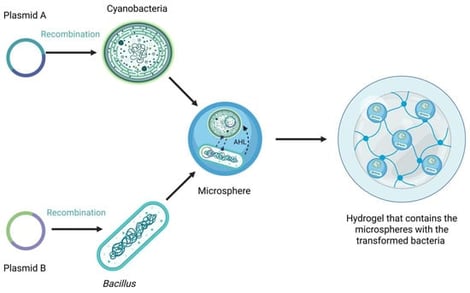
The proposed synthetic biology conceptual framework for sustainable post-wildfire restoration: Engineered bacterial consortium, in which the bacterium Bacillus subtilis is genetically engineered via a plasmid vector to produce the extracellular enzyme laccase while the cyanobacterium Nostoc oryzae is genetically modified to overexpress hetR gene involved in heterocyte differentiation, functioning as a novel biofertilizer to replenish soil nitrogen levels. The two strains engage in a quorum sensing system that functions through the autoinducer molecule Acyl-Homoserine Lactone (AHL). The bacterial consortium is encapsulated inside microspheres contained in the hydrogel. Created in BioRender. Thessaloniki, I. (2026) https://BioRender.com/1cd3gfm.

The open access journal SynBio [...]

19 January 2026

Programmable Plant Immunity: Synthetic Biology for Climate-Resilient Agriculture

  • Sopan Ganpatrao Wagh,
  • Akshay Milind Patil and
  • Harshraj Shinde
  • + 3 authors

Agricultural systems face mounting pressures from climate change, as rising temperatures, elevated CO2, and shifting precipitation patterns intensify plant disease outbreaks worldwide. Conventional strategies, such as breeding for resistance, pesticides, and even transgenic approaches, are proving too slow or unsustainable to meet these challenges. Synthetic biology offers a transformative paradigm for reprogramming plant immunity through genetic circuits, RNA-based defences, epigenome engineering, engineered microbiomes, and artificial intelligence (AI). We introduce the concept of synthetic immunity, a unifying framework that extends natural defence layers, PAMP-triggered immunity (PTI), and effector-triggered immunity (ETI). While pests and pathogens continue to undermine global crop productivity, synthetic immunity strategies such as CRISPR-based transcriptional activation, synthetic receptors, and RNA circuit-driven defences offer promising new avenues for enhancing plant resilience. We formalize synthetic immunity as an emerging, integrative concept that unites molecular engineering, regulatory rewiring, epigenetic programming, and microbiome modulation, with AI and computational modelling accelerating their design and climate-smart deployment. This review maps the landscape of synthetic immunity, highlights technological synergies, and outlines a translational roadmap from laboratory design to field application. Responsibly advanced, synthetic immunity represents not only a scientific frontier but also a sustainable foundation for climate-resilient agriculture.

4 January 2026

Nucleic acid-based gene interfering and editing molecules, such as antisense oligonucleotides, ribozymes, small interfering RNAs (siRNAs), and CRISPR-Cas9-associated guide RNAs, are promising gene-targeting agents for therapeutic applications. Cancer’s heterogeneous and diverse nature demands gene-silencing technologies that are both specific and adaptable. RNase P ribozymes, called M1GS RNAs, are engineered constructs that link the catalytic M1 RNA from bacterial RNase P to a programmable guide sequence. This guide sequence directs the M1GS ribozyme to base-pair with a target RNA, inducing it to fold into a structure resembling pre-tRNA. Catalytic activity can be enhanced through in vitro selection strategies. In this review, we will discuss the application of M1GS ribozymes in targeting cancer-associated RNAs, focusing on the BCR-ABL transcript in leukemia, the internal ribosome entry site (IRES) of hepatitis C virus (HCV), and the replication and transcription activator (RTA) of Kaposi’s sarcoma-associated herpesvirus (KSHV). Together, these examples highlight the versatility of M1GS ribozymes across both viral and cellular oncogenic targets, underscoring their potential as a flexible synthetic biology platform for cancer therapy.

8 December 2025

News & Conferences

Issues

Open for Submission

Editor's Choice

Get Alerted

Add your email address to receive forthcoming issues of this journal.

XFacebookLinkedIn
SynBio - ISSN 2674-0583