


Abstract
Between June and September 2023, a total of 80 meat samples from pork and chicken meat were collected from 16 retail markets in La Plata, Argentina. Eighty-four highest priority critically important antimicrobial-resistant Escherichia coli and two Salmonella spp. were isolated. Resistance to ciprofloxacin and cefotaxime was observed in 65 and 49 E. coli isolates, respectively. Seventy-five E. coli isolates were multidrug resistant. Fourteen E. coli isolates from chicken meat showed resistance to three of the HPCIA. Resistance to third-generation cephalosporin was associated with blaCTX-M. It is 15 times more likely to find HPCIA-resistant E. coli in chicken meat than in pork.
1. Introduction
The emergence and dissemination of antimicrobial resistance (AMR) is a worldwide public health concern. To address this issue, in 2005, the World Health Organization (WHO) first developed the List of Critically Important Antimicrobials (CIA). The list categorizes antimicrobial classes authorized in humans and animals based on the importance of the antimicrobial class in human medicine and the contribution of non-human use to the risk of transmitting AMR to humans. The WHO Medically Important Antimicrobial List is systematically updated. Cephalosporins (third and fourth generation), quinolones, polymyxins, and phosphonic acid derivatives are authorized for human and animal use and are categorized in the class of highest priority critically important antimicrobial (HPCIA) [1].
Resistant bacteria can be transmitted through the food chain with the consumption of raw foods or possibly through the consumption of inadequately cooked food, via cross-contamination with other food, or indirectly through the environment [2]. Pork and chicken can serve as reservoirs of antimicrobial resistance, which can be monitored using Escherichia coli as an indicator bacteria and Salmonella as a zoonotic pathogen. In 2022, pork and chicken meat consumption in Argentina was 16.76 kg/inhabitant/year [3] and 45.5 kg/inhabitant/year [4], respectively.
This study aimed to determine the presence of the highest priority critically important antimicrobial-resistant E. coli and Salmonella spp. from pork and chicken meat at retail markets in La Plata, Buenos Aires, Argentina.
2. Materials and Methods
2.1. Retail Markets Sampling
Between June and September 2023, meat samples were purchased from 16 retail markets randomly selected in La Plata, Buenos Aires, Argentina. A total of 80 meat samples were collected, 48 from pork and 32 from chicken meat.
2.2. Sample Processing
Briefly, 25 g of each meat sample was mixed with 225 mL of buffered peptone water followed by incubation overnight at 37 °C. Enriched cultures (30 μL) were inoculated on Mac Conkey agar plates supplemented with 2 mg/L of cefotaxime or 0.5 mg/L ciprofloxacin (HCl salt) followed by incubation at 37 °C for 18 h. Presumptive E. coli colonies were selected for biochemical identification and those confirmed to be E. coli were subcultured and preserved at −20 °C. One colony was picked per plate, though, rarely, if colonies had clearly different morphologies, up to two colonies were picked, one representing each colony type.
Isolation of Salmonella spp. was performed according to ISO 6579-1:2017 [5].
2.3. Antimicrobial Susceptibility Testing
Antimicrobial susceptibility was evaluated using the disk diffusion method according to the Clinical and Laboratory Standards Institute (CLSI) guidelines [6], except for colistin for which resistance was evaluated as growth or not on Müeller–Hinton screening agar plates containing 3 mg/mL colistin. Isolates were considered multidrug resistant (MDR) when they were resistant to ≥1 agent in >3 antimicrobial categories [7].
2.4. Molecular Characterization of Beta-Lactamases Resistance Genes
PCR was performed to detect common ESBL and plasmidic AmpC β-lactamase genes, and specific PCR was also used to discriminate between blaCTX-M-2, blaCTX-M-1/15, blaCTX-M-8/25, and blaCTX-M-9/14 groups [8].
2.5. Statistical Analysis
Generalized linear models (GLMs) with binomial distribution were fitted and validated. The type of sample (pork/chicken meat) was used as a fixed effect predictor variable. The proportion of isolates obtained in both types of meat per establishment was evaluated. Likewise, it was studied whether there were differences in the proportion of isolates resistant to highest priority critically important antimicrobials obtained for each type of sample analyzed. Both the effects of errors and the goodness of fit to the proposed models and assumptions were tested. The degree of significance was set at p < 0.05. Statistical analysis was performed with R software (R Core Team (2020) version 2023.09.1, Vienna, Austria).
3. Results
All retail markets were positive for at least one cefotaxime or ciprofloxacin resistant E. coli isolate. Of the total samples processed, at least one resistant E. coli isolate was obtained in 63.75% (51/80). From 43.7% (21/48) of the pork samples and 93.75% (30/32) of chicken meat, 84 resistant E. coli isolates, 34 and 50, respectively, were obtained. Two Salmonella spp. were isolated from chicken meat. Table 1 shows the distribution of E. coli resistant to HPCIA by retail market.

Table 1.
Distribution of Highest Priority Critical Important Antimicrobial-resistant Escherichia coli isolated from retail market.
The proportion of chicken samples positive for HPCIA-resistant E. coli was significantly higher than that obtained in those from pigs (p-value < 0.05) (Figure 1). In this sense, it is 15 times more likely to find HPCIA-resistant E. coli in chicken meat than in pork [OR chicken/pig = 15; CI (3.58; 62.78)] (Table 2).
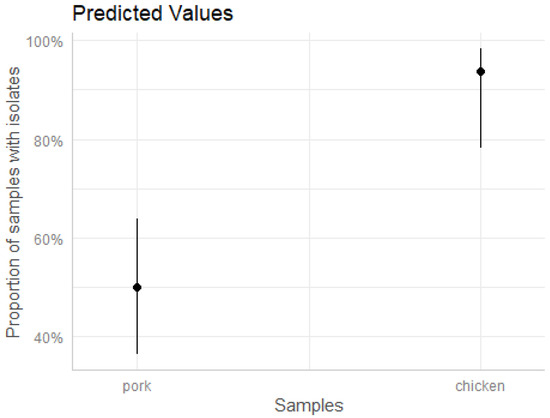
Figure 1.
Proportion of samples that presented HPCIA-resistant E. coli isolates according to the type of meat (pork/chicken).
Table 2.
Results obtained for the proportion of samples that presented isolates, according to the type of meat (pork/chicken).
Likewise, the proportion of E. coli isolates resistant to the following combinations of HPCIA was evaluated: CTX-CIP/CTX-FOS/CTX-FOS-CIP, obtained from pork and chicken. Only for this last combination of antibiotics was it significantly higher for chicken meat compared to pork (p < 0.05), while the other two combinations of antibiotics did not present differences between both types of meat.
All the isolates (100%) were susceptible to the polymyxin colistin, the carbapenems meropenem and imipenem, and nitrofurantoin. The rates of resistance of the E. coli isolates were as follows: ampicillin, 91.7%; tetracycline, 78.6%; ciprofloxacin, 77.4%; cefotaxime, 58.3%; chloramphenicol, 48.8%; amoxicillin/clavulanic acid, 47.6%; sulfamethoxazole-trimethoprim, 45.2%; fosfomycin, 32.1%; cefepime, 25%; gentamicin, 22.6%; ceftazidime, 8.3%; cefoxitin, 4.8%. Fourteen E. coli isolates from chicken meat showed resistance to three of the HPCIAs: cefotaxime/cefepime, ciprofloxacin, and fosfomycin.
Figure 2 shows the percentage of E. coli isolates resistant to important antimicrobials discriminated by pork and chicken meat.
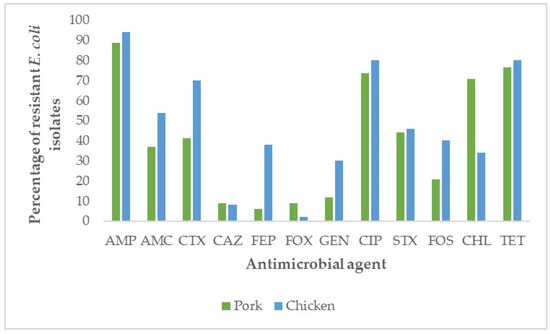
Figure 2.
Percentage of important antimicrobials-resistant E. coli isolated from pork and chicken meat
A high diversity of resistance profiles was observed. Moreover, 75 isolates (89%) were categorized as MDR. Twenty-four E. coli isolates showed resistance to four antibiotic classes, and twenty strains were resistant to five antibiotic classes.
Salmonella spp. isolates were sensitive to ampicillin, gentamicin, nalidixic acid, ciprofloxacin, fosfomycin, trimethoprim-sulfamethoxazole, chloramphenicol, and azithromycin. The isolates showed resistance to tetracycline.
Principally, resistance to third- and fourth-generation cephalosporin was associated with blaCTX-M genes. Table 3 describes the distribution of beta-lactamase resistance genes found in pork and chicken meat.
Table 3.
Distribution of beta lactamase resistance genes found in pork and chicken meat.
4. Discussion
In Argentina, the published data related to the presence of resistant E. coli in pigs and poultry were obtained from farms or slaughterhouses. In relation to the resistance profiles and enzymes involved, the results obtained from chicken meat are like those observed by other authors [9]. A similar situation was not observed with pork [8,10].
Although our results agree with those shown by Clemente et al. [11] regarding the higher frequency of E. coli resistant to third-generation cephalosporins observed in chicken meat, our isolation rate of ESBL/AmpC-producing E. coli exceeds what they reported. In this work, 27% (13/48) of the pork samples and 72% of the chicken sample (23/32) were positive of CTX-resistant E. coli, contrasting with 10.5% and 30.3% respectively.
Dominguez et al. [9] reported that CTX-M-2 cefotaximase was the main mechanism responsible for third generation cephalosporins resistance, observed in E coli from avian systems in Argentina. Our results partially agree with this information since the presence of CTX-M-2 cefotaximase and CTX-M-1/15 cefotaximase was observed in equal parts. CTX-M-1 and CTX-M-15 are the leading ESBL-producing Enterobacterales associated with animal and human infection, respectively, and are an increasing antimicrobial resistance global health concern. Faccone et al. [10] and Gómez et al. [8] reported that the main mechanism of resistance to third-generation cephalosporin was mainly associated with CTX-M, with those grouped as CTX-M-8/25.
It is important to highlight that by municipal provision, in retail markets, meat from different origins (pork, chicken, and beef) must be separated. This would explain the fact that resistant E. coli isolates from pork and chicken meat from the same place are not similar.
5. Conclusions
The observed results do not refute the hypothesis proposed that “pork and chicken meat obtained from retail markets in La Plata City are contaminated with highest priority critically important resistant E. coli”. The presence of resistant E. coli in pork and chicken meat is a source of multiple resistance genes associated with clones epidemiologically relevant to public health.
These are the first data obtained from pork and chicken meat from retail markets in La Plata City. Complementary studies are necessary to determine the totality of resistance genes carried by these resistant E. coli isolates. The information that will be obtained will allow intervention strategies to be proposed that will reduce the risk of cross-contamination.
Supplementary Materials
The following supporting information can be downloaded at: https://www.mdpi.com/article/10.3390/ECA2023-16388/s1, Table S1: Resistance phenotype and beta-lactamases resistance genes in Escherichia coli isolated from pork and chicken meat in La Plata, Buenos Aires, Argentina.
Author Contributions
Conceptualization and methodology, L.G. and F.A.M.; formal analysis, M.E.H.; investigation, H.D.N., C.A., R.E.I. and M.M.Z.; resources, V.F.N. and M.C.; writing—original draft preparation, H.D.N. and F.A.M.; writing—review and editing, L.G. and F.A.M.; project administration and funding acquisition, F.A.M. All authors have read and agreed to the published version of the manuscript.
Funding
This research was partially funded by Universidad Nacional de La Plata, grant number V294.
Institutional Review Board Statement
Not applicable.
Informed Consent Statement
Not applicable.
Data Availability Statement
Data may be available upon reasonable request.
Acknowledgments
We acknowledge the technical assistance of Walter Darío Nievas.
Conflicts of Interest
The authors declare no conflicts of interest.
References
- World Health Organization. WHO Medically Important Antimicrobial List. 2023. Available online: https://cdn.who.int/media/docs/default-source/antimicrobial-resistance/amr-gcp-irc/who_mialist_draft_forexternaldiscussion.pdf?sfvrsn=af6f2ebf_1 (accessed on 27 September 2023).
- Himanshu, R.P.; da Costa, A.C.; Leal, E.; Chang, C.-M.; Pandey, R.P. Systematic Surveillance and Meta-Analysis of Antimicrobial Resistance and Food Sources from China and the USA. Antibiotics 2022, 11, 1471. [Google Scholar] [CrossRef]
- Secretaría de Agricultura; Ganadería y Pesca. Anuario Porcino 2022. Ministerio de Economía. Available online: https://www.magyp.gob.ar/sitio/areas/porcinos/estadistica/_archivos//000005-Anuario/220000_Anuario%202022.pdf (accessed on 27 September 2023).
- Secretaría de Agricultura; Ganadería y Pesca. Anuario Avícola 2022. Ministerio de Economía. Available online: https://www.magyp.gob.ar/sitio/areas/aves/informes/boletines/_archivos//000001_Anuario%20Avicola%202022.pdf (accessed on 27 September 2023).
- ISO 6579:1; Microbiology of Food and Animal Feeding Stuffs—Horizontal Method for the Detection of Salmonella spp. International Organization for Standardization: Vernier, Switzerland, 2017.
- Clinical and Laboratory Standards Institute. M100-ED33:2023 Performance Standards for Antimicrobial Susceptibility Testing, 33rd ed.; Available online: http://em100.edaptivedocs.net/GetDoc.aspx?doc=CLSI%20M100%20ED33:2023&sbssok=CLSI%20M100%20ED33:2023%20TABLE%202A&format=HTML#CLSI%20M100%20ED33:2023%20TABLE%202A (accessed on 2 October 2023).
- Magiorakos, A.A.; Srinivasan, A.; Carey, R.B.; Carmeli, Y.; Falagas, M.E.; Giske, C.G.; Harbarth, S.; Hindler, J.F.; Kahlmeter, G.; Olsson-Liljequist, B.; et al. Multidrug-resistant, extensively drug-resistant and pandrug-resistant bacteria: An international expert proposal for interim standard definitions for acquired resistance. Clin. Microbiol. Infect. 2012, 18, 268–281. [Google Scholar] [CrossRef]
- Gómez, M.F.; Vinocur, F.; Rodríguez Ramos, S.; Garassino, B.J.; Nievas, H.D.; Nievas, V.F.; Alarcón, L.V.; Armocida, A.D.; Pérez, E.M.; Griffo, D.; et al. Porcine Escherichia coli isolates resistant to critically important antimicrobials for public health. Analecta Vet. 2022, 42, e067. [Google Scholar] [CrossRef]
- Domínguez, J.E.; Redondo, L.M.; Figueroa Espinosa, R.A.; Cejas, D.; Gutkind, G.O.; Chacana, P.A.; Di Conza, J.A.; Fernández Miyakawa, M.E. Simultaneous Carriage of mcr-1 and Other Antimicrobial Resistance Determinants in Escherichia coli From Poultry. Front. Microbiol. 2018, 9, 1679. [Google Scholar] [CrossRef]
- Faccone, D.; Moredo, F.A.; Giacoboni, G.I.; Albornoz, E.; Alarcón, L.; Nievas, V.F.; Corso, A. Multidrug-resistant Escherichia coli harbouring mcr-1 and blaCTX-M genes isolated from swine in Argentina. J. Glob. Antimicrob. Resist. 2019, 18, 160–162. [Google Scholar] [CrossRef] [PubMed]
- Clemente, L.; Leão, C.; Moura, L.; Albuquerque, T.; Amaro, A. Prevalence and Characterization of ESBL/AmpC Producing Escherichia coli from Fresh Meat in Portugal. Antibiotics 2021, 10, 1333. [Google Scholar] [CrossRef] [PubMed]
Disclaimer/Publisher’s Note: The statements, opinions and data contained in all publications are solely those of the individual author(s) and contributor(s) and not of MDPI and/or the editor(s). MDPI and/or the editor(s) disclaim responsibility for any injury to people or property resulting from any ideas, methods, instructions or products referred to in the content. |
© 2023 by the authors. Licensee MDPI, Basel, Switzerland. This article is an open access article distributed under the terms and conditions of the Creative Commons Attribution (CC BY) license (https://creativecommons.org/licenses/by/4.0/).