
You are currently viewing a new version of our website. To view the old version click .
Physical Sciences Forum
  • Proceeding Paper
  • Open Access

30 June 2023

The ENUBET Monitored Neutrino Beam for High Precision Cross-Section Measurements †
,
,
,
,
,
,
,
,
and
1
INFN (Istituto Nazionale di Fisica Nucleare)–Sezione di Padova, Via Marzolo 8, 35131 Padova, Italy
2
Physics Department, Università di Padova, Via Marzolo 8, 35131 Padova, Italy
3
Fondazione Bruno Kessler (FBK), INFN (Istituto Nazionale di Fisica Nucleare) and Trento Institute for Fundamental Physics and Applications, 38123 Trento, Italy
4
Aristotle University of Thessaloniki, 54124 Thessaloniki, Greece
This article belongs to the Proceedings The 23rd International Workshop on Neutrinos from Accelerators

Abstract

The main source of systematic uncertainty on neutrino cross-section measurements at the GeV scale originates from the poor knowledge of the initial flux. The goal of reducing this uncertainty to 1% can be achieved through the monitoring of charged leptons produced in association with neutrinos, by properly instrumenting the decay region of a conventional narrow-band neutrino beam. Large-angle muons and positrons from kaons are measured by a sampling calorimeter on the decay tunnel walls, while muon stations after the hadron dump can be used to monitor the neutrino component from pion decays. Furthermore, the narrow momentum width (<10%) of the beam provides a O (10%) measurement of the neutrino energy on an event-by-event basis, thanks to its correlation with the radial position of the interaction at the neutrino detector. The ENUBET project has been funded by the ERC in 2016 to prove the feasibility of such a monitored neutrino beam and, since 2019, ENUBET is also a CERN neutrino platform experiment (NP06/ENUBET). The breakthrough the project achieved is the design of a horn-less neutrino beamline that would allow for a 1% measurement of ν e and ν μ cross-sections in about 3 years of data taking at CERN-SPS, using ProtoDUNE as far detector.

1. Introduction

The knowledge of the initial flux in conventional neutrino beams is the primary source of systematic error on the neutrino cross-section. ENUBET’s goal is to develop a so-called “monitored neutrino beam”, in which a controlled neutrino flux can be obtained by monitoring the charged leptons from meson decays along an instrumented decay region (the “tagger”) [1]. In June 2016, ENUBET started as an ERC project with the goal of designing a facility for the measurement of large angle positrons from K e 3 decay ( K + e + ν e π 0 ), allowing it to constrain the ν e flux. The project’s primary purpose was then extended, considering the possibility of measuring large-angle muons from the two-body K μ 2 and K μ 3 decays of the kaons ( K + μ + ν μ and K + μ + π 0 ν μ ), as well as the small angle ones from the pion decays ( π + μ + ν μ ) by instrumenting the region after the hadron dump. The physics goal of ENUBET is to use this monitoring technique to reduce below 1% the uncertainty on the ν e and ν μ fluxes and to perform high-precision cross-section measurements, thus boosting the physics potential of next-generation oscillation experiments by reducing their systematic uncertainties.

2. The ENUBET Beamline

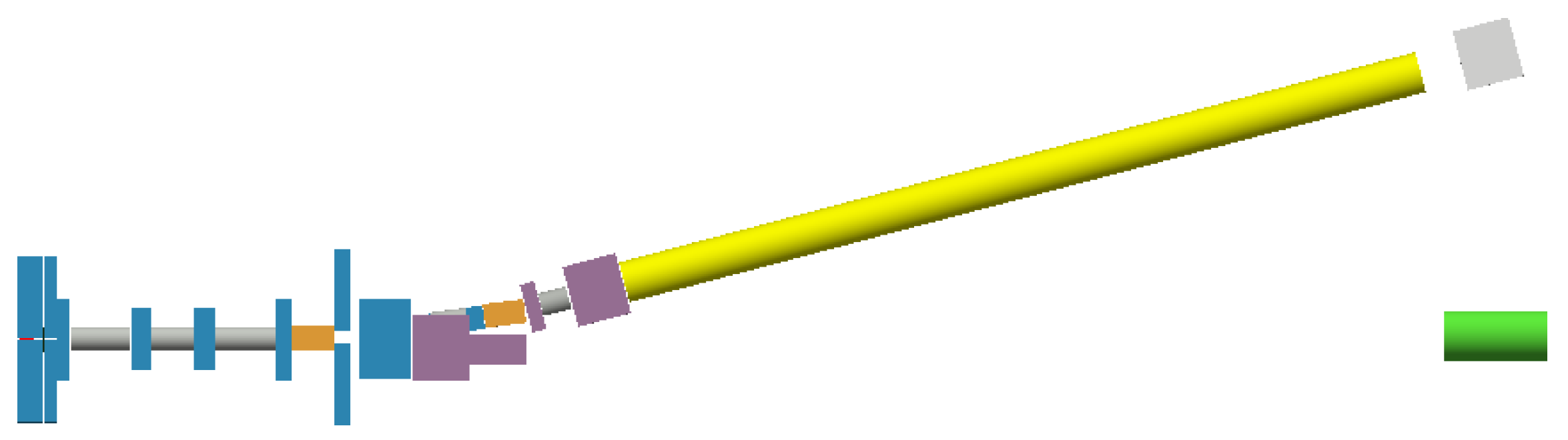
The ENUBET beamline is designed as a narrow band secondary beamline relying on normal-conducting magnets. When protons hit a target, they generate secondaries that are sign- and momentum-selected all the way to the instrumented decay tunnel. The transfer line is kept short (about 20 m) to enhance the kaon component, and focuses the mesons with a design momentum of 8.5 G e V / c ± 5 10 % . This is an ideal choice for the e + / π + separation and to span the region of interest for the neutrino energy in DUNE and HyperK. In the most recent design, the transfer line relies on a quadrupole triplet for the initial focusing of the secondaries from the target, followed by a double-bend momentum selection section and additional quadrupoles for constraining the beam envelope: an overview is shown in Figure 1.
Figure 1. Latest beamline design. Focusing quadrupoles and bending dipoles are shown in gray and orange, respectively. Collimators are made of Iron (blue) or Inermet180 (violet). The decay tunnel (yellow), the hadron dump (light grey) and the proton dump (green) are also shown.
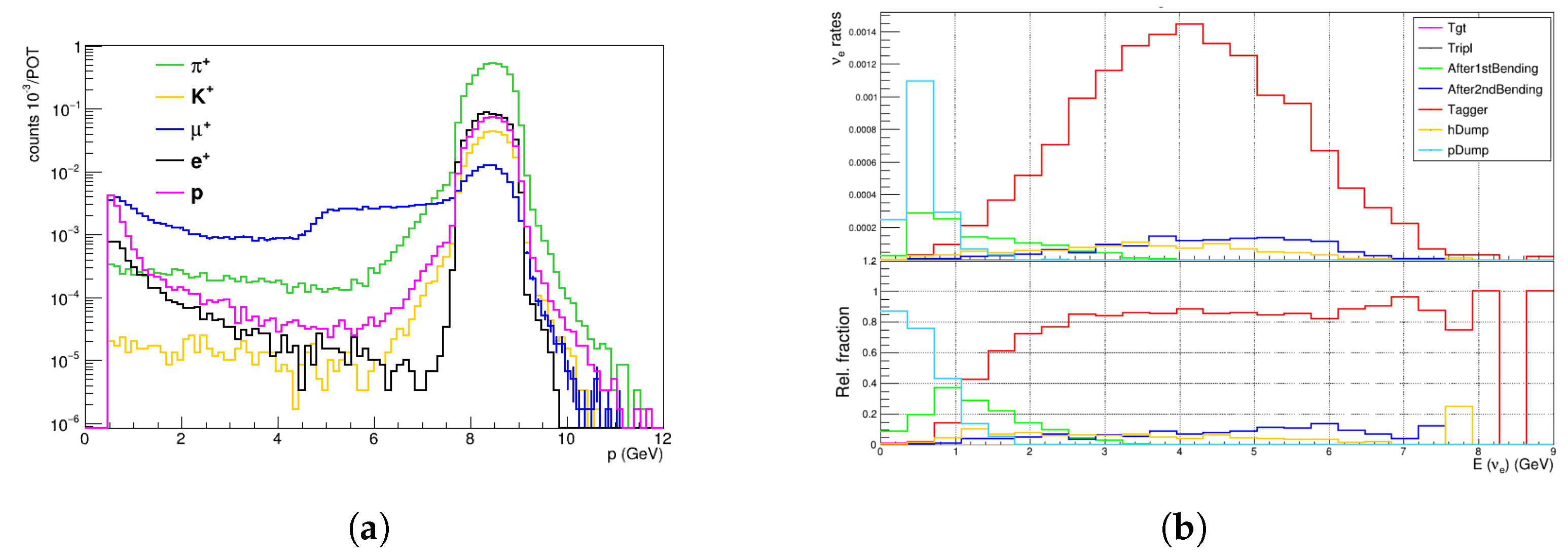
The background ν e component at the neutrino detector coming from early kaon decays in the first half of the transfer line is reduced thanks to the bending angle. The facility has been simulated in G4beamline, FLUKA and GEANT4 [2]. According to simulation results, the kaon flux at the tunnel entrance increased in comparison to transfer line designs reported in the past years. Figure 2 shows the most recent simulated fluxes at the entrance of the decay tunnel and the ν spectra at the far detector. The results in terms of neutrino flux would allow us to detect 10 4 ν e C C in about 3 years of data taking, assuming a 500 t, 6 × 6 m 2 LAr detector 50 m away from the end of the beamline.
Figure 2. (a) Particle budget at the decay tunnel entrance. The rates obtained for a momentum of 8.5 ± 5% GeV are 4.13 × 10 3 π + / POT and 0.34 × 10 3 K + / POT . (b) Energy spectrum of the ν e C C interactions in the neutrino detector. Colored lines represent the neutrino contribution generated in a specific area of the transfer line, with the neutrinos generated inside the tagger (in red) representing ∼80% of spectrum above 1 GeV. The most relevant component below this threshold is the one coming from the proton dump (in cyan), whose position and shape are still to be fine−tuned.
The latest design has been improved thanks to an extensive optimization campaign that employed a generic optimization framework based on a genetic algorithm. More details on this and on the beamline design features can be found in [3].

3. Tunnel Instrumentation

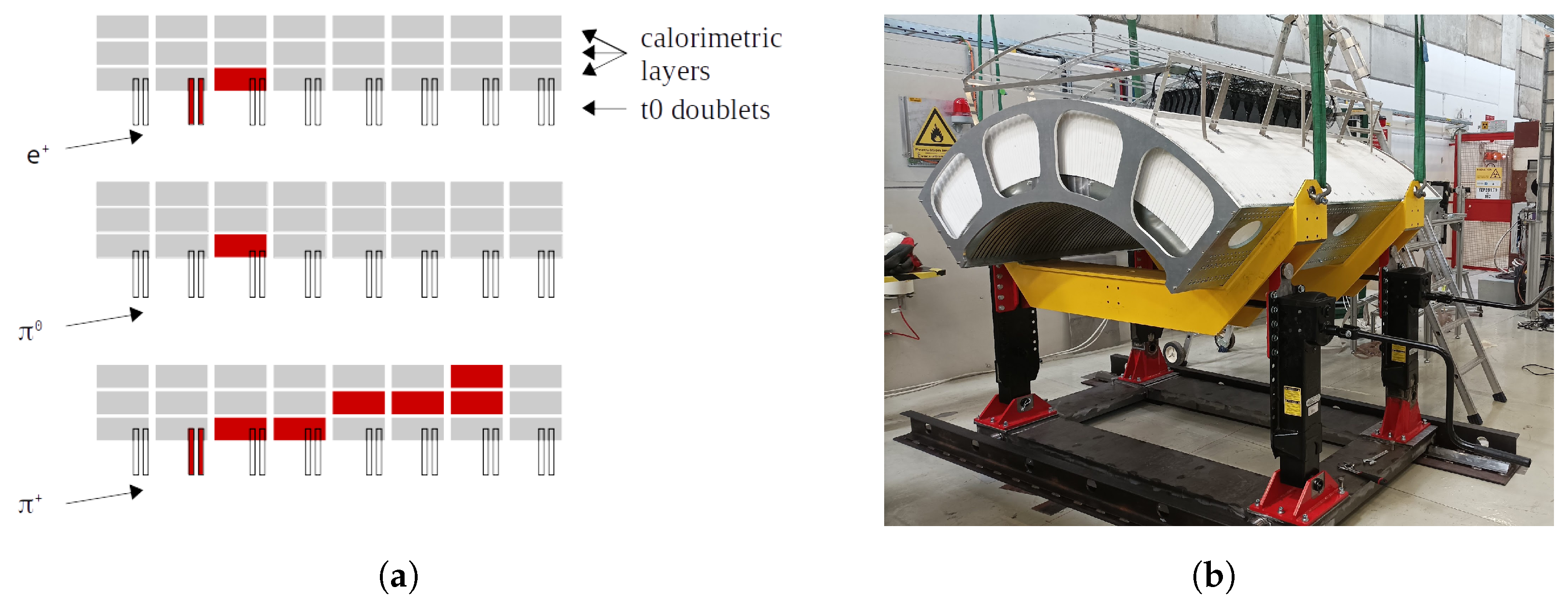
The ENUBET decay tunnel will be instrumented with a modular sampling calorimeter for positron and muon tagging and e + / μ / π + separation. The tunnel walls are instrumented by three radial layers of LCM (Lateral Compact Modules): sampling calorimeter units of 9 cm 2 transverse area composed by five couples of iron (1.5 cm thick) and plastic scintillator (0.7 cm thick) tiles for a total of 11 cm and 4.3 X 0 in the longitudinal direction. The light is collected using wavelength shifting (WLS) fibers and read out using SiPMs. Rings made of doublets of scintillator tiles (the “t0 layer”) positioned in the inner tunnel surface act as photon veto, allowing for e + / π 0 separation. Figure 3a shows a schematic of the ENUBET event topology.
Figure 3. (a) Event topology for the ENUBET calorimeter. EM shower from a positron, top; EM shower from a π 0 , middle; hadronic shower from a π + , bottom. The modules involved in a typical e + , π 0 or π + event are marked in red. In the π 0 case, photons coming from its decay do not leave any signal in the t0 doublet. (b) The demonstrator.
Prototypes were tested in the CERN East Area to evaluate the physics performance, particularly the separation capabilities for e + / π + and e + / π 0 , as discussed in [4]. The light readout system has been studied in detail and the latest designs were tested on a small prototype of the tagger instrumentation (ENUBINO), in terms of efficiency and uniformity of response. A final demonstrator 1.65 m long and spanning 90° in azimuth (Figure 3b) was built at the INFN-LNL and it has been tested in October 2022 [5].

4. Particle Reconstruction and Assessment of Systematics

The ENUBET facility has been fully simulated using GEANT4, including particle propagation and decay from the transfer line to the detector, hit level detector response, and pile-up effects. Data from the prototype testing at CERN have been used to validate the simulation.
The analysis chain starts with the event builder algorithm, followed by a neural-network-based signal/background separation step [6]. The achieved particle identification performance is:
  • 22% efficiency for K e 3 signal events, with a S/N of 2;
  • 34% efficiency for K μ 2 signal events, with a S/N of 6.
The design of an instrumented hadron dump for the detection of muons from pion decays is under study.
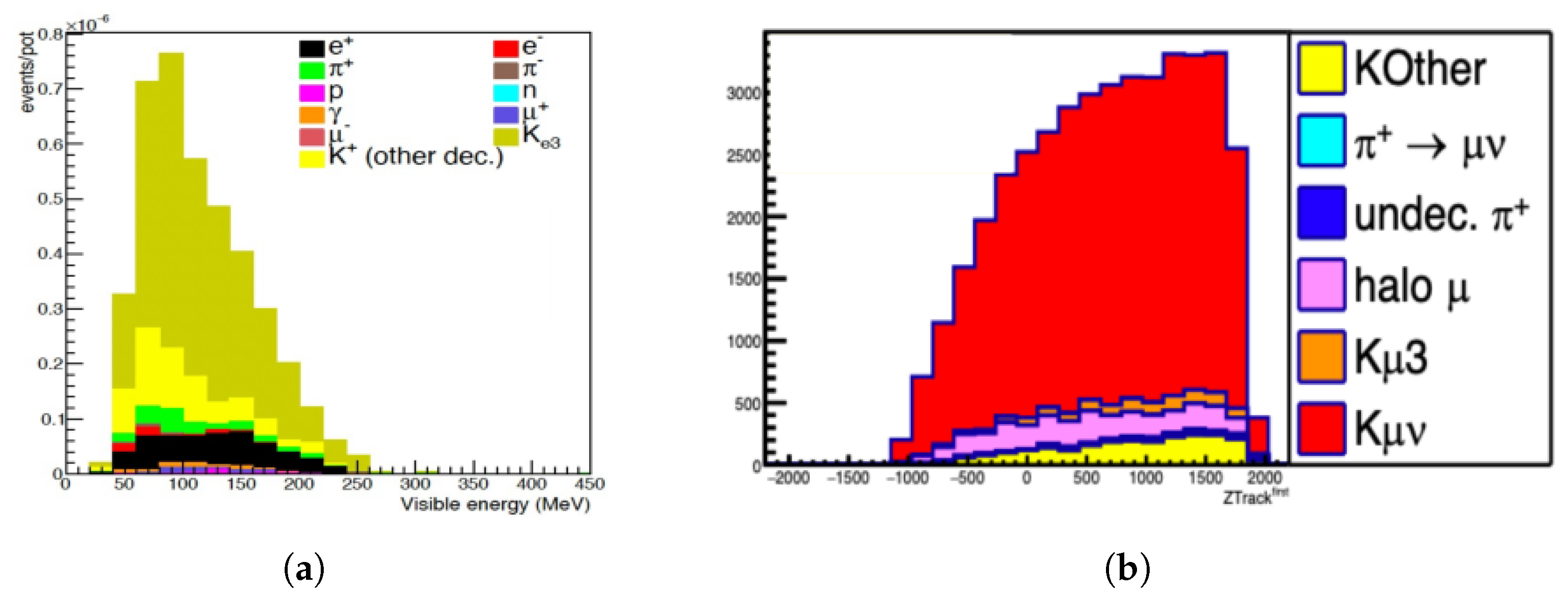
The systematics of neutrino flux are evaluated by employing the relationship between leptons identified in the calorimeter and neutrino flux at the detector. Using the lepton distributions for the observables reported in Figure 4, a signal plus background model that includes a priori hadro-production (HP) and transfer-line-related systematics is constructed. Toy-MC experiments are created and fitted to analyze the systematic uncertainty a posteriori and evaluate the resulting uncertainty reduction. Reweighting the simulation eventually causes the systematic errors to be propagated to the neutrino flux [7]. The main factors contributing to the uncertainty on the neutrino flux include uncertainties in hadro-production (HP), systematics associated with the calorimeter (energy calibration, scintillator aging), and uncertainties in the nominal magnet current. For now, only HP uncertainties have been used for the computation, as they represent the major contribution to the flux uncertainty. The other (minor) components will also be included in the future. Thanks to the ENUBET instrumented tunnel, a successful reduction of the neutrino flux systematics from 10% down to the 1% level has been reached.
Figure 4. Reconstructed events after the application of the neural network. (a) Visible energy of K e 3 positrons. (b) Impact point along calorimeter wall of muons from K μ 2 . In both plots, the background contributions are also reported as in the legend.

Author Contributions

All authors have read and agreed to the published version of the manuscript.

Funding

This project has received funding from the European Research Council (ERC) under the European Unions Horizon 2020 research and innovation programme (grant agreement N. 681647) and by the Italian Ministry of Education and Research—MIUR (Bando “FARE”, progetto NUTECH).

Institutional Review Board Statement

Not applicable.

Data Availability Statement

Not applicable.

Conflicts of Interest

The authors declare no conflict of interest.

References

  1. Longhin, A.; Ludovici, L.; Terranova, F. A novel technique for the measurement of the electron neutrino cross section. Eur. Phys. J. C 2015, 75, 155. [Google Scholar] [CrossRef]
  2. Acerbi, F.; Tenti, M.; Cindolo, F.; Sampsonidis, D.; Votano, L.; Catanesi, M.G.; Charitonidis, N.; Cecchini, S.; Cindolo, F.; Collazuol, G.; et al. NP06/ENUBET Annual Report for the SPSC (2021); CERN-SPSC-2021-013, SPSC-SR-290; CERN: Geneva, Swizerland, 2021. [Google Scholar]
  3. Parozzi, E. The design of the ENUBET beamline. In Proceedings of the NuFACT 2022, Salt Lake City, UT, USA, 31 July–6 August 2022. [Google Scholar]
  4. Acerbi, F.; Bonesini, M.; Bramati, F.; Branca, A.; Brizzolari, C.; Brunetti, G.; Capelli, S.; Carturan, S.; Catanesi, M.G.; Cecchini, S.; et al. The ENUBET positron tagger prototype: Construction and testbeam performance. JINST 2020, 15, P08001. [Google Scholar] [CrossRef]
  5. Acerbi, F.; Tenti, M.; Cindolo, F.; Sampsonidis, D.; Votano, L.; Catanesi, M.G.; Charitonidis, N.; Cecchini, S.; Cindolo, F.; Collazuol, G.; et al. NP06/ENUBET Annual Report 2022 for the SPSC; CERN-SPSC-2022-016, SPSC-SR-310; CERN: Geneva, Swizerland, 2022. [Google Scholar]
  6. ENUBET Collaboration. Lepton reconstruction in the ENUBET tagger. In Proceedings of the 22nd International Workshop on Neutrinos from Accelerators (NuFact 2021), Cagliari, Italy, 6–11 September 2021; p. 025. [Google Scholar]
  7. Branca, A.; Acerbi, F.; Angelis, I.; Bonesini, M.; Bramati, F.; Brizzolari, C.; Brunetti, G.; Calviani, M.; Capelli, S.; Carturan, S.; et al. Fluxes and systematics reduction with decay monitoring. In Proceedings of the 22nd International Workshop on Neutrinos from Accelerators, Cagliari, Italy, 6–11 September 2021; p. 030. [Google Scholar]
Disclaimer/Publisher’s Note: The statements, opinions and data contained in all publications are solely those of the individual author(s) and contributor(s) and not of MDPI and/or the editor(s). MDPI and/or the editor(s) disclaim responsibility for any injury to people or property resulting from any ideas, methods, instructions or products referred to in the content.

Article Metrics

Citations

Article Access Statistics

Multiple requests from the same IP address are counted as one view.