


Abstract
An abundant byproduct of the Uruguayan winemaking industry, Tannat grape pomace (TGP), has a unique profile of phenolic compounds, making it a great candidate as an ingredient in the formulation of healthy and sustainable foods. The addition of TGP and sweetener to a muffin formulation may represent a challenge regarding technological properties. In this work, the objective was to develop potential functional muffins with the nutritional claims of “source of/high in fiber” and “no added sugars”, by incorporating TGP as a source of fiber and bioactive compounds and stevia as a sweetener. For this purpose, a factorial experimental design with central points was assessed by varying TGP and sweetener contents. Color was measured in the muffins by a CieLab system, and texture parameters (hardness, elasticity, cohesiveness, gumminess, and chewiness) were obtained by a texture analyzer. The antioxidant capacity was also assessed by total phenol content (TPC by Folin reaction), ABTS, and ORAC-FL methods. Regarding color parameters, the main results showed lower L values for the muffins with higher TGP content (34.4–35.9, p < 0.05). As for texture parameters, lower hardness values (3170–3655 N) were displayed by muffins with higher TGP content (p < 0.05). Elasticity showed no significant differences between the samples (0.773–0.873), with the exception of one of the formulations with higher TGP content. Cohesiveness values ranged between 0.210 and 0.374. Gumminess and chewiness values were lower for the muffin formulation with higher TGP and stevia contents (694 ± 202 N and 538 ± 182 N). Moreover, antioxidant capacity showed increased TPC values for muffins with higher TGP content when compared to the control muffin (without TGP). Similarly, ABTS and ORAC-FL values were higher for the muffins with higher TGP content (15.26–15.59 and 23.92–25.56 µmol Trolox equivalent (TE)/g samples, respectively). In conclusion, TGP muffins represent a sustainable food with adequate technological properties and enhanced nutritional properties, presenting potential to promote health.
1. Introduction
The food industry is evolving and must keep evolving in order to carry out the Sustainable Development Goals proposed by the United Nations and to apply circular economy strategies to the food chain for sustainable and healthy nutrition. One strategy could be the use of agri-food industry byproducts as ingredients in the formulation of foods. In this context, the management of the agri-food byproducts generated by agri-food industries, particularly the winemaking industry, has emerged as an urgent priority, as this sector is one of the main contributors to global waste accumulation [1]. Tannat red wine (Vitis vinifera cv. Tannat) production is emblematic in Uruguay, with this grape variety bringing international recognition to the country in the global wine industry [2]. However, the large-scale production of Tannat wine generates substantial amounts of byproducts, with Tannat grape pomace (TGP) being the primary solid residue from the winemaking process. Composed primarily of grape skins and seeds, TGP represents a valuable resource with significant potential for food product development [3]. TGP is particularly notable for its unique polyphenolic profile and high dietary fiber content, both of which have been associated with various health-promoting properties [4]. Epidemiological evidence consistently highlights that higher dietary fiber intake reduces the risk of chronic diseases [5]. Additionally, the phenolic compounds in TGP contribute bioactive properties, including antioxidant, anti-inflammatory, prebiotic, and anti-obesity effects [4,6]. Several studies have successfully enriched baked products such as biscuits and breads with TGP, demonstrating that these bioactive properties are retained even after high-temperature processes [4,7]. This highlights TGP as an ideal byproduct for high-temperature processes, offering potential health benefits while contributing to product functionality.
The objective of the present work was to develop potential functional muffins with the nutritional claims of “source of/high in fiber” and “no added sugars”, by incorporating Tannat grape pomace (TGP) as a source of fiber and bioactive compounds, and stevia as a sweetener.
2. Materials and Methods
2.1. Tannat Grape Pomace and Muffins Preparation
Tannat grape pomace (TGP) was provided by Bouza winecellar (Montevideo, Uruguay) and dried as reported by Olt et al. [4] in a conventional oven at 50 °C for 24 h, which achieved a constant weight. Dried TGP was then milled in a domestic coffee mill obtaining TGP powder to be used in the formulation of the muffins. The muffins were prepared using eggs, sunflower oil, vanilla, cow milk, wheat flour, baking powder, stevia as sweetener, and TGP. A diagram of the procedure can be seen in the supplementary material. All the ingredients were purchased from Montevideo (Uruguay) local stores. A factorial experimental design with central points was assessed by varying TGP (7, 11, and 15%) and stevia (0.65, 0.75, and 0.85 g) contents. Based on these TGP percentages, the developed muffins could potentially be labeled as a “source of fiber”, considering that TGP contains 64% fiber, as reported by Olt et al. [4] for the same pomace utilized in this study. However, the experimental verification of the fiber content is necessary to confirm this claim. In addition to the five formulations containing TGP, control muffins without TGP but with the respective stevia contents were developed for comparison purposes.
Due to the inclusion of cow milk and wheat flour in the formulation, the muffins are not suitable for individuals with lactose intolerance or celiac disease. Future formulations could explore alternative ingredients to address these dietary restrictions.
2.2. Muffin Color and Texture Analysis
The color of the muffins was measured by the CieLab system with a portable spectrophotometer CM-2300d (Konica Minolta, Nieuwegein, the Netherlands), obtaining L* (luminosity), a* (redness/greenness), and b* (yellowness/bluish).
Texture parameters (hardness, cohesiveness, elasticity, gumminess, and chewiness) were assessed by a TA-XT2i texture analyzer with the software “Texture Expert” version 1.1 (Stable Micro Systems Ltd., Surrey, UK), obtaining the “Texture Profile Analysis” (TPA). These parameters provide insights into the structural and mechanical properties of the muffins, which are critical for assessing their quality and consumer acceptance. Hardness represents the resistance of the sample to deformation, while cohesiveness reflects its ability to maintain structure after deformation. Elasticity describes the capacity of the sample to return to its original shape, whereas gumminess indicates the energy required to disintegrate the product into a state ready for swallowing. Finally, chewiness refers to the effort needed to chew the sample until it is ready for swallowing [8,9].
2.3. Antioxidant Capacity of Muffins
Firstly, the muffins were grinded in a domestic coffee mill and the extraction of antioxidants was assessed by DMSO in H2O (6:94, DMSO:H2O). The DMSO in H2O mixture was chosen for its ability to dissolve both polar and non-polar compounds and enhance polyphenol extraction efficiency at low concentrations by increasing cell membrane permeability [6,10].
Total phenol content (TPC) by Folin–Ciocalteu method, ABTS, and ORAC-FL assays were performed as described by Fernández-Fernández et al. [10] to obtain the antioxidant capacity of the developed muffins. For TPC and ABTS assays, a microplate reader (Thermo Scientific Multiskan FC model, Waltham, MA, USA) was used, and for the ORAC-FL assay, a VarioskanTM Lux (SkanIt RE 5.0 software, Thermo Scientific, Waltham, MA, USA) fluorimeter microplate reader. Results were expressed as mg of gallic acid equivalents (GAE)/g of sample for TPC assay, and as μmol of trolox equivalents (TE)/g of sample for ABTS and ORAC-FL assays.
2.4. Statistical Analysis
Results were analyzed by analysis of variance (ANOVA) and significant differences between values were obtained by Tukey test (p < 0.05). Statistical analysis was performed by the Infostat v. 2015 program (Universidad Nacional de Córdoba, Córdoba, Argentina).
3. Results and Discussion
3.1. Color and Texture of the Muffins
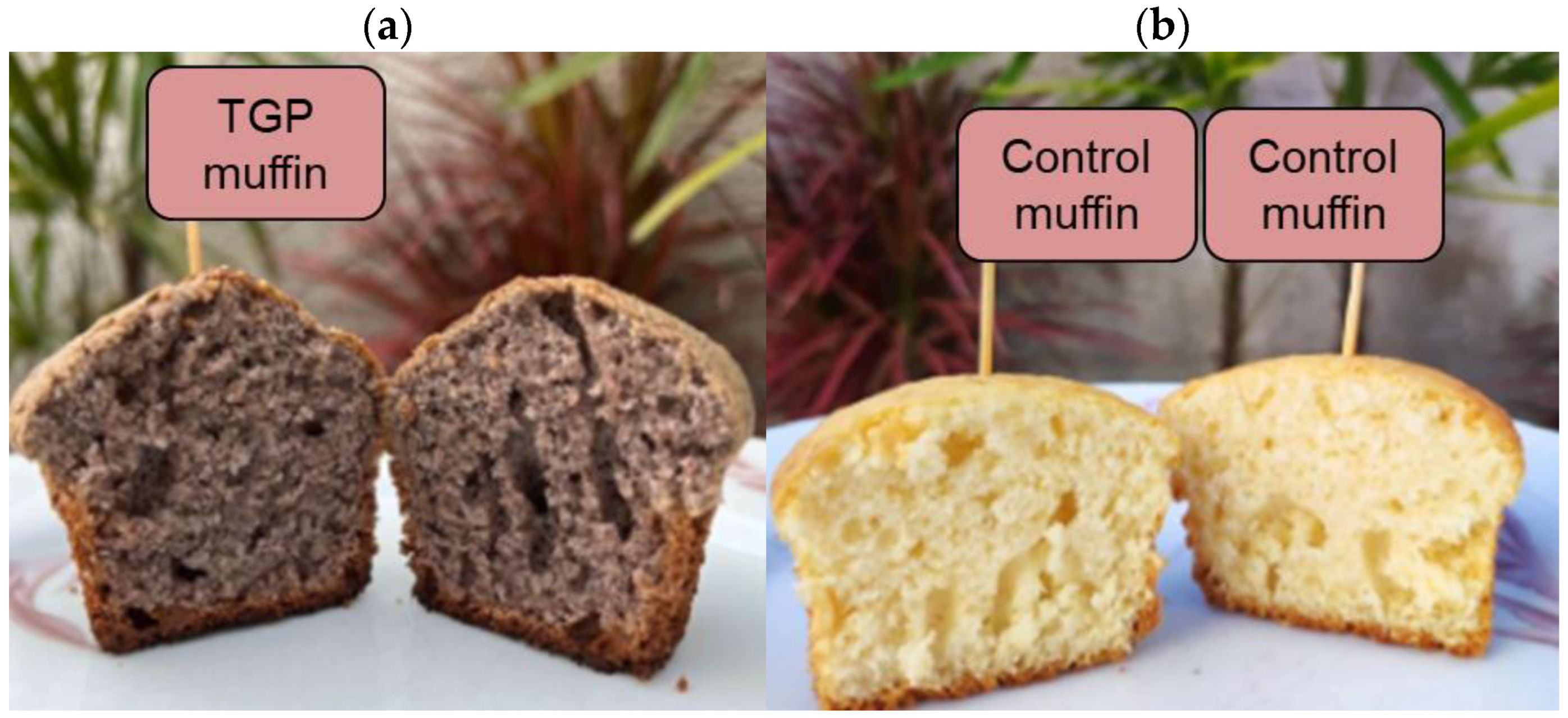
Five formulations of muffins with TGP were obtained, as well as their control muffins (without TGP) (Figure 1).
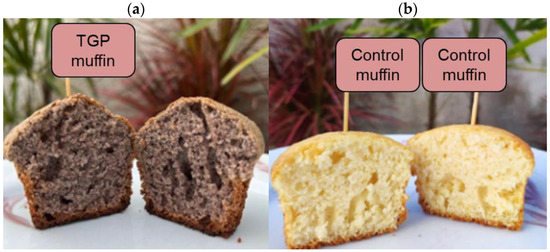
Figure 1.
Visual appearance muffin with 15% Tannat grape pomace (TGP) (a) and its corresponding control muffin without TGP addition (b).
The main results of color measurements showed lower L values for the muffins with higher TGP content (34.4–35.9, p < 0.05) (Table 1). Texture profile analysis (Table 2) showed lower hardness values for the muffins with higher TGP content (11 and 15%, p < 0.05), indicating that these muffins are softer compared to those with lower TGP content (7%). No significant differences (p > 0.05) were obtained between elasticity values, with the exception of one of the formulations with 15% of TGP and 0.85 of stevia. Regarding cohesiveness values, results showed no significant differences (p > 0.05) between the muffins with TGP with the exception of the formulation with 11% of TGP and 0.75 of stevia (central point) that presented the highest value. This suggests that this mixture has a superior ability to maintain its structure during chewing. As for the gumminess values, the muffin formulation with higher TGP and stevia contents (15% TGP and 0.85 stevia) presented the lowest value (p < 0.05), and chewiness values presented the same tendency as gumminess results. These results could be explained by the dietary fiber content [11].

Table 1.
Color results of the muffins with (TGPM) and without TGP (CM).
Table 2.
Texture results of the muffins with different percentages of TGP and sucralose (%TGP; %sucralose).
In summary, increasing the TGP content in the muffins appears to correlate with a softer and less dense texture, which may enhance their appeal to consumers [12].
The present results are in agreement with previous work on muffins fortified with Tannat and Riesling (a white grape variety) skin flour (5, 7.5, and 10%), finding increased dietary fiber content and darker color in crumbs and crusts, with good overall acceptability [13]. These findings suggest that the incorporation of grape-derived ingredients not only enhances the nutritional profile but may also influence sensory properties such as color and texture. Although a darker crumb may initially be perceived as a deviation from conventional muffin characteristics, the favorable consumer acceptance documented in previous studies indicates that such modifications do not necessarily undermine the product’s marketability [13,14]. Future research could focus on determining optimal substitution levels of grape byproducts and exploring their effects on other sensory attributes, such as flavor and aroma, as well as their interaction with different flour types. This would provide a more comprehensive understanding of how best to utilize grape pomace and related grape-derived ingredients in bakery formulations for both health promotion and product innovation.
3.2. Antioxidant Capacity of the Muffins
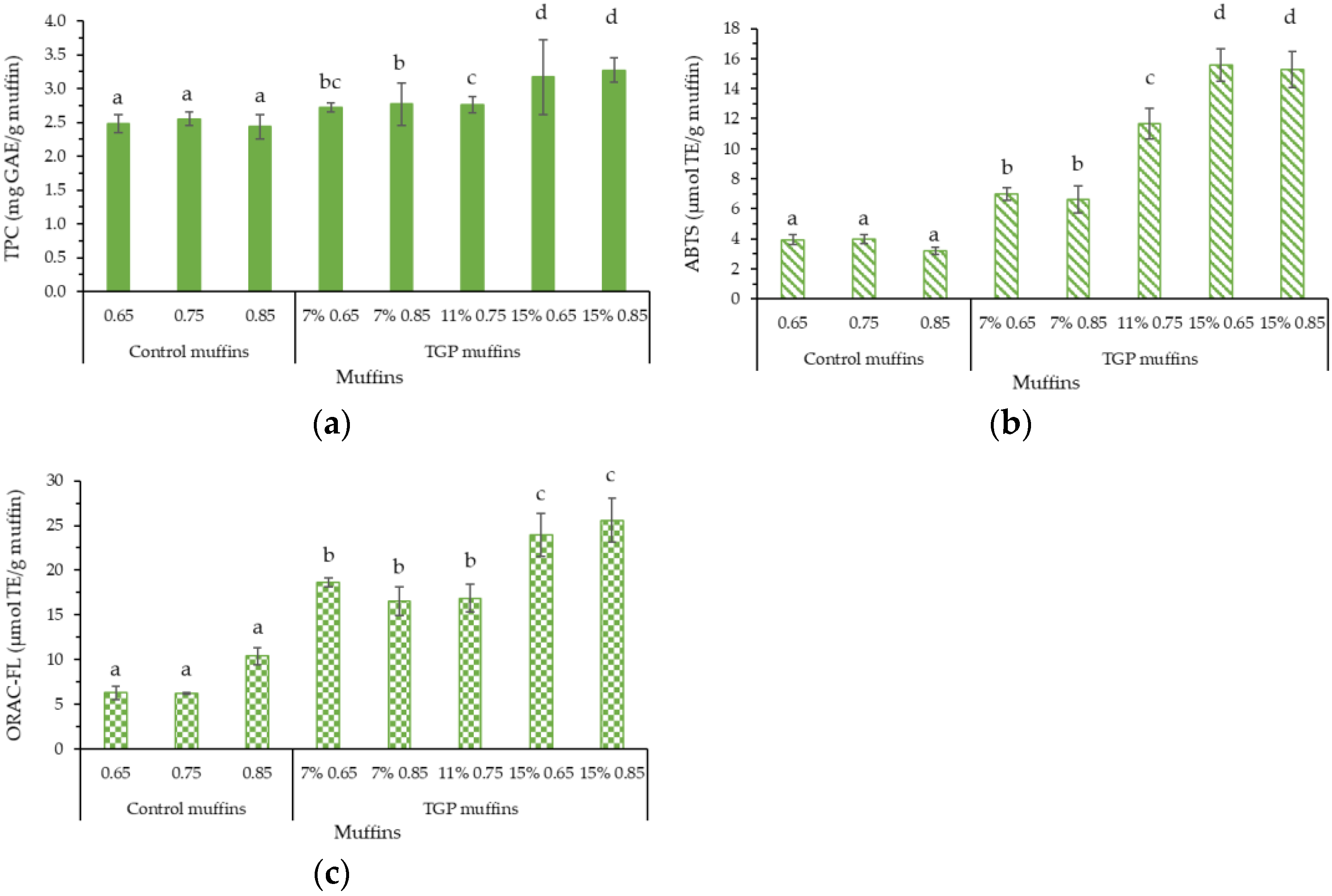
In muffins where wheat flour was partially substituted with TGP powder, both TPC and antioxidant capacity were higher than in the control muffins (without TGP) (Figure 2). These findings align with previous research reporting improved antioxidant properties in bakery products enriched with grape pomace, including muffins [15], bread, pasta [15], and biscuits [4]. The elevated antioxidant capacity in the muffins with TGP likely stems from the high concentration of phenolic compounds present in TGP, suggesting that incorporating TGP may be an effective strategy to enhance the functional profile of bakery products [7,16]. Since polyphenols can undergo conformational changes that potentially alter their biological activity during digestion, further studies are warranted to assess their bioaccessibility and bioavailability [17].
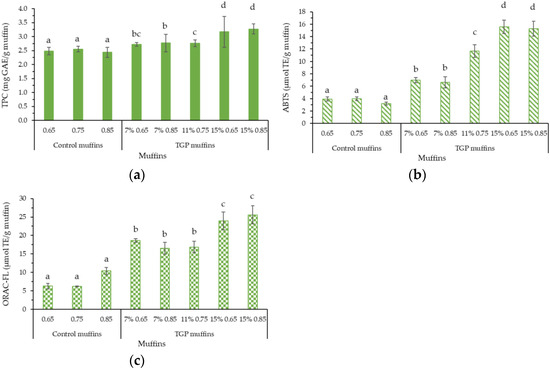
Figure 2.
Antioxidant capacity of the muffins assessed by total phenol content (a), ABTS (b), and ORAC-FL (c). Different letters indicate significant differences between samples in the same assay by Tukey test (p < 0.05). CM: control muffin; TGPM: Tannat grape pomace muffin.
4. Conclusions
In the present work, Tannat grape pomace (TGP) represented a feasible ingredient for the formulation of muffins presenting characteristic color and textural parameters. Additionally, TGP-enriched muffins demonstrated enhanced nutritional quality, with increased antioxidant capacity. Although the fiber content in the final product requires further investigation to confirm the nutritional claim, TGP, as a known source of dietary fiber, offers promising potential. The incorporation of TGP aligns with the principles of the circular economy, valorizing winemaking byproducts in a sustainable manner. Furthermore, these muffins not only represent an innovative approach to food waste reduction but also offer potential health benefits, including antioxidant effects. The incorporation of TGP in muffin formulations contributes to the application of the circular economy concept and represents a sustainable food with the potential to promote health.
Supplementary Materials
The following supporting information can be downloaded at https://www.mdpi.com/article/10.3390/blsf2024040011/s1. Poster: Development of muffins with Tannat grape pomace as potential functional foods.
Author Contributions
Conceptualization, A.M.F.-F.; methodology, V.O., J.B. and A.M.F.-F.; validation, V.O. and A.M.F.-F.; formal analysis, V.B., L.d.C., V.I., F.P., A.R., V.M., V.O. and A.M.F-F.; investigation, V.B., L.d.C., V.I., F.P., A.R., V.M., V.O., A.M. and A.M.F-F.; resources, A.M. and A.M.F-F.; data curation, A.M.F.-F.; writing—original draft preparation, A.M.F-F.; writing—review and editing, V.O., J.B., A.M. and A.M.F.-F.; visualization, A.M.F.-F.; supervision, V.O. and A.M.F.-F.; project administration, A.M.F.-F.; funding acquisition, A.M. and A.M.F.-F. All authors have read and agreed to the published version of the manuscript.
Funding
This research was funded by Agencia Nacional de Investigación e Innovación (ANII) project grant FMV_3_2020_1_162341, Programa de Apoyo a la Investigación Estudiantil (PAIE) from Comisión Sectorial de Investigación Científica (CSIC-UdelaR, Uruguay), project titled “Preparation of functional muffins using a byproduct of the wine industry”, and by PEDECIBA—Programa de Desarrollo de las Ciencias Básicas (Uruguay).
Institutional Review Board Statement
Not applicable.
Informed Consent Statement
Not applicable.
Data Availability Statement
All the results obtained in the present work are included in Section 3. Further inquiries can be directed to the corresponding author.
Acknowledgments
The authors would like to thank Bouza S.A. for providing Tannat grape pomace. The authors V.O. and J.B. wish to thank Agencia Nacional de Investigación e Innovación (ANII) for their postgraduate scholarships (POS_NAC_M_2020_1_164532 and POS_NAC_2021_1_169815, respectively).
Conflicts of Interest
The authors declare no conflicts of interest.
References
- Rodrigues, R.; Gando-Ferreira, L.; Quina, M. Increasing Value of Winery Residues through Integrated Biorefinery Processes: A Review. Molecules 2022, 27, 4709. [Google Scholar] [CrossRef] [PubMed]
- INAVI ESTADÍSTICAS DE VIÑEDOS 2022 DATOS NACIONALES. Available online: https://www.inavi.com.uy/uploads/vinedo/b001699f9585532cfd1fa06a35756544f917eda5.pdf (accessed on 12 January 2023).
- Balli, D.; Cecchi, L.; Innocenti, M.; Bellumori, M.; Mulinacci, N. Food By-Products Valorisation: Grape Pomace and Olive Pomace (Pâté) as Sources of Phenolic Compounds and Fiber for Enrichment of Tagliatelle Pasta. Food Chem. 2021, 355, 129642. [Google Scholar] [CrossRef] [PubMed]
- Olt, V.; Báez, J.; Curbelo, R.; Boido, E.; Amarillo, M.; Gámbaro, A.; Alborés, S.; Gerez García, N.; Cesio, M.V.; Heinzen, H.; et al. Tannat Grape Pomace as an Ingredient for Potential Functional Biscuits: Bioactive Compound Identification, in Vitro Bioactivity, Food Safety, and Sensory Evaluation. Front. Nutr. 2023, 10, 1241105. [Google Scholar] [CrossRef] [PubMed]
- Veronese, N.; Solmi, M.; Caruso, M.G.; Giannelli, G.; Osella, A.R.; Evangelou, E.; Maggi, S.; Fontana, L.; Stubbs, B.; Tzoulaki, I. Dietary Fiber and Health Outcomes: An Umbrella Review of Systematic Reviews and Meta-Analyses. Am. J. Clin. Nutr. 2018, 107, 436–444. [Google Scholar] [CrossRef] [PubMed]
- Fernández-Fernández, A.M.; Iriondo-DeHond, A.; Dellacassa, E.; Medrano-Fernandez, A.; del Castillo, M.D. Assessment of Antioxidant, Antidiabetic, Antiobesity, and Anti-Inflammatory Properties of a Tannat Winemaking by-Product. Eur. Food Res. Technol. 2019, 245, 1539–1551. [Google Scholar] [CrossRef]
- Rainero, G.; Bianchi, F.; Rizzi, C.; Cervini, M. Breadstick Fortification with Red Grape Pomace: Effect on Nutritional, Technological and Sensory Properties. J. Sci. Food Agric. 2022, 102, 2545–2552. [Google Scholar] [CrossRef] [PubMed]
- Nishinari, K.; Kohyama, K.; Kumagai, H.; Funami, T.; Bourne, M.C. Parameters of Texture Profile Analysis. Food Sci. Technol. Res. 2013, 19, 519–521. [Google Scholar] [CrossRef]
- Mabrouki, S.; Abid, K.; Kaihara, H.; Patrucco, S.G.; Tassone, S.; Barbera, S. Assessing Texture Profile Analysis in Natural State versus Texture Profile Analysis with Back Extrusion Post-Homogenization of Cooked Pea Protein-Based and Meat Patties: A Comparative Study. Future Foods 2024, 9, 100345. [Google Scholar] [CrossRef]
- Selvakumar, P.; Sivashanmugam, P. Studies on the Extraction of Polyphenolic Compounds from Pre-Consumer Organic Solid Waste. J. Ind. Eng. Chem. 2020, 82, 130–137. [Google Scholar] [CrossRef]
- Iuga, M.; Mironeasa, S. Potential of Grape Byproducts as Functional Ingredients in Baked Goods and Pasta. Compr. Rev. Food Sci. Food Saf. 2020, 19, 2473–2505. [Google Scholar] [CrossRef] [PubMed]
- Guiné, R.P.F. Textural Properties of Bakery Products: A Review of Instrumental and Sensory Evaluation Studies. Appl. Sci. 2022, 12, 8628. [Google Scholar] [CrossRef]
- Bender, A.B.B.; Speroni, C.S.; Salvador, P.R.; Loureiro, B.B.; Lovatto, N.M.; Goulart, F.R.; Lovatto, M.T.; Miranda, M.Z.; Silva, L.P.; Penna, N.G. Grape Pomace Skins and the Effects of Its Inclusion in the Technological Properties of Muffins. J. Culin. Sci. Technol. 2017, 15, 143–157. [Google Scholar] [CrossRef]
- Troilo, M.; Difonzo, G.; Paradiso, V.M.; Pasqualone, A.; Caponio, F. Grape Pomace as Innovative Flour for the Formulation of Functional Muffins: How Particle Size Affects the Nutritional, Textural and Sensory Properties. Foods 2022, 11, 1799. [Google Scholar] [CrossRef] [PubMed]
- Antoniolli, A.; Becerra, L.; Piccoli, P.; Fontana, A. Phenolic, Nutritional and Sensory Characteristics of Bakery Foods Formulated with Grape Pomace. Plants 2024, 13, 590. [Google Scholar] [CrossRef] [PubMed]
- Dini, I.; Grumetto, L. Recent Advances in Natural Polyphenol Research. Molecules 2022, 27, 8777. [Google Scholar] [CrossRef] [PubMed]
- Tamargo, A.; Cueva, C.; Silva, M.; Molinero, N.; Miralles, B.; Bartolomé, B.; Moreno-Arribas, M.V. Gastrointestinal Co-Digestion of Wine Polyphenols with Glucose/Whey Proteins Affects Their Bioaccessibility and Impact on Colonic Microbiota. Food Res. Int. 2022, 155, 111010. [Google Scholar] [CrossRef] [PubMed]
Disclaimer/Publisher’s Note: The statements, opinions and data contained in all publications are solely those of the individual author(s) and contributor(s) and not of MDPI and/or the editor(s). MDPI and/or the editor(s) disclaim responsibility for any injury to people or property resulting from any ideas, methods, instructions or products referred to in the content. |
© 2025 by the authors. Licensee MDPI, Basel, Switzerland. This article is an open access article distributed under the terms and conditions of the Creative Commons Attribution (CC BY) license (https://creativecommons.org/licenses/by/4.0/).