


State Nature Connectedness and Perceived Time Poverty’s Effects on Student Psychological Outcomes After Nature-Based Intervention

Abstract
1. Introduction
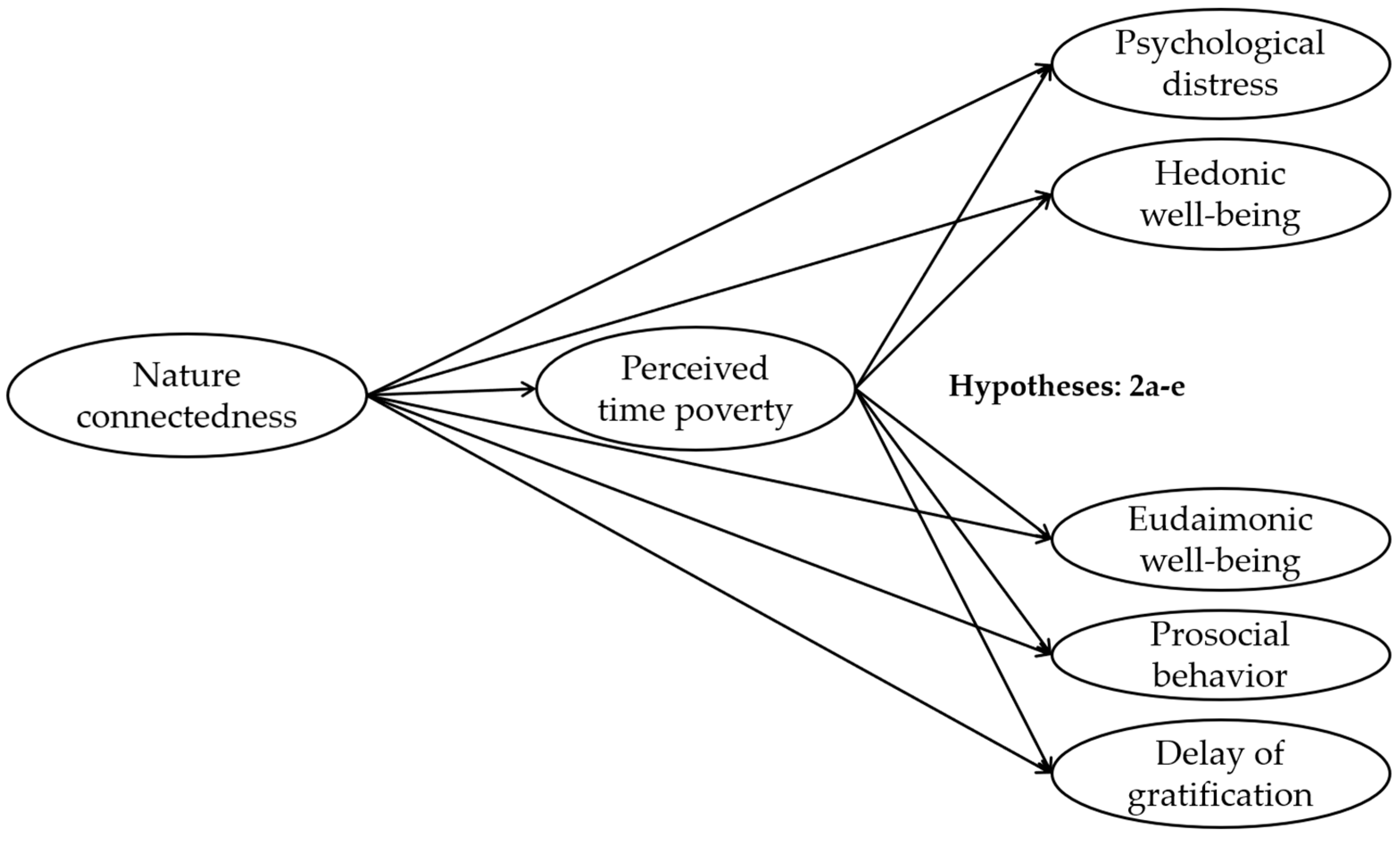
2. Theoretical Backgrounds and Hypothesis Development
2.1. Nature Connectedness, Nature-Based Interventions, and Mental Health
2.2. Perceived Time Poverty and Scarcity Theory
3. Materials and Methods
3.1. Participants and Procedures
3.2. Measurements
3.2.1. Time Perception Poverty
3.2.2. Connectedness to Nature
3.2.3. Psychological Distress
3.2.4. Hedonic Well-Being
3.2.5. Eudaimonic Well-Being
3.2.6. Prosocial Behavior Intentions (PBI) Scale
3.2.7. Academic Delay of Gratification Scale (ADOG)
3.3. Statistical Analysis
4. Results
4.1. Pre–Post and Follow-Up Change Comparison
4.2. Indirect Effect Analysis
5. Discussion
5.1. Theoretical Contributions
5.2. Practical Implications
5.3. Limitations and Future Directions
6. Conclusions
Author Contributions
Funding
Institutional Review Board Statement
Informed Consent Statement
Data Availability Statement
Acknowledgments
Conflicts of Interest
Abbreviations
| NC | Nature connectedness |
| ADOG | Academic delay of gratification |
| NBIs | Nature-based intervention |
| LMM | Linear mixed-effects models |
References
- Angelis, S., & Pensini, P. (2023). Honesty-humility predicts humanitarian prosocial behavior via social connectedness: A parallel mediation examining connectedness to community, nation, humanity, and nature. Scandinavian Journal of Psychology, 64(6), 810–818. [Google Scholar] [CrossRef]
- Bailey, D. H., Duncan, G. J., Cunha, F., Foorman, B. R., & Yeager, D. S. (2020). Persistence and fade-out of educational-intervention effects: Mechanisms and potential solutions. Psychological Science in the Public Interest, 21(2), 55–97. [Google Scholar] [CrossRef]
- Bakir-Demir, T., Berument, S. K., & Akkaya, S. (2021). Nature connectedness boosts the bright side of emotion regulation, which in turn reduces stress. Journal of Environmental Psychology, 76, 101642. [Google Scholar] [CrossRef]
- Bates, D., Mächler, M., Bolker, B., & Walker, S. (2015). Fitting linear mixed-effects models using lme4. Journal of Statistical Software, 67(1), 1–48. [Google Scholar] [CrossRef]
- Baumsteiger, R., & Siegel, J. T. (2019). Measuring prosociality: The development of a prosocial behavioral intentions scale. Journal of Personality Assessment, 101(3), 305–314. [Google Scholar] [CrossRef] [PubMed]
- Bembenutty, H., & Karabenick, S. A. (1998). Academic delay of gratification. Learning and Individual Differences, 10(4), 329–346. [Google Scholar] [CrossRef]
- Bembenutty, H., & Karabenick, S. A. (2004). Inherent association between academic delay of gratification, future time perspective, and self-regulated learning. Educational Psychology Review, 16, 35–57. [Google Scholar] [CrossRef]
- Capaldi, C. A., Dopko, R. L., & Zelenski, J. M. (2014). The relationship between nature connectedness and happiness: A meta-analysis. Frontiers in Psychology, 5, 976. [Google Scholar] [CrossRef]
- Castelo, N., White, K., & Goode, M. R. (2021). Nature promotes self-transcendence and prosocial behavior. Journal of Environmental Psychology, 76, 101639. [Google Scholar] [CrossRef]
- Cheng, L., Yu, Y., Wang, Y., & Zheng, L. (2023). Influences of mental accounting on consumption decisions: Asymmetric effect of a scarcity mindset. Frontiers in Psychology, 14, 1162916. [Google Scholar] [CrossRef]
- Choe, E. Y., Lee, J. Y., & Zhu, S. (2025). Exploring the dose-response relationship between nature-based outdoor activities, nature connectedness and social health in adolescents: A quasi-experimental controlled study. Journal of Adolescence, 97(4), 941–952. [Google Scholar] [CrossRef]
- Civai, C., Elbaek, C. T., & Capraro, V. (2024). Why scarcity can both increase and decrease prosocial behaviour: A review and theoretical framework for the complex relationship between scarcity and prosociality. Current Opinion in Psychology, 60, 101931. [Google Scholar] [CrossRef] [PubMed]
- Conway, K. M., Wladis, C., & Hachey, A. C. (2021). Time poverty and parenthood: Who has time for college? AERA Open, 7, 233285842110116. [Google Scholar] [CrossRef]
- Coventry, P. A., Brown, J. E., Pervin, J., Brabyn, S., Pateman, R., Breedvelt, J., Gilbody, S., Stancliffe, R., McEachan, R., & White, P. L. (2021). Nature-based outdoor activities for mental and physical health: Systematic review and meta-analysis. SSM—Population Health, 16, 100934. [Google Scholar] [CrossRef] [PubMed]
- Dapkus, M. A. (1985). A thematic analysis of the experience of time. Journal of Personality and Social Psychology, 49(2), 408–419. [Google Scholar] [CrossRef]
- De Bruijn, E. J., & Antonides, G. (2022). Poverty and economic decision making: A review of scarcity theory. Theory and Decision, 92, 5–37. [Google Scholar] [CrossRef]
- Diener, E. D., Emmons, R. A., Larsen, R. J., & Griffin, S. (1985). The satisfaction with life scale. Journal of Personality Assessment, 49(1), 71–75. [Google Scholar] [CrossRef]
- Droit-Volet, S., Miot, S., & Chaulet, M. (2024). Awe and time perception. Acta Psychologica, 244, 104232. [Google Scholar] [CrossRef] [PubMed]
- Forsythe, S. M., & Bailey, A. W. (1996). Shopping enjoyment, perceived time poverty, and time spent shopping. Clothing and Textiles Research Journal, 14(3), 185–191. [Google Scholar] [CrossRef]
- Furukawa, T. A., Kawakami, N., Saitoh, M., Ono, Y., Nakane, Y., Nakamura, Y., Tachimori, H., Iwata, N., Uda, H., Nakane, H., Watanabe, M., Naganuma, Y., Hata, Y., Kobayashi, M., Miyake, Y., Takeshima, T., & Kikkawa, T. (2008). The performance of the Japanese version of the K6 and K10 in the World Mental Health Survey Japan. International Journal of Methods in Psychiatric Research, 17(3), 152–158. [Google Scholar] [CrossRef]
- Giurge, L. M., Whillans, A. V., & West, C. (2020). Why time poverty matters for individuals, organisations and nations. Nature Human Behaviour, 4, 993–1003. [Google Scholar] [CrossRef]
- Griskevicius, V., & Kenrick, D. T. (2013). Fundamental motives: How evolutionary needs influence consumer behavior. Journal of Consumer Psychology, 23(3), 372–386. [Google Scholar] [CrossRef]
- Hassell, S., Moore, S. A., & Macbeth, J. (2015). Exploring the motivations, experiences and meanings of camping in national parks. Leisure Sciences, 37(3), 269–287. [Google Scholar] [CrossRef]
- Hinde, S., Bojke, L., & Coventry, P. (2021). The cost effectiveness of ecotherapy as a healthcare intervention, separating the wood from the trees. International Journal of Environmental Research and Public Health, 18(21), 11599. [Google Scholar] [CrossRef]
- Huang, L., Liu, C., & Hung, K. (2025). Understanding camping tourism experiences through thematic analysis: An embodiment perspective. Journal of Leisure Research, 56(5), 660–683. [Google Scholar] [CrossRef]
- Ibes, D. C., & Forestell, C. A. (2022). The role of campus greenspace and meditation on college students’ mood disturbance. Journal of American College Health, 70(1), 99–106. [Google Scholar] [CrossRef] [PubMed]
- Kaleta, B., Campbell, S., O’keeffe, J., & Burke, J. (2025). Nature-based interventions: A systematic review of reviews. Frontiers in Psychology, 16, 1625294. [Google Scholar] [CrossRef] [PubMed]
- Kaplan, R., & Kaplan, S. (1989). The experience of nature: A psychological perspective. Cambridge University Press. [Google Scholar]
- Kaplan, S. (1992). The restorative environment: Nature and human experience. Timber Press. [Google Scholar]
- Kessler, R. C., Andrews, G., Colpe, L. J., Hiripi, E., Mroczek, D. K., Normand, S. L., Walters, E. E., & Zaslavsky, A. M. (2002). Short screening scales to monitor population prevalences and trends in non-specific psychological distress. Psychological Medicine, 32(6), 959–976. [Google Scholar] [CrossRef]
- Keyes, C. L. (2002). The mental health continuum: From languishing to flourishing in life. Journal of Health and Social Behavior, 43(2), 207–222. [Google Scholar] [CrossRef] [PubMed]
- Kinoshita, K., Usami, S., & Matsuoka, H. (2024). Perceived event impacts of the Tokyo 2020 Olympic Games on residents’ eudaimonic well-being: A longitudinal study of within-person changes and relationships. Sport Management Review, 27(3), 455–479. [Google Scholar] [CrossRef]
- Lengieza, M. L., Swim, J. K., & Hunt, C. A. (2021). Effects of post-trip eudaimonic reflections on affect, self-transcendence and philanthropy. The Service Industries Journal, 41(15–16), 1013–1033. [Google Scholar] [CrossRef]
- Lesser, J. A., & Forsythe, S. M. (1989). Antecedents and consequences of the intrinsic motivation to shop. Psychological Reports, 64(3c), 1183–1191. [Google Scholar] [CrossRef]
- Levine, R. V. (1988). Measuring the silent language of time. In P. A. Bronstein, & K. Quina (Eds.), Teaching about culture, ethnicity, and diversity (pp. 29–34). American Psychological Association. [Google Scholar]
- Li, B., Yu, W., Hu, X., & Jin, L. (2024). The impact of subjective social class on subjective well-being: Examining the mediating roles of perceived scarcity and sense of control. Current Psychology, 43, 27327–27338. [Google Scholar] [CrossRef]
- Liu, T., Yang, X., Meng, F., & Wang, Q. (2023). Teachers who are stuck in time: Development and validation of teachers’ time poverty scale. Psychology Research and Behavior Management, 16, 2267–2281. [Google Scholar] [CrossRef]
- Lyubomirsky, S., & Lepper, H. S. (1999). A measure of subjective happiness: Preliminary reliability and construct validation. Social Indicators Research, 46, 137–155. [Google Scholar] [CrossRef]
- Martin, L., White, M. P., Hunt, A., Richardson, M., Pahl, S., & Burt, J. (2020). Nature contact, nature connectedness and associations with health, wellbeing and pro-environmental behaviours. Journal of Environmental Psychology, 68, 101389. [Google Scholar] [CrossRef]
- Mayer, F. S., & Frantz, C. M. (2004). The connectedness to nature scale: A measure of individuals’ feeling in community with nature. Journal of Environmental Psychology, 24(4), 503–515. [Google Scholar] [CrossRef]
- Mayer, F. S., Frantz, C. M., Bruehlman-Senecal, E., & Dolliver, K. (2008). Why is nature beneficial?: The role of connectedness to nature: The role of connectedness to nature. Environment and Behavior, 41(5), 607–643. [Google Scholar] [CrossRef]
- Mullainathan, S., & Shafir, E. (2013). Decision making and policy in contexts of poverty. In E. Shafir (Ed.), Behavioral foundations of public policy (pp. 281–300). Princeton University Press. [Google Scholar]
- OECD. (2024). Fiscal sustainability of health systems: How to finance more resilient health systems when money is tight? OECD Publishing. [Google Scholar] [CrossRef]
- Pretty, J., & Barton, J. (2020). Nature-based interventions and mind–body interventions: Saving public health costs whilst increasing life satisfaction and happiness. International Journal of Environmental Research and Public Health, 17(21), 7769. [Google Scholar] [CrossRef] [PubMed]
- Pritchard, A., Richardson, M., Sheffield, D., & McEwan, K. (2020). The relationship between nature connectedness and eudaimonic well-being: A meta-analysis. Journal of Happiness Studies, 21, 1145–1167. [Google Scholar] [CrossRef]
- Puhakka, R. (2021). University students’ participation in outdoor recreation and the perceived well-being effects of nature. Journal of Outdoor Recreation and Tourism, 36, 100425. [Google Scholar] [CrossRef]
- Ribeiro, H., Santana, K. V. D. S., & Oliver, S. L. (2024). Natural environments in university campuses and students’ well-being. International Journal of Environmental Research and Public Health, 21(4), 413. [Google Scholar] [CrossRef]
- Sato, S., Kinoshita, K., Kim, M., Oshimi, D., & Harada, M. (2022). The effect of Rugby World Cup 2019 on residents’ psychological well-being: A mediating role of psychological capital. Current Issues in Tourism, 25(5), 692–706. [Google Scholar] [CrossRef]
- Shanahan, D. F., Astell–Burt, T., Barber, E. A., Brymer, E., Cox, D. T. C., Dean, J., Depledge, M., Fuller, R. A., Hartig, T., Irvine, K. N., Jones, A., Kikillus, H., Lovell, R., Mitchell, R., Niemelä, J., Nieuwenhuijsen, M., Pretty, J., Townsend, M., van Heezik, Y., … Gaston, K. J. (2019). Nature-based interventions for improving health and wellbeing: The purpose, the people and the outcomes. Sports, 7(6), 141. [Google Scholar] [CrossRef] [PubMed]
- Silva, A., Matos, M., & Gonçalves, M. (2024). Nature and human well-being: A systematic review of empirical evidence from nature-based interventions. Journal of Environmental Planning and Management, 67(12), 3397–3454. [Google Scholar] [CrossRef]
- Spielvogel, B., Lubeznik-Warner, R. P., Sibthorp, J., & Browne, L. P. (2024). A national longitudinal study examining social-emotional benefits of summer camp for early adolescents: Effects of attendance, dosage, and experience quality. Journal of Leisure Research. advance online publication. [Google Scholar] [CrossRef]
- Ulrich, R. S. (1983). Aesthetic and affective response to natural environment. In I. Altman, & J. F. Wohlwill (Eds.), Behavior and the natural environment (pp. 85–125). Springer. [Google Scholar]
- Wilkie, S., & Davinson, N. (2021). Prevalence and effectiveness of nature-based interventions to impact adult health-related behaviours and outcomes: A scoping review. Landscape and Urban Planning, 214, 104166. [Google Scholar] [CrossRef]
- Wladis, C., Hachey, A. C., & Conway, K. (2023). Time poverty: A hidden factor connecting online enrollment and college outcomes? The Journal of Higher Education, 94(5), 609–637. [Google Scholar] [CrossRef]
- Wu, Y., Kinoshita, K., Zhang, Y., Kagami, R., & Sato, S. (2022). Influence of COVID-19 crisis on motivation and hiking intention of Gen Z in China: Perceived risk and coping appraisal as moderators. International Journal of Environmental Research and Public Health, 19(8), 4612. [Google Scholar] [CrossRef]
- Xu, H., Wu, Y., Zhang, Y., Kinoshita, K., & Sato, S. (2025). Investigating the psychological benefits of authentic sport event: The case of dragon boat races. Managing Sport and Leisure, 1–16. [Google Scholar] [CrossRef]
- Yamashita, R., Wu, Y., & Sato, S. (2025). How sport tourism experience influences daily pro-environmental behaviour: The role of eco-friendly reputation and personal norm. Tourism Recreation Research, 50(4), 863–875. [Google Scholar] [CrossRef]
- Yu, L., Gao, J., Kong, Y., & Huang, L. (2024). Impact of perceived scarcity on delay of gratification: Meditation effects of self-efficacy and self-control. Current Psychology, 43, 2899–2907. [Google Scholar] [CrossRef] [PubMed]
- Zhang, L., Yuan, Z., & Li, C. (2023). Prosocial decision-making under time pressure: Behavioral and neural mechanisms. Human Brain Mapping, 44(17), 6090–6104. [Google Scholar] [CrossRef]
- Zheng, X., Zhang, Q., Li, X., & Wu, B. (2022). Being busy, feeling poor: The scale development and validation of perceived time poverty. International Journal of Selection and Assessment, 30(4), 596–613. [Google Scholar] [CrossRef]

| Predictor | NC | TP | Distress | Hed | Eud | PBI | ADOG |
|---|---|---|---|---|---|---|---|
| Main Effects | |||||||
| Intercept | 4.05 (0.14) *** | 3.99 (0.19) *** | 2.09 (0.13) *** | 5.69 (0.19) *** | 5.25 (0.16) *** | 5.71 (0.14) *** | 2.60 (0.08) *** |
| TP | --- | --- | 0.20 (0.07) ** | −0.21 (0.10) * | −0.29 (0.08) *** | −0.05 (0.06) | −0.01 (0.04) |
| NC | --- | --- | 0.05 (0.09) | 0.20 (0.13) | 0.22 (0.11) | 0.13 (0.09) | 0.15 (0.05) ** |
| T2 vs. T1 | 0.98 (0.14) *** | −0.97 (0.19) *** | −0.50 (0.17) ** | −0.09 (0.24) | 0.20 (0.20) | 0.35 (0.16) * | −0.19 (0.09) * |
| T3 vs. T2 | −0.64 (0.15) *** | 0.92 (0.22) *** | 0.36 (0.16) * | −0.37 (0.24) | −0.40 (0.20) * | −0.21 (0.15) | 0.16 (0.09) |
| T3 vs. T1 | 0.34 (0.15) * | −0.04 (0.22) | −0.13 (0.14) | −0.46 (0.21) * | −0.20 (0.18) | 0.13 (0.13) | −0.03 (0.08) |
| Hypothesis | H1a | H1b | H1c | H1d | H1e | H1f | H1g |
| Indirect Effect | β | S.E. | 95% CI | ||
| NC→TP→DIS | −0.09 | 0.05 | [−0.24, −0.04] | support H2a | |
| NC→TP→HED | 0.08 | 0.05 | [0.01, 0.20] | support H2b | |
| NC→TP→EUD | 0.12 | 0.06 | [0.05, 0.27] | support H2c | |
| NC→TP→PBI | 0.04 | 0.03 | [0.01, 0.10] | support H2d | |
| NC→TP→ADOG | −0.01 | 0.02 | [−0.05, 0.02] | not support H2e | |
| Direct Effect | β | S.E. | t | p | |
| NC→DIS | 0.12 | 0.11 | 1.06 | 0.30 | |
| NC→HED | 0.01 | 0.17 | 0.01 | 0.99 | |
| NC→EUD | 0.05 | 0.14 | 0.34 | 0.73 | |
| NC→PBI | 0.21 | 0.12 | 1.86 | 0.07 | |
| NC→ADOG | 0.13 | 0.07 | 1.96 | 0.05 | |
Disclaimer/Publisher’s Note: The statements, opinions and data contained in all publications are solely those of the individual author(s) and contributor(s) and not of MDPI and/or the editor(s). MDPI and/or the editor(s) disclaim responsibility for any injury to people or property resulting from any ideas, methods, instructions or products referred to in the content. |
© 2025 by the authors. Licensee MDPI, Basel, Switzerland. This article is an open access article distributed under the terms and conditions of the Creative Commons Attribution (CC BY) license (https://creativecommons.org/licenses/by/4.0/).
Share and Cite
Wu, Y.; Sato, S. State Nature Connectedness and Perceived Time Poverty’s Effects on Student Psychological Outcomes After Nature-Based Intervention. Youth 2025, 5, 134. https://doi.org/10.3390/youth5040134
Wu Y, Sato S. State Nature Connectedness and Perceived Time Poverty’s Effects on Student Psychological Outcomes After Nature-Based Intervention. Youth. 2025; 5(4):134. https://doi.org/10.3390/youth5040134
Chicago/Turabian StyleWu, Yunfan, and Shintaro Sato. 2025. "State Nature Connectedness and Perceived Time Poverty’s Effects on Student Psychological Outcomes After Nature-Based Intervention" Youth 5, no. 4: 134. https://doi.org/10.3390/youth5040134
APA StyleWu, Y., & Sato, S. (2025). State Nature Connectedness and Perceived Time Poverty’s Effects on Student Psychological Outcomes After Nature-Based Intervention. Youth, 5(4), 134. https://doi.org/10.3390/youth5040134

