


Abstract
The AIMS-3G was developed to expand and reconceptualize previous measures and conceptualizations of athletic identity. Although the AIMS-3G has appeared in research, comprehensive tests of its validity and reliability had not extended beyond the initial work by Brewer and his colleagues. This study examined the psychometric properties of three AIMS-3G models: the unidimensional Athletic Identity Scale, the Athletic Identity Property model comprising Prominence and Self-worth Contingency components, and the Athletic Identity Process Model comprising Self-presentation and Social Reinforcement components. In total, there were 366 participants (M age = 21.52, SD = 3.68), primarily team sport athletes (n = 322, 87.98%). A smaller portion of the sample (n = 50, 13.66%) competed at the highest levels of sport, including the Olympics, World Championships, or top professional basketball leagues (e.g., the WNBA). Gender distribution was nearly equal (female n = 195, 53.28%). Participants were drawn from European women’s basketball teams and from an American university club and recreational sport teams. The university sample completed the full AIMS-3G, whereas the European women’s sample completed the four-item unidimensional scale. The results strongly supported the psychometric soundness of the four-item Athletic Identity Scale. For the Property model, reliability and factor loadings were acceptable, though confirmatory factor analysis (CFA) produced mixed fit indices. For the Process model, CFA indicated inadequate fit despite good to excellent reliability and significant factor loadings. Practical implications, limitations, and future directions were discussed in relation to Brewer and colleagues’ work and this study’s findings.
1. Introduction
Athletic identity is defined as the degree to which an individual identifies with the athlete role that influences various psychological and behavioral outcomes among athletes (Brewer et al., 1993). Brewer et al. (1993) developed an athletic identity measurement tool that gained rapid popularity in the research literature. Other iterations of the questionnaire appeared in the research literature purporting athletic identity as a multidimensional construct. Lochbaum et al.’s (2022) systematic review with meta-analyses synthesized findings from 101 studies using published athletic identity scales and iterations to test the basic propositions of the athletic identity research. Since Lochbaum et al.’s (2022) meta-analysis, Brewer et al. (2022) reconceptualized and updated the measurement of athletic identity and developed the Athletic Identity Measurement Scale 3rd Generation (AIMS-3G). Researchers have begun using the AIMS-3G, yet little confirmation of the new questionnaire has been provided and the construction of parts of the AIMS-3G has been questioned (Liu & Noh, 2024). Hence, the current study aimed to examine the psychometric properties of the AIMS-3G by conducting confirmatory factor analyses (CFAs) and reliability assessments.
1.1. Brief AIMS History
Brewer et al. (1993) brought the concept of athletic identity to prominence in the 1990s with their seminal article Athletic Identity: Hercules’ Muscles or Achilles’ Heel? In that work, they proposed that a strong athletic identity could be associated with both beneficial (desirable) and detrimental (undesirable) outcomes. These possible links, particularly the negative ones, were central to the construct’s theoretical importance. For instance, if higher levels of athletic identity relate to eating disorders, the construct gains considerable relevance. Within the same publication, Brewer and his team also presented validation evidence for what they termed the Athletic Identity Measurement Scale (AIMS). The initial version of the AIMS comprised 10 items and was conceptualized as unidimensional. Shortly thereafter, researchers advanced a multidimensional interpretation of the scale, identifying four subscales: social identity, self-identity, negative affectivity, and exclusivity (Martin et al., 1995, 1997). Later, Brewer and Cornelius (2001) revised the original 10-item measure, retaining three subscales, social identity, exclusivity, and negative affectivity, while omitting 3 items (the self-identity questions) due to poor statistical support.
These two questionnaires resulted in a substantial body of research as evidenced by Lochbaum et al.’s (2022) meta-analyses of 101 studies using one of the first two published athletic identity scales to test the basic propositions of the athletic identity research. The quantitative review supported that higher athletic engagement leads to a stronger athletic identity, with elite athletes (i.e., professionals, Olympic participation) showing higher AIMS scores compared to lower-level athletes. Furthermore, Lochbaum et al. (2022) reported that athletic identity was linked to both beneficial factors, such as intrinsic motivation and commitment, and, to a lesser extent, detrimental factors like negative emotions. This review confirmed the core propositions of Brewer et al. (1993). The review also highlighted the lack of AIMS subscale data reporting, recommending future research provided data on these subscales. However, now that the AIMS-3G is in the literature, perhaps the past AIMS subscales will eventually be obsolete.
1.2. AIMS-3G
Brewer et al. (2022) published a lengthy multi-study publication on the development and validation of the AIMS-3G, what they considered an updated tool designed to clarify and assess the complex concept of athletic identity, providing a more nuanced understanding of how individuals define themselves through their athletic role and how this self-definition impacts their lives. In short, Brewer and colleagues sought to improve upon the earlier versions of the scale by distinguishing athletic identity itself from related properties, titled Prominence and Self-worth Contingency, and processes, titled Self-presentation and Social Reinforcement. Through rigorous psychometric testing on various college athlete samples, they established the AIMS-3G as a reliable and valid measure with a unidimensional scale for core athletic identity and separate subscales for its properties, defined by Brewer et al. (2018, p. 155) as “descriptive characteristics of athletic identity” and processes as “dynamic elements that act upon and produce systematic changes in athletic identity.” However, Liu and Noh (2024) questioned the development of the two models with the four new subscales: Prominence, Self-worth Contingency, Self-presentation, and Social Reinforcement. Specifically, they stated that the AIMS-3G did not adhere to “contemporary best practices” (Liu & Noh, 2024, p. 3) such as the items originating from past measures and a lack of assessing the reading level or item difficulty before testing the questions with samples. Thus, they concluded that “the efficacy of the athletic identity properties and athletic identity processes constructs remains to be determined.”
In a search of the AIMS-3G in the literature, it is apparent that the AIMS-3G is being used in theses (Milowsky, 2025; Monsen, 2025) and peer-reviewed publications (Liu & Noh, 2024; Russell, 2025) though a search by this research team of the AIMS literature demonstrates a substantial increase since Lochbaum’s meta-analysis in athletic identity research. If the AIMS-3G takes hold and Liu and Noh’s (2024) criticisms are accurate, then more psychometric research is needed.
1.3. Research Questions
This study investigated three research questions: (1) the validity and reliability of the Athletic Identity Scale; (2) the validity and reliability of the Athletic Identity Property model comprising Prominence and Self-worth Contingency components; and (3) the validity and reliability of the Athletic Identity Processed model comprising Self-presentation and Social Reinforcement components.
2. Materials and Methods
2.1. Participants and Procedure
Across the two data collections, 366 participants (n = 235, 64.20% from the university-based collection) with an average age of 21.52 (SD = 3.68) submitted a survey. The split of selected genders was nearly equal (female n = 195, 53.28%). Team sports (n = 322, 87.98%) were the vast majority of participants with basketball (n = 134, 36.61%) along with soccer (n = 55, 15.03%) and rugby (n = 37, 10.11%) both being more than 10% of the total sample. As for level of sport, 68.58% were not professional athletes (n = 251). A small portion of the sample indicated playing in the very upper level (n = 50, 13.66%) of sport such as having played in the Olympics, World Championships, or the highest professional leagues in their sport (e.g., the WNBA).
The survey was approved by the lead author’s institution. To ensure each participant was aware of the approval, at the beginning of the anonymous web-based questionnaire, the approved human subject approval from the first author’s university was stated. By completing the questionnaire, participants provided their consent. There were two data collections, one being at a university and the other across Europe focused on female professional basketball players. In the European-focused data collection, participants were asked about their birth country. These participants were from five continents as follows: Africa (Egypt), Asia (Indonesia), Europe (Austria, Belarus, Cyprus, Estonia, Finland, France, Germany, Hungary, Ireland, Latvia, Lithuania, Luxembourg, The Netherlands, Poland, Portugal, Romania, Serbia, Slovenia, Sweden, Ukraine), North America (Canada, USA), and South America (Brazil).
Both data sets presented in this investigation are part of ongoing data collections with well-being and thoughts of success variables in athletes. In the university-focused data collection, participants completed the entire AIMS-3G whereas in the European data collection, participants completed only the unidimensional athletic identity items as the focus on this investigation was athletic identity-focused and not focused specifically on validating the AIMS-3G. Across the different data collection sites, the research team presented the web-based link or corresponding QR code via personal interactions, social media outlets, and posted information sheets at various locations such as practice facilities. As this was anonymous, we did not collect information on how many potential participants were possibly exposed to the recruitment efforts.
2.2. Measures
As part of the survey, the following demographic characteristics were collected: current biological age, sex (male, female, or prefer not to report); sport type (participants wrote in participants’ sport); and sport level (participants chose from several options such as professional, university, or club). Sport type was categorized by the research team as being individual or team in nature.
The AIMS-3G developed by Brewer et al. (2022) measures athletic identity, athletic identity properties measured by two subscales titled Prominence and Self-worth Contingency, and athletic identity processes measured by two subscales titled Self-presentation and Social Reinforcement. The unidimensional athletic identity (e.g., “I would consider myself an athlete.”), Self-worth Contingency (e.g., How I feel about myself depends a lot on how I perform as an athlete.”), Self-presentation (e.g., “When I meet someone new, I introduce myself as an athlete.”), and Social Reinforcement (e.g., “My family and friends are very willing to accommodate my involvement in sport.”) scales contain 4 items each whereas the Prominence scale (e.g., “My life revolves around sport participation.”) contains 5 items. All the AIMS-3G questions are scored on a 7-point Likert-type scale ranging from strongly disagree (1) to strongly agree (7). The questionnaire items from Brewer et al. (2022) with appropriate numbering to correspond to this publication are located in Table S1.
2.3. Sample Size
Factor analysis requires a large sample size to construct repeatable and reliable factors. A variety of authors suggest different benchmarks to determine sufficient sample size for CFA. Some authors use benchmarks based on overall sample size (Tabachnick & Fidell, 2013; Comrey & Lee, 2013). Other authors use the ratio (N:q) of overall sample size to the number of free parameter estimates included in the model. Kline (2015) recommends that the N:q ratio should be about 20 to 1 whereas Schreiber et al. (2006) suggest that the consensus for a sufficient N:q ratio is 10:1. All analyses were above or nearly the 20 to 1 ratio.
2.4. Data Analysis Plan
All analyses and resulting generative output were from Intellectus Statistics (2025). Descriptive statistics including skewness and kurtosis were calculated for each of the AIMS-3G questionnaire items and summed scale scores. For each scale, the Cronbach’s alpha coefficient was evaluated using the guidelines suggested by George and Mallery (2018) where >0.9 excellent, >0.8 good, >0.7 acceptable, >0.6 questionable, >0.5 poor, and ≤0.5 unacceptable. A Pearson correlation analysis was conducted among the AIMS-3G scales. Cohen’s standard was used to evaluate the strength of the relationships, where coefficients between 0.10 and 0.29 represent a small effect size, coefficients between 0.30 and 0.49 represent a moderate effect size, and coefficients above 0.50 indicate a large effect size (Cohen, 1988). The result of the correlations was examined using the Bonferroni correction to adjust for multiple comparisons based on an alpha value of 0.05.
Although variables should be correlated with one another to be considered suitable for factorization, variables that are too highly correlated can cause problems in CFA. To assess multicollinearity, the squared multiple correlations were inspected and the determinant of the correlation matrix was calculated. Any variable with an R2 > 0.90 can contribute to multicollinearity in the CFA model (Kline, 2015). Variables that exhibit high multicollinearity should either be removed from the analysis or combined as a composite variable. There were no variables that had an R2 > 0.90. Another assessment for multicollinearity is to assess the determinant of the data’s correlation matrix. A determinant that is ≤ 0.00001 indicates that multicollinearity exists in the data (Field, 2017).
CFA models were conducted to determine whether the latent variables adequately described the data. Bootstrapping was performed using a maximum of 100 iterations to determine the standard errors for the parameter estimates. For each CFA, influential points were identified in the data by calculating Mahalanobis distances and comparing them with the quantiles of a χ2 distribution (Newton & Rudestam, 2013). An outlier was defined as any Mahalanobis distance that exceeds 18.47, the 0.999 quantile of a χ2 distribution with 4 degrees of freedom (Kline, 2015). There are a variety of ways to measure if the CFA model adequately describes the data (Hooper et al., 2008). The “good” or “fit well” fit indices interpretation guidelines were as follows: NFI greater than or equal to 0.95; TLI was greater than or equal to 0.95, CFI greater than 0.95; RMSEA index less than 0.08; and SRMR was between 0.05 and 0.08. The Chi-square statistic is the most popular statistic used to measure model fit. In addition to the Chi-square statistic, fit indices are also used to help researchers determine if the factor analysis model fits the data properly. Along with the Chi-square goodness-of-fit test, the following fit indices were used to assess the model fit: Bentler–Bonett normed fit index (NFI), Tucker–Lewis index (TLI), comparative fit index (CFI), root mean square error of approximation (RMSEA), and standardized root mean square residual (SRMR). The individual relationship between each indicator variable and latent variable can be assessed by the observed variable’s R2 value. The R2 value identifies how much of the indicator variable’s variance explains the factor. An R2 value ≤ 0.20 suggests that the observed variable does not adequately describe the factor and should be considered for removal from the model (Hooper et al., 2008).
3. Results
3.1. Descriptive Statistics.
Table 1 contains the summary statistics for each AIMS-3G questionnaire. Only the first Athletic Identity question, “I would describe myself as an athlete”, had a skewness value greater than 2 in absolute value. Given the sample was athletes, it is logical that this variable was asymmetrical about its mean value. The Prominence and Self-presentation total scores fell below the “Mixed or neither agree nor disagree” option and above “Slight disagree” while the other scales averaged between “Slightly Agree” and “Agree” on the Likert scale.
Table 1.
Summary statistics for the AIMS-3G questionnaire.
A Cronbach alpha coefficient was calculated for each of the AIMS-3G scales. The scales ranged from acceptable to excellent. The results for each scale are found in Table 2 along with the correlations among the AIMS-3G scale scores. The correlations ranged from small to large in meaningfulness.
Table 2.
Bootstrapped (1000 resamples) Pearson correlation matrix of the AIMS-3G scales with 95% confidence intervals with Cronbach’s alpha coefficients on the diagonals.
3.2. CFA
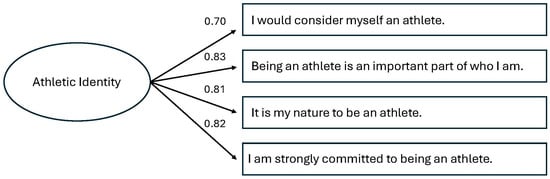
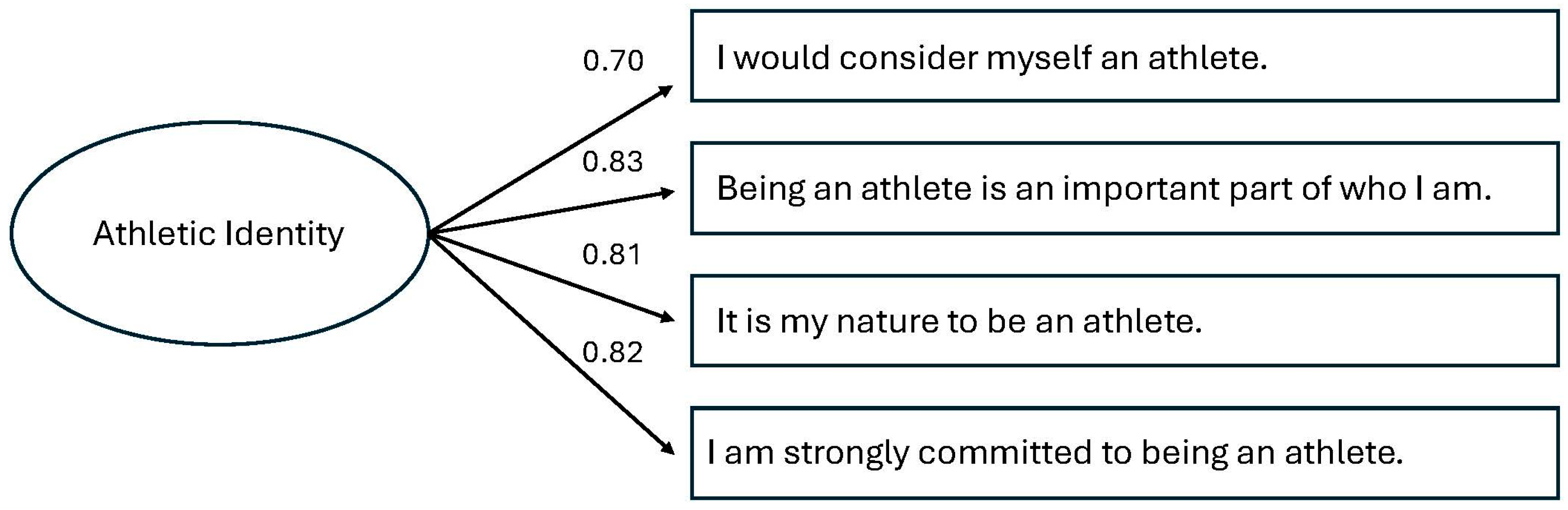
For the Athletic Identity Scale, there were 17 observations detected as outliers. There were no variables that had an R2 > 0.90 and the value of the determinant for the correlation matrix was 0.15, indicating that there was no multicollinearity in the data. The results of the CFA model are presented in Figure 1, Table 3 and Table S2. The results for each fit statistic (NFI, TLI, CFI, RMSEA, and SRMR) met or exceeded the “good fit” or “fit the data well” guidelines (Hooper et al., 2008). The results of the Chi-square goodness-of-fit test were not significant, χ2(2) = 4.22, p = 0.121, suggesting that the model fit the data well. Lastly, there were no observed variables with R2 values ≤ 0.20. The R2 values, along with the error variances for each observed variable, are presented in Supplementary Table S3.
Figure 1.
Factor loadings of the Athletic Identity Scale questions.
Table 3.
Fit indices for the CFA model.
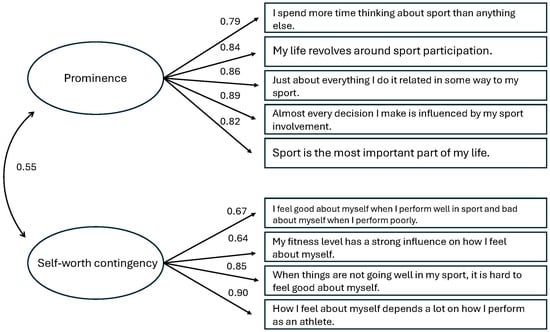
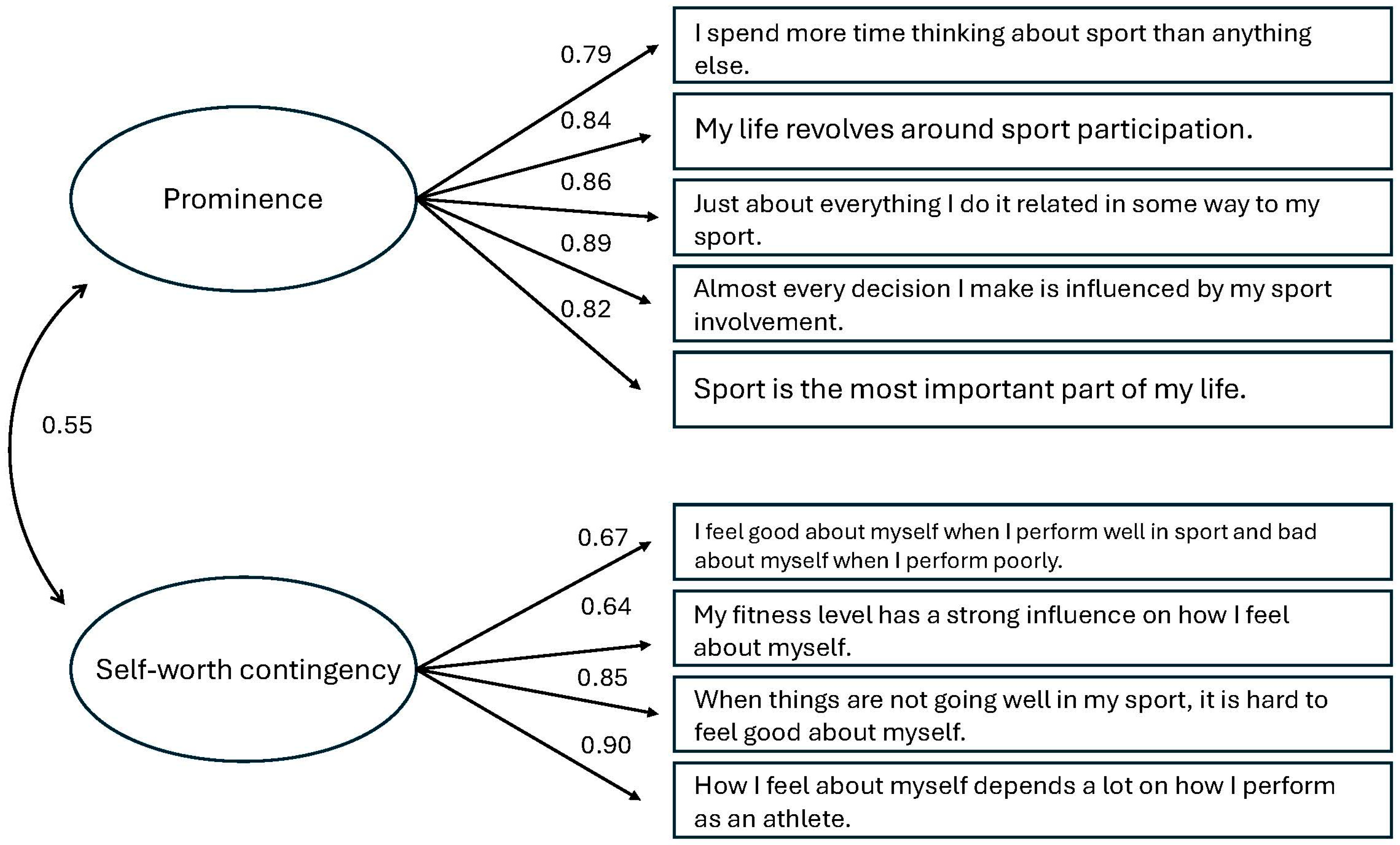
For the Athletic Identity Properties model, there were five observations detected as outliers. There were no variables that had an R2 > 0.90 and the value of the determinant for the correlation matrix was 0.002, indicating that there was no multicollinearity in the data. The results of the CFA model are presented in Figure 2, Table 3 and Table S2. The fit statistics ranged in interpretation from “fit the data adequately” to “poor” (Hooper et al., 2008). The results of the Chi-square goodness-of-fit test were significant, χ2(26) = 142.73, p < 0.001, suggesting that the model did not adequately fit the data. Lastly, there were no observed variables with R2 values ≤ 0.20. The R2 values, along with the error variances for each observed variable, are presented in Supplementary Table S3.
Figure 2.
Factor loadings of the Prominence and Self-worth Contingency scale items and correlation between the two factors.
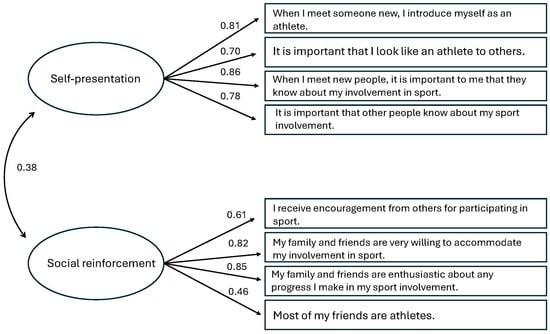
For the Athletic Identity Processes model, there were four observations detected as outliers. There were no variables that had an R2 > 0.90 and the value of the determinant for the correlation matrix was 0.03, indicating that there was no multicollinearity in the data. The results of the CFA model are presented in Figure 3, Table 3 and Table S2. The fit statistics were all “poor” (Hooper et al., 2008). The results of the Chi-square goodness-of-fit test were significant, χ2(19) = 78.89, p < 0.001, suggesting that the model did not adequately fit the data. There were no observed variables with R2 values ≤ 0.20. The R2 values, along with the error variances for each observed variable, are presented in Table S3.
Figure 3.
Factor loadings of the Self-presentation and Social Reinforcement scale items and correlation between the two factors.
4. Discussion
The current study aimed to examine the psychometric properties of the unidimensional Athletic Identity Scale and its components, addressing the validity of the measurement models through CFA and reliability assessments. The findings provide important insights into the psychometric properties of these measurement models and contribute to our understanding of how athletic identity is structured and assessed by Brewer et al.’s (2022) AIMS-3G. This discussion synthesizes the key findings in relation to Brewer and colleagues’ findings and the existing but very limited AIMS-3G literature, examines the current findings along with practical implications, study limitations, and suggests directions for future research.
4.1. Interpretation of Findings
The findings from this study offer implications for our understanding of athletic identity. Firstly, the robust psychometric properties of the unidimensional Athletic Identity Scale support the continued conceptualization of athletic identity as a coherent psychological construct that can be confidently measured based on results from Brewer et al. (2022), Liu and Noh (2024), and this study. These findings align with the foundational work by Brewer et al. (1993), who initially defined athletic identity as the degree to which an individual identifies with the athlete role and looks to others for acknowledgment of that role. However, the mixed findings regarding the two component models, as Brewer and colleagues did report sufficient model fit whereas our data did not fully match those results, suggest that athletic identity may be either more complex or not as Brewer et al. (2022) envisioned. Liu and Noh (2024) suggested that the process of item development by Brewer et al. (2022) was flawed and both models require more work.
We believe that it is important to note that the distinction between the property aspects (Prominence and Self-worth Contingency) and process aspects (Self-presentation and Social Reinforcement) of athletic identity potentially represent advancements as defined (Brewer et al., 2018) and proposed in the AIMS-3G (Brewer et al., 2022). These differentiations are consistent with a variety of identity theories that distinguish between the content of identities and the processes by which they are formed and maintained (e.g., Burke & Stets, 2009) and the importance of such processes across an athlete’s life (e.g., Haslam et al., 2021). As discussed in the practical implications, the subscales themselves might be of particular interest and use in the applied settings regardless of the mostly poor CFA model results.
4.2. Practical Implications
The findings from this study have several practical implications for coaches, sport psychologists, and other professionals working with athletes. Firstly, the strong psychometric properties of the Athletic Identity Scale suggest that it can be used as a reliable screening tool in applied settings to assess the degree to which individuals identify with the athlete role. This brief measure could be valuable for identifying athletes who strongly identify with their athletic role and may therefore be at risk of identity-related challenges such as difficulty with sport transitions, career-ending injuries, depression and anxiety, or self-medication (Bursik et al., 2024; Clark et al., 2025; Giannone et al., 2017; Park et al., 2013; Smith & Hardin, 2018). Athletic identity is also and importantly related to motivation and positive mood states and thus could be used to help predict or better understand athletes (Lochbaum et al., 2022).
Though the two component models lacked full CFA support, it does not mean that the subscales are not of potential value. For instance, the high reliability of the Prominence scale suggests that this measure could be particularly useful in applied settings for identifying athletes for whom sport is a central component of their identity and might be at greater risk of psychological distress with career transition or setbacks such as suboptimal performances. Similarly, the good reliability of the Self-worth Contingency scale indicates its potential utility in identifying athletes whose self-esteem is highly dependent on athletic performance. Practitioners could use this scale to identify athletes who might benefit from interventions aimed at developing non-contingent self-worth and multiple sources of self-esteem. The same could be said about using the two subscales from the processes model: Self-presentation and Social Reinforcement.
The subscales themselves might be useful in future athletic identity or other similar types of research. However, the factor loading statistics for two of the Self-worth Contingency scales and two of the Social Reinforcement scales seem low and problematic. The current study did not attempt to modify the AIMS-3G via eliminating questions or proposing new questions. It does seem based on a review of some of the questions that loaded less than 0.70 that they might be misplaced. For instance, the Self-worth Contingency items mix fitness level in within clearly performance-based questions. In addition, one of the statements with less than a 0.70 included two possible scenarios, performing well and performing poorly. Apparently more problematic based on factor loading statistics are two of the Social Reinforcement questions. Perhaps the confusion comes from Social Reinforcement being a mix of encouragement, accommodation, enthusiasm, and then from “Most of my friends are athletes.”
4.3. Limitations
Despite the valuable insights provided by this study, limitations should be acknowledged when interpreting the findings. Firstly, the study relied exclusively on self-report measures, which may be subject to social desirability bias and limited by participants’ self-awareness. This limitation is particularly relevant for constructs like athletic identity that carry social value and may be influenced by self-presentation concerns. As noted by Podsakoff et al. (2003), common method variance can inflate correlations between constructs measured using the same method, which may have affected the correlations observed between the athletic identity components. Additionally, as a limitation, the cross-sectional nature of the study precludes causal inferences about the relationships between different aspects of athletic identity. While the structural models propose theoretical relationships between constructs, the temporal ordering and causal dynamics cannot be determined from the current data. Longitudinal research would be necessary to examine how different aspects of athletic identity develop and influence each other over time, as highlighted by Ronkainen et al. (2016) in their review of athletic identity research and stressed by Lochbaum et al. (2022) based on the 101 reviewed studies.
4.4. Conclusions and Future Directions
Athletic identity research is much studied (Lochbaum et al., 2022) and appears to be expanding (Lochbaum & Yehle, 2025). This study provides important insights into the psychometric properties of the AIMS-3G and its component models. The findings demonstrate that the unidimensional Athletic Identity Scale possesses excellent validity and reliability, supporting its use as an efficient measure of athletic identity. The component models examining the property aspects (Prominence and Self-worth Contingency) and process aspects (Self-presentation and Social Reinforcement) of athletic identity showed good to excellent reliability at the scale level but overall poor fit indices.
Moving forward, future research could build on the Athletic Identity Scale findings by examining the longitudinal development of athletic identity, examining the predictive ability of athletic identity to well-being and performance, and exploring measurement invariance across diverse athletic populations. For the two models, testing alternative model specifications or questions or both appears the next steps in better understanding whether the AIMS-3G as proposed by Brewer et al. (2022) is an improvement over the past iterations of the original AIMS. Via meta-analytic summary (Lochbaum et al., 2022), the past AIMS measures discriminated between athlete levels and related with correlates as conceptualized. In summary, researchers should continue to investigate the AIMS-3G to advance our understanding of athletic identity in athletes’ development, well-being, and performance while further refining the Property and Process models.
Supplementary Materials
The following supporting information can be downloaded at: https://www.mdpi.com/article/10.3390/youth5040133/s1, Table S1. AIMS-3G items. Table S2. Unstandardized loadings (Standard Errors), standardized loadings, and significance levels for each parameter in the CFA models. Table S3. Estimated error variances and R2 values for each indicator variable in the CFA model.
Author Contributions
Conceptualization, M.L. and D.P.; methodology, M.L. and D.P.; software, M.L.; formal analysis, M.L.; investigation, M.L., D.P., K.Y., S.P.-A. and H.W.; data curation, M.L., D.P., K.Y., S.P.-A. and H.W.; writing—original draft preparation, M.L.; writing—review and editing, M.L., D.P., K.Y., S.P.-A. and H.W.; supervision, M.L.; project administration, M.L. All authors have read and agreed to the published version of the manuscript.
Funding
This research received no external funding.
Institutional Review Board Statement
The study was conducted in accordance with the Declaration of Helsinki and approved by the Institutional Review Board at Texas Tech University (protocol code IRB2024-71, 26 February 2024) as an anonymous survey not requiring participants to sign informed consent paperwork.
Informed Consent Statement
By the potential participant submitting the anonymous questionnaire, informed consent was obtained from all subjects involved in the study.
Data Availability Statement
The data are available from M.L.
Acknowledgments
During the preparation of this manuscript/study, the authors used Intellectus Statistics for the purposes of generating results and discussion points. The authors have reviewed and edited the output and take full responsibility for the content of this publication.
Conflicts of Interest
The authors declare no conflicts of interest.
References
- Brewer, B. W., & Cornelius, A. E. (2001). Norms and factorial invariance of the athletic identity measurement scale (AIMS). Academic Athletic Journal, 16, 103–113. [Google Scholar]
- Brewer, B. W., Petitpas, A. J., & Van Raalte, J. L. (2018). Self-identity and young athletes. In C. J. Knight, C. G. Harwood, & D. Gould (Eds.), Sport psychology for young athletes (pp. 153–163). Routledge. [Google Scholar]
- Brewer, B. W., Van Raalte, J. L., Cornelius, A. E., & Pans Sancho, M. À. (2022). Third-generation quantitative assessment of athletic identity: Clarifying the concept. International Journal of Sport Psychology, 53, 434–458. [Google Scholar] [CrossRef]
- Brewer, B. W., Van Raalte, J. L., & Linder, D. E. (1993). Athletic identity: Hercules’ muscles or Achilles heel? International Journal of Sport Psychology, 24, 237–254. [Google Scholar]
- Burke, P. J., & Stets, J. E. (2009). Identity theory. Oxford University Press. [Google Scholar]
- Bursik, J., John, J. M., Mayer, J., Thiel, A., & Kühnle, F. (2024). Risk profiles for self-medication with analgesics among elite German handball players. International Review for the Sociology of Sport, 60(4), 611–633. [Google Scholar] [CrossRef] [Scilit]
- Clark, V. C., Ulman, S. M., Erdman, A. L., Gale, E. B., Janosky, J., & Stapleton, E. J. (2025). Athletic identity, anxiety, and depression in moderate to highly specialized female adolescent volleyball players. Frontiers in Psychology, 16, 1525074. [Google Scholar] [CrossRef] [Scilit] [PubMed]
- Cohen, J. (1988). Statistical power analysis for the behavior sciences (2nd ed.). West Publishing Company. [Google Scholar]
- Comrey, A. L., & Lee, H. B. (2013). A first course in factor analysis. Psychology Press. [Google Scholar] [CrossRef] [Scilit]
- Field, A. (2017). Discovering statistics using IBM SPSS statistics: North American edition. Sage Publications. [Google Scholar]
- George, D., & Mallery, P. (2018). Descriptive statistics. In IBM SPSS statistics 25 step by step (pp. 126–134). Routledge. [Google Scholar]
- Giannone, Z. A., Haney, C. J., Kealy, D., & Ogrodniczuk, J. S. (2017). Athletic identity and psychiatric symptoms following retirement from varsity sports. International Journal of Social Psychiatry, 63(7), 598–601. [Google Scholar] [CrossRef] [Scilit] [PubMed]
- Haslam, C., Lam, B. C. P., Yang, J., Steffens, N. K., Haslam, S. A., Cruwys, T., Boen, F., Mertens, N., De Brandt, K., Wang, X., Mallett, C. J., & Fransen, K. (2021). When the final whistle blows: Social identity pathways support mental health and life satisfaction after retirement from competitive sport. Psychology of Sport and Exercise, 57, 102049. [Google Scholar] [CrossRef] [Scilit]
- Hooper, D., Coughlan, J., & Mullen, M. (2008). Structural equation modelling: Guidelines for determining model fit. Electronic Journal of Business Research Methods, 6(1), 53–60. [Google Scholar]
- Intellectus Statistics. (2025). Intellectus statistics [Online computer software]. Available online: https://statistics.intellectus360.com (accessed on 1 October 2025).
- Kline, P. (2015). A handbook of test construction (psychology revivals): Introduction to psychometric design. Routledge. [Google Scholar]
- Liu, S., & Noh, Y.-E. (2024). Beyond physical recovery: Investigating athletic identity as a mediator between social support and psychological readiness for return to sport. Australian Journal of Psychology, 76(1). [Google Scholar] [CrossRef] [Scilit] [PubMed]
- Lochbaum, M., Cooper, S., & Limp, S. (2022). The athletic identity measurement scale: A systematic review with meta-analysis from 1993 to 2021. European Journal of Investigation in Health, Psychology and Education, 12(9), 1391–1414. [Google Scholar] [CrossRef] [Scilit] [PubMed]
- Lochbaum, M., & Yehle, K. (2025). Athletic identity: A substantial update of Lochbaum et al. (2022) [Manuscript in preparation]. Department of Kinesiology and Sport Management, Texas Tech University. [Google Scholar]
- Martin, J. J., Adams-Mushett, C., & Smith, K. L. (1995). Athletic identity and sport orientation of adolescent swimmers with disabilities. Adapted Physical Activity Quarterly, 12(2), 113–123. [Google Scholar] [CrossRef] [Scilit]
- Martin, J. J., Eklund, R. C., & Mushett, C. A. (1997). Factor structure of the athletic identity measurement scale with athletes with disabilities. Adapted Physical Activity Quarterly, 14(1), 74–82. [Google Scholar] [CrossRef] [Scilit]
- Milowsky, A. (2025). Amateur athletes’ psychological experiences of participation-altering and participation-ending injuries [Doctoral dissertation, The University of Memphis]. [Google Scholar]
- Monsen, E. (2025). Når drakten legges bort [Master’s thesis, UiT The Arctic University of Norway]. [Google Scholar]
- Newton, R., & Rudestam, K. (2013). The bigger picture. In Your statistical consultant: Answers to your data analysis questions (2nd ed., pp. 315–332). SAGE Publications, Ltd. [Google Scholar] [CrossRef] [Scilit]
- Park, S., Lavallee, D., & Tod, D. (2013). Athletes’ career transition out of sport: A systematic review. International Review of Sport and Exercise Psychology, 6(1), 22–53. [Google Scholar] [CrossRef] [Scilit]
- Podsakoff, P. M., MacKenzie, S. B., Lee, J. Y., & Podsakoff, N. P. (2003). Common method biases in behavioral research: A critical review of the literature and recommended remedies. Journal of Applied Psychology, 88(5), 879–903. [Google Scholar] [CrossRef] [Scilit] [PubMed]
- Ronkainen, N. J., Kavoura, A., & Ryba, T. V. (2016). A meta-study of athletic identity research in sport psychology: Current status and future directions. International Review of Sport and Exercise Psychology, 9(1), 45–64. [Google Scholar] [CrossRef] [Scilit]
- Russell, W. (2025). The role of athletic identity and sport motivation in collegiate eSport burnout. Journal of Amateur Sport, 11(1). [Google Scholar] [CrossRef] [Scilit]
- Schreiber, J. B., Nora, A., Stage, F. K., Barlow, E. A., & King, J. (2006). Reporting structural equation modeling and confirmatory factor analysis results: A review. The Journal of Educational Research, 99(6), 323–338. [Google Scholar] [CrossRef] [Scilit]
- Smith, A. B., & Hardin, R. (2018). Female student-athletes’ transition out of collegiate competition. Journal of Amateur Sport, 4(2), 61–86. [Google Scholar] [CrossRef] [Scilit]
- Tabachnick, B. G., & Fidell, L. S. (2013). Using multivariate statistics (6th ed.). Pearson. [Google Scholar]

Disclaimer/Publisher’s Note: The statements, opinions and data contained in all publications are solely those of the individual author(s) and contributor(s) and not of MDPI and/or the editor(s). MDPI and/or the editor(s) disclaim responsibility for any injury to people or property resulting from any ideas, methods, instructions or products referred to in the content. |
© 2025 by the authors. Licensee MDPI, Basel, Switzerland. This article is an open access article distributed under the terms and conditions of the Creative Commons Attribution (CC BY) license (https://creativecommons.org/licenses/by/4.0/).