Article

Validation of the Positive Eating Scale in Chinese University Students and Its Associations with Mental Health and Eating Behaviors

Department of Nutrition Science & Food Hygiene, Xiangya School of Public Health, Changsha 410013, China
*
Author to whom correspondence should be addressed.
These authors contributed equally to this work.
Youth 2025, 5(4), 135; https://doi.org/10.3390/youth5040135
Submission received: 3 November 2025 / Revised: 12 December 2025 / Accepted: 16 December 2025 / Published: 18 December 2025

Abstract

Positive eating behaviors may be linked to improved health outcomes, but reliable assessment tools are scarce. This study aims to translate the Positive Eating Scale (PES) into Chinese (PES-C), culturally adapt it, and examine its psychometric properties and its relationship with psychological symptoms among Chinese college students. A two-stage cross-sectional study was conducted from October 2024 to April 2025. A total of 800 valid questionnaires were collected in Stage 1 and 1882 in Stage 2. PES-C showed good structural validity (CFI = 0.991, RMSEA = 0.067) and high internal agreement (Cronbach α = 0.963), with measurement invariance established across gender and ethnicity. Correlation analysis showed that PES-C score was significantly negatively correlated with depression (PHQ-9, r = −0.24) and anxiety (GAD-7, r = −0.22), positively correlated with the frequency of vegetable consumption (r = 0.13–0.18), and negatively correlated with beverage consumption (r = −0.01–−0.17). These findings indicate that positive eating attitudes help improve psychological symptoms and may also affect food choices. PES-C is a dependable and effective tool for assessing the eating behaviors of Chinese university students, offering both theoretical and practical support for campus nutrition and mental health promotion programs.

1. Introduction

Mental health issues among university students have increased worldwide, with depression and anxiety affecting 33.6% and 39.0% of students, respectively (W. Z. Li et al., 2022). Simultaneously, unhealthy eating habits—especially the regular intake of energy-dense, nutrient-poor foods and beverages—have become more common and are linked to both physical and mental health risks (Pouyfung et al., 2025). This trend is particularly salient in China, where high intake of sugar-sweetened beverages (SSBs) was associated with increased anxiety and depression among students (Xu et al., 2023).
While research predominantly focus on maladaptive eating patterns, such as eating disorders (Brytek-Matera et al., 2020; Jones et al., 2020) and emotional eating and their associated behavioral correlates (Firth et al., 2020; Zhu et al., 2019). This negative bias has overlooked the protective role of positive eating. We define positive eating as a psychological construct that emphasizes a positive, non-judgmental relationship with food, viewing eating as a source of pleasure and vitality (Macht, 2008; Sproesser et al., 2018). Unlike existing measures that focus on external dietary behaviors or nutritional outcomes (Green & García, 2025), this construct exclusively targets the internal subjective experience. This critical distinction underscores the urgent need to develop and validate the Positive Eating Scale–Chinese (PES-C). Addressing this gap is particularly critical for Chinese university students, who are exposed to intense academic stress and nutritional knowledge deficits while forming lifelong eating habits (Marquis et al., 2018; Qi et al., 2023).
To measure positive eating—defined as pleasure-focused, non-pathological eating attitudes, the eight-item Positive Eating Scale (PES) was created (Felske et al., 2022; Lee et al., 2007; Q. Wu et al., 2022). Crucially, positive eating promotes healthier diets and improved psychological well-being in students (Takeda et al., 2025). Despite this proven utility, research in China is severely limited by the lack of a culturally validated tool that accurately captures this psychological construct within the Chinese context. Therefore, this study pursued two primary objectives: (1) to translate, culturally adapt, and validate the Positive Eating Scale—Chinese version (PES-C) in Chinese university students, and (2) to examine the relationships between positive eating, mental health outcomes, and dietary behaviors using the validated PES-C.

2. Materials and Methods

2.1. Translation and Cultural Adaptation

This study was carried out in strict accordance with standard procedures and guidelines for cross-cultural adaptation (Beaton et al., 2000; Cruchinho et al., 2024). In July 2024, email correspondence with the scale’s developer, Professor Gudrun Sproesser, secured official permission to use the PES. Two bilingual nutrition experts, fluent in both Chinese and English and familiar with the scale’s content, independently translated the PES into Chinese. A draft of the Chinese version was then reviewed and finalized by the research team. Two bilingual translators who were not involved in the study performed blind back-translations. By comparing the back-translated text with the original scale items, conceptual equivalence was ensured. Discrepancies between translators were resolved through group discussion among the translation panel, where the team compared alternative wordings and reached consensus based on semantic equivalence and cultural appropriateness, and then sent the revised version to the original author for discussion and final decision. The final version of the eight PES-C items was thus obtained (Table S1).

2.2. Study Population and Sampling Methods

We used a sequential two-stage design to ensure both psychometric rigor and generalizability. Stage 1: Establishing a Valid Tool. The goal of Stage 1 was to thoroughly validate the translated and culturally adapted PES-C. To accomplish this, we used an accessible university sample and distributed the questionnaire in controlled, offline environments like classrooms. This face-to-face method was deliberate, as it enabled our research team to clarify instructions, answer participants’ questions about the scale items in real-time, and ensure a high rate of complete and thoughtful responses. Stage 2: Generalizable Hypothesis Testing. With a validated PES-C in hand, we proceeded to Stage 2. The aim was to explore the relationships between various variables and key outcomes in a larger and more diverse sample of university students. A non-probability sampling approach was adopted due to the feasibility constraints of recruiting large and geographically dispersed university student samples. This method allowed efficient data collection across diverse majors and grade levels, although it may limit external generalizability.
Stage 1 (October–November 2024): 800 university students from three comprehensive universities in Hunan Province participated in item comprehension assessment, confirmatory factor analysis, and reliability and validity testing after cross-cultural adaptation.
Stage 2 (January–April 2025): 1929 university students from across the country were further recruited, and 1882 valid questionnaires were collected for demographic analysis and to examine the relationships between positive eating attitudes, psychological symptoms, and SSBs intake. The sample size was calculated as follows:
(1) Item-ratio rule: 8 items × 10 = 80 persons, consider 20% attrition, yielding a target of 100 for confirmatory factor analysis.
(2) Power analysis: prior Confirmatory factor analysis (CFA) power calculation (Sem Tools, RMSEA 0.05 vs. 0.08, α = 0.05, power = 0.90, 1:1 sex ratio) required ≥260 per group, plus 20% dropout, giving measurement invariance analysis target of 650.

2.3. Reliability Assessment

To determine the temporal stability of the measure, a test–retest reliability study was conducted using an independent sample of 60 participants. These individuals were recruited separately from the Stage 1 primary data collection. Data were collected in two administrations separated by a time interval of two weeks.

2.4. Inclusion and Exclusion Criteria

The same inclusion and exclusion criteria applied to both stages.
Inclusion criteria: (1) Full-time university students in China; (2) voluntarily participate and sign the electronic informed consent form; (3) ability to read and understand Chinese; (4) no dietary behavior interventions within the past three months.
Exclusion criteria: (1) Presence of medical conditions that impact eating behaviors; (2) questionnaire completion rate less than 80% or response time shorter than 10 min; (3) logically inconsistent questionnaire responses or duplicate IP addresses.

2.5. Data Collection Methods

Access to the online survey was preceded by an electronic informed consent page. Participants had to read the full consent statement and confirm their voluntary participation by checking a box to proceed to the questionnaire. The participants then voluntarily completed and submitted the online questionnaire.

2.6. Measurement Tools

2.6.1. Original Scale

The PES created by Professor Gudrun Sproesser was adopted. The original scale has two dimensions: eating satisfaction and eating pleasure, each with four items. All items are rated on a 4-point Likert scale: 1 = strongly disagree, 2 = disagree, 3 = agree, and 4 = strongly agree. A higher total score for each dimension indicates greater satisfaction or pleasure experienced during eating.

2.6.2. Anxiety and Depression Questionnaires

Anxiety and depression were evaluated using the Generalized Anxiety Disorder Scale (GAD-7) (Lowe et al., 2008) and the Patient Health Questionnaire-9 (PHQ-9) (Kroenke et al., 2001), respectively. The GAD-7 total score ranges from 0 to 21: 0–4 indicates no anxiety, 5–9 indicates mild anxiety, 10–14 indicates moderate anxiety, and 15–21 indicates severe anxiety. The PHQ-9 total score ranges from 0 to 27: 0–4 indicates minimal or no depression, 5–9 indicates mild depression, 10–14 indicates moderate depression, 15–19 indicates moderately severe depression, and 20–27 indicates severe depression.

2.6.3. Dietary Survey

A 42-item semi-quantitative Food Frequency Questionnaire (SQ-FFQ) was used for evaluating dietary intake. The questionnaire was adapted from a previous study by He (Liu et al., 2020) and was designed to align with the objectives of this research. It included 16 items on sugar-sweetened beverages (SSBs), 4 zero-calorie beverages, 4 dairy-based drinks, and 18 vegetable items. Consumption frequency was recorded using a 9-point Likert scale, ranging from 0 to 180 times per month.

2.6.4. Date Cleaning

Data cleaning was performed before analysis. Minor missing values were imputed using person-mean substitution. Responses showing inattentive patterns (e.g., identical answers across all items, completion time < 120 s) were excluded. For the food frequency data, implausible values (e.g., >8 times/day for any item) were treated as extreme and winsorized at the 99th percentile. Logical inconsistencies were checked and corrected or removed when necessary.

2.7. Data Analysis

Statistical analyses were performed using SPSS 27.0 (IBM Corp., Armonk, NY, USA), including descriptive statistics, reliability analysis, correlation, and difference tests; CFA was carried out with AMOS 27.0 (IBM Corp., Chicago, IL, USA). Cronbach’s α coefficient and split-half reliability were employed to evaluate the scale’s internal consistency. According to convention, Cronbach’s α (W. Z. Li et al., 2022) and split-half reliability coefficients greater than 0.70 are considered acceptable (Xu et al., 2023). Test-retest reliability was assessed using Cohen’s Kappa coefficient, with the following criteria: 0.41–0.60 indicates moderate agreement, 0.61–0.80 good agreement, and greater than 0.81 excellent agreement. Structural validity was examined through CFA, which was performed with maximum-likelihood estimation; model fit was deemed acceptable when χ2/df < 3, CFI > 0.90, TLI > 0.90, and RMSEA < 0.08 (Tylka et al., 2024). Given the large sample size, CFA estimation using maximum likelihood is considered robust against moderate violations of normality.
Pearson correlation analysis was used to examine the relationships between PES-C total and dimension scores with PHQ-9, GAD-7 scores, and dietary behaviors (vegetable and SSBs intake frequency). A correlation heatmap was generated using R 4.5.1. Independent samples t-tests and one-way analysis of variance (ANOVA) were conducted to compare group differences. In addition, to explore differences in positive eating across different levels of mental health, participants were grouped based on the clinical cutoffs of PHQ-9 and GAD-7 (Kroenke et al., 2001; Rutter & Brown, 2017); cases of moderate-to-severe anxiety and depression were combined due to limited distribution, and compared PES-C total and dimension scores between groups. Furthermore, distribution shapes and group medians were visualised with violin plots generated in R 4.5.1.

2.8. Ethical Approval

This study was approved by the Ethics Committee of BLINDED FOR PEER REVIEW (approval No. XYGW-2023-137). All procedures complied with the Declaration of Helsinki.

3. Results

3.1. Basic Characteristics of the Sample

A confirmatory factor analysis was performed on data from 800 university students recruited in stage 1, with demographic characteristics as follows: mean age 19.4 ± 1.3 years, 423 males (52.9%), and 534 participants with normal weight (66.8%). The distribution of majors was primarily in engineering (56.1%) and liberal arts (29.4%), with a smaller proportion in medical-related majors (3.5%). Detailed data are provided in Table S2.

3.2. Validation of the Validity of PES-C

Model Construction and Model Fit Indices

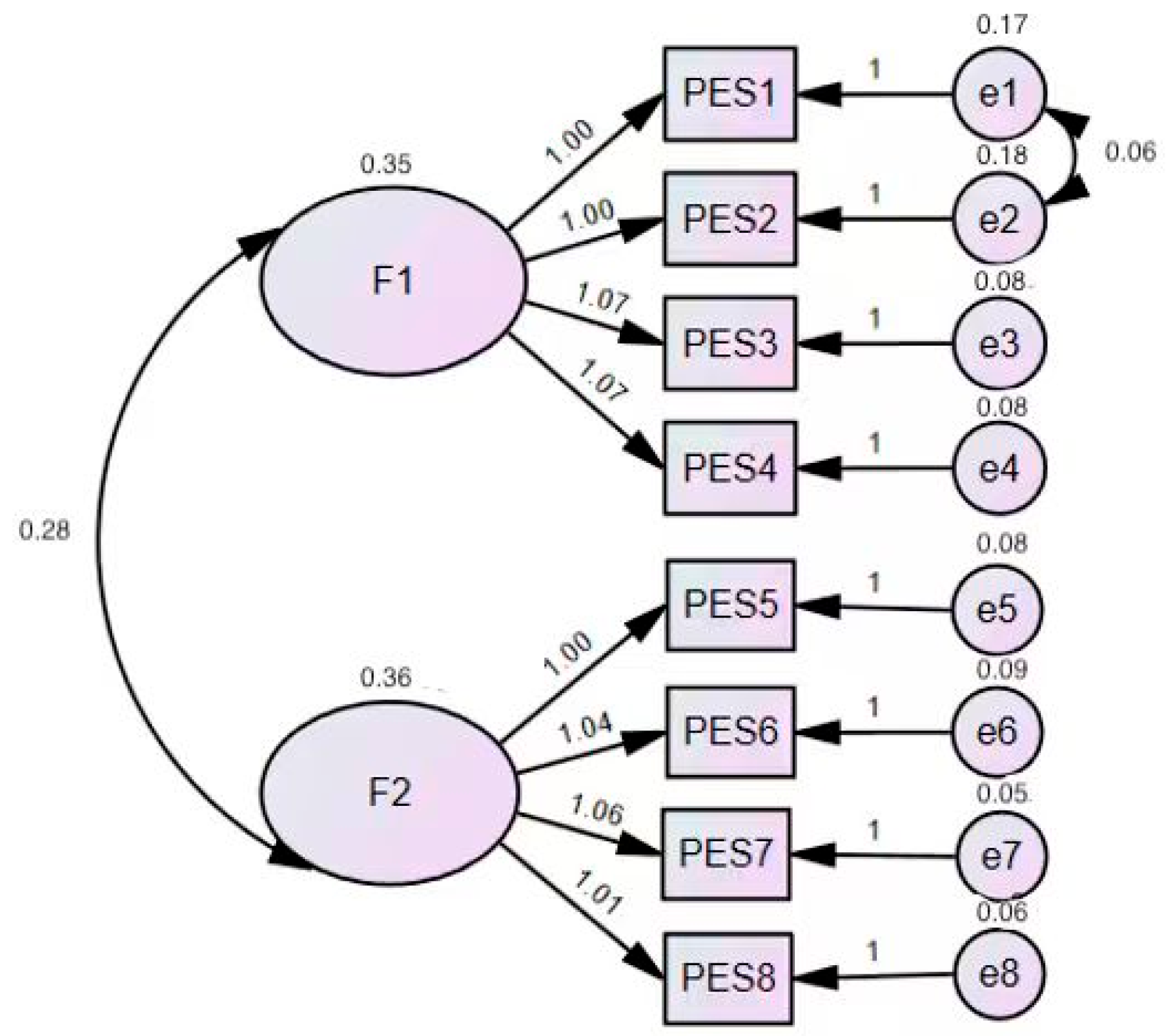
The eight PES-C items revealed two common factors: Factor 1 (F1) comprised items related to eating satisfaction, while Factor 2 (F2) included items associated with eating pleasure. The optimal model configuration is shown in Figure 1. The fit indices for the 8-item PES-C model were as follows: χ2/df = 4.549, RMSEA = 0.067, GFI = 0.976, AGFI = 0.951, CFI = 0.991, IFI = 0.991, and TLI = 0.985.

3.3. Reliability Analysis of PES-C

3.3.1. Internal Consistency, Test-Retest Reliability, Split-Half Reliability and Inter-Item and Item-Total Correlations

The reliability analysis results indicated that the PES-C demonstrated acceptable reliability. In terms of internal consistency, the Cronbach’s α coefficient for the overall scale (8 items) was 0.963, and the α coefficients for the two subdimensions ranged from 0.956 to 0.961. The Spearman-Brown split-half reliability coefficient was 0.848. Regarding test-retest reliability, the Intra-class Correlation Coefficients (ICCs) of the items ranged from 0.630 to 0.825. Detailed data are available in Table S3. Correlation analysis revealed significant positive correlations among all PES-C items, as well as between each item and the total score (p < 0.01), indicating good internal homogeneity of the scale. Detailed data are shown in Table S4.

3.3.2. Measurement Invariance Analysis of PES-C Across Gender and Ethnicity

Multigroup CFA demonstrated full measurement invariance of the PES-C across gender and ethnicity: configural, metric, scalar, and strict models all had acceptable fits, with ΔCFI ≤ 0.004, ΔRMSEA ≤ 0.005, and ΔSRMR ≤ 0.010 (Table S5). Scores can therefore be meaningfully compared between male and female students and between Han and minority groups, allowing for latent-mean comparisons and subsequent regression analyses.

3.4. PES-C Scores Across Demographic Variables

In stage 2 of the study, a total of 1882 valid questionnaires were collected, and the associations between PES scores and demographic variables of university students were analyzed. The results showed that there were statistically significant differences in PES total scores and eating satisfaction dimension scores across different genders and majors. Table 1 shows that only-child status was significantly associated with higher Eating Satisfaction dimension scores.

3.5. Correlation Analysis of PES-C Total Score and Dimension Score with PHQ-9, GAD-7 and Dietary Intake Frequency

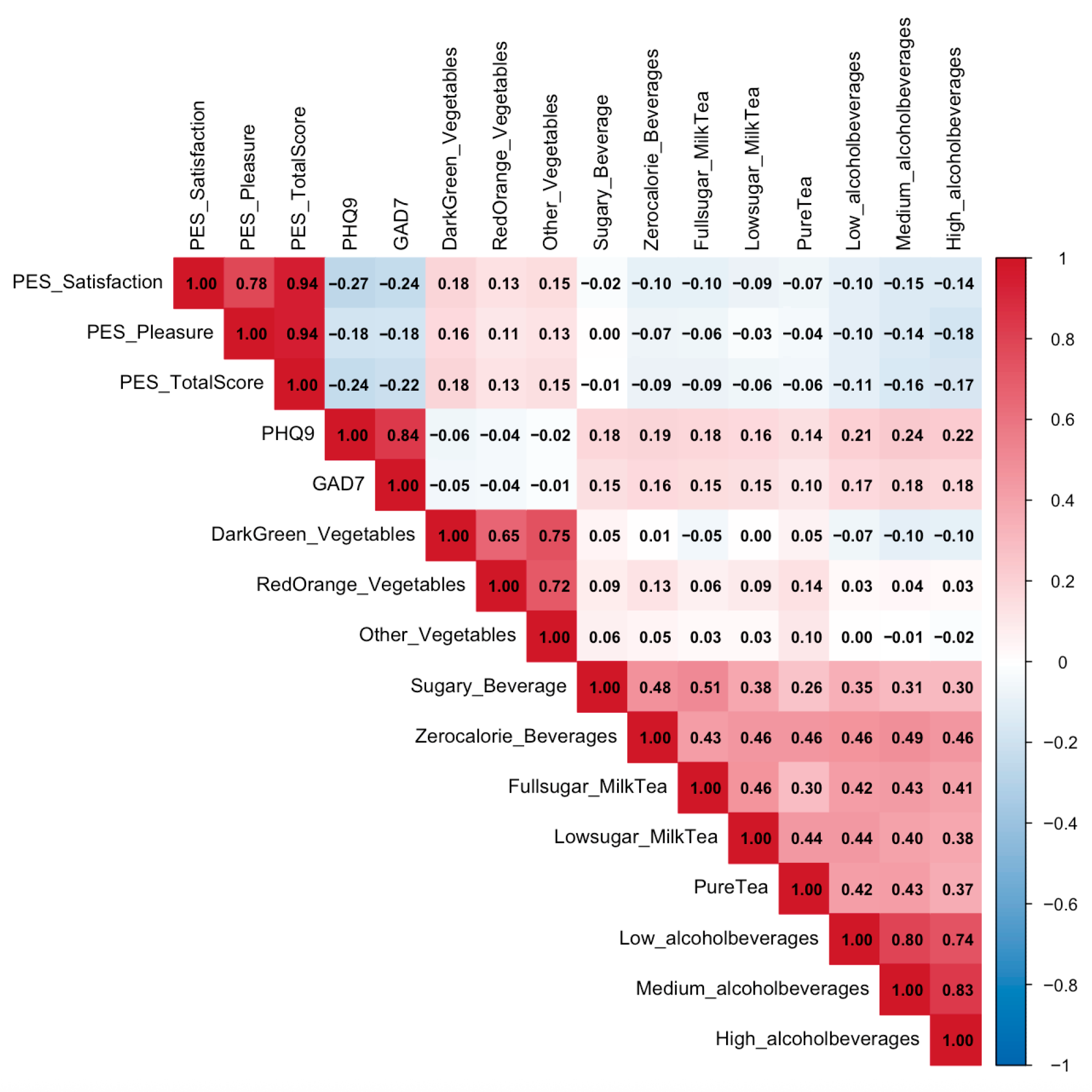
As shown in Figure 2, positive eating attitudes were negatively correlated with psychological symptoms. Depression scores (PHQ-9) were negatively correlated with the PES-C total score (r = −0.24), eating pleasure (r = −0.18), and eating satisfaction (r = −0.27). Anxiety scores (GAD-7) also showed negative correlations, with correlation coefficients of r = −0.22, r = −0.18, and r = −0.24 with the three indicators, respectively.
The association between beverage consumption frequency and PES total score was negatively correlated (r = −0.01 to −0.17) and positively correlated with anxiety and depression symptoms (r = 0.10 to 0.24). The frequency of intake of reddish-orange vegetables, dark green vegetables, and other vegetables was positively correlated with the PES total score, eating satisfaction, and eating pleasure score (r = 0.11 to 0.15).

3.6. Distribution Characteristics of PES-C Scores Across Different Levels of Anxiety and Depression

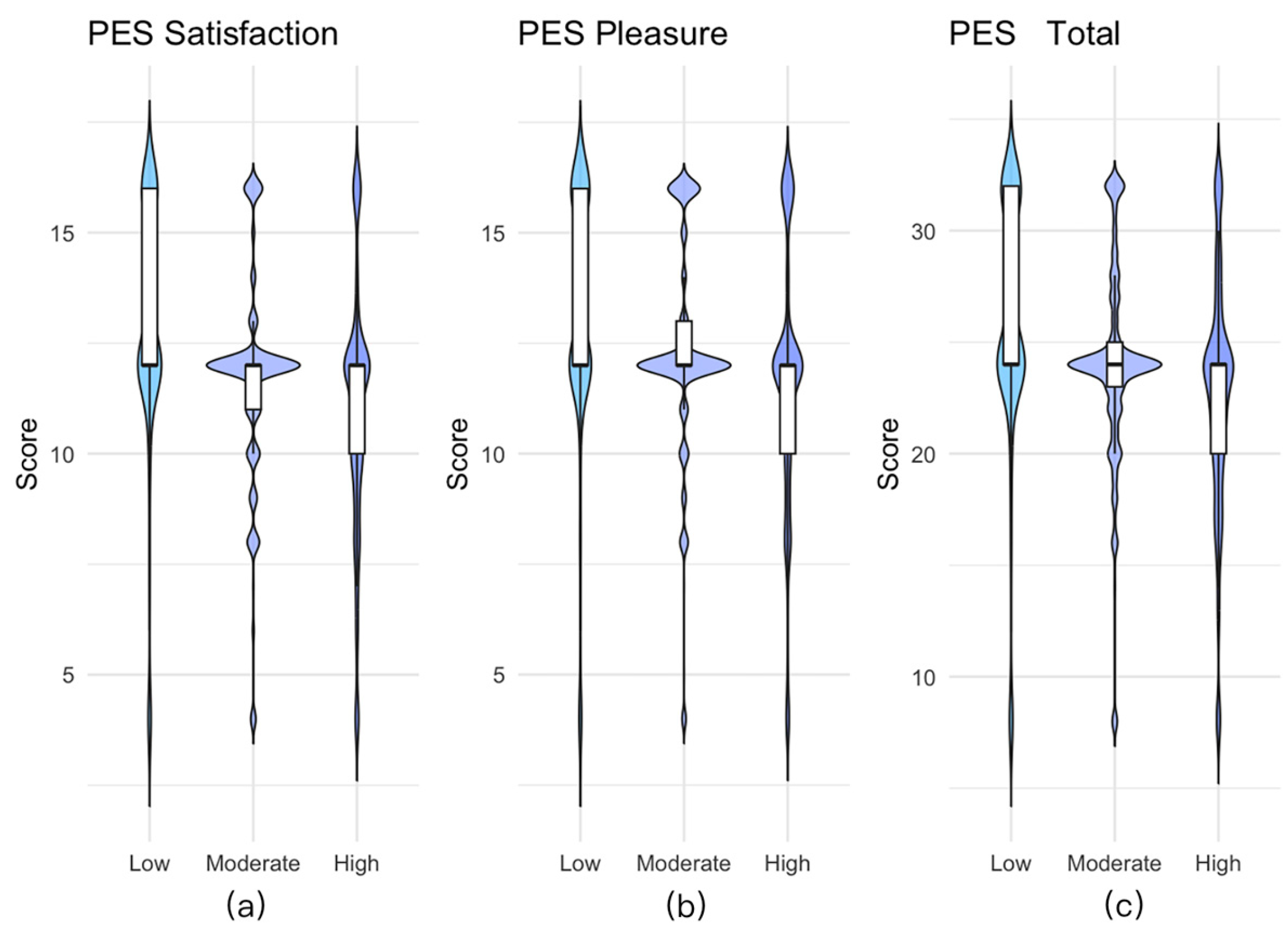
Because of small sample sizes in several severity categories, we combined groups to form a “high-depression group” (PHQ-9 ≥ 10) to ensure reliable statistical estimates. Depression severity showed a clear negative relationship with PES scores (Figure 3). As severity increased from Low (0–4) to Moderate (5–9) and then to High (10–27), the distributions of PES Satisfaction, PES Pleasure, and PES Total gradually shifted toward lower score ranges, with stepwise decreases in group medians. The High-depression group showed the most pronounced clustering of scores at the lower end of the scale, along with a visibly elongated lower tail.
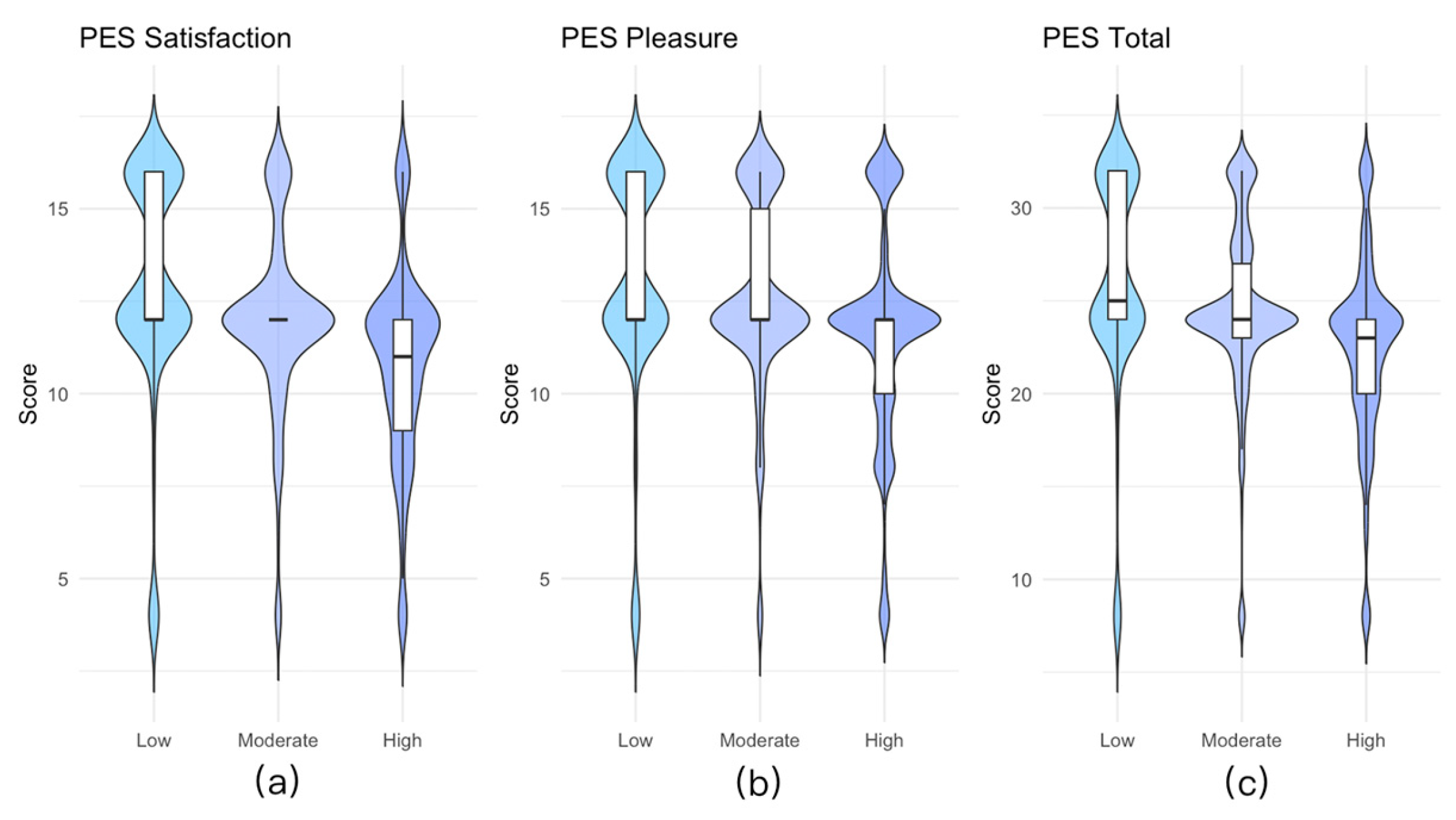
Similarly, due to limited sample sizes in several severity categories, participants were grouped into a “high-anxiety group” (GAD-7 ≥ 10) for further analysis. Anxiety severity also showed a negative correlation with PES scores (Figure 4). Across the Low (0–4), Moderate (5–9), and High (10–21) groups, the score distributions shifted leftward as medians decreased. The High-anxiety group exhibited the tightest clustering of low scores, the narrowest interquartile range, and the flattest distribution peak. Kruskal-Wallis tests confirmed significant differences among severity groups for both depression and anxiety (all p < 0.001).
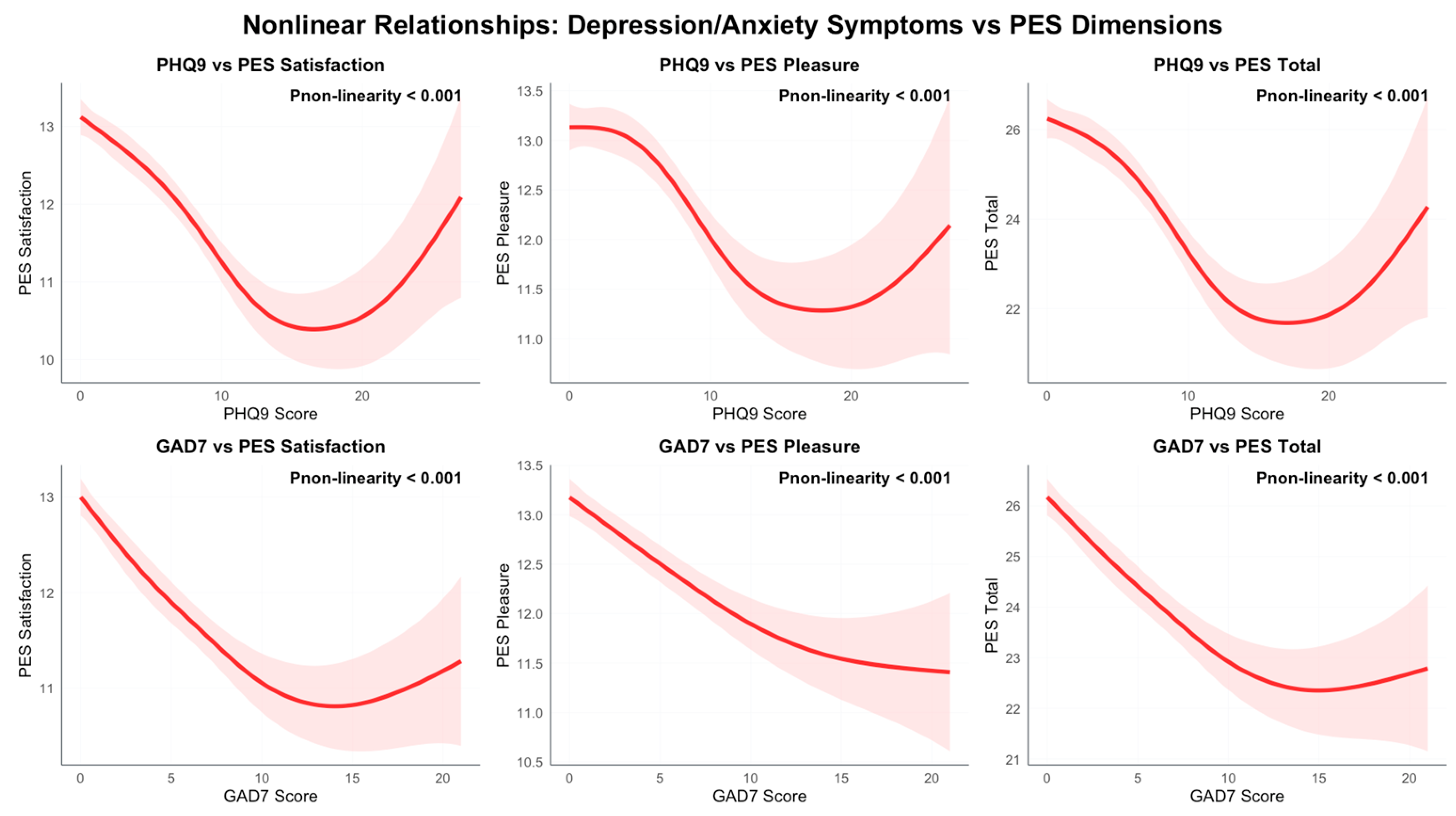
Restricted cubic spline (RCS) analyses, illustrated in Figure 5, showed that higher depression (PHQ-9) and anxiety (GAD-7) scores were generally linked to lower scores across the PES dimensions (Dietary Satisfaction, Dietary Pleasure, and PES Total). The effect of anxiety on positive eating attitudes appeared more straightforward and linear, while the impact of depression showed a clear nonlinear pattern. Specifically, in the early stages of depression and anxiety, their effects on dietary satisfaction and pleasure were more significant. However, once PHQ-9 and GAD-7 scores surpassed 15 and 10, respectively, the downward trends in PES dimension scores tended to level off.

4. Discussion

The PES-C demonstrated robust psychometric properties in Chinese college students, with an 8-item structure confirmed by CFA and model fit indices comparable to or superior to the original and recent adaptations (Sproesser et al., 2018; Takeda et al., 2025).
Although the χ2/df ratio (4.549) was slightly high, this is likely linked to the large sample size given the excellent fit on alternative indices (Hu & Bentler, 1999). However, two limitations warrant attention. First, the exceptionally high internal consistency (Cronbach’s α = 0.963) and strong inter-item correlations (>0.85) suggest a degree of statistical redundancy, likely reflecting semantic overlap among positively valenced terms in Chinese. While this ensures high reliability, it also limits conciseness of the scale. Future research should develop a simplified version to improve discriminant validity by reducing or simplifying items (Tavakol & Dennick, 2011). For example, in this study, we found that PES3 and PES4 (r = 0.912) and PES7 and PES8 (r = 0.913) are very similar in function, which could be a major goal for future PES simplification work. Second, the lower ICCs for items PES7 (0.63) and PES8 (0.70) indicate that “eating pleasure” is susceptible to temporary shifts in mood and hunger. Therefore, to accurately capture this variability, future studies should consider either adding a temporal anchor or modeling these items as a separate, time-varying component.
Strict measurement invariance across both gender and ethnicity supports valid group comparisons (Table S5). Although RMSEA values in several invariance models were slightly above the conventional cutoff (<0.08), this pattern is not uncommon, particularly in large samples and models with limited degrees of freedom, where RMSEA tends to over-reject correctly specified models (Kenny et al., 2015). In gender analysis, no significant difference appeared in eating pleasure, indicating that sensory enjoyment of food is universal. However, women reported lower eating satisfaction than men. This disparity likely results from increased sociocultural pressures to be thin among young women in China, which can cause cognitive-affective conflicts during eating (Yan et al., 2022). Similarly, medical students exhibited lower PES-C total and Satisfaction subscale scores, whereas only-children showed higher eating satisfaction scores. These differences may be associated with variations in eating patterns or family dining dynamics (Bizri et al., 2020; Cai et al., 2018). Given the cross-sectional design, these interpretations remain speculative and warrant longitudinal investigation. In addition, we further calculated the effect sizes for variables that showed statistical differences. We found that some effect sizes were small (e.g., Cohen’s d for gender differences in PES scores was 0.14; the Cohen’s d effect size between only children and non-only children was 0.13), so we need to be more cautious when interpreting these results.
RCS analyses revealed a nonlinear, predominantly negative association between mental health symptoms and positive eating attitude. Although the association appeared to plateau at severe levels of depression and anxiety symptoms, this pattern most likely a statistical artifact attributable to small sample sizes in the upper tail of the PHQ-9 and GAD-7 distributions (see Limitations). The most pronounced decline in eating pleasure and dietary satisfaction occurred at mild-to-moderate symptom severity, consistent with the early emergence of anhedonia and reduced reward sensitivity to food (X. Li et al., 2019; H. Wu et al., 2017). These findings align with longitudinal studies evidence of bidirectional associations between mental health symptoms and dysregulated eating behaviors (Skalski-Bednarz et al., 2024). Accordingly, within Chinese university settings, incorporating brief, low-stigma screening questions about reduced eating pleasure or appetite changes into routine mental health assessments may serve as an accessible early detection tool (Choi & Lee, 2020; Eck & Byrd-Bredbenner, 2021). When combined with accessible, low-cost campus initiatives—such as collaborative programs between psychological counseling centers and dining services, these efforts may help interrupt vicious cycles between poor mental health and unhealthy eating behaviors in this population (X. Li et al., 2022).
Our analysis revealed associations between lower positive eating satisfaction (PES-C) and higher beverage consumption—especially alcohol—alongside elevated psychological symptoms in Chinese university students. This pattern may reflect increased reliance on readily available beverages among individuals reporting reduced eating pleasure and greater distress. (Hsu & Forestell, 2021). In contrast, the relationship between PES and the consumption of nutrient-dense foods were weak (e.g., r = 0.11–0.15 for vegetable intake frequency). Although previous research has linked positive attitudes to higher fruit and vegetable consumption (Acik & Aslan Cin, 2025), our findings suggest that eating pleasure extends beyond conventionally “healthy” foods and can arise from diverse dietary experiences. These results highlight a potential shortcoming of many current dietary interventions, which emphasize behavioral nudges to alter food choice while underemphasizing the psychological aspects of eating (Melo et al., 2025; Moore et al., 2025). Interventions that neglect subjective eating experiences may have limited sustained impact. In contrast, cultivating a positive relationship with food could be associated with reducing emotional eating and improved long-term dietary adherence (Warren et al., 2017).
In conclusion, this study supports the cross-cultural applicability of PES-C and reveals associations between eating pleasure, psychological symptoms, and beverage-oriented dietary patterns among Chinese university students. Positive eating emerges as a potential transdiagnostic marker between mental health and diet. Future campus initiatives may integrate psychoeducation, food environment improvements, and low-stigma screening, pending longitudinal studies to confirm causality and effectiveness.
This study has several limitations. First, the non-probability sampling of predominantly young, highly educated university students recruited online restricts generalizability. Second, the cross-sectional design precludes causal inferences, including those between demographic factors and positive eating attitudes. Third, self-reported dietary intake is susceptible to recall bias, potentially misestimating actual consumption. Fourth, responses to positive eating attitude items may be influenced by social desirability bias, especially among students. Finally, the apparent plateau in restriction curves among participants with severe symptoms is likely a statistical artifact resulting from small sample sizes in the upper tail of the PHQ-9 and GAD-7 distributions, rather than indicating a genuine attenuation of the association between mental health symptoms and positive eating attitudes. Future studies could employ probability sampling, longitudinal designs, and diverse populations to enhance generalizability and causality.

5. Conclusions

This study translated and validated the PES-C and demonstrated its strong reliability, validity, and applicability across subgroups of Chinese university students. Positive eating attitudes were inversely related to depressive and anxiety symptoms and positively associated with healthier dietary behaviors. These findings highlight the potential value of promoting positive eating attitudes as an effective strategy to support both mental well-being and healthy eating habits in university students. The PES-C offers a brief, reliable tool for screening positive eating attitudes and can guide future intervention development and health promotion efforts.

Supplementary Materials

The following supporting information can be downloaded at: https://www.mdpi.com/article/10.3390/youth5040135/s1, Table S1: Chinese and English Versions of the PES. Table S2: Baseline Characteristics of the Study Participants (n = 800). Table S3: Test-retest reliability (interclass correlation coefficient) of the PES-C. Table S4: Correlation matrix of PES-C items and total score. Table S5: Results of measurement invariance analysis of PES-C across gender and ethnicity.

Author Contributions

Conceptualization, Q.L.; Methodology, Q.L., J.C. and W.X.; Formal Analysis, J.C. and W.X.; Investigation Q.L., J.C., W.X., Y.L., W.L. and J.O.; Data input and Data cleaning, Y.H., C.W. and D.Z.; Original Draft Preparation, J.C. and W.X.; Writing—Review & Editing, J.C. and W.X.; Supervision, Q.L.; Project Administration, Q.L. All authors have read and agreed to the published version of the manuscript.

Funding

This research received no external funding.

Institutional Review Board Statement

The study was conducted in accordance with the Declaration of Helsinki, and approved by the Ethics Committee of Xiangya School of Public Health, Central South University (No.: XYGW-2023-137, 29 December 2023).

Informed Consent Statement

Informed consent was obtained from all subjects involved in the study.

Data Availability Statement

All data in this article are available from the corresponding author upon appropriate request.

Acknowledgments

Permission to use the Positive Eating Scale (PES) was kindly granted by Gudrun Sproesser (gudrun.sproesser@uni-konstanz.de), to whom we are deeply grateful for both her generous authorization and her insightful recommendations on scale adaptation. We also thank Zhiqian Jiang (zhiqian.jiang@mail.mcgill.ca) for her invaluable assistance in the translation of the Positive Eating Scale. We would like to thank all the student for participating in the study.

Conflicts of Interest

The authors declare no conflicts of interest.

Abbreviations

PESPositive Eating Scale
PES-Cthe Chinese version of the Positive Eating Scale
SSBssugar-sweetened beverages
RCSRestricted cubic spline

References

  1. Acik, M., & Aslan Cin, N. N. (2025). Links between intuitive and mindful eating and mood: Do food intake and exercise mediate this association? Frontiers in Nutrition, 12, 1458082. [Google Scholar] [CrossRef] [PubMed]
  2. Beaton, D. E., Bombardier, C., Guillemin, F., & Ferraz, M. B. (2000). Guidelines for the process of cross-cultural adaptation of self-report measures. Spine, 25(24), 3186–3191. [Google Scholar] [CrossRef] [PubMed]
  3. Bizri, M., Geagea, L., Kobeissy, F., & Talih, F. (2020). Prevalence of eating disorders among medical students in a Lebanese medical school: A cross-sectional study. Neuropsychiatric Disease and Treatment, 16, 1879–1887. [Google Scholar] [CrossRef] [PubMed]
  4. Brytek-Matera, A., Onieva-Zafra, M. D., Parra-Fernandez, M. L., Staniszewska, A., Modrzejewska, J., & Fernandez-Martinez, E. (2020). Evaluation of orthorexia nervosa and symptomatology associated with eating disorders among European university students: A multicentre cross-sectional study. Nutrients, 12(12), 3716. [Google Scholar] [CrossRef]
  5. Cai, L., Lin, L., Dai, M., Chen, Y., Li, X., Ma, J., & Jing, J. (2018). One-child policy, weight status, lifestyles and parental concerns in Chinese children: A nationwide cross-sectional survey. European Journal of Clinical Nutrition, 72(8), 1150–1158. [Google Scholar] [CrossRef]
  6. Choi, S. H., & Lee, H. (2020). Associations of mindful eating with dietary intake pattern, occupational stress, and mental well-being among clinical nurses. Perspectives in Psychiatric Care, 56(2), 355–362. [Google Scholar] [CrossRef]
  7. Cruchinho, P., López-Franco, M. D., Capelas, M. L., Almeida, S., Bennett, P. M., da Silva, M. M., Teixeira, G., Nunes, E., Lucas, P., Gaspar, F., & Handovers4SafeCare. (2024). Translation, cross-cultural adaptation, and validation of measurement instruments: A practical guideline for novice researchers. Journal of Multidisciplinary Healthcare, 17, 2701–2728. [Google Scholar] [CrossRef]
  8. Eck, K. M., & Byrd-Bredbenner, C. (2021). Disordered eating concerns, behaviors, and severity in young adults clustered by anxiety and depression. Brain and Behavior, 11(12), e2367. [Google Scholar] [CrossRef]
  9. Felske, A. N., Williamson, T. M., Rash, J. A., Telfer, J. A., Toivonen, K. I., & Campbell, T. (2022). Proof of concept for a mindfulness-informed intervention for eating disorder symptoms, self-efficacy, and emotion regulation among bariatric surgery candidates. Behavioral Medicine, 48(3), 216–229. [Google Scholar] [CrossRef]
  10. Firth, J., Gangwisch, J. E., Borisini, A., Wootton, R. E., & Mayer, E. A. (2020). Food and mood: How do diet and nutrition affect mental wellbeing? BMJ, 369, m2382. [Google Scholar] [CrossRef]
  11. Green, H. L., & García, L. (2025). Intuitive eating and its associations with psychological and physical health indicators among rural US adults. Journal of Health Psychology. [Google Scholar] [CrossRef]
  12. Hsu, T., & Forestell, C. A. (2021). Mindfulness, mood, and food: The mediating role of positive affect. Appetite, 158, 105001. [Google Scholar] [CrossRef]
  13. Hu, L. T., & Bentler, P. M. (1999). Cutoff criteria for fit indexes in covariance structure analysis: Conventional criteria versus new alternatives. Structural Equation Modeling—A Multidisciplinary Journal, 6(1), 1–55. [Google Scholar] [CrossRef]
  14. Jones, E. J., Egan, S. J., Howell, J. A., Hoiles, K. J., & Mazzucchelli, T. G. (2020). An examination of the transdiagnostic cognitive-behavioural model of eating disorders in adolescents. Eating Behaviors, 39, 101445. [Google Scholar] [CrossRef] [PubMed]
  15. Kenny, D. A., Kaniskan, B., & McCoach, D. B. (2015). The performance of RMSEA in models with small degrees of freedom. Sociological Methods & Research, 44(3), 486–507. [Google Scholar] [CrossRef]
  16. Kroenke, K., Spitzer, R. L., & Williams, J. B. (2001). The PHQ-9: Validity of a brief depression severity measure. Journal of General Internal Medicine, 16(9), 606–613. [Google Scholar] [CrossRef] [PubMed]
  17. Lee, S. W., Stewart, S. M., Striegel-Moore, R. H., Lee, S., Ho, S. Y., Lee, P. W. H., Katzman, M. A., & Lam, T. H. (2007). Validation of the eating disorder diagnostic scale for use with Hong Kong adolescents. International Journal of Eating Disorders, 40(6), 569–574. [Google Scholar] [CrossRef]
  18. Li, W. Z., Zhao, Z. Y., Chen, D. J., Peng, Y., & Lu, Z. X. (2022). Prevalence and associated factors of depression and anxiety symptoms among college students: A systematic review and meta-analysis. Journal of Child Psychology and Psychiatry, 63(11), 1222–1230. [Google Scholar] [CrossRef]
  19. Li, X., Braakhuis, A., Li, Z., & Roy, R. (2022). How does the university food environment impact student dietary behaviors? A systematic review. Frontiers in Nutrition, 9, 840818. [Google Scholar] [CrossRef]
  20. Li, X., Zhang, Y. T., Huang, Z. J., Chen, X. L., Yuan, F. H., & Sun, X. J. (2019). Diminished anticipatory and consummatory pleasure in dysphoria: Evidence from an experience sampling study. Frontiers in Psychology, 10, 2124. [Google Scholar] [CrossRef]
  21. Liu, H. M., Yang, Q. P., Luo, J., Ouyang, Y. F., Sun, M. H., Xi, Y., Yong, C. T., Xiang, C. H., & Lin, Q. (2020). Association between emotional eating, depressive symptoms and laryngopharyngeal reflux symptoms in college students: A cross-sectional study in Hunan. Nutrients, 12(6), 1595. [Google Scholar] [CrossRef] [PubMed]
  22. Lowe, B., Decker, O., Muller, S., Brahler, E., Schellberg, D., Herzog, W., & Herzberg, P. Y. (2008). Validation and standardization of the Generalized Anxiety Disorder Screener (GAD-7) in the general population. Medical Care, 46(3), 266–274. [Google Scholar] [CrossRef] [PubMed]
  23. Macht, M. (2008). How emotions affect eating: A five-way model. Appetite, 50(1), 1–11. [Google Scholar] [CrossRef] [PubMed]
  24. Marquis, M., Talbot, A., Sabourin, A., & Riopel, C. (2018). Exploring the environmental, personal and behavioural factors as determinants for university students’ food behaviour. International Journal of Consumer Studies, 43(1), 113–122. [Google Scholar] [CrossRef]
  25. Melo, G. L. R., Santo, R. E., Mas Clavel, E., Bosque Prous, M., Koehler, K., Vidal-Alaball, J., van der Waerden, J., Gobina, I., Lopez-Gil, J. F., Lima, R., & Agostinis-Sobrinho, C. (2025). Digital dietary interventions for healthy adolescents: A systematic review of behavior change techniques, engagement strategies, and adherence. Clinical Nutrition, 45, 176–192. [Google Scholar] [CrossRef]
  26. Moore, D., Ma, Z., Villasenor, D., Odegaard, A., Lu, Y., & Lindsay, K. (2025). Easy-to-learn dietary behavior change intervention does not significantly improve diet quality of college students: A randomized controlled trial. Nutrition Research, 140, 11–23. [Google Scholar] [CrossRef]
  27. Pouyfung, P., Petchoo, J., & Chaisit, S. (2025). Sugar-sweetened beverage consumption and risk of visceral fat accumulation among university students in Thailand. Roczniki Państwowego Zakładu Higieny, 76(1), 75–85. [Google Scholar] [CrossRef]
  28. Qi, Q., Sun, Q., Yang, L., Cui, Y., Du, J., & Liu, H. (2023). High nutrition literacy linked with low frequency of take-out food consumption in chinese college students. BMC Public Health, 23(1), 1132. [Google Scholar] [CrossRef]
  29. Rutter, L. A., & Brown, T. A. (2017). Psychometric properties of the generalized anxiety disorder scale-7 (GAD-7) in outpatients with anxiety and mood disorders. Journal of Psychopathology and Behavioral Assessment, 39(1), 140–146. [Google Scholar] [CrossRef]
  30. Skalski-Bednarz, S. B., Hillert, A., Surzykiewicz, J., Riedl, E., Harder, J. P., Hillert, S. M., Adamczyk, M., Uram, P., Konaszewski, K., Rydygel, M., Maier, K., & Dobrakowski, P. (2024). Longitudinal impact of disordered eating attitudes on depression, anxiety, and somatization in young women with anorexia and bulimia. Journal of Clinical Medicine, 13(17), 5078. [Google Scholar] [CrossRef]
  31. Sproesser, G., Klusmann, V., Ruby, M. B., Arbit, N., Rozin, P., Schupp, H. T., & Renner, B. (2018). The positive eating scale: Relationship with objective health parameters and validity in Germany, the USA and India. Psychology & Health, 33(3), 313–339. [Google Scholar] [CrossRef]
  32. Takeda, G. A., Moraes, J. M. M., Carvalho, P. H. B., & Alvarenga, M. D. S. (2025). Adaptação transcultural e avaliação das propriedades psicométricas da versão brasileira da Positive Eating Scale [Cross-cultural adaptation and evaluation of the psychometric properties of the Brazilian version of the Positive Eating Scale]. Ciência & Saúde Coletiva, 30(4), e13322023. [Google Scholar] [CrossRef]
  33. Tavakol, M., & Dennick, R. (2011). Making sense of Cronbach’s alpha. International Journal of Medical Education, 2, 53–55. [Google Scholar] [CrossRef] [PubMed]
  34. Tylka, T. L., Maiano, C., Fuller-Tyszkiewicz, M., Linardon, J., Burnette, C. B., Todd, J., & Swami, V. (2024). The Intuitive Eating Scale-3: Development and psychometric evaluation. Appetite, 199, 107407. [Google Scholar] [CrossRef]
  35. Warren, J. M., Smith, N., & Ashwell, M. (2017). A structured literature review on the role of mindfulness, mindful eating and intuitive eating in changing eating behaviours: Effectiveness and associated potential mechanisms. Nutrition Research Reviews, 30(2), 272–283. [Google Scholar] [CrossRef]
  36. Wu, H., Mata, J., Furman, D. J., Whitmer, A. J., Gotlib, I. H., & Thompson, R. J. (2017). Anticipatory and consummatory pleasure and displeasure in major depressive disorder: An experience sampling study. Journal of Abnormal Psychology, 126(2), 149–159. [Google Scholar] [CrossRef]
  37. Wu, Q., Gao, Z. J., Yu, X., & Wang, P. (2022). Dietary regulation in health and disease. Signal Transduction and Targeted Therapy, 7(1), 252. [Google Scholar] [CrossRef]
  38. Xu, H., Yang, Z., Liu, D., Yu, C., Zhao, Y., Yang, J., Su, Y., Jiang, Y., & Lu, Q. (2023). Mediating effect of physical sub-health in the association of sugar-sweetened beverages consumption with depressive symptoms in Chinese college students: A structural equation model. Journal of Affective Disorders, 342, 157–165. [Google Scholar] [CrossRef]
  39. Yan, J. M., Su, H. D., & Li, C. L. (2022). Effect of body dissatisfaction on binge eating behavior of Chinese university students: A moderated mediation model. Frontiers in Psychology, 13, 995301. [Google Scholar] [CrossRef]
  40. Zhu, Z., Cui, Y., Gong, Q., Huang, C., Guo, F., Li, W., Zhang, W., Chen, Y., Cheng, X., & Wang, Y. (2019). Frequency of breakfast consumption is inversely associated with the risk of depressive symptoms among Chinese university students: A cross-sectional study. PLoS ONE, 14(8), e0222014. [Google Scholar] [CrossRef]
Figure 1. Confirmatory factor model of the optimally constructed 8-item PES-C.
Youth 05 00135 g001
Figure 2. Heatmap of correlations between PES total/dimension scores and PHQ-9, GAD-7, and dietary intake.
Youth 05 00135 g002
Figure 3. Distributions of PES scores across different depression severity groups. (a) Satisfaction; (b) Pleasure; (c) Total Score.
Youth 05 00135 g003
Figure 4. Distributions of PES scores across different anxiety severity groups. (a) Satisfaction; (b) Pleasure; (c) Total Score.
Youth 05 00135 g004
Figure 5. Nonlinear associations between anxiety, depression scores and PES-C scores. Note. The solid red line represents the nonlinear association fitted by restricted cubic spline models, and the shaded area indicates the 95% confidence interval.
Youth 05 00135 g005
Table 1. PES-C total and dimension scores by demographic characteristics (n = 1882).
ContentSample Size
(Percentage)
Total ScoreDietary SatisfactionDietary Pleasure
Gender
Male1040 (55.3)25.239 ± 5.54012.520 ± 2.87112.720 ± 2.922
Female842 (44.7)24.464 ± 5.25811.860 ± 2.82812.610 ± 2.828
t 3.0135.0120.854
p 0.008 **0.024 *0.091
Grade
Freshman863 (45.9)25.096 ± 5.51312.330 ± 2.91712.760 ± 2.881
Sophomore603 (32.0)24.801 ± 5.59712.170 ± 2.91712.630 ± 3.006
Junior312 (16.6)24.513 ± 5.03612.020 ± 2.71012.490 ± 2.687
Senior and above 104 (5.5)24.875 ± 4.82812.320 ± 1.98812.660 ± 2.028
F 0.9710.9880.764
p 0.4050.3980.514
Ethnicity
Han1681 (89.3)24.870 ± 5.46212.210 ± 2.88312.660 ± 2.904
Zhuang16 (0.9)25.687 ± 5.68812.810 ± 3.01612.880 ± 2.986
Hui21 (1.1)26.568 ± 4.39912.590 ± 2.52613.330 ± 2.309
Other ethnic groups164 (8.7)24.823 ± 5.18012.140 ± 2.79512.680 ± 2.708
F 0.0811.1520.412
p 0.4930.3270.745
BMI
Underweight297 (15.8)24.336 ± 5.72912.030 ± 3.05412.300 ± 2.031
Normal weight1243 (66.0)25.097 ± 5.27912.340 ± 2.76412.760 ± 2.809
Overweight180 (9.6)24.601 ± 5.80111.990 ± 3.06612.610 ± 3.045
Obese162 (8.6)24.740 ± 5.39611.980 ± 3.02512.760 ± 2.845
F 2.2951.9271.976
p 0.0760.1220.116
Only child
Yes760 (40.4)25.188 ± 5.59012.450 ± 2.90912.740 ± 2.987
No1122 (59.6)24.692 ± 5.30912.070 ± 2.83412.620 ± 2.801
t 1.6772.2600.847
p 0.0940.024*0.397
Academic discipline
Liberal arts555 (29.5)24.279 ± 5.33012.040 ± 2.82212.680 ± 2.905
Science244 (13.0)25.184 ± 5.41412.380 ± 2.97712.800 ± 2.742
Engineering970 (51.5)25.062 ± 5.52812.380 ± 2.87812.680 ± 2.917
Medicine105 (5.6)23.810 ± 4.53211.510 ± 2.49712.300 ± 2.453
Agriculture8 (0.4)21.375 ± 8.76510.500 ± 4.24310.880 ± 4.643
F 2.4373.8631.362
p 0.045 *0.004 **0.245
Mean monthly living cost (CNY)
≤100058 (3.1)25.086 ± 6.43512.520 ± 3.41412.570 ± 3.229
1001–1500492 (26.1)24.607 ± 5.42712.110 ± 2.86012.490 ± 2.883
1501–2000847 (45.0)25.098 ± 5.21712.310 ± 2.75212.790 ± 2.769
>2000485 (25.8)24.800 ± 5.65912.150 ± 3.01012.650 ± 2.966
F 0.9270.8061.117
p 0.4270.4910.341
Note: * indicates p < 0.05, ** indicates p < 0.01. CNY, Chinese Yuan.
Disclaimer/Publisher’s Note: The statements, opinions and data contained in all publications are solely those of the individual author(s) and contributor(s) and not of MDPI and/or the editor(s). MDPI and/or the editor(s) disclaim responsibility for any injury to people or property resulting from any ideas, methods, instructions or products referred to in the content.