Abstract
Matricaria chamomilla and Tripleurospermum inodorum (syn. Matricaria inodora) are two closely related species in the Asteraceae family that are often mistaken for one another due to their similar appearance. However, they differ significantly in their chemical composition and biological activities. This study offers comparative characterisation through microscopy, phytochemical profiling, and biological assays. Microscopic observations revealed distinct morphological differences in the structure of the receptacle and the size of the pollen grains between the two species. Total phenol and flavonoid contents were quantified using spectrophotometry, while essential oils were extracted through hydrodistillation and analysed by gas chromatography–mass spectrometry (GC-MS). M. chamomilla was found to have a higher phenol content (20.48 mg GAE/g DW), whereas T. inodorum showed a greater flavonoid concentration (15.93 mg RE/g DW). The essential oils from each species displayed different chemical composition: M. chamomilla was dominated by bisabolol oxides and chamazulene, while T. inodorum primarily contained β-farnesene and cis-lachnophyllum ester. The antioxidant activity of both species was evaluated using the DPPH assay and found to be moderate compared to standard antioxidants, such as ascorbic acid (IC50 < 5 µg/mL). The IC50 values for M. chamomilla ranged from 17.7 to 21.5 µg/mL, while for T. inodorum, they ranged from 8.4 to 10.2 µg/mL. In antimicrobial tests, the essential oil of T. inodorum inhibited both Staphylococcus aureus and Candida albicans, while M. chamomilla was only active against C. albicans. These findings highlight important morphological and chemical markers that differentiate the two species and affirm T. inodorum as a promising source of bioactive compounds.

1. Introduction
Matricaria chamomilla L., syn. Chamomilla recutita (L.) Rauschert (German chamomile) is an annual species widely cultivated across Europe, Asia, and the Americas. It thrives in well-drained, moderately fertile soil and is commonly found in cultivated fields and gardens, but also in wild areas [1]. In contrast, Tripleurospermum inodorum (L.) Sch.Bip., syn. Matricaria inodora L., commonly known as scentless mayweed, or scentless chamomile, is a ruderal species that grows spontaneously in uncultivated lands, field margins, and roadsides. It is often considered an invasive weed, being highly adaptable to diverse environmental conditions, including various soil types (from sandy to clay), different moisture levels, and a broad range of temperate climatic conditions [2].
Although both species belong to the Asteraceae family and display capitulate inflorescences, they exhibit significant morphological differences. Matricaria chamomilla (M. chamomilla) has erect stems, pinnatisect leaves, and a hollow, conical receptacle, bearing white ligulate florets and yellow tubular disc florets [1,3]. In contrast, Matricaria inodora sin. Tripleurospermum inodorum (T. inodorum) features more finely divided, feathery leaves and a solid receptacle. Its inflorescences are similar in appearance but lack the characteristic aroma of true chamomile, which is a key trait for accurate identification [2].
The chemical composition of M. chamomilla has been extensively studied and is characterised by a rich and complex profile of secondary metabolites. The essential oil of chamomile typically contains α-bisabolol, chamazulene, matricin, bisabolol oxides A and B, β-farnesene, and spathulenol (Figure 1) [3]. These constituents vary depending on the plant’s origin, geographical position, harvesting time, and extraction method. Based on the main component of the essential oils, there are a few chemotypes of chamomile: type A (bisabolol oxide A predominant), type B (bisabolol oxide B predominant), type C (alpha-bisabolol predominant), and type D (α-bisabolol, and α-bisabolol oxide A and B in 1:1 ratio) [4,5].
Among the flavonoids found in large amounts in chamomile, apigenin, apigenin-7-O-glucoside, luteolin, patuletin, and quercetin are included. Other notable biocompounds are phenolic acids (caffeic acid, chlorogenic acid, and ferulic acid), coumarins (herniarin, umbelliferone), mucilages, polysaccharides, small amounts of tannins and bitter substances (matricarin) [6,7]. These constituents contribute to its numerous pharmacological effects.
Preparations from M. chamomilla are traditionally used for their anti-inflammatory, antispasmodic, sedative, carminative, and antiseptic properties. Chamomile is administered as teas, infusions, tinctures, or essential oils for gastrointestinal disorders, anxiety, skin irritations, and mucosal inflammation [3]. Recent clinical studies have highlighted the therapeutic potential of M. chamomilla in anxiety, insomnia, and inflammation-related conditions. A double-blind, placebo-controlled trial showed that chamomile extract significantly reduced anxiety symptoms in patients with generalised anxiety disorder [8]. A follow-up study confirmed its role in preventing relapses and improving long-term well-being [9]. Additionally, a meta-analysis found that chamomile improved sleep quality and reduced night-time awakenings [10]. Topical chamomile oil has also shown benefits in reducing pain and inflammation in patients with carpal tunnel syndrome [11]. M. chamomilla is generally considered safe, with low toxicity, although allergic reactions may occur in individual sensitive to Asteraceae species. Potential interactions with anticoagulants have also been noted [12].
T. inodorum is a less chemically and pharmacologically studied species. So far, it is known that it contains a significantly lower amount of essential oil, typically below 0.05%, and the composition varies. Unlike M. chamomilla, it lacks chamazulene and α-bisabolol. Identified constituents include α-pinene, limonene, β-myrcene [13,14], artemisia ketone, terpinene-4-ol, 1,8-cineole, sabinene, tricosane [2], and matricaria ester [15]. Other components are flavonoids (apigenin, luteolin, quercetin, kaempferol, and isorhamnetin derivatives), phenolic acids (caffeic acid, p-coumaric acid, quinic acid, 5-O-caffeoyl quinic acid, and protocatechuic acid), tannins and terpenoids, and smaller doses of sesquiterpene lactones than chamomile [2,7]. Nonetheless, its phytochemical profile remains less characterised and more variable. T. inodorum is rarely cited in traditional medicine. Few studies have reported antioxidant activity [14,15], alleviating gastrointestinal pain and anti-inflammatory properties [16], but its therapeutic relevance remains uncertain due to low concentrations of active constituents. Regarding T. inodorum, there is limited data on toxicity, but it is typically regarded as non-toxic, with low allergenic potential.
Both species belong to the Asteraceae family and share similar morphological characteristics; however, they exhibit distinct anatomical and chemical features. Previous studies have focused on each species individually, and there are some comparative works addressing cytogenetic or taxonomic aspects [17,18]. Nevertheless, comprehensive investigations that combine diagnostic morphology with chemical composition and biological activity are limited. Additionally, due to their close phenotypic resemblance, M. chamomilla and T. inodorum are often misidentified or intentionally substituted in herbal preparations and essential oil products. The present study offers an integrative comparison of the two species by correlating morphological observations with phytochemical and bioactivity data. This approach contributes to a clearer taxonomic distinction and a deeper understanding of the bioactive potential of T. inodorum as a complementary source of valuable natural compounds.
2. Materials and Methods
2.1. Plant Materials
Flowers at full maturity or floral buds from the two chamomile species were collected in May 2025 in the village of Dumitresti, Vrancea County, Romania. The studied species included Matricaria chamomilla L. (chamomile, German chamomile, blue chamomile), and Matricaria inodora L. sin. Tripleurospermum inodorum (L.) Sch.Bip. (scentless mayweed, scentless chamomile). Species identification was performed at the Botany Laboratory of the Faculty of Pharmacy, Titu Maiorescu University.
2.2. Chemicals and Reagents
All reagents and solvents used in this study were of analytical grade. Solvents methanol and ethanol were purchased from commercial suppliers (analytical grade). Standards of gallic acid, caffeic acid, and rutin were obtained from Sigma-Aldrich (St. Louis, MO, USA). Folin–Ciocalteu reagent, sodium carbonate, sodium acetate, and aluminium chloride were obtained from Merck (Darmstadt, Germany) and Sigma-Aldrich. All chemicals were used without further purification. Deionised water was obtained from a Milli-Q purification system (Millipore, Bedford, MA, USA).
2.3. Botanical Examination
For morphological observation, representative capitula of both species were selected and dissected. The selection included healthy, fully developed, and undamaged inflorescences that displayed typical morphological characteristics of each species. Floral parts—including ray and disc florets, receptacle structure—were examined and photographed using a Motic BA310 optical microscope equipped with an integrated Motic digital imaging system (Motic Microscopes, Kowloon, Hong Kong), equipped with standard 10× eyepieces and objective lenses of 4×, 10×, 40×, and 100×. Observations were conducted under brightfield illumination. Morphological characteristics such as floret arrangement, symmetry, corolla type, and receptacle shape were recorded for each species. Comparative measurements of floral structures were taken, and taxonomic identification was confirmed with standard floristic keys and herbarium references.
For pollen analysis of the plants, mature anthers from fully developed disc florets were carefully removed and mounted on glass slides. Samples were analysed under the same optical microscope. Parameters such as pollen shape, size (polar and equatorial diameter), aperture number and type (colpi and pori), and exine ornamentation were analysed. Measurements were performed on at least 10 pollen grains per species. Pollen grains were described following Erdtman’s system, and the terminology following standard palynological nomenclature [19,20]. All of the botanical examinations were performed in triplicate.
2.4. Phytochemical Investigations
For the total phenolic and flavonoid content, and for the determination of antioxidant capacity, the plant material was air-dried at room temperature in the absence of direct light, then finely ground. Ethanolic extracts were obtained by refluxing 1 g of the dried material with 100 mL of 50% ethanol for 30 min at 100 °C using an electric water bath (Witeg Labortechnik, Wertheim, Germany). The resulting mixtures were filtered through a Whatman ashless filter paper, and the final volumes were adjusted to 100 mL with the same solvent in a graduated flask. The two extracts were stored at 4 °C until the analyses were performed.
All of the experiments were conducted in triplicate to ensure consistency of the results, and data were reported as mean ± standard deviation.
2.4.1. Total Phenolic Content
The total polyphenolic content of the two species was determined using a spectrophotometric method based on the Folin–Ciocalteu reagent, with gallic acid and caffeic acid employed as calibration standards, as previously described [21,22].
Briefly, 1 mL of each hydroethanolic extract (M. chamomilla and T. inodorum flowers) was mixed with 4.5 mL of deionised water and 2.5 mL of a diluted Folin–Ciocalteu reagent. After 5 min, 2 mL of 7% (w/v) sodium carbonate solution was added to the mixture. The reaction mixtures were incubated for 30 min at room temperature, protected from light. Absorbance was measured at 765 nm using a VWR UV-6300 PC spectrophotometer (VWR International, Vienna, Austria).
The total polyphenolic content was quantified using calibration curves constructed with standard solutions of gallic acid and caffeic acid. The calibration curve for gallic acid showed an R2 = 0.999728 and followed the regression equation:
while the calibration curve for caffeic acid showed an R2 = 0.999723 and followed the regression equation:
Results were expressed as milligrams of gallic acid equivalents per gram of dry weight (mg GAE/g DW) and milligrams of caffeic acid equivalents (mg CAE/g DW) per gram of dry weight.
2.4.2. Total Flavonoid Content
For the determination of total flavonoid content, the spectrophotometric method with aluminium chloride in the presence of sodium acetate was used, where the absorbance of the yellow complex formed allows quantification of total flavonoids [23].
Ethanolic extracts (10 mL) of both species were diluted with methanol to a final volume of 25 mL in volumetric flasks and then filtered. An aliquot of 5 mL from each diluted extract was mixed with 5 mL of sodium acetate solution (100 g/L) and 3 mL of aluminium chloride solution (25 g/L). The mixtures were brought to a final volume of 25 mL with methanol and homogenised thoroughly. After incubation for 15 min at room temperature, the absorbance was measured at 430 nm using a VWR UV-6300 PC spectrophotometer (VWR International, Vienna, Austria). Quantification was performed using a calibration curve prepared with rutin as a standard. The calibration curve showed a linear relationship between absorbance and concentration, with a correlation coefficient of R2 = 0.99952, following the regression equation:
The results were expressed as mg rutin equivalent per gram dry weight (mg RE/g DW) ± standard deviation.
2.4.3. Essential Oil Extraction and GC/MS Analysis
Freshly ground inflorescences of chamomile and scentless mayweed (150 g) were subjected to hydrodistillation using a closed-loop Clevenger-type apparatus made of borosilicate glass (500 mL). The distillation was conducted for 3 h under boiling conditions with 600 mL of distilled water, following the volumetric assay method for determining essential oil yield [24]. The essential oil yield was calculated as a percentage (% v/w), based on the volume of oil obtained in relation to the mass of plant material.
Subsequently, the chemical composition of each essential oil was determined using Gas Chromatography–Mass Spectrometry (GC–MS). The analysis was performed using a Thermo Electron Corporation Focus gas chromatograph equipped with a splitter and coupled to a Thermo Electron Corporation DSQII mass spectrometer (Thermo Scientific, Waltham, MA, USA). The capillary column was coated with Macrogol 20,000 (Ohio Valley, OH, USA), with a film thickness of 0.25 μm, a length of 30 m, and an internal diameter of 0.25 mm. Helium was used as the carrier gas at a flow rate of 1.5 mL/min. The injection volume was 1.0 μL, and the column oven temperature was programmed to increase from 65 °C to 200 °C over a 60 min runtime [25]. Quantification of components was based on integration of peak areas in the chromatograms, and compound identification was achieved by comparing the obtained mass spectra with reference spectra from the Wiley 8 and NIST 07 databases.
2.5. Biological Activity Assays
2.5.1. Antioxidant Capacity
The antioxidant activity of the two flower extracts was evaluated using the DPPH (2,2-diphenyl-1-picrylhydrazyl) radical scavenging assay. This widely used method is based on the reduction of the stable, violet-coloured DPPH radical by antioxidants capable of donating electrons or hydrogen atoms, resulting in a colour change from deep purple to pale yellow as the radical is neutralised [22].
For the preparation of the DPPH solution, 100 mg of DPPH was dissolved in methanol and brought to volume in a 200 mL volumetric flask. A 1 mL volume of extract was combined with 5 mL of the DPPH solution, and methanol was added to bring the final volume to 25 mL. The mixture was thoroughly homogenised and incubated for 30 min at room temperature in the dark to prevent photo-degradation of the radical. After incubation, the absorbance of the solution was measured at 517 nm using a VWR UV-6300 PC spectrophotometer (VWR International, Vienna, Austria). The radical scavenging activity was calculated using the following equation:
where Abs control represents the absorbance of the DPPH solution without extract, and Abs sample represents the absorbance of the DPPH solution containing the sample.
The IC50 values, indicating the concentration needed to inhibit DPPH radical activity by half, were calculated using both linear interpolation and nonlinear regression (4PL) models. Results are expressed in relation to the total polyphenol content (µg GAE/mL), allowing for a more accurate comparison between extracts that differed in phenolic composition. Tests were performed in triplicate, and the results are presented as mean values ± standard deviation.
2.5.2. Antimicrobial Activity
Antimicrobial activity was evaluated against reference strains: Staphylococcus aureus ATCC 25923, Escherichia coli ATCC 35218, Pseudomonas aeruginosa ATCC 27853, and Candida albicans ATCC 10231 (Deutsche Sammlung von Mikroorganismen und Zellkulturen, Braunschweig, Germany). Bacteria were cultured on Plate Count Agar at 37 °C for 22 ± 2 h. The antimicrobial effect of the oils was assessed by the Kirby–Bauer diffusion method under standardised, reproducible conditions [26,27].
Mueller–Hinton agar plates were inoculated with a 0.5 McFarland suspension (OD550 = 0.125) of each strain, and essential oils were applied in spots of 5–30 µL at the centre of each plate to ensure uniform diffusion through the medium. After pre-diffusion (15 min), plates were incubated at 35 ± 2 °C for 16–18 h under aerobic conditions. Any inhibition zone was recorded as sensitivity (S), while its absence indicated resistance (R). Each biological test was performed in triplicate.
2.6. Statistical Data Processing
Statistical analyses were performed using XL STAT 2022.4.5 software. The results are expressed as mean ± standard deviation (SD) of three independent replicates. Differences among groups were evaluated using one-way analysis of variance (ANOVA). Statistical significance was set at p < 0.05.
3. Results
3.1. Botanical Examination
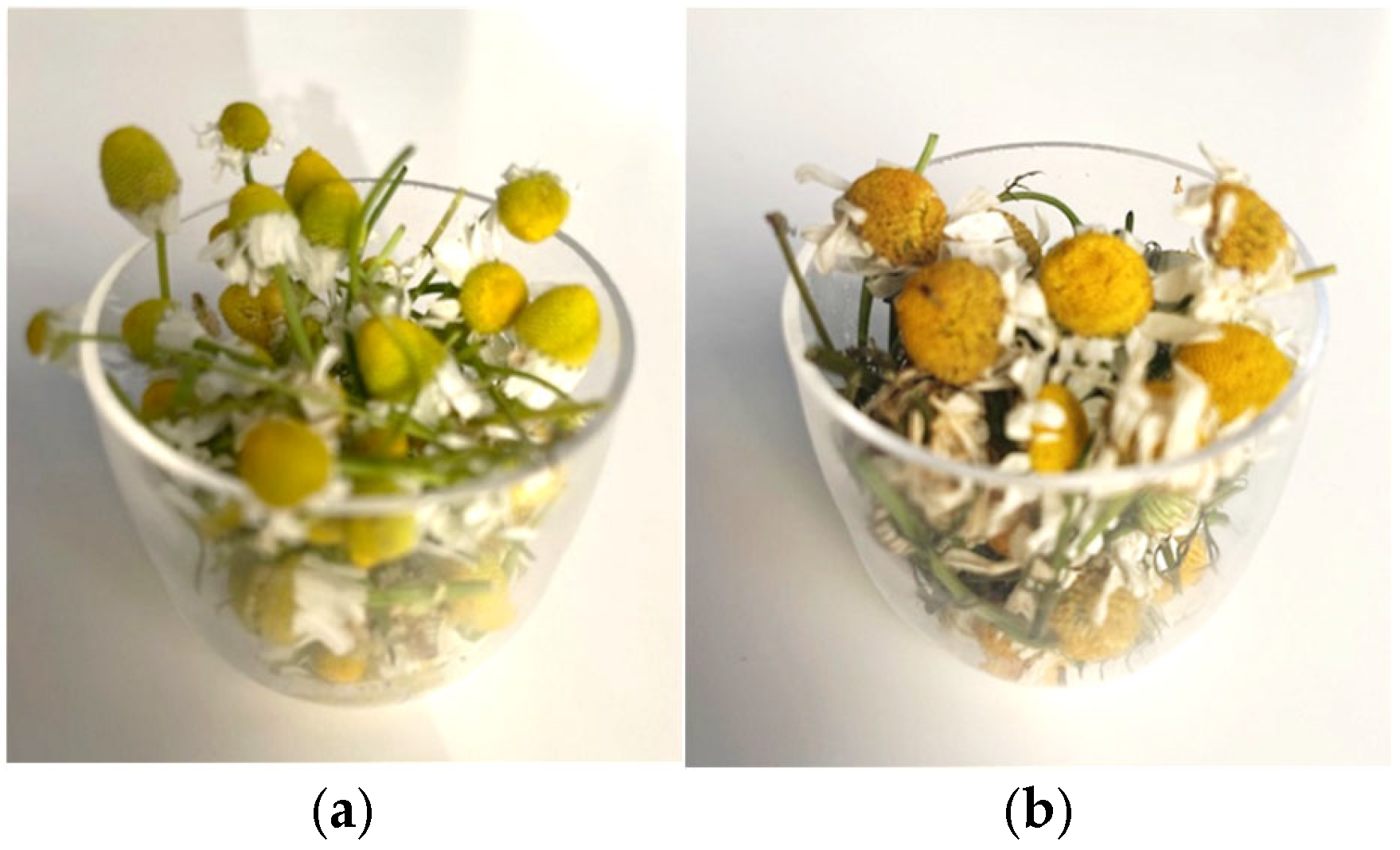
The morphological examination indicates that both species exhibit capitulum-type inflorescences, specific to the Asteraceae family, but with distinct differences. In M. chamomilla, the receptacle was conical and hollow, while in T. inodorum, the receptacle appeared flat and solid. This is a key taxonomic feature that enables an accurate differentiation between the two species (Figure 1). Moreover, ray florets in M. chamomilla were ligulate, strap-shaped, having three teeth at apex, and white, while in T. inodorum the ray florets were also white, strap-shaped, but more deeply three-lobed. The disc florets in M. chamomilla were tubular, bright yellow coloured, with prominent bifid stigmas, while in T. inodorum they were golden-yellow, more compact, having a reduced stigma structure. Additional images of the botanical examination are presented in Supplementary Figure S1.
Figure 1.
Flowers capitulum of chamomile species. (a) M. chamomilla; (b) T. inodorum.
Pollen of M. chamomilla appeared spheroidal, isopolar, and tricolporate, with a diameter of approximately 22–27 µm. The exine surface was finely reticulate, and the colpi were well defined, extending nearly the entire length of the grain. In contrast, pollen of T. inodorum was similarly spheroidal, and tricolporate, but slightly larger, with a diameter of 25–30 µm. The exine ornamentation was coarser, and the colpi appeared smoother, and less defined compared to M. chamomilla. Minor variations in aperture size and exine thickness were also observed. These palynological features also contribute to a more precise distinction between the two chamomile species, being used as supportive criteria for their identification. Additional data is provided in Figure S2 (Supplementary Material).
Botanical differences between the two species are presented in Table 1.
Table 1.
Morphological characteristics of M. chamomilla and T. inodorum.
3.2. Phytochemical Investigations
3.2.1. Total Phenolic Content
Table 2.
Total polyphenol content in the two chamomile species.
Analysis of the results indicates that M. chamomilla exhibited the highest total polyphenol content, in both gallic acid equivalents (20.48 mg/g) and caffeic acid equivalents (20.10 mg/g). In comparison, T. inodorum showed slightly lower values—17.88 mg/g (GAE) and 17.73 mg/g (CAE), respectively. These differences in total phenolic content may be associated with variations in phytochemical composition between the two species, suggesting a comparatively higher antioxidant potential for M. chamomilla flowers.
3.2.2. Total Flavonoid Content
The total flavone content of M. chamomilla and T. inodorum is presented in Table 3. The results showed values of 13.872 ± 0.009 mg/g for M. chamomilla and 15.925 ± 0.005 mg/g for T. inodorum. The flowers of T. inodorum contain slightly more flavonoids than those of M. chamomilla, which may contribute to a greater overall antioxidant capacity. Although M. chamomilla is traditionally regarded as the plant with stronger medicinal properties, the present results indicate that T. inodorum may also represent a valuable source of bioactive compounds, particularly flavonoids.
Table 3.
Total flavonoid content in the two chamomile species.
3.2.3. Essential Oil Extraction and GC/MS Analysis
Through hydrodistillation of two types of chamomile flowers, distinct essential oils were obtained. The oil from M. chamomilla was characterised as a deep blue liquid, a feature attributed to the presence of chamazulene formed during the distillation process. Its aroma was strong, sweet, herbaceous, and slightly fruity. The essential oil content was 0.75 ± 0.008 mL per 100 g of plant material. In contrast, the oil from T. inodorum appeared as a yellow liquid with considerably lower viscosity and a weakly herbaceous to camphoraceous odour. The essential oil content was 1.14 ± 0.007 mL per 100 g of plant material.
The major compounds revealed by GC-MS analysis of the M. chamomilla essential oil are presented in Table 4. The detailed GC-MS chromatograms of the two essential oils are presented in Figures S3 and S4 from the Supplementary Materials.
Table 4.
GC/MS analysis of M. chamomilla and T. inodorum essential oil.
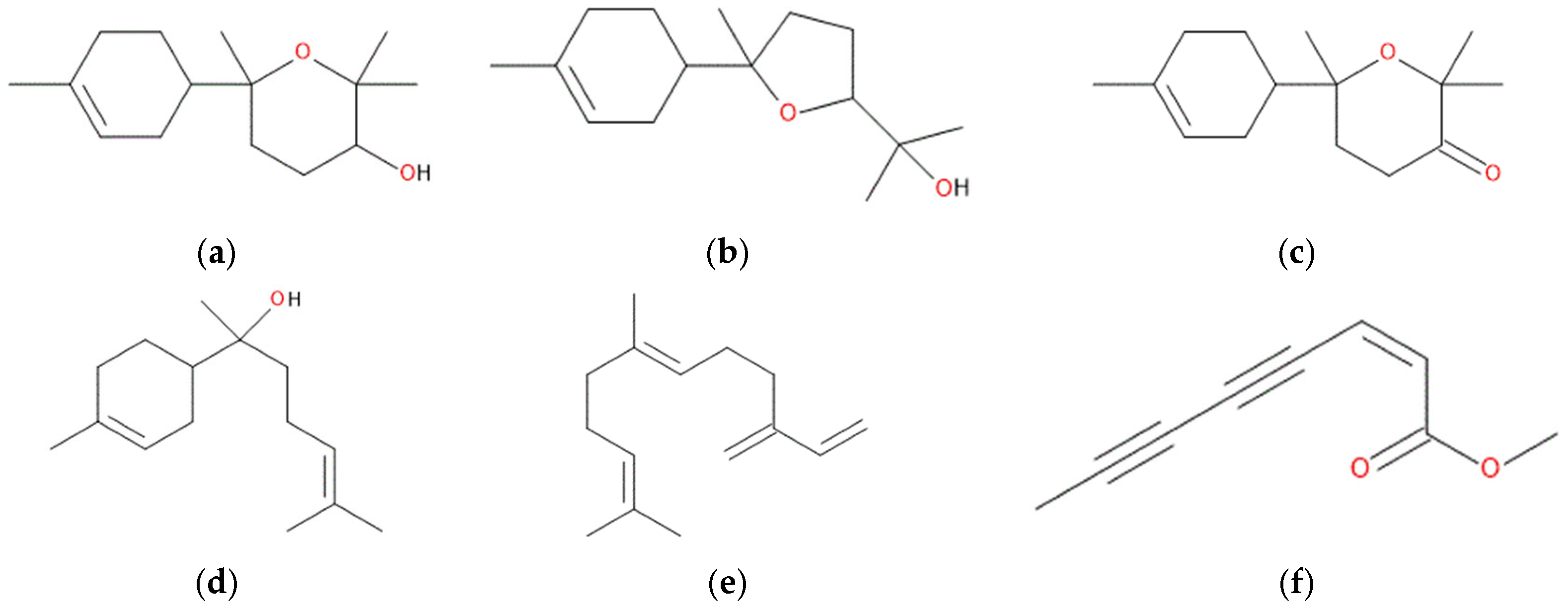
The essential oil of chamomile contains mostly oxygenated sesquiterpenes (76.80%), followed by other oxygenated/aromatic compounds (14.45%) and sesquiterpene hydrocarbons (8.71%). Among the identified bioactive compounds, the major ones are bisabolol oxide A (39.49%), bisabolol oxide B (18.69%), bisabolone oxide A (12.73%), ß-farnesene (7.96%), lachnophyllum ester, trans (6.18%), and chamazulene (4.24%) (Figure 2). Based on its chemical profile, chamomile, can be classified as chemotype B, with bisabolol oxide A as the major compound [4,5,28].
Figure 2.
Bioactive compounds from the two chamomile essential oils. (a) Bisabolol oxide A; (b) bisabolol oxide B; (c) bisabolone oxide A; (d) α-bisabolol; (e) ß-farnesene; (f) lachnophyllum ester, cis.
The essential oil of scentless chamomile has a different chemical profile, as revealed by GC-MS analysis. Thus, the major compounds are oxygenated and aromatic compounds (87.98%), with a smaller proportion of sesquiterpene hydrocarbons (11.56%). The predominant bioactive compounds discovered in this essential oil are 1,3-naphthalenediol (69.70%), followed by lachnophyllum ester, cis (11.59%), and ß-farnesene (11.56%) (Figure 2). While β-farnesene and cis-lachnophyllum ester were consistent with previous reports for T. inodorum, the tentative identification of 1,3-naphthalenediol is unexpected due to its low volatility. This signal may instead reflect a possible identification or co-elution with semi-volatile compounds and thus requires cautious interpretation until further validation.
It can be observed that several compounds are present in both species, such as ß-farnesene, lachnophyllum ester, cis, and (Z)-1-[isobenzofuran-1-ylidene]propan-2-one, due to a similar metabolism along the course of evolution, both species belonging to the same taxonomic genus.
3.3. Biological Activity Assays
3.3.1. Antioxidant Capacity
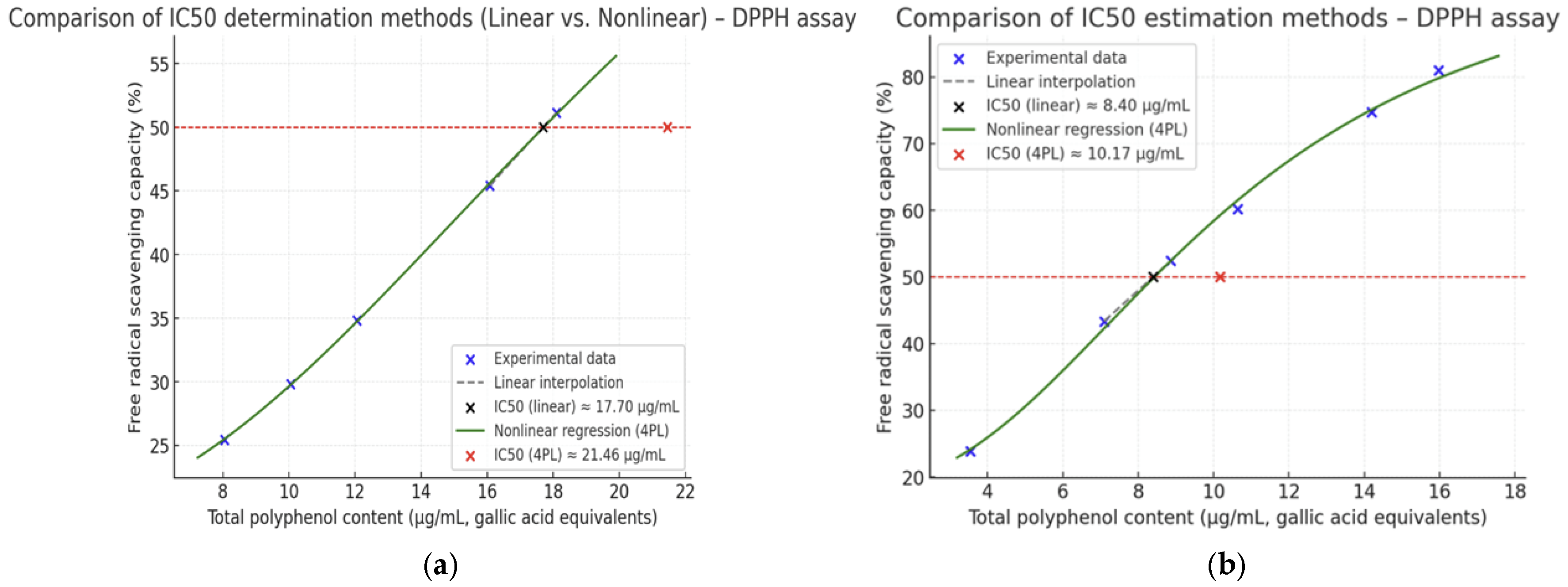
The antioxidant potential of the tested extracts evaluated using the DPPH is shown in Figure 3. For M. chamomilla, the IC50 was estimated at 17.7 µg/mL GAE using linear interpolation and 21.5 µg/mL GAE using the nonlinear model. For T. inodorum, the respective values were 8.40 µg/mL and 10.17 µg/mL GAE. The slight differences between the models highlight the importance of using sigmoidal regression to obtain reliable IC50 estimates. It is important to note that the DPPH assay, while widely used for rapid screening of antioxidants, has certain limitations. This method is based on a chemical reaction in a non-physiological medium and measures the ability of compounds to donate electrons or hydrogen atoms to a stable free radical. As a result, it does not account for factors such as bioavailability, enzymatic antioxidant systems, or synergistic effects that may occur in biological environments. This often leads to overestimations of radical-scavenging values compared to biological assays. To attain a more comprehensive evaluation, future studies should employ complementary methods such as ABTS, FRAP, or ORAC, as these can provide a broader assessment of antioxidant behaviour.
Figure 3.
IC50 determination by linear and nonlinear regression (DPPH assay). (a) M. chamomilla; (b) T. inodorum.
3.3.2. Antimicrobial Activity
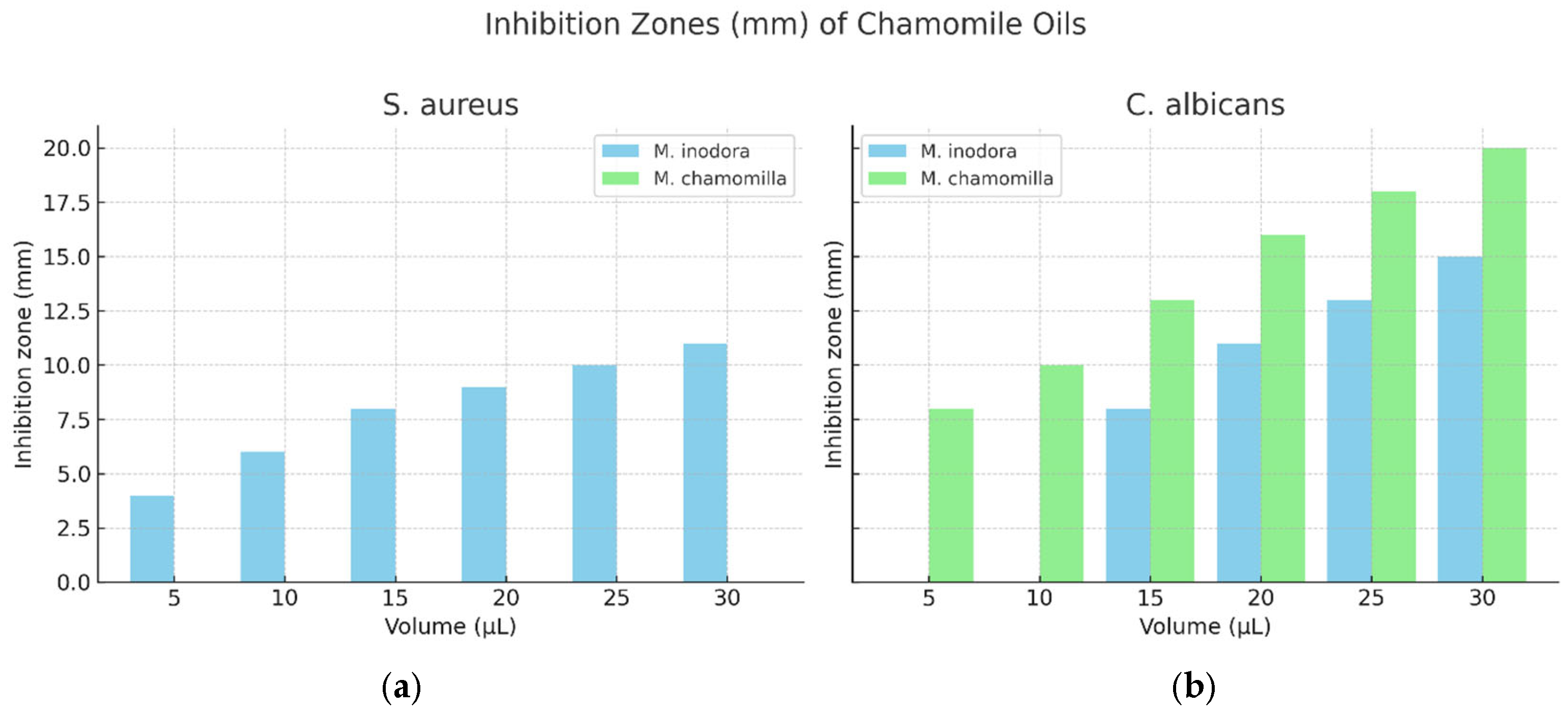
The antimicrobial assays revealed distinct differences between the two chamomile species. The essential oil obtained from T. inodorum exhibited both antibacterial activity against Gram-positive strains and antifungal activity against C. albicans (Figure 4). Antibacterial effects were detected at all tested volumes (5–30 µL), while antifungal inhibition zones were evident at higher volumes (15–30 µL). In contrast, the oil from M. chamomilla displayed only antifungal activity, which was consistently observed across all tested volumes. No inhibitory effect was observed for both essential oils against Escherichia coli and Pseudomonas aeruginosa under the tested conditions. These findings suggest a broader antimicrobial spectrum for T. inodorum, highlighting its potential as a more effective source of bioactive compounds compared to M. chamomilla.
Figure 4.
Inhibition zones (mm) produced by essential oils of M. chamomilla and T. inodorum against Staphylococcus aureus ATCC 25923 and Candida albicans ATCC 10231. (a) M. chamomilla; (b) T. inodorum.
4. Discussion
The comparative analysis of M. chamomilla and T. inodorum reveals that microscopic, phytochemical, and biological characteristics are closely interconnected, indicating that variations in structural features and chemical composition are reflected in their distinct antioxidant and antimicrobial activities.
This study highlights the diagnostic significance of both morphological and palynological characteristics in distinguishing the two species of chamomile. The observed differences in receptacle structure, ray florets and disc florets are consistent with previously reported taxonomic descriptions and represent reliable characters for species identification [28,29]. These findings underscore the value of detailed floral morphology for accurate species identification, for better knowing the plant material used for medicinal purposes. Palynological characteristics are consistent with previously published studies [28,30,31], and provide reliable diagnostic features for accurate species authentication within the Asteraceae family.
Furthermore, the size, shape, and exine surface of pollen are also important in triggering seasonal allergies. Although allergic reactions to the pollen of these two species are rarely reported, cross-reactive IgE-mediated anaphylactic responses may occur, particularly in individuals sensitised to ragweed or mugwort pollen [32]. Further research is needed to clarify the specific allergenic substances (haptenes), the significance of pollen morphology, and the underlying mechanisms by which these species may induce allergic responses.
The results of this study confirm that both M. chamomilla and M. inodora represent valuable sources of polyphenolic compounds with relevant biological potential. The total phenolic content measured for M. chamomilla (20.48 mg GAE/g DW) falls within the range reported by Sheydaei et al. (28.8 mg/g) and Haghi et al. (1.77–50.75 g GAE/100 g), while the total flavonoid content (13.87 mg RE/g DW) corresponds to the reported interval of 0.82–36.75 g QE/100 g [2,33,34].
For T. inodora, the total flavonoid content (15.93 mg RE/g DW) was considerably higher than that reported by Marakhova et al., who obtained 7.65 ± 0.03 mg RE/100 g DW using ultrasound-assisted extraction followed by heat treatment. These discrepancies likely reflect variations in extraction parameters and solvent polarity affecting flavonoid recovery. Marakhova et al. also emphasised the influence of harvest timing, noting that plants collected at full bloom exhibited the highest flavonoid levels [35]. Since the plant material analysed in the present study was harvested at this phenological stage, the higher flavonoid content is consistent with this observation.
In contrast to the findings of Sheydaei et al., who reported higher flavonoid concentrations in M. chamomilla, the present data indicate greater flavonoid accumulation in M. inodora (15.93 mg RE/g DW). This variation may result from interspecific chemotypic differences or environmental factors influencing the biosynthesis of secondary metabolites. The total phenolic and flavonoid contents obtained for T. inodora (17.88 mg GAE/g DW and 15.93 mg RE/g DW, respectively) are consistent with the range reported by Šibul et al. (2020) for wild-growing populations of M. inodora, where phenolic content varied between 13.7 and 18.7 mg/g, and flavonoid content ranged from 7.95 to 43.1 mg/g across regional samples [36]. Comparable patterns were also observed in other Tripleurospermum species; for instance, Kilic et al. (2012) reported total phenolic and flavonoid contents of 21.58 ± 1.9 mg GAE/g and 3.28 ± 0.45 mg QE/g, respectively, in methanolic extracts of T. parviflorum [37]. Collectively, these findings confirm that Tripleurospermum species, although less investigated than M. chamomilla, possess comparable levels of phenolic metabolites, supporting their pharmacological relevance. These results align with recent studies showing significant fluctuations in phenol and flavonoid profiles of Asteraceae species depending on harvest season and geographic origin [32].
The IC50 value for M. chamomilla (17.7–21.5 µg/mL) indicates moderate antioxidant activity, consistent with its higher polyphenol content, and falls at the lower end of the wide range reported for chamomile extracts (13.15–73.35 µg/mL), confirming its relevance as a natural source of antioxidants. T. inodorum showed comparable IC50 values (8.4–10.2 µg/mL), which may be attributed to its relatively higher flavonoid content. Although its potency does not approach that of classical antioxidants such as ascorbic acid or quercetin (IC50 < 5 µg/mL), its activity is consistent with other medicinal plants of moderate radical-scavenging capacity [38,39,40]. These findings underline the importance of considering both phenolic and flavonoid fractions when evaluating antioxidant potential, which is why the antioxidant capacity was assessed on hydroethanolic extracts, where such compounds are the main contributors to radical scavenging activity. In contrast, antimicrobial assays were performed on essential oils, rich in volatile terpenoids with well-documented antibacterial and antifungal effects. This complementary approach allowed us to capture the distinct bioactive potential of the polar versus volatile fractions of the two chamomile species.
The chemical profile of M. chamomilla essential oil, classified as chemotype B, is characterised by bisabolol oxide A as the major compound (39.49%). This amount is quite similar to samples reported from Armenia (27.2%), Estonia (27.5–56.0%), or Albania (45.47), where bisabolol oxide A was also the main component [4,5,28]. As bisabolol oxides (A and B) are natural oxidation derivates of α- bisabolol, known for their anti-inflammatory, antihyperalgesic, antimicrobial, antiedematous, and wound-healing properties [41,42,43,44], these findings underscore the therapeutic potential of the species. Bisabolol oxide B (18.69%) represents another predominant constituent of chamomile essential oil, showing higher levels compared to samples originating from Germany (10.02–13.91%), Bulgaria (11.60%), and Nepal (4.5%) [45,46,47]. Bisabolone oxide A (12.73%), the third major compound, exhibits similar percentages to those reported from Germany (11.33–12.47%), and higher than those from Nepal (4.0%) [45,47]. β-Farnesene is also present in considerable amounts (7.96%), though slightly lower than that found in Turkish samples (13.8%) [48]. Beyond its antimicrobial and anti-inflammatory potential, β-farnesene functions as an ecological signalling compound, acting as an alarm pheromone in certain insects and as a plant defence metabolite against herbivory [49,50]. Trans-lachnophyllum ester (6.18%), an acetylenic compound known for its antifungal and antioxidant activity [51], is of particular interest since it is rarely reported in chamomile and generally found only in small quantities. However, previous chemical analyses have noted the occurrence of diacetylenes such as cis-lachnophyllum ester and matricaria ester within the genera of the Asteraceae family, such as Erigeron (37.20%), Blumea (25.5%), or Conyza (57.24%), so its presence in this species or related species is not unexpected [52,53,54,55]. An important compound, found in the essential oil of chamomile that contributes to its characteristic blue colour is chamazulene, a sesquiterpene derivate. In the Romanian chamomile sample, the chamazulene content (4.24%) falls within the range reported in the literature (2.3–10.9%) [28]. Chamazulene is generated from matricin, during hydrodistillation, and exhibits anti-inflammatory, antispasmodic, and antioxidant properties, thereby contributing significantly to the pharmacological profile of the plant, along with other major compounds [6,56].
In contrast, the essential oil of T. inodorum displays a comparatively simpler phytochemical profile, characterised by fewer bioactive constituents. Here, cis-lachnophyllum ester emerges as a major component (11.59%), significantly higher than in M. chamomilla, and contributes substantially to the oil’s antifungal, antioxidant, and cytotoxic activities [54,55]. β-Farnesene, a sesquiterpene alkene accounting for 11.56% of the composition and known for its anti-inflammatory and neuroprotective properties [57], was also reported by Chehregani et al. in the genus Tripleurospermum, in higher amounts (22.46%) [58]. Thus, T. inodorum emerges as a species of therapeutic interest due to its distinctive bioactive profile.
Overall, the chemical composition of the essential oils in the two species is influenced by the biodiversity of geographical and climatic conditions. Therefore, understanding these environmental factors is important for accurately characterising their chemotypes and for guiding their potential therapeutic, ecological agricultural and industrial applications.
The broader antimicrobial spectrum of T. inodora essential oil, active against both S. aureus and C. albicans, contrasts with the strictly antifungal effect of M. chamomilla. This difference reflects their distinct chemotypes, with β-farnesene and lachnophyllum ester in T. inodora linked to antimicrobial activity, while bisabolol derivatives in M. chamomilla are primarily associated with anti-inflammatory and antifungal effects. Our findings are consistent with previous reports: M. chamomilla oils are known to inhibit Candida species, particularly due to α-bisabolol oxides and chamazulene, whereas T. disciforme [58] and T. inodorum extracts [59,60] demonstrated antibacterial and antifungal activity. Together, these results confirm that both volatile and polar fractions of T. inodorum contribute to its antimicrobial potential, supporting its recognition as an underexplored source of bioactive metabolites.
Future research is needed to deepen the understanding of the chemical profiles of both chamomile species, identifying potential new pharmacological effects, and evaluate their safety and toxicity.
5. Conclusions
This study provides an integrative comparison of Matricaria chamomilla and Tripleurospermum inodorum, emphasising their distinct morphological, chemical, and biological features. M. chamomilla exhibited a higher total polyphenol content (20.48 mg GAE/g DW) and an essential oil dominated by oxygenated sesquiterpenes such as bisabolol oxides and chamazulene. In contrast, T. inodorum accumulated more flavonoids (15.93 mg RE/g DW) and produced an oil rich in β-farnesene and cis-lachnophyllum ester. Both species exhibited moderate antioxidant activity, with IC50 values ranging from 17.7 to 21.5 µg/mL for M. chamomilla and from 8.4 to 10.2 µg/mL for T. inodorum. The broader antimicrobial spectrum observed for T. inodorum, active against both Staphylococcus aureus and Candida albicans, highlights its potential as an underexplored source of natural antioxidants and antimicrobial agents. These findings not only confirm the chemical and biological distinctiveness of T. inodorum but also support its taxonomic differentiation from M. chamomilla, reinforcing the importance of accurate identification in phytochemical and pharmacological studies.
Supplementary Materials
The following supporting information can be downloaded at: https://www.mdpi.com/article/10.3390/compounds5040050/s1. Figure S1: Disc florets in microscopic view (10×). (a) M. chamomilla; (b) T. inodorum; Figure S2: Pollen grains in microscopic view (100×). (a,b) M. chamomilla; (c,d) T. inodorum; Figure S3: GC-MS chromatogram of M. chamomilla; Figure S4: GC-MS chromatogram of T. inodorum.
Author Contributions
Conceptualization, M.P. (Mariana Panțuroiu) and M.L.G.; methodology, M.P. (Mariana Panțuroiu) and M.L.G.; software, R.C.S.; validation, C.E.M. and R.C.S.; formal analysis, M.P. (Mariana Panțuroiu) and M.L.G.; investigation, M.P. (Mariana Panțuroiu), M.L.G., M.P. (Mariana Popescu). and E.P.; resources, M.P. (Mariana Panțuroiu), E.P. and M.L.G.; data curation, R.C.S. and C.E.M.; writing—original draft preparation, M.P. (Mariana Panțuroiu) and M.L.G.; writing—review and editing, M.P. (Mariana Panțuroiu), M.L.G. and E.P.; visualisation, M.P. (Mariana Panțuroiu); supervision, R.C.S. All authors have read and agreed to the published version of the manuscript.
Funding
This research received no external funding.
Data Availability Statement
The original contributions presented in this study are included in the article/Supplementary Material. Further inquiries can be directed to the corresponding authors.
Conflicts of Interest
The authors declare no conflicts of interest.
References
- Haţieganu, E.; Gălăţanu, M.L. Botanică Farmaceutică. Sistematică Vegetală; Editura Hamangiu: Bucureşti, Romania, 2023; pp. 301–302. [Google Scholar]
- Sheydaei, P.; Duarte, A.P. The Genus Tripleurospermum Sch. Bip. (Asteraceae): A Comprehensive Review of Its Ethnobotanical Utilizations, Pharmacology, Phytochemistry, and Toxicity. Life 2023, 13, 1323. [Google Scholar] [CrossRef] [PubMed]
- El Mihyaoui, A.; Esteves da Silva, J.C.G.; Charfi, S.; Candela Castillo, M.E.; Lamarti, A.; Arnao, M.B. Chamomile (Matricaria chamomilla L.): A Review of Ethnomedicinal Use, Phytochemistry and Pharmacological Uses. Life 2022, 12, 479. [Google Scholar] [CrossRef] [PubMed]
- Orav, A.; Raal, A.; Arak, E. Content and composition of the essential oil of Chamomilla recutita (L.) Rauschert from some European countries. Nat. Prod. Res. 2010, 24, 48–55. [Google Scholar] [CrossRef] [PubMed]
- Salamon, I.; Ibraliu, A.; Kryvtsova, M. Essential Oil Content and Composition of the Chamomile Inflorescences (Matricaria recutita L.) Belonging to Central Albania. Horticulturae 2023, 9, 47. [Google Scholar] [CrossRef]
- Srivastava, J.K.; Shankar, E.; Gupta, S. Chamomile: A herbal medicine of the past with bright future. Mol. Med. Rep. 2010, 3, 895–901. [Google Scholar] [CrossRef]
- Wichtl, M. Herbal Drugs and Phytopharmaceuticals: A Handbook for Practice on a Scientific Basis, 3rd ed.; MedPharm Scientific Publishers: Stuttgart, Germany, 2004; pp. 322–325. [Google Scholar]
- Amsterdam, J.D.; Li, Y.; Soeller, I.; Rockwell, K.; Mao, J.J.; Shults, J. A randomized, double-blind, placebo-controlled trial of oral Matricaria recutita (chamomile) extract therapy for generalized anxiety disorder. J. Clin. Psychopharmacol. 2009, 29, 378–382. [Google Scholar] [CrossRef]
- Amsterdam, J.D.; Shults, J.; Soeller, I.; Mao, J.J.; Rockwell, K.; Newberg, A.B. Chamomile (Matricaria chamomilla L.) may provide antidepressant activity in anxious, depressed humans: An exploratory study. Altern. Ther. Health Med. 2012, 18, 44–49. [Google Scholar]
- Kazemi, S.M.A.; Shojaei-Zarghani, S.; Eskandarzadeh, P.; Hashempur, M.H. Effects of Chamomile (Matricaria chamomilla L.) on Sleep: A Systematic Review and Meta-Analysis of Clinical Trials. Complement. Ther. Med. 2024, 84, 103071. [Google Scholar] [CrossRef]
- Hashempur, M.H.; Ghasemi, M.S.; Daneshfard, B.; Ghoreishi, P.S.; Lari, Z.N.; Homayouni, K.; Zargaran, A. Efficacy of Topical Chamomile Oil for Mild and Moderate Carpal Tunnel Syndrome: A Randomized Double-Blind Placebo-Controlled Clinical Trial. Complement. Ther. Clin. Pract. 2017, 26, 61–67. [Google Scholar] [CrossRef]
- Segal, R.; Pilote, L. Warfarin interaction with Matricaria chamomilla. CMAJ 2006, 174, 1281–1282. [Google Scholar]
- Göger, G.; Yüksel, D.; Göger, F.; Köse, Y.B.; Demirci, F. Antimicrobial evaluation of Tripleurospermum callosum (Boiss. & Heldr.) E. Hossain extracts using in vitro and in vivo Caenorhabditis elegans model against urinary system pathogens. Int. J. Environ. Health Res. 2024, 34, 1466–1478. [Google Scholar]
- Ćavar Zeljković, S.; Ayaz, F.A.; Inceer, H.; Hayirlioglu-Ayaz, S.; Colak, N. Evaluation of Chemical Profile and Antioxidant Activity of Tripleurospermum insularum, a New Species from Turkey. Nat. Prod. Res. 2015, 29, 293–296. [Google Scholar] [CrossRef]
- Suleimen, Y.M.; Van Hecke, K.; Ibatayev, Z.A.; Iskakova, Z.B.; Akatan, K.; Martins, C.; Silva, T. Crystal Structure and Biological Activity of Matricaria Ester Isolated from Tripleurospermum inodorum (L.) Sch. Bip. J. Struct. Chem. 2018, 59, 988–991. [Google Scholar] [CrossRef]
- Mahernia, S.; Bagherzadeh, K.; Mojab, F.; Amanlou, M. Urease Inhibitory Activities of some Commonly Consumed Herbal Medicines. Iran. J. Pharm. Res. 2015, 14, 943–947. [Google Scholar]
- Samatadze, T.E.; Zoshchuk, S.A.; Amosova, A.V.; Rodionov, A.V. Comparative cytogenetic study of the tetraploid Matricaria chamomilla L. and Matricaria inodora L. Biol. Bull. 2014, 41, 109–117. [Google Scholar] [CrossRef]
- Applequist, W.L. A reassessment of the nomenclature of Matricaria L. and Tripleurospermum Sch. Bip. (Asteraceae: Anthemideae). Taxon 2002, 51, 757–761. [Google Scholar] [CrossRef]
- Punt, W.; Hoen, P.P.; Blackmore, S.; Nilsson, S.; Le Thomas, A. Glossary of pollen and spore terminology. Rev. Palaeobot. Palynol. 2007, 143, 1–81. [Google Scholar] [CrossRef]
- Erdtman, G. The acetolysis method: A revised description. Sven. Bot. Tidskr. 1960, 54, 561–564. [Google Scholar]
- Rîmbu, M.C.; Cord, D.; Savin, M.; Grigoroiu, A.; Mihăilă, M.A.; Gălățanu, M.L.; Ordeanu, V.; Panțuroiu, M.; Țucureanu, V.; Mihalache, I.; et al. Harnessing Plant-Based Nanoparticles for Targeted Therapy: A Green Approach to Cancer and Bacterial Infections. Int. J. Mol. Sci. 2025, 26, 7022. [Google Scholar] [CrossRef]
- Gălățanu, M.L.; Panțuroiu, M.; Cima, L.M.; Neculai, A.M.; Pănuș, E.; Bleotu, C.; Enescu, C.M.; Mircioiu, I.; Gavriloaia, R.M.; Aurică, S.N.; et al. Polyphenolic Composition, Antioxidant Activity, and Cytotoxic Effect of Male Floral Buds from Three Populus Species Growing in the South of Romania. Molecules 2025, 30, 913. [Google Scholar] [CrossRef]
- Agentia Natională a Medicamentului. Farmacopeea Română; Editura Medicala: București, Romania, 1993; p. 335. [Google Scholar]
- European Directorate for the Quality of Medicines HealthCare of the Council of Europe. European Pharmacopoeia, 10th ed.; Council of Europe: Strasbourg, France, 2019; Volume I, Available online: https://www.edqm.eu/en/european-pharmacopoeia-ph.-eur.-11th-edition (accessed on 27 May 2025).
- Panturoiu, M.; Galatanu, M.L.; Cristache, R.E.; Truta, E. Characterisation of nutraceutical fatty acids and amino acids in the buds of Populus nigra, Populus alba, and Populus × euramericana by gas chromatography. J. Sci. Arts 2025, 25, 395. [Google Scholar] [CrossRef]
- Clinical and Laboratory Standards Institute (CLSI). Performance Standards for Antimicrobial Susceptibility Testing, 33rd ed.; CLSI document M100; CLSI: Wayne, PA, USA, 2023. [Google Scholar]
- Clinical and Laboratory Standards Institute (CLSI). Development of In Vitro Susceptibility Test Methods, Breakpoints, and Quality Control Parameters, 6th ed.; CLSI document M23; CLSI: Wayne, PA, USA, 2023. [Google Scholar]
- Singh, O.; Khanam, Z.; Misra, N.; Srivastava, M.K. Chamomile (Matricaria chamomilla L.): An overview. Pharmacogn. Rev. 2011, 5, 82–95. [Google Scholar] [CrossRef]
- Wilcox, M. Examining Tripleurospermum inodorum (Scentless False Mayweed). Br. Ir. Bot. 2022, 4, 113–146. [Google Scholar]
- Khan, S.; Jan, G.; Ahmad, M.; Gul, F.; Zafar, M.; Mangi, J.; Bibi, H.; Sultana, S.; Usma, A.; Majeed, S. Morpho-palynological assessment of some species of family Asteraceae and Lamiaceae of District Bannu, Pakistan on the bases of light microscope & scanning electron microscopy. Microsc. Res. Tech. 2021, 84, 1220–1232. [Google Scholar] [PubMed]
- Tümen, G.; Öztürk, M. The comparative pollen morphology of genera Matricaria L. and Tripleurospermum Sch. Bip. (Asteraceae) in Turkey. Turk. J. Bot. 2012, 36, 959–977. [Google Scholar]
- Ključevšek, T.; Kreft, S. Allergic potential of medicinal plants from the Asteraceae family. Health Sci. Rep. 2025, 8, e70398. [Google Scholar] [CrossRef] [PubMed]
- Saeedi, M.; Khanavi, M.; Shahsavari, K.; Manayi, A. Matricaria chamomilla: An Updated Review on Biological Activities of the Plant and Its Constituents. Res. J. Pharmacogn. 2024, 11, 109–136. [Google Scholar]
- Haghi, G.; Hatami, A.; Safaei, A.; Mehran, M. Analysis of phenolic compounds in Matricaria chamomilla and its extracts by UPLC-UV. Res. Pharm. Sci. 2014, 9, 31–37. [Google Scholar]
- Marakhova, A.; Zhilkina, O. The development of a method for obtaining Tripleurospermum inodorum extract with a high flavonoid content. Plants 2023, 12, 634. [Google Scholar]
- Šibul, F.; Orčić, D.; Berežni, S.; Anačkov, G.T. HPLC–MS/MS profiling of wild-growing scentless chamomile (Tripleurospermum inodorum L.). Acta Chromatogr. 2020, 32, 86–94. [Google Scholar] [CrossRef]
- Kilic, O.; Bagci, E. Chemical Composition of the Essential Oil of Tripleurospermum parviflorum (Willd.) Pobed. (Asteraceae) from Turkey. Asian J. Chem. 2012, 24, 1033–1036. [Google Scholar]
- Skrovankova, S.; Mlcek, J. Antioxidant Potential and Its Changes Caused by Various Factors in Lesser-Known Medicinal and Aromatic Plants. Horticulturae 2025, 11, 104. [Google Scholar] [CrossRef]
- Alsabri, S.G.; Zetrini, A.E.; Ermeli, N.B.; Mohamed, S.B.; Bensaber, S.M.; Hermann, A.; Gbaj, A. Study of Eight Medicinal Plants for Antioxidant Activities. J. Chem. Pharm. Res. 2012, 4, 4028–4031. [Google Scholar]
- Pisoschi, A.M.; Pop, A.; Cimpeanu, C.; Predoi, G. Antioxidant Capacity Determination in Plants and Plant-Derived Products: A Review. Oxid. Med. Cell Longev. 2016, 2016, 9130976. [Google Scholar] [CrossRef]
- Akram, W.; Ahmed, S.; Rihan, M.; Arora, S.; Khalid, M.; Ahmad, S.; Ahmad, F.; Haque, S.; Vashishth, R. An updated comprehensive review of the therapeutic properties of Chamomile (Matricaria chamomilla L.). Int. J. Food Prop. 2024, 27, 133–164. [Google Scholar] [CrossRef]
- Tomić, M.; Popović, V.; Petrović, S.; Stepanović-Petrović, R.; Micov, A.; Pavlović-Drobac, M.; Couladis, M. Antihyperalgesic and antiedematous activities of bisabolol-oxides-rich matricaria oil in a rat model of inflammation. Phytother. Res. 2014, 28, 759–766. [Google Scholar] [CrossRef]
- Alimi, D.; Hraoui, M.; Hajri, A.; Taamalli, W.; Selmi, S.; Sebai, H. Bioactivity and molecular docking studies of selected plant compounds. J. Sci. Food Agric. 2024, 104, 4391–4399. [Google Scholar] [CrossRef]
- Solovăstru, L.G.; Stîncanu, A.; De Ascentii, A.; Capparé, G.; Mattana, P.; Vâţă, D. Randomized, controlled study of innovative spray formulation containing ozonated oil and α-bisabolol in the topical treatment of chronic venous leg ulcers. Adv. Ski. Wound Care 2015, 28, 406–409. [Google Scholar] [CrossRef]
- Rathore, S.; Kumar, R. Dynamics of phosphorus and biostimulants on agro-morphology, yield, and essential oil profile of German chamomile (Matricaria chamomilla L.) under acidic soil conditions of the Western Himalaya. Front. Plant Sci. 2022, 13, 917388. [Google Scholar] [CrossRef]
- Yilmaz, S.; Fidan, H.; Çağlayan, M.; Stankov, S.; Yazar, S.; Stoyanova, A. Exploring the Chemical Composition and Anti-Cancer Potential of Matricaria recutita L. Essential Oil. Z. Naturforsch. C J. Biosci. 2025. advance online publication. [Google Scholar] [CrossRef]
- Satyal, P.; Shrestha, S.; Setzer, W.N. Composition and bioactivities of an (E)-β-farnesene chemotype of chamomile (Matricaria chamomilla) essential oil from Nepal. Nat. Prod. Commun. 2015, 10, 1453–1457. [Google Scholar] [CrossRef]
- Biltekin, S.N.; Karadağ, A.E.; Demirci, F.; Demirci, B. In vitro anti-inflammatory and anticancer evaluation of Mentha spicata L. and Matricaria chamomilla L. essential oils. ACS Omega 2023, 8, 17143–17150. [Google Scholar] [CrossRef] [PubMed]
- Schepetkin, I.A.; Özek, G.; Özek, T.; Kirpotina, L.N.; Khlebnikov, A.I.; Klein, R.A.; Quinn, M.T. Neutrophil immunomodulatory activity of farnesene, a component of Artemisia dracunculus essential oils. Pharmaceuticals 2022, 15, 642. [Google Scholar] [CrossRef] [PubMed]
- Wang, B.; Dong, W.; Li, H.; D’Onofrio, C.; Bai, P.; Chen, R.; Yang, L.; Wu, J.; Wang, X.; Wang, B.; et al. Molecular basis of (E)-β-farnesene-mediated aphid location in the predator Eupeodes corollae. Curr. Biol. 2022, 32, 951–962.e7. [Google Scholar] [CrossRef] [PubMed]
- Sobrinho, A.C.N.; Fontenelle, R.O.S.; Souza, E.B.; Morais, S.M. Antifungal and antioxidant effect of the lachnophyllum ester, isolated from the essential oil of Baccharis trinervis (Lam.) Pers., against dermatophytes fungi. Rev. Bras. Saude Prod. Anim. 2021, 22, e2122542021. [Google Scholar] [CrossRef]
- Nazaruk, J.; Kalemba, D. Chemical Composition of the Essential Oils from the Roots of Erigeron acris L. and Erigeron annuus (L.) Pers. Molecules 2009, 14, 2458–2465. [Google Scholar] [CrossRef]
- Lateef, R.; Bhat, K.A.; Chandra, S.; Banday, J.A. Chemical composition, antimicrobial and antioxidant activities of the essential oil of Conyza canadensis growing wild in Kashmir valley. Am. J. Essent. Oils Nat. Prod. 2018, 6, 321–331. [Google Scholar]
- Satyal, P.; Chhetri, B.K.; Dosoky, N.S.; Shrestha, S.; Poudel, A.; Setzer, W.N. Chemical Composition of Blumea lacera Essential Oil from Nepal. Biological Activities of the Essential Oil and (Z)-Lachnophyllum Ester. Nat. Prod. Commun. 2015, 10, 1749–1750. [Google Scholar] [CrossRef]
- Ferreira, R.C.; do Nascimento, Y.M.; de Araújo Loureiro, P.B.; Martins, R.X.; de Souza Maia, M.E.; Farias, D.F.; Tavares, J.F.; Gonçalves, J.C.R.; da Silva, M.S.; Sobral, M.V. Chemical Composition, In Vitro Antitumor Effect, and Toxicity in Zebrafish of the Essential Oil from Conyza bonariensis (L.) Cronquist (Asteraceae). Biomolecules 2023, 13, 1439. [Google Scholar] [CrossRef]
- McKay, D.L.; Blumberg, J.B. A review of the bioactivity and potential health benefits of chamomile tea (Matricaria recutita L.). Phytother. Res. 2006, 20, 519–530. [Google Scholar] [CrossRef]
- Turkez, H.; Sozio, P.; Geyikoglu, F.; Tatar, A.; Hacimuftuoglu, A.; Di Stefano, A. Neuroprotective effects of farnesene against hydrogen peroxide-induced neurotoxicity in vitro. Cell. Mol. Neurobiol. 2014, 34, 101–111. [Google Scholar] [CrossRef]
- Chehregani, A.; Mohsenzadeh, F.; Mirazi, N.; Hajisadeghian, S.; Baghali, Z. Chemical composition and antibacterial activity of essential oils of Tripleurospermum disciforme in three developmental stages. Pharm. Biol. 2010, 48, 1280–1284. [Google Scholar] [CrossRef]
- Marakhova, A.; Zhilkina, V.Y.; Elapov, A.; Sachivkina, N.; Samorodov, A.; Pupykina, K.; Krylova, I.; Kezimana, P.; Stoynova, A.M.; Venkatesan, R.; et al. The development of a method for obtaining Tripleurospermum inodorum (L.) Sch. Bip. herb extract enriched with flavonoids and an evaluation of its biological activity. Plants 2024, 13, 1629. [Google Scholar] [CrossRef]
- Ivanov, M.; Popov Aleksandrov, A.; Božunović, J.; Dias, M.I.; Calhelha, R.C.; Kulaš, J.; Barros, L.; Ferreira, I.C.F.R.; Stojković, D. Bioactive potential of Tripleurospermum inodorum with detailed insight into anti-inflammatory activity through in vitro, in vivo evaluations and network pharmacology. Inflammopharmacology 2025, 33, 3363–3376. [Google Scholar] [CrossRef]
Disclaimer/Publisher’s Note: The statements, opinions and data contained in all publications are solely those of the individual author(s) and contributor(s) and not of MDPI and/or the editor(s). MDPI and/or the editor(s) disclaim responsibility for any injury to people or property resulting from any ideas, methods, instructions or products referred to in the content. |
© 2025 by the authors. Licensee MDPI, Basel, Switzerland. This article is an open access article distributed under the terms and conditions of the Creative Commons Attribution (CC BY) license (https://creativecommons.org/licenses/by/4.0/).