1. Introduction
International tourism has demonstrated remarkable resilience and sustained expansion as of late 2025, having fully recovered from the unprecedented disruption caused by the COVID-19 pandemic and, in several respects, exceeding pre-pandemic benchmarks (
World Tourism Organization, 2025). According to the most recent UN Tourism World Tourism Barometer, global international tourist arrivals reached approximately 1.4 billion in 2024, representing an 11 percent increase relative to 2023 and a near-complete return to 2019 levels (
World Tourism Organization, 2024). During the first nine months of 2025, arrivals grew by a further 5 percent compared to the same period in 2024, surpassing 1.1 billion and placing global tourism volumes around 3 percent above pre-pandemic figures. Projections for the full year 2025 indicate moderate growth of 3–5 percent, underpinned by resilient travel demand, improved international connectivity, and robust performance in major source markets, notwithstanding persistent challenges such as elevated travel costs and ongoing geopolitical tensions (
Tehran Times, 2025).
This recovery reaffirms tourism’s pivotal role in the global economy, supporting approximately one in ten jobs worldwide and constituting a major source of foreign exchange earnings (
Jie, 2025). At the same time, the rapid rebound underscores the urgency of integrating sustainability considerations into tourism development strategies to mitigate environmental degradation, social pressures, and resource constraints associated with renewed growth.
Within this global context, the Asia-Pacific region has re-emerged as a key driver of international tourism dynamics, recording the fastest relative growth despite a delayed recovery compared to other regions (
Miller, 2025). In 2024, Asia received roughly 316 million international tourist arrivals, corresponding to 87 percent of its 2019 level. Between January and September 2025, arrivals increased by 8 percent, reaching approximately 90 percent of pre-pandemic volumes, with particularly strong rebounds observed in North-East Asia (
Xinhua, 2025). Destinations such as Japan, Vietnam, the Republic of Korea, Indonesia, Thailand, Singapore, Malaysia, India, and Cambodia have exhibited especially robust recoveries, supported by favorable exchange rate movements, enhanced air connectivity, policy liberalization, and targeted digital promotion, with several exceeding their 2019 benchmarks by late 2025 (
Antom, 2025).
The eight countries examined in this study—Cambodia, India, Indonesia, Japan, the Republic of Korea, Singapore, Thailand, and Vietnam—capture the heterogeneity of Asia’s tourism landscape, encompassing emerging heritage-based destinations, mass coastal tourism markets, and advanced urban and experiential hubs. Together, they illustrate the region’s substantial potential to shape global tourism growth in the coming decade, driven by expanding intra-regional travel, rising middle-class demand, and strategic policy initiatives.
Despite this positive momentum, the expansion of tourism in Asia faces significant structural and sustainability-related challenges. Overtourism has placed increasing pressure on iconic destinations such as Bali and Kyoto, leading to congestion, infrastructure overload, environmental degradation, and growing social discontent. Climate-related risks-including sea-level rise, extreme weather events, and ecosystem degradation-pose acute threats to nature-dependent destinations, while unsustainable tourism practices exacerbate carbon emissions, resource depletion, and waste generation. In several emerging economies, institutional weaknesses, regulatory gaps, and corruption risks continue to undermine investor confidence and equitable benefit distribution. Moreover, the post-pandemic rebound has often outpaced planning and governance capacity, intensifying seasonality, market volatility, and spatial imbalances.
Existing scholarly research on tourism determinants has largely focused on the tourism-led growth hypothesis, with comparatively limited attention paid to demand-side drivers such as international tourist arrivals (
Segarra et al., 2025;
Abbas et al., 2025;
Almeida, 2023). In the Asian context, long-run panel studies that simultaneously incorporate macroeconomic fundamentals, foreign direct investment (FDI), and institutional quality remain scarce, particularly those addressing cross-sectional dependence, slope heterogeneity, and recent global shocks extending through 2022 (
Odeleye et al., 2022;
Wahab et al., 2023;
Mamadiyarov et al., 2025). Furthermore, the moderating role of governance and differences between emerging and mature tourism markets have received insufficient empirical scrutiny, underscoring the need for advanced econometric techniques capable of generating robust and policy-relevant insights.
To align the conceptual framing with the notion of sustainable tourism demand, this study emphasizes not only the volume of international tourist arrivals but also the structural and institutional conditions that support long-run sustainability. Specifically, sustainable tourism demand is conceptualized as tourism growth that is resilient, inclusive, and supported by robust governance and effective institutional frameworks. Institutional quality, FDI, and trade openness are treated as key determinants that enable destinations to manage resources efficiently, respond to external shocks, and maintain tourism attractiveness over time. By integrating governance–environment–resilience linkages, the study situates international tourist arrivals within a broader sustainability perspective, highlighting that long-run tourism growth depends on macroeconomic stability, investment-led capacity expansion, and high-quality institutions that collectively foster resilient and sustainable tourism systems. This approach follows recent institutional tourism analyses, which emphasize that sustainability emerges from the interaction between economic, social, and governance dimensions rather than from visitor numbers alone.
Building on the identified gaps in the tourism economics literature and the contemporary challenges facing Asian destinations, this study is guided by the following research questions. First, what are the long-run effects of macroeconomic fundamentals—namely GDP per capita growth, inflation, and trade openness—on international tourist arrivals in selected Asian destinations? Second, to what extent do FDIs contribute to sustaining long-run tourism demand, particularly through capacity expansion and infrastructure development? Third, how does institutional quality influence international tourist arrivals, and does it exert an independent effect beyond traditional macroeconomic determinants? Fourth, does institutional quality moderate the impact of macroeconomic conditions and FDI on tourism demand, thereby acting as an amplifying or constraining mechanism? Finally, do these long-run relationships differ systematically between emerging and mature tourism markets within Asia, and what implications do such heterogeneities hold for designing effective and sustainable tourism policies?
Against this backdrop, the present study makes several important contributions to the literature on tourism economics and development by linking a robust theoretical framework with advanced empirical analysis. First, it provides new empirical evidence on the long-run determinants of international tourist arrivals in the top eight Asian destinations over the period 1995–2024, a regional and temporal context that has remained underexplored in previous research. Second, the study applies the Augmented Mean Group (AMG) estimator, which explicitly accounts for cross-sectional dependence arising from global shocks and regional spillovers, while allowing for slope heterogeneity across countries, thereby addressing key econometric limitations of earlier panel studies. Third, guided by the integrated theoretical framework combining international tourism demand theory, the investment-led development perspective, and institutional economics, the analysis incorporates macroeconomic fundamentals—GDP per capita growth, inflation measured via Consumer Price Index changes, and trade openness-alongside foreign direct investment (FDI) inflows and institutional quality. This approach captures both real-sector and financial channels influencing tourism demand while explicitly modeling the role of governance as a conditional factor that moderates the effectiveness of FDI. Fourth, the study constructs a composite Institutional Quality Index using Principal Component Analysis based on the Worldwide Governance Indicators, providing a multidimensional and theoretically grounded measure of governance that improves upon single-indicator approaches. Importantly, the study extends the empirical analysis by employing Method of Moments Quantile Regressions (MMQR) as a robustness check, enabling the examination of how the effects of GDP, CPI, FDI, trade openness, and institutional quality vary across the distribution of tourism inflows. This distributional approach uncovers significant heterogeneity in determinants—for example, GDP is particularly influential in countries with smaller tourism sectors, whereas the impact of FDI is strongly conditioned by institutional quality across most quantiles—highlighting that mean-based estimates may obscure important variations across countries with different tourism profiles. Finally, by integrating theory and empirical evidence, the study provides policy-relevant insights that clarify the relative importance of macroeconomic stability, institutional quality, and foreign investment in shaping long-run tourism performance, thereby informing both destination-specific strategies and regionally coordinated initiatives aimed at fostering sustainable, inclusive, and growth-enhancing tourism development in Asia.
The remainder of the paper is organized as follows. The next section reviews the relevant theoretical and empirical literature. This is followed by a description of the data sources, variable construction and the econometric methodology. The subsequent section presents empirical results, along with diagnostic and robustness analyses.
Section 7 discusses the findings, outlines policy implications in light of contemporary challenges, and concludes with recommendations for sustainable tourism development.
2. Literature Review
The tourism industry is widely characterized as a “clean” or smokeless sector that fulfills global demands for leisure and consumption (
Tan et al., 2024;
Nyaupane, 2023;
Zaytseva et al., 2024). Governments actively promote tourism development through policies related to immigration, foreign investment, and tourism services, with the aim of generating employment opportunities and fostering broader economic development (
Taufik et al., 2023;
P. G. Martins et al., 2022). As a result, tourism has become a central component of national development strategies in many countries.
A substantial body of literature has examined the long-term relationship between tourism development and economic growth, commonly referred to as the tourism-led growth hypothesis (TLGH). This hypothesis posits that tourism stimulates economic growth through multiple channels, including employment creation, foreign exchange earnings, and increases GDP (
Alhowaish, 2016). Conversely, economic growth may also promote tourism development by enabling investments in infrastructure and facilities such as hotels, transportation networks, restaurants, digital communication systems, and recreational amenities. Consequently, the empirical literature reflects a variety of causal patterns, including unidirectional, bidirectional, and non-causal relationships between tourism and economic growth (
Bilen et al., 2017;
Nunkoo et al., 2020;
Nyasha et al., 2020;
Pulido-Fernández & Cárdenas-García, 2020).
Numerous empirical studies provide strong support for the TLGH, demonstrating that tourism expansion significantly enhances economic growth. These findings suggest that policymakers can improve macroeconomic performance by implementing tourism-oriented development strategies (
Sokhanvar et al., 2018). Recent contributions by
Ansari (
2024) as well as
Singh and Alam (
2024) highlight tourism’s growing importance as a driver of development at both regional and national levels. Similarly,
Kyara et al. (
2021) report that tourism contributes more than 10% of global GDP and nearly 10% of total employment, accounting for approximately 330 million jobs worldwide. Moreover, tourism is widely believed to be growing at a faster rate than the global economy, underscoring its increasing economic significance. Beyond income and employment generation, tourism also contributes to poverty reduction, stimulates demand for domestic goods and services, and supports overall economic development.
At the country level, several studies confirm the positive growth effects of tourism.
Kyara et al. (
2021), using a vector autoregression (VAR) model for Tanzania over the period 1989–2018, identify a unidirectional causal relationship running from tourism development to economic growth, and emphasize the importance of sustainable tourism policies.
Ribeiro and Wang (
2020) find that tourism receipts exert a significant positive effect on economic growth in São Tomé using annual time-series data from 1997 to 2018. Similarly,
Kibara et al. (
2012), applying causality tests and ARDL bounds testing within an error-correction framework for Kenya (1983–2010), confirm a favorable relationship between tourism and economic growth.
In contrast, another strand of the literature supports the economic-driven tourism growth hypothesis (EDTH), which argues that economic growth stimulates tourism development.
Payne and Mervar (
2010), using the Toda–Yamamoto causality approach for Croatia (2000–2008), find that real GDP positively affects international tourism revenues. Likewise,
Oh (
2005) demonstrates that economic growth precedes tourism development in Korea using a VAR model with quarterly data from 1975 to 2001.
Several studies document bidirectional causality between tourism and economic growth.
Bilen et al. (
2017) identify mutual causality in 12 Mediterranean countries over the period 1995–2012 using panel Granger causality tests.
Fahimi et al. (
2018) report similar findings for microstates during 1995–2015, while
Dritsakis (
2004) documents bidirectional causality in Greece over the period 1960–2000, with particularly strong effects running from tourism to economic growth. Using a broader cross-country framework,
Sokhanvar et al. (
2018) find heterogeneous results across emerging market economies, with bidirectional causality observed in Chile, unidirectional tourism-led growth in some countries, reverse causality in others, and no significant relationship in several cases.
Beyond direction of causality, recent studies emphasize that the tourism–growth relationship is neither linear nor uniform across countries. Tourism development is widely acknowledged as an important driver of economic growth through spillover channels such as service exports, exchange rate dynamics, infrastructure expansion, technological innovation, and human capital accumulation (
Ahmad et al., 2022;
Chou, 2013;
Shi et al., 2020;
Eshov et al., 2025;
Hu et al., 2025). However, the magnitude of these effects varies with countries’ levels of economic development.
Sahni et al. (
2021) show that tourism has a stronger growth effect in countries at lower stages of development, while
Maneejuk et al. (
2022) as well as
Cheng and Zhang (
2020) document a nonlinear relationship between tourism development and economic growth. Additionally,
Liu et al. (
2022) demonstrate that policy uncertainty weakens the tourism–growth nexus. Evidence from a quantile-on-quantile approach further indicates that inbound tourism and foreign direct investment are positively related, suggesting that FDI serves as an indirect channel through which tourism influences economic growth (
Arain et al., 2020).
Despite extensive empirical investigation, the overall impact of tourism on economic growth remains inconclusive, largely due to differences in institutional environments across countries. Institutional quality plays a crucial role in shaping tourism development and its growth effects. Countries with stronger institutions tend to attract more international tourists, as effective governance reduces risks associated with political instability, corruption, weak property rights, and social unrest, while ensuring the provision of modern infrastructure and public services. A growing body of empirical evidence confirms that higher institutional quality significantly enhances international tourism inflows (
Ghalia et al., 2019;
Kuncoro, 2020;
Lee & Chen, 2020;
Tang, 2022). Tourists’ destination choices are highly sensitive to perceptions of security, governance effectiveness, and regulatory reliability (
Groizard et al., 2021;
Huang et al., 2022;
Shim et al., 2022).
Taken together, the literature suggests that institutional quality not only directly influences tourism development but also moderates the extent to which tourism contributes to economic growth. Consequently, tourism-led growth is more likely to materialize in countries with stable and effective institutional frameworks, highlighting the need to incorporate institutional factors when examining the tourism–growth nexus.
3. The Theoretical Framework
In this study, the concept of “sustainable tourism demand” is defined from a macro-institutional and long-run perspective rather than in terms of environmental or ecological indicators. Sustainability is understood as the ability of tourism demand to be maintained over time through stable, resilient, and predictable economic and institutional conditions. Specifically, institutional quality, macroeconomic stability, and trade openness are treated as structural drivers that enhance the persistence and growth of tourism inflows by fostering good governance, reducing uncertainty, promoting investor confidence, and facilitating international integration. By framing sustainability in this way, the study emphasizes the long-run resilience and stability of tourism demand across Asian economies, highlighting how sound institutions and macroeconomic fundamentals contribute to sustainable growth in tourism without focusing exclusively on environmental measures. This conceptualization clarifies the theoretical and empirical rationale for the study’s variable selection while aligning the notion of “sustainable tourism demand” with structural and governance-based determinants.
The theoretical framework of this study is developed by synthesizing three complementary strands of economic theory: international tourism demand theory, institutional economics, and the investment-led development perspective. The framework integrates classical tourism demand theory—highlighting income elasticity, relative prices, and destination competitiveness (
Lim, 1997,
1999;
Song & Li, 2008)—with institutional and governance perspectives (
Ritchie & Crouch, 2003;
Dwyer et al., 2000;
Nag & Mishra, 2023,
2024;
Jeong et al., 2023) to explain tourism inflows in Asian economies. According to standard tourism demand theory, international tourist arrivals depend on income levels and relative prices, where higher GDP reflects improved infrastructure, service capacity, and destination attractiveness, thereby stimulating tourism demand, while higher consumer prices reduce cost competitiveness and discourage travel (
Lim, 1997,
1999;
Song & Li, 2008). Extending this framework, foreign direct investment (FDI) enhances tourism through capital accumulation, infrastructure expansion, service upgrading, and international network spillovers, consistent with the eclectic (OLI) paradigm of
Dunning (
2001). However, the productivity of FDI depends on institutional quality, as emphasized in institutional economics (
North, 1990), which posits that strong institutions reduce uncertainty and transaction costs, thereby enhancing economic performance. In the tourism sector, sound institutions improve regulatory transparency, safety, and investor confidence, increasing the absorptive capacity of foreign capital (
Ritchie & Crouch, 2003;
Dwyer et al., 2000;
Nag & Mishra, 2023,
2024). Trade openness further supports tourism by deepening international integration, strengthening connectivity, and facilitating business and leisure mobility. Given differences in structural development and tourism maturity across countries, these effects are theoretically expected to vary along the distribution of tourism inflows, highlighting the need to examine heterogeneous impacts across emerging and mature tourism markets.
Formally, international tourism demand theory posits that tourism inflows depend on income and relative prices, such that
where
Y denotes income (GDP) and
P represents relative prices. The investment-led development perspective extends this demand function by incorporating capital accumulation through foreign direct investment and external integration via trade openness:
reflecting the role of foreign capital in expanding tourism infrastructure and service quality. Institutional economics further modifies this structure by introducing institutional quality as both an independent determinant and a conditioning factor influencing the productivity of investment:
Thus, the combined theoretical framework can be expressed as
where
captures demand-side effects,
reflects investment and integration channels, and
represents institutional conditioning effects. Assuming a multiplicative structure consistent with growth and tourism demand models, the integrated framework becomes
This representation explicitly demonstrates how the three theoretical strands are structurally integrated: tourism demand theory determines the core income–price relationship; the investment-led perspective introduces capital and openness effects; and institutional economics conditions and amplifies the impact of foreign investment through governance quality.
Overall, the proposed framework contributes theoretically by moving beyond fragmented approaches that examine tourism determinants in isolation and instead developing an integrated model that jointly embeds tourism demand theory, the investment-led development perspective, and institutional economics within a unified analytical structure. By conceptualizing institutional quality not merely as an additional determinant but as a conditioning factor that modifies the productivity of foreign direct investment, the framework introduces a complementarity mechanism that helps explain cross-country variation in tourism outcomes. Furthermore, by formally incorporating interaction effects and allowing for structural heterogeneity across different stages of tourism development, the framework extends conventional tourism demand models toward a more dynamic and context-sensitive perspective. In doing so, it provides a stronger theoretical foundation for analyzing how macroeconomic fundamentals, foreign capital, trade integration, and governance jointly shape long-run tourism inflows, particularly within structurally diverse Asian economies.
4. Data and Methodology
4.1. Data
Table 1 presents the variables employed in this study, along with their definitions, data sources, and temporal coverage for the top 8 tourist destination countries in Asia over the period 1995–2024. The selection of variables is guided by the tourism–economic growth literature and aims to capture the key economic, institutional, and macroeconomic channels through which tourism influences growth. International tourist arrivals serve as the primary proxy for tourism development. Measured by the total number of inbound tourists, this variable captures the scale and intensity of tourism activity in each country. Tourist arrivals are widely used in empirical studies as they directly reflect international tourism demand and are closely linked to foreign exchange earnings, employment generation, and service-sector expansion. The data are sourced from the World Development Indicators (
WDI, 2025), ensuring cross-country comparability and consistency over time. Economic growth is measured by GDP per capita growth. This indicator reflects improvements in average living standards while accounting for population dynamics, making it more suitable than aggregate GDP for cross-country growth analysis. GDP per capita growth is commonly adopted in tourism–growth studies to evaluate whether tourism contributes to sustainable economic progress rather than mere output expansion (
Khan et al., 2020;
Du et al., 2014). In this study, GDP per capita growth (in logs) is employed as a proxy for income to capture the dynamic changes in economic conditions and their impact on international tourism demand. While classical tourism demand models often use income levels, the growth rate allows for assessing how changes in economic performance influence tourism inflows over time, particularly in emerging economies where fluctuations can be substantial. The log transformation ensures that the estimated coefficients can be interpreted as elasticities, representing the percentage change in tourist arrivals associated with a 1% change in GDP growth. This approach is consistent with prior studies that examine dynamic responses in tourism demand (
Lim, 1997,
1999;
Song & Li, 2008) and provides comparability across countries with differing economic scales. Macroeconomic stability is captured by the consumer price index, measured as the annual percentage change in prices (
Hardi et al., 2024). Inflation plays a critical role in the tourism–growth nexus, as high and volatile inflation can reduce international competitiveness, discourage foreign investment, and erode tourists’ purchasing power. Including CPI allows the model to control for price instability that may affect both tourism demand and economic growth. Trade openness, defined as the ratio of total trade (exports plus imports) to GDP, is included to account for the role of international integration in economic growth (
Tahir & Azid, 2015;
Idris et al., 2017;
Shahzad & Miao, 2025). Consumer prices, measured via the Consumer Price Index (CPI), are included in the model as a proxy for tourism price competitiveness. While classical tourism demand models often employ relative price indices or real effective exchange rates to capture international competitiveness (
Lim, 1997;
Song & Li, 2008), CPI provides a widely available and comparable measure of the cost of living and travel expenses within a destination. Higher CPI values are expected to reduce tourism demand by increasing the relative cost of visiting a country. In this study, CPI is complemented by other determinants such as GDP, FDI, trade openness, and institutional quality to provide a comprehensive assessment of the economic, financial, and governance factors shaping sustainable tourism demand.
Tourism is closely linked to trade in services, and more open economies tend to benefit from stronger spillover effects between tourism, exports, and overall economic performance (
Khalid et al., 2021). Trade openness also reflects a country’s exposure to global markets, which is particularly relevant for tourism-driven economies in Asia (
Gupta & Das, 2025). FDI, measured as net inflows relative to GDP, is incorporated as a key transmission channel between tourism and economic growth. Tourism development often attracts FDI into hotels, transportation, infrastructure, and related service industries, while FDI itself can enhance productivity, technology transfer, and employment creation (
Dwyer, 2022). The inclusion of FDI allows the analysis to capture both direct and indirect growth effects associated with tourism expansion. Institutional quality represents a composite indicator constructed using Principal Component Analysis (PCA) based on governance-related variables from the World Development Indicators. This index reflects the effectiveness of political, legal, and administrative institutions, including regulatory quality, rule of law, and government effectiveness. Institutional quality is a crucial conditioning factor in the tourism–growth relationship, as countries with stronger institutions are better able to attract international tourists, ensure safety and service quality, protect property rights, and sustain long-term economic benefits from tourism (
Beha et al., 2024). The chosen time span (1995–2024) enables the analysis to capture long-run dynamics, structural changes in the tourism sector, and the evolving role of institutions in Asia’s leading tourist destinations. Taken together, the variables included in
Table 1 provide a comprehensive framework for examining the direct effects of tourism on economic growth, as well as the moderating role of institutional quality and key macroeconomic controls in the Asian context.
Most variables have complete series across all countries; however, a small number of missing observations exist for some indicators in specific years. These gaps are handled by the AMG and MMQR estimators, which accommodate unbalanced panels. Consequently, the total number of observations differs slightly between models depending on the variables included, and these variations are reported in the relevant tables to ensure transparency and reproducibility of the analysis.
Table 2 reports the descriptive statistics for the variables employed in the analysis of the top eight tourist destinations in Asia during the period 1995–2024.
International tourist arrivals record a mean of approximately 8.6 million, accompanied by a large dispersion, reflecting substantial differences in tourism activity across countries and time. GDP per capita growth averages 3.5%, but the wide range of values indicates notable volatility in economic performance, including periods of both rapid growth and economic downturns. Inflation remains moderate on average at about 4.0%, although the broad range suggests the presence of inflationary pressures and occasional deflation in some economies. FDI accounts for an average of 4.8% of GDP, with considerable variation, pointing to differences in investment inflows and capital mobility across the sample. Trade openness exhibits a high mean value, exceeding 114% of GDP, highlighting strong integration into international markets, alongside marked heterogeneity among countries. The institutional quality index has a mean close to zero, consistent with its standardized construction, while its dispersion indicates substantial variation in governance quality across countries and years.
This section presents the empirical framework used to examine the long-run determinants of tourism development in eight major Asian tourist destinations over the period 1995–2024. Drawing on tourism-led growth theory and the institutional economics literature, the model incorporates key macroeconomic indicators, external openness, foreign direct investment, and institutional quality to capture both economic and governance-related influences on international tourist arrivals. The specification allows for cross-country heterogeneity and common shocks affecting tourism dynamics across the region. Given the presence of cross-sectional dependence and mixed orders of integration among the variables, the empirical model is estimated using an approach suitable for long-run panel analysis.
4.1.1. Empirical Model Specification
Let
index countries and
denote time. The empirical model is specified as follows:
where
= natural logarithm of international tourist arrivals;
= natural logarithm of GDP per capita growth;
= natural logarithm of consumer price index (inflation proxy);
= natural logarithm of trade openness (% of GDP);
= natural logarithm of foreign direct investment inflows (% of GDP);
= institutional quality index constructed via principal component analysis;
= country-specific fixed effects capturing unobserved heterogeneity;
= error term.
The model captures the long-run determinants of tourism development by incorporating key macroeconomic indicators, external openness, foreign investment, and institutional quality. The log–log specification allows the estimated coefficients to be interpreted as elasticities, except for the institutional quality index, which is measured in levels. Given evidence of cross-sectional dependence, heterogeneous slope coefficients, and a mixed order of integration (I(0)/I(1)) based on CIPS unit root tests, the model is estimated using the Augmented Mean Group (AMG) estimator. This approach controls unobserved common factors and yields consistent long-run parameter estimates across countries.
We modeled tourism arrivals using three different models to examine the determinants of international tourist inflows and to understand the role of key economic and institutional factors.
4.1.2. Institutional Quality Index (IQI) Construction
A composite Institutional Quality Index (IQI) was constructed using Principal Component Analysis (PCA) based on six governance indicators from the Worldwide Governance Indicators (WGI) database: Voice and Accountability, Political Stability, Government Effectiveness, Regulatory Quality, Rule of Law, and Control of Corruption. All indicators were standardized prior to analysis, and PCA was applied to extract the common latent dimension underlying these measures. The first principal component (PC1), which captures the majority of the total variance across indicators, was retained and used as the IQI, with weights determined by the component loadings. This approach provides a statistically rigorous and data-driven measure summarizing overall institutional quality across the selected countries.
The correlation matrix in
Table 3 reveals consistently strong and positive associations among the six governance indicators, with correlation coefficients ranging from 0.65 to 0.88. The strongest correlations appear between Government Effectiveness and Regulatory Quality (0.88) and between Rule of Law and Control of Corruption (0.85), reflecting that higher institutional quality tends to be consistent across multiple governance dimensions. These high correlations indicate that the variables are well suited for dimension-reduction techniques such as PCA.
The eigenvalue structure in
Table 4 justifies retaining only PC1. PC1 has an eigenvalue of 3.72 and explains 62.0% of the total variance, far exceeding the Kaiser criterion. The remaining components each explain less than 12% of the variance, contributing little additional information.
Component loadings for PC1 are reported in
Table 5, with all values exceeding 0.70, confirming that each governance indicator contributes meaningfully to the latent institutional quality dimension.
Robustness checks in
Table 6 confirm the stability of the index. Alternative normalization (min–max scaling) produces a nearly identical structure (PC1 explains 60.5% of variance; correlation with baseline = 0.96). Leave-one-indicator-out tests yield correlations between 0.91 and 0.95, and missing value imputation does not materially affect factor loadings.
PCA diagnostics further confirm the suitability of the data. The KMO measure is 0.81, exceeding the recommended threshold of 0.70, and Bartlett’s Test of Sphericity is significant (χ
2 = 214.35,
p < 0.001), validating the use of PCA (
Table 7).
4.1.3. Model 1: Baseline Model of Tourism Arrivals
In this study, we estimate the determinants of tourism arrivals () using panel data from eight countries. Model 1 serves as the baseline specification, examining the effects of economic size (GDP), price levels (CPI), and foreign direct investment (FDI) on tourism arrivals, while controlling for unobserved, time-invariant country characteristics through fixed effects. The results indicate that higher GDP and FDI significantly increase tourism arrivals, whereas higher CPI reduces them, reflecting the sensitivity of tourism flows to both economic prosperity and relative prices.
4.1.4. Model 2: Extended Model Including Trade
Model 2 extends the baseline by including trade openness () as an additional explanatory variable. The inclusion of trade captures the role of global economic integration in attracting tourists. The results show that trade openness has a positive and significant effect on tourism arrivals, suggesting that countries more connected to international markets tend to experience higher inflows of tourists, in addition to the effects of GDP, CPI, and FDI.
4.1.5. Model 3: Interaction Model with Institutional Quality
Model 3 introduces an interaction term between FDI and institutional quality () to assess whether the effect of FDI on tourism arrivals depends on the quality of institutions. The results reveal that the positive effect of FDI on tourism is stronger in countries with higher institutional quality, highlighting the importance of effective institutions in enhancing the benefits of foreign investment for the tourism sector. Across all models, country fixed effects are included to account for unobserved heterogeneity, and standard errors are reported to assess statistical significance. Collectively, these findings suggest that macroeconomic conditions, trade openness, and institutional quality play important roles in shaping international tourism arrivals.
Table 8 presents the correlation matrix for the variables under the study. According to the findings of correlation matrix, international tourist arrivals are positively correlated with institutional quality and weakly with trade openness, but negatively correlated with GDP growth, inflation, and FDI. GDP growth is positively associated with inflation and FDI, while trade and FDI are strongly correlated, reflecting their close economic link. Institutional quality shows positive relationships with tourism and trade but negative associations with GDP growth and inflation. The correlation coefficients do not indicate severe multicollinearity, supporting the use of these variables in multivariate analysis. Furthermore, the Variance Inflation Factor (VIF) test results indicate that multicollinearity is not a concern among the explanatory variables, with all VIF values well below commonly accepted thresholds (e.g., 10), ensuring that the estimated coefficients are reliable and not distorted by excessive correlation among regressors.
4.2. Pre-Estimation Tests
4.2.1. Panel Unit Root Tests
To determine the stationarity properties of the panel variables, the study employs the
Pesaran (
2007) Cross-Sectionally Augmented IPS (CIPS) test. Unlike conventional unit root tests, the CIPS test accounts for cross-sectional dependence by including cross-sectional averages of lagged levels and first differences in the ADF regression for each country. The null hypothesis assumes that the series contains a unit root (non-stationary), while the alternative allows for at least some countries to be stationary. Given the presence of significant cross-sectional dependence, as indicated by Pesaran’s CD test, the CIPS test provides a more reliable assessment of stationarity. The outcomes of the test guide the choice of appropriate estimation methods. Since the AMG estimator accommodates variables integrated of order zero or one, it is sufficient that none of the series is integrated of order two, ensuring consistent estimation of long-run coefficients.
4.2.2. Panel Cointegration Test
After examining the order of integration using second-generation panel unit root tests, the study investigates whether a long-run equilibrium relationship exists among the variables. For this purpose, the
Westerlund (
2007) panel cointegration test is employed. The Westerlund test is a second-generation cointegration method that explicitly accounts for cross-sectional dependence, making it particularly suitable for panels where unobserved common shocks may affect multiple countries. The long-run relationship is specified as
where
represents the vector of explanatory variables—GDP per capita growth, consumer price index, trade openness, FDI inflows, and institutional quality—and
is the residual term. Rejection of the null hypothesis of no cointegration confirms the existence of a stable long-run relationship among the variables, providing justification for the use of the AMG estimator as the primary estimation technique.
4.2.3. Slope Homogeneity Test
To examine whether the effects of explanatory variables are uniform across countries, the study applies the
Pesaran and Yamagata (
2008) slope homogeneity test. The null hypothesis assumes that the slope coefficients are identical across cross-sectional units, while the alternative allows for heterogeneity. Rejection of the null hypothesis indicates significant cross-country variation, supporting the application of heterogeneous panel estimators such as AMG.
4.2.4. Heteroskedasticity, Autocorrelation, and Cross-Sectional Dependence Tests
Before estimation, classical assumptions of panel data models are assessed to ensure robust results. Heteroskedasticity is tested using Cameron & Trivedi’s test, the Breusch–Pagan/Cook–Weisberg test, and the modified Wald test for groupwise heteroskedasticity in fixed-effects models. Serial correlation is examined with the Wooldridge test for autocorrelation in panel data, while cross-sectional dependence is assessed using
Pesaran’s (
2014) CD test. The results of these diagnostic tests confirm the presence of heteroskedasticity, autocorrelation, and cross-sectional dependence, highlighting the need for robust estimation methods. Accordingly, the AMG estimator is employed, as it can account for slope heterogeneity, cross-sectional dependence, and other violations of classical panel assumptions.
4.2.5. Estimation Techniques
Main Estimation: Augmented Mean Group (AMG)
To account for cross-sectional dependence, heterogeneity, and unobserved common factors, the AMG estimator (
Eberhardt & Bond, 2009) is employed. The AMG model augments the standard panel regression with a common dynamic effect
obtained from first-differenced pooled regressions:
Here, captures unobserved common factors (e.g., global shocks) that affect all countries, allowing slope heterogeneity across countries while mitigating bias from cross-sectional dependence.
Robustness Check: Method of Moments Quantile Regression (MMQR)
To verify the consistency of results across the conditional distribution of tourism arrivals, MMQR is employed (
Machado & Santos Silva, 2019). The MMQR framework models the
-th conditional quantile of
as
where
denotes the quantile of interest, and
are quantile-specific coefficients. MMQR addresses potential heterogeneity in the impact of covariates across low, median, and high tourism arrival countries, providing a robust check of the AMG estimate.
The Augmented Mean Group (AMG) estimator is employed to account for cross-sectional dependence, unobserved common factors, and heterogeneous slope coefficients across countries, which are likely present due to global shocks and regional spillovers in tourism. AMG provides robust long-run estimates even when countries respond differently to macroeconomic and institutional determinants. Compared to other second-generation panel estimators, such as the Common Correlated Effects Mean Group (CCEMG;
Pesaran, 2007) and the Cross-Sectionally Augmented ARDL (CS-ARDL;
Chudik & Pesaran, 2015), the AMG estimator is particularly suited for panels with a relatively small number of cross-sectional units and a moderate time dimension, as in the present study. Unlike CCEMG, which focuses on long-run equilibrium relationships with strong cross-sectional averages, AMG explicitly incorporates dynamic common factors into the error structure, improving estimation efficiency in the presence of unobserved global or regional shocks. Similarly, while CS-ARDL accommodates both short- and long-run dynamics under cross-sectional dependence, AMG provides robust long-run coefficient estimates without imposing strict lag structures. This methodological choice ensures consistent and reliable estimation of the long-run effects of macroeconomic fundamentals, FDI, trade openness, and institutional quality on tourism inflows. To complement this analysis, Method of Moments Quantile Regressions (MMQRs) are applied to examine how the effects of GDP, consumer prices, FDI, trade openness, and institutional quality vary across the distribution of tourism inflows. While the AMG estimator provides average long-run effects across the panel, it does not capture potential heterogeneity in the impact of explanatory variables across different levels of the dependent variable. Therefore, the Method of Moments Quantile Regression (MMQR) approach is employed to examine whether the estimated relationships vary across the conditional distribution of the dependent variable. This allows for a more comprehensive assessment of heterogeneous effects, particularly in the presence of non-normality, asymmetry, and potential distributional differences across countries. Consequently, MMQR complements AMG by revealing whether the determinants exert differential impacts at lower, median, and upper quantiles.
Table 9 presents diagnostic tests for heteroskedasticity, autocorrelation, and cross-sectional dependence in the panel dataset. The Breusch–Pagan/Cook–Weisberg test (χ
2 = 24.31,
p < 0.01) and the Modified Wald test for groupwise heteroskedasticity in the fixed-effects model (χ
2 = 141.80,
p < 0.01) both indicate the presence of heteroskedasticity, suggesting that the variance of the error terms is not constant across observations. The Wooldridge test for autocorrelation (F = 34.449,
p < 0.01) confirms significant serial correlation within panels, implying that shocks to tourism inflows or macroeconomic variables are persistent over time. Furthermore, Pesaran’s test for cross-sectional independence (12.711,
p < 0.01) reveals significant cross-sectional dependence, indicating that unobserved common factors or regional/global shocks simultaneously affect multiple countries. Collectively, these results underscore the necessity of employing panel estimation techniques, such as the Augmented Mean Group (AMG) estimator, which account for heteroskedasticity, autocorrelation, cross-sectional dependence, and slope heterogeneity, thereby ensuring consistent and reliable inference.
Table 10 reports the results of the Cross-sectionally Augmented Im–Pesaran–Shin (CIPS) panel unit root tests for the variables included in the analysis. The findings indicate that GDP per capita growth, inflation, and foreign direct investment are stationary in levels, whereas international tourist arrivals, trade openness, and institutional quality exhibit unit roots at levels but become stationary after first differencing. These results suggest a mixed order of integration, with variables integrated of order zero, I(0), and order one, I(1).
Given the presence of both stationary and non-stationary variables, along with potential cross-sectional dependence across countries, the use of the Augmented Mean Group (AMG) estimator is appropriate. The AMG approach explicitly accounts for unobserved common factors and heterogeneous slope coefficients, while remaining robust to a mixture of I(0) and I(1) regressors. The stationarity properties confirmed by the CIPS test therefore support the suitability of the AMG estimator and ensure consistent estimation of long-run coefficients, allowing for reliable inference on the relationships between tourism development, macroeconomic conditions, and institutional quality in the leading Asian tourist destinations.
Table 11 presents the results of the Westerlund panel cointegration test, which examines whether a long-run equilibrium relationship exists among the key variables in the study, namely tourism, economic growth, macroeconomic controls, FDI, trade openness, and institutional quality. The variance ratio statistic is 8.4264 and is statistically significant at the 1% level (
p = 0.0000), indicating strong evidence of cointegration. This result confirms that despite some variables being non-stationary in levels, a stable long-run relationship exists among the series. Consequently, it justifies the use of long-run estimators, such as the AMG method, to investigate the enduring effects of tourism and institutional quality on economic growth in the top eight Asian tourist destinations. The cointegration finding ensures that the estimated relationships are not spurious and that the long-term interactions captured by the AMG regression reflect meaningful economic linkages.
Table 12 reports the results of the
Pesaran and Yamagata (
2008) slope homogeneity test, which examines whether the slope coefficients in the panel regression are homogeneous across countries. Both the Delta (Δ) and Adjusted Delta statistics are highly significant at the 1% level (
p = 0.000), rejecting the null hypothesis of slope homogeneity. This indicates that the effects of tourism, economic growth, inflation, trade openness, FDI, and institutional quality vary significantly across the top eight Asian tourist destinations. The presence of slope heterogeneity justifies the use of the AMG estimator, which accommodates country-specific heterogeneity in long-run coefficients, allowing each country to have distinct responses while producing robust average estimates for the panel.
5. Empirical Findings
Table 13 presents Augmented Mean Group (AMG) estimation results for the long-run determinants of international tourist arrivals in the top Asian tourist destinations over the period 1995–2024. The AMG estimator is particularly suitable in this setting as it accounts for cross-sectional dependence, unobserved common dynamic factors, and slope heterogeneity across countries. Consequently, the reported coefficients can be interpreted as average long-run elasticities, capturing percentage changes in tourist arrivals in response to percentage changes in the explanatory variables, while allowing tourism dynamics to differ across destinations.
The results indicate that real GDP has a positive and highly significant effect on tourist arrivals across all specifications, with elasticities ranging from 0.016 to 0.020. A 1% increase in GDP corresponds to a 0.016–0.020% increase in international arrivals, holding other factors constant. Economic expansion facilitates sustained investment in tourism infrastructure, transport networks, and hospitality services, while also enhancing destination branding and global visibility. This positive relationship between economic size and tourism demand is consistent with the tourism demand literature, which emphasizes income and market size as fundamental drivers of inbound visitor flows (
L. F. Martins et al., 2017;
Gwenhure & Odhiambo, 2016). In emerging economies such as Cambodia, India, Indonesia, Thailand, and Vietnam, higher GDP translates into improvements in public capital and service quality that are essential for attracting international tourists. In advanced economies, including Japan, Korea, and Singapore, GDP growth not only supports infrastructure but also strengthens global reputation and facilitates the development of sophisticated tourism products such as cultural, medical, and business tourism (
Özer et al., 2022). Within the AMG framework, these results suggest that despite heterogeneous growth paths, GDP consistently exerts a robust long run influence on tourism demand, even after accounting for unobserved common shocks such as global economic cycles and regional tourism trends.
Consumer prices exhibit negative elasticities ranging from −0.051 to −0.124, implying that a 1% increase in domestic price levels reduces tourist arrivals by 0.05–0.12%. This supports the tourism price competitiveness hypothesis: higher domestic costs reduce the attractiveness of destinations, particularly in price sensitive emerging economies such as Cambodia and Vietnam. Price competitiveness is a central concept in tourism economics, where relative costs influence destination choice and expenditure patterns. In contrast, Japan and Singapore, as premium destinations, display lower sensitivity to price changes due to their orientation toward higher spending tourists. From a microeconomic consumer choice perspective, travelers substitute toward relatively cheaper destinations when prices rise, consistent with general demand theory in tourism (
Blundell & Lewbel 1991;
L. F. Martins et al., 2017).
FDI has a positive and significant long-run effect on tourist arrivals, with baseline elasticities suggesting that a 1% increase in FDI inflows raises arrivals by approximately 0.06%, while in the fully specified model including institutional quality, the effect rises to approximately 0.33%. FDI contributes to tourism development by expanding accommodation capacity, transport infrastructure, and service quality, while also facilitating technology transfer and global marketing linkages (
Endo, 2006;
Nunkoo & Seetanah, 2018;
Dwyer, 2022;
Sobirov et al., 2023). This is consistent with the FDI spillover and capital accumulation frameworks, where foreign capital is associated with productivity improvements in host economies. Emerging economies such as Indonesia, Thailand, India, Cambodia, and Vietnam benefit substantially from FDI as it supports the growth of tourism infrastructure and international exposure. Advanced economies like Singapore, Japan, and Korea already possess high institutional quality, ensuring that FDI is efficiently transformed into high quality tourism offerings, particularly in niche markets.
Trade openness exhibits positive and statistically significant elasticities, ranging from 0.24 to 0.33, indicating that a 1% increase in trade openness increases tourist arrivals by 0.24–0.33%. Open economies reduce transaction costs, facilitate cross border mobility, and improve the exchange of services, consistent with international trade and gravity models of tourism (
Santana-Gallego et al., 2016;
Khalid et al., 2021). Highly integrated economies such as Singapore, Korea, and Japan benefit from liberal visa regimes, efficient air connectivity, and established trade networks. Emerging economies such as India, Thailand, Indonesia, Vietnam, and Cambodia also gain through improved destination visibility, regional business travel, and medical tourism opportunities. These findings underscore that trade liberalization has long run benefits for tourism inflows, especially when complemented by other structural reforms.
The interaction between FDI and institutional quality is positive and significant, highlighting the complementary role of governance in maximizing tourism benefits from foreign investment. Specifically, a 1% increase in FDI generates an additional 0.25% increase in tourist arrivals when institutional quality improves by one unit. Well-functioning institutions reduce transaction costs, protect property rights, and ensure efficient contract enforcement, allowing FDI to be effectively allocated to productive tourism projects. This perspective aligns with institutional economics, where governance quality is shown to enhance foreign investment’s contribution to economic outcomes (
North, 1990;
Rodrik, 2004). In Cambodia and Vietnam, where institutional frameworks are developing, improvements in governance markedly enhance the tourism returns to FDI. In India, Thailand, and Indonesia, gradual reforms similarly amplify FDI effectiveness, though lingering regulatory inefficiencies moderate the impact. In advanced economies such as Singapore, Japan, and Korea, institutional quality is already robust, ensuring efficient FDI deployment in tourism infrastructure and service sectors.
The interaction between institutional quality and FDI is central to our analysis. Recent studies emphasize that the effectiveness of governance in enhancing tourism inflows may depend on institutional thresholds, resilience, and structural competitiveness of destinations (
Nag & Mishra, 2023,
2024;
Ritchie & Crouch, 2003). Our findings indicate that stronger institutions amplify the impact of FDI and macroeconomic stability on tourism, particularly in emerging Asian markets. By embedding these results within contemporary debates on institutional mediation, we demonstrate that the benefits of governance improvements are context-dependent: countries must reach a minimum institutional threshold to fully leverage foreign investment and structural capabilities, thereby achieving sustainable and competitive tourism development.
To sum up, the results indicate that tourism demand in Asia responds positively to GDP growth, FDI, trade openness, and institutional quality, while remaining highly sensitive to price competitiveness. Emerging economies—Cambodia, Vietnam, India, Indonesia, and Thailand—should pursue integrated strategies that combine economic growth, institutional strengthening, FDI attraction, and trade liberalization to maximize tourism inflows. Advanced economies—Japan, Korea, and Singapore—continue to benefit from economic expansion, trade integration, and investment in high-quality tourism offerings, though marginal gains from further institutional improvements are limited. Collectively, the findings underscore the interdependence of economic fundamentals, governance quality, and foreign investment in sustaining long-run tourism growth across heterogeneous Asian destinations.
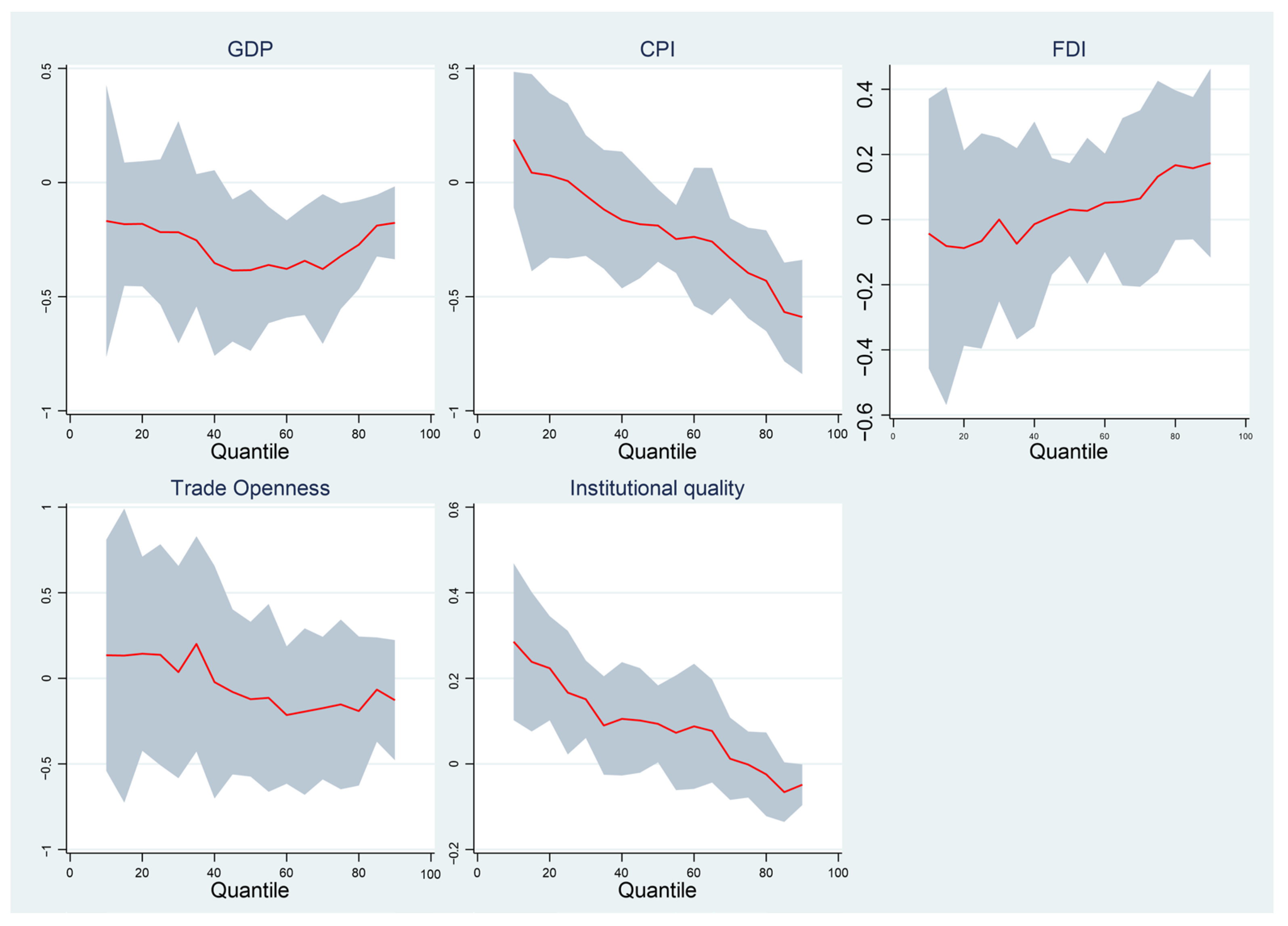
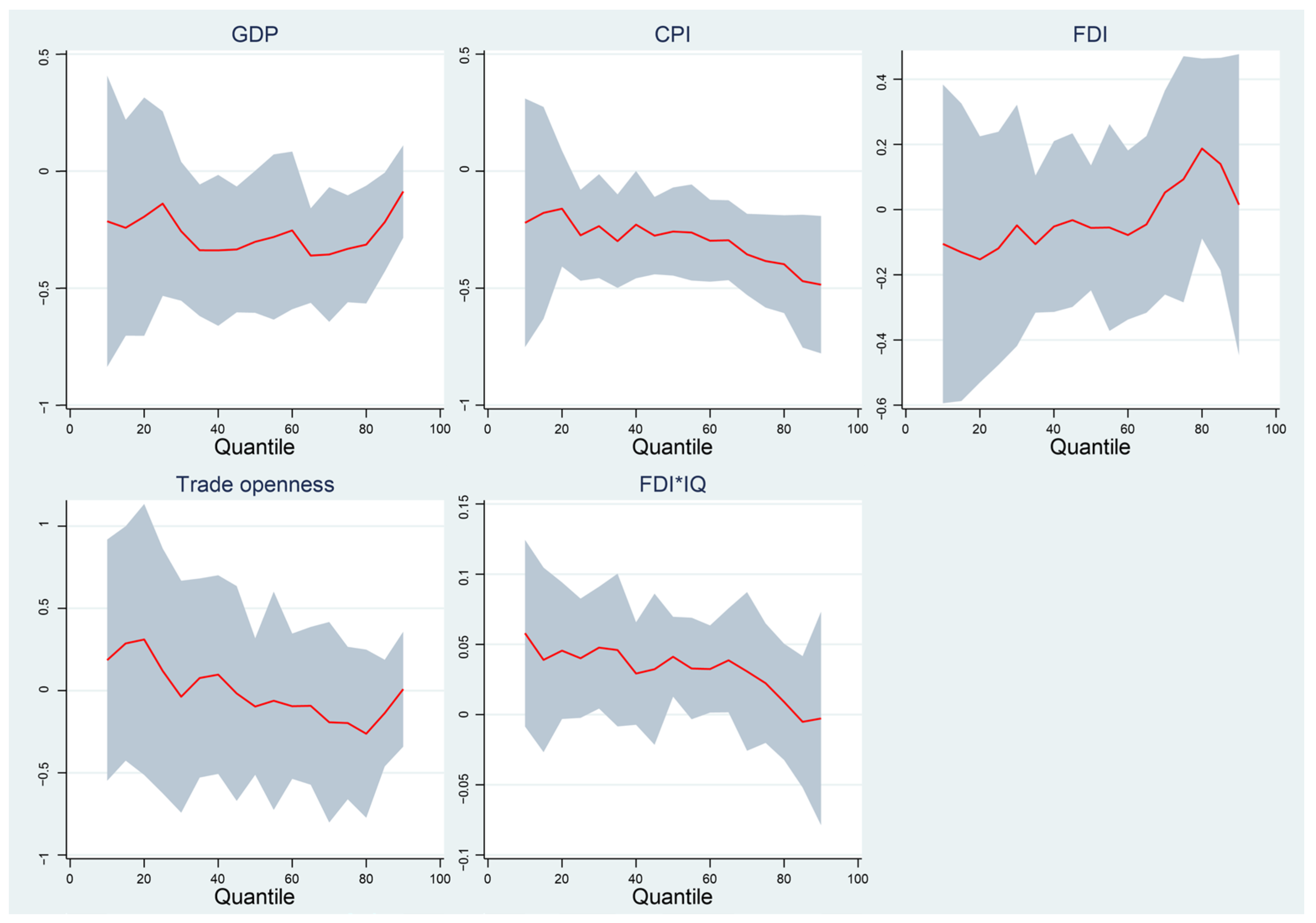
To further explore the determinants of tourism arrivals, we estimated method of moments quantile regressions to examine how the effects of GDP, CPI, FDI, trade openness, and institutional quality vary across the distribution of tourism inflows.
The results indicate that GDP has a consistently positive effect on tourism arrivals, particularly for countries with lower to median tourism inflows, suggesting that economic size is more important for attracting tourists in countries with smaller tourism sectors. CPI exhibits a negative effect across all quantiles, with the impact slightly stronger for countries with higher tourism inflows, reflecting the sensitivity of tourism demand to price levels. FDI positively influences tourism, especially at middle quantiles, but its effect becomes more conditional when interacted with institutional quality. The FDI × IQ interaction is positive across most quantiles, indicating that foreign investment is more effective in attracting tourists in countries with stronger institutions, particularly in countries with initially lower to medium tourism arrivals.
The interaction term between FDI and institutional quality is estimated within a semi-logarithmic model, where the dependent variable is log-transformed. To facilitate interpretation, we examine conditional marginal effects of FDI on tourism inflows across different quantiles of the distribution, as illustrated by the MMQR results in
Figure 1 and
Figure 2. The results indicate that a one-unit increase in FDI generates a larger percentage increase in tourist arrivals in countries with higher institutional quality, while the effect is substantially muted in countries with weaker governance. The quantile-specific analysis further highlights that institutional improvements amplify FDI’s impact most strongly in countries with lower to median tourism inflows, confirming governance as a critical factor in enhancing the effectiveness of foreign investment for sustainable tourism demand.
Trade openness has modest positive effects, mainly in the lower and middle quantiles, suggesting that global economic integration supports tourism growth primarily in countries with smaller to moderate tourism inflows. Overall, these results demonstrate significant heterogeneity in the determinants of tourism arrivals, highlighting the importance of considering conditional and distributional effects rather than relying solely on mean estimates.
6. Policy Recommendations
The empirical findings of this study provide clear, evidence-based guidance for policymakers seeking to strengthen tourism performance in Asia.
First, economic growth emerges as a statistically significant determinant of tourism demand. The positive GDP elasticity confirms that improvements in income levels and overall macroeconomic performance stimulate international tourist arrivals. Although the magnitude of the elasticity is moderate, it indicates that tourism expansion is closely linked to broader economic dynamics. In major tourism economies, sustained economic growth enhances public investment capacity in transportation infrastructure, digital connectivity, urban development, and cultural assets—thereby reinforcing destination competitiveness. For highly visited destinations, tourism policy should therefore be embedded within comprehensive economic development frameworks. Coordinated investments in airports, logistics systems, smart tourism platforms, and service-sector modernization can simultaneously strengthen overall productivity and tourism attractiveness.
Second, the negative and significant elasticity of inflation underscores the sensitivity of tourism demand to macroeconomic instability. Higher or volatile price levels reduce cost competitiveness and may discourage international travel flows. In highly competitive regional tourism markets, even moderate inflationary pressures can shift demand toward alternative destinations. Accordingly, policymakers in leading tourism economies should prioritize prudent monetary and fiscal policies aimed at maintaining low and predictable inflation. Exchange rate stability, transparent pricing structures, and cost management in tourism-related sectors are essential for preserving destination competitiveness and sustaining international visitor confidence.
Third, the positive elasticity of FDI highlights the critical role of external capital in enhancing tourism infrastructure, service quality, and technological upgrading. In advanced tourism markets, foreign investment contributes to the expansion of accommodation capacity, modernization of transport systems, digital innovation, and international brand integration. Policies designed to attract investment into hospitality, aviation, and tourism-support industries—through regulatory simplification, investment protection frameworks, and targeted incentives—can therefore generate significant tourism gains. Beyond capital accumulation, foreign investment facilitates knowledge transfer, managerial expertise, and integration into global tourism value chains.
Fourth, the positive and highly significant interaction between FDI and institutional quality demonstrates that governance strength amplifies the benefits of foreign capital inflows. Strong regulatory frameworks, transparency, rule of law, and effective public administration enhance investor confidence and improve project implementation efficiency. Conversely, weaker institutional environments may limit the developmental impact of tourism-related investment. For leading tourism destinations, strengthening institutional quality is therefore not merely supportive but fundamental. Institutional reform increases absorptive capacity, reduces transaction costs, and ensures that tourism expansion contributes to long-term economic resilience.
Fifth, the positive association between trade openness and tourism demand indicates that greater integration into global markets enhances international visitor flows. Trade liberalization improves connectivity, facilitates cross-border mobility, and strengthens service exports linked to tourism activities. Economies that are more deeply integrated into international trade networks tend to benefit from improved transport infrastructure, streamlined customs procedures, and stronger global visibility. Thus, policies promoting regional integration, bilateral transport agreements, digital trade facilitation, and efficient border management can reinforce the complementary relationship between trade and tourism growth.
Finally, the MMQR results reveal significant heterogeneity across the conditional distribution of tourism demand. The determinants of tourism do not exert uniform effects across all performance levels. Economies at earlier stages of tourism development appear more responsive to income growth, foreign investment, and institutional improvements, whereas more mature destinations rely more heavily on macroeconomic stability, service differentiation, and global connectivity. This distributional heterogeneity implies that uniform policy prescriptions are inappropriate. Instead, tourism strategies should be calibrated according to market maturity, infrastructure capacity, and institutional development levels. Tailored interventions can enhance effectiveness and avoid inefficient resource allocation.
Overall, the empirical evidence suggests that effective tourism policy in Asia’s leading destinations requires a multidimensional framework anchored in macroeconomic stability, institutional strength, strategic investment promotion, and international integration. Tourism performance is structurally embedded within broader economic and governance systems. By aligning tourism strategies with the quantified elasticities and interaction effects identified in this study, policymakers can promote tourism growth that is competitive, resilient, and supported by strong economic fundamentals.
7. Conclusions
This study investigates the dynamic relationship between tourism development and economic growth in the top eight tourist destinations in Asia over the period 1995–2024, with particular attention to the moderating role of institutional quality. Using the Augmented Mean Group (AMG) estimator, which accounts for cross-sectional dependence, unobserved common factors, and heterogeneous country-specific dynamics, the study provides robust estimates of the long-run effects of key macroeconomic and institutional determinants on tourism. To further validate the results and explore heterogeneity, method of moments quantile regressions (MMQRs) were employed, enabling the examination of how the effects of GDP, consumer prices (CPI), foreign direct investment (FDI), trade openness, and institutional quality vary across the distribution of tourism inflows.
The empirical findings provide several important insights. First, GDP consistently exhibits a positive effect on tourism arrivals, with the MMQR results revealing that this effect is particularly strong in countries with lower to median tourism inflows. This suggests that economic expansion and infrastructure development are especially crucial for smaller tourism sectors. Second, higher consumer prices negatively affect tourism demand across all quantiles, with the adverse impact slightly more pronounced in countries with higher inflows, highlighting the importance of price competitiveness for attracting international tourists.
Third, foreign direct investment emerges as an important driver of tourism, particularly in countries with medium levels of tourism inflows. Crucially, the interaction between FDI and institutional quality indicates that good governance—characterized by transparency, rule of law, regulatory efficiency, and political stability—enhances the effectiveness of foreign investment in boosting tourism. This finding underscores that attracting investment alone is insufficient; strong institutions are essential for translating investment into tangible tourism growth. Fourth, trade openness has modest but positive effects, mainly in countries with lower to medium tourism inflows, suggesting that integration into global markets provides opportunities for tourism expansion, particularly in emerging destinations.
The MMQR analysis highlights significant heterogeneity in tourism determinants across the distribution of tourism arrivals, emphasizing that mean-based approaches may obscure critical differences. For example, emerging economies benefit substantially from FDI and institutional reforms, while more advanced economies rely primarily on GDP growth, trade integration, and high-quality tourism services. These insights underscore the need for tailored policy strategies: smaller tourism markets may benefit more from economic stimulus, investment facilitation, and institutional strengthening, whereas larger, more mature tourism destinations should focus on service quality, price competitiveness, and maintaining macroeconomic stability.
The study also reinforces the role of macroeconomic stability, particularly low and predictable inflation, as a prerequisite for sustainable tourism-led growth. Stable price environments reduce uncertainty for both tourists and investors, supporting long-term planning and the development of tourism infrastructure. Additionally, the complementary roles of FDI and trade highlight the interconnectedness of economic policies; tourism growth is maximized when investment-friendly policies, trade liberalization, and sound governance are implemented in tandem.
Despite its contributions, the study has several limitations. First, the analysis focuses on the top tourist destinations in Asia, which, while capturing the leading tourism economies, may limit the generalizability of the findings to countries or regions with different economic structures, cultural contexts, or tourism profiles. Second, the reliance on national-level data may mask regional disparities in tourism development, infrastructure availability, and governance quality. Third, although the Augmented Mean Group (AMG) estimator is employed to account for cross-sectional dependence and slope heterogeneity, the relatively small number of cross-sectional units may limit the asymptotic efficiency of the estimator and affect the precision of the long-run coefficient estimates. A limited cross-sectional dimension can reduce the robustness of long-run inferences and constrain the external validity of the findings. Therefore, the estimated effects should be interpreted with appropriate caution. Future research may further validate the robustness of the results by employing alternative second-generation estimators, such as the Common Correlated Effects Mean Group (CCEMG) and the Cross-Sectionally Augmented ARDL (CS-ARDL) approach, particularly in panels with larger cross-sectional coverage. Fourth, the set of control variables is limited, and external shocks such as pandemics, natural disasters, or political instability are not explicitly modeled, despite their potential short- and long-term impacts on tourism flows. Fifth, while institutional quality is incorporated as a moderating factor, other socio-cultural, technological, and environmental determinants—such as climate change, digitalization of tourism services, and cultural attractions—may also influence the tourism–growth nexus and merit further investigation. Finally, the study does not include direct environmental or ecological sustainability indicators, meaning that the analysis emphasizes long-run structural and governance-based sustainability rather than environmental sustainability per se. Additionally, a formal subgroup AMG estimation or the inclusion of a development-status dummy was not conducted, which may limit the empirical validation of differences between emerging and advanced tourism economies. These limitations suggest avenues for future research, including expanding the sample, incorporating additional sustainability and shock-related variables, and employing micro-level or causal designs to deepen the understanding of tourism demand dynamics in Asia.
Future research could address these limitations by incorporating subnational or city-level data, expanding the set of control variables, and exploring dynamic interactions with external shocks. Comparative studies between emerging and advanced tourism markets, or between Asia and other regions, could also provide valuable insights into the generalizability of the results. Finally, the integration of environmental sustainability and technological innovation into tourism–growth analyses would help policymakers design more resilient and forward-looking tourism development strategies.
In conclusion, this study demonstrates that sustainable tourism-led growth is conditional not only on macroeconomic fundamentals, investment, and trade policies but also on strong and effective institutions. Policies aimed at improving governance, maintaining macroeconomic stability, encouraging foreign investment, and integrating trade can collectively enhance the long-term economic benefits of tourism. By highlighting both average and distributional effects through AMG and MMQR analyses, this study provides nuanced evidence for policymakers seeking to foster tourism as a catalyst for inclusive and sustainable economic growth in Asia.




 ,
,