
Ethylenediaminetetraacetic Acid (EDTA)-Decalcified, Formalin-Fixed Paraffin-Embedded (FFPE) Tumor Tissue Shows Comparable Quality and Quantity of DNA to Non-Decalcified Tissue in Next-Generation Sequencing (NGS)

 ,
,
Abstract
1. Introduction
2. Methods
3. Results
4. Discussion
5. Conclusions
Author Contributions
Funding
Institutional Review Board Statement
Data Availability Statement
Conflicts of Interest
References
- Miquelestorena-Standley, E.; Jourdan, M.-L.; Collin, C.; Bouvier, C.; Larousserie, F.; Aubert, S.; Gomez-Brouchet, A.; Guinebretière, J.-M.; Tallegas, M.; Brulin, B.; et al. Effect of decalcification protocols on immunohistochemistry and molecular analyses of bone samples. Mod. Pathol. 2020, 33, 1505–1517. [Google Scholar] [CrossRef] [PubMed]
- Choi, S.E.; Hong, S.W.; Yoon, S.O. Proposal of an appropriate decalcification method of bone marrow biopsy specimens in the era of expanding genetic molecular study. J. Pathol. Transl. Med. 2015, 49, 236–242. [Google Scholar] [CrossRef] [PubMed]
- Singh, V.M.; Salunga, R.C.; Huang, V.J.; Tran, Y.; Erlander, M.; Plumlee, P.; Peterson, M.R. Analysis of the effect of various decalcification agents on the quantity and quality of nucleic acid (DNA and RNA) recovered from bone biopsies. Ann. Diagn. Pathol. 2013, 17, 322–326. [Google Scholar] [CrossRef] [PubMed]
- Brown, R.S.; Edwards, J.; Bartlett, J.W.; Jones, C.; Dogan, A. Routine acid decalcification of bone marrow samples can preserve DNA for FISH and CGH studies in metastatic prostate cancer. J. Histochem. Cytochem. 2002, 50, 113–115. [Google Scholar] [CrossRef] [PubMed]
- Alers, J.C.; Krijtenburg, P.J.; Vissers, K.J.; van Dekken, H. Effect of bone decalcification procedures on DNA in situ hybridization and comparative genomic hybridization. EDTA is highly preferable to a routinely used acid decalcifier. J. Histochem. Cytochem. 1999, 47, 703–710. [Google Scholar] [CrossRef] [PubMed]


| No. | Diagnosis | Tumor Content % | Tumor Area/mm | No. of Days in EDTA | Mutations Identified |
|---|---|---|---|---|---|
| 1 | Metastatic lung adenocarcinoma | 30 | 15 | 2 | EGFR exon 20 T790M, EGFR exon 19 deletion p.(Glu746_Ala750del), TP 53, exon 6, p. (Leu194Arg) |
| 2 | Metastatic breast carcinoma | 70 | 20 | 3 | Wild type for PIK3CA |
| 3 | Metastatic lung adenocarcinoma | 50 | 78 | 2 | EGFR exon 19, p.(Glu746_Ser752delinsVal) |
| 4 | Metastatic lung adenocarcinoma | 40 | 60 | 1 | MET exon14, p.(Asp1010Asn), TP53, exon 6, p.(Arg196 *) |
| 5 | Metastatic lung adenocarcinoma | 60 | 28 | 2 | EGFR exon21, p.(Leu858Arg), TP53 exon7, p.(Arg248Gln), MET exon2, p.(Asn375Ser) |
| 6 | Metastatic lung adenocarcinoma | 40 | 64 | 3 | Suboptimal run |
| 7 | Metastatic lung adenocarcinoma | 80 | 7 | 3 | No variant detected in EGFR, BRAF, KRAS, MET |
| 8 | Metastatic lung adenocarcinoma | 30 | 8 | 3 | EGFR exon 20, p.(Pro772_773dup), TP53, exon 5, p.(Gln136Pro), MET exon2, p.(Asn375Ser) |
| 9 | Metastatic breast carcinoma | 50 | 18 | 2 | KRAS, exon2, p.(Gly12Asp), PIK3CA, exon 21, p.(His1047Leu) |
| 10 | Metastatic lung adenocarcinoma | 20 | 11 | 2 | No variants in EGFR, MET, KRAS, BRAF |
| 11 | Acral melanoma | 70 | 32 | 3 | KIT, exon 13, p.(Lys642Glu), KIT exon 8, p.(Asp419del) |
| 12 | Systemic mastocytosis | 50 | 4 | 2 | KIT, exon 17, p.(Asp816Val) |
| 13 | Metastatic lung adenocarcinoma | 30 | 163 | 2 | TP53, exon 6, p.(His193Arg) |
| 14 | Metastatic lung adenocarcinoma | 30 | 54 | 5 | EGFR, exon21, p.(Leu858Arg), CTNNB1, exon3, p.(Ser33Cys), TP53, exon4, p.(Phe113Cys) |
| 15 | Metastatic lung adenocarcinoma | 50 | 83 | 2 | BRAF, exon15, p.(Val600Glu) |
| 16 | Metastatic lung adenocarcinoma | 20 | 18 | 2 | EGFR, exon 21, p.(Leu858Arg), TP53, exon8, p.(Val272Leu) |
| 17 | Metastatic melanoma | 40 | 44 | 3 | KIT exon 11, p.(Tyr578_His580dup) |
| 18 | Metastatic lung adenocarcinoma | 40 | 35 | 2 | EGFR exon 21, p.(Lys860Ile), EGFR exon21, p.(Leu858Arg) |
| 19 | Metastatic breast carcinoma | 50 | 300 | 3 | Wild type for PIK3CA |
| 20 | Metastatic lung adenocarcinoma | 30 | 9 | 2 | EGFR, exon19, p.(Pro753_Ile759delinsGly), CTNNB1, exon3, p.(Gly34Glu) |
| 21 | GIST | 50 | 168 | 3 | KIT exon 11, p.(Leu576Pro) |
| 22 | Metastatic lung adenocarcinoma | 80 | 88 | 1 | TP53, exon7, p.(Cys238Phe), BRAF, exon15, p.(Asn581Ile) |
| 23 | Metastatic lung adenocarcinoma | 30 | 131 | 2 | EGFR exon 18, p.(Glu709Val), EGFR, exon18, p.(Gly719Cys) |
| 24 | Metastatic lung adenocarcinoma | 70 | 52 | 2 | EGFR exon 21, p.(Leu858Arg) |
| 25 | Metastatic lung adenocarcinoma | 20 | 6 | 2 | EGFR, exon 20, p.(His773dup), TP53, exon8, p.(Arg273Cys) |
| 26 | Metastatic lung adenocarcinoma | 20 | 50 | 4 | EGFR, exon18, p.(Gly719_Ser720delinsAlaTyr), TP53, exon7, p.(Ile255Thr), MET, exon2, p.(Asn375Ser) |
| 27 | Metastatic lung adenocarcinoma | 30 | 213 | 2 | EGFR, exon19, p.(Glu746_Ala750del), CTNNB1, exon3, p.(Ser37Cys), TP53, exon6, p.(Pro223fs) |
| 28 | Metastatic lung adenocarcinoma | 35 | 261 | 2 | EGFR, exon21, p.(Leu858Arg), TP53, exon6, p.(Leu194Arg) |
| 29 | Metastatic breast carcinoma | 20 | 16 | 2 | Suboptimal run |
| 30 | Metastatic lung adenocarcinoma | 25 | 75 | 1 | EGFR, exon21, p.(Leu858Arg), TP53, exon10, p.(Ala347Val) |
| 31 | Metastatic carcinoma of unknown primary origin | 15 | 20 | 4 | Suboptimal run |
| Characteristic | EDTA, N = 31 | Non-EDTA, N = 721 | p-Value 1 |
|---|---|---|---|
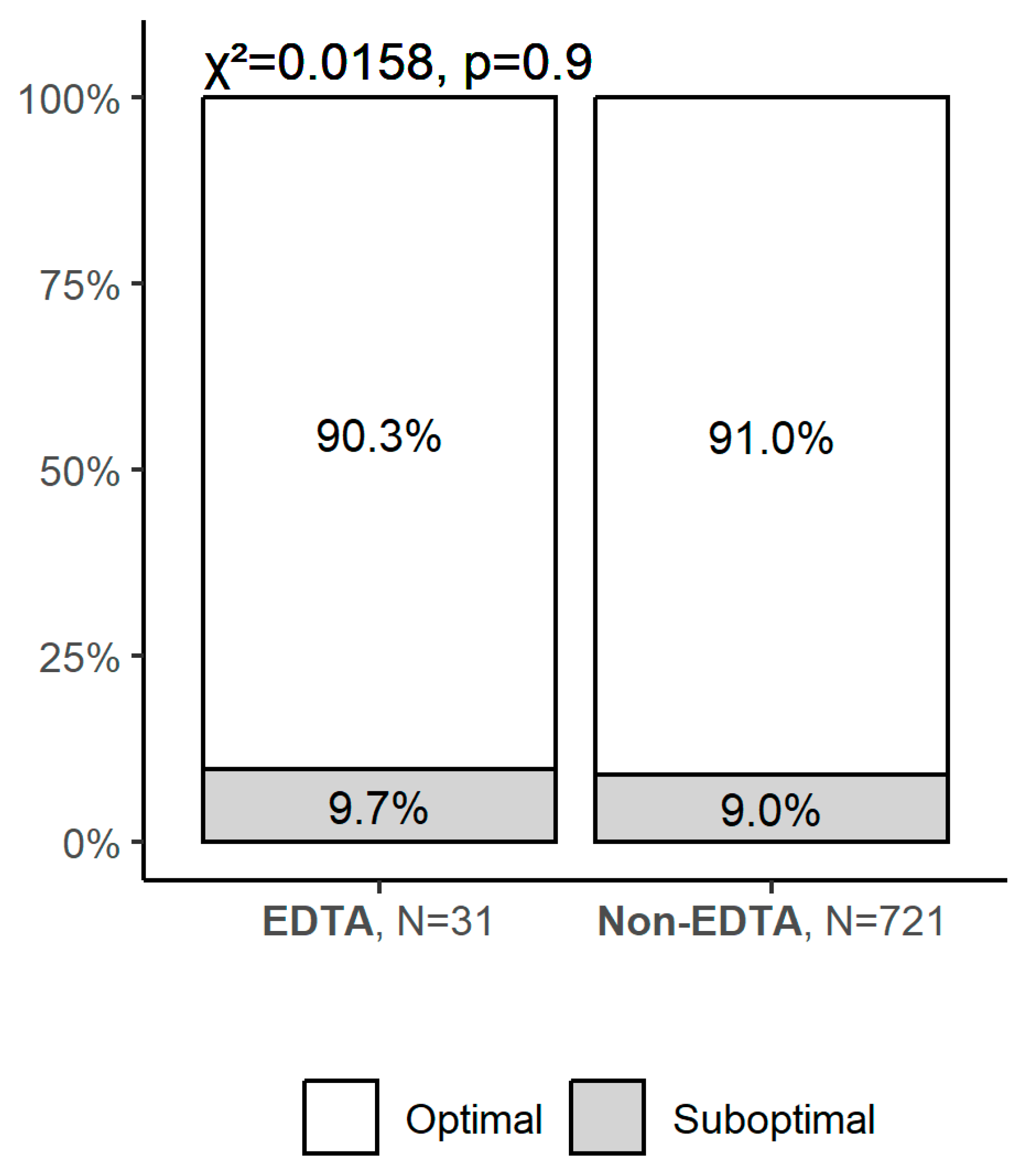
| Suboptimal Sequencing, n (%) | 3 (9.7) | 65 (9.0) | 0.9 |
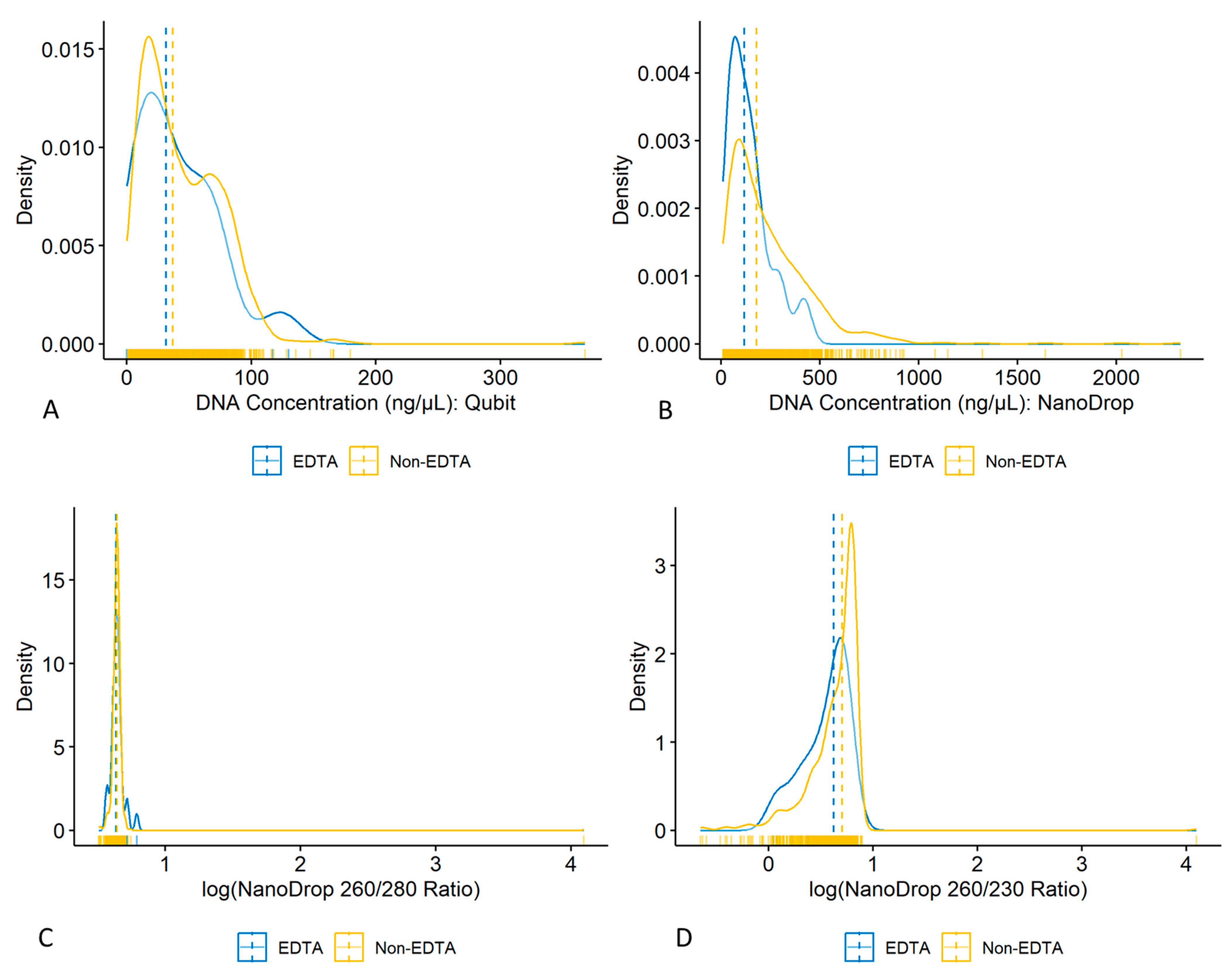
| DNA Concentration (ng/µL): Qubit | 0.4 | ||
| Median (IQR) | 31.60 (16.09, 60.50) | 37.00 (18.14, 66.80) | |
| Mean (SD) | 40.68 (32.36) | 44.30 (32.39) | |
| Minimum–Maximum | 0.11–130.00 | 0.99–368.00 | |
| DNA Concentration (ng/µL): NanoDrop | 0.006 | ||
| Median (IQR) | 116.80 (63.70, 178.05) | 180.40 (88.30, 343.60) | |
| Mean (SD) | 141.04 (107.82) | 241.66 (223.68) | |
| Minimum–Maximum | 13.20–421.20 | 9.50–2326.20 | |
| NanoDrop 260/280 Ratio | 0.8 | ||
| Median (IQR) | 1.89 (1.86, 1.93) | 1.90 (1.87, 1.92) | |
| Mean (SD) | 1.90 (0.09) | 1.97 (2.17) | |
| Minimum–Maximum | 1.76–2.20 | 1.66–60.10 | |
| NanoDrop 260/230 Ratio | 0.002 | ||
| Median (IQR) | 1.86 (1.53, 2.06) | 2.02 (1.72, 2.21) | |
| Mean (SD) | 1.75 (0.34) | 1.99 (2.20) | |
| Minimum–Maximum | 1.05–2.16 | 0.52–60.10 |
| Characteristic | Suboptimal, N = 3 | Optimal, N = 28 | p-Value 1 |
|---|---|---|---|
| Tumor content (%), median (IQR) | 20 (15, 40) | 40 (30, 50) | 0.091 |
| Tumor area (mm2), median (IQR) | 20 (16, 64) | 47 (17, 86) | 0.6 |
Disclaimer/Publisher’s Note: The statements, opinions and data contained in all publications are solely those of the individual author(s) and contributor(s) and not of MDPI and/or the editor(s). MDPI and/or the editor(s) disclaim responsibility for any injury to people or property resulting from any ideas, methods, instructions or products referred to in the content. |
© 2025 by the authors. Licensee MDPI, Basel, Switzerland. This article is an open access article distributed under the terms and conditions of the Creative Commons Attribution (CC BY) license (https://creativecommons.org/licenses/by/4.0/).
Share and Cite
Yap, F.H.X.; Sng, J.-H.; Ng, J.W.K.; Kadir, H.A.; Chan, P.Y.; Tay, T.K.Y. Ethylenediaminetetraacetic Acid (EDTA)-Decalcified, Formalin-Fixed Paraffin-Embedded (FFPE) Tumor Tissue Shows Comparable Quality and Quantity of DNA to Non-Decalcified Tissue in Next-Generation Sequencing (NGS). J. Mol. Pathol. 2025, 6, 21. https://doi.org/10.3390/jmp6030021
Yap FHX, Sng J-H, Ng JWK, Kadir HA, Chan PY, Tay TKY. Ethylenediaminetetraacetic Acid (EDTA)-Decalcified, Formalin-Fixed Paraffin-Embedded (FFPE) Tumor Tissue Shows Comparable Quality and Quantity of DNA to Non-Decalcified Tissue in Next-Generation Sequencing (NGS). Journal of Molecular Pathology. 2025; 6(3):21. https://doi.org/10.3390/jmp6030021
Chicago/Turabian StyleYap, Francis Hong Xin, Jen-Hwei Sng, Jeremy Wee Kiat Ng, Hanis Abdul Kadir, Pei Yi Chan, and Timothy Kwang Yong Tay. 2025. "Ethylenediaminetetraacetic Acid (EDTA)-Decalcified, Formalin-Fixed Paraffin-Embedded (FFPE) Tumor Tissue Shows Comparable Quality and Quantity of DNA to Non-Decalcified Tissue in Next-Generation Sequencing (NGS)" Journal of Molecular Pathology 6, no. 3: 21. https://doi.org/10.3390/jmp6030021
APA StyleYap, F. H. X., Sng, J.-H., Ng, J. W. K., Kadir, H. A., Chan, P. Y., & Tay, T. K. Y. (2025). Ethylenediaminetetraacetic Acid (EDTA)-Decalcified, Formalin-Fixed Paraffin-Embedded (FFPE) Tumor Tissue Shows Comparable Quality and Quantity of DNA to Non-Decalcified Tissue in Next-Generation Sequencing (NGS). Journal of Molecular Pathology, 6(3), 21. https://doi.org/10.3390/jmp6030021