


Abstract
Environmental Protection Plans (EPPs) are vital for mitigating the socio-ecological impacts of quarry operations, especially in emerging economies like Thailand, where rapid industrialization often intensifies air, water, noise, and land degradation. This study applies the social return on investment (SROI) framework to evaluate the cost-effectiveness of multi-domain EPPs implemented in a quarry. By applying compliance-based assessment and monetization of environmental and health co-benefits, annual economic outcomes were quantified for particulate matter (PM10), total dissolved solids (TDS), noise reduction, and carbon sequestration. The analysis revealed a high SROI ratio of 59.55:1, primarily driven by substantial health benefits from PM10 and noise abatement. This ratio also reflects consideration of investment from an annual operational cost, with a sensitivity analysis of incorporating an estimated capital expenditure, reducing the ratio to moderate value ranges of 5–10:1. A number of limitations, such as exclusion of capital costs, reliance on fixed proxies, and single-year scope, may overstate short-term returns, suggesting the application of stochastic methods for enhanced robustness. Overall, the findings demonstrate that EPPs deliver substantial economic and public health benefits, supporting their role in fostering community resilience and advancing sustainable operations in quarry sectors.
1. Introduction
The quarrying industry in Thailand plays a vital role in the nation’s economy by supplying essential raw materials for construction and infrastructural development. Thailand holds an estimated 7,140,426 million tons of industrial rock and dimension stone reserves, which include limestone, basalt, granite, andesite, and sandstone, with a projected economic value of approximately 1.588 trillion baht [1]. Although quarrying plays a crucial role in economic development, it also presents significant environmental issues, such as air, water, and noise pollution and ecosystem degradation. Some of the significant cases highlighting these risks in Thailand include a case of arsenic contamination and cadmium and lead poisoning in mining operations at Nakhon Si Thammarat, Kanchanaburi, and Tak Provinces, respectively [2]. These cases, and many more, present evidence that unevaluated and unsustainable mining operations can lead to significant health and environmental impacts, which present barriers to sustainable development. This necessitates the establishment of effective environmental protection policies and the use of innovative technologies and measures to facilitate sustainable mining practices in order to mitigate these challenges. Environmental impacts of quarrying operations are often diverse and highly site-specific, due to their capacity to impact environmental and ecological systems at varying intensities. Due to this complexity, the Environmental Impact Assessment (EIA) process has emerged as an essential regulatory and planning tool for evaluating the potential consequences of quarrying operations. EIA can be defined as a tool that facilitates the systematic process of evaluating the potential environmental impacts of proposed projects before their implementation through identifying, predicting, and mitigating adverse impacts [3]. EIA offers a holistic analysis that includes impacts on biodiversity, flora and fauna, abiotic factors (e.g., air, water, and soil quality), human health, safety, and community well-being [4]. The EIA process is particularly critical during the early stages of quarry operations, where early identification of environmental risks can inform project design and guide the implementation of Environmental Protection Plans (EPPs) [3]. EPPs are systems or frameworks designed to curb and regulate the adverse impacts of quarrying on the environment. EPPs serve as a strategic system for countering potential environmental threats, implementing mitigation measures, and ensuring compliance with environmental regulations and sustainability standards [5]. The quarry industry in Thailand is regulated under the Minerals Act B.E. 2560 (2017), which outlines the legal framework for mineral exploration, extraction, and processing. The act highlights that quarry operations in Thailand are required to invest in the implementation of Environmental Protection Plans (EPPs) as part of their regulatory compliance and sustainability efforts. In addition, under the Enhancement and Conservation of National Environmental Quality Act B.E. 2535 (1992), mining operations are required to implement an Environmental Impact Assessment (EIA) and set up Environmental Protection Plans (EPPs) prior to receiving project approval. This plan takes into account cumulative expected environmental impacts of the operations and a corresponding protective plan to mitigate each impact [6].
While these EPPs facilitate compliance with environmental regulations of Thailand’s quarry sector, their cost-effectiveness remains largely unevaluated. This is because most evaluations emphasize procedural compliance and monitoring rather than quantified outcome or benefit evaluation, leaving substantive and transactive effectiveness under-documented [7,8,9,10]. This limitation hinders the ability to determine whether investments yield proportionate and optimal benefits for stakeholders. Thus, evaluating cost-effectiveness of EPPs is therefore critical to determine if these interventions provide optimal environmental protection while maintaining economic viability for the quarry industry. However, a critical challenge in evaluating the cost-effectiveness of EPPs lies in the difficulty of quantifying their environmental outcomes or benefits [11]. To address this, scholars such as [12] recommend further research focusing on measurable and evidence-based approaches for evaluating intervention outcomes. Recent studies like [13] have applied Social Return on Investment (SROI) to quantify the social benefits of EIA projects in monetary terms, thereby evaluating their effectiveness compared to financial investments.
Social Return on Investment (SROI) is a systematic framework designed to analyze social and environmental outcomes by strategically quantifying them in monetary terms [14,15]. This enables organizations to evaluate the effectiveness of transforming resources into value. However, despite the growing application of SROI in sustainability assessments [16,17,18], there remains a notable gap in the application of the framework for evaluating the cost-effectiveness of environmental interventions within the quarrying sector in Thailand.
Given the multifaceted variables that affect the quantification of EPPs benefits, this study proposes an SROI model to quantify and monetize the social and environmental value generated. The analysis focuses on four critical EPP interventions—air, water, noise, and reforestation schemes—which are mandatory for quarry operations in Thailand [6,19]. The decision to apply the SROI framework is driven by its capacity to measure the environmental benefits of EPPs by analyzing impact pathways and monetizing outcomes, thereby capturing environmental, social, and economic dimensions in a single metric [20,21]. Thus, this study contributes to strategic cost–benefit evaluation in quarry operations while supporting the design and implementation of economically viable and environmentally sustainable EPPs.
2. Materials and Methods
2.1. Monitoring Method, Parameters and Standards
The datasets used in the study are based on the EIA report of the quarry for the year 2024, which was accessed from https://eia.onep.go.th/eia/detail?id=13736 (accessed 28 October 2025). The data were obtained on a daily basis and reported biannually as part of the EIA report.
Ambient air quality was assessed using 24 h averages of particulate matter less than 10 microns (PM10), measured at three stations covering the quarry pit and the surrounding host community through gravimetric analysis in accordance with standard environmental monitoring protocols of Thailand’s National Environment Board Announcement No. 24 (2004) [22], which stipulates a threshold of ≤ 0.12 mg/m3 for PM10 in ambient air. Water quality data were collected from 6 stations, which comprised sedimentation ponds and reservoirs around the quarry concession area and host community, which has a total volume of 310,000 m3. Water sampling and analysis were conducted using the Standard Methods for the Examination of Water and Wastewater (APHA, AWWA, WEF, 23rd Edition, 2017) [22]. The target parameter was Total Dissolved Solids (TDS), measured using Method 2540 C (APHA, 2017). The regulatory threshold applied is ≤ 3000 mg/L, in accordance with the National Environment Committee Announcement No. 8 (1994), issued under the National Environmental Quality Promotion and Conservation Act, B.E. 2535 [22]. Noise levels were monitored at the same stations as air quality monitoring. The equivalent continuous sound level (Leq 24 h) and daytime (06:00–22:00) 1 hr. average noise levels were recorded using a calibrated Sound Level Meter, following the ISO 1996-1:2003 standard for environmental noise assessment. The noise threshold applied is based on the Ministry of Natural Resources and Environment Regulation (2005) for mining operations, with a maximum permissible level of 70 dB(A) [22]. Reforestation was implemented on a 15 rai (24,000 m2) area, formerly used for open-pit limestone mining. The area was rehabilitated by filling 0.5 m of topsoil, followed by terracing and stabilization. A total of 28 native plant species, selected for their adaptability to local conditions, were planted using 30 cm × 30 cm planting holes. Species selection was informed by ecological restoration guidelines and site-specific vegetation surveys. The objective was to restore ecological function, prevent erosion, and enhance biodiversity in the post-mining landscape, leading to the reforestation of 31,645 trees.
2.2. SROI for Impact Quantification and Cost-Effectiveness Evaluation
Social Return on Investment (SROI) offers a systematic framework designed to analyze the social, economic, and environmental impacts associated with projects by quantifying outcomes in financial terms. This approach enables organizations to effectively assess the impact and overall effectiveness of their initiatives. The SROI framework is grounded in stakeholder theory and impact measurement principles. It emphasizes the importance of engaging stakeholders to identify and prioritize outcomes that matter most to them. By assigning monetary values to these outcomes, SROI provides a comprehensive understanding of the value created relative to the resources invested. This approach amplifies the understanding of how organizational activities influence stakeholders, thereby enabling resource allocation decisions that reflect these impacts [15]. The framework of Social Return on Investment (SROI) is founded on key principles that include stakeholder engagement, analysis of changes, the prioritization of impacts, valuation of important outcomes, transparency, and proper attribution of impacts. The Social Return on Investment (SROI) is calculated by dividing the social and environmental value generated by a project by the financial cost of implementation. This ratio quantifies the social and environmental values generated per unit of financial investment, offering a clear measure of the impact relative to the resources allocated.
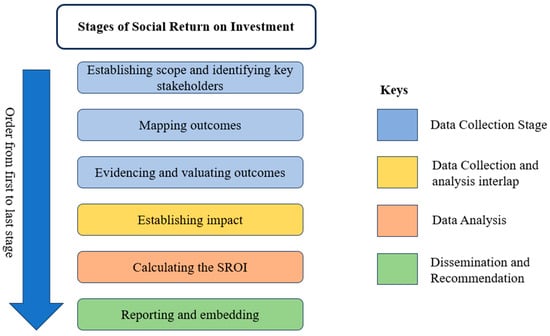
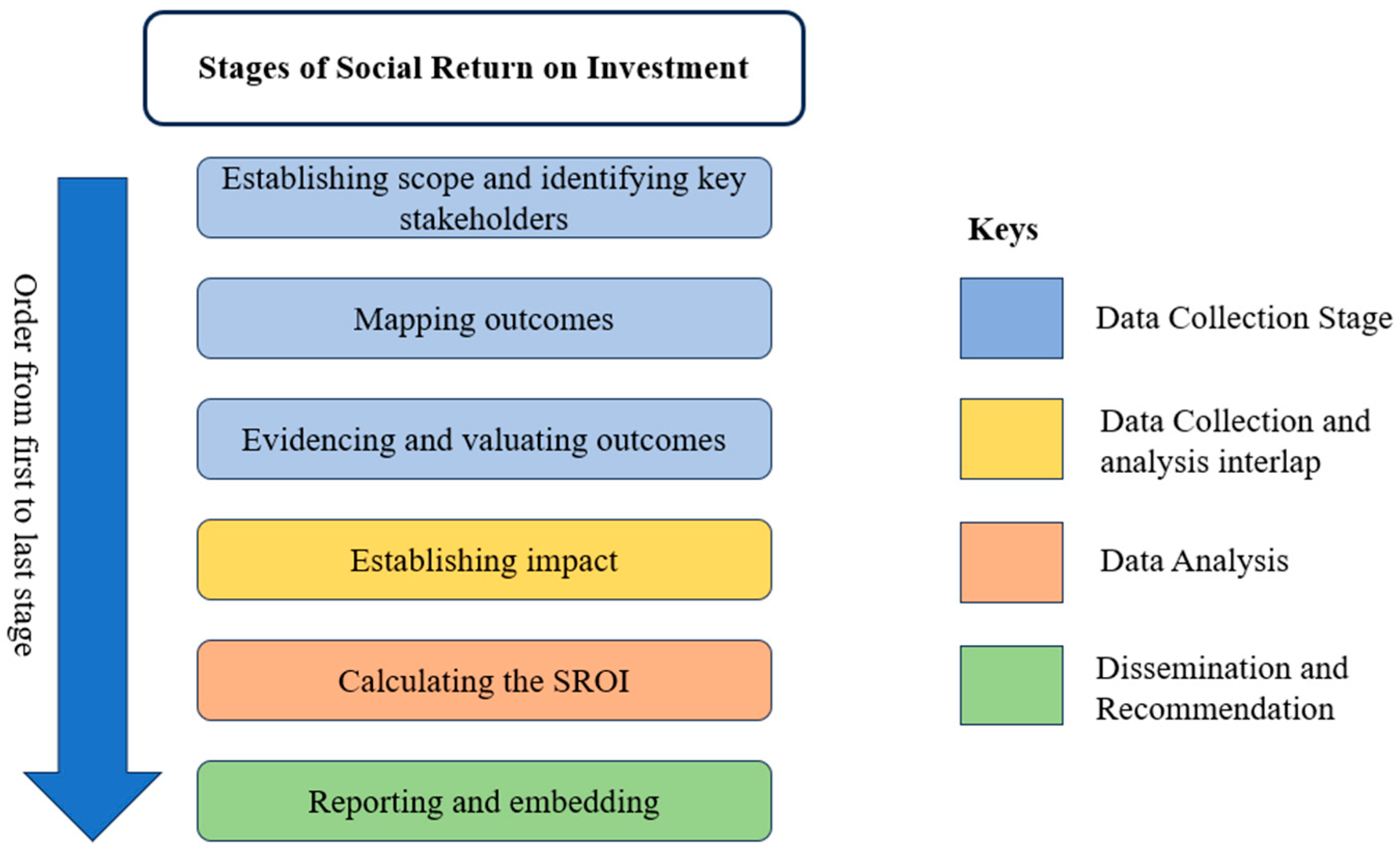
In the context of environmental protection, SROI has been increasingly applied to assess the value of initiatives such as reforestation, pollution control, and biodiversity conservation. These interventions often generate a mix of tangible benefits (e.g., reduced healthcare costs due to improved air quality) and intangible benefits (e.g., enhanced community well-being or ecosystem services). However, the application of SROI in the mining sector remains relatively underexplored, despite its potential to provide actionable insights into the cost-effectiveness of Environmental Protection Plans (EPPs). The application of SROI is vital in EPPs’ performance evaluation, since the focus is not just on environmental impacts but also on its alignment with broader socio-economic goals [23]. The Social Return on Investment (SROI) framework recommends an SROI ratio of at least 1:1, indicating that every dollar invested yields an equivalent or greater amount of value [15,24]. This reinforces the concept that higher return ratios indicate more effective and impactful investments. By using SROI as a performance indicator, industries and policymakers can identify interventions that will provide the utmost return on investment, ensuring that funds are directed toward the most impactful initiatives [13]. The framework in this study follows a structured, multi-phase approach designed to assess the cost-effectiveness and social-environmental value of Environmental Protection Plans (EPPs) implemented by the quarry, according to SROI principles. This model is designed to align with the core principles of the SROI framework, which is applied in this study, as illustrated in Figure 1.
Figure 1.
Stages and principles of SROI as applied in the study.
2.3. Establishing Study Boundary and Identifying Key Stakeholders
This section defines the scope and context of the Social Return on Investment (SROI) assessment by outlining the environmental initiatives under evaluation and the key actors involved. It sets clear parameters for measuring impact, ensuring that the analysis remains focused, relevant, and aligned with the intended objectives. The study centers on four Environmental Protection Programs (EPPs): air and water quality enhancement, noise protection, and reforestation, as shown in Section 2.4. The investment data were sourced from the Environmental Impact Assessment (EIA) report, which detailed cumulative expenditures for the year 2024. As mentioned earlier, Thailand’s Minerals Act B.E. 2560 (2017) mandates that quarry operations in Thailand allocate funds annually toward Environmental Protection Plans (EPPs) as part of regulatory compliance and sustainable development efforts [6]. The investment is a total sum of THB 5,447,804.93, which includes the quarry’s direct operating expenditure (OPEX) in the Environmental Protection Plans (EPPs) for the year of evaluation. To ensure effective accounting of impacts, an impact area of 5 km radius was used for study. This constitutes the area designated for monitoring and implementation of Environmental Protection Plans (EPPs), which also falls within the officially approved concession granted in the quarry’s license to operate. This area captures the most directly affected communities and environmental receptors, providing a focused scope for assessing the quarry’s environmental and social impacts. The stakeholders identified in this study include the local community, regulatory bodies, and quarry management. Consultation with stakeholders revealed that issues related to PM10 pollution, dissolved solids in water bodies, noise exposure, and carbon emissions were highlighted as priorities. These insights directly guided the focus of evaluation and informed the selection of relevant outcomes, ensuring that the proxies and valuation methods employed in the analysis were based on local context and community-relevant concerns.
2.4. Mapping Outcomes: Developing the Theory of Change
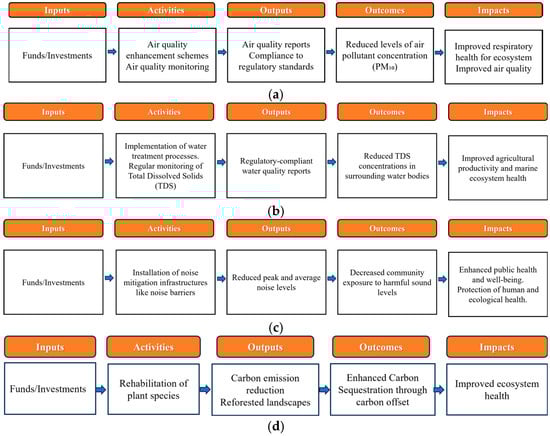
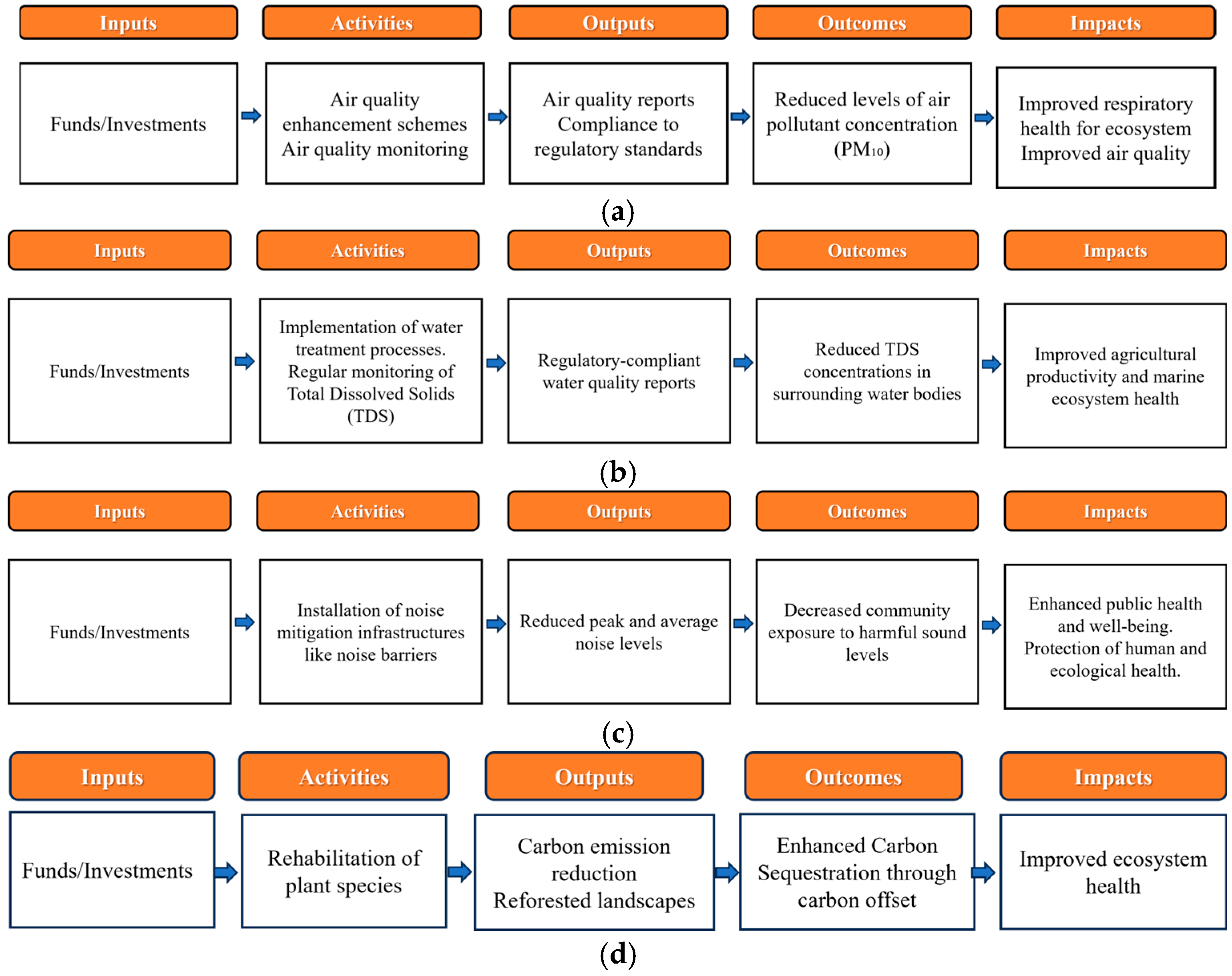
The Theory of Change (ToC) is an integral part of the Social Return on Investment (SROI) framework, which maps out how specific operations lead to intended outcomes or impacts. ToC ensures that an SROI analysis is performed with a precise understanding of how change occurs; this approach enhances the credibility and transparency of the evaluation process [25], as shown in Figure 2.
Figure 2.
(a) ToC for air-quality enhancement. (b) ToC for water-quality protection. (c) ToC for noise reduction. (d) ToC for reforestation.
2.5. Quantification of Benefits/Values Generated
This study is designed as a compliance-based evaluation, focusing on regulatory and health implications rather than solely on baseline comparisons. By comparing measured values to legally mandated standards, the analysis assesses whether interventions achieve the minimum environmental and health protection required by regulatory policy in Thailand. This is also the case in prior studies [13,26,27,28]. Datasets used in this study were sourced from credible references, including the quarry’s EIA reports, which provided daily average pollution reduction rates and reforested species data. This study quantifies the environmental benefits of reducing air pollution by multiplying the quantity of reduced pollutants by the social cost per unit of pollutants. To quantify the reduction in pollutant concentrations, we compared the measured ambient air quality concentration to the legally mandated standard for PM10, reflecting a compliance-based evaluation approach, as shown in Equation (1). In Thailand, the industrial regulatory threshold for PM10 concentration is 0.12 mg/m3, while the ambient air monitoring at the mine recorded an annual concentration of 0.01767 mg/m3. By subtracting the measured concentration from the standard benchmark, we determined a sustained annual average reduction in PM10 concentration of 0.10233 mg/m3, equivalent to 102.33 µg/m3, which is a reduction of 85.28% from the regulatory standard. To quantify the volume of PM10 reduced, this study utilizes the closed-box model, which is a simplified air quality model that conceptualizes the atmosphere over a defined region as a box with fixed horizontal and vertical dimensions, within which pollutants are assumed to be uniformly mixed, enabling the estimation of pollutant concentrations or total pollutant mass by combining emissions data, mixing height, and the volume of the airshed [29,30]. In this study, the airshed was bound horizontally by the 5 km radius, comprising the intervention area, and vertically by the mixing height, empirically set at a conservative average bound of 1500 m, which is within the threshold supported by observations of PM10 dispersion patterns in Northern Thailand, as documented by the Pollution Control Department [31]. Considering this airshed as a well-mixed box with consistent volume for a year period (2.7375 × 10¹² m3), the PM10 reduction per year is a product of the concentration reduction and the airshed volume, yielding an estimated annual PM10 reduction of approximately 2.80 × 10¹⁴ µg, equivalent to 280.18 metric tons.
where Cstandard is the legal or regulatory standard and Cmeasured is the measured ambient concentration level.
ΔC (mg/m3) = Cstandard − Cmeasured
In quantifying the benefits of improved water quality, the analysis also adopts a compliance-based evaluation approach, which compares the measured TDS concentrations (339.7 mg/L) with Thailand’s regulatory threshold (3000 mg/L), as shown in Equation (2). The primary datasets were obtained from the project’s Environmental Impact Assessment (EIA) report, which includes TDS concentration levels across six water points comprising reservoirs and a sedimentation pond making up a total water volume of 310,000 m3. Additional data include the shadow pricing values based on the cost-recovery principle under the Industrial Estate Authority of Thailand (IEAT), which applies a standardized fee of 12 THB per cubic meter for industrial water treatment services, reflecting actual operational and compliance costs of centralized wastewater treatment in Thailand’s industrial sector [32]. This aligns with the Shadow Price per Unit of Compliance (SPUC) framework, commonly used in environmental economics to value non-market benefits of pollution control [33,34]. This approach quantifies benefits by multiplying the mass of pollutant removed by the unit shadow price (in baht/kg), which in this study represents the avoided treatment costs to downstream users, such as agricultural or municipal water consumers. The mass of TDS removed is obtained by applying the mass balance principle using the water volume and change in pollutant concentration (2.6603 kg/m3), which yields an annual reduction of 824,693 kg/year. The shadow price (Baht/kg TDS removed) is obtained by dividing the treatment cost (Baht/m3) by TDS concentration reduction (kg/m3), yielding a shadow price of 4.5108 THB/kg, Equation (3).
where Cstandard is the legal or regulatory standard and Cmeasured is the measured (ambient) concentration level.
where Sp = shadow price (Baht/kg pollutant removed), T = Treatment cost/water tariff (Baht/m3), and ΔC kg/m3 = concentration reduction (kg/m3).
ΔC (mg/L) = Cstandard (mg/L) − Cmeasured (mg/L)
The benefits of noise abatement were estimated using the marginal willingness to pay (WTP) per household for reductions in noise levels, which reflects the perceived discomfort and potential health impacts associated with exposure [35,36,37]. The analysis focused on 24 h equivalent continuous noise levels (Leq 24 h), a standard metric in environmental impact assessments for industrial and traffic-related noise sources [38]. The measured noise level was 42.29 dB(A) on average, resulting in a 23.71 dB(A) reduction relative to Thailand’s legal noise limit of 70 dB(A) [1,6]. While this difference represents a legal compliance margin rather than an engineering-based reduction, it provides a useful measure of the environmental benefit achieved by keeping noise emissions below regulatory thresholds, as shown in Equation (4). Within the 5 km radius impact area, 2590 households were identified as directly affected by quarry-related noise from blasting and transportation. The total benefit of noise reduction was therefore calculated as the product of the decibel reduction (23.71 dB), the WTP per decibel reduction (2400 THB), and the number of exposed households, providing a practical estimate of the economic value of noise abatement for the affected community.
where Lstandard is the legal or regulatory standard and Lmeasured is the measured noise level.
ΔL dB(A) = Lstandard dB(A) − Lmeasured dB(A)
For quantifying the benefits of the reforestation program, Thailand’s T-VER (Thailand Voluntary Emission Reduction Program) provides the primary framework for economically valuing reforestation efforts in the mining sector by assigning carbon credits to verified restoration activities. In Thailand, as mining operations reforest degraded and disturbed lands, the amount of CO2 sequestered by the project is calculated following the T-VER methodology (T-VER-S-TOOL-01-01: Calculation for Carbon Sequestration in Trees) [39]. During the reporting period, a total of 31,645 trees were accounted for, including both newly planted and maintained species. To estimate the total annual carbon sequestered in biomass, the T-VER-S-TOOL-01-01 procedure was applied, which calculates carbon storage based on tree counts and species-specific growth factors such as the Mean Annual Increment (MAI), which is a standard forestry metric for expressing the average annual increase in tree volume, biomass, or carbon stock over the lifetime of a tree or stand up to a specified age [39], as shown in Equation (5). The total biomass/carbon stock is converted to Carbon Dioxide Equivalent (tCO2eq), using the molecular weight ratio of CO2 to C, which is 3.667, as shown in Equation (6). This converts the total biomass of 300.6 tons to 1102 tCO2eq.
where Ctt is Total carbon sequestered over the monitoring period (t), T is the total number of trees in the project area (trees), t is number of monitoring years (years), MAI is the Mean Annual Increment in biomass carbon (9.5 kg C tree−1 yr−1, conservative MAI for slow-growing native tree species according to T-VER), and 10−3, which is Conversion factor from kilograms (kg) to metric tons (t).
where CO2eq is total carbon dioxide equivalent (tCO2eq) and 3.667 is the Conversion factor based on the molar mass ratio of CO2 (44) to C (12) which is equivalent to molecular weight ratio (44/12).
Ctt = T × t × MAI × 10−3
CO2eq = Ctt × 3.667
2.6. Use of Financial Proxies for Impact Monetization
Monetization of environmental benefits of these schemes involves assigning financial values to the quantified environmental improvements or ecosystem services. This approach is important as it allows the assignment of tangible economic value to environmental and other non-market benefits derived from interventions [15]. This study estimates the social cost of PM10 using a monetary proxy derived from the International Institute for Applied Systems Analysis & United Nations Environment Programme (IIASA&UNEP) air quality cost report, which employed the Greenhouse Gas Air Pollution Interactions and Synergies (GAINS) model to quantify the economic impact of air pollution in Thailand. The GAINS model calculates costs based on health outcomes such as years of life lost (YLLs) and morbidity-related healthcare expenditures and considers various social and policy scenarios. The resulting unit cost of PM10 is estimated at 615,834 THB/ton [40,41]. This value represents the monetary damages avoided per ton of PM10 reduction, providing a basis for evaluating the economic benefits of air quality interventions. The shadow price of Total Dissolved Solids (TDS) adopted in this study is based on a cost-based proxy from the Industrial Estate Authority of Thailand (IEAT), which applies a standardized fee of 12 THB per cubic meter for industrial water treatment services, reflecting actual operational and compliance costs of centralized wastewater treatment in Thailand’s industrial sector [32]. For noise abatement, a financial proxy for noise reduction benefits was derived from a stated-choice survey on Thailand’s aviation noise conducted by [42], which estimated households’ willingness to pay (WTP) at 104.76 THB/year for a 1% reduction in noise intensity levels, which is approximately 2400 THB/dB/year after mathematical adjustment using change in sound intensity (Supplementary Materials) [43,44]. This proxy provides Thailand-specific estimates that capture household decision-making regarding health impacts, discomfort, and cultural perceptions of environmental quality [45,46]. Although originally derived from aviation noise due to the absence of WTP for mining noise context, this choice aligns with international dose–response evidence, which illustrates that health and annoyance effects are comparable across aviation, road transport, and industrial noise sources [47,48].
Furthermore, to estimate carbon sequestration in monetary terms, we adopt the prevailing carbon credit trading price per ton of carbon in Thailand’s voluntary market at the time of the research. According to the Thailand Greenhouse Gas Management Organization (TGO), the average voluntary market trading price for the overall fiscal year of 2025 is 709.05 THB/tCO2e, providing a context-specific proxy that reflects national trading conditions [49], Table 1.
Table 1.
A summary of EPP activities, outcomes, proxies, monetary benefits and SROI percentage contributions.
2.7. Economic Valuation of Benefits/Value Generated
To estimate the social benefits of improved air quality from the reduction of PM10, we estimated by multiplying the total mass of PM10 reduced in tons (280.18 Mt) by the cost per ton of PM10 (615,834 THB/ton), yielding 172,544,370 THB. Meanwhile, the economic value of improved water quality was estimated by multiplying the annual reduction in total dissolved solids (TDS) with the shadow price per kilogram. The project reduces approximately 824,693 kg of TDS each year, and with a shadow price of 4.5108 THB per kg, results in a social benefit of 3,720,000 THB annually. Furthermore, the economic value of noise abatement is obtained by the product of reduced noise levels (23.71 dB(A)), the financial proxy (2400 THB/dB/year), and affected households (2590). This yields the total annual social benefit of 147,384,529 THB. The economic benefit of the reforestation scheme was estimated by multiplying the total amount of carbon sequestered with the prevailing carbon credit price. The project sequesters approximately 1102 tCO2e, and with a market value of 709.05 THB per ton of CO2 equivalent, this translates into an annual social benefit of approximately 781,373 THB, Table 1.
2.8. Calculation of SROI
As previously outlined, the Social Return on Investment (SROI) is determined by dividing the total monetary value of benefits generated by a project by its financial cost of implementation, as shown in Equation (7).
Total Benefits therefore comprise improvements from air pollution reduction, water pollution reduction, noise abatement, and reforestation.
Total Investment in EPPs = 5,447,804.93 THB
3. Results and Discussion
3.1. Environmental Protection Plans and Context in Thailand
Environmental Protection Plans (EPPs) in quarry operations are essential for countering the socio-ecological damages resulting from extraction and processing activities. This is particularly critical in emerging economies like Thailand, where rapid industrialization amplifies environmental degradation [2,50]. Environmental degradation remains an acute issue in Thailand. For example, PM10 levels in industrial zones often surpass World Health Organization (WHO) thresholds, leading to annual health costs estimated in trillions of THB [28]. In addition, dissolved and suspended particle pollution in watersheds threatens agricultural productivity and aquatic ecosystems. Industrial noise contributes to perceived high stress and sleep disturbances among nearby populations, while deforestation limits effective greenhouse gas capture [42,51,52]. Therefore, the evaluation of EPPs outcomes such as an annual reduction of 280.18 tons of PM10, 824,693 kg of TDS, 23.71 dB(A)/daily noise reduction, and 1102 tCO2eq sequestration underscores the urgency of these interventions in fostering resilient communities, reducing public health burdens, and supporting long-term economic viability for sustainable mining operations [2,7,8,42].
3.2. SROI Ratio Analysis and Methodological Considerations
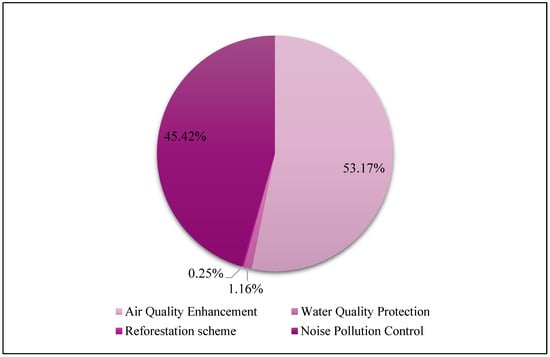
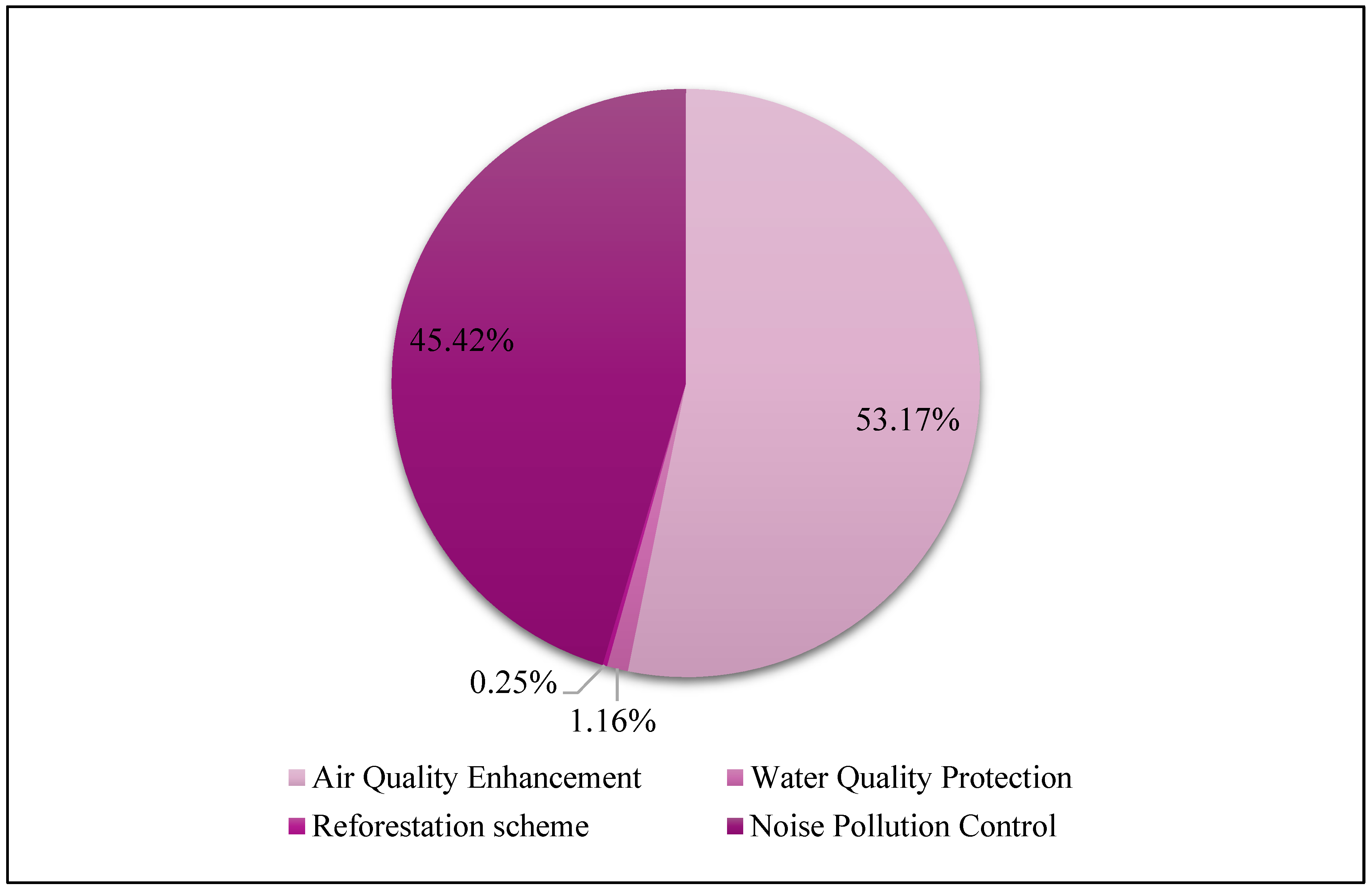
The analysis yields total monetized benefits of 324,430,272 THB from the EPPs intervention against an annual operational investment of 5,447,804.93 THB, resulting in an SROI ratio of approximately 59.55:1. This high ratio primarily stems from dominant contributions in air quality enhancement and noise pollution control, with modest contributions from water protection and reforestation (Figure 3). These findings nuance the broader SROI literature in environmental and resource sectors by demonstrating that integrating EPPs in mining can achieve significant returns when health co-benefits are monetized [53]. The findings also challenge more conservative SROI ratios reported in similar contexts [54,55], while confirming trends in high-impact public health-related interventions [56,57,58]. This further shows that multi-domain EPPs can amplify social value through synergistic ecosystem services [59,60]. A key insight driving this high SROI is the methodological utilization of only budgeted operational investments for the year of evaluation. Therefore, capital costs for developing the EPPs systems such as dust settling chambers, monitoring units, and other technologies were excluded. If these expenditures, which potentially span multiple years of the quarry’s operation, were included, the ratio would likely decrease substantially, perhaps aligning closer to mid-range SROIs observed in lifecycle analyses of high-infrastructure environmental projects [13,61,62,63]. This exclusion was made due to uncertainties in estimating historical costs of construction and technological upgrades, as the quarry was commercialized in 1996. Consequently, the analysis focused on verifiable annual budgets, in line with the quarry’s stipulations. However, this approach may overstate short-term returns, highlighting a common SROI limitation where temporal boundaries influence ratios [20,64,65]. To address this, a sensitivity test was conducted. Assuming capital costs equivalent to 5–10 times annual operations (based on industrial benchmarks), the SROI is reduced from an extremely high 59.55:1 to a more moderate 5–10:1 range, further aligning with mid-range values found in projects related to public health and environmental interventions [13,61,62,63].
Figure 3.
This figure shows a pie chart representing the percentage contribution of each EPP category to the SROI and total benefit.
3.3. Health, Environmental, and Cross-Sectoral Benefits
Globally, health investments demonstrate high returns, with the World Bank estimating that universal health coverage can generate significant economic benefits by enhancing workforce participation and community resilience [66]. Similarly, reports from the World Health Organization and related global health literature show that investments in community health offer ROIs as high as 10:1. These benefits are often driven by preventive measures that mirror health co-benefits in such interventions (e.g., CO2 and PM10 reductions lowering respiratory disease burdens; noise reduction mitigating cardiovascular risks, hypertension, and sleep disturbances; reduced TDS concentrations improving irrigation services and lowering water treatment costs) [67,68,69,70]. The high economic value derived from PM10 reduction illustrates a significant environmental health benefit, given the association between particulate matter and adverse respiratory and cardiovascular outcomes [71]. Similarly, the subsequent high outcome from noise reduction reflects the link between tranquility and measurable public-health improvements, such as reduced stress-hormone secretion, lower hypertension prevalence, and better subjective well-being [72,73], since epidemiological meta-analyses indicate that every 10 dB(A) decrease in long-term exposure can cut ischemic-heart-disease incidence by 5–7% [47,74]. The economic value derived from water quality improvements also underscores the cross-sectoral implications of effective water management in quarry operations. Such measures directly benefit agricultural productivity, reduce risks to aquatic ecosystems, and lessen treatment burdens on downstream users [75,76,77]. While the economic contribution of the reforestation scheme appears nearly insignificant relative to other EPPs, its ecological and climatic implications are significant. Beyond its carbon mitigation value, the ecological significance of this intervention lies in the use of native species, which ensure better adaptation to local conditions and long-term sustainability of the restored ecosystem. These factors catalyzes successional ecological processes critical for post-mining landscape recovery, such as enhancements in soil structure, biodiversity support, pollinator return, and microclimate stabilization. Although these ecosystem services are not currently captured in the SROI, they hold substantial long-term ecological and social value [78,79]. Furthermore, the estimated sequestration rate of 0.0095 metric tons of CO2 per tree per year, according to the Thailand Greenhouse Gas Management Organization (TGO), represents a conservative figure for young trees in early growth stages. As the forest matures, this rate is expected to increase, resulting in a larger cumulative carbon sink. This is because tree maturity contributes significantly to carbon stocks due to biomass accumulation and long carbon residence times, maintaining high rates of carbon uptake even in later stages of their lifespan [80,81,82]. These outcomes further align with Thailand’s National Resources Management Strategy, which emphasizes the role of mining operators in preventing point-source pollution and safeguarding local landscapes [19].
3.4. The Dynamic Nature of the SROI Outcomes
It is noteworthy that the SROI outcomes reported in this study are dynamic and may evolve over time. This is because the economic benefits derived from EPPs’ air quality enhancement, noise abatement, water quality management, and reforestation can significantly influence the SROI ratio, as improvements in pollutant removal and mitigation yield greater social and environmental benefits [13,15]. Furthermore, the magnitude of investment allocated to the EPPs also plays a critical role in the outcome of the SROI ratio. This is because large effective investment can amplify both immediate and cumulative returns, while underinvestment may limit measurable impacts [13,15]. Consequently, the SROI in this study is interpreted as a time-sensitive indicator that reflects not only current performance but also the potential trajectory of benefits under varying levels of implementation effectiveness and commitment. The dominant shares of air quality enhancement in the SROI are driven by the significant health value attached to reducing particulate matter in the atmosphere. In Thailand, annual deaths attributable to particulate matter-related air pollution exceed 29,000, surpassing fatalities from road accidents, drug misuse, and homicide [40,83]. Similarly, the economic benefit from noise reduction reflects the strong value and willingness to pay that people associate with noise abatement and auditory well-being [42,84]. Given such pronounced health impacts, investment in air quality improvements and noise reduction delivers high monetary benefits through avoided mortality and morbidity, aligning with the dominant share of SROI observed in the evaluation.
3.5. Limitations and Future Research
While this study provides valuable insights into the cost-effectiveness of EPPs in the quarry sector, several limitations must be noted. Firstly, the use of fixed proxies for analysis may slightly obscure regional variations and evolving social preferences. Secondly, the compliance-based evaluation may overstate perceived EPP impacts by not accounting for baseline pollution levels or contributions from non-quarry sources, such as biomass burning, traffic emissions, and background noise. Additionally, the focus on direct pollution mitigation may underestimate indirect benefits such as improved community health, biodiversity restoration, ecosystem resilience, and enhanced landscape aesthetics. This study’s single-year scope limits its ability to capture temporal dynamics, such as accelerating carbon sequestration from maturing biomass or diminishing emission as quarry activities evolve. Furthermore, the exclusion of capital costs for installing EPP infrastructure (e.g., dust chambers, monitoring systems) inflates the SROI ratio, which would likely be lower if full investment costs were included. These limitations are not unique to this study but reflect common challenges in Social Return on Investment (SROI) and environmental cost–benefit analysis [25,64,65]. To address these issues, future research should incorporate both capital and operational expenditures, expand valuations to include a broader spectrum of ecosystem services, and adopt stochastic methods like Monte Carlo or Bayesian simulations to capture uncertainty and generate probabilistic SROI distributions, thereby improving robustness, decision confidence, and transferability.
4. Conclusions
This study demonstrates that Environmental Protection Plans (EPPs) in quarry operations deliver substantial social and environmental returns, underscoring their importance in addressing the socio-ecological challenges of rapid industrialization. The Social Return on Investment (SROI) analysis yielded a high ratio of 59.55:1, driven primarily by improvements in air quality and noise reduction, which accounted for the majority of benefits. Reductions in PM10 alone generated the largest economic value, reflecting the considerable health and socio-economic burden of particulate-related morbidity and mortality in Thailand. Likewise, noise abatement contributed significantly by improving well-being and reducing cardiovascular risks, consistent with global evidence of high willingness to pay for quieter environments. Additional contributions from water quality protection and reforestation, though more modest in immediate monetary terms, are crucial for providing long-term ecosystem services that are not fully captured in the current study. Methodologically, the analysis excludes capital costs, which inflates the short-term ratio relative to other lifecycle evaluations of intensive environmental infrastructure projects; however, this approach reflects the focus on operational outcomes verified during the study period. Nonetheless, when tested under general sensitivity scenarios, the results remain consistent with mid-range values reported across environmental and health-related SROI studies. Importantly, the findings highlight the evolving nature of SROI outcomes, which will change with sustained investment, ecological maturation, and implementation effectiveness. Overall, the analysis reinforces the value of multi-domain EPPs as cost-effective levers for public health, ecological restoration, and sustainable development in emerging economies, with broader implications for policy adoption and replication in similar industrial contexts.
Supplementary Materials
The following supporting information can be downloaded at: https://www.mdpi.com/article/10.3390/pollutants5040042/s1.
Author Contributions
Conceptualization, T.A.N. and K.S.; methodology, T.A.N. and K.S.; software, T.A.N.; validation, C.P.O., K.S. and C.C.; formal analysis, T.A.N. and K.S.; resources, K.S. and C.P.O.; data curation, T.A.N.; writing—original draft preparation, T.A.N.; writing—review and editing, K.S.; C.P.O. and C.C.; visualization, T.A.N. and K.S.; supervision, K.S. All authors have read and agreed to the published version of the manuscript.
Funding
This research received no external funding.
Data Availability Statement
Data for research was collected from the publicly available archive; https://eia.onep.go.th/eia/detail?id=13736 (accessed 28 October 2025).
Acknowledgments
T.N. would like to acknowledge the support of CMU Presidential Scholarship in his master’s research under the Engineering faculty of Chiang Mai University. During the preparation of this manuscript/study, the author(s) used ahrefs, ChatGPT (GPT—4 Turbo) for the purposes of paraphrasing and vocabulary adjustments. The authors have reviewed and edited the output and take full responsibility for the content of this publication.
Conflicts of Interest
The authors declare no conflicts of interest.
Abbreviations
The following abbreviations are used in this manuscript:
| EPPs | Environmental Protection Plans |
| SROI | Social Return on Investment |
| DEFRA | Department for Environment, Food and Rural Affairs |
| WTP | Willingness To Pay |
| EIA | Environmental Impact Assessment |
| DPIM | Department of Primary Industries and Mines |
| TDS | Total Dissolved Solids |
| ToC | Theory of Change |
| TGO | Thailand Greenhouse Gas Management Organization |
| PM | Particulate Matter |
| IEAT | Industrial Estate Authority of Thailand |
| UNEP | United Nations Environment Programme |
| PCD | Pollution Control Department |
| THB | Thai Baht (Currency of Thailand) |
| YLLs | years of life lost |
| GAINS | Greenhouse Gas Air Pollution Interactions and Synergies |
| IIASA&UNEP | International Institute for Applied Systems Analysis & United Nations Environment Programme |
| CAPEX/OPEX | Capital Expenditure/Operational Expenditure |
References
- Department of Mineral Resources Ministry of Natural Resources and Environment. Report on Geological and Mineral Resources Situation; Department of Mineral Resources Ministry of Natural Resources and Environment: Bangkok, Thailand, 2021; Available online: https://www.dmr.go.th/wp-content/uploads/2022/11/Report-eng-final.pdf (accessed on 26 October 2025).
- Niyomthai, S.; Wattanawan, A. Sustainable Mining in Thailand: Paradigm Shift in Environmental Management. Appl. Environ. Res. 2014, 36, 55–63. [Google Scholar] [CrossRef] [Scilit]
- Rikhtegar, N.; Mansouri, N.; Ahadi, O.A.; Yazdani-Chamzini, A.; Zavadskas, K.; Kildienė, S. Environmental Impact Assessment Based on Group Decision-Making Methods in Mining Projects. Econ. Res. 2014, 27, 378–392. [Google Scholar] [CrossRef] [Scilit]
- Chandrappa, R.; Das, D.B. Environmental Impact Assessment. In Environmental Health–Theory and Practice: Coping with Environmental Health; Chandrappa, R., Das, D.B., Eds.; Springer: Cham, Switzerland, 2021; Volume 2, pp. 47–68. [Google Scholar] [CrossRef] [Scilit]
- Antoci, A.; Borghesi, S.; Russu, P. Environmental Protection Mechanisms and Technological Dynamics. Econ. Model. 2012, 29, 840–847. [Google Scholar] [CrossRef] [Scilit]
- Department of Primary Industries and Mines; Ministry of Industry. Mining in Thailand: An Investment Guide; Ministry of Industry: Bangkok, Thailand, 2009; Available online: https://www-old.dpim.go.th/en/media/003_mine.pdf (accessed on 26 October 2025).
- Chanchitpricha, C.; Bond, A.J. Evolution or Revolution? Reflecting on IA Effectiveness in Thailand. Impact Assess. Proj. Apprais. 2019, 38, 156–166. [Google Scholar] [CrossRef] [Scilit]
- Chanchitpricha, C.; Morrison-Saunders, A.; Bond, A. Investigating the Effectiveness of Strategic Environmental Assessment in Thailand. Impact Assess. Proj. Apprais. 2019, 37, 356–368. [Google Scholar] [CrossRef] [Scilit]
- Krasaesen, P.; Nitivattananon, V.; Pramanik, M.; Chatterjee, J.S. The Performance of Environmental and Health Impact Assessment Implementation: A Case Study in Eastern Thailand. Int. J. Environ. Res. Public Health 2024, 21, 644. [Google Scholar] [CrossRef] [Scilit] [PubMed]
- Kilajian, A.; Chareonsudjai, P. Conflict Resolution and Community Engagement in Post-Audit EIA Environmental Management: Lessons Learned from a Mining Community in Thailand. Environ. Chall. 2021, 5, 100253. [Google Scholar] [CrossRef] [Scilit]
- Jay, S.; Jones, C.; Slinn, P.; Wood, C. Environmental Impact Assessment: Retrospect and Prospect. Environ. Impact Assess. Rev. 2007, 27, 287–300. [Google Scholar] [CrossRef] [Scilit]
- Mebratu, D. Sustainability and Sustainable Development: Historical and Conceptual Review. Environ. Impact Assess. Rev. 1998, 18, 493–520. [Google Scholar] [CrossRef] [Scilit]
- Sung-Tae, L.; Sun-Moon, J. Social Return on Investment as a Tool for Environmental Impact and Strategic Assessments: Evidence from South Korea. Environ. Impact Assess. Rev. 2025, 112, 107765. [Google Scholar] [CrossRef] [Scilit]
- Erik, B. Developing an Approach to Sustainable Return on Investment in the UK, Brazil and the USA. In Report for Royal Institution of Chartered Surveyors; The Royal Institution of Chartered Surveyors (RICS): London, UK, 2015; Available online: https://urban-leds.org/ (accessed on 26 October 2025).
- Nicholls, J.; Lawlor, E.; Neizert, E.; Goodspeed, T. A Guide to Social Return on Investment; The SROI Network: Liverpool, UK, 2012; pp. 3–105. Available online: https://socialvalueuk.org/resources/a-guide-to-social-return-on-investment-2012/ (accessed on 26 October 2025).
- Chinnakum, W.; Intapan, C.; Singvejsakul, J.; Wongsirikajorn, M.; Thongkaw, B.; Eakkapun, P.; Chaiboonsri, C. The Socio-Economic Impact of University in Thailand: Evidence from Chiang Mai University. Economies 2024, 12, 339. [Google Scholar] [CrossRef] [Scilit]
- Ainuddin, I.; Hadi, S.P.; Suryoko, S.; Purnomo, A.; Ihsanto, M. Measuring the Effectiveness of Community Development through Social Return on Investment (SROI) Method: Case Study of PT Bukit Asam Pelabuhan Tarahan, Lampung, Indonesia. In Proceedings of the 6th International Conference on Social and Political Enquiries, ICISPE 2021, Semarang, Indonesia, 14–15 September 2021. [Google Scholar] [CrossRef] [Scilit]
- Anam, A.K.; Arifin, M.; Mahaputra, W.; Ilham, A. Inovasi Sosial Tubanan Agrocyrcleforestry: Sebuah Studi Menggunakan Metode Social Return On Investment (SROI). J. Nusant. Apl. Manaj. Bisnis 2023, 8, 268–280. [Google Scholar] [CrossRef] [Scilit]
- ONEP (Office of Natural Resources and Environmental Policy and Planning), Thailand. Thailand’s Strategic Plan on Integrated Water Resources Management. 2022. Available online: https://www.onep.go.th (accessed on 26 October 2025).
- Corvo, L.; Pastore, L.; Mastrodascio, M.; Cepiku, D. The Social Return on Investment Model: A Systematic Literature Review. Meditari Account. Res. 2022, 30, 49–86. [Google Scholar] [CrossRef] [Scilit]
- Lingane, A.; Olsen, S. Guidelines for Social Return on Investment. Calif. Manag. Rev. 2004, 46, 116–135. [Google Scholar] [CrossRef] [Scilit]
- National Environmental Board. Collection of Environmental Quality Standards under the Enhancement and Conservation of National Environmental Quality Act B.E. 2535 (1992); Royal Thai Government: Bangkok, Thailand, 2004; Available online: https://www.pcd.go.th/laws/2819/ (accessed on 29 October 2025).
- Scholten, P.; Nicholls, J.; Olsen, S.; Galimidi, B. Social Return on Investment: A Guide to SROI Analysis; Lenthe Publishers: Amsterdam, The Netherlands, 2006. [Google Scholar]
- Social Value Aotearoa, New Zealand. Introduction to SROI. 2025. Available online: https://sportnz.org.nz/resources/introduction-to-sroi/ (accessed on 26 October 2025).
- Vasiliu, E.E.; Bisello, A.; Torabi Moghadam, S.; Lombardi, P. A Social Return on Investment (SROI) Analysis of Visionary Nature-Based Solutions (VS): An Italian Urban Green Space (UGS). SSRN, 2023; SSRN: 4570597. [CrossRef] [Scilit]
- Markandya, A. The Indirect Costs and Benefits of Greenhouse Gas Limitations Handbook Reports: Economics of Greenhouse Gas Limitations; Risø National Laboratory: Roskilde, Denmark, 1998; Available online: https://wedocs.unep.org/20.500.11822/8145 (accessed on 26 October 2025).
- Kang, S.; Jungwoo, S.; Kyunam, K.; Chang, H. Improving Noise Policies in South Korea: Non-Market Valuation Based on an Impact Pathway Approach. Environ. Sci. Pollut. Res. 2021, 28, 510–520. [Google Scholar] [CrossRef] [Scilit]
- Attavanich, W. Willingness to Pay for Air Quality in Thailand: An Analysis of Multiple Pollutants; Research Paper No. 15/2021; Kasetsart University: Bangkok, Thailand, 2021; 57p, Available online: https://kukr.lib.ku.ac.th/kukr_es/BKN/search_detail/result/424865 (accessed on 26 October 2025).
- Seinfeld, J.H.; Pandis, S.N. Atmospheric Chemistry and Physics: From Air Pollution to Climate Change, 3rd ed.; Wiley: Hoboken, NJ, USA, 2016; ISBN 978-1-118-94740-1. [Google Scholar]
- Yannawar, V.B.; Bhosle, A.B.; Yannawar, S.B. Prediction of Air Pollution Concentration Using a Fixed Box Model. Researcher 2014, 6, 89–92. Available online: https://www.researchgate.net/publication/262565051_Prediction_of_Air_Pollution_Concentration_Using_a_Fixed_Box_Model (accessed on 26 October 2025).
- Phaihong, S.; Sriket, C. The Relationship Between Mixing Height and Particulate Matter Less Than 10 μm (PM10) from Climate Change in Nine Provinces in Northern Thailand. J. Sci. Technol. Nakhon Sawan Rajabhat Univ. 2018, 10, 20–32. [Google Scholar]
- Industrial Estate Authority of Thailand. Kaeng Khoi Industrial Estate: Service Rates. 2025. Available online: https://www.ieat.go.th/en/kaeng-khoi-industrial-estate/21# (accessed on 26 October 2025).
- Organization for Economic Co-operation and Development. Cost–Benefit Analysis and the Environment: Recent Developments; OECD Publishing: Paris, France, 2006. [Google Scholar] [CrossRef] [Scilit]
- Emerson, K.; Nabatchi, T.; Balogh, S. An Integrative Framework for Collaborative Governance. J. Public Adm. Res. Theory 2012, 22, 1–29. [Google Scholar] [CrossRef] [Scilit]
- Department for Environment, Food & Rural Affairs. Noise Pollution: Economic Analysis. 2014. Available online: https://www.gov.uk/guidance/noise-pollution-economic-analysis (accessed on 26 October 2025).
- Lera López, F.; Faulin, J.; Sánchez, M. Determinants of the Willingness-to-Pay for Reducing the Environmental Impacts of Road Transportation. Transp. Res. Part D Transp. Environ. 2012, 17, 215–220. [Google Scholar] [CrossRef] [Scilit]
- Kamaludin, M.; Azlina, A.A.; Nazirah, I.; Ridzuan, Y. Valuing Road Users’ Willingness to Pay to Reduce Traffic Congestion in Klang Valley, Malaysia. Asian Soc. Sci. 2015, 11, 48. [Google Scholar] [CrossRef] [Scilit]
- World Health Organization (WHO). Environmental Noise Guidelines for the European Region; WHO Regional Office for Europe: Copenhagen, Denmark, 2018; Available online: https://www.who.int/europe/publications/i/item/9789289053563 (accessed on 26 October 2025).
- Thailand Greenhouse Gas Management Organization. T-VER-S-TOOL-01-01: Calculation for Carbon Sequestration in Tree. Version 2 (Effective from 26 March 2025). 2025. Available online: https://ghgreduction.tgo.or.th/en/methodology/calculation-tools/forestry-and-agriculture-project/item/3451-calculation-for-carbon-sequestration.html (accessed on 26 October 2025).
- Kiesewetter, G.; Klimont, Z.; Ru, M.; Slater, J. National Assessment of the Cost of Inaction of Tackling Air Pollution in Thailand; International Institute for Applied Systems Analysis & United Nations Environment Programme: Laxenburg, Austria, 2023; 17p, Available online: https://pure.iiasa.ac.at/id/eprint/18826/ (accessed on 26 October 2025).
- EDGAR-Emissions Database for Global Atmospheric Research. 2015. Available online: https://edgar.jrc.ec.europa.eu/country_profile/THA (accessed on 26 October 2025).
- Cheramakara, N.; Bristow, A.; Budd, L.; Zanni, A. Stated Choice Valuation of Aircraft Noise and Other Environmental Externalities at Bangkok Suvarnabhumi Airport. In Proceedings of INTER-NOISE 2014: The 43rd International Congress and Exposition on Noise Control Engineering; International Institute of Noise Control Engineering, Melbourne, Australia, 16–19 November 2014; pp. 335–342. Available online: https://www.acoustics.asn.au/conference_proceedings/INTERNOISE2014/papers/p335.pdf (accessed on 26 October 2025).
- Beranek, L.L.; Ver, I.L. Noise and Vibration Control Engineering: Principles and Applications; Wiley-Interscience: New York, NY, USA, 1992; ISBN 0471617512/9780471617518. [Google Scholar]
- Ver, I.L.; Beranek, L.L. Noise and Vibration Control Engineering: Principles and Applications, 2nd ed.; Wiley: Hoboken, NJ, USA, 2006; ISBN 0471449423. [Google Scholar]
- Bristow, A.L.; Wardman, M. Valuation of Aircraft Noise by Time of Day: A Comparison of Two Approaches. Transp. Rev. 2006, 26, 417–433. [Google Scholar] [CrossRef] [Scilit]
- Navrud, S. The Economic Value of Noise Within the European Union: A Review and Analysis of Studies. Acustica 2004, 89, 113. Available online: https://www.researchgate.net/publication/253226205_The_Economic_Value_of_Noise_Within_the_European_Union_-_A_Review_and_Analysis_of_Studies (accessed on 26 October 2025).
- Miedema, H.M.; Oudshoorn, C.G. Annoyance from Transportation Noise: Relationships with Exposure Metrics DNL and DENL and Their Confidence Intervals. Environ. Health Perspect. 2001, 109, 409–416. [Google Scholar] [CrossRef] [PubMed] [PubMed Central]
- European Environment Agency. Environmental Noise in Europe; EEA Publications Office: Copenhagen, Denmark, 2020; Available online: https://data.europa.eu/doi/10.2800/686249 (accessed on 26 October 2025).
- Thailand Greenhouse Gas Management Organization (TGO). Price of Voluntary Carbon Credit in Thailand. 2025. Available online: https://carbonmarket.tgo.or.th/index.php?lang=EN&mod=Y2N0X3ByaWNl (accessed on 26 October 2025).
- Niampradit, S.; Kiangkoo, N.; Mingkhwan, R.; Kliengchuay, W.; Worakhunpiset, S.; Limpananont, Y.; Hongsibsong, S.; Inthorn, D.; Tantrakarnapa, K. Occurrence, distribution, and ecological risk assessment of heavy metals in Chao Phraya River, Thailand. Sci Rep. 2024, 14, 8366. [Google Scholar] [CrossRef] [Scilit] [PubMed]
- Chavanaves, S.; Fantke, P.; Limpaseni, W.; Attavanich, W.; Panyametheekul, S.; Gheewala, S.H.; Prapaspongsa, T. Health impacts and costs of fine particulate matter formation from road transport in Bangkok Metropolitan Region. Atmos. Pollut. Res. 2021, 12, 101191. [Google Scholar] [CrossRef] [Scilit]
- Muttaraid, A.; Towprayoon, S.; Chiemchaisri, C.; Silalertruksa, T.; Wangyao, K. Enhanced Landfill Mining in Thailand: Policy Implications from Qualitative Case Study Analysis. Sustainability 2024, 16, 11181. [Google Scholar] [CrossRef] [Scilit]
- Logar, I.; Brouwer, R.; Paillex, A. Do the Societal Benefits of River Restoration Outweigh Their Costs? A Cost-Benefit Analysis. J. Environ. Manag. 2019, 232, 1075–1085. [Google Scholar] [CrossRef] [Scilit]
- Saleh, A.R.; Ayuba, E.; Lukita, N.D.; Yudianto. Evaluating Corporate Social Responsibility (CSR) Program through the Social Return on Investment (SROI) Approach: A Case Study of Sundung Cisarua Program at PT ANTAM Gold Mining Business Unit. Influ. Int. J. Sci. Rev. 2025, 7, 44–50. [Google Scholar]
- KPMG. Exxaro Resources–A Case Study of How Understanding Impacts of Mine Community Development Can Help Maximise Value for Stakeholders. Social Return on Investment Impact Assessment. 2015. Available online: https://assets.kpmg.com/content/dam/kpmg/pdf/2015/02/kpmg-exxaro-social-return-on-investment-sroi.pdf (accessed on 28 August 2025).
- Banke-Thomas, A.O.; Madaj, B.; Charles, A.; van den Broek, N. Social Return on Investment (SROI) methodology to account for value for money of public health interventions: A systematic review. BMC Public Health 2015, 15, 1935. [Google Scholar] [CrossRef] [Scilit]
- Kadel, R.; Stielke, A.; Ashton, K.; Masters, R.; Dyakova, M. Social Return on Investment (SROI) of mental health related interventions—A scoping review. Front. Public Health 2022, 10, 965148. [Google Scholar] [CrossRef] [Scilit]
- Evidence Action. Deworm the World is Likely Generating Billions of Dollars in Economic Returns. 14 September 2023. Available online: https://www.evidenceaction.org/insights/deworming-generating-billions (accessed on 28 August 2025).
- Shi, M.; Wu, H.; Fan, X.; Jia, H.; Dong, T.; He, P.; Baqa, M.F.; Jiang, P. Trade-Offs and Synergies of Multiple Ecosystem Services for Different Land Use Scenarios in the Yili River Valley, China. Sustainability 2021, 13, 1577. [Google Scholar] [CrossRef] [Scilit]
- Raveloaritiana, E.; Wurz, A.; Osen, K.; Soazafy, M.R.; Grass, I.; Martin, D.A.; Bemamy, C.; Ranarijaona, H.L.T.; Borgerson, C.; Kreft, H.; et al. Complementary ecosystem services from multiple land uses highlight the importance of tropical mosaic landscapes. Ambio 2023, 52, 1558–1574. [Google Scholar] [CrossRef] [Scilit] [PubMed]
- Prasadi, O.; Kurniawan, H.; Rudi Saputra, R.; Putri Lestari, S.; Gunawan, A. Impact Performance Measurement Using the SROI Method (Social Return on Investment) in the Jagapati Mangrove Conservation Program (SIMANJA) PT. Pertamina Patra Niaga Integrated Terminal Cilacap, Indonesia. J. Econ. Financ. Manag. Stud. 2023, 10, 88–98. [Google Scholar] [CrossRef] [Scilit]
- Amelia, T.; Fermata, W.; Puspita Sari, E.; Ayu, K.; Badriansyah, B. Analisis Social Return On Investment (SROI) Dalam Penerapan Program “Agroeduwisata Mamalam”. J. Komun. 2024, 10, 88–98. Available online: https://ojs.unida.ac.id/JK/article/view/13452 (accessed on 26 October 2025). [CrossRef] [Scilit]
- Hermansyah, D. Analysis of Social Return on Investment for The Sekar Arum Domestic Wastewater Management System in Malang. Eduvest-J. Univers. Stud. 2023, 3, 1617–1635. [Google Scholar] [CrossRef] [Scilit]
- Cordes, J.J. Using Cost-Benefit Analysis and Social Return on Investment to Evaluate the Impact of Social Enterprise: Promises, Implementation, and Limitations. Eval. Program Plan. 2017, 64, 98–104. [Google Scholar] [CrossRef] [Scilit]
- Basset, F. The Evaluation of Social Farming through Social Return on Investment: A Review. Sustainability 2023, 15, 3854. [Google Scholar] [CrossRef] [Scilit]
- World Bank. Health, Economic Growth and Jobs. 2025. Available online: https://www.worldbank.org/en/topic/health/brief/health-economic-growth-and-jobs (accessed on 28 August 2025).
- World Health Organization (WHO). Action and Investment to Defeat Malaria 2016–2030: For a Malaria-Free World; WHO Library Cataloguing-in-Publication Data: UK; WHO Press: Geneva, Switzerland, 2015; ISBN 978-92-4-150897-1. Available online: https://linksglobal.org/AMI/extras/RBM_AIM_Report_A4_AW_EN.pdf (accessed on 26 October 2025).
- Filmer, D.; Pritchett, L. The impact of public spending on health: Does money matter? Soc. Sci. Med. 1999, 49, 1309–1323. [Google Scholar] [CrossRef] [Scilit]
- Ashton, K.; Schröder-Bäck, P.; Clemens, T. The social value of investing in public health across the life course: A systematic scoping review. BMC Public Health 2020, 20, 597. [Google Scholar] [CrossRef] [Scilit] [PubMed]
- Masters, R.; Anwar, E.; Collins, B.; Cookson, R.; Capewell, S. Return on investment of public health interventions: A systematic review. J. Epidemiol. Community Health 2017, 71, 827–834. [Google Scholar] [CrossRef] [Scilit]
- World Health Organization. WHO Global Air Quality Guidelines: Particulate Matter (PM2.5 and PM10), Ozone, Nitrogen Dioxide, Sulfur Dioxide and Carbon Monoxide. 2021. Available online: https://www.who.int/news/item/22-09-2021-new-who-global-air-quality-guidelines-aim-to-save-millions-of-lives-from-air-pollution (accessed on 26 October 2025).
- Basner, M.; McGuire, S. WHO Environmental Noise Guidelines for the European Region: A Systematic Review on Environmental Noise and Effects on Sleep. Int. J. Environ. Res. Public Health 2018, 15, 519. [Google Scholar] [CrossRef] [Scilit] [PubMed]
- Münzel, T.; Daiber, A.; Engelmann, N.; Röösli, M.; Kuntic, M.; Banks, J. Noise Causes Cardiovascular Disease: It’s Time to Act. J. Expo. Sci. Environ. Epidemiol. 2025, 35, 24–33. [Google Scholar] [CrossRef] [Scilit]
- Vienneau, D.; Schindler, C.; Perez, L.; Probst-Hensch, N.; Röösli, M. The Relationship Between Transportation Noise Exposure and Ischemic Heart Disease: A Meta-Analysis. Environ. Res. 2015, 138, 372–380. [Google Scholar] [CrossRef] [Scilit]
- Ghonimy, M.; Alharbi, A.; Saad, S.A.H.; Hussein, N.S. Improving Wastewater Quality Using Ultrafiltration Technology for Sustainable Irrigation Reuse. Water 2025, 17, 870. [Google Scholar] [CrossRef] [Scilit]
- Feng, W.; Qian, H.; Xu, P.; Hou, K. Hydrochemical Characteristic of Groundwater and Its Impact on Crop Yields in the Baojixia Irrigation Area, China. Water 2020, 12, 1443. [Google Scholar] [CrossRef] [Scilit]
- WWAP/UNESCO. Nature-Based Solutions for Water. The United Nations World Water Development Report; UNESCO: Paris, France, 2018; Available online: https://unesdoc.unesco.org/ark:/48223/pf0000261424 (accessed on 26 October 2025).
- de Groot, R.S.; Wilson, M.A.; Boumans, R.M.J. A Typology for the Classification, Description and Valuation of Ecosystem Functions, Goods and Services. Ecol. Econ. 2002, 41, 393–408. [Google Scholar] [CrossRef] [Scilit]
- Franklin, S.L., Jr.; Pindyck, R.S. A Supply Curve for Forest-Based CO2 Removal; CEEPR WP 2024-04; MIT Center for Energy and Environmental Policy Research: Cambridge, MA, USA, 2024. [Google Scholar]
- Köhl, M.; Neupane, R.; Lotfiomran, N. The impact of tree age on biomass growth and carbon accumulation capacity: A retrospective analysis using tree-ring data of three tropical tree species grown in natural forests of Suriname. PLoS ONE 2017, 12, e0181187. [Google Scholar] [CrossRef] [Scilit]
- Schnabel, F.; Guillemot, J.; Barry, K.E.; Brunn, M. Tree Diversity Increases Carbon Stocks and Fluxes Above-But Not Belowground in a Tropical Forest Experiment. Glob. Change Biol. 2025, 31, e70089. [Google Scholar] [CrossRef] [Scilit] [PubMed] [PubMed Central]
- Reay, M.K.; Sayer, E.J.; Smith, A. Elevated CO2 Alters Relative Belowground Carbon Investment for Nutrient Acquisition in a Mature Temperate Forest. Proc. Natl. Acad. Sci. USA 2025, 122, e2503595122. [Google Scholar] [CrossRef] [Scilit]
- Farrow, A.; Anhäuser, A.; Moun-Ob, A. The Burden of Air Pollution in Thailand 2021; Greenpeace Report; Greenpeace: Amsterdam, The Netherlands, 2022; Available online: https://www.greenpeace.org/static/planet4-southeastasia-stateless/2022/06/67375e28-the-burden-of-air-pollution-in-thailand_2021.pdf (accessed on 29 August 2025).
- Istamto, T.; Houthuijs, D.; Lebret, E. Willingness to Pay to Avoid Health Risks from Road-Traffic-Related Air Pollution and Noise across Five Countries. Sci. Total Environ. 2014, 497–498, 420–429. [Google Scholar] [CrossRef] [Scilit]

Disclaimer/Publisher’s Note: The statements, opinions and data contained in all publications are solely those of the individual author(s) and contributor(s) and not of MDPI and/or the editor(s). MDPI and/or the editor(s) disclaim responsibility for any injury to people or property resulting from any ideas, methods, instructions or products referred to in the content. |
© 2025 by the authors. Licensee MDPI, Basel, Switzerland. This article is an open access article distributed under the terms and conditions of the Creative Commons Attribution (CC BY) license (https://creativecommons.org/licenses/by/4.0/).