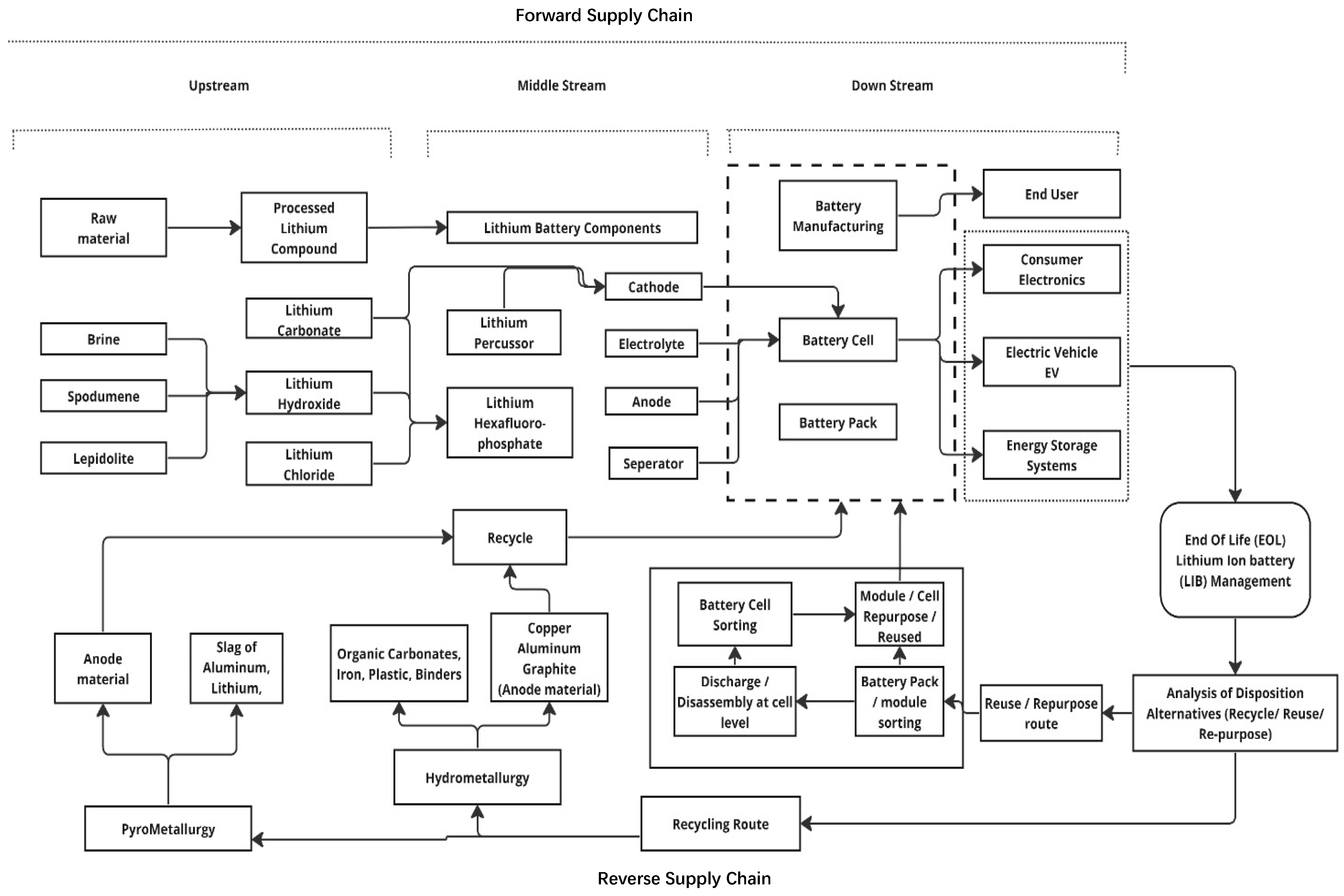
Sustainable Management of Spent Lithium-Ion Batteries: The Role of Reverse Logistics in the Automotive Sector †
 , ,
, , 
Abstract
1. Introduction
2. Literature Review
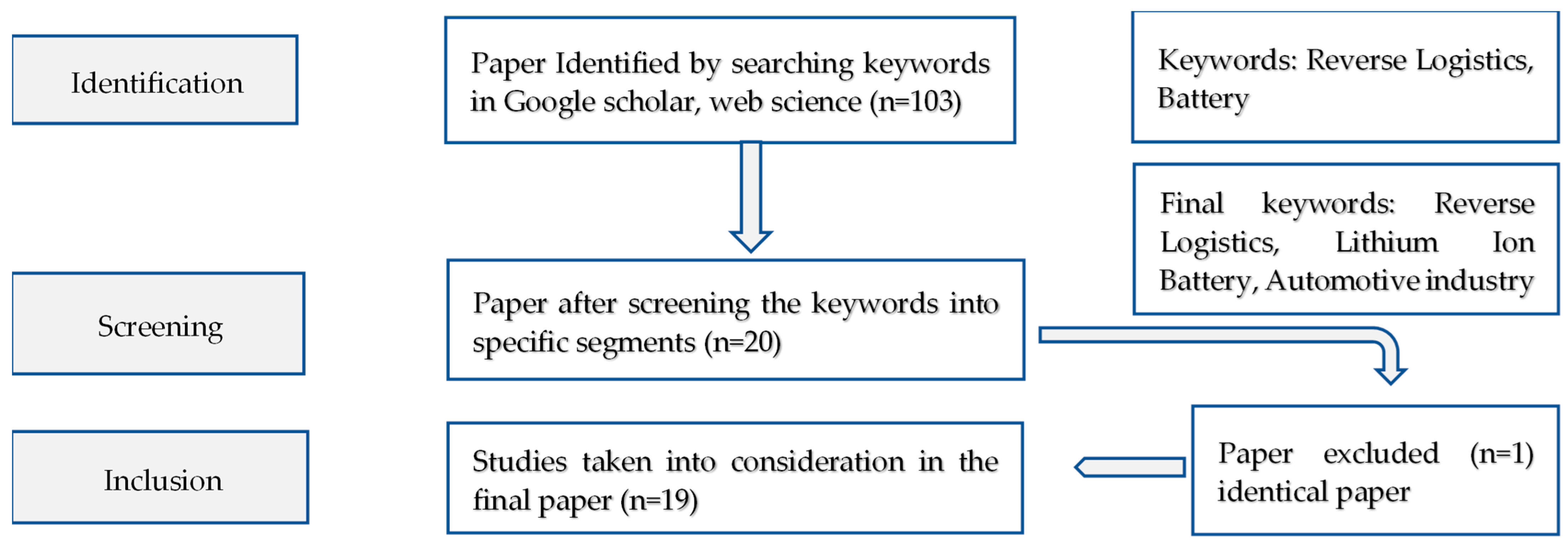
3. Methodology
4. Research Objectives
- RQ1. What are the effective strategies for managing spent (LIBs) within an environmental hierarchy covering prevention, reuse, recycling, recovery, and disposal?
- RQ2. How can the second life of spent LIBs be assessed, particularly through remanufacturing and repurposing?
- RQ3. What are the key factors differentiating the three main recycling approaches (pyro metallurgy, direct recycling, hydrometallurgy), and how do they compare in terms of costs and net present values?
- RQ4. What are the critical cost factors, specifically in transportation, influencing LIB recycling across different countries?
- RQ5. How do environmental regulations in North America and Europe govern LIB waste management, and what role do state and provincial regulations play?
5. Results
5.1. Unused LIB Management Hierarchy
5.2. Second Life of Spent LIBs
5.3. Recycling Is the Way LIBs Are Finally Used
5.4. Recycling Costs and Methods Comparison
5.5. LIB Transportation for Recycling
5.6. Regulation Regarding LIB
6. Discussion
- Enhance direct recycling: Development of more efficient processes for manual disassembly and reconstitution of batteries, which could reduce labor costs and environmental impact. Optimize the direct recycling process for improved material recovery rates, emphasizing economic and environmental refinement for long-term lithium-ion battery (LIB) recycling.
- Hydrometallurgical techniques: improvement of hydrometallurgical methods to reduce energy consumption, reagent use, and water purification needs.
- Standardization of LIB design: establishment of common designs and labeling specifications for LIBs to facilitate easier sorting and recycling.
- Establish regional recycling infrastructure: Suggest the creation of consolidated recycling facilities in Canada, especially in high LIB consumption regions, to reduce transportation costs and associated carbon emissions. Further research is needed to understand and validate the cost-effectiveness and environmental benefits of this regionalization strategy.
7. Conclusions
Author Contributions
Funding
Institutional Review Board Statement
Informed Consent Statement
Data Availability Statement
Conflicts of Interest
References
- Mo, J.Y.; Jeon, W. The Impact of Electric Vehicle Demand and Battery Recycling on Price Dynamics of Lithium-Ion Battery Cathode Materials: A Vector Error Correction Model (VECM) Analysis. Sustainability 2018, 10, 2870. [Google Scholar] [CrossRef]
- Panda, N.; Cueva-Sola, A.B.; Dzulqornain, A.M.; Thenepalli, T.; Lee, J.-Y.; Yoon, H.-S.; Jyothi, R.K. Review on lithium ion battery recycling: Challenges and possibilities. Geosyst. Eng. 2023, 26, 101–118. [Google Scholar] [CrossRef]
- Fountain, J.; Peng, E.J.; Angeles, N. LCA: Batteries and Fuel Cells for Commercial Buildings in British Columbia; UBC Social Ecological Economic Development Studies (SEEDS) Student Report; University of British Columbia Library: Vancouver, BC, Canada, 2012. [Google Scholar]
- Fleischmann, M.; Krikke, H.R.; Dekker, R.; Flapper, S.D.P. A characterisation of logistics networks for product recovery. Omega 2000, 28, 653–666. [Google Scholar] [CrossRef]
- Jayaraman, K. Manufacturing sisal–polypropylene composites with minimum fibre degradation. Compos. Sci. Technol. 2003, 63, 367–374. [Google Scholar] [CrossRef]
- Mathiyazhagan, K.; Rajak, S.; Panigrahi, S.S.; Agarwal, V.; Manani, D. Reverse supply chain management in manufacturing industry: A systematic review. Int. J. Prod. Perform. Manag. 2021, 70, 859–892. [Google Scholar] [CrossRef]
- Sharmili, N.; Nagi, R.; Wang, P.; Sharmili, N.; Nagi, R.; Wang, P. A review of research in the Li-ion battery production and reverse supply chains. J. Energy Storage 2023, 68. [Google Scholar] [CrossRef]
- Akram, M.N.; Abdul-Kader, W. Electric vehicle battery state changes and reverse logistics considerations. Int. J. Sustain. Eng. 2021, 14, 390–403. [Google Scholar] [CrossRef]
- Azadnia, A.H.; Onofrei, G.; Ghadimi, P. Electric vehicles lithium-ion batteries reverse logistics implementation barriers analysis: A TISM-MICMAC approach. Resour. Conserv. Recycl. 2021, 174, 105751. [Google Scholar] [CrossRef]
- Grandjean, T.R.; Groenewald, J.; McGordon, A.; Marco, J. Cycle life of lithium ion batteries after flash cryogenic freezing. J. Energy Storage 2019, 24. [Google Scholar] [CrossRef]
- Gonzales-Calienes, G.; Yu, B.; Bensebaa, F. Development of a Reverse Logistics Modeling for End-of-Life Lithium-Ion Batteries and Its Impact on Recycling Viability—A Case Study to Support End-of-Life Electric Vehicle Battery Strategy in Canada. Sustainability 2022, 14, 15321. [Google Scholar] [CrossRef]
- Wang, J.; Li, H.; Lu, H.; Yang, H.; Wang, C. Integrating offline logistics and online system to recycle e-bicycle battery in China. J. Clean. Prod. 2020, 247. [Google Scholar] [CrossRef]
- Islam, T.; Iyer-Raniga, U. Lithium-Ion Battery Recycling in the Circular Economy: A Review. Recycling 2022, 7, 33. [Google Scholar] [CrossRef]
- Martins, L.S.; Guimarães, L.F.; Junior, A.B.B.; Tenório, J.A.S.; Espinosa, D.C.R. Electric car battery: An overview on global demand, recycling and future approaches towards sustainability. J. Environ. Manag. 2021, 295, 113091. [Google Scholar] [CrossRef]
- Lin, J.; Fan, E.; Zhang, X.; Huang, R.; Zhang, X.; Chen, R.; Wu, F.; Li, L. A lithium-ion battery recycling technology based on a controllable product morphology and excellent performance. J. Mater. Chem. A 2021, 9, 18623–18631. [Google Scholar] [CrossRef]
- Sarkis-Onofre, R.; Catalá-López, F.; Aromataris, E.; Lockwood, C. How to properly use the PRISMA Statement. Syst. Rev. 2021, 10, 117. [Google Scholar] [CrossRef]
- Harper, G.; Sommerville, R.; Kendrick, E.; Driscoll, L.; Slater, P.; Stolkin, R.; Walton, A.; Christensen, P.; Heidrich, O.; Lambert, S.; et al. Recycling lithium-ion batteries from electric vehicles. Nature 2019, 575, 75–86. [Google Scholar] [CrossRef]
- Hesselbach, J.; Herrmann, C. (Eds.) Glocalized Solutions for Sustainability in Manufacturing. In Proceedings of the 18th CIRP International Conference on Life Cycle Engineering, Technische Universität, Braunschweig, Braunschweig, Germany, 2–4 May 2011; Springer Science & Business Media: Dordrecht, The Netherlands, 2011. [Google Scholar] [CrossRef]
- Li, L.; Zhang, X.; Li, M.; Chen, R.; Wu, F.; Amine, K.; Lu, J. The Recycling of Spent Lithium-Ion Batteries: A Review of Current Processes and Technologies. Electrochem. Energy Rev. 2018, 1, 461–482. [Google Scholar] [CrossRef]
- Chen, M.; Ma, X.; Chen, B.; Arsenault, R.; Karlson, P.; Simon, N.; Wang, Y. Recycling End-of-Life Electric Vehicle Lithium-Ion Batteries. Joule 2019, 3, 2622–2646. [Google Scholar] [CrossRef]
- A Llamas-Orozco, J.; Meng, F.; Walker, G.S.; Abdul-Manan, A.F.N.; MacLean, H.L.; Posen, I.D.; McKechnie, J. Estimating the environmental impacts of global lithium-ion battery supply chain: A temporal, geographical, and technological perspective. PNAS Nexus 2023, 2, pgad361. [Google Scholar] [CrossRef]
- Giosuè, C.; Marchese, D.; Cavalletti, M.; Isidori, R.; Conti, M.; Orcioni, S.; Ruello, M.L.; Stipa, P. An Exploratory Study of the Policies and Legislative Perspectives on the End-of-Life of Lithium-Ion Batteries from the Perspective of Producer Obligation. Sustainability 2021, 13, 11154. [Google Scholar] [CrossRef]
- Baum, Z.J.; Bird, R.E.; Yu, X.; Ma, J. Lithium-Ion Battery Recycling—Overview of Techniques and Trends. ACS Energy Lett. 2022, 7, 712–719. [Google Scholar] [CrossRef]
- Foster, M.; Isely, P.; Standridge, C.R.; Hasan, M. Feasibility assessment of remanufacturing, repurposing, and recycling of end of vehicle application lithium-ion batteries. J. Ind. Eng. Manag. 2014, 7, 698–715. [Google Scholar] [CrossRef]
- Wang, X.; Gaustad, G.; Babbitt, C.W.; Richa, K. Economies of scale for future lithium-ion battery recycling infrastructure. Resour. Conserv. Recycl. 2014, 83, 53–62. [Google Scholar] [CrossRef]
- Hoyer, C.; Kieckhäfer, K.; Spengler, T.S. Technology and capacity planning for the recycling of lithium-ion electric vehicle batteries in Germany. J. Bus. Econ. 2014, 85, 505–544. [Google Scholar] [CrossRef]
- Ma, X.; Ma, Y.; Zhou, J.; Xiong, S. The Recycling of Spent Power Battery: Economic Benefits and Policy Suggestions. IOP Conf. Ser. Earth Environ. Sci. 2018, 159, 012017. [Google Scholar] [CrossRef]
- Alfaro-Algaba, M.; Ramirez, F.J. Techno-economic and environmental disassembly planning of lithium-ion electric vehicle battery packs for remanufacturing. Resour. Conserv. Recycl. 2020, 154, 104461. [Google Scholar] [CrossRef]
- Dai, Q.; Spangenberger, J.; Ahmed, S.; Gaines, L.; Kelly, J.C.; Wang, M. EverBatt: A Closed-Loop Battery Recycling Cost and Environmental Impacts Model. Argonne National Laboratory. 2019. Available online: https://publications.anl.gov/anlpubs/2019/07/153050.pdf (accessed on 1 July 2021).
- Wang, L.; Wang, X.; Yang, W. Optimal design of electric vehicle battery recycling network—From the perspective of electric vehicle manufacturers. Appl. Energy 2020, 275, 115328. [Google Scholar] [CrossRef]


| Strategy | Description | Reference |
|---|---|---|
| Prevention | To reduce the generation of waste, this method uses LIBs with less-critical materials and creates smaller electronic gadgets with smaller LIBs. | [17] |
| Reuse | This strategy involves extending the service life of spent LIBs by giving them a second use, which is primarily applicable to electric vehicle (EV) batteries. | [18] |
| Recycling | Reintroducing beneficial components from unused lithium-ion batteries back into the value chain is the objective of this method. | [17] |
| Recovery | The process involves extracting energy from wastes like pyrometallurgy and other procedures that use elements from waste LIBs as fuel. | [17] |
| Disposal | Used LIBs are consumed at municipal waste combustion plants or landfills under this method, with little chance of recovery. | [17] |
| Strategy | Description | Reference |
|---|---|---|
| Re-manufacturing | This is the process of repurposing power lithium-ion batteries (LIBs) for their intended applications. It includes evaluating and disassembling LIB packs, replacing defective cells and components, and assembling them to create new, functional LIB packs. | [20] |
| Re-purposing | Renewing withdrawn automotive batteries for “second life” use in non-automotive applications like permanent archiving is easier than in electric automobiles. |
| Method | Method Description | Recycling Cost ($/kWh) | Net Present Value ($/kWh) |
|---|---|---|---|
| Direct | Physically separates battery components, retaining the cathode’s functional structure without chemical alteration. | USD 9.40 | USD 15.90 |
| Hydro metallurgical | Uses chemical leaching to recover all key cathode and anode materials, including lithium. | USD 10.10 | USD 8.60 |
| Pyro metallurgical | Uses high-temperature smelting to recover metals such as cobalt, nickel, and copper. | USD 11.60 | USD 5.10 |
| Recycling Technique | Pros | Cons |
|---|---|---|
| Hydrometallurgy | Lower energy requirements compared to pyro metallurgy. Detailed metal separation process. Ability to extract metals using aqueous solutions. | Requires purification of water and uses many reagents. Selective precipitation or solvent extraction may be needed for metal recovery. |
| Pyro metallurgy | Simpler implementation. Effective for recycling a variety of battery compositions. Effective for recovering valuable metals like cobalt. | Incurs significant energy costs for combustion and calcination. Consumes some battery materials, limiting direct incorporation into new batteries. |
| Direct Recycling | Likely lower energy and reagent costs compared to other methods. Preserves intact crystal structure of cathode materials for reuse. Potential for reducing environmental impact by reusing materials without extensive processing. | Requires manual disassembly, potentially leading to higher labor costs. Requires standardization of battery chemistries and packaging for economic viability. |
| References | Country | Carriage Expense | Normalize Expense (USD per kg) | Additional Information |
|---|---|---|---|---|
| [24] | United States | USD 2.50 per lb | USD 5.51 | Cost of volt battery transportation from Detroit to Lancaster. |
| [25] | North America | USD 1120 per ton | USD 1.12 | Total transportation cost, including collection and processing. |
| [26] | Germany | USD 215.25/BEV-eq. (330 kg) | USD 0.71 | Costing for one collection center. |
| [27] | Shenzen | USD 302.62 per ton | USD 0.30 | Market survey is conducted to determine costing. |
| [28] | Spain | USD 1096.32 per truckload | NA | The transportation of 500 batteries is estimated at EUR 11,520, meaning that 42 batteries can be shipped in one truck. |
| [29] | United States | USD 2.09 per kg | USD 2.09 | Total travel time to collection, then to disassembly and finally to recycling is considered. |
| [30] | China | USD 158.00 per battery (365 kg) | USD 0.43 | The route from collection to recycling center is considered to be uninterrupted. |
Disclaimer/Publisher’s Note: The statements, opinions and data contained in all publications are solely those of the individual author(s) and contributor(s) and not of MDPI and/or the editor(s). MDPI and/or the editor(s) disclaim responsibility for any injury to people or property resulting from any ideas, methods, instructions or products referred to in the content. |
© 2024 by the authors. Licensee MDPI, Basel, Switzerland. This article is an open access article distributed under the terms and conditions of the Creative Commons Attribution (CC BY) license (https://creativecommons.org/licenses/by/4.0/).
Share and Cite
Ahmed, M.S.; Hasan, M.F.; Kabir, S.M.S.; Khan, A.S.; Khan, S.A. Sustainable Management of Spent Lithium-Ion Batteries: The Role of Reverse Logistics in the Automotive Sector. Eng. Proc. 2024, 76, 61. https://doi.org/10.3390/engproc2024076061
Ahmed MS, Hasan MF, Kabir SMS, Khan AS, Khan SA. Sustainable Management of Spent Lithium-Ion Batteries: The Role of Reverse Logistics in the Automotive Sector. Engineering Proceedings. 2024; 76(1):61. https://doi.org/10.3390/engproc2024076061
Chicago/Turabian StyleAhmed, Md Shahariar, Md Ferdous Hasan, Sheikh Md Shahadat Kabir, Arafat Sultan Khan, and Sharfuddin Ahmed Khan. 2024. "Sustainable Management of Spent Lithium-Ion Batteries: The Role of Reverse Logistics in the Automotive Sector" Engineering Proceedings 76, no. 1: 61. https://doi.org/10.3390/engproc2024076061
APA StyleAhmed, M. S., Hasan, M. F., Kabir, S. M. S., Khan, A. S., & Khan, S. A. (2024). Sustainable Management of Spent Lithium-Ion Batteries: The Role of Reverse Logistics in the Automotive Sector. Engineering Proceedings, 76(1), 61. https://doi.org/10.3390/engproc2024076061