


Abstract
This report aims to provide a patent landscape analysis on carbon allotrope-based textile electrodes and biosensors to measure biosignals and detect several parameters. Espacenet, a free-of-charge patent database provided by the EPO (European Patent Office) and containing data on more than 140 million patent publications from over 100 countries, was used as the reference database. The patent search was carried out by combining keywords and classification symbols. Both classification schemes (IPC–International Patent Classification and CPC–Cooperative Patent Classification) were used. As a result of this study, a total of 227 patent documents were found between 2002 and 2023. The first patent application claiming a fabric electrode arrangement with carbon black as conductive material was filed in 2002 (and published in 2004) by Philips. 2021 was the year with the highest number of published patent applications, with 36 documents. The United States was ranked first with 126 patent documents. Carbon nanotubes and graphene are the most patented carbon allotrope materials, while body temperature, motion, and heart rate measurements are the main disclosed applications. We also analyzed the Orbit database obtaining 288 patent documents (vs. 227) with only 238 still active records (148 granted and 90 pending applications): the first application by Philips on an electrode arrangement is confirmed, and the patent distribution shows a peak in the period 2016–2020 (146 records available), while today it seems to be stable or even decreasing (“only” 52 records in the half period January 2021–June 2023). This outcome suggests that this material and related technology has reached its maximum exploitation or has not demonstrated a disruptive output.
1. Introduction
Patent surveys and related content are deemed to be of great value for identifying R&D trends and improvements; thus, a patent landscape analysis (PLA) is a very useful tool able to provide an overview of a specific technology field and its exploitation status. PLA is a retrospective study because (almost) all patent applications are published eighteen months (or at least three months) after filing. However, since novel inventions are protected for a considerable time before related products/devices enter the market, patents can be seen as an early indicator of upcoming technologies and related systems and/or services [1].
In recent years, wearable systems and smart textiles for monitoring several biomedical parameters have been the most evolving and diffusing technologies. In this field, together with conductive fibers and fabric, another very promising material is carbon, in the form of fibers, nanotubes, or graphene layers. Its exploration and study are still under development, and no integrated surveys about this material and its application in biomedical sensing were found. This study aims to provide a PLA in the field of carbon allotrope-based textile sensors/electrodes useful for monitoring physiological signals such as heart rate (HR), SpO2, body temperature, and other bioelectrical or mechanical parameters.
2. Resources and Methods
Espacenet and Orbit databases were used to retrieve patent information. Espacenet (https://worldwide.espacenet.com) is a free-of-charge patent database provided by the European Patent Office (EPO) and contains data on more than 140 million patent documents from over 90 countries. Orbit Intelligence (https://www.orbit.com) is a platform managed by Questel that offers access to patent information through three patent databases (FamPat, FullPat, and FullText). The coverage of the above-mentioned tools is quite similar, in terms of the number of documents, available full text, and updates. The patent search was carried out through a combination of specific keywords and classification symbols. Both the International Patent Classification (IPC) [2] and the Cooperative Patent Classification (CPC) [3] were used.
These systems share the same hierarchical structure, but the CPC is characterized by more subdivisions (250,000 vs. 80,000). While the IPC is adopted by more than 120 patent offices around the world to classify patent applications, only 30 Offices are participating in the CPC [4]. CPC is limited to a narrow circle of countries [5]. Therefore, both systems have to be used to obtain comprehensive research [6,7]. This statement can be explained using the main group A61B 5/00 (measuring for diagnostic purposes), which is the reference classification symbol for biosensors.
This query was used on Espacenet (accessed on 7 August 2023) to obtain patents classified with IPC symbols only: ipc = “A61B5/00” NOT (cpc = “A” OR cpc = “B” OR cpc = “C” OR cpc = “D” OR cpc = “E” OR cpc = “F” OR cpc = “G” OR cpc = “H”).
A total of 48,428 patent documents do not have any CPC code (see Figure 1).
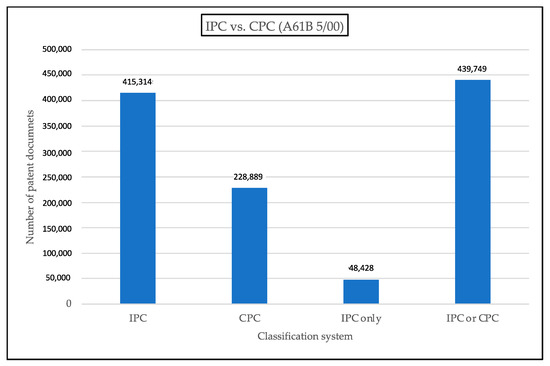
Figure 1.
Comparison of patent classification systems (IPC vs. CPC).
Therefore, the exclusion of the IPC would lead to a limited patent search.
The classification and indexing codes (and the corresponding definitions) used for carrying out the patent searches are listed in Table 1.

Table 1.
List of classification symbols (IPC/CPC) used in patent searches.
Classification codes are used to classify inventive or additional information, while indexing codes are helpful to categorize additional information only and to specify aspects not covered by the classification scheme. Moreover, codes are assigned according to the structure, or the function/application of the subject matter claimed in a patent.
Codes referred to function/application are the following: A61B5, D03D 1/0088, A41D 13/1281, A63B 2230, D06M, B82Y, C08K 3/042, C08K 3/041.
The classification and indexing codes listed in Table 1 were retrieved using a simple query [ftxt = (“textile” prox/distance < 3 “electrode?”) OR ftxt = (“textile “ prox/distance < 3 “sensor?”)] on Espacenet and analyzing the results through the function “Filters”.
A patent search can be carried out on one or more patent databases. Usually, the collected results are different, and this depends on the specific coverage and search engine of the database.
The following query on Espacenet (accessed on 8 August 2023) (ctxt = (“textile” prox/distance < 3 “electrode?”) OR ctxt = (“textile” prox/distance < 3 “sensor?”)) AND ftxt = (“carbon” prox/ordered “nanotube?”) yielded 110 results. The same search query on Orbit (see Figure 2) produced 154 results.
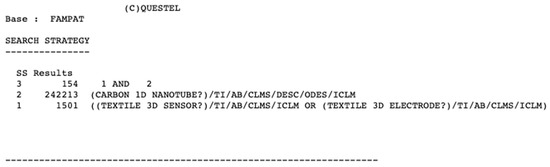
Figure 2.
Simple search queries on the Orbit platform (FamPat database).
Therefore, a patent landscape analysis should be conducted on more than one database to obtain a more complete retrieval of documents.
3. Results
Data were acquired by Espacenet and the Orbit Intelligence platform (FamPat database). The latter is provided with a comprehensive suite for searching and analyzing patent documents [8].
3.1. Espacenet Results
The following search query was carried out on Espacenet (accessed on 16 July 2023) using keywords and classification symbols (listed in Table 1) in the Title/Abstract/Claims and Full-text fields for data mining of carbon-allotrope based textile sensors and electrodes:
cl any “A61B5” AND ctxt = (“textile” prox/distance < 3 “sensor?”) OR (cl any “A61B5” AND ctxt = (“textile” prox/distance < 3 “electrode?”)) OR (cpc any “D03D1/0088” AND (ftxt = (“textile” prox/distance < 3 “electrode?”) OR ftxt = (“textile” prox/distance < 3 “sensor?”))) OR (cpc any “A41D1/002” AND (ftxt = (“textile” prox/distance < 3 “electrode?”) OR ftxt = (“textile” prox/distance < 3 “sensor?”))) OR (cpc any “G06F1/163” AND (ftxt = (“textile” prox/distance < 3 “electrode?”) OR ftxt = (“textile” prox/distance < 3 “sensor?”))) OR (cpc any “H01L23/5387” AND (ftxt = (“textile” prox/distance < 3 “electrode?”) OR ftxt = (“textile” prox/distance < 3 “sensor?”))) OR (cpc any “H05K1/038” AND (ftxt = (“textile” prox/distance < 3 “electrode?”) OR ftxt = (“textile” prox/distance < 3 “sensor?”))) OR (cpc any “A41D13/1281” AND (ftxt = (“textile” prox/distance < 3 “electrode?”) OR ftxt = (“textile” prox/distance < 3 “sensor?”))) OR (cpc any “A61B2562” AND (ftxt = (“textile” prox/distance < 3 “electrode?”) OR ftxt = (“textile” prox/distance < 3 “sensor?”))) OR (cpc any “A63B2230” AND (ftxt = (“textile” prox/distance<3 “electrode?”) OR ftxt = (“textile” prox/distance < 3 “sensor?”))) OR (cpc any “H05K2201” AND (ftxt = (“textile” prox/distance < 3 “electrode?”) OR ftxt = (“textile” prox/distance < 3 “sensor?”))) OR (cl any “D06M” AND (ftxt = (“textile” prox/distance < 3 “electrode?”) OR ftxt = (“textile” prox/distance < 3 “sensor?”))) AND (ftxt all “graphene” OR ftxt all “carbon nanotube?” OR ftxt all “carbon black” OR ftxt all “CNTs” OR ftxt all “SWCNTs” OR ftxt all “MWCNTs” OR ftxt all “graphene oxide” OR ftxt all “reduced graphene oxide” OR ftxt all “graphene nanosheet?” OR ftxt all “carbon allotrope?” OR cl =/low “C01B32/00” OR cpc =/low “C01B2204/00” OR cl =/low “B82Y”).[Query 1]
As a result of this study, a total of 227 patent documents were found between 2002 and 2023 (see Supplementary File Spreadsheet S1). The first patent application claiming a fabric electrode arrangement with carbon black as conductive material was filed in 2002 (and published in 2004) by Philips. 2021 was the year with the highest number of published patent applications, with 36 documents. The maximum number of patent applications filed was in 2019 with 32 documents. The United States was ranked first with 126 patent documents, followed by China and Europe (see Figure 3). Carbon nanotubes and graphene are the most patented carbon allotrope materials (Figure 4), while body temperature, motion, and heart rate measurements are the main disclosed applications (Figure 5).
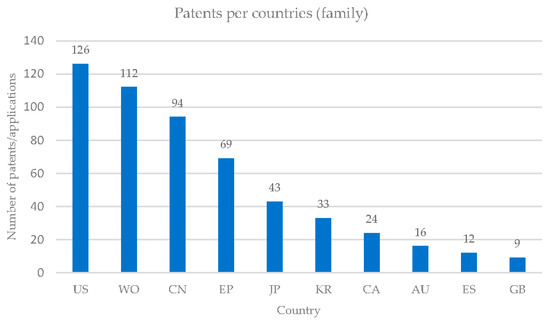
Figure 3.
Top ten countries per number of published patent documents.
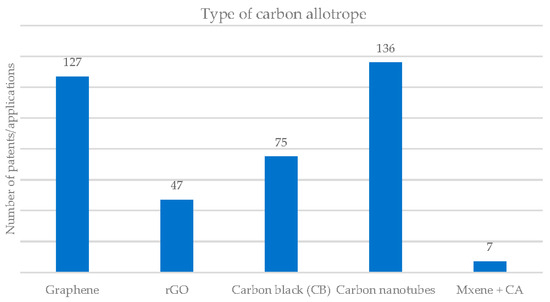
Figure 4.
Number of patent documents per type of carbon allotrope claimed.
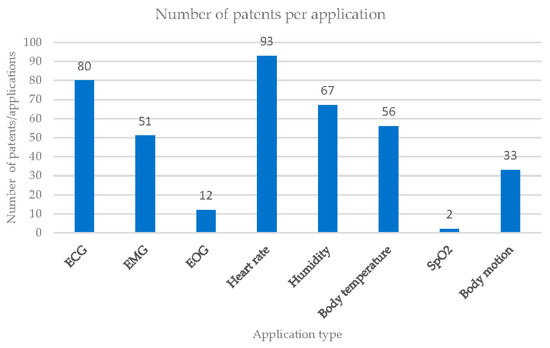
Figure 5.
Number of patent documents per type of application.
Carbon nanotubes are the main (claimed and described) electrically conductive materials, followed by graphene, carbon black, reduced graphene oxide, and Mxenes (a group of two-dimensional transition metal carbides, nitrides, or carbonitrides with a composition of Mn+1XnTx, where M is a transition metal (Ti, V, Nb, etc.), X is nitrogen or carbon, and T is surface functional groups (-OH, -F, -O-, -Cl) [9].
The top ten applicants are reported in Figure 6.
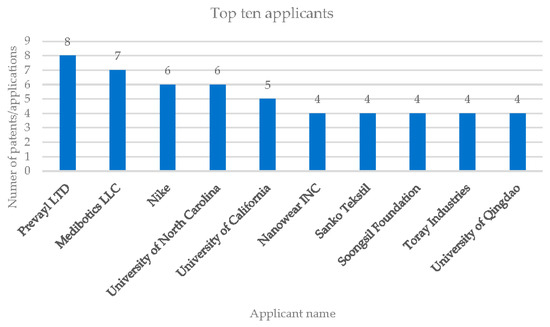
Figure 6.
The top ten applicants per number of published patent documents.
Both companies and universities are listed as leading applicants per the number of published patent applications. Prevayl is ranked as the first owner, which has recorded eight patent documents. In second place, the company Medibotics has filed seven patent applications. The third place is shared between Nike and the University of North Carolina.
3.2. Orbit Results
The patent strategy used on the FamPat database is reported in Table 2. The patent search gave a total of 288 results, of which 238 are active patents (148 granted and 90 pending patent families, see Supplementary File Spreadsheet S2). Four patent families were litigated and nine were subjected to an opposition procedure at the EPO.
Table 2.
List of search queries used on FamPat (Orbit Intelligence) [Query 2].
The evolution of patent filings by the first application year, first publication year, and first priority year are shown in Figure 7.
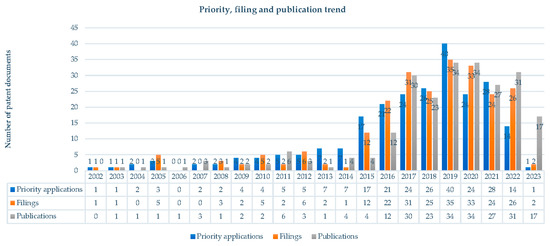
Figure 7.
Trend of patent priorities, filings, and publications between 2002 and 2023.
Patents are assembled in families. A patent family is a group of patent publications on a single invention, filed by the same applicant or joint applicants in one or more countries [10].
The first application by Philips on an electrode arrangement is confirmed, and the patents distribution shows a peak in the period 2016–2020 (146 records available), while today it seems to be stable or even decreasing (“only” 52 records in the half period January 2021–June 2023).
The year 2019 has seen the maximum patent activity in priority applications filed and published patent applications.
This growing trend has been confirmed in a scientific literature search published in a recent review [11] on carbon-based textile sensors.
The patent protection, publication, and priority trends by country are reported in Figure 8. Patent families by protection country means the number of alive patents protected in the various national offices.
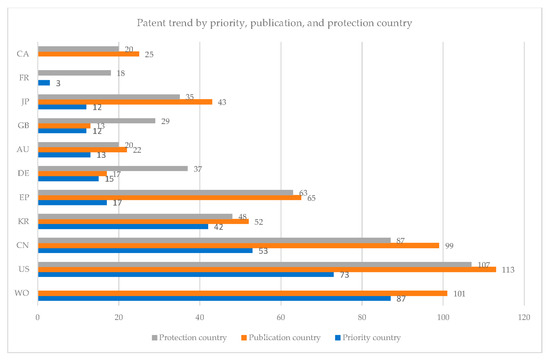
Figure 8.
Patent filings trend by protection/publication/priority country.
The PCT (Patent Cooperation Treaty) procedure is the preferred solution for filing priority applications, followed by the US and China.
The top ten applicants list is reported in Figure 9.
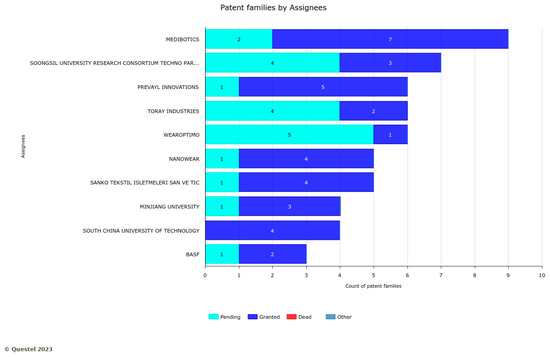
Figure 9.
The top ten applicants per number of patents.
Medibotics ranks first with nine patent documents (7 granted and 2 pending applications), followed by a Korean foundation and Prevayl Innovations Ltd, a British company.
The top ten cited patents are listed in Table 3.
Table 3.
List of the top ten cited patents (see Supplementary File Spreadsheet S3).
Considering the geographical scope of protection, the number of forward citations, and the expiration dates, the most valuable patents are EP2404148 (“Elastically stretchable fabric force sensor arrays and methods of making”), EP3116395 (“Physiological monitoring garments”) and EP2866596 (“Electronic textile assembly”).
4. Conclusions
Patent documents are a valuable source of technical information that is often not available elsewhere since many companies disclose their research and development results only in patents.
Patent landscape analysis can be used to guide R&D work, to find out the most recent inventions, and to study the development of a particular technology.
Results obtained with Espacenet and Orbit are slightly different, and this is due to the different search engines of these databases.
The patenting trend since 2002 shows an increase in filing numbers starting from 2015 until 2019, with a decline in 2020 and an upswing in 2021.
Global patenting is led by the US and China, while the more promising applications are dedicated to electronic textiles applied to biomedical parameter monitoring (with particular relevance to bioelectric signals like ECG and EMG) and mechanical measurements (force monitoring through stretchable fabrics).
Supplementary Materials
The following supporting information can be downloaded at: https://www.mdpi.com/article/10.3390/ecsa-10-16216/s1, Spreadsheet S1: Espacenet search results.xls; Spreadsheet S2: Orbit search results.xls, Spreadsheet S3: List of top patent cited.xls, Spreadsheet.
Author Contributions
Conceptualization, methodology, data curation, writing—original draft preparation. M.B.; supervision, writing—review and editing, G.A. All authors have read and agreed to the published version of the manuscript.
Funding
This study was supported by the funds for biomedical research, in particular for the project “5x1000/2023—Sviluppo di nuovi protocolli di valutazione funzionale multifattoriale e relativi indici per l’età pediatrica” awarded to Prof. Giuseppe Andreoni, and by the Italian Ministry of Health (Ricerca Corrente 2023 to Dr.Eng. E. Biffi).
Institutional Review Board Statement
Not applicable.
Informed Consent Statement
Not applicable.
Data Availability Statement
Data are available.
Conflicts of Interest
The authors declare no conflict of interest. The authors have no relevant affiliations or financial involvement with any organization or entity with a financial interest in or financial conflict with the subject matter or materials discussed in this article.
References
- Van Rijn, T.; Timmis, J.K. Patent landscape analysis–Contributing to the identification of technology trends and informing research and innovation funding policy. Microb. Biotechnol. 2023, 16, 683–696. [Google Scholar] [CrossRef] [PubMed]
- WIPO IPC Publication. Available online: https://ipcpub.wipo.int (accessed on 7 August 2023).
- Cooperative Patent Classification. Available online: https://www.cooperativepatentclassification.org/home (accessed on 7 August 2023).
- EPO-USPTO Presentation–CPC Status Update. Available online: https://www.cooperativepatentclassification.org/sites/default/files/attachments/970c93f0-c03f-4cde-a88a-a72bac6b7c2c/CPC+Annual+meeting+with+industry+users+29+March+2021.pdf (accessed on 7 August 2023).
- Blokhina, Y.V.; Ilin, A.S. Use of Patent Classification in Searching for Biomedical Information. Russ. J. Bioorg. Chem. 2021, 47, 1225–1230. [Google Scholar] [CrossRef]
- Degroote, B.; Held, P. Analysis of the patent documentation coverage of the CPC in comparison with the IPC with a focus on Asian documentation. World Pat. Inf. 2018, 54, S78–S84. [Google Scholar] [CrossRef]
- Barbieri, M. Patent Prior Art Searches: Basic Principles and Strategies. Preprints 2022, 2022050054. [Google Scholar] [CrossRef]
- Machuca-Martinez, F.; Camargo Amado, R.; Gutierrez, O. Coronaviruses: A patent dataset report for research and development (R&D) analysis. Data Brief 2020, 30, 105551. [Google Scholar] [CrossRef] [PubMed]
- Shen, X.; Zheng, Q.; Kim, J.K. Rational design of two-dimensional nanofillers for polymer nanocomposites toward multifunctional applications. Prog. Mater. Sci. 2021, 115, 100708. [Google Scholar] [CrossRef]
- Simmons, E.S. Black sheep in the patent family. World Pat. Inf. 2009, 31, 11–18. [Google Scholar] [CrossRef]
- Shao, W.; Cui, T.; Li, D.; Jian, J.; Li, Z.; Ji, S.; Cheng, A.; Li, X.; Liu, K.; Liu, H.; et al. Carbon-Based Textile Sensors for Physiological-Signal Monitoring. Materials 2023, 16, 3932. [Google Scholar] [CrossRef] [PubMed]
Disclaimer/Publisher’s Note: The statements, opinions and data contained in all publications are solely those of the individual author(s) and contributor(s) and not of MDPI and/or the editor(s). MDPI and/or the editor(s) disclaim responsibility for any injury to people or property resulting from any ideas, methods, instructions or products referred to in the content. |
© 2023 by the authors. Licensee MDPI, Basel, Switzerland. This article is an open access article distributed under the terms and conditions of the Creative Commons Attribution (CC BY) license (https://creativecommons.org/licenses/by/4.0/).