


Abstract
This research is concerned with the free vibration and buckling analysis of carbon nanotube-reinforced beams (CNT-RBs) using a novel high-order shear deformation theory (HSDT). The current HSDT is modeled by a trigonometric function without a shear correction factor, and the displacement field has only four variables. Several different carbon nanotube distributions, including two uneven CNT distributions (X-CNT and O-CNT), are considered. The mixture rule is applied to express the effective material properties of carbon nanotube-reinforced beams. The CNTR beams are rested on two springs and a shear layer (Kerr foundation). Hamilton’s principle is employed to derive the governing equations, which are then solved using the Navier technique. The current theory and several parameter effects are studied and validated in comparison to benchmark studies and theories. The main purpose of this study is to enhance understanding of high-order shear theories, such as third order, sinusoidal, exponential, etc. In this context, our theory yields excellent results when compared to other theories. The difference between our theory and the exact solution is so minimal that it is superior to other theories. The second part of the study focuses on investigating the distribution of carbon nanotubes to enhance understanding. This knowledge can assist panel manufacturers in determining the appropriate distribution shape. Our results indicate that the third distribution (X-CNT) significantly influences mechanical behavior, unlike the first and second distributions (UD-CNT and O-CNT).
1. Introduction
Emerging materials like carbon nanotube-reinforced composites have a huge potential for use in high-tech industries, especially those like aerospace that demand advanced mechanical properties. Quality, sturdiness, dependability, and overall effectiveness can all be enhanced by adding carbon nanotubes to conventional matrices [1].
Recently, numerous research studies have focused on analyzing the behavior of beams constructed from carbon nanotube-reinforced composites. We will mention some of these studies in references [2,3,4,5,6].
In the context of advancing our understanding and obtaining results related to high-order shear deformation theories, which constitutes the primary objective of this paper, several prior theories were employed. These include the third-order theory developed by Reddy [7], the sinusoidal HSD theory by Touratier [8], the exponential HSD theory introduced by Karama et al. [9], the hyperbolic HSD theory by Kenanda et al. [10], and the trigonometric-exponential HSD theory, also developed by Kenanda et al. [11,12].
This article will concentrate solely on the key points and fundamental equations that elucidate the novelty presented in this work. Detailed specifics will not be provided in this article, as the complete scope of our work will be published in an independent journal following our participation in the conference.
2. Material Properties of CNTR Beams
Take into account the reference frame consisting of coordinates (x, y, and z) for a CNTR beam, characterized by its dimensions: width (b), length (L), and thickness (h). This beam is mounted on the Kerr foundation as depicted in Figure 1.
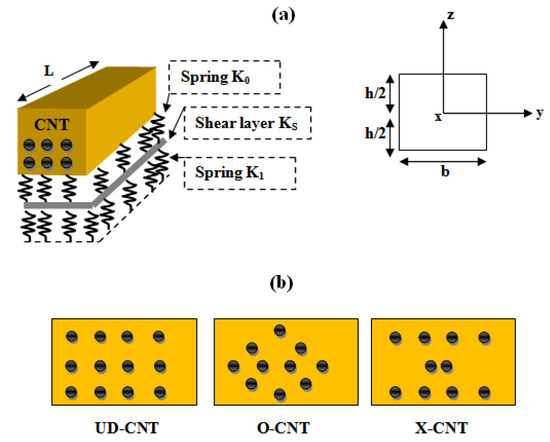
Figure 1.
Carbon nanotube-reinforced beam resting on Kerr foundation: (a) Coordinate system for the CNTR beam and (b) three patterns of CNT distribution.
Based on the rule of mixture, material properties such as Young’s modulus, mass density, and Poisson’s ratio can be defined as:
where () are the homogenized material properties of the composite and () are the volume fractions of matrix and carbon nanotubes, respectively. The latter is determined through the equations shown in Table 1, according to the appropriate distribution. In addition, () are efficiency parameters of carbon nanotubes and matrix.

Table 1.
The volume fraction of several patterns of CNT distribution.
3. Mathematical Formulation
Displacement and Strain Field
High-order shear deformation beam theory provides the displacements along the x and z directions as follows:
In which
where (u and w) are the displacements along the x and z axes of the CNTR beam, and () presents the rotation of the cross section. In which is shape function that expresses the transverse shear stress distribution in a parabolic manner called the high-order shear theory. There are many functions that have been developed in this regard. We show the most important of them in Table 2.
Table 2.
Present the most important beam theories.
According to Equation (2a,b), the strain field can be obtained in the following form:
where () are the components of the strain tensor.
4. Results and Discussion
In this section, our focus is on assessing the reliability and efficiency of the present trigonometric high-order shear deformation theory by contrasting it with various established theories. At the same time, we are investigating how the different CNT distributions influence the behavior of the CNRT (Carbon Nanotube Reinforced) beam. The mechanical characteristics employed in this section are outlined in Table 3.
Table 3.
Present the material properties of CNT and matrix.
Table 4 presents the first non-dimensional fundamental frequency () for three patterns of CNT distribution (UD-CNT, O-CNT, and X-CNT) and two values of () with (L/h = 15). It can be seen from the table that the results of our theory are largely consistent with the third-order shear deformation theory results. In addition, our theory gives better results than classical beam and first-order shear theories in describing mechanical behavior. We also notice from the table that the effect of the third distribution (X-CNT) affects the frequencies significantly compared to the first and second distributions (UD-CNT and O-CNT). Moreover, an increase in the value of () causes an increase in fundamental frequencies.
Table 4.
The first non-dimensional fundamental frequency () for three patterns of CNT distribution (UD-CNT, O-CNT, and X-CNT) and two values of () with (L/h = 15).
5. Conclusions
The current theory outlines a novel trigonometric function for characterizing shear stress distribution, eliminating the need for a shear correction factor. This theory successfully meets the zero traction boundary conditions on both the upper and lower surfaces of the CNTR beam. The trigonometric shear deformation theory involves only four variables in its displacement field. Compared to other shear deformation theories, the proposed hyperbolic theory offers a more comprehensive and accurate representation of transverse shear stress, resulting in superior outcomes when describing the mechanical behavior of CNTR beam.
Author Contributions
Conceptualization, M.A.K. and F.H.; methodology, M.A.K. and F.H.; software M.A.K. and F.H.; validation, M.A.K. and F.H.; formal analysis, M.A.K. and F.H.; investigation, M.A.K. and F.H.; resources, M.A.K. and F.H.; data curation, M.A.K. and F.H.; writing—original draft preparation, M.A.K.; writing—review and editing, F.H.; visualization, M.A.K. and F.H.; supervision M.A.K. and F.H. All authors have read and agreed to the published version of the manuscript.
Funding
This research received no external funding.
Institutional Review Board Statement
Not applicable.
Informed Consent Statement
Not applicable.
Data Availability Statement
Data are contained within the article.
Conflicts of Interest
The authors declare no conflicts of interest.
References
- Ebrahimi, F.; Rostami, P. Wave propagation analysis of carbon nanotube reinforced composite beams. Eur. Phys. J. Plus 2018, 133, 285. [Google Scholar] [CrossRef]
- Lin, F.; Xiang, Y. Vibration of carbon nanotube reinforced composite beams based on the first and third order beam theories. Appl. Math. Model. 2014, 38, 3741–3754. [Google Scholar] [CrossRef]
- Civalek, Ö.; Dastjerdi, S.; Akbaş, Ş.D.; Akgöz, B. Vibration analysis of carbon nanotube-reinforced composite microbeams. Math. Methods Appl. Sci. 2021, 1–17. [Google Scholar] [CrossRef]
- Ansari, R.; Hasrati, E.; Shojaei, M.F.; Gholami, R.; Shahabodini, A. Forced vibration analysis of functionally graded carbon nanotube-reinforced composite plates using a numerical strategy. Phys. E Low-Dimens. Syst. Nanostruct. 2015, 69, 294–305. [Google Scholar] [CrossRef]
- Borjalilou, V.; Taati, E.; Ahmadian, M.T. Bending, buckling and free vibration of nonlocal FG-carbon nanotube-reinforced composite nanobeams: Exact solutions. SN Appl. Sci. 2019, 1, 1323. [Google Scholar] [CrossRef]
- Eghbali, M.; Hosseini, S.A. On Moving Harmonic Load and Dynamic Response of Carbon Nanotube-Reinforced Composite Beams using Higher-Order Shear Deformation Theories. Mech. Adv. Compos. Struct. 2023, 10, 257–270. [Google Scholar] [CrossRef]
- Reddy, J. Analysis of functionally graded plates. Int. J. Numer. Methods Eng. 2000, 47, 663–684. [Google Scholar] [CrossRef]
- Touratier, M. An efficient standard plate theory. Int. J. Eng. Sci. 1991, 29, 901–916. [Google Scholar] [CrossRef]
- Karama, M.; Afaq, K.S.; Mistou, S. A new theory for laminated composite plates. Proc. Inst. Mech. Eng. Part L J. Mater. Des. Appl. 2009, 223, 53–62. [Google Scholar] [CrossRef]
- Meliani, M.H.; Kenanda, M.A.; Hammadi, F.; Belabed, Z. Free vibration analysis of the structural integrity on the porous functionally graded plates using a novel Quasi-3D hyperbolic high order shear deformation theory. Frat. Ed. Integrità Strutt. 2023, 17, 266–282. [Google Scholar] [CrossRef]
- Kenanda, M.A.; Hammadi, F.; Zakaria Belabed, Y.A. Free Vibration Analysis of Porous FG Nanoplates via a New Nonlocal 2D Trigonometric High-Order Shear Deformation Theory. In Proceedings of the 9th World Congress on Mechanical, Chemical, and Material Engineering (MCM’23), London, UK, 6–8 August 2023. [Google Scholar]
- Kenanda, M.A.; Hammadi, F.; Belabed, Z. A novel quasi-3d and 2d high-order shear deformation theory for the thermo-mechanical analysis of porous functionally graded plates resting on elastic foundations. In Proceedings of the 20th International Conference on Experimental Mechanics, Porto, Portugal, 2–7 July 2023. [Google Scholar]
Disclaimer/Publisher’s Note: The statements, opinions and data contained in all publications are solely those of the individual author(s) and contributor(s) and not of MDPI and/or the editor(s). MDPI and/or the editor(s) disclaim responsibility for any injury to people or property resulting from any ideas, methods, instructions or products referred to in the content. |
© 2023 by the authors. Licensee MDPI, Basel, Switzerland. This article is an open access article distributed under the terms and conditions of the Creative Commons Attribution (CC BY) license (https://creativecommons.org/licenses/by/4.0/).