


Abstract
Inclined Rayleigh–Benard Convection (RBC) is numerically investigated in a two-dimensional vertical cavity; the critical aspect ratio and the critical Rayleigh number are discussed. It is established that beyond the 6500 Rayleigh number, secondary cell formation starts in the cavity. But this phenomenon is not visible at lower aspect ratios. The presence of secondary cells is directly related to heat transfer across the cavity. In recent times, insulated glazing units (IGUs) have been considered for better thermal performance, typically in energy-efficient buildings. The study gains significance by gauging the performance and optimization of IGUs.
1. Introduction
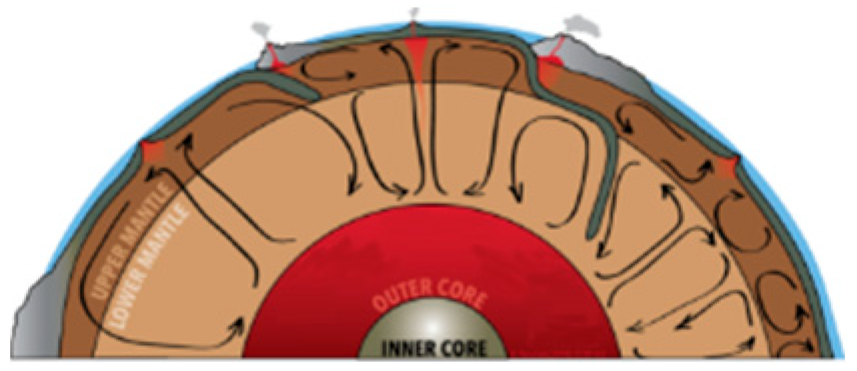
Convection is a common and natural mode of heat transfer between moving fluids as well as solids. It sets in the fluid when there is any kind of thermal inhomogeneity [1]. The study of the convection phenomenon is vigorously important in the disciplines of basic sciences, engineering, and technology [2]. The existence of convection phenomena inside earth layers is depicted in Figure 1.
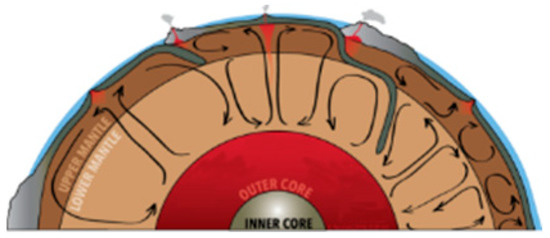
Figure 1.
Convection currents inside the Earth’s layers.
Convection can occur in a fluid due to the horizontal or vertical temperature gradient. The typical Rayleigh–Benard configuration (RBC) consists of a lower heated wall and an upper cold wall [3]. This RBC problem is the simplest and one of the earliest ones to be investigated. The two important parameters here are the Rayleigh number (Ra) and the Prandtl number (Pr). The Rayleigh number is a dimensionless parameter and is defined as the product of the Grashof number, which compares the buoyancy and viscosity effects within fluid, and the Prandtl number, which compares momentum diffusivity and thermal diffusivity. The formed patterns are cells in 2-dimension and rolls in 3-dimension. A very critical part is carried out by the lateral boundaries and the large extent of the third dimension. Vertical cavities with a varying aspect ratio were studied with the same phenomenological approach in this research. It is deduced that, in addition to the critical Rayleigh number, the critical aspect ratio also plays a significant role in heat transfer and heat flux.
The inclined RBC (RBC with a horizontal temperature gradient) has several practical uses; for instance, in developed countries, almost 40% of total energy is consumed only in buildings. Fenestration products, such as windows, perform as thermal holes and are among the main causes of energy loss in a building. Therefore, window thermal performance analysis and optimization have become important concerns to predict and control energy loss and make buildings more energy efficient. This arrangement is also used in solar collectors and the cooling of electronic chips and equipment.
Lartigue et al. [4] studied the phenomenon in AR = 40 for the presence, rotatory motion, and global displacement of secondary cells. In another study, the melting front of purely incompressible material amongst liquid and solid phases is studied as a case of the RBC problem [5]. D’Orazio et al. [6] studied small aspect ratios for heat transfer evolution, bifurcations, and hysteresis phenomena. Nakhoul et al. [7] reported high AR nanoparticles using near-field, surface-coupled, sophistically controlled polarized pulses with the aim of preventing bacterial proliferation. The phenomenon is extensively studied and reported by Bergman et al. [8], Yang et al. [9], and Poel [10].
2. Problem Statement and Numerical Methodology
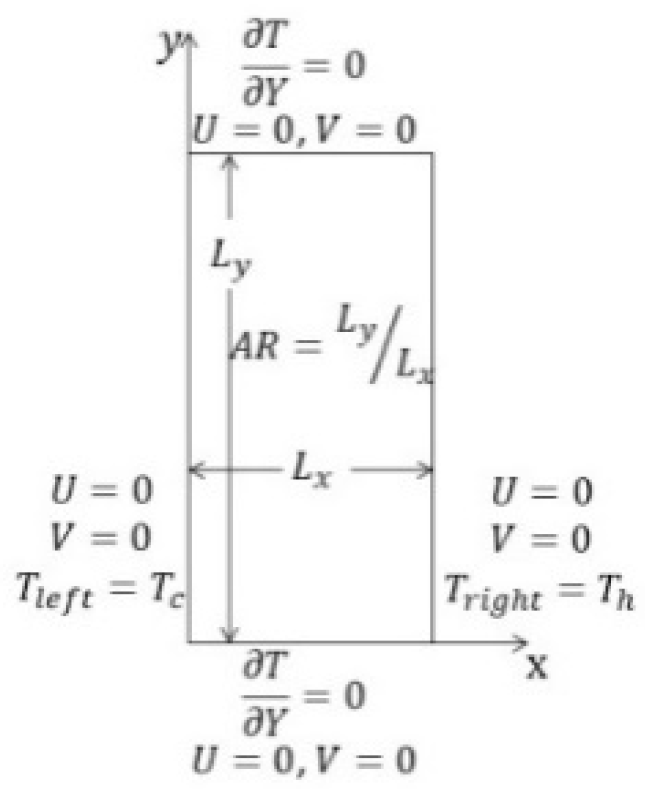
A vertical cavity filled with air (Pr = 0.71) at atmospheric pressure is considered for 1 ≤ AR ≤ 40 and Ra ≤ 10,000. The assumptions and numerical methodology deployed here are the same as those in [11]. The schematic is shown in Figure 2.
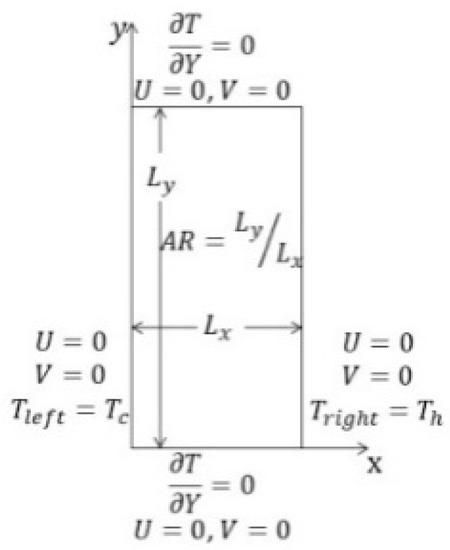
Figure 2.
Schematic of the vertical cavity under study [11].
Dimensionless forms of Navier–Stokes equations are used along with the artificial compressibility method [12] to couple velocity and pressure, and a forward in time central in space (FTCS) explicit scheme is employed to discretize the governing equations.
3. Results and Discussions
3.1. The Critical Rayleigh Number
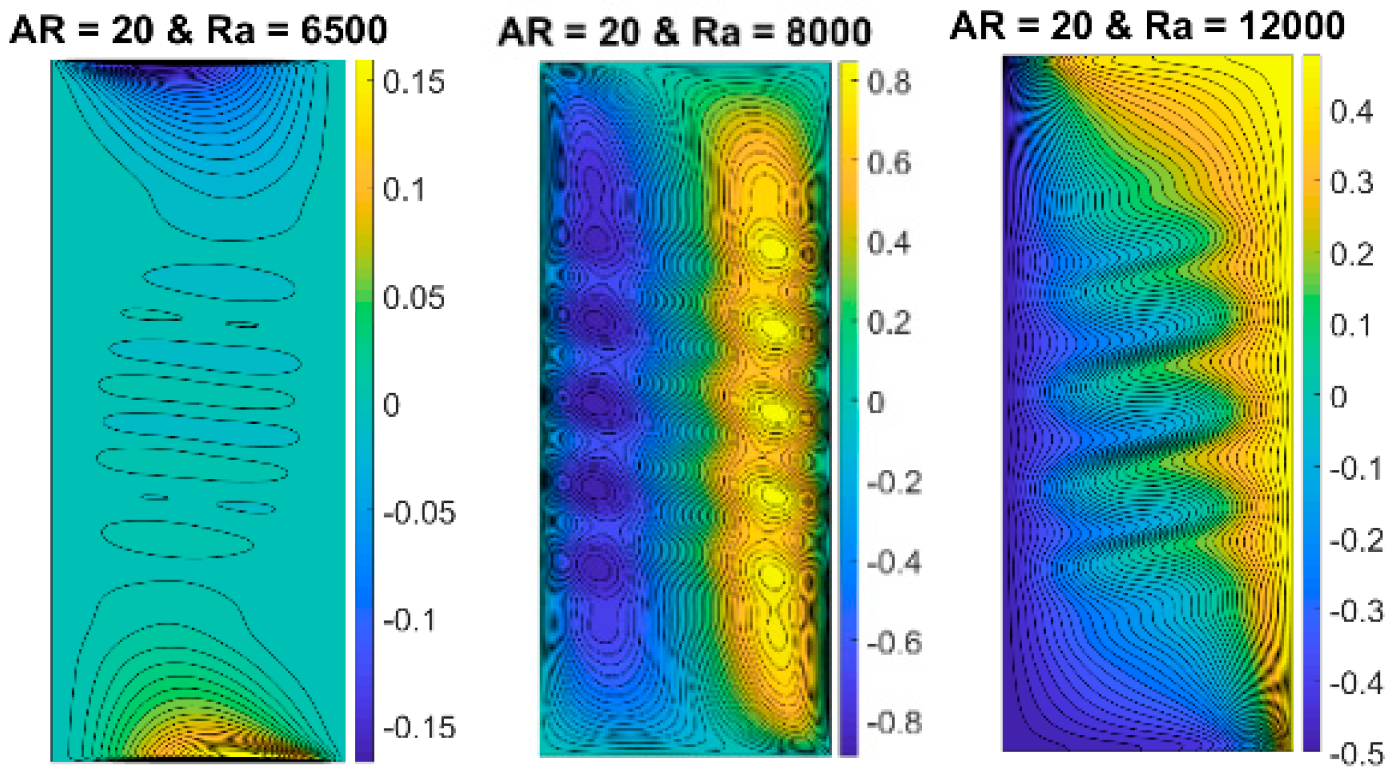
Numerical simulations are performed, and different output parameters are compared. It is established from [11] that at AR greater than ARcr, the RB instability sets in the flow at 6500 Ra; beyond this, secondary cells are formed, as shown in Figure 3.
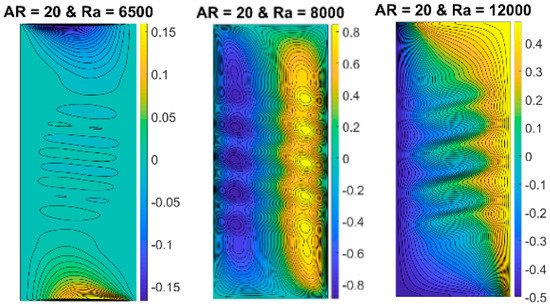
Figure 3.
RB instability at AR = 20 in contours of U−velocity, V−velocity, and temperature (L to R).
The first critical Ra (Racr), at which convection starts in the cavity in the case of a horizontal temperature gradient, is found to be as low as 370. The convection currents and thus the resultant heat transfer is initially weak and present only in the vicinity of vertical walls. The second critical-Ra (Racr,2), at which Rayleigh–Benard instability sets in the flow, is found to be constant for all ARs greater than critical-AR i.e., 6500.
The same instability patterns are visible in other parameters as well (Figure 3). The higher the heat transfer rate required, the higher Ra is desirable and vice versa.
3.2. The Critical Aspect Ratio
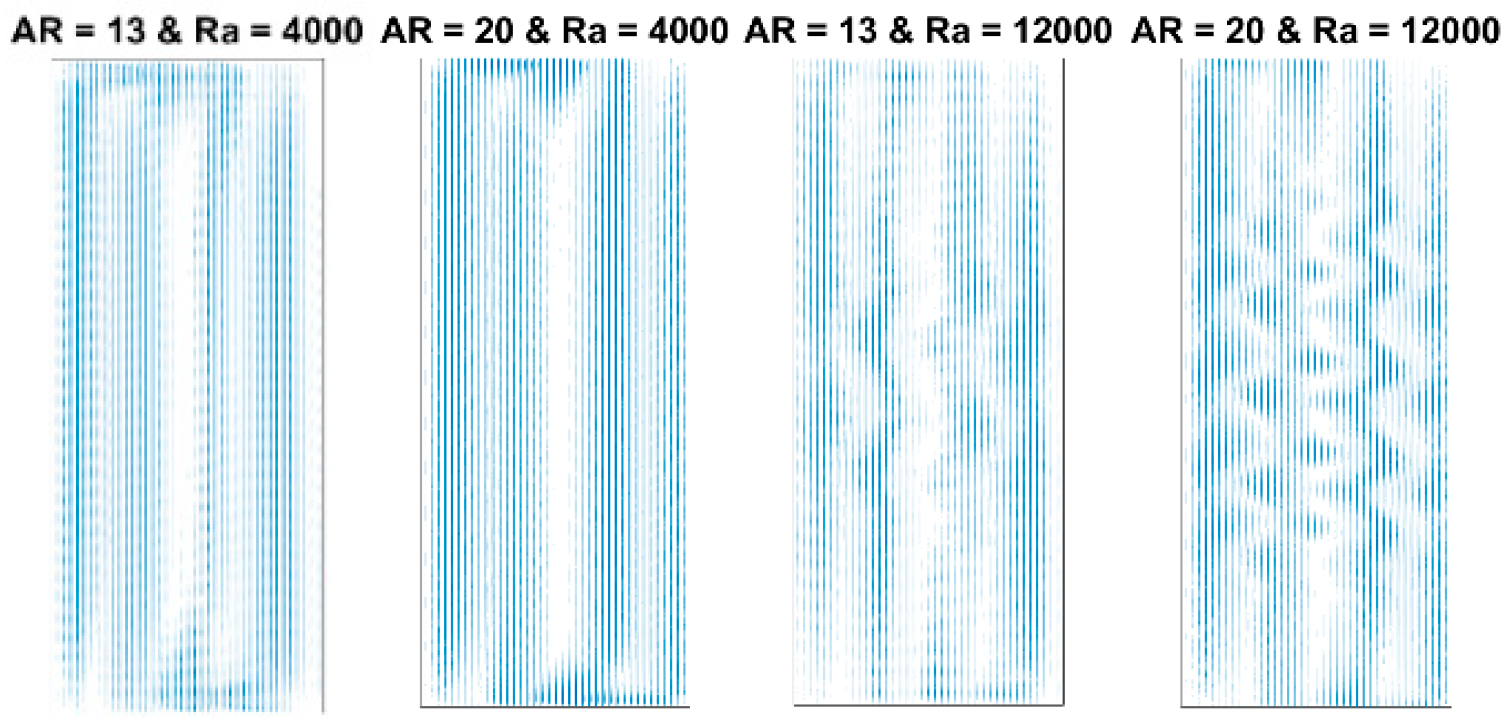
The threshold value of aspect ratio; the critical AR (ARcr), decides the boundary for the existence of RB instability in the flow. It is implied through the numerical study that RB instability will not occur in the flow for AR < ARcr. Other instabilities might be present at a higher Ra in this case. The difference is displayed in Figure 4.
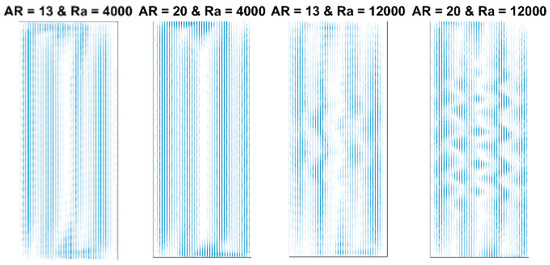
Figure 4.
Velocity vector field comparison at Ra = 4000 and 12,000; AR = 13 and 20.
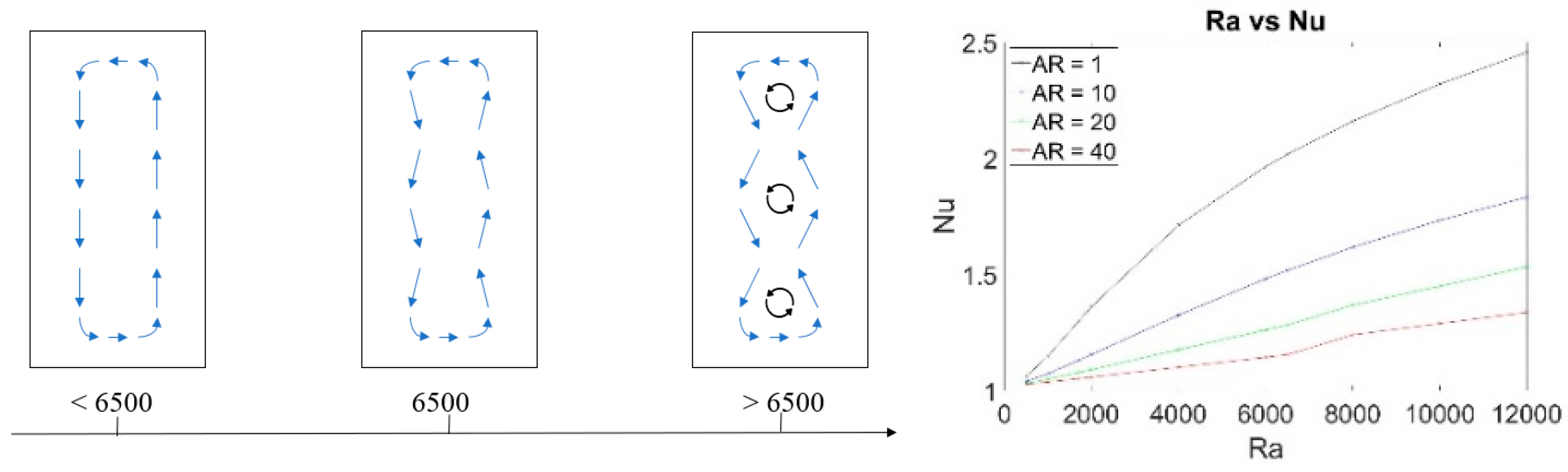
The reason for instability leading to secondary cell formation lies in the flow mechanics of Rayleigh–Benard (RB) instability; RB instability arises when the convection intensity continues to increase until the counterclockwise rotating single cell approaches and fills the core zone. At this stage, the streamlines of the flow begin to fluctuate due to the opposing walls’ interference, as depicted by the schematic in Figure 5. Three mesh sizes are examined and tested to determine the AR-critical value to be ARcr = 14.
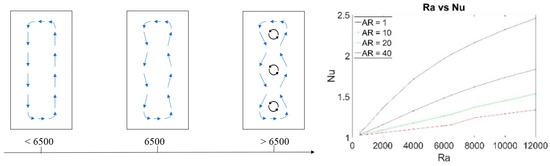
Figure 5.
Formation procedure of secondary cells in RBC; Nu versus Ra plot.
From a practical application point of view, the heat transfer rate jumps high after critical aspect ratio and after critical Ra; therefore, these should be kept towards the lower side if lower heat transfer is anticipated.
3.3. Nusselt Number Versus Rayleigh Number
Generally, average Nu increases as Ra increases for all AR, as shown in Figure 5. There are slight bumps in slopes for Ra > 6500 for ARs larger than the critical value, indicating a significant rise in the heat transfer rate. It is noted that other instabilities present at lower Ra do not contribute to the added heat transfer rate as much as the RB instability does. A simplified dimensional analysis for IGU is done for Ra = 8000 for case 1: AR = 10 and case 2: AR = 40 to further substantiate the argument. In the usual summer season in Islamabad, the average maximum temperature remains around 45 °C, and the ideal room temperature is taken as 26 °C. The real focus is to compare the design conditions for the internal air-filled cavity of a double-glazed window. It is perfectly visible from Table 1 that the heat flux in the case of a higher AR is significantly smaller than that of a lower AR.

Table 1.
Comparison of two ARs for Ra = 8000.
4. Conclusions
For a wide range of Ra, natural air flows and RB instability are numerically studied for a vertical cavity from a square cavity up to AR = 40 with horizontal temperature gradients. It is found that a single counter-rotating cell is formed for AR < ARcr. As Ra increases, this single cell deforms but does not break down into smaller cells. For AR ≥ ARcr, the secondary flow sets in the cavity after 6500 Ra; the RB instability originates at this specific Ra, and secondary cells are formed beyond it. Two different cases have been compared to establish that this theatrical study provides the desired effect.
Funding
This research was funded by the National University of Sciences and Technology, Islamabad under Grant 00000116261.
Institutional Review Board Statement
Not applicable.
Informed Consent Statement
Not applicable.
Data Availability Statement
Not applicable.
Acknowledgments
The author is grateful to Imran Akhtar and Naveed Mazhar for their assistance.
Conflicts of Interest
The author declares no conflict of interest.
References
- Ahlers, G.; Grossmann, S.; Lohse, D. Heat transfer and large scale dynamics in turbulent Rayleigh-Bénard convection. Rev. Mod. Phys. 2009, 81, 503. [Google Scholar] [CrossRef]
- Zoubir, A.; El Otmani, R.; Bouferra, R.; Essaleh, L. Effects of thermal stratification on natural convection in a symmetrically heated channel: Comparison of characteristic quantities between air and water. Case Stud. Therm. Eng. 2023, 45, 102950. [Google Scholar] [CrossRef]
- Koneti, L.; Venkatasubbaiah, K. A comparative heat transfer study of water and liquid gallium in a square enclosure under natural convection. Int. J. Fluid Mech. Res. 2023, 50, 39–44. [Google Scholar] [CrossRef]
- Lartigue, B.; Lorente, S.; Bourret, B. Multicellular natural convection in a high aspect ratio cavity: Experimental and numerical results. Int. J. Heat Mass Transf. 2000, 43, 3157–3170. [Google Scholar] [CrossRef]
- Favier, B.; Purseed, J.; Duchemin, L. Rayleigh–Bénard convection with a melting boundary. J. Fluid Mech. 2019, 858, 437–473. [Google Scholar] [CrossRef]
- D’Orazio, M.C.; Cianfrini, C.; Corcione, M. Rayleigh–Bénard convection in tall rectangular enclosures. Int. J. Therm. Sci. 2004, 43, 135–144. [Google Scholar] [CrossRef]
- Nakhoul, A.; Rudenko, A.; Maurice, C.; Reynaud, S.; Garrelie, F.; Pigeon, F.; Colombier, J.P. Boosted Spontaneous Formation of High-Aspect Ratio Nanopeaks on Ultrafast Laser-Irradiated Ni Surface. Adv. Sci. 2022, 9, 2200761. [Google Scholar] [CrossRef] [PubMed]
- Bergman, T.L.; Lavine, A.S.; Incropera, F.P.; Dewitt, D.P. Fundamentals of Heat and Mass Transfer; John Wiley & Sons: Hoboken, NJ, USA, 2011. [Google Scholar]
- Yang, Y.-H.; Zhu, X.; Wang, B.-F.; Liu, Y.-L.; Zhou, Q. Experimental investigation of turbulent Rayleigh-Bénard convection of water in a cylindrical cell: The Prandtl number effects for Pr > 1. Phys. Fluids 2020, 32, 015101. [Google Scholar] [CrossRef]
- Van Der Poel, E.P.; Stevens, R.J.; Lohse, D. Comparison between two-and three-dimensional Rayleigh–Bénard convection. J. Fluid Mech. 2013, 736, 177–194. [Google Scholar] [CrossRef]
- Siddiqui, W.; Abbas, Z.; Akhtar, I.; Khalid, M.S.U. Nusselt Number Dependence on Aspect Ratio and Rayleigh Number: A Numerical Study of Rayleigh-Benard Instability. In Proceedings of the Fluids Engineering Division Summer Meeting, Toronto, ON, Canada, 2 August 2022; p. V002T005A029. [Google Scholar]
- Chorin, A.J. A numerical method for solving incompressible viscous flow problems. J. Comput. Phys. 1997, 135, 118–125. [Google Scholar] [CrossRef]
Disclaimer/Publisher’s Note: The statements, opinions and data contained in all publications are solely those of the individual author(s) and contributor(s) and not of MDPI and/or the editor(s). MDPI and/or the editor(s) disclaim responsibility for any injury to people or property resulting from any ideas, methods, instructions or products referred to in the content. |
© 2023 by the author. Licensee MDPI, Basel, Switzerland. This article is an open access article distributed under the terms and conditions of the Creative Commons Attribution (CC BY) license (https://creativecommons.org/licenses/by/4.0/).