


Abstract
Water scarcity is currently one of the world’s major issues. Water treatment technologies are a solution to the water crisis problems. In this study, the outcomes of pre-pilot scale testing of solar-powered Ion-exchange resin technology is presented. The tests were carried out using industrial wastewater at the Kungrad Soda Plant located in Kungrad, Uzbekistan. From the plant, about 1500 m3/day of waste water containing total dissolved solids (TDS) is discharged into the environment. In order to reduce the negative impact on the environment and to reuse waste water, the factory proposed conducting water purification tests from unwanted ions (Ca2+, Mg2+, Cl−, SO42−, dissolved CO2). During the test of the technology, water with a TDS of about 2000 ppm was passed through the ion-exchange resin and clean water of around 30 ppm was obtained (purify up to 98–99%). However, according to the requirement of the plant, a certain amount of daily water is purified and added to the total water, and no more than 1600 ppm water is produced and sent for reuse. Experiments have been successfully carried out on a pre-pilot scale using this technology.
1. Introduction
There is currently a significant mismatch between freshwater demand and supply, and roughly one-quarter of the world’s population is experiencing economic water scarcity [1]. Global water demand is anticipated to rise due to a population that is both urbanizing and increasing quickly, as well as industrial development. Worldwide, water shortage is spreading, and getting worse as water demand rises [2]. Therefore, humanity is moving to use another alternative method of obtaining freshwater. Desalination of water has been suggested as a viable approach to the issue of water scarcity [3]. Desalination is the process of purifying brackish or seawater by removing salts and other minerals to make it fit for human consumption [4]. Currently, commercial desalination technologies are mainly divided into two categories: (a) thermal distillation and (b) membrane separation. Thermal desalination technologies are multi-stage-flash distillation (MSF) and multi-effect-distillation (MED), while membrane-based desalination technology is mainly reverse osmosis (RO) [5].
At present, conventional technologies (MSF, MED, and RO) are mainly used in the process of water desalination, but these technologies have several disadvantages, for example, high energy consumption, low recovery, and negative impact on the environment. Therefore, emerging desalination technologies such as forward osmosis (FO), electro dialysis/electro dialysis-reverse (ED/EDR), humidification/dehumidification (H/DH), membrane distillation (MD), solar still distillation (SSD), capacitive deionization (CDI), and ion-exchange resin (IXR)—although not yet fully commercialized—are gaining attention [6]. Desalination processes often employ fossil fuel energy, as was previously explained, and as a result, they have a negative environmental impact. To achieve this, renewable energy sources (solar, wind, biomass, geothermal, hydropower, and tidal) can produce energy with little harm to the environment. Desalination technologies and renewable energy sources can be combined for two benefits: environmental and energy sustainability, and the long-term protection of freshwater supplies [7].
Often, industrial wastewater is not treated, it is just discharged, which is a waste of water as well as a negative impact on the environment. About 1500 m3/day of brackish water is discharged into the environment at “Kungrad Soda Plant” located in Kungrad, Uzbekistan. In this work, solar-powered ion-exchange resin technology was proposed to clean and reuse the wastewater released from the Kungrad Soda Plant. This technology has been prototyped and tested at the factory. In the following sections, the outcomes of pre-pilot scale testing of solar-powered ion-exchange resin technology are presented.
2. Materials and Methods
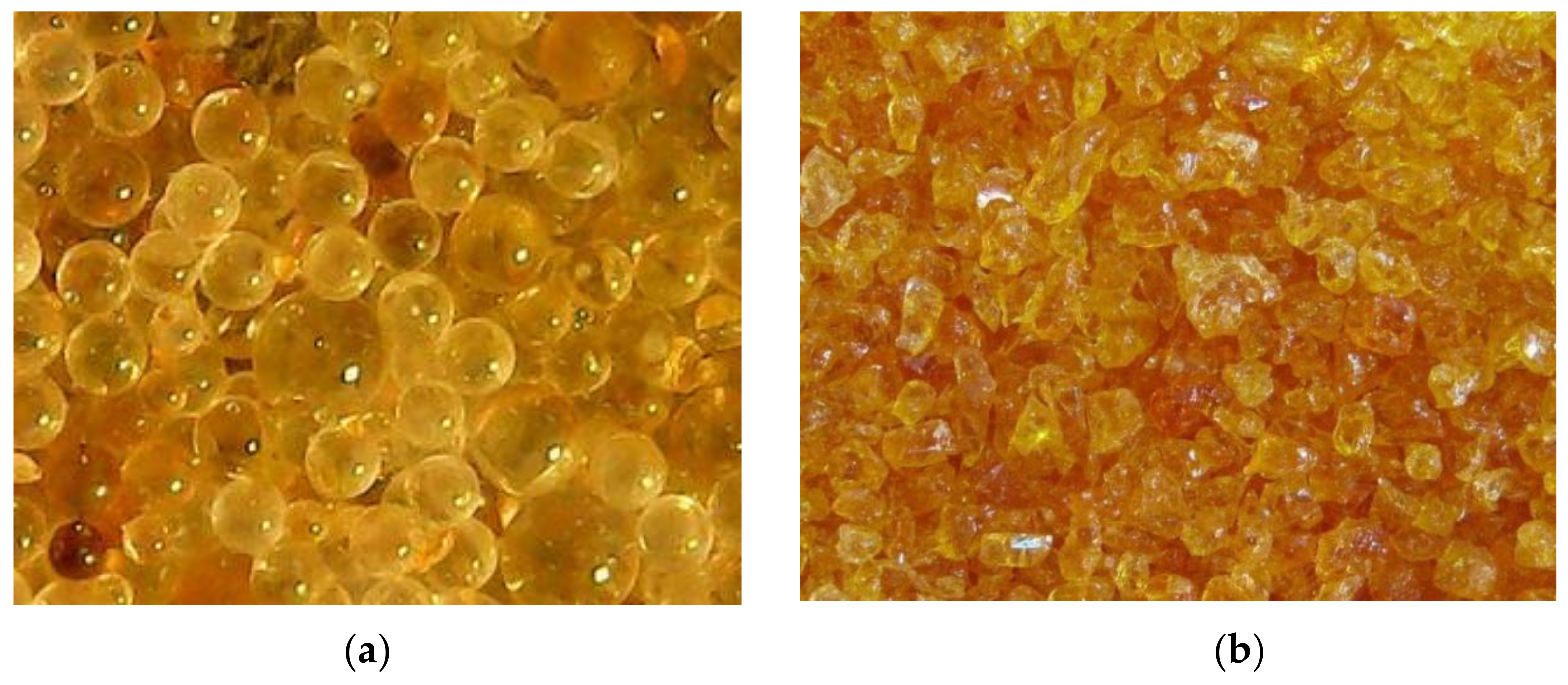
Ion-exchange resin (IXR) is a word used to describe a range of organic compounds that have undergone chemical processing to react with the ions in a solution, collecting some of the ions from the solution and releasing other ions from the resin into the solution. The purpose of acid resins, also known as cation resins, is to absorb positive ions (such as Ca2+, Na+, Mg2+, K+, Mn2+, and Fe3+) and release H+ ions. As a result, the pH rises due to the higher concentration of H+ ions, which reduces the water’s hardness and increases its acidity. Basic resins, which are also known as anion resins, are used to trap negative ions like Ca−, NO32, SO42, SiO2, and CO32 and release OH− ions [8]. In this study, the composition of wastewater was first analyzed; it was found that the water contains a large amount of total dissolved solids such as Ca2+, Mg2+, Al3+, Fe3+, Na+, K+, NH4+, Cl−, Br−, SO42−, and NO3− and corresponding KU-2-8, AN-31 ion-exchange resins (cationite and anionite) were selected (see Figure 1). The process of wastewater treatment with ion-exchange resins follows this reaction (1), (2).
R − H = cationite, R − OH = anionite, Me+ = Ca2+, Mg2+, Al3+, Fe3+, Na+, K+, NH4+ etc.,
A− = Cl−, Br−, SO42−, NO3− etc.
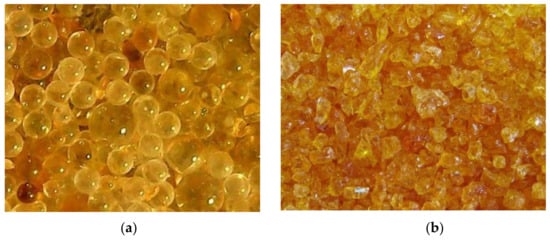
Figure 1.
KU-2-8 cation-exchange resin (a) and AN-31 anion-exchange resin (b).
Figure 1.
KU-2-8 cation-exchange resin (a) and AN-31 anion-exchange resin (b).
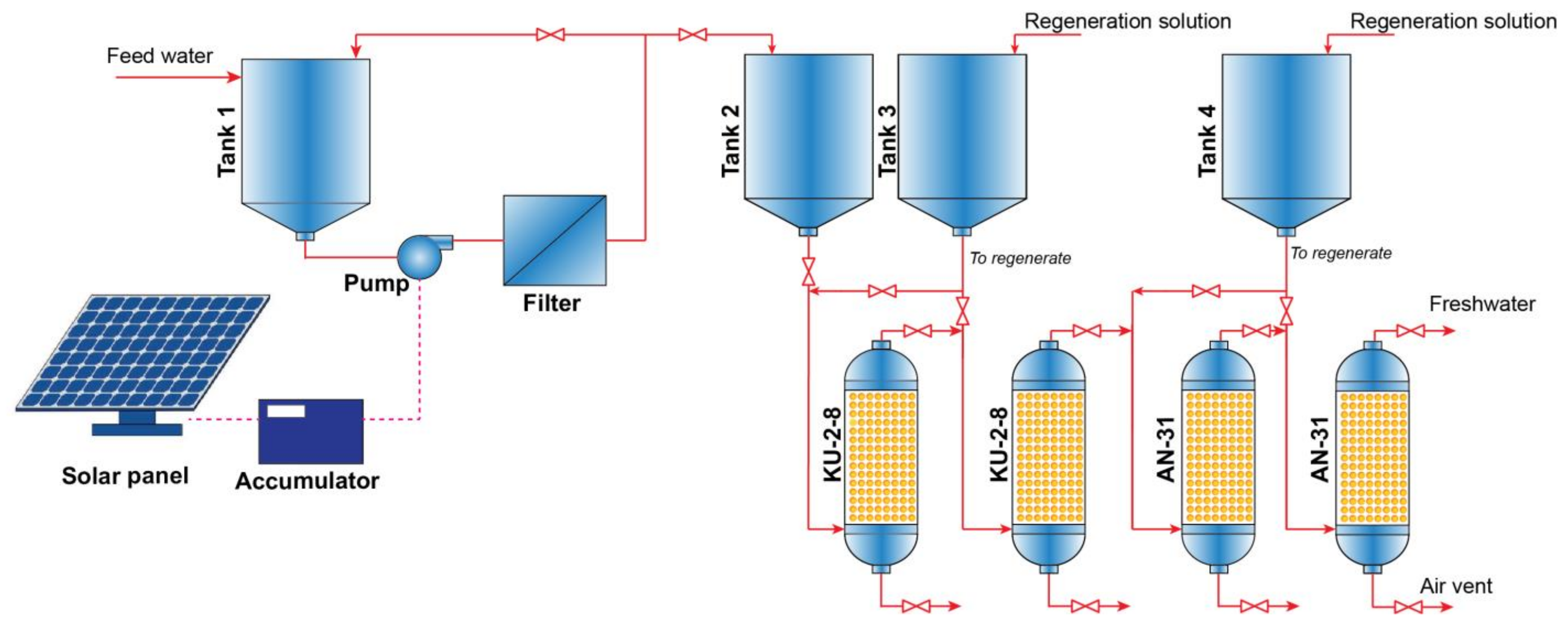
This pre-pilot testing scale technology is designed to treat 15 L of wastewater per hour. It is equipped with a pre-treatment filter (10 Big Blue 5 Micron Pleated Sediment Whole House Water Filter, RonAqua, NY, United States), an electric pump (24 V Truck man 1501015, 75.3780-01), two solar panels (30 W 12 V monocrystalline solar panel) for powering the pump and an accumulator (two Delkor 35 Ah, 12 V), solar charge controller (30 A, 24 V), four tanks for water storage and regeneration of resins, two KU-2-8 cations-exchange resin filter, two AH-31 anions-exchange filters and connecting plastic tubes as well as valves. (see Figure 2).
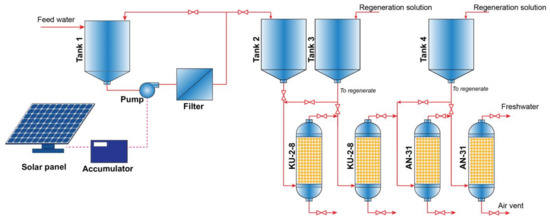
Figure 2.
Solar-powered ion-exchange resin desalination technology.
As for the equipment’s working principle, a pump transfers the industrial water mixture stored in Tank 1 to the pre-treatment filter. Wastewater that has undergone preliminary treatment is supplied to the KU-2-8 ion-exchange resin filter at the expense of its stealing power. Wastewater is passed through a cationic filter filled with ion-exchange resin KU-2-8 in the form of sodium with a volume of 1 kg at a speed of 10 L per hour, where the wastewater is mainly cleaned of heavy metal ions such as Ca2+, Mg2+, Al3+, and Fe3+. After that, at the same speed, hydrogen in the form of 1 kg is passed through a cationic filter filled with ion-exchange resin KU-2-8 at a speed of 10 L/h, in which mainly wastewater is cleaned of ions such as Fe3+, Na+, K+, and NH4+. The process goes through cationic filters connected in series, so no intermediate tanks are required. At the next stage of the technology, a volume of 1 kg of acidic water purified from cations is passed through an anionite filter filled with AN-31 ion-exchange resin in the hydroxy form at a speed of 10 L per hour, in which mainly wastewater is purified from anions such as Cl−, Br−, SO42−, and NO3−.
Two different solutions are prepared for the regeneration of ion-exchange resins. Cationite in hydrogen(H+) form is regenerated with 5–10% solutions of hydrochloric acid (HCl). Mainly, the ions of active metals such as sodium (Na), potassium (K), and ammonium (NH4+) are exchanged with hydrogen ions and the cationite is returned to hydrogen form. Anionite chloride is regenerated with 5–10% sodium hydroxide solution after saturation with sulfate ions. In this case, anions are exchanged with hydroxide ions, as a result of which the anionite changes back to the hydroxy form and is ready to work. The ion-exchange resins in the filter can be regenerated up to about a thousand times. The process of regeneration follows this reaction (3), (4).
The pre-pilot scale testing of equipment was developed as described above, and on 4–5 August 2022, it was tested on the territory of the Kungrad Soda Plant, together with the plant’s specialists. The following results were also obtained when the calcined soda production wastewater mixture was passed through a 60 L device.
3. Result and Discussion
Before passing the wastewater mixture through the device, the composition of the water was analyzed and the following results were obtained. Table 1 shows that the water contained a large amount of Calcium (4.4 mEq/L), Magnesium (4.6 mEq/L), Chlorides (553 mg/L), Sulfates (827 mg/L), total dissolved solids (1885 mg/L), as well as a high total hardness (9.3 mEq/L) and hydrogen index (9.2 pH). An amount of 60 L of water from the wastewater mixture was passed through the resin at a rate of 10 L per hour and these results were achieved: Calcium (0.27 mEq/L), Magnesium (0 mEq/L), Chlorides (16.5 mg/L), Sulfates (10.6 mg/L), total dissolved solids (27.3 mg/L), as well as a high total hardness (0.27 mEq/L) and hydrogen index (7.5 pH) (see Table 1). The results illustrated that the total dissolved solids in the wastewater were purified from 1885 mg/L to 27.3 mg/L (98.5%). The obtained results fully correspond to the technical requirements set by the factory.

Table 1.
Results of the analysis and treatment.
In this work, as mentioned above, solar panels are used as the energy source. Depending on the requirements of the manufacturer, the equipment can be developed in any size and in a portable (does not require a connection to the main electricity grid) form using a solar panel. Also, this technology is environmentally friendly as it does not use any fossil fuel [9]. If we compare this technology with other conventional water treatment technologies, such as MSF, MED, and RO, we can see that the ion-exchange resin method for small-scale wastewater treatment is effective in some aspects. During the testing of the equipment, it was found that the recovery ratio was 0.8, energy consumption was 1.2–1.8 kWh/m3 and water quality was 27.3 ppm (see Table 2).
Table 2.
Comparison of recovery ratio and energy consumption of the water treatment technologies. Usually, TDS of Brackish water is 930–2200 ppm (Adapted from [8,10,11,12]); in this work TDS of industrial wastewater is 2000 ppm.
4. Conclusions
Although 71 percent of the Earth is covered by water, fresh water is one of the scarcest resources on our planet. With the development of industry, the demand for clean water is also increasing, so the treatment and reuse of wastewater are very important. Currently, conventional (MSF, MED, and RO) water treatment technologies are widely used. Although these technologies are considered effective, they have disadvantages in terms of economic and negative impact for environment due to the adaptation of fossil fuels and low recovery ratio. In this work, an ion-exchange resin water treatment technology integrated with solar energy was developed, and the equipment was tested in industrial wastewater treatment. The obtained results showed that the device has a recovery ratio of 0.8, energy consumption is lower than other devices (1.2–1.8 kWh/m3), and can purify from total dissolved solids up to 98–99%. The main drawback of emerging technologies such as ion-exchange resin is that it has not yet been commercialized on a large scale. Therefore, we should pay more attention to emerging technologies that are still on the laboratory scale but have a less negative impact on the environment and high recovery.
Author Contributions
Conceptualization, Z.T. and O.K.; methodology, O.K. and J.E.; formal analysis, O.K.; investigation, J.E., Z.T. and O.K.; resources, O.K.; data curation, O.K.; writing—original draft preparation, J.E. and Z.T.; writing—review and editing, Z.T. and A.N.; visualization, J.E. and Z.T.; supervision, A.N., O.K. and B.K. All authors have read and agreed to the published version of the manuscript.
Funding
This research received no external funding.
Institutional Review Board Statement
Not applicable.
Informed Consent Statement
Not applicable.
Data Availability Statement
The data presented in this study are available on request from the corresponding author.
Conflicts of Interest
The authors declare no conflict of interest.
Abbreviations
| TDS | Total dissolved solids |
| MSF | Multi-stage-flash distillation |
| MED | Multi-effect-distillation |
| RO | Reverse osmosis |
| FO | Forward osmosis |
| ED | Electro dialysis |
| EDR | Electro dialysis-reverse |
| H/DH | Humidification/dehumidification |
| MD | Membrane distillation |
| SSD | Solar still distillation |
| CDI | Capacitive deionization |
| IXR | Ion-exchange resin |
References
- Qasim, M.; Badrelzaman, M.; Darwish, N.N.; Darwish, N.A.; Hilal, N. Reverse Osmosis Desalination: A State-of-the-Art Review. Desalination 2019, 459, 59–104. [Google Scholar] [CrossRef]
- Darre, N.C.; Toor, G.S. Desalination of water: A Review. Curr. Pollut. Rep. 2018, 4, 104–111. [Google Scholar] [CrossRef]
- Esrafilian, M.; Ahmadi, R. Energy, Environmental and Economic Assessment of a Polygeneration System of Local Desalination and CCHP. Desalination 2019, 454, 20–37. [Google Scholar] [CrossRef]
- Nair, M.; Kumar, D. Water Desalination and Challenges: The Middle East Perspective: A Review. Desalin. Water Treat 2013, 51, 2030–2040. [Google Scholar] [CrossRef]
- Ihsanullah, I.; Atieh, M.A.; Sajid, M.; Nazal, M.K. Desalination and Environment: A Critical Analysis of Impacts, Mitigation Strategies, and Greener Desalination Technologies. Sci. Total Environ. 2021, 780, 146585. [Google Scholar] [CrossRef] [PubMed]
- Elsaid, K.; Sayed, E.T.; Abdelkareem, M.A.; Mahmoud, M.S.; Ramadan, M.; Olabi, A.G. Environmental Impact of Emerging Desalination Technologies: A Preliminary Evaluation. J. Environ. Chem. Eng. 2020, 8, 104099. [Google Scholar] [CrossRef]
- Panagopoulos, A. Water-Energy Nexus: Desalination Technologies and Renewable Energy Sources. Environ. Sci. Pollut. Res. 2021, 28, 21009–21022. [Google Scholar] [CrossRef] [PubMed]
- Curto, D.; Franzitta, V.; Guercio, A. A Review of the Water Desalination Technologies. Appl. Sci. 2021, 11, 670. [Google Scholar] [CrossRef]
- Kamolov, A.; Turakulov, Z.; Rejabov, S.; Díaz-Sainz, G.; Gómez-Coma, L.; Norkobilov, A.; Fallanza, M.; Irabien, A. Decarbonization of Power and Industrial Sectors: The Role of Membrane Processes. Membranes 2023, 13, 130. [Google Scholar] [CrossRef] [PubMed]
- Saleh, L.; Mezher, T. Techno-Economic Analysis of Sustainability and Externality Costs of Water Desalination Production. Renew. Sustain. Energy Rev. 2021, 150, 111465. [Google Scholar] [CrossRef]
- Davies, P.A.; Afifi, A.; Khatoon, F.; Kuldip, G.; Javed, S.; Khan, S.J. Double-Acting Batch-RO System for Desalination of Brackish Water with High Efficiency and High Recovery. Desalin. Water Treat 2021, 224, 1–11. [Google Scholar] [CrossRef]
- Pearce, G.K. UF/MF Pre-Treatment to RO in Seawater and Wastewater Reuse Applications: A Comparison of Energy Costs. Desalination 2008, 222, 66–73. [Google Scholar] [CrossRef]
Disclaimer/Publisher’s Note: The statements, opinions and data contained in all publications are solely those of the individual author(s) and contributor(s) and not of MDPI and/or the editor(s). MDPI and/or the editor(s) disclaim responsibility for any injury to people or property resulting from any ideas, methods, instructions or products referred to in the content. |
© 2023 by the authors. Licensee MDPI, Basel, Switzerland. This article is an open access article distributed under the terms and conditions of the Creative Commons Attribution (CC BY) license (https://creativecommons.org/licenses/by/4.0/).