


Abstract
This work presents a simple, scalable and flexible zinc-ion secondary battery, fabricated on top of a textile substrate via standard fabrication processes. The proposed zinc-ion battery was fabricated on top of a polyester-cotton textile using solution-based processes and inexpensive cathode, anode and electrolyte materials. This battery achieved an area capacity of 19.1 µAh·cm−2 between 1.9 and 0.9 V.
1. Introduction
Wearable electronics also known as e-textile are the integration of flexible electrical devices in clothing and accessories. In these systems, sufficient electrical energy is required for devices such as sensor nodes [1], microprocessors and transceivers [2]. At present, such systems are typically powered using an external electrical connection, battery or supercapacitor [3] which require frequent replacement [4] and/or need to be physically removed before washing. Therefore, a flexible energy-storage device such as a zinc-ion battery (ZIB) integrated on top of or inside a textile is important for e-textile applications.
ZIBs are rechargeable secondary electrical energy-storage devices. In comparison to ordinary secondary batteries such as lithium-ion and aluminium air batteries. This type of battery demonstrates distinct advantages, such as improving device safety by not using aggressive or environmentally unfriendly electrolytes (in lithium-ion batteries) and can be fully sealed without the requirement of oxygen access such as in an aluminium air battery. In addition, the assembly of ZIBs can be performed in the air, offering reduced fabrication complexity. Previously Yong et al. [5] presented a zinc-ion secondary textile battery. The manganese oxide cathode, zinc anode and polymer separator were integrated into a single polyester cotton textile layer. After vacuum impregnating the battery with an aqueous electrolyte, the zinc-ion battery device achieved an areal capacity of 35.6 µAh·cm−2 between 1.9 V and 0.9 V. The use of the polyester cotton textile as the separator layer holder increased the device thickness, introducing extra encapsulation challenges. Xu et al. [6] reported flexible vanadium (V) oxide carbon-fiber cloth electrodes for potential zinc-ion battery application. This electrode demonstrated an areal capacity of 154 mAh·g−1. These examples demonstrate the capability of fabricated ZIBs within textile material. However, the electrode material vanadium (V) oxide is corrosive and required extra consideration during the device-encapsulation process. It can increase the device thickness and mechanical inflexibility, introducing extra encapsulation challenges for real-world power source units in e-textile systems.
This paper builds upon the previous works [5], the proposed zinc-ion battery was fabricated on top of a polyester-cotton textile using solution-based processes and inexpensive materials. The battery’s anode was a flexible zinc polymer film prepared via spray coating, and the battery’s cathode was a spray-coated manganese (II, III)-oxide (Mn3O4) polymer layer on a polyester-cotton textile. The separator layers were implemented on top of the battery’s cathode with doctor blading or screen printing followed by a phase inversion process. The battery was tested with an aqueous electrolyte to study its discharge performance.
2. Material and Methods
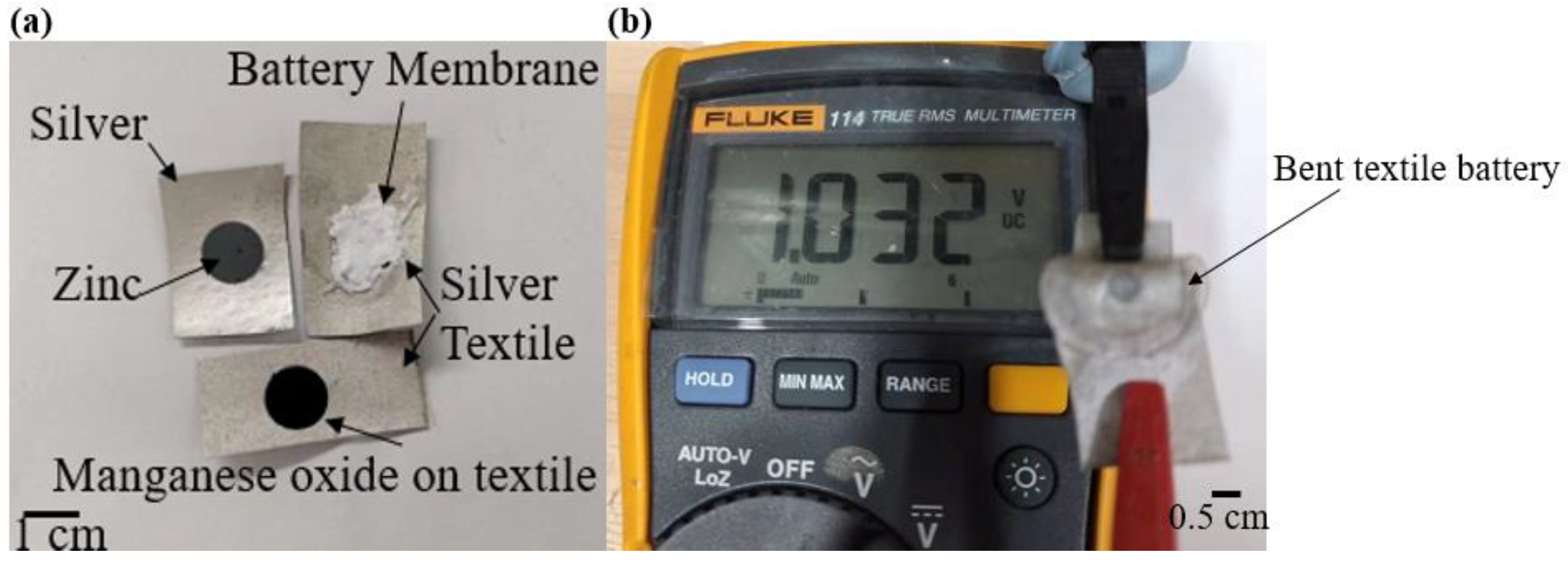
Figure 1 shows the fabrication process of the zinc-ion battery. Firstly, silver paste (TC-C4001, Smart Fabric Inks Ltd., Southampton, UK) was screen printed on the hotmelt PEVA encapsulation film that dried at room temperature for 24 h and polyester-cotton textile where the silver paste soaked through the textile, forming the current collector after cured in a box oven at 100 °C for 30 min. A thin film of nickel metal was sputter coated on top of silver textile forming an inert layer. A Mn3O4/polymer (85:15 by wt.%) cathode was spray coated onto the top of the nickel film. The coated textile was then dried in a box oven at 120 °C for 30 min. The current collector and cathode layer were screen-printed with a co-polymer solution and treated with a phase-inversion process to form a porous membrane published previously [5]. This co-polymer membrane acts as the separator of the supercapacitor that prevents electrical short circuitry but allows ions to transfer between the cathode and anode electrodes. The anode layer used to evaluate the battery performance was a spray-coated zinc/polymer (95:5 by wt.%) on top of silver that printed on the encapsulation film. The current collector, cathode, separator combined textiles and the zinc metal anode foil shown in Figure 2a were punched into circular shapes with a diameter of 1 cm, added with an aqueous electrolyte containing 1 M ZnSO4 + 0.1 M MnSO4 through the hole before being heat pressed together to form the full device.
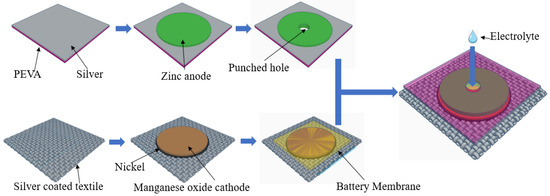
Figure 1.
Schematic, illustration of the fabrication process.
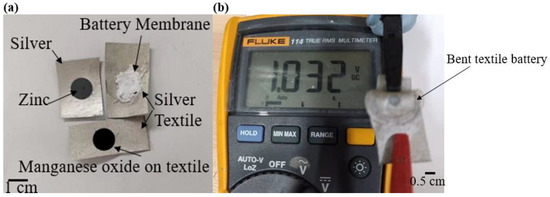
Figure 2.
(a) Photograph of manganese oxide cathode textile, cathode textile with membrane coating and zinc anode layer with encapsulation film, (b) battery initial voltage reading under 90 degrees bending.
3. Results
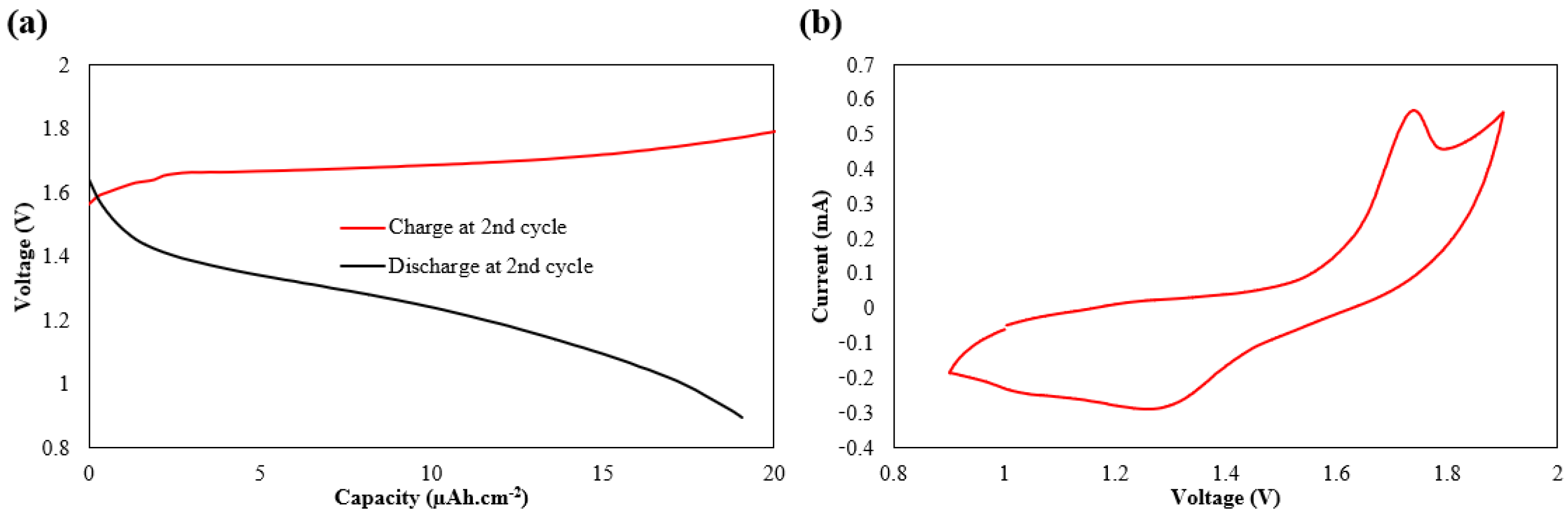
The manganese-oxide cathode textile, cathode textile with membrane coating and zinc anode layer with encapsulation film are shown in Figure 2a. The device is assessed using a potentiostat Autolab pgsatat101(Metrohm Autolab, Utrecht, The Netherlands). Its electrochemical performance was obtained from galvanostatic cycling (GC) at 1 mA·cm−2 and cyclic voltammetry (CV) at 10 mV·s−1 between 0.9 and 1.9 V.
The cycling test in Figure 3a was derived from the GC test at 1; this battery achieved an area capacity of 19.1 µAh·cm−2 between 1.9 and 0.9 V after the initial test cycle. Figure 3b shows the CV test results after the first test cycle for the zinc-ion battery on the textile. The oxidation (charging) peak occurred at 1.72 V; it also demonstrated a reduction (discharging) peak at 1.26 V. These are typical voltage peaks for the redox reactions in a zinc-ion secondary battery with manganese-oxide cathodes.
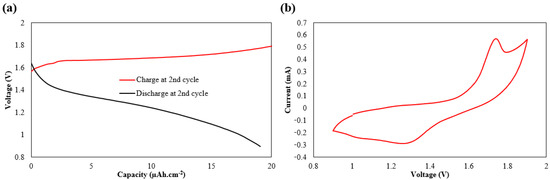
Figure 3.
(a) GC-derived voltage charge and discharge result of the zinc-ion battery at 1 mA cm−2 tested between 0.9 and 1.9 V, (b) CV tests between 0.9 V to 1.9 V at the scan rate of 10 mV·s−1.
4. Conclusions
This paper presents an encapsulated, flexible zinc-ion battery on a single piece of polyester cotton. The operating voltage for this textile battery in this work was between 0.9–1.9 V and achieves an area-specific capacity of 19.1 µAh·cm−2 and demonstrates good bending durability. In comparison with the previous devices [6], the proposed zinc-ion battery is encapsulated and tested without tube fitting. Future work will include optimizing the formulation and fabrication method of the polymer membrane in the textiles for better electrochemical performances and durability. The final device can be applied in a wide range in the e-textile system.
Author Contributions
Conceptualization, S.Y.; methodology, S.Y. and N.H.; validation, S.Y. and N.H.; formal analysis, S.Y.; investigation, S.Y.; resources, S.B.; data curation, S.Y.; writing—original draft preparation, S.Y.; writing—review and editing, N.H. and S.B.; visualization, S.Y.; supervision, S.B.; project administration, S.B.; funding acquisition, S.B. All authors have read and agreed to the published version of the manuscript.
Funding
The authors thank the EPSRC for supporting this research with grant references EP/P010164/1 and EP/I005323/1.
Institutional Review Board Statement
Not applicable.
Informed Consent Statement
Not applicable.
Data Availability Statement
The data for this paper can be found at DOI: https//doi.org/10.5258/SOTON/D1127.
Acknowledgments
This work was also supported by the Royal Academy of Engineering under the Chairs in Emerging Technologies scheme.
Conflicts of Interest
Steven Beeby is the director of Smart Fabric Inks.
References
- Zhu, D.; Beeby, S.; Tudor, J.; Harris, N. A credit card-sized self-powered smart sensor node. Sens. Actuators A Phys. 2011, 169, 317–325. [Google Scholar] [CrossRef]
- Carvalho, J.G.; da Silva, J.M. A transceiver for E-textile body-area-networks. In Proceedings of the 2014 IEEE International Symposium on Medical Measurements and Applications (MeMeA), Lisbon, Portugal, 11–12 June 2014; pp. 1–6. [Google Scholar] [CrossRef]
- Beeby, S.; Zhu, D. Energy Harvesting Products and Forecast. Mater. Sci. Found. 2011, 9, 197–218. [Google Scholar]
- Dias, T. Electronic Textiles Smart Fabrics and Wearable Technology; Woodhead Publishing: Cambridge, UK, 2015. [Google Scholar]
- Yong, S.; Hillier, N.; Beeby, S. Fabrication of a Flexible Aqueous Textile Zinc-Ion Battery in a Single Fabric Layer. Front. Electron. 2022, 3, 866527. [Google Scholar] [CrossRef]
- Xu, N.; Yan, C.; He, W.; Xu, L.; Jiang, A.; Zheng, A.; Wu, H.; Chen, M.; Diao, G. Flexible electrode material of V2O5 carbon fibre cloth for enhanced zinc ion storage performance in the flexible zinc-ion battery. J. Power Sources 2022, 533, 231358. [Google Scholar] [CrossRef]
Disclaimer/Publisher’s Note: The statements, opinions and data contained in all publications are solely those of the individual author(s) and contributor(s) and not of MDPI and/or the editor(s). MDPI and/or the editor(s) disclaim responsibility for any injury to people or property resulting from any ideas, methods, instructions or products referred to in the content. |
© 2023 by the authors. Licensee MDPI, Basel, Switzerland. This article is an open access article distributed under the terms and conditions of the Creative Commons Attribution (CC BY) license (https://creativecommons.org/licenses/by/4.0/).