


1. Overview and Novelty
Cold recycling materials (CRM) with bitumen emulsion are getting increasingly important, aiming at highly efficient road infrastructure and tackling energy consumption, as well as its further consequences on climate change. Normally, cement is added to get improved strength, but its usage leads to risk, again, in mixture performance, such as brittleness behavior and drying shrinkage [1,2]. The objective of the present study is to analyze how eco-friendly by-product fillers affect the moisture resistance, as well as the stiffness of CRM.
2. Methodology and Results
The aggregate blend of the mortars was obtained by removing the coarse aggregate (larger than 2 mm) CRM granulate. The emulsion and filler content was fixed to 5% emulsion content and filler content of 3%. Cationic slow-setting bitumen emulsion was used. Various fillers were selected to provide an extensive overview of the effect of fillers on the mechanical properties and water sensitivity of CRM materials: cement (CE), ladle slag (LD), silica fume (SF), Ettringite binder (ET:70% LD + 30% gypsum), and geopolymer (GO:55% LD 35% Fly ash + 10% SF). Two different methods were used to assess the water sensitivity which are Rolling Bottle Test (RBT) and Shaking Abrasion Test (SAT). Dynamic Modulus were derived and Ultrasonic Pulse Velocity (UPV) tests were performed to validate RBT and SAT method results.
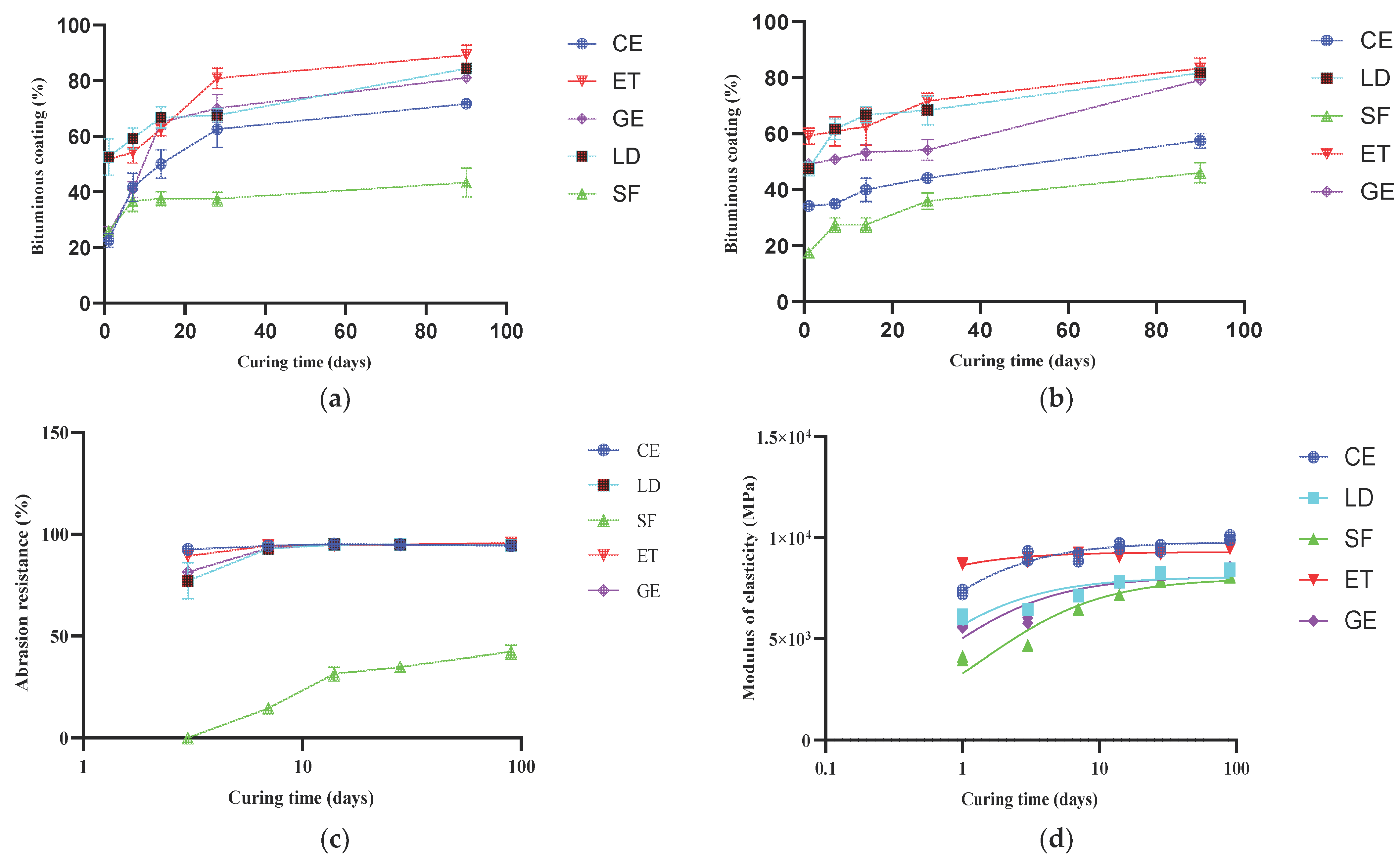
In general, Figure 1 shows that the curing time has a clear influence on the coating ability, abrasion resistance, and dynamic modulus especially at the initial stage of curing (within 28 days). Figure 1a,b show that the used fillers improved the bitumen coverage for both basalt and limestone aggregate compared with CE as a control filler, except SF which exhibited poor bitumen covering ability. It is worth noting that bitumen affinity to basalt aggregate is higher, especially at an early age, this finding is lined up with. When compared with CE, ET filler improved the bitumen coating ability after water erosion due to the early formed crystallin that increases the interlocking force between bitumen and aggregate surface, which improves adhesion between the mastic and the aggregate surface. In contrast, the bitumen coating ability of the CE specimen was considerably low. In the CE blended aggregate, the rigid hydration products improve the stiffness properties of the bitumen which, in turn, increases the stiffness of the mortar, as shown in Figure 1c, which improves the cohesion considerably but the adhesion slightly, and since the stripping resistance mostly depends on adhesion. Generally, all used fillers showed comparable abrasion resistance in 90 days of observation except SF. However, CE has slightly higher abrasion resistance on the first days of curing. Considering the effect of fillers on E, mortars with CE and ET exhibited the highest long-term and short-term performances, respectively. SF mortar performed the worst.
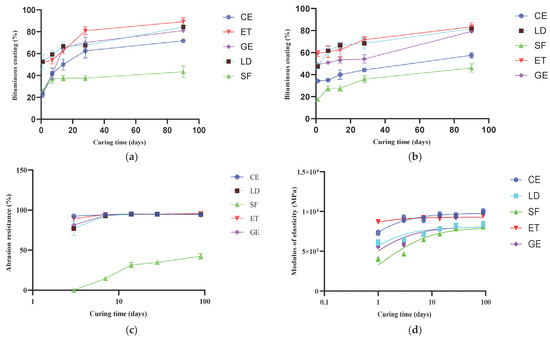
Figure 1.
(a) Results of RBT test for the Basalt, (b) results of RBT test for the limestone, (c) results of SAT, and (d) results of UPV.
3. Conclusions and Recommendations
- Adding the active fillers provided a higher bitumen coverage and abrasion resistance than the SF, resulting in better affinity and moisture resistance, especially ET;
- The effect of filler on moisture sensitivity was found to be higher than the effect of aggregates;
- Adding ET filler provided higher E values at an early age, while the CE led to higher stiffening behavior in long term;
- LD and GO allowed for general lower stiffness and higher bitumen coverage and comparable abrasion resistance compared with CE;
- The result of the E test is generally correlated with abrasion resistance;
- Applying those methods and tests will provide a more comprehensive view for evaluating the moisture resistance of the CRM mixtures.
Author Contributions
Conceptualization, A.A.-M. and K.M.; methodology, A.A.-M.; investigation, A.A.-M.; writing—original draft preparation, A.A.-M.; writing—review and editing, A.A.-M.; visualization, A.A.-M.; supervision, K.M.; project administration, K.M.; funding acquisition, K.M. All authors have read and agreed to the published version of the manuscript.
Funding
This research was funded by the German Academic Exchange Service (DAAD).
Institutional Review Board Statement
Not applicable.
Informed Consent Statement
Not applicable.
Data Availability Statement
No new data were created or analyzed in this study. Data sharing is not applicable to this article.
Conflicts of Interest
The authors declare no conflict of interest.
References
- Al-Mohammedawi, A.; Mollenhauer, K. Characterization of mechanical properties and shrinkage behavior of Cold recycled material (CRM) stabilized with different active fillers. In Proceedings of the 7th International Conference on Road and Rail Infrastructure, Pula, Croatia, 11–13 May 2022. [Google Scholar]
- Al-Mohammedawi, A.; Mollenhauer, K. A Synergic Study on The Fatigue-Fracture Behavior of Cold Recycling Materials Using Innovative Green Additives. In Proceedings of the 8th Transport Research Arena Conference, Lisbon, Portugal, 14–17 November 2022. [Google Scholar]
Publisher’s Note: MDPI stays neutral with regard to jurisdictional claims in published maps and institutional affiliations. |
© 2022 by the authors. Licensee MDPI, Basel, Switzerland. This article is an open access article distributed under the terms and conditions of the Creative Commons Attribution (CC BY) license (https://creativecommons.org/licenses/by/4.0/).