


Abstract
During operation, parts of agricultural machinery (working and structural parts) are exposed to severe corrosion. Corrosion processes are primarily caused by the working environment (high humidity and abrasive soils) and then by atmospheric conditions due to inadequate storage (garaging) of agricultural machinery during the off-season. The aim of the article is to analyze the causes of corrosion in selected agricultural machinery and to propose appropriate methods of corrosion protection and proper garage storage for agricultural machinery.
1. Introduction
To meet the needs of modern society in agricultural production and to supply the population with quality food, the use of appropriate agricultural mechanization is a necessary prerequisite [1]. In agricultural production, there are many different aspects, such as complex working conditions, unfavorable terrain configuration, and low engagement of working machines during the year, etc., that require quality maintenance of agricultural machinery [2]. All of these factors favor the development of corrosion on agricultural machinery. Corrosion is a universal problem and makes losses in all sectors in global economies. The agricultural sector is one of those highly impacted sectors due to corrosion [3]. Colloquially, people call corrosion “rust” and it is primarily an unsightly stain that can often be seen in very different places. In technical terms, corrosion is a specific form of unintentional wear of mechanical parts caused by various chemical, mechanical, and biological influences [4].
With technical progress and the development of agricultural machinery in terms of increasing production efficiency, sophistication of procedures, and applying modern (contemporary) technologies in agricultural production, the economic importance of corrosion in agriculture is also growing [5]. This is reflected in the increase in metal materials incorporated into the structure with the simultaneous deterioration of corrosion conditions (irrigation, use of mineral fertilizers and protective agents, etc.) to which the structural materials are exposed. In addition to construction materials, internal combustion engine parts are also exposed to corrosion [6]. In addition, corrosion is favored by new technological processes that involve difficult working conditions due to increased working speeds, temperatures, pressures, and stresses, as well as the use of aggressive chemicals.
The aim of this work is to analyze the causes and types of corrosion processes that occur on selected parts of agricultural machinery, the negative effects of corrosion, and the methods of protecting parts of agricultural machinery from corrosion.
2. Corrosion
According to the authors [7,8,9], corrosion is defined as chemical wear of metallic and non-metallic structural materials, where the corrosion rate depends on thermodynamic and kinetic conditions, i.e., internal (material composition, irregularities in the crystal lattice, residual mechanical stresses, surface condition, and shape of the object) and external factors (composition of the surrounding medium, purity of the medium, speed and turbulence of the movement of the medium, temperature, pressure, contact with other materials, mechanical stresses, and radiation). These factors influence the driving force of corrosion and the resistances that oppose this force.
2.1. Classification of Corrosion
There are numerous examples of the classification of corrosion, but many authors [7,8,9,10] agree that the most important classification of corrosion according to the mechanism of action is into two basic forms: chemical and electrochemical corrosion.
2.1.1. Chemical Corrosion
Chemical corrosion occurs in non-electrolytes through a chemical process between at least one phase or component of the metal and at least one component of the environment. In most cases, the result of such a chemical process is oxide or sulfide compounds. Chemical corrosion occurs in hot gases (e.g., flue gases) and non-aqueous liquids (fuels and lubricants) that do not conduct electricity [11].
2.1.2. Electrochemical Corrosion
Electrochemical corrosion is caused by the reaction of metals or metal alloys with electrolytes, in which the process of oxidation–ionization of the metal takes place. Electrochemical corrosion occurs in natural and industrial water, in aqueous solutions of acids, alkalis, salts, and other substances, as well as in soil, in the atmosphere (especially in humid environments), etc. This form of corrosion is much more common than chemical corrosion.
In addition to the above-mentioned subdivision according to the mechanism of action, corrosion can also be subdivided according to the geometric form of corrosion destruction as follows:
- General corrosion,
- Localized corrosion (intercrystalline, galvanic, pitting, underbody, and contact corrosion),
- Selective corrosion.
The above-mentioned geometric forms of corrosion can occur individually, but in practice, it is not unusual for several forms of corrosion to occur simultaneously. In addition, the authors [12] state that specific corrosion phenomena often occur on various structural elements and equipment depending on mechanical stresses (stress corrosion and corrosion fatigue), tribological processes (erosion, cavitation, and fretting corrosion), biological processes (biological corrosion, due to the action of animal excretions) and electrical factors (a particular type of corrosion that is caused by stray currents in soil and water).
2.2. Corrosion of Agricultural Machinery
During exploitation, the parts of agricultural machinery are exposed to the negative effects of the working environment, which leads to wear (abrasion, erosion, mechanical wear, surface fatigue, etc.) of the working parts of agricultural machinery, and in most cases, improper storage affects the development of corrosion. The combination of corrosion and a certain form of wear, primarily the mechanism of abrasion of the working surfaces of tools by hard soil particles, which in addition to their structure and composition also have a certain humidity, leads to a significant deterioration of the metallic materials from which the working parts of agricultural machinery are made. Various physical and chemical factors, surface deposits, and various mechanical damage and changes in operating temperature can also lead to the rapid destruction not only of metal parts, but also negatively affect parts made of other engineering materials.
The degradation of metal used for the manufacture of parts of agricultural machinery and equipment in agriculture usually leads to various forms of corrosion: general corrosion, pitting, corrosion fatigue, stress corrosion, etc. The authors [13] state that the work processes used in agricultural production represent a special area from the point of view of corrosion. The corrosive aggressiveness of the mentioned operations depends on the environments in which they are carried out and they often reach the highest degree of corrosion, which is why the application of high-quality surface protection is necessary. The authors list the following environments as the most aggressive:
- Application of artificial fertilizers and agrochemicals,
- Areas for keeping animals,
- Preparation of silage,
- Tillage of the soil.
2.3. Corrosion Protection
The authors [12] state that corrosion protection methods are based on the theory of corrosion processes. Changes in internal (properties of the construction materials) and external (properties of the environment) factors affect the slowing down or stopping of the corrosion process. The same authors state that corrosion processes are essentially spontaneous processes between metals and environmental components in which metals transition to a more thermodynamically stable state. Corrosion therefore inevitably reduces the utility value of metals and products made of metals. For this reason, timely and correctly selected corrosion protection methods are very important.
The authors [14] list the following methods of corrosion protection:
- Electrochemical protection methods:
- Cathodic protection.
- Anodic protection.
- Protection by changing the circumstances:
- Removal of corrosion activators.
- Corrosion inhibitors.
- Use of corrosion-resistant materials:
- Constructive and technological measures.
- Protection through coatings.
In the following, the causes and types of corrosion processes on selected representatives of agricultural machinery and methods of corrosion protection are analyzed.
3. Materials and Methods
The investigations in this work were carried out at PIK Vinkovci Ltd., a trading company based in Vinkovci, Croatia. For the analysis of corrosion processes, machines and equipment most exposed to corrosion were selected (reversible plough, heavy-duty disc harrow, mineral fertilizer spreader, and manure application trailer). First, they were visually inspected and data were collected on the forms of corrosion that occur during the exploitation of these machines, on the causes and effects of these phenomena and on the application of direct corrosion protection measures to the working parts. The storage of agricultural machinery during downtime was also analyzed.
3.1. Överum Xcelsior EX 6975 F Reversible Plough
A plough is a basic tillage tool that turns the soil over the entire plough width and depth, loosening, crushing, and aerating the soil and incorporating plant residues and weeds into the soil with the plough. Figure 1 shows the Överum Xcelsior EX 6975 F (Manufacturer: Overum Industries, Överum, Sweden) reversible plough with six working bodies and a working width of 210 to 330 cm.
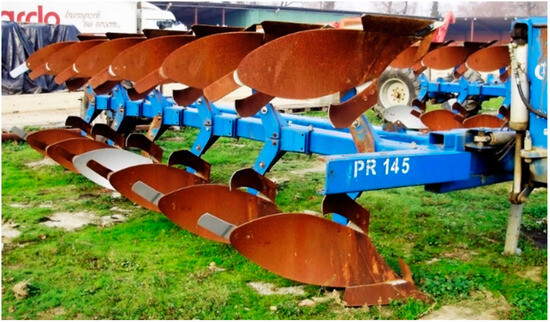
Figure 1.
Reversible plough Överum Xcelsior EX 6975 [4].
The parts of the plough most susceptible to corrosion are the plough body (share, scraper, scraper blade, and heel) as well as the plough frame and the connecting part.
The development of corrosion of plough parts is influenced by the atmosphere and, above all, by the tilled soil. During use, the plough moves through the soil, where corrosion develops in combination with oxygen and moisture in the soil. The abrasive wear to which the plough is exposed during operation further promotes the development of corrosion. From the above picture, it can be seen that the plough bodies are the most affected by corrosion, with a general uniform corrosion prevailing. The other parts of the plough show significantly less corrosion, with other forms of corrosion visible in some parts (plough frame—stress corrosion at the welding points and contacts of the bolted connections, and connecting part—corrosion fatigue, etc.).
Plough protection measures against corrosion:
- Thorough removal of soil and plant debris and high-pressure water washing (especially in hard-to-reach areas where dirt accumulates).
- Coating the working parts (possibly the entire plough) with an anti-corrosion agent (protective wax, or grease).
- Areas with damaged paint should be sanded down, primed and then given a top coat to prevent corrosion in these areas.
- The pistons of the hydraulic cylinders should be fully retracted into the cylinders to protect against corrosion and the ends of the hydraulic hoses should be sealed with plastic caps.
- When the plough is not in use, it should be parked in a covered or enclosed area on wooden pallets or boards.
3.2. Kongskilde Terra-X-7000 Heavy-Duty Disc Harrow
A disc harrow is a tool for supplementary soil cultivation. The disc harrow is used to break up the soil after primary tillage and to incorporate and mix mineral fertilizers, manure, chopped plant residues, etc., into the soil. Figure 2 shows Kongskilde’s Terra-X-700 heavy-duty trailed disc harrow (Manufacturer: Kongskilde Industries A/S, Sorø, Denmark), which is equipped with 56 discs.
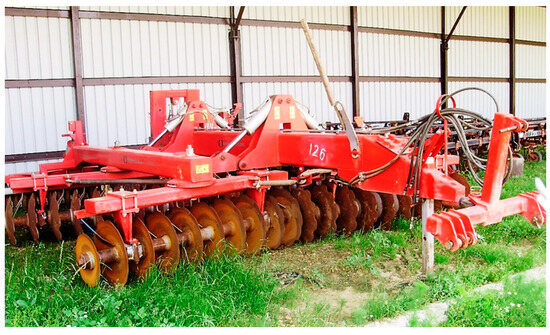
Figure 2.
Kongskilde Terra X-7000 heavy-duty disc harrow [4].
The parts of the disc harrow that are most exposed to corrosion are the working discs (discs), disc cleaner, axle bearings, disc harrow frame, and attachments.
As with the plough, corrosion of most parts of the disc harrow is caused by the working environment, with the soil having the greatest influence due to its composition and properties. The mixture of dust and grease has the greatest influence on the corrosion of the axle bearings. Figure 2 shows that the working discs of the disc harrow exhibit general, uniform corrosion on all discs. Cases of fretting corrosion occur on inadequately protected bearings, while corrosion fatigue can be observed on the connecting part.
The corrosion protection measures for heavy disc harrows are very similar to the protection measures for ploughs and include
- Thorough removal of soil and plant debris, and washing with high-pressure water.
- Coating the working parts with an anti-corrosion agent.
- Thorough lubrication of the slide bearings with a suitable lubricant.
- Touching up damaged parts with paint (in two coats, primer and protective paint).
- Storage in a covered or closed room when not in use.
3.3. Trailed Mineral Fertilizer Spreader RCW P-5500
The task of a mineral fertilizer spreader is to distribute the fertilizer evenly over the area and over the crops in a specific quantity. The RCW P-5500 spreader (Manufacturer: UNIA Sp. z o.o., Grudziądzu, Poland) performs the centrifugal distribution of mineral fertilizer in the form of granules or grains using two rotating working plates. The spreader has a capacity of 5500 kg, and a working range of 10–36 m, depending on the speed of fertilizer distribution, and is shown in Figure 3.
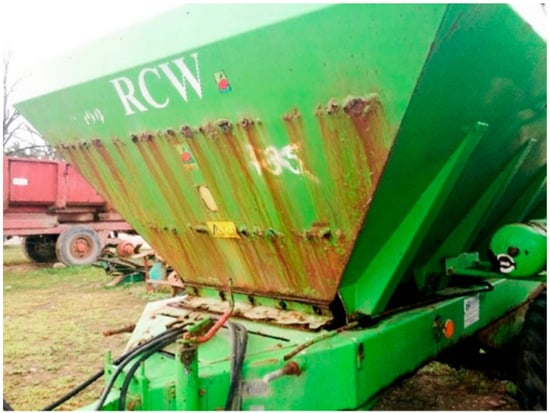
Figure 3.
Trailed mineral fertilizer spreader Unia RCW P-5500 [4].
The parts of the spreader that are most exposed to corrosion are the mineral fertilizer hopper, the transport device, the mineral fertilizer mixer, the rotating working plates, the wheel bearings, and the connecting part of the spreader.
Corrosion of the spreader parts is caused by the working environment, i.e., the atmosphere with its humidity, but the greatest influence is exerted by artificial mineral fertilizers, which are salts of various minerals (nitrogen, phosphorus, potassium, magnesium, calcium, sodium, etc.). These salts are formed by chemical reactions with strong acids (nitric acid, phosphoric acid, sulfuric acid, and hydrochloric acid). For all these reasons, mineral fertilizers attack the metal surfaces of the spreader with which they come into contact to a considerable extent, damaging the corrosion protection and allowing corrosion to develop. This applies, in particular, to the mineral fertilizer hopper and its components. Figure 4 shows the grates inside the tank, which are used to break up the fertilizer clumps and as such are exposed to the strongest corrosive and corrosive effects of the chemical components of the fertilizer composition.
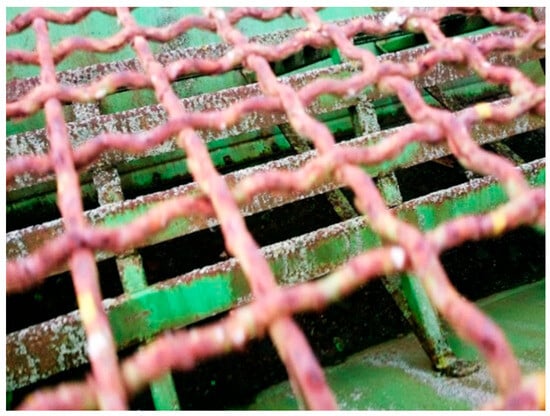
Figure 4.
Fertilizer distributor tank grates [4].
Uneven corrosion generally occurs on the inside of the mineral fertilizer container, the intensity of which depends on how long it has been in contact with the fertilizer. Other parts of the spreader (transport device, fertilizer mixer, and turntables) located inside the tank are also subject to this form of corrosion. On the outside of the tank, underbody corrosion is visible in Figure 3, caused by stress corrosion on the weld seams of the grids and the tank frame. The wheel bearings are sometimes affected by fretting corrosion if the bearing housing is poorly sealed and/or improper lubricants are used. The connecting parts of the spreader are subject to corrosion fatigue during operation, which can lead to their breakage.
Recommended measures to protect the spreader from corrosion:
- Immediately after spreading, completely remove (empty) the mineral fertilizer from the tank and wash the entire spreader with hot water under high pressure.
- Mechanical or chemical removal of corrosion products. Thoroughly coat the cleaned surfaces with an anti-corrosion agent.
- Sand down damaged painted parts and coat with a primer and top coat.
- Regular lubrication of the working parts (turntables and wheels).
- When the spreader is not in operation, it should be parked in a covered or closed area.
3.4. Unia-Agrmet TYTAN 18 Solid Manure Application Trailer
The solid manure application trailer is used for the even distribution of manure on agricultural land. The Unia-Agromet Tytan 18 (Manufacturer: UNIA Sp. z o.o., Grudziądzu, Poland) trailer has a capacity of 14 tonnes and is equipped with a manure conveyor belt and four vertical rollers with manure application discs with a width of 6 to 9 m. The trailer in question is shown in Figure 5.
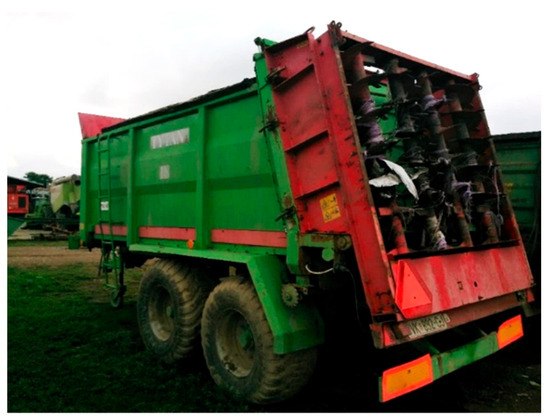
Figure 5.
Unia_Agrmet TYTAN 18 solid manure application trailer [4].
The parts of the solid manure application trailer that are most exposed to corrosion are the trailer tank, the conveyor belt and its components (chains and sprockets, and belt floor), the manure application device (vertical rollers), wheel bearings, and the coupling part.
Since the manure application trailer, like most agricultural machinery, operates outdoors, the ambient humidity has a major influence on the occurrence of corrosion. However, the greatest influence on the development of corrosion is the solid manure that comes into contact with the working parts of the trailer. This is a mixture of litter, solid and liquid animal excrement with varying degrees of biodegradation, stability, and maturity, containing organic and mineral acids, dust, soil, oxygen, etc. Such a mixture has a corrosive effect, which has a negative impact on corrosion protection (paint corrosion) and forms a good substrate for the development of the corrosion process. The manure application rollers shown in Figure 6 are the most exposed (with their entire surface) to these effects.
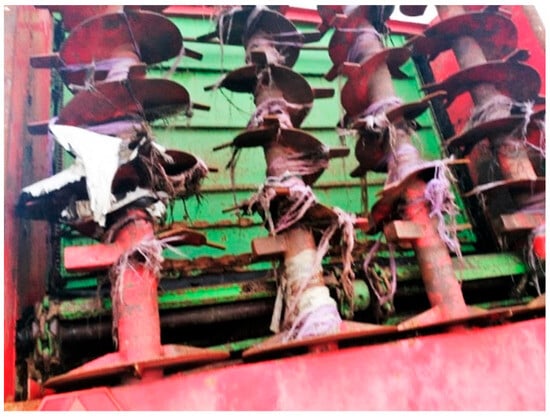
Figure 6.
Rollers for applying solid manure [4].
Figure 5 and Figure 6 show that the manure tank is subject to generally uneven corrosion depending on the surface that comes into contact with the manure. Since the tank consists of a welded construction, stress corrosion occurs at the weld seams due to the increased corrosive effect of the manure. The moving parts of the conveyor belt, especially the rollers for spreading the manure, are subject to the phenomenon of fretting corrosion and, if poorly maintained, the wheel bearings are also subject to this form of corrosion. The sprockets of the conveyor belt and the connecting parts of the trailer are also subject to corrosion fatigue during operation.
The suggested measures to protect the trailer for manure application from corrosion are
- Thorough cleaning of the trailer from manure residues by washing with high-pressure water.
- Mechanical removal of corrosion and thorough protection with an anti-corrosion agent.
- Lubricating the moving parts of the trailer (chains, gear wheels, and vertical rollers) with a suitable lubricant.
- Sanding of damaged paint parts and coating with a primer and top coat.
- When the trailer is not in use, it should be parked in a closed or covered area.
3.5. Storage for Agricultural Machinery
Agricultural production or the performance of certain agricultural work is tied to certain periods of time, so that not all agricultural machinery is in operation all year round. When they are not in use (idle), storage is an extremely important part of corrosion protection. Proper storage significantly reduces the occurrence of corrosion, especially general corrosion, as the influence of the ambient atmosphere, especially through humidity and the possible presence of acidic corrosive substances, is the main cause of corrosion. Before storage, it is extremely important to thoroughly clean the agricultural machinery of soil and plant residues as well as corrosion-promoting substances (mineral and manure fertilizers, etc.). Cleaning and washing of agricultural machinery must be carried out in designated areas so that the environment is not polluted by cleaning and degreasing agents and removed impurities. In addition, after proper cleaning and washing, all parts of the agricultural machinery must be thoroughly inspected and any defects found must be rectified before storing in a garage in order to prevent further corrosion development, which mainly refers to repairing damaged paint parts and coating the agricultural machinery with anti-corrosion agents. Agricultural machinery can only be stored in a garage after the defects have been rectified and preserved. In agricultural practice, storage in a garage usually takes place in semi-enclosed (covered) spaces such as with steel roofs or outdoors.
4. Conclusions
Corrosion is a widespread phenomenon that affects all areas of production activity and occurs on various technical means (machines, devices, equipment, installations, etc.). During exploitation, agricultural machinery is exposed to various corrosion phenomena, mainly because the basic mode of operation of its representatives (various machines and equipment) is to work outdoors and in aggressive environments. Another important reason why agricultural machinery is exposed to corrosion is the fact that most of their parts are made of metallic materials, especially different types of steel. The efficiency of agricultural machinery depends on its functionality, and therefore protection against corrosion is extremely important as it significantly affects its utilization properties.
The negative effects of corrosion can be significantly prevented by applying common corrosion protection measures. These measures include cleaning, washing, and preserving if necessary, touching up damaged paintwork, and garages and enclosed and semi-enclosed spaces.
The examples of corrosion phenomena on agricultural machinery parts presented in this work, along with the proposed protection measures, offer guidelines for users regarding effective corrosion protection and proper storage of agricultural machinery, which represents the practical value of this work.
Author Contributions
Conceptualization, I.V. and I.A.; methodology, I.V.; software, I.V.; validation, G.P., D.R. and I.A.; formal analysis, I.V.; investigation, I.V. and I.A.; resources, I.V.; data curation, I.V. and I.A.; writing—original draft preparation, I.V.; writing—review and editing, I.V., G.P., D.R. and I.A.; visualization, I.V.; supervision, G.P., D.R. and I.A.; project administration, I.V.; funding acquisition, I.V. All authors have read and agreed to the published version of the manuscript.
Funding
This research received no external funding.
Institutional Review Board Statement
Not applicable.
Informed Consent Statement
Not applicable.
Data Availability Statement
The data presented in this study are available upon request from the corresponding author.
Conflicts of Interest
The authors declare no conflicts of interest.
References
- Asonja, A.; Desnica, E. Reliability of agriculture universal joint shafts based on temperature measuring in universal joint bearing assemblies. Span. J. Agric. Res. 2015, 13, e0201. [Google Scholar] [CrossRef]
- Asonja, A.; Adamovic, Z.; Jevtic, N. Analysis of reliability of cardan shafts based on condition diagnostics of bearing assembly in cardan joints. Metalurg. Int. 2013, 18, 216–221. [Google Scholar]
- Muley, N.S.; Parihar, R.T. Corrosion in Agriculture Instruments and Equipments: Reasons and Solutions. JETIR 2022, 9, 477–484. [Google Scholar]
- Andrić, I. Korozija i Zaštita od Korozije Poljoprivrednu Tehnike. Master’s Thesis, Josip Juraj Strossmayer University in Osijek, Faculty of Agrobiotechnical Sciences, Osijek, Croatia, 2017. [Google Scholar]
- Heffer, G.; Vidaković, I.; Barač, Ž.; Andrić, I. Čimbenici korozije poljoprivrednih strojeva u ratarstvu. In Proceedings of the 10th International Scientific/Professional Conference “Agriculture in Nature and Environment Protection”, Vukovar, Croatia, 5–7 June 2017. [Google Scholar]
- Asonja, A.; Mikic, D.; Stojanovic, B.; Savin, L. Examination of motor oils in exploitation of agricultural tractors in process of basic treatment of plot. J. Balk. Tribol. Assoc. 2013, 19, 314–322. [Google Scholar]
- Esih, I.; Dugi, Z. Tehnologija Zaštite od Korozije I; Školska Knjiga: Zagreb, Croatia, 1990. [Google Scholar]
- Esih, I.; Dugi, Z. Tehnologija Zaštite od Korozije II; Školska Knjiga: Zagreb, Croatia, 1992. [Google Scholar]
- Stupnišek-Lisac, E. Korozija i Zaštita Konstrukcijskih Materijala; Fakultet Kemijskog Inženjerstva i Tehnologije: Zagreb, Croatia, 2007. [Google Scholar]
- Juraga, I.; Alar, V.; Žimunović, V.; Stojanović, I. Korozija I Metode Zaštite od Korozije, Fakultet Strojarstva I Brodogrdnja, Zagreb. Available online: https://www.scribd.com/doc/157692594/Korozija-i-Zastita (accessed on 14 May 2025).
- Alar, V. Kemijska Postojanost Metala, The Script, Fakultet Strojarstva I Brodogradnje, Zagreb. Available online: https://www.scribd.com/doc/225404006/KEMIJSKA-POSTOJANOST-1 (accessed on 14 May 2025).
- Alar, V.; Šimunović, V.; Juraga, I. Teorijske Osnove Korozijskih Procesa I Metode Zaštite; Fakultet Strojarstva i Brodogradnje: Zagreb, Croatia, 2011. [Google Scholar]
- Augustin, M.; Ščerbejovà, M. Anticorrosive efficiency of preservants for farming machinery. Res. Agric. Eng. 2003, 49, 22–26. [Google Scholar] [CrossRef]
- Juraga, I.; Šimunović, V.; Stojanović, I.; Alar, V. Mehanizmi Zaštite od Korozije. Autorizirana Predavanja, Fakultet Strojarstva i Brodogradnje, Zagreb. Available online: https://www.scribd.com/document/429963023/ert (accessed on 16 May 2025).
Disclaimer/Publisher’s Note: The statements, opinions and data contained in all publications are solely those of the individual author(s) and contributor(s) and not of MDPI and/or the editor(s). MDPI and/or the editor(s) disclaim responsibility for any injury to people or property resulting from any ideas, methods, instructions or products referred to in the content. |
© 2026 by the authors. Licensee MDPI, Basel, Switzerland. This article is an open access article distributed under the terms and conditions of the Creative Commons Attribution (CC BY) license.