


Abstract
The article explores the current challenges and prospects for the electrification of the bus fleet in urban passenger transport, with a particular focus on the municipal operator Municipal Transport Ruse EAD. The study is motivated by the growing importance of sustainable mobility and the European Union’s policy framework aimed at decarbonization of urban transport systems. A mixed-integer linear programming (MILP) model is developed to optimize the investment and operational strategies for the gradual replacement of diesel buses with electric ones, taking into account capital expenditures, operational costs, charging infrastructure, and environmental benefits. Scenario analysis is employed to compare six different pathways of fleet electrification, ranging from partial to full transition within a defined planning horizon. The results highlight significant trade-offs between financial feasibility and ecological impact, illustrating that an accelerated electrification strategy yields the largest emission reductions but requires substantial upfront investment. Conversely, gradual transition scenarios demonstrate better budget alignment but achieve lower environmental benefits. The discussion emphasizes the practical applicability of the model for municipal decision-makers, offering a tool for strategic planning under economic and ecological constraints. The paper concludes that sustainable electrification of municipal bus fleets requires a balanced approach that aligns environmental objectives with financial and operational capacities.
1. Introduction
In the context of escalating climate change, accelerated urbanization, and increasingly stringent emission regulations, the sustainable development of urban mobility has become a key priority for both European Union policy and local governance. The transport sector remains one of the primary sources of greenhouse gas emissions, accounting for approximately 25% of carbon emissions within the EU, with road-based passenger transport representing a dominant share.
Urban mobility faces a range of systemic challenges, from air pollution and noise exposure to energy dependence and social inequality in access to transport. Urbanization further amplifies the pressure on transport infrastructure and increases traffic flows, necessitating the implementation of more sustainable, efficient, and equitable transport solutions. Of particular importance is the role of urban bus services, which serve thousands of passengers daily, but at the same time significantly contribute to air pollution, noise, and congestion in the street network [1].
In this context, proposals have been made to reduce the speed limit in urban areas from 50 km/h to 30 km/h and to introduce low-emission zones where environmentally friendly modes of transport are prioritized [2]. Reducing vehicle speed limits within cities and establishing dedicated lanes for public transport allow for more consistent, steady-speed operation, which is expected to lower fuel/energy consumption and reduce harmful emissions [3]. However, research in [4] indicates that lowering speed limits does not always result in reduced energy use and emissions; therefore, an optimal and balanced solution should be sought.
In response to these problems, the European Union, together with national governments and local authorities, has set increasingly ambitious targets in the fields of decarbonization, digitalization, and improving quality of life in cities. Key strategic documents shaping the transition towards sustainable transport include the European Green Deal (2019), the Sustainable and Smart Mobility Strategy (2020), as well as the national recovery and resilience plans. At the core of these initiatives is the transformation of public transport systems through the introduction of low- and zero-emission vehicles.
Within this context, the electrification of urban bus fleets stands out as a crucial step in the transition to sustainable urban mobility. Electric buses offer a number of advantages: zero CO2 and other harmful emissions, significantly reduced noise, lower energy and maintenance costs, and greater public acceptance. However, the transition from conventional diesel buses to electric buses is complex and requires careful planning, a well-founded strategy, and coordinated actions. Solutions are needed that integrate technical, economic, environmental, and social considerations into a unified, systemic approach.
The phased electrification of bus fleets poses a range of challenges for transport operators and public authorities: limited investment budgets, the need to ensure uninterrupted transport services, the deployment of adequate charging infrastructure, and compliance with existing environmental and social priorities. These challenges are compounded by factors such as the differing service life of vehicles and the need for technological and organizational adaptation of maintenance processes.
To address these challenges, this article presents an integrated mathematical model for the phased electrification of urban bus fleets, based on Mixed-Integer Linear Programming (MILP). The model accounts for fleet dynamics, annual budgetary constraints, operating and maintenance costs, carbon dioxide emissions, and social impacts, generating optimized transformation scenarios within a defined planning horizon.
The innovation of the proposed methodology lies in the inclusion of sustainability indicators related to the social valuation of reductions in fine particulate matter, noise, and health impacts. This enables a comprehensive assessment of the return on electrification—not only in economic terms but also from social and environmental perspectives.
The developed model has practical applications in strategic urban transport management, in preparing investment projects for European funding, and as a decision-support tool for municipalities and transport operators. The article contributes a theoretical foundation that can be further enhanced with empirical data and applied in real urban environments—with the aim of achieving greener, cleaner, and more efficient public transport.
2. Literature Review
The electrification of public transport systems has garnered increasing academic and policy interest over the past decade, driven by the imperative to transition toward a low-carbon economy, improve urban air quality, and reduce energy dependency. The scholarly literature spans a broad spectrum of issues related to this transition—from technological and infrastructural dimensions [5] to economic viability [6], environmental benefits [7], and optimization frameworks for planning and deployment [8].
Numerous studies emphasize the inherent advantages of electric buses over their diesel counterparts. Key benefits include zero direct greenhouse gas emissions, lower operational costs, reduced noise pollution, and positive impacts on urban livability and public health [5,6,7]. In addition to the latter, and not less important, the benefit is the lower energy consumption of electric buses compared to diesel buses [9].
Despite these undeniable advantages, a number of studies identify significant challenges that hinder the large-scale implementation of electric buses. These include high upfront capital investments, limited driving range, the need for substantial charging infrastructure, and difficulties in integrating electric buses with existing transport systems [10,11].
Studies conducted in CA, USA on the electrification of passenger transport fleets show that, over a 15-year vehicle lifetime with an annual mileage of 250,000 km, the total costs of diesel buses (USD 7.15 million) and battery-electric buses (USD 7.21 million) are nearly identical. These are followed by hydrogen buses (USD 8.51 million) and, lastly, diesel-hybrid buses (USD 10.44 million) [12].
Regarding engine energy consumption, research conducted in Sakarya, Türkiye reports similar results: conventional diesel internal combustion engine (ICE) buses consume about 155 kWh/100 km, while diesel-electric buses consume around 208 kWh/100 km. The lowest consumption is observed for hybrid-electric buses, in which a diesel engine drives a generator that in turn powers an electric motor. For this type of bus, the consumption is approximately 130 kWh/100 km [13]. These findings indicate that, in the long term, electric mobility represents a serious alternative to liquid-fuel-powered (diesel) vehicles.
In addition to the deployment of hybrid and battery-electric buses, another popular solution is the use of trolleybuses. Although their dependence on an overhead contact network significantly limits their range, a modern technology has been introduced that combines trolley operation with on-board batteries, allowing the extension of routes by up to 15 km without overhead wires. A study conducted in Žilina, Slovakia [14] showed that this hybrid approach is a promising alternative: trolleybuses achieved an energy consumption of 115–121 kWh/100 km without requiring long battery charging stops. Similar results were observed in a study conducted in the city of Zlín, Czech Republic, where trolleybus energy consumption ranged from 150 to 237 kWh/100 km for ambient temperatures between −3.5 °C and 18.7 °C [15].
In response to these obstacles, the literature increasingly supports the development of mathematical models to guide strategic planning of electrification. For instance, Pelletier, et al. [16] formulate the electric bus fleet transition problem as an optimization model that jointly determines fleet replacement plans and charging infrastructure investments to meet electrification targets cost-effectively. Similarly, Li, et al. [17] formulate a mixed-integer optimization model for mixed fleet scheduling under range and refueling constraints, minimizing operator and passenger costs while internalizing emissions-related external costs. Common methodological approaches include linear programming (LP), mixed-integer programming (MIP), stochastic modeling, and dynamic simulations that account for demand variability, electricity availability, and fiscal constraints.
Over time, the focus of these models has expanded beyond purely economic metrics. Recent studies highlight the necessity of integrating sustainability indicators into the planning process—such as emissions of particulate matter (PM2.5), noise pollution, and socially relevant outcomes linked to public health and urban quality of life [18,19]. The authors of [20] emphasize the importance of modeling uncertainties in energy consumption, associated with factors such as weather conditions, road surface quality, and driver behavior. They propose a robust optimization approach that ensures the reliability and resilience of electric bus routes. In [21], the authors provide a comprehensive synthesis of the key factors related to the adoption, transition, and procurement of electric buses, underlining the critical role of social, economic, and infrastructure aspects in ensuring the sustainable introduction of e-buses into urban transport. This evolution has led to the incorporation of multi-criteria decision analysis (MCDA), enabling a more balanced evaluation of scenarios that combine technical feasibility, cost-effectiveness, and social equity [22].
Urban bus electrification cannot be dissociated from its political and regulatory context. The alignment of optimization models with prevailing policy and regulatory frameworks is a key concern across the literature. European Union initiatives—including the European Green Deal [23], the Clean Vehicles Directive (Directive (EU) 2019/1161) [24], and the Sustainable and Smart Mobility Strategy [25]—have created favorable conditions for applying scientific models in practice. As highlighted in [26], the compatibility of municipal transport strategies with broader decarbonization, energy efficiency, and social sustainability goals is paramount. This increases the relevance of integrated models that reconcile scientific rigor with applicability in political and administrative decision-making environments.
The literature review thus reveals that research in the domain of bus fleet electrification is progressively evolving to embrace multidimensional integration—encompassing technological, economic, environmental, and social considerations. Despite the richness of methodologies and models, relatively few frameworks simultaneously account for fleet dynamics, budgetary constraints, and the composite evaluation of social and environmental impacts. The present article addresses this gap by proposing a comprehensive mathematical model that integrates optimization techniques, sustainability indicators, and applicability in real-world urban environments.
3. Methodology
3.1. Key Components of the Mathematical Model
This study develops an integrated mathematical model for the strategic planning of bus fleet electrification under conditions of constrained resources, environmental obligations, and rising social expectations. The methodological approach combines quantitative analysis, mathematical optimization, and multi-criteria assessment through a Mixed-Integer Linear Programming (MILP) framework. The model aims to optimize the phased replacement of diesel buses with electric alternatives over a fixed planning horizon, with the objective of minimizing total costs, emissions, and socio-environmental impact—without compromising transport service capacity.
The model operates over a fixed period of T years, during which the transition is executed in discrete annual steps. The optimization seeks to minimize either
- The total financial cost, or
- The carbon emissions and associated social-environmental externalities, while ensuring uninterrupted transport operations and meeting minimum service thresholds.
The main components of the model are summarized in Table 1.
Table 1.
Key Components of the Optimization Model.
The MILP model has the following main elements:
- Maintaining a minimum number of buses in operation;
- Annual budget ceiling;
- Charging infrastructure capacity;
- Gradual increase in the share of electric buses;
- Full electrification by the final period.
3.2. Mathematical Model
3.2.1. Parameters
—Initial number of electric buses, 0;
—Initial number of diesel buses, 0;
—Unit cost of electric and diesel buses, EUR/bus;
—Annual operational costs for electric and diesel buses, EUR/year;
—Annual CO2 emissions from electric and diesel buses, kg CO2/year;
—Annual investment in infrastructure, EUR/year;
—Annual investment budget, EUR/year;
—Maximum allowable replacements in year T, 0;
—Weighting coefficients in the combined objective function;
—Monetary valuation of reductions in PM and noise per one person, EUR/g, EUR/(dB).
3.2.2. Decision Variables
0—Number of newly acquired electric buses in year T;
—Fleet composition in year T (electric and diesel buses);
—Operational costs and emissions in year T, EUR/year (kg CO2/year);
—Social benefit from emission reduction in year T, EUR/year.
3.2.3. Constraints
Fleet Dynamics:
Budget Limitation:
3.2.4. Operational Costs
3.2.5. Carbon Emissions
3.2.6. Final Condition
3.2.7. Annual Replacement Capacity
3.2.8. Charging Infrastructure Capacity (Optional)
3.2.9. Objective Function
A variant of a sustainable model in which we also include the social benefit of replacement
where is the social benefit of replacing diesel buses with electric buses in a given year T. This function takes into account the difference in environmental burden from the two types of buses, valued through economic assessments of health impacts.
The coefficients α and β serve as weighting factors in the model’s objective function and are calibrated in accordance with the priorities of municipal policy—depending on whether the emphasis is placed on fiscal efficiency or sustainable impact.
The transition to electric buses is not merely a technical or economic undertaking; it forms part of a broader strategy for sustainable urban development. Accordingly, the baseline optimization model is extended with ecological and social indicators that reflect quality-of-life improvements—an essential goal of any public transport system.
While the model’s core parameters (such as costs and CO2 emissions) capture the financial and part of the environmental implications of electrification, the full societal benefits extend further and include:
- Reduction in particulate matter (PM) emissions, which are critical pollutants with direct adverse effects on human health;
- Mitigation of traffic noise, particularly significant in densely populated urban areas;
- Direct social benefits, quantifiable through savings in public healthcare expenditures;
- Improved well-being and enhanced urban attractiveness, contributing to long-term livability.
The model thus enables an evaluation that encompasses not only direct costs but also the externalities of transport operations. It supports the evidence-based selection of optimal phased replacement strategies and is well-suited for sensitivity analysis. By varying the monetary valuations αPM and αNoise, policymakers can assess the influence of clean air and noise-reduction policies on the model’s outcomes. This is fully aligned with the European Union’s principles of green budgeting and integrated sustainable planning.
The model allows for scenario analysis as well as “What-if” exploration through sensitivity analysis with respect to prices, budgets, and social weighting factors. This makes it possible to investigate how changes in key parameters influence the final outcomes of the model.
4. Results and Discussion
To demonstrate the applicability of the proposed integrated model for bus fleet electrification, a hypothetical case study was developed based on the real operating environment of Municipal Transport Ruse EAD. The case study examines the phased replacement of diesel buses (EURO V Emission Class) [27] with electric vehicles, accompanied by a comprehensive digital transformation of operations. Over the past 4–5 years, the company has undertaken targeted actions to rethink public transport in Ruse—not merely as a transport service, but as a strategic tool for sustainable urban development, social connectivity, and environmental responsibility (Table 2).
Table 2.
Key achievements of Municipal Transport Ruse EAD in the period 2021–2025.
Ruse Municipality plans to achieve full electrification of its urban bus fleet by the year 2035, establishing a 10-year planning horizon (i.e., T = 10). The objective is to deliver environmental, social, and economic benefits through the phased replacement of diesel buses with electric ones, while accounting for budgetary, infrastructural, and logistical constraints.
According to current data, the average annual mileage per bus in the company is approximately 60,000 km.
Although electric buses generate indirect CO2 emissions related to electricity production, they produce no direct emissions within the urban area, thus contributing to cleaner air and improved quality of life.
Sources of particulate matter (PM) emissions from electric buses include:
- Tire wear;
- Brake wear (significantly lower than for diesel buses due to regenerative braking systems);
- Road dust resuspension.
According to estimates, total PM emissions from electric buses are up to 90% lower than from diesel buses, primarily due to the absence of engine exhaust and reduced brake wear as a result of regenerative braking. The weighting coefficients α and β in the model’s objective function are chosen in accordance with applied policies—for example, prioritizing emission reduction, cost minimization, or enhanced comfort and accessibility.
As of 1 August 2025, the official currency of Bulgaria is the Bulgarian lev (BGN), with a fixed exchange rate of 1 EUR = 1.95583 BGN. All values originally expressed in BGN in this study have been converted to EUR using this exchange rate.
Table 3 presents the annual operating costs for electric and diesel buses. Operating costs for electric buses are almost twice as low.
Table 3.
Annual Operating Costs for Diesel and Electric Buses—Municipal Transport Ruse, EAD.
Model Parameter Values Used in the Case Study:
- T = 10 (planning period in years);
- No = 20 (initial number of electric buses);
- Mo = 49 (initial number of diesel buses);
- Ce = 562,421 EUR (unit cost of a mid-range electric bus);
- Cd = 306,775 EUR (unit cost of a mid-range diesel bus);
- Oe = 16,291 EUR/year (annual operating cost per electric bus);
- Od = 30,166 EUR/year (annual operating cost per diesel bus, EURO V);
- Ee = 0 t CO2/year (CO2 emissions per electric bus);
- Ed = 77.4 t CO2/year (CO2 emissions per diesel bus, EURO V);
- PMe = 1.92 kg PM10/year (particulate emissions from electric bus/PM10);
- PMd = 19.2 kg PM10/year (particulate emissions from diesel bus, EURO V);
- Noisee = 0.3 (normalized noise index of electric bus);
- Noised = 1.0 (normalized noise index of diesel bus);
- αPM = 5112.92 EUR (value per unit reduction in PM);
- αNoise = 2556.46 EUR (value per unit reduction in noise).
The remaining values are determined depending on financial capabilities (annual investments in infrastructure and budget for vehicle investments), operating conditions (determine the maximum number of buses to be replaced annually), as well as political decisions regarding the weights α and β.
Example Policy Scenario Values:
- It = 511,291.88 EUR/year—annual investment in charging infrastructure;
- Bt = 5,112,918.81 EUR/year—total annual investment budget;
- Rt = 10 buses/year—maximum allowable annual replacements;
- α = 0.6. β = 0.4—weights in the objective function.
Applying the model thus developed and the specific values of the parameters. using the Solver function (Simplex LP-integer linear programming) in Excel, the solutions for the specified specific values of the parameters is found. Additionally, the development of model-based simulations will allow the assessment of different scenarios.
The model framework clearly illustrates environmental and social benefits, which outweigh the initial capital investments. This makes the model a powerful tool for strategic planning in municipal transport policy.
It incorporates an approach that enables scenario planning and “What-if” analysis—key components of the strategic management of the bus fleet electrification undertaken by Municipal Transport Ruse EAD. These tools allow for a systematic examination of the effects of different policies, investment decisions, and changes in key parameters. As a result, alternative scenarios are modeled, reflecting different economic, technological, and regulatory conditions.
The scenario-based approach aims to:
- identify the conditions under which the municipality can achieve an optimal balance between environmental, social and economic benefits;
- highlight risks and constraints that may hinder the implementation of electrification;
- support informed decision-making in an environment characterized by high uncertainty and interdependent factors.
The “What-if” analysis answers the question “What will happen if…?”, enabling the dynamic simulation of different development options.
To carry out realistic and useful simulations key parameters that can be varied are determined based on expert judgment (Table 4).
Table 4.
Key parameters for simulations.
Example Scenarios
Scenario 1: Accelerated electrification
- increased investment budget: Bt = 7,670,000 EUR/year;
- weights in the objective function: α (environmental indicators) = 0.4. β (financial indicators) = 0.6.
Result of Scenario 1
- rapid replacement of diesel buses—achieving 100% electrification as early as 2030;
- higher upfront investments but substantial long-term environmental benefits.
Scenario 2: Limited funding
- reduced budget: Bt = 3,066,000 EUR/year;
- bus prices: No change.
Result of Scenario 2:
- delayed electrification with full replacement achievable only after 2040;
- risk of additional costs due to an aging fleet and increased emissions.
Scenario 3: Increase in the price of electric buses
- Ce = 664,679.40 EUR (approx. 18% increase);
- budget Bt = 5,115,000 EUR/year.
Result of Scenario 3:
- fewer buses can be replaced each year;
- need to revise timelines or the weights in the objective function.
Scenario 4: Change in the valuation of environmental externalities
- αPM = 7670 EUR; αNoise = 4090 EUR;
- priority given to reducing noise and particulate matter pollution.
Result of Scenario 4:
- higher social value attributed to electrification;
- earlier replacement of buses in sensitive areas (city center, residential neighborhoods, schools).
Scenario 5: EU subsidy and local co-financing
- Bt = 6,134,000 EUR of which 60% comes from the Recovery and Resilience Plan (European fund);
- Ce = 562,700 EUR after discounts from group purchases;
- CO2 emissions valued at 102 EUR/t CO2.
Result of Scenario 5:
- replacement of 60% of the fleet by 2033;
- emission savings are also accounted for in the municipal budget.
Scenario 6: EU subsidy and local co-financing
- Rt limited to 5 electric buses/year.
Result of Scenario 6:
- prolonged use of old diesel vehicles;
- reassessment of emission values and replacement timelines.
Table 5.
Full electrification of all scenarios.
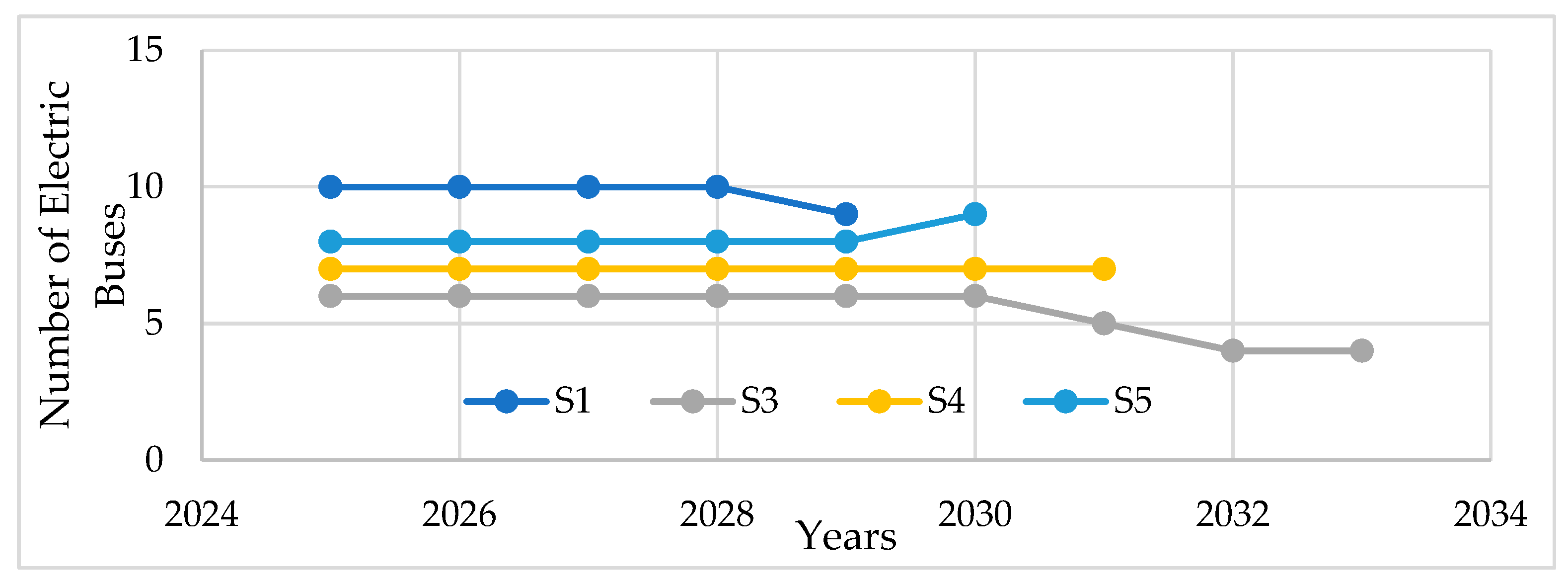
Figure 1.
Number of buses under scenarios S1, S3, S4 and S5.
The results allow for informed strategic policy decisions:
- If the priority is earliest electrification, the increased budget (Scenario 1, S1) is an effective tool, but requires a clear presentation of the higher overall infrastructure costs. In this case, the objective function has the highest value, i.e., the acceleration “costs” more, but with lower emissions and earlier social benefits.
- If the objective is the lowest value of the objective function (EUR): the increased monetization of externalities (Scenario 4, S4) argues for an earlier replacement in sensitive areas, improving the overall target value compared to the baseline.
- The increased budget (Scenario 1, S1) delays electrification to year 5, while the higher price of buses (Scenario 3) postpones it to year 9.
- Budget constraints do not allow the desired change to be achieved (Scenario 2, S2).
- Even with available funds, the Rt (supply chain risk) constraint is unacceptable (scenario 6, S6).
- EU subsidy and local co-financing (scenario 5, S5) require careful budget planning, related to both EU programs and the financial capabilities of the owner of the transport company in the settlement.
The analysis shows that:
- Budgetary constraints are a critical factor—even with the lower operating costs of electric buses. Their high purchase price limits the number that can be replaced;
- Prioritizing social/environmental benefits (β > α) leads to a different replacement structure. With a preference for earlier replacement despite higher upfront costs;
- The flexibility of the model allows it to adapt to a dynamic environment—when one or more parameters change. Solver finds a new optimal solution;
- Scenario planning is a tool for sustainable management that can support policy dialogue and the justification of investment programs;
- The “What-if” analysis makes it possible to identify which factors have the greatest influence on the results. How robust the solution is to variations in real-world conditions and where investments or policy measures will have the greatest effect.
5. Conclusions
This article presents a comprehensive integrated model for the strategic planning of bus fleet electrification in urban public transport, going beyond traditional economic and technological frameworks. The adopted approach based on Mixed-Integer Linear Programming (MILP) combines cost optimization, emission reduction and the integration of social and environmental indicators, including noise pollution and fine particulate matter.
The model proves its practical applicability through a hypothetical but realistically structured case study for “Municipal Transport Ruse” EAD, demonstrating the possibilities for making informed strategic decisions within real constraints—budgetary, infrastructure and logistics. The total investment amounts to around 78 million EUR, while achieving significant environmental and social benefits. The results highlight not only the economic benefits of electrification (reduced operating costs) but also the significant external effects on the urban environment and public health, adding value to the model as a tool for preparing funding applications under European and national programs.
Through integrated scenario analysis and “What-if” simulations, the model provides a toolkit for adaptive and sustainable transport planning, particularly suitable for use by local authorities, municipal operators, and consulting teams when developing long-term strategies for decarbonization and modernization of public transport. Thus, the proposed model represents a substantial contribution to scientific knowledge and good practice in the field of sustainable urban mobility and can be further enhanced in future research through the inclusion of stochastic factors, energy scenarios, and real-world data from the operation of electric vehicles.
In conclusion, bus fleet electrification should not be regarded merely as an investment in technology, but as a systemic transformation with high returns—economic, social and environmental. The proposed model constitutes an important step toward achieving sustainable, smart and inclusive urban transport in line with the objectives of the European Green Deal and national sustainable development plans.
In future research, the model can be extended to incorporate elements such as uncertainty in dynamic demand, fluctuations in energy prices and integration with other modes of transport within a multimodal system. Such enhancements will further support accurate planning and the implementation of sustainable transport policies in both Bulgarian and international contexts.
Author Contributions
Conceptualization, V.P. and A.A.; methodology, V.P.; software, V.P.; validation, A.G., K.M.; formal analysis, V.P.; investigation, K.M.; resources. A.G.; data curation, V.P.; writing—original draft preparation, V.P. and M.K.; writing—review and editing, A.A.; visualization, M.K.; supervision, A.G.; project administration, V.P.; funding acquisition. A.A. All authors have read and agreed to the published version of the manuscript.
Funding
This research has been supported by contract No. KП-06-H77/11 of 14 December 2023 “Modelling and development of a complex system for environmental and energy efficiency of transportation in urban conditions” funded by the National Science Fund of the Ministry of Education and Science of Bulgaria.
Institutional Review Board Statement
Not applicable.
Informed Consent Statement
Not Applicable.
Data Availability Statement
The data presented in this study are available on request from the corresponding author due to privacy reasons.
Conflicts of Interest
The authors declare no conflict of interest.
References
- Tettamanti, A.; Varga, B.; Rottenstreich, O.; Emanuel, D. On the relationship of speed limit and CO2 emissions in urban traffic. Transp. Res. Interdiscip. Perspect. 2025, 32, 101513. [Google Scholar] [CrossRef]
- Sarmiento, L.; Wägner, N.; Zaklan, A. The air quality and well-being effects of low emission zones. J. Public Econ. 2023, 227, 105014. [Google Scholar] [CrossRef]
- Czerepicki, A.; Kozłowski, M. Application of the Bayesian inference method to synthesize urban driving cycle speed schedules using measured data. Transp. Probl. 2024, 19, 31–44. [Google Scholar] [CrossRef]
- Gressai, M.; Varga, B.; Tettamanti, T.; Varga, I. Investigating the impacts of urban speed limit reduction through microscopic traffic simulation. Commun. Transp. Res. 2021, 1, 100018. [Google Scholar] [CrossRef]
- Mahmoud, M.; Garnett, R.; Ferguson, M.; Kanaroglou, P. Electric buses: A review of alternative powertrains. Renew. Sustain. Energy Rev. 2016, 62, 673–684. [Google Scholar] [CrossRef]
- Lajunen, A.; Lipman, T. Lifecycle cost assessment and carbon dioxide emissions of diesel, natural gas, hybrid electric, fuel cell hybrid and electric transit buses. Energy 2016, 106, 329–342. [Google Scholar] [CrossRef]
- Buekers, J.; Van Holderbeke, M.; Bierkens, J.; Int Panis, L. Health and environmental benefits related to electric vehicle introduction in EU countries. Transp. Res. Part D Transp. Environ. 2014, 33, 26–38. [Google Scholar] [CrossRef]
- Lu, Z.; Xing, T.; Li, Y. Optimization of electric bus vehicle scheduling and charging strategies under Time-of-Use electricity price. Transp. Res. Part E Logist. Transp. Rev. 2025, 196, 104021. [Google Scholar] [CrossRef]
- Borén, S. Electric buses’ sustainability effects, noise, energy use, and costs. Int. J. Sustain. Transp. 2019, 14, 956–971. [Google Scholar] [CrossRef]
- Perumal, S.S.G.; Lusby, R.M.; Larsen, J. Electric bus planning & scheduling: A review of related problems and methodologies. Eur. J. Oper. Res. 2022, 301, 395–413. [Google Scholar] [CrossRef]
- Manzolli, J.A.; Trovão, J.P.; Antunes, C.H. A review of electric bus vehicles research topics—Methods and trends. Renew. Sustain. Energy Rev. 2022, 159, 112211. [Google Scholar] [CrossRef]
- Lipman, T. Recent Developments and Challenges with Electric Bus Implementation for Transit Fleets. Curr. Sustain./Renew. Energy Rep. 2025, 12, 12–19. [Google Scholar] [CrossRef]
- Soylu, S.; Demir, Z. Investigation of basic operating characteristics of conventional, diesel-electric and hybrid-electric city buses under urban driving conditions. Transp. Res. Procedia 2023, 72, 1427–1434. [Google Scholar] [CrossRef]
- Kendra, M.; Pribula, D.; Skrúcaný, T.; Blažeková, O.; Stoilova, S. Battery-Assisted Trolleybuses: Effect of Battery Energy Utilization Ratio on Overall Traction Energy Consumption. Sustainability 2024, 16, 11303. [Google Scholar] [CrossRef]
- Hurtova, I.; Sejkorova, M.; Verner, J.; Sarkan, B. Comparison of electricity and fossil fuel consumption in trolleybuses and buses. In Proceedings of the 17th International Scientific Conference Engineering for Rural Development, Jelgava, Latvia, 23–25 May 2018; pp. 2079–2085. [Google Scholar] [CrossRef]
- Pelletier, S.; Jabali, O.; Mendoza, J.E.; Laporte, G. The electric bus fleet transition problem. Transp. Res. Part C Emerg. Technol. 2019, 109, 174–193. [Google Scholar] [CrossRef]
- Li, L.; Lo, H.K.; Xiao, F. Mixed bus fleet scheduling under range and refueling constraints. Transp. Res. Part C Emerg. Technol. 2019, 104, 443–462. [Google Scholar] [CrossRef]
- Laib, F.; Braun, A.; Rid, W. Modelling noise reductions using electric buses in urban traffic: A case study from Stuttgart, Germany. Transp. Res. Procedia 2019, 37, 377–384. [Google Scholar] [CrossRef]
- Bhat, T.H.; Farzaneh, H. Quantifying the multiple environmental, health, and economic benefits from the electrification of the Delhi public transport bus fleet, estimating a district-wise near roadway avoided PM2.5 exposure. J. Environ. Manag. 2022, 321, 116027. [Google Scholar] [CrossRef] [PubMed]
- Pelletier, S.; Jabali, O.; Laporte, G. The electric vehicle routing problem with energy consumption uncertainty. Transp. Res. Part B Methodol. 2019, 126, 225–255. [Google Scholar] [CrossRef]
- Varghese, A.; Pradhan, R. A comprehensive review and research agenda on the adoption, transition, and procurement of electric bus technologies into public transportation. Sustain. Energy Technol. Assess. 2025, 75, 104218. [Google Scholar] [CrossRef]
- Belton, V.; Stewart, T. Multiple Criteria Decision Analysis: An Integrated Approach; Springer: New York, NY, USA, 2002; p. 372. [Google Scholar] [CrossRef]
- European Commission. The European Green Deal. COM (2019) 640 Final. 2019. Available online: https://eur-lex.europa.eu/legal-content/EN/TXT/?uri=CELEX:52019DC0640 (accessed on 15 May 2025).
- Directive (EU) 2019/1161 of the European Parliament and of the Council of 20 June 2019 Amending Directive 2009/33/EC on the Promotion of Clean and Energy-Efficient Road Transport Vehicles. Available online: https://eur-lex.europa.eu/legal-content/EN/TXT/?uri=CELEX%3A32019L1161 (accessed on 15 May 2025).
- Communication from the Commission to the European Parliament, the Council, the European Economic and Social Committee and the Committee of the Regions Sustainable and Smart Mobility Strategy—Putting European Transport on Track for the Future. Available online: https://eur-lex.europa.eu/legal-content/EN/TXT/?uri=CELEX%3A52020DC0789 (accessed on 15 May 2025).
- European Commission. Commission Recommendation (EU) 2023/550 of 8 March 2023 on National Support Programmes for Sustainable Urban Mobility Planning (Notified Under Document C(2023) 1524). Off. J. Eur. Union 2023, L 73, 23–33. Available online: https://eur-lex.europa.eu/legal-content/EN/TXT/PDF/?uri=CELEX%3A32023H0550 (accessed on 15 May 2025).
- Commission Directive 2003/27/EC of 3 April 2003 on Adapting to Technical Progress Council Directive 96/96/EC as Regards the Testing of Exhaust Emissions from Motor Vehicles (Text with EEA Relevance). Available online: https://eur-lex.europa.eu/legal-content/EN/TXT/HTML/?from=ET&uri=CELEX%3A32003L0027 (accessed on 15 May 2025).
Disclaimer/Publisher’s Note: The statements, opinions and data contained in all publications are solely those of the individual author(s) and contributor(s) and not of MDPI and/or the editor(s). MDPI and/or the editor(s) disclaim responsibility for any injury to people or property resulting from any ideas, methods, instructions or products referred to in the content. |
© 2026 by the authors. Licensee MDPI, Basel, Switzerland. This article is an open access article distributed under the terms and conditions of the Creative Commons Attribution (CC BY) license.


