


Abstract
In this paper, a modified variable step Incremental Conductance (VS-InCond) algorithm integrated with modified pq theory and double-band hysteresis current control (PQ-DBHCC) is proposed for the implementation on a single-stage single-phase grid-tied photovoltaic (PV) inverter system. As the single-phase inverter in a grid-tied PV system receives varying DC voltage from PV modules, the PQ-DBHCC strategy is deployed to regulate the ac output voltage along with its capability to deliver the maximum power during onload conditions. VS-InCond algorithm and DC-link capacitor are used as the interface between the PV modules and the inverter for tracking maximum power point. Furthermore, the PQ-DBHCC strategy also controls active and reactive power between inverter, load, and grid. The simulation results obtained from MATLAB Simulink software show that PQ-DBHCC strategy is capable of achieving the desired fixed DC voltage at inverter input and maintaining the maximum power point tracking, even under varying environmental conditions and load variations. The inverter ac output has a steady 230 Vrms at 50 Hz frequency. The total harmonic distortions (THDs) of output ac current and ac voltage are observed to be less than 5%, as recommended in IEEE 519 standard. Additionally, during full load conditions, the proposed system successfully delivers 95% of the theoretical maximum power from PV modules.
1. Introduction
With more emphasis among nations and business communities towards the initiatives for climate change, solar energy has attracted greater attention due to its availability in abundance and emission-free energy source. Grid-connected photovoltaic (GPV) generation system connected to the low-voltage distributed generations (DG) has become the research hotspot. In grid-connected DG, single-phase inverters are primarily used to inject active power into the grid. However, the inverter should not be limited to inject the active power into the grid; quite the contrary, it should also have the capability to contribute to the voltage regulation and establish the support for the grid through providing reactive power control as an ancillary service, injecting the reactive power if there is a demand, and/or absorbing the reactive power if there is a surplus in the grid [1].
The primary approaches for regulating active and reactive powers are reactive power detection, acquisition of the grid-connected reference current, and grid current control. The instantaneous reactive power (IRP) theory [2] and the synchronous reference frame (SRF) theory are those most referred to [3,4]. The active and reactive powers in a three-phase system may be easily managed by using SRF and IRP methods with two orthogonal axes. In a single-phase DG system, the IRP and SRF theories with two orthogonal variables obtained from a single variable were applied. The virtual α-β phase currents are generated using a 90 phase-shift operation at the fundamental frequency in this technique, which imposes a considerable long delay and impairs the system dynamic responsiveness. To overcome the problem mentioned, the pq theory is proposed in this system [5,6].
There are several current control methods available including mainly proportional-integral (PI) control [7], proportional-resonant (PR) control [8], predictive current control [9], fuzzy control [1], and hysteresis (HCC) [10]. The other controller mentioned is simple and straightforward to establish, but also tracks a reference current with a high steady-state error. Due to the application of its band, the HCC controller can track the reference current with zero steady-state errors, making it suitable to be used in this application. In this paper, an improved PQ-DBHCC is proposed for the single-phase DG system located at the end of the feeder, while VS-InCond algorithm is used to regulate the dc-link voltage to a desired value.
2. Methodology of Proposed Controller
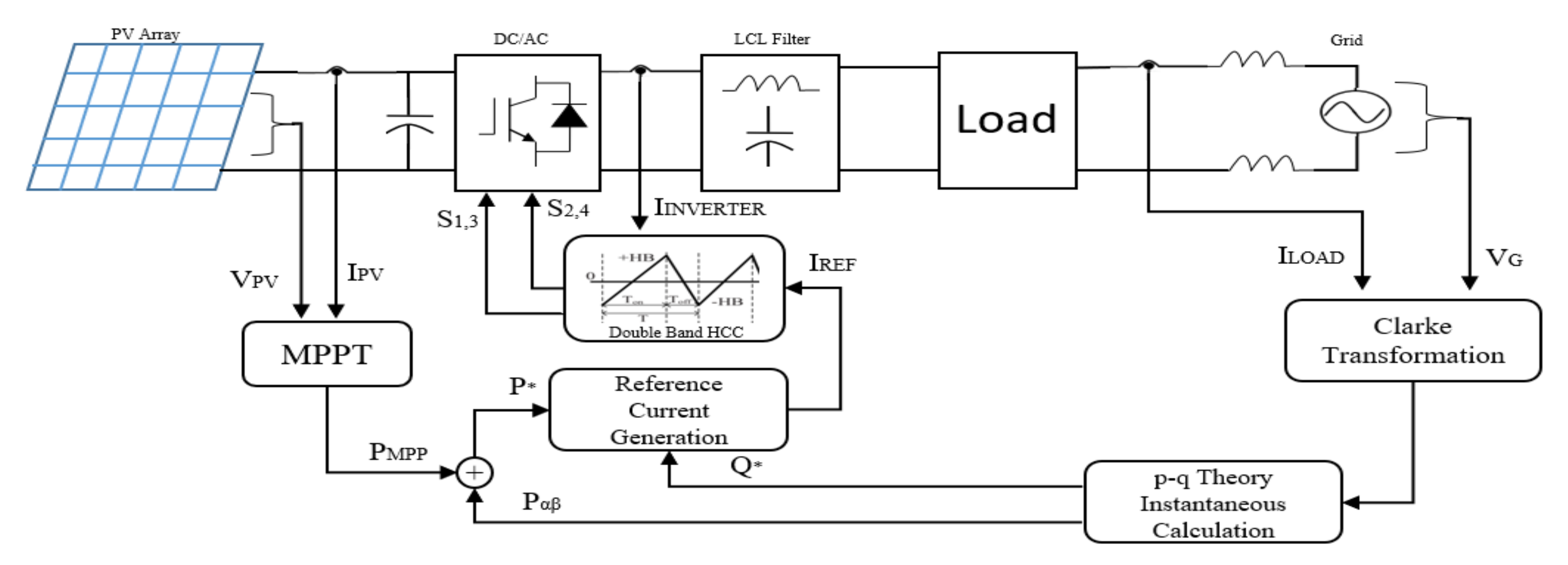
The block diagram of the proposed system is shown in Figure 1. The inverter consists of four switching devices (represented as ideal switches) connected in the form of a full-bridge topologies. In order to filter out the harmonics present during on-load operation, an LCL filter is connected at the output stage of the inverter. The inductor at the grid side acts as the grid-connected reactor. The input power for the proposed inverter is sourced from the PV arrays.
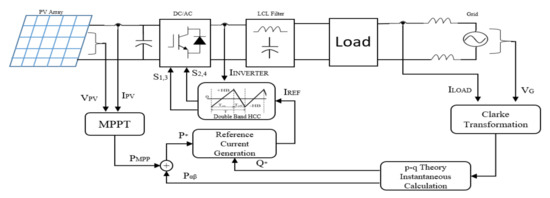
Figure 1.
Configuration of the proposed single-phase grid-connected PV system.
The single-phase system transformation to two orthogonal variables can be carried out by creating a virtual two-phase. This virtual concept introducing a lag or lead of π/2 rad to both single-phase voltage and current as expressed in Equations (1) and (2). As a matter of fact, all of the features and benefits of a three-phase system are retained in a single-phase system.
Then, the pq theory defines the instantaneous active power, Pαβ, and instantaneous reactive power, Qαβ in terms of α–β components as
The reference current in the α–β coordinate as obtained from pq theory is given by
where , P* is the reference active power obtained from summation of PMPP and Pαβ, and Q* is the reference reactive power.
3. Results and Discussion
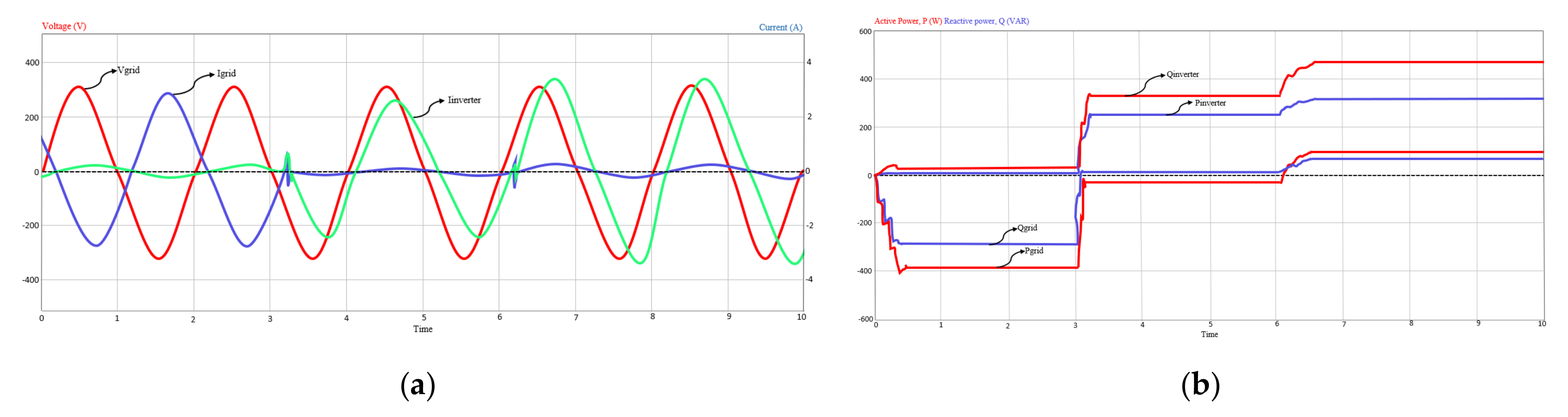
The simulation is carried out in MATLAB Simulink software and its parameters are listed in Table 1. To verify the system performance, the initial light intensity is set at 0 W/m2 and the local load is inductive, i.e., ZL = 94.99+ j67.54 Ω. Later, the light intensity changes to 800 W/m2 at t =3 s and 1000 W/m2 at t = 6 s, respectively. Simulation waveforms are shown in Figure 2a,b, where Vgrid is the grid voltage, Igrid and Iinverter are the grid current and inverter current, respectively. Pinverter and Qinverter are the inverter output active power and reactive power, respectively. Pgrid and Qgrid are the active power and reactive power injected into the grid, respectively. Under low irradiance condition from 0 to 3 s, the load consumes active and reactive power from the grid simultaneously. When the light intensity increases, from 3 s onwards, the inverter provides not only active power and reactive power for the local load, but also supplies the remaining energy into the grid. The DG system can regulate active and reactive power effectively under varying environmental conditions. Table 2 shows more detailed results.

Table 1.
Simulations Parameters.
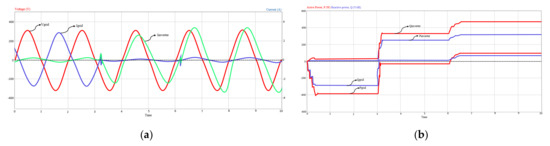
Figure 2.
(a) Grid voltage and Current; (b) active and reactive power of grid and inverter.
Table 2.
Active and Reactive power under varying irradiance.
4. Conclusions
In this paper, an improved active-reactive power control method is proposed to realize in the power compensation. Compared with the others method mentioned in Section 1, the proposed system has solved the shortage of the long delay. VS-InCond algorithm is used to stabilize the dc-link voltage and speeds up the system response by delivering above 95% theoretical maximum power of PV modules, while the PQ-DBHCC method tracks the reference current with zero steady error and reduces the current distortion due to the frequency offset and distortion of the grid voltage, while maintaining the THD value within 5% limit set by the IEEE 519 standard.
Institutional Review Board Statement
Not applicable.
Informed Consent Statement
Not applicable.
Data Availability Statement
Not applicable.
Conflicts of Interest
The authors declare no conflict of interest.
References
- Rezwan, S.; Bhavani, R. Power Quality Improvement of Single Phase Grid Connected Photo Voltaic System Master Of Technology Power Quality Improvement Of Single Phase Grid Connected Master of Technology. Electr. Power Syst. Res. 2018, 2018, 193–203. [Google Scholar]
- Dash, A.R.; Panda, A.K.; Penthia, T.; Dhal, P.K. Implementation of improved pq theory in shunt active filter based on cascaded multilevel inverter with single excited DC source. IEEMA Eng. Infin. Conf. eTechNxT 2018, 22, 1–6. [Google Scholar]
- Zafar, S.; Amin, M.A.; Javaid, B.; Khalid, H.A. On Design of DC-Link Voltage Controller and PQ Controller for Grid Connected VSC for Microgrid Application. In Proceedings of the 4th International Conference on Power Generation Systems and Renewable Energy Technologies, PGSRET 2018, Islamabad, Pakistan, 10–12 September 2018; pp. 10–12. [Google Scholar]
- Shaikh, F.; Joseph, B. Simulation of synchronous reference frame PLL for grid synchronization using Simulink. In Proceedings of the 2017 International Conference on Advances in Computing, Communication and Control, ICAC3 2017, Mumbai, India, 1–2 December 2017; pp. 1–6. [Google Scholar]
- Datta, A.; Sarker, R.; Hazarika, I. An Efficient Technique Using Modified p–q Theory for Controlling Power Flow in a Single-Stage Single-Phase Grid-Connected PV System. IEEE Trans. Ind. Inform. 2019, 15, 4635–4645. [Google Scholar] [CrossRef]
- Dasgupta, S.; Sahoo, S.K.; Panda, S.K. A novel current control scheme using Lyapunov function to control the active and reactive power flow in a single phase hybrid PV inverter system connected to the grid. In Proceedings of the 2010 International Power Electronics Conference—ECCE Asia, IPEC 2010, Sapporo, Japan, 21–24 June 2010; pp. 1701–1708. [Google Scholar]
- Sujatha, B.; Anitha, G. Enhancement of PQ in grid connected PV system using hybrid technique. Ain Shams Eng. J. 2018, 9, 869–881. [Google Scholar] [CrossRef] [Green Version]
- Tarasantisuk, C.; Kumsup, S.; Piyarat, W.; Witheepanich, K. Stationary frame current regulation using Proportional Resonant controller for single phase grid connected inverter. In Proceedings of the 2016 13th International Conference on Electrical Engineering/Electronics, Computer, Telecommunications and Information Technology, ECTI-CON 2016, Piscataway, NJ, USA, 28 June 2016–1 July 2016. [Google Scholar]
- Nikroo, M.; Montazeri, S.H.; Milimonfared, J.; Shadian, F. Performance Analysis of Model Predictive Controller for Grid-Connected Quasi Z-Source and Split-Source PV Inverters. In Proceedings of the 2020 11th Power Electronics, Drive Systems, and Technologies Conference (PEDSTC), PEDSTC 2020, Tehran, Iran, 4–6 February 2020; pp. 1–6. [Google Scholar]
- Sorte, P.K.; Panda, K.P.; Peesapati, R.; Panda, G. An Improved Control Strategy for Single-Phase Single-Stage Grid-Tied PV System with Current Reference MPPT Control. In Proceedings of the 2020 IEEE International Conference on Computing, Power and Communication Technologies (GUCON), GUCON 2020, Greater Noida, UP, India, 2–4 October 2020; pp. 461–466. [Google Scholar]
Publisher’s Note: MDPI stays neutral with regard to jurisdictional claims in published maps and institutional affiliations. |
© 2022 by the authors. Licensee MDPI, Basel, Switzerland. This article is an open access article distributed under the terms and conditions of the Creative Commons Attribution (CC BY) license (https://creativecommons.org/licenses/by/4.0/).