You are currently viewing a new version of our website. To view the old version click .
Engineering Proceedings
  • Proceeding Paper
  • Open Access

21 January 2022

Experimental Study on the Particle Flow and Validation of the Results Using TIS Model in a Continuously Operated Horizontal Fluidized Bed †
,
,
,
,
and
1
Department of Chemical Engineering, H.H Campus, University of Gujrat, Gujrat 50700, Pakistan
2
State Environmental Protection Key Laboratory of Environmental Risk Assessment and Control on Chemical Process, School of Resources and Environmental Engineering, East China University of Science and Technology, Shanghai 200237, China
*
Author to whom correspondence should be addressed.
Presented at the 1st International Conference on Energy, Power and Environment, Gujrat, Pakistan, 11–12 November 2021.
This article belongs to the Proceedings The 1st International Conference on Energy, Power and Environment

Abstract

The particle residence time in a gas–solid fluidized bed is of great interest. In this work, experiments have been carried out to investigate particle transportation, which is a matter of concern especially in pharmaceuticals, agriculture, food, and many other industries where time is the major concern, which effects the product quality. By varying the feed rate and baffle gap height in this research, the dispersion coefficient decreases significantly, which reduces the back-mixing and number of tanks as well. Moreover, the obtained results were validated with the tank in series (TIS) model.

1. Introduction

The control of the particle-mixing process in the reactor is crucial for the design and operation of gas–solid reactors due to its vital role in maximizing the profitability [1]. Therefore, the Residence Time Distribution (RTD) of particles has a great impact on product quality in many industrial processes; e.g., in the drying process, if a product is achieved before its optimum time, it still has some unwanted moisture. However, if it exits the system after its optimum time, it could be deteriorated [2]. The drying rate has a close relationship with mean residence time and the dispersion coefficient; regarding this, researchers worked on a continuous fluidized bed by varying parameters such as solid feed rates, weir height, and inlet solid moisture content [3,4]. Moreover, some scientists have worked on particle mixing in a continuous fluidized bed and they observed that the bed appearance seems to be more homogeneous at higher gas velocities, and the dispersion coefficient also increases with increasing bed height due to the excess air velocity [5,6]. According to the literature review, several authors have attempted to find the RTD and dispersion coefficient by using different techniques and by varying parameters of the fluidized bed, but further work is still required to reach a particular conclusion. The present paper aims to examine the particle RTDs from the experimental data by varying the baffle gap height and solid feed rate.

2. Experimental Procedure

The experiments were performed by using the material and tracer particles of γ _ A l 2 O 3 , with a particle size of 1.8 mm in diamter. The tracer particles were usually injected directly into the bed using a pulse technique [7]. The number of tracer particles in each experiment was 500 g . First of all, three baffles were installed into the processing chamber, with a gap height of 0.4 cm from the distributor plate. After that, the process was started by turning on the blower and rotary feeders. The airflow rate was maintained constant throughout the experiment at 1400 m 3 /h. The samples were analyzed in the laboratory with the help of a rotary cone sample divider and vibratory feeder. The same procedure was repeated for the feed rates of 1.0 and 1.5 kg / min by varying the gap height of the baffles i.e., 0.6 or 1.2 cm .

3. Results and Discussion

In this section, results of all the RTD experiments are displayed in Table 1. The investigated parameters are the solid feed rate and baffle gap height.
Table 1. The operating parameters and results of the RTD experiments.

3.1. Effect of Solid Feed Rate on Dispersion Coefficient and Bodenstein Number

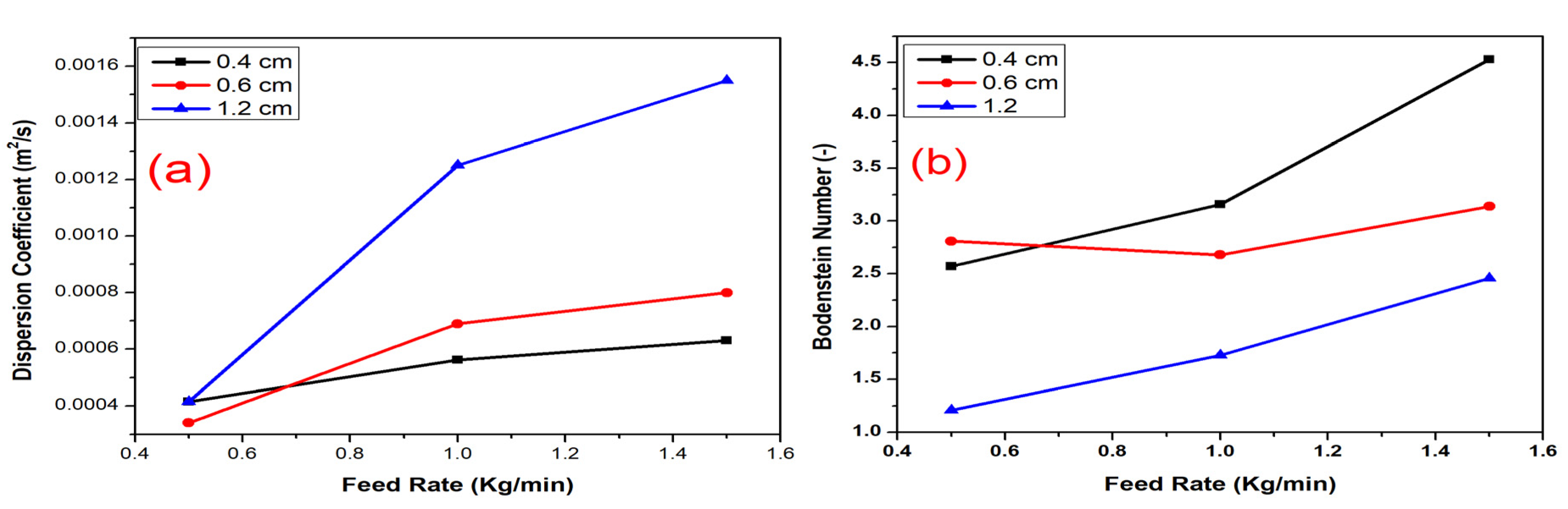
The dispersion coefficient is a very important characteristic number for consideration that represents the spreading process and it also gives information about back-mixing. Figure 1a presents the relationship between the dispersion coefficient and the feed rate for constant baffle gap heights. The graph shows that the dispersion coefficients increase with an increasing feed rate for the cases of 0.4, 0.6, and 1.2 cm. Furthermore, it was also observed that the Dispersion Coefficient has the lowest value by using a lower baffle gap height i.e., 0.4 cm.
Figure 1. The effect of solid feed rate on (a) dispersion coefficient and (b) Bodenstein Number.
Figure 1b shows the relation of Bodenstein’s number with the solid feed rate. The Bodenstein number is one of the more important characteristic numbers for studying the behavior of particles with respect to RTD. It is a ratio between convective transport and dispersive transport of particles in the system. The Bodenstein number increasing tells us that the convective moment is dominant and particles move in a forward direction, whereas if the Bodenstein number decreases, it shows that particles are more dispersive. It can be seen from Figure 1b that the Bodenstein number increases when baffles are installed and the feed rate is increased for the case of baffle gap heights of 0.4, 0.6, and 1.2 cm.

3.2. Effect of Baffle Gap Height on Dispersion Coefficient and Bodenstein Number

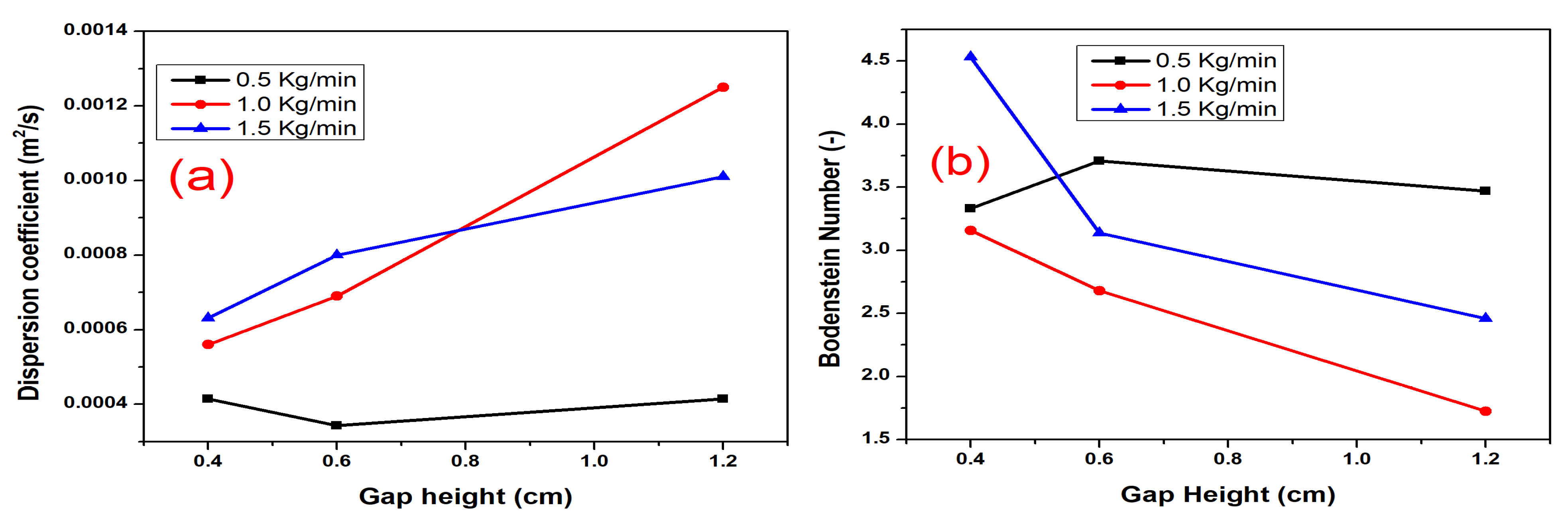
Figure 2a shows that the dispersion coefficient increases with an increase of the baffles gap height for the cases of 1 kg/min and 1.5 kg/min. wherever for the case of 0.5 kg/min, the dispersion coefficient initially exhibits a declining trend with an increase in the gap height from 0.4 cm to 0.6 cm. However, a further increase in the gap height from 0.6 cm to 1.0 cm exhibits a slight increasing trend. The results tell that the dispersion coefficient increases with an increase in baffle gap height. The results are as per expectations, as some researchers had worked on this issue previously and found the same results [5,8]. Figure 2b depicts the declining trend of the Bodenstein number while the gap height increases.
Figure 2. The effect of gap height on (a) dispersion coefficient and (b) Bodenstein number.

4. Analysis with Tank in Series Model

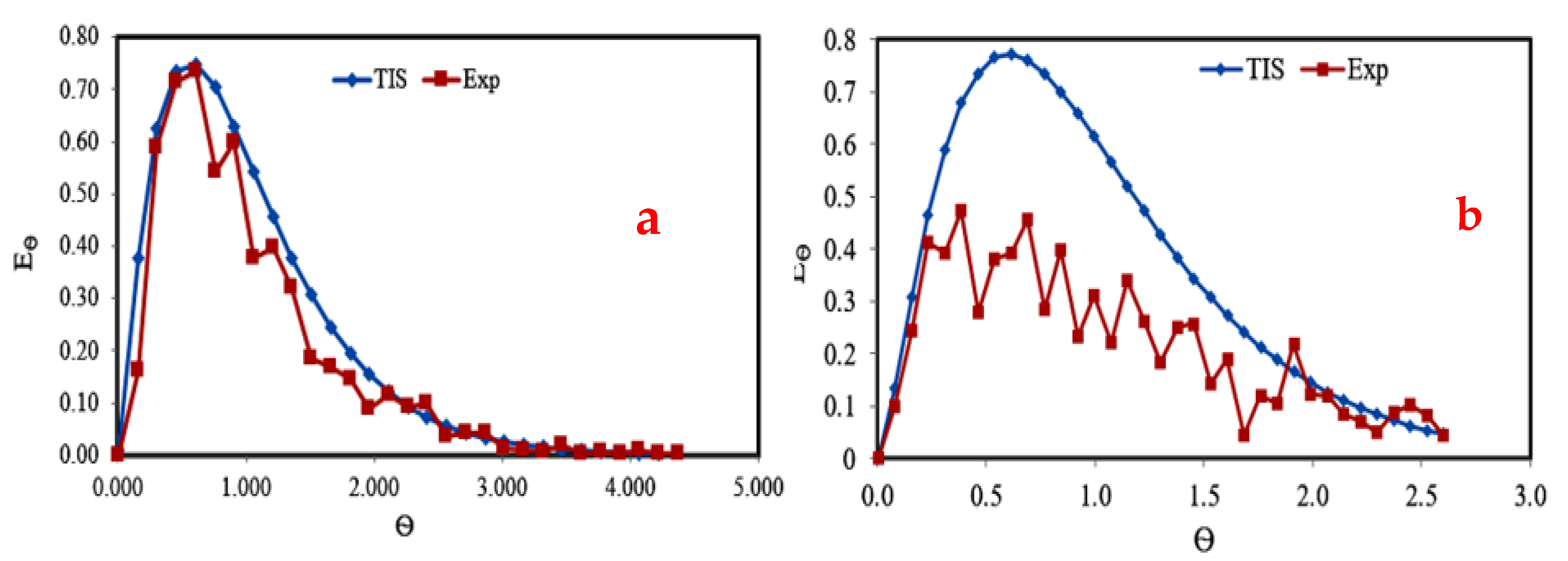
It can be observed that out of the 12 graphs, the curves of 9 experiments fit with the tank in series model very well, while 3 of them have irregular behavior. As can be seen from Figure 3a,b, the curve from experiment results fits so well with the tank in series model curve because of the mass balance.
Figure 3. Comparison of experimental results with TIS Model: (a) Run # 6; (b) Run # 4.

5. Conclusions

The dispersion coefficient and the Bodenstein number are the most important characteristic numbers for studying the RTD in horizontal fluidized beds. By introducing parameters such as feed rate and baffle gap height, the back-mixing of the particles decreases and the particles can thereby be better controlled. Furthermore, the tank in series model was also used to investigate the behavior of these fluidized beds and the result fit with the model very well. The relations between the number of the tanks, the dispersion coefficient, and the Bodenstein number are also established in this study.

Institutional Review Board Statement

Not applicable.

Data Availability Statement

Not applicable.

Conflicts of Interest

The authors declare no conflict of interest.

References

  1. Hua, L.; Wang, J. Residence time distribution of particles in circulating fluidized bed risers. Chem. Eng. Sci. 2018, 186, 168–190. [Google Scholar] [CrossRef]
  2. Bachmann, P.; Tsotsas, E. Analysis of residence time distribution data in horizontal fluidized beds. Procedia Eng. 2015, 102, 790–798. [Google Scholar] [CrossRef] [Green Version]
  3. Srinivasakannan, C.; Al Shoaibi, A.; Balasubramanian, N. Continuous fluidized bed drying with and without internals: Kinetic model. Chem. Biochem. Eng. Q. 2012, 26, 97–104. [Google Scholar]
  4. Khanali, M.; Rafiee, S.; Jafari, A.; Banisharif, A. Study of residence time distribution of rough rice in a plug flow fluid bed dryer. Int. J. Adv. Sci. Technol. 2012, 48, 103–114. [Google Scholar]
  5. Avidan, A.; Yerushalmi, J. Solids mixing in an expanded top fluid bed. AIChE J. 1985, 31, 835–841. [Google Scholar] [CrossRef]
  6. Borodulya, V.; Epanov, Y.G.; Teplitskii, Y.S. Horizontal particle mixing in a free fluidized bed. J. Eng. Phys. 1982, 42, 528–533. [Google Scholar] [CrossRef]
  7. Levenspiel, O. Tracer Technology: Modeling the Flow of Fluids; Springer Science & Business Media: New York, NY, USA; Dordrecht, The Netherlands; Heidelberg, Germany; London, UK, 2011; Volume 96. [Google Scholar]
  8. Satija, S.; Zucker, I. Hydrodynamics of vibro-fluidized beds. Dry. Technol. 1986, 4, 19–43. [Google Scholar] [CrossRef]
Publisher’s Note: MDPI stays neutral with regard to jurisdictional claims in published maps and institutional affiliations.

Article Metrics

Citations

Article Access Statistics

Multiple requests from the same IP address are counted as one view.