


Abstract
Herein we first attempt to compare the catalytic and electrocatalytic properties of the most commonly used peroxidase-mimicking nanozymes based on transition metal ions, including magnetite, cerium oxide, and Prussian Blue. For the nanomaterials under consideration, the catalytic rate constant for reducing substrate increases upon decreasing its redox potential and reaches its maximum value for Prussian Blue in the presence of ferrocyanide (kcat = 3.8 s−1 per single redox-active site). In addition to the highest kcat, Prussian Blue nanoparticles in electrochemical sensors exhibit sensitivity to H2O2 more than three orders of magnitude higher than other nanomaterials. The sensing properties of the electrodes modified with Prussian Blue nanoparticles appear to be dependent on their diameter; particles with a diameter of 140 nm provide optimal sensitivity and lifespan of the corresponding sensor. The achieved exceptional (electro)catalytic properties of Prussian Blue nanoparticles open prospects for their application as universal labels for personal analyzers with either optical or electrochemical readout.
1. Introduction
Nanozymes (nanoparticles with enzyme-like activity) favorably differ from their natural counterparts by combining high stability with low cost. These advantages make them attractive for the development of personalized medical devices. Since most enzymatic sensing systems utilize peroxidases as labels, nanozyme-related research is mainly devoted to the development of peroxidase-mimicking particles. To date, peroxidase-like activity has been demonstrated for a large number of materials, including metal oxides, carbon-based structures, and noble metal nanoparticles [1]. Probably the most studied nanozymes are magnetite nanoparticles, for which peroxidase-like activity was first demonstrated [2], and CeO2 nanoparticles, which are generally applied for therapeutic applications [3,4]. Such nanozymes are able to successfully replace the enzyme labels in a number of colorimetric assays [5,6,7]. However, in terms of personalized sensing devices, the challenge of precise optical reading limits the use of nanozymes, which appear to be suitable only for immunochromatographic test strips. In this regard, electrochemical analysis is attractive, combining high accuracy with the simplicity of readout, though requiring the use of electrocatalytic labels. Despite the promised advantages of electrochemical biosensing, the electrocatalytic properties of even the most common nanozymes are rarely discussed, with the only exception being Prussian Blue-based nanostructured catalysts. These are recognized as the most efficient electrocatalysts of H2O2 reduction, displaying high selectivity and sensitivity [8,9].
With this study, we intend to compare the catalytic and electrocatalytic activity of a set of electroactive nanomaterials to reveal the most promising candidates for the elaboration of universal labels for further biosensing applications.
2. Materials and Methods
2.1. Materials
Hydrogen peroxide (30% solution), KCl, K2HPO4, KH2PO4, and citric acid were purchased from Reachim (Moscow, Russia). FeCl3·6H2O, K3[Fe(CN)6], catechol, ο-phenylenediamine, 3,3′,5,5′-tetramethylbenzidine (TMB), Ce(NO3)3·6H2O, ethylene glycol, and ammonia solution (25–28%) were purchased from Sigma Aldrich (Burlington, MA, USA). Iron (III) acetylacetonate from Acros Organics (Geel, Belgium) and benzyl alcohol from Alfa Aesar (Ward Hill, MA, USA) were used as received. LiFePO4 with an average nanoparticle size of 8 nm was purchased from AME Energy Co. (Shenzhen, China).
2.2. Instrumentation
The UV/Vis absorption measurements in transmission mode were carried out using a Lambda 950 Spectrophotometer (PerkinElmer, Shelton, CT, USA). Electrochemical measurements were carried out using PalmSens 4 (PalmSens, Houten, The Netherlands) and planar screen-printed structures with a graphite working electrode (d = 1.8 mm; Rusens, Moscow, Russia).
2.3. Methods
2.3.1. Synthesis
Catalytic synthesis of Prussian Blue nanoparticles of different sizes (roughly 30–300 nm (Figure S1a,b)) was carried out as we reported earlier in Ref. [10]. Hydrogen peroxide (10–100 mM) was added to an equimolar mixture of FeCl3 and K3[Fe(CN)6] (5–100 mM) in 0.1 M KCl/HCl upon ultrasonication. After centrifugation, the resulting nanoparticles were redispersed in 0.1 M KCl/HCl solution, and the washing cycle was repeated 5–7 times.
Using the solvothermal method, Fe3O4 and CeO2 nanoparticles with an average size of 6 nm and 4 nm (Figure S1c,d), respectively, were synthesized. CeO2 nanoparticles were obtained using solvothermal method according to Ref. [11]. A detailed synthesis technique is described in the Supporting Information.
2.3.2. Electrochemical Investigations of the Prussian Blue Modified Electrodes
For the electrode modification, 2 μL of nanozyme colloids with a bulk concentration of Prussian Blue from 0.1 to 4 mM was drop-cast onto its surface and annealed at 100 °C for 20 min.
The sensitivity of the nanoparticle-based sensors was investigated in chronoamperometry mode (EDC = 0.0 V) by correlating the current response to an increase in the H2O2 concentration in batch mode upon vigorous stirring.
To study the operational stability of the electrode coatings based on Prussian Blue nanoparticles with different sizes, a continuous detection of 0.1 mM H2O2 monitoring was carried out. All electrochemical studies were carried out in a phosphate buffer (pH = 6.0).
2.3.3. Investigation of Peroxidase-like Activity
Steady-state kinetics measurements were carried out at room temperature in phosphate-citrate buffer (pH = 5.0), containing 2 mM of H2O2, from 0.5 µM to 50 mM of reducing substrate and 0.2–200 µM of electroactive material. The concentration of the oxidized substrate was monitored spectrophotometrically.
3. Results and Discussion
In this article, we examined probably the most widely used peroxidase mimetics based on Fe3O4, CeO2, and Prussian Blue nanoparticles. Along with the listed materials, LiFePO4 nanoparticles displaying high intrinsic electroactivity were studied. One can assume that, similarly to peroxidases, catalysis with such electroactive nanoparticles occurs upon redox transformations of the transition metal atoms. Accordingly, it is expected that both the intrinsic electroactivity and the substrate reducing ability will significantly affect the catalytic properties of nanozymes.
The kinetics of the hydrogen peroxide reduction reaction catalyzed by the nanozymes were studied in the presence of substrates with different electron-donor ability: K4[Fe(CN)6] (E0′ = 0.21 V), o-phenylenediamine (E0′ = 0.29 V), catechol (E0′ = 0.36 V), o-dianisidine (E0′ = 0.43 V), and TMB (E0′ = 0.50 V). The reaction rate was determined spectrophotometrically by registration of the substrate’s oxidized form under conditions that are optimal for the peroxidases ([H2O2]0 = 2 mM, pH = 5.0). The initial reaction rate depends on the reducing substrate concentration hyperbolically, while it is proportional to the nanozyme concentration (Figure S2), which allows for formal analysis using the Michaelis–Menten equation and estimation of the catalytic constants (kcat) values. Catalytic constants per single transition metal atom that can be involved in the redox reaction were considered.
As shown, kcat strongly depends on the substrate: a decrease in redox potential of 300 mV leads to a practically 100-fold increase in the kcat (Figure 1). Regardless of the substrate used, the catalytically synthesized Prussian Blue nanoparticles exhibit kcat values at least an order of magnitude higher compared to the other nanomaterials (Figure 1). The maximum kcat value (3.8 s−1) was achieved for Prussian Blue-based nanozymes in the presence of K4[Fe(CN)6].
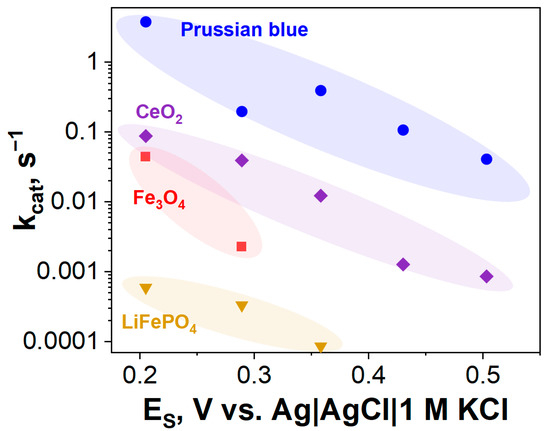
Figure 1.
Catalytic rate constants (kcat) per single potentially electroactive site of different nanozymes (catalytically synthesized Prussian Blue, CeO2, Fe3O4, LiFePO4) depending on the substrates redox potential; [H2O2]0 = 2.0 mM, citrate-phosphate buffer, pH = 5.0.
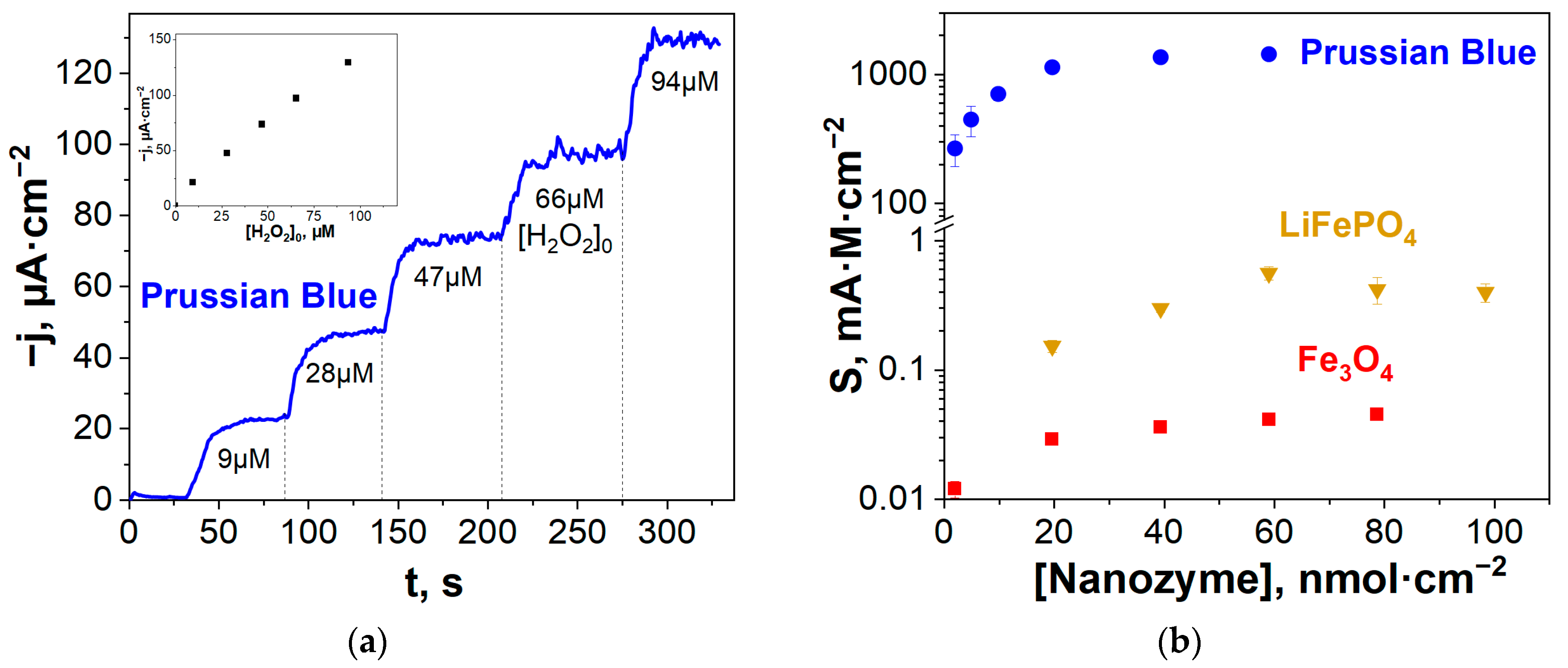
By simple drop-casting of nanozyme suspensions, the electrodes can be modified with different amounts of electroactive nanomaterials. The sensitivity to H2O2 of the resulting nanozyme-based electrodes was investigated at EDC = 0.0 V (Figure 2a), which allowed us to obtain the limiting electrocatalytic current values for all the studied nanomaterials (E0′(Prussian Blue/Prussian White) = 0.14 V, E0′(Fe(OH)2+@Fe3O4/Fe2+(s)@Fe3O4) = 0.12 V, E0′(FePO4/LiFePO4) = 0.05 V) [10].
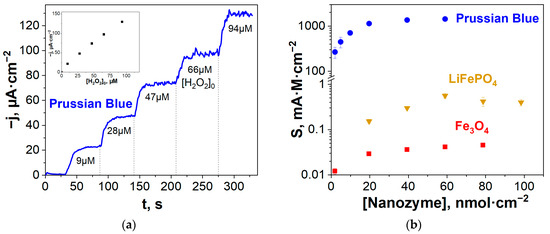
Figure 2.
(a) Dependence of the current density on the added concentration of H2O2 for the electrode with immobilized Prussian Blue nanoparticles (d = 30 nm); surface concentration 79 nmol·cm−2. (b) Sensitivity of the nanozyme-based electrodes to hydrogen peroxide depending on the surface concentrations of the immobilized material; phosphate buffer pH = 6.0, EDC = 0.0 V.
As shown, the sensitivity grows as the surface concentration of immobilized nanozymes increases, reaching a plateau at high surface concentrations: 1.4 ± 0.1, (4 ± 1)∙10−4, and (4 ± 1)∙10−5 A∙M∙cm−1 for electrodes based on Prussian Blue, LiFePO4, and Fe3O4 nanoparticles, respectively (Figure 2b). Such significant differences are probably related to the different electroactivities of immobilized nanomaterials: while the electroactive fraction of immobilized Prussian Blue reaches 60% [12], it is several percent for LiFePO4 and below one tenth of a percent for Fe3O4 (Figure S3). Despite its high catalytic activity, the electrocatalytic activity of CeO2 turned out to be too low for sensor applications. This may be due to its low conductivity, as estimated by means of impedance spectroscopy (Figure S4): the charge transfer resistance for electrodes based on CeO2 is about 870 Ohm·cm2. This value is 1000-fold higher than for Prussian Blue (Table S1, [13]), and as a result, the fraction of electroactive material in the case of CeO2 cannot be determined reliably.
For the Prussian Blue-based nanozymes, the size effects on their electrocatalytic properties were investigated. For this aim, the carbon electrodes were modified with equal amounts (79 nmol·cm−2) of Prussian Blue consisting of nanoparticles sized from 30 to 300 nm.
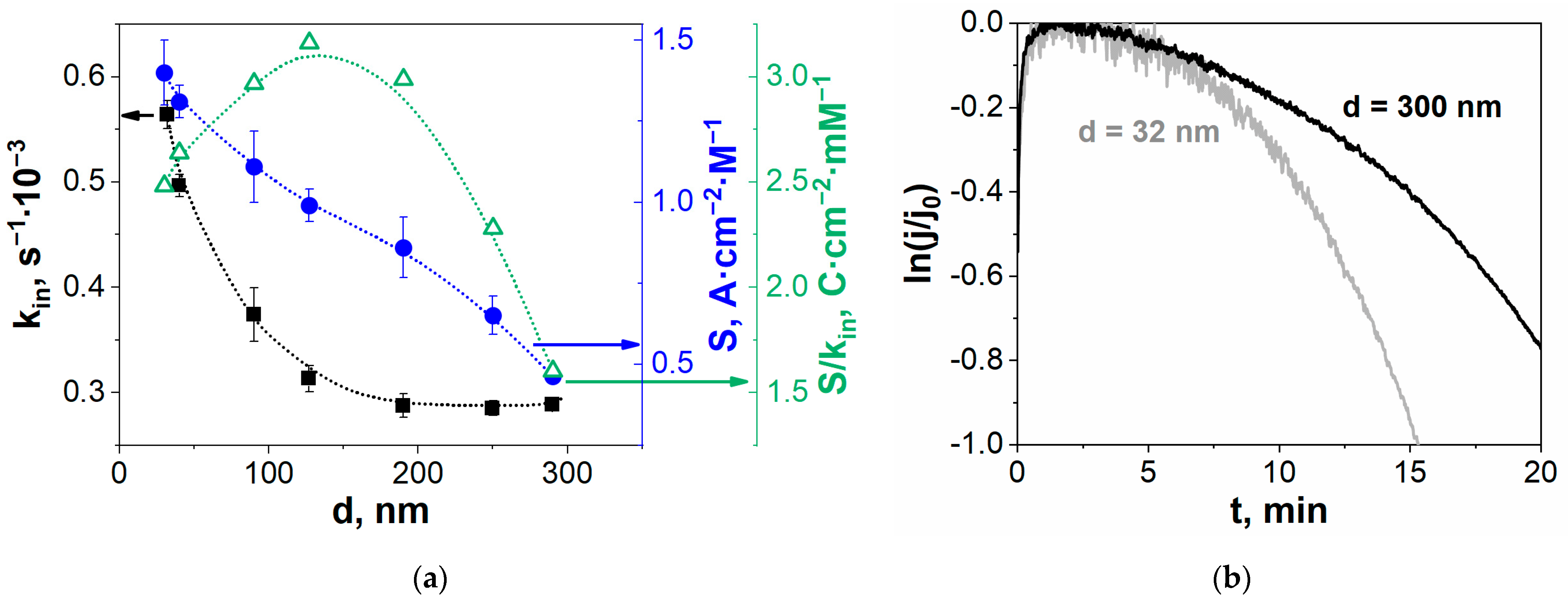
As shown, in the case of the smallest nanozymes, a three-fold-higher sensitivity can be achieved compared to the electrodes with 300 nm particles (Figure 3a). This is probably due to insufficient contact area for the larger nanoparticles between themselves and the electrode surface. In turn, for smaller nanoparticles, the contact area is greater, while enhanced porosity of the resulting sensing coating facilitates diffusion of H2O2 within its bulk.
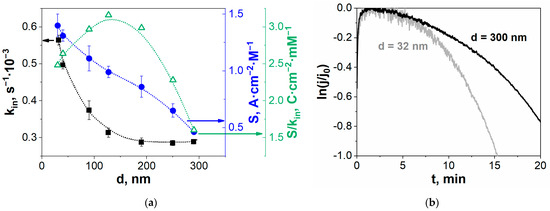
Figure 3.
(a) Dependence of the inactivation constant (kin, ■, black), sensor sensitivity (S, ●, blue), and their ratio (S/kin, Δ, green) on the size of the catalytically synthesized Prussian Blue nanoparticles. (b) Logarithm of the relative change in the current response of sensors based on Prussian Blue nanoparticles of different sizes (32 and 300 nm) to [H2O2]0 = 0.1 mM as a function of time.
The operational stability of the electrodes modified with the Prussian Blue nanoparticles was investigated via continuous monitoring of 0.1 mM H2O2 (Figure 3b). The gradual current decrease, generally associated with Prussian Blue solubilization, can be fit to the first-order reaction equation, which allows us to evaluate the inactivation constant (kin):
Contrary to the sensitivity, the operational stability of the larger nanozymes is expectedly higher. As a result, as the size of the nanoparticles composing the electrode coating increases from 32 to 300 nm, kin decreases two-fold, reaching the value of ~3·10−4 s−1.
Since both high sensitivity and operational stability are important for practical use, and depend on size in opposite ways, we considered their ratio (S/kin) as an optimization parameter. As shown, S/kin dependence on the nanozyme size reaches a maximum for particles of about 140 nm in diameter.
To sum up, the demonstrated high (electro)catalytic activity of Prussian Blue-based nanozymes makes them promising nanomaterials for analytical applications. High catalytic activity of nanozymes can be used to produce sensors with an optical readout. At the same time, the outstanding electrocatalytic properties would allow for applying Prussian Blue nanoparticles as labels for personalized electrochemical test systems.
Supplementary Materials
The following supporting information can be downloaded at https://www.mdpi.com/article/10.3390/ECSA-12-26495/s1. Figure S1: TEM images of nanozymes; Figure S2: examples of initial reaction rate dependence on the substrate and nanozymes concentrations; Figure S3: electroactive versus immobilized amounts of nanozymes; Figure S4: impedance spectra on Nyquist plots for a glassy carbon electrode modified with CeO2-based nanozymes; Table S1: values of charge transfer resistance for nanozyme-based electrodes. References [11,13] are cited in the supplementary materials.
Author Contributions
Investigation, A.A.S. and E.S.P.; visualization, A.A.S. and E.S.P.; writing—original draft preparation, A.A.S.; writing—review and editing, M.A.K. and A.A.K.; conceptualization, M.A.K.; methodology, M.A.K. and A.A.K.; supervision, M.A.K. and A.A.K. All authors have read and agreed to the published version of the manuscript.
Funding
The study was conducted under the state assignment of Lomonosov Moscow State University “Creation of functional materials, highly effective methods and means of chemical analysis for monitoring and forecasting the state of the environment, transition to highly productive and environmentally friendly agricultural and aquaculture, personalized medicine, health-preserving technologies, creation of safe and high-quality food products, medicines”, №AAAA-A21-121011990021-7.
Institutional Review Board Statement
Not applicable.
Informed Consent Statement
Not applicable.
Data Availability Statement
Data is contained within the article.
Conflicts of Interest
The authors declare no conflicts of interest.
Abbreviations
The following abbreviations are used in this manuscript:
| TMB | 3,3′,5,5′-Tetramethylbenzidine |
| DC | Direct current |
References
- Wang, Y.; Liang, M.; Wei, T. Types of Nanozymes: Materials and Activities; Springer: Singapore, 2020; pp. 41–77. [Google Scholar]
- Gao, L.; Zhuang, J.; Nie, L.; Zhang, J.; Zhang, Y.; Gu, N.; Wang, T.; Feng, J.; Yang, D.; Perrett, S.; et al. Intrinsic peroxidase-like activity of ferromagnetic nanoparticles. Nat. Nanotechnol. 2007, 2, 577–583. [Google Scholar] [CrossRef] [PubMed]
- Chen, S.; Wang, Y.; Bao, S.; Yao, L.; Fu, X.; Yu, Y.; Lyu, H.; Pang, H.; Guo, S.; Zhang, H.; et al. Cerium oxide nanoparticles in wound care: A review of mechanisms and therapeutic applications. Front. Bioeng. Biotechnol. 2024, 12, 1404651. [Google Scholar] [CrossRef] [PubMed]
- Stephen Inbaraj, B.; Chen, B.-H. An overview on recent in vivo biological application of cerium oxide nanoparticles. Asian J. Pharm. Sci. 2020, 15, 558–575. [Google Scholar] [CrossRef] [PubMed]
- Ju, J.; Chen, Y.; Liu, Z.; Huang, C.; Li, Y.; Kong, D.; Shen, W.; Tang, S. Modification and application of Fe3O4 nanozymes in analytical chemistry: A review. Chin. Chem. Lett. 2023, 34, 107820. [Google Scholar] [CrossRef]
- Guo, N.; Yang, J.; Li, Y.; Wang, W.; Liang, X.; Xu, Q.; Du, L.; Qin, J. A review of a colorimetric biosensor based on Fe3O4 nanozymes for food safety detection. Anal. Bioanal. Chem. 2025, 417, 1713–1730. [Google Scholar] [CrossRef] [PubMed]
- Zhang, J.; Tan, Z.; Leng, W.; Chen, Y.-C.; Zhang, S.; Lo, B.T.W.; Yung, K.K.L.; Peng, Y.-K. Chemical state tuning of surface Ce species on pristine CeO2 with 2400% boosting in peroxidase-like activity for glucose detection. Chem. Commun. 2020, 56, 7897–7900. [Google Scholar] [CrossRef] [PubMed]
- Jiang, Y.; Yang, Y.; Shen, L.; Ma, J.; Ma, H.; Zhu, N. Recent Advances of Prussian Blue-Based Wearable Biosensors for Healthcare. Anal. Chem. 2022, 94, 297–311. [Google Scholar] [CrossRef] [PubMed]
- Matos-Peralta, Y.; Antuch, M. Review—Prussian Blue and Its Analogs as Appealing Materials for Electrochemical Sensing and Biosensing. J. Electrochem. Soc. 2020, 167, 037510. [Google Scholar] [CrossRef]
- Komkova, M.A.; Shneiderman, A.A.; Povaga, E.S.; Wang, Y.; Chen, X.; Kustov, A.L.; Yang, C.; Wei, H.; Karyakin, A.A. Peculiarities of Redox Catalysis with Peroxidase-Like Nanozymes. ACS Appl. Mater. Interfaces 2025, 17, 40964–40973. [Google Scholar] [CrossRef] [PubMed]
- Cheng, H.; Lin, S.; Muhammad, F.; Lin, Y.W.; Wei, H. Rationally Modulate the Oxidase-like Activity of Nanoceria for Self-Regulated Bioassays. ACS Sensors 2016, 1, 1336–1343. [Google Scholar] [CrossRef]
- Komkova, M.A.; Zarochintsev, A.A.; Karyakina, E.E.; Karyakin, A.A. Electrochemical and sensing properties of Prussian Blue based nanozymes “artificial peroxidase”. J. Electroanal. Chem. 2020, 872, 114048. [Google Scholar] [CrossRef]
- Komkova, M.A.; Karpova, E.V.; Sukhorukov, G.A.; Sadovnikov, A.A.; Karyakin, A.A. Estimation of Continuity of Electroactive Inorganic Films Based on Apparent Anti-Ohmic Trend in Their Charge Transfer Resistance. Electrochim. Acta 2016, 219, 588–591. [Google Scholar] [CrossRef]
Disclaimer/Publisher’s Note: The statements, opinions and data contained in all publications are solely those of the individual author(s) and contributor(s) and not of MDPI and/or the editor(s). MDPI and/or the editor(s) disclaim responsibility for any injury to people or property resulting from any ideas, methods, instructions or products referred to in the content. |
© 2025 by the authors. Licensee MDPI, Basel, Switzerland. This article is an open access article distributed under the terms and conditions of the Creative Commons Attribution (CC BY) license (https://creativecommons.org/licenses/by/4.0/).