


Abstract
In the building sector, time and cost overruns are still ongoing difficulties; hence, good project management depends critically on accurate evaluation of project performance. Usually, project success is measured in several performance criteria: cost, schedule, quality, safety, and others as well. This research suggests the construction of a thorough Project Performance Index (PPI) methodically combining these important performance criteria. One finds the relative weight of every element by means of a frequency-based analysis of their occurrence in the current literature. The final index presents a complete method for assessing and contrasting the performance of building projects, giving researchers and practitioners trying to improve project results a helpful instrument.
1. Introduction
For many different types of stakeholders—including construction managers, project owners, and clients—project performance is a major issue and is fundamental in the building sector. Not only a strategic benefit but also a basis for informed decision-making and ongoing development over the project life is the capacity to evaluate and grasp the elements influencing effective project execution [1].
Historically, the assessment of building projects has been mostly focused on schedule performance and given great weight to following intended deadlines [2]. However, as the complexity of building projects has changed, it is clear that time-based measurements have limits. Reflecting the twin focus on timeliness and financial control, a significant body of research emphasizes that construction project performance is often judged in terms of time delays and cost overruns [3,4].
Notwithstanding these traditional measures, project performance is becoming increasingly understood as a multidimensional construct. Beyond budget and schedule, elements including quality, safety, risk management, stakeholder satisfaction, change management, and technological integration have become absolutely essential for thorough performance evaluation. Still, a consistent and generally accepted method to combine these several aspects into a coherent performance index is still under development.
This paper attempts to close this discrepancy by suggesting a disciplined framework for spotting and evaluating the main elements affecting the performance of building projects. By means of a two-step approach anchored in the literature synthesis, the study not only aggregates important performance indicators but also provides the framework for creating a scalable Project Performance Index (PPI). Especially in situations when similar project profiles exist, this index is meant to offer a fair and data-driven method for evaluating project results.
This study aims to theoretically and practically help the discipline of construction management by laying a basis for a more complex knowledge of project performance.
2. Project Success Areas
2.1. Critical Success Factors
Critical Success Factors (CSFs) have long been studied as essential determinants of successful project delivery across various industries, including healthcare, manufacturing, information technology, and construction. According to Toor and Ogunlana [5], CSFs are defined as “the elements that contribute significantly, and that is of vital importance for the success of a project.” In the context of construction, identifying and understanding these factors is key to enhancing performance outcomes and reducing the risks associated with complex project environments.
The concept of CSFs was first systematically introduced by Pinto and Slevin [6], who aimed to classify and quantify variables contributing to project success. Their early framework sparked extensive research efforts that compiled and categorized CSFs into multiple thematic areas. Subsequent scholars have expanded upon these classifications, often emphasizing similar domains of influence such as time, cost, quality, and safety as core metrics for evaluating construction project success [7,8,9].
More recently, there has been a notable shift toward recognizing and quantifying the influence of human and organizational factors in addition to traditional performance metrics. These include the roles of emotional intelligence [10], management commitment [11], and the clarity of project objectives [5], all of which are increasingly seen as pivotal to achieving successful project outcomes.
Drawing from a comprehensive literature review, the following CSFs emerged as the most frequently cited and influential in the context of construction project performance:
2.1.1. Top Management Support
Support from senior leadership has consistently been identified as one of the most critical factors influencing project success. This study cited top management support in over 70% of the reviewed literature. Its significance lies in its cascading effect, empowering decision-making, ensuring resource availability, and reinforcing organizational alignment throughout the project lifecycle [11].
2.1.2. Client Involvement
Active client or owner involvement is a cornerstone of project success, particularly in aligning project outputs with stakeholder expectations. Several studies highlight that the degree of owner engagement directly correlates with overall satisfaction and project performance outcomes [5,7,8,12]. The client’s role in defining objectives, approving deliverables, and facilitating decision-making is fundamental.
2.1.3. Clear Goals and Objectives
Establishing well-defined goals and performance criteria at the project’s inception plays a pivotal role in avoiding scope creep and ensuring adherence to budget and schedule. Numerous studies have found that unclear or shifting objectives are among the leading causes of project failure [9,13]. This highlights the importance of front-end planning and transparent communication during the early project phases.
2.1.4. Project Controls
Project controls encompass tools and techniques used to monitor and manage cost, schedule, and scope throughout execution. Given the dynamic nature of construction projects, the ability to realign baselines and forecasts in response to changes is essential. Effective control mechanisms ensure that projects remain on track despite inherent uncertainties.
2.1.5. Team Composition
The capabilities and coordination of the project team significantly influence project execution. A well-balanced team comprising experienced project managers and skilled field labor is instrumental in navigating technical challenges and maintaining productivity [5]. Team dynamics, communication, and competency are increasingly seen as predictors of project resilience.
2.1.6. Change Management
With the advent of advanced technologies such as Building Information Modeling (BIM), data analytics, and virtual preconstruction, managing change has become a critical competency. Projects that effectively support staff through transitions and integrate new technologies seamlessly tend to outperform those that resist adaptation [14]. The maturity of change management practices within a project team can thus serve as a proxy for innovation readiness.
2.1.7. Contractor and Subcontractor Selection
The selection process for contractors and subcontractors is vital to ensuring successful project outcomes. Traditional procurement methods—often based solely on the lowest bid—have been linked to increased risks of delays and cost overruns. A more holistic evaluation of contractor qualifications, past performance, and technical capabilities is essential to mitigate execution risks and foster collaborative project environments [5].
2.2. Project Performance Measurement in the Construction Industry
The Project Excellence model used by the German Project Management Association is one of the earliest nationwide performance measurement models [15]. The project performance has been noticed and investigated by many research work as the main concern for construction industry [14,16,17,18,19,20,21]. Wuni et al. [22] grouped the benefits of evaluation of design for excellence in industrialized construction Projects into project design productivity, efficiency, and management; shortened design and construction time; life cycle cost savings; and improved flexibility, adaptability, and circularity. Ahmad and Hjelseth [23] opted for a pragmatic approach to investigate the perception of the Virtual Design and Construction practitioners to use VDC framework as a performance measurement system for projects through an online survey. Peñaloza et al. [24] presented a Resilience engineering (RE) based framework for assessing safety performance measurement systems (SPMSs) in construction projects. Amarkhil and Elwakil [25] identified a framework to understand and determine critical constraints and opportunities in a post-conflict condition facing local construction firms in Afghanistan. Rathnayake and Ranasinghe [26] presented a performance measurement framework (PMF) for contractors in Sri Lanka. They considered the local context and Key Performance Indicator (KPI) based system. Sruthi and Aravindan [27] analyzed the cost and schedule for a residential building by using earned value management. Ingle and Mahesh [28] determined that performance areas are affecting the Indian construction industry. Rahman and Adnan [29] analyzed the risk management and risk management performance measurement through an in-depth empirical analysis of two complex construction projects in Finland. Meng and Fenn [30] developed a comprehensive model (HMCPPM) to hierarchically measure performance from the contractor’s perspective at the project level. Zheng et al. [31] extended the number and type of indicators used in project performance measurement by adapting the leading indicators defined in systems engineering measurement. Liu et al. [32] developed a novel performance metric, the direct dispatch index, which adds a distance weight to the clustering coefficient of social network analysis (SNA), to measure equipment dispatching performance from equipment logistics data. Gupta [33] identified the key performance indicators that affect construction projects and industries by identifying the factors affecting the performance of construction projects. Jong et al. [34] examined the relationship between TQM and project performance in Malaysian construction organizations. Tripathi, and Jha [35] addressed these gaps in the literature by identifying critical factors for examining the performance of construction firms at the organizational level. Elwakil [36] designed a comprehensive performance assessment model by identifying and ranking a set of critical success factors (CSFs).
3. Methodology
To achieve the research objectives and develop a robust framework for constructing a Project Performance Index (PPI), a structured methodological approach was adopted. This methodology comprises three main phases:
- Identification and Shortlisting of Critical Performance Factors
The first phase involved identifying and shortlisting the key factors that significantly influence construction project performance. This was accomplished through an extensive review of scholarly articles, industry reports, and empirical studies. The selection criteria for inclusion emphasized recurrence in the literature, relevance to construction outcomes (e.g., cost, time, quality, and safety), and applicability to current project management practices. Both traditional performance metrics and emerging organizational and technological factors were considered.
- Data Collection from Literature Sources
In the second phase, a comprehensive literature review was conducted across leading databases and peer-reviewed journals to extract relevant performance factors. This included studies from a variety of domains within construction management, such as project planning, risk control, team dynamics, stakeholder involvement, and change management. The goal was to compile a holistic and representative list of Critical Success Factors (CSFs) with documented impact on project outcomes. A frequency analysis was performed to identify the most commonly cited factors, providing a foundation for the next step of the framework.
- Weight Determination Using the Analytical Hierarchy Process (AHP)
The final phase involved quantifying the relative importance of the identified factors using the Analytical Hierarchy Process (AHP). AHP is a widely accepted multi-criteria decision-making (MCDM) technique that enables structured comparison of alternatives based on expert judgment and pairwise comparisons. In this study, AHP was used to assign weights to each shortlisted factor, reflecting their relative contribution to project performance. The process included the development of a hierarchical structure of performance factors, the creation of a pairwise comparison matrix, and the calculation of normalized weights and consistency ratios to ensure logical coherence.
By combining qualitative insights from literature with a quantitative weighting mechanism, this methodology provides a balanced and data-informed approach to designing a Project Performance Index. It lays the groundwork for future validation through empirical studies and offers a replicable process for both academic and industry applications.
CSF Matrix
The following factors have been collected from several research papers spanning the last two decades, as shown in Table 1.

Table 1.
Shortlisted Critical success factors from the literature review.
Table 1.
Shortlisted Critical success factors from the literature review.
| No. | Factor | Source |
|---|---|---|
| 1 | Top Management Support | [5,6,8,11,37,38,39] |
| 2 | Regular Client Involvement | [5,6,8,11,38,40] |
| 3 | Clear Statement of Requirements | [5,11,38] |
| 4 | Proper Planning & Project Controls | [5,11,37,38,39,40,41,42] |
| 5 | Smaller Project Milestones | [11,37] |
| 6 | Realistic Expectations | [5,11] |
| 7 | Clear Vision and Objectives | [5,8,11,37,39,41,42] |
| 8 | Team Composition and Competency | [5,6,8,11,37,38,42] |
| 9 | Change Management | [5,8,11] |
| 10 | Project Manager Competence | [5,8,40,41,42] |
| 11 | Contractors and Subcontractors | [5,8] |
| 12 | IT Support | [5,8,38] |
| 13 | Monitoring and Feedback | [5,8,38,39,40] |
| 14 | Stakeholder Support and Involvement | [5] |
| 15 | Continued Financial Support | [6,8,11,37,38,39,42] |
| 16 | Communication between all parties | [5,6,37,41] |
| 17 | Risk Management | [8] |
| 18 | Staff Training | [8] |
4. Data Analysis
4.1. Recurrence in the Literature
After shortlisting the respective success factors from research this research will tackle the respective weights of these factors. To this end, the researcher has calculated their respective frequency in the 20 research papers as shown in Table 2.
Based on their recurrence in the literature the top 10 factors can be selected for project performance measurement. There is a provision in existing performance metrics for the calculation of performance in these factors. For example, project controls can be measured by schedule performance and budgetary regulations of a project.
Table 2.
Recurrence of factors in the literature.
Table 2.
Recurrence of factors in the literature.
| Factor | Recurrence in the Literature |
|---|---|
| Top Management Support | 70% |
| Regular Client Involvement | 50% |
| Clear Statement of Requirements | 20% |
| Proper Planning & Project Controls | 90% |
| Smaller Project Milestones | 20% |
| Realistic Expectations | 20% |
| Clear Vision and Objectives | 70% |
| Team Composition and Competency | 70% |
| Change Management | 30% |
| Project Manager Competence | 50% |
| Contractors and Subcontractors | 20% |
| IT Support | 30% |
| Monitoring and Feedback | 60% |
| Stakeholder Support and Involvement | 10% |
| Continued Financial Support | 50% |
| Communication between All Parties | 50% |
| Risk Management | 10% |
| Staff Training | 10% |
4.2. Analytical Hierarchy Process
As discussed earlier, AHP is a pairwise comparison tool that can be used to establish the relative weights between factors. Figure 1 is an excerpt of the survey that has been designed by the author for the top 10 factors shortlisted from the literature. This survey establishes the preferential importance of factors for input into AHP. Respondents to the survey answer in pairwise comparisons selecting which factor they consider more important (or equal) then select a number between 2 and 9 to indicate ‘how much more’ important their selected factor is. This will help us establish the pair-to-pair comparisons for AHP. The result from AHP will be a weightage eigenvector for the factors that establish their relative importance. The recommended sample size for this survey is 30 respondents. This ensures that the established results of this analysis are applicable to the population.
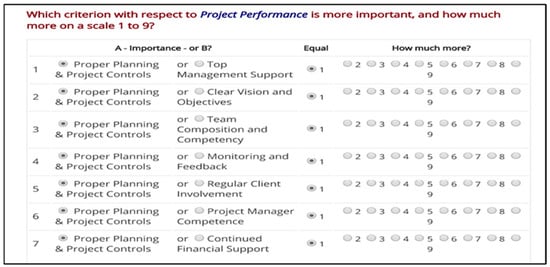
Figure 1.
Excerpt of Likert Scale Survey for AHP.
5. Conclusions and Future Work
The main goal of this research was to create a disciplined framework for building a Project Performance Index (PPI) fit for the building sector. The proposed framework uses a two-step approach: first, shortlisting the important elements influencing project performance; then, it creates relative weights among these elements to reflect their influence on general project success. Although the scope, complexity, and stakeholder needs of building projects vary greatly, this framework provides a relative tool that is especially useful when assessing projects with similar traits and little variation in particular constraints. Under such circumstances, the derived weights can be a consistent basis for performance factor prioritizing.
By means of a comprehensive literature review, this study found that elements connected to project planning and control—especially cost and schedule performance—are repeatedly mentioned as the most important elements of effective project implementation. These results confirm the central part-time and cost control play in the results of a project. Fascinatingly, although elements like change management and IT support seem less often in the studied literature, they are becoming more and more important in the modern project management debate. Their prominence as performance metrics emphasizes how changing project environments are, particularly in view of growing digital integration and organizational flexibility requirements.
One of the main limits of this study is its sole dependence on published material. Although this guarantees theoretical grounding and academic rigor, it does not adequately reflect the contextual knowledge and experience ingrained in business practice. Thus, validating the suggested framework using empirical approaches becomes crucial for the next investigation. In particular, systematic questionnaires and in-depth interviews with business leaders can support the confirmation of the relevance of found Critical Success Factors (CSFs) and help to improve the assigned weights. This will also assist in capturing emergent elements that, although not yet common in academic publications, are quite important in daily life.
Moreover, including cutting-edge analytical and computational methods helps the framework to be stronger. Future research could investigate how multiple linear regression (MLR), fuzzy logic, or artificial neural networks (ANNs) might operationalize the factors found in performance indices. These methods enable cross-valuation of results over several project types and contexts in addition to helping to support the quantification and modeling of complicated relationships.
Ultimately, this study prepares the foundation for a methodical and flexible evaluation of building project performance. Future research can further hone this model to generate a practical, credible, and scalable performance measuring system for the building sector by combining literature-based insights with practitioner views and using modern analytical tools.
Author Contributions
Conceptualization, E.E.; methodology, E.E.; validation, E.E., and M.H.; formal analysis, E.E.; investigation, E.E. and M.H.; resources, EE.; data curation, E.E.; writing—original draft preparation, E.E.; writing—review and editing, E.E.; visualization, E.E.; supervision, E.E. All authors have read and agreed to the published version of the manuscript.
Funding
This research received no external funding.
Institutional Review Board Statement
The study was reviewed by the Institutional Review Board of Purdue University [Protocol: 1603017499] and determined to be exempt.
Informed Consent Statement
Not applicable.
Data Availability Statement
The original contributions presented in this study are included in the article. Further inquiries can be directed to the corresponding author.
Conflicts of Interest
The authors declare no conflict of interest.
References
- Hughes, M. Performance analysis–a 2004 perspective. Int. J. Perform. Anal. Sport 2004, 4, 103–109. [Google Scholar] [CrossRef]
- Cao, Q.; Hoffman, J.J. A case study approach for developing a project performance evaluation system. Int. J. Proj. Manag. 2011, 29, 155–164. [Google Scholar] [CrossRef]
- Mirza, E.; Ehsan, N. Quantification of project execution complexity and its effect on performance of infrastructure development projects. Eng. Manag. J. 2017, 29, 108–123. [Google Scholar] [CrossRef]
- Syed, S.; Elwakil, E. Project Performance Index for Capital Intensive Construction Projects. In Proceedings of the 10th International Structural Engineering and Construction Conference (ISEC-10), Chicago, IL, USA, 20–25 May, 2019. [Google Scholar]
- Toor, S.; Ogunlana, S.O. Construction professionals’ perception of critical success factors for large-scale construction projects. Constr. Innov. 2009, 9, 149–167. [Google Scholar] [CrossRef]
- Pinto, J.K.; Slevin, D.P. Critical factors in successful project implementation. IEEE Trans. Eng. Manag. 1987, EM-34, 22–27. [Google Scholar] [CrossRef]
- Belassi, W.; Tukel, O.I. A new framework for determining critical success/failure factors in projects. Int. J. Proj. Manag. 1996, 14, 141–151. [Google Scholar] [CrossRef]
- Fortune, J.; White, D. Framing of project critical success factors by a systems model. Int. J. Proj. Manag. 2006, 24, 53–65. [Google Scholar] [CrossRef]
- Sanvido, V.; Grobler, F.; Parfitt, K.; Guvenis, M.; Coyle, M. Critical success factors for construction projects. J. Constr. Eng. Manag. 1992, 118, 94–111. [Google Scholar] [CrossRef]
- Maqbool, R.; Sudong, Y.; Manzoor, N.; Rashid, Y. Transformational Leadership on Project Success: An Empirical Perspective. Proj. Manag. J. 2017, 48, 58–75. [Google Scholar] [CrossRef]
- Young, R.; Poon, S. Top management support-almost always necessary and sometimes sufficient for success: Findings from a fuzzy set analysis. Int. J. Proj. Manag. 2013, 31, 943–957. [Google Scholar] [CrossRef]
- Song, Y.W.; Kim, J.D.; Yu, L.; Lee, H.K.; Lee, H.S. A comparative study of the telematics industry in Korea and China. J. Internet Bank. Commer. 2012, 17, 97–112. [Google Scholar]
- Kagioglou, M.; Cooper, R.; Aouad, G. Performance management in construction: A conceptual framework. Constr. Manag. Econ. 2001, 19, 85–95. [Google Scholar] [CrossRef]
- Bassioni, H.A.; Price, A.D.F.; Hassan, T.M. Performance Measurement in Construction. J. Manag. Eng. 2004, 20, 42–50. [Google Scholar] [CrossRef]
- Westerveld, E. The project excellence Model®. Linking Success Criteria and Critical Success Factor. Int. J. Proj. Manag. 2003, 21, 411–418. [Google Scholar] [CrossRef]
- Elwakil, E. Integrating AHP-fuzzy model for assessing construction organizations’ performance. Int. J. Archit. Eng. Construction. 2016, 5, 1–12. [Google Scholar] [CrossRef]
- Rathore, Z.; Elwakil, E. A framework of organization performance assessment in the construction industry using fuzzy approach. In Proceedings of the Canadian Society for Civil Engineering’s 5th International/11th Construction Specialty Conference, Vancover, Canada, 7–10 June 2015. [Google Scholar]
- Radwan, A.; Elwakil, E. Functional units based model for construction organizations performance. Int. J. Archit. Eng. Constr. 2016, 4, 194–203. [Google Scholar] [CrossRef]
- Costa, D.B.; Formoso, C.T.; Kagioglou, M.; Alarcón, L.F.; Caldas, C.H.; Asce, M. Benchmarking Initiatives in th e Construction Industry: Lessons Learned and Improvement Opportunities. J. Manag. Eng. 2006, 22, 158–167. [Google Scholar]
- Nasir, H.; Haas, C.T.; Rankin, J.H.; Fayek, A.R.; Forgues, D.; Ruwanpura, J. Development and implementation of a benchmarking and metrics program for construction performance and productivity improvement. Can. J. Civ. Eng. 2012, 39, 957–967. [Google Scholar] [CrossRef]
- Rankin, J.; Fayek, A.R.; Meade, G.; Haas, C.; Manseau, A. Initial metrics and pilot program results for measuring the performance of the Canadian construction industry. Can. J. Civ. Eng. 2008, 35, 894–907. [Google Scholar] [CrossRef]
- Wuni, I.Y.; Wu, Z.; Shen, G.Q.; Bugri, J.T.; Frimpong-Asante, J. Benefit Evaluation of Design for Excellence in Industrialized Construction Projects. J. Archit. Eng. 2021, 27, 05021015. [Google Scholar] [CrossRef]
- Ahmad, S.B.S.; Hjelseth, E. The practice of VDC framework as a performance measurement system for projects. In ECPPM 2021–eWork and eBusiness in Architecture, Engineering and Construction, Proceedings of the 13th European Conference on Product & Process Modelling (ECPPM 2021), Moscow, Russia, 15–17 September 2021; Semenov, V., Scherer, R.J., Eds.; CRC Press: London, UK, 2021; pp. 495–501. [Google Scholar]
- Peñaloza, G.A.; Formoso, C.T.; Saurin, T.A. A resilience engineering-based framework for assessing safety performance measurement systems: A study in the construction industry. Saf. Sci. 2021, 142, 105364. [Google Scholar] [CrossRef]
- Amarkhil, Q.; Elwakil, E. Constraints and opportunities facing construction organization in post-conflict condition in Afghanistan. J. Financ. Manag. Prop. Constr. 2021, 26, 301–308. [Google Scholar] [CrossRef]
- Rathnayake, A.; Ranasinghe, M. A KPI Based Performance Measurement Framework for Sri Lankan Construction Projects. In Proceedings of the 2020 Moratuwa Engineering Research Conference (MERCon), Moratuwa, Sri Lanka, 27–29 July 2020; pp. 348–353. [Google Scholar]
- Sruthi, M.D.; Aravindan, A. Performance measurement of schedule and cost analysis by using earned value management for a residential building. Mater. Today: Proc. 2020, 33, 524–532. [Google Scholar]
- Ingle, P.V.; Mahesh, G. Construction project performance areas for Indian construction projects. Int. J. Constr. Manag. 2020, 22, 1–12. [Google Scholar] [CrossRef]
- Rahman, M.; Adnan, T. Risk management and risk management performance measurement in the construction projects of Finland. J. Proj. Manag. 2020, 5, 167–178. [Google Scholar] [CrossRef]
- Meng, K.; Fenn, P. Performance measurement for construction projects. In Proceedings of the 8th International Scientific Conference on Project Management in the Baltic Countries, Rīga, Latvia, 25–26 April 2019. [Google Scholar]
- Zheng, L.; Baron, C.; Esteban, P.; Xue, R.; Zhang, Q.; Yang, S. Using leading indicators to improve project performance measurement. J. Syst. Sci. Syst. Eng. 2019, 28, 529–554. [Google Scholar] [CrossRef]
- Liu, C.; Ji, W.; AbouRizk, S.M.; Siu, M.F.F. Equipment logistics performance measurement using data-driven social network analysis. J. Constr. Eng. Manag. 2019, 145, 04019033. [Google Scholar] [CrossRef]
- Gupta, S. Identification of KPIs in Construction Industry: A Review. Int. J. Constr. Eng. Plan. 2019, 5, 28–38. [Google Scholar]
- Jong, C.Y.; Sim, A.K.; Lew, T.Y. The relationship between TQM and project performance: Empirical evidence from Malaysian construction industry. Cogent Bus. Manag. 2019, 6, 1568655. [Google Scholar] [CrossRef]
- Tripathi, K.K.; Jha, K.N. An empirical study on performance measurement factors for construction organizations. KSCE J. Civ. Eng. 2018, 22, 1052–1066. [Google Scholar] [CrossRef]
- Elwakil, E. Integrating analytical hierarchy process and regression for assessing construction organizations’ performance. Int. J. Constr. Manag. 2017, 17, 76–88. [Google Scholar] [CrossRef]
- Martin, C.C. Project Management: How to Make it Work; Amacom: New York, NY, USA, 1976. [Google Scholar]
- Cleland, D.I.; King, W.R. Systems Analysis and Project Management; McGraw Hill: New York, NY, USA, 1983. [Google Scholar]
- Morris, P.W.G.; Hough, G.H. The Anatomy of Major Projects: A Study of the Reality of Project Management, Chichester; John Wiley & Sons, Ltd.: Chichester, UK, 1987. [Google Scholar]
- Sayles, L.R.; Chandler, M.K. Managing Large Systems: Organizations for the Future; Harper & Row: Madison, WI, USA, 1971. [Google Scholar]
- Lock, D. Project Management, 6th ed.; St. Martins Press: New York, NY, USA, 1968. [Google Scholar]
- Baker, B.N.; Murphy, D.C.; Fisher, D. Factors Affecting Project Success, Project Management Handbook; Van Nostrand Reinhold Co.: New York, NY, USA, 1983. [Google Scholar]
Disclaimer/Publisher’s Note: The statements, opinions and data contained in all publications are solely those of the individual author(s) and contributor(s) and not of MDPI and/or the editor(s). MDPI and/or the editor(s) disclaim responsibility for any injury to people or property resulting from any ideas, methods, instructions or products referred to in the content. |
© 2026 by the authors. Licensee MDPI, Basel, Switzerland. This article is an open access article distributed under the terms and conditions of the Creative Commons Attribution (CC BY) license.