

Proceeding Paper

Demolition Practices, Procedures, and Management in Structural Engineering †
Department of Civil Engineering, Faculty of Engineering, Cukurova University, Adana 01330, Türkiye
Presented at the 34th International Scientific Conference on Organization and Technology of Maintenance (OTO 2025), Osijek, Croatia, 12 December 2025.
Eng. Proc. 2026, 125(1), 25; https://doi.org/10.3390/engproc2026125025
Published: 20 February 2026

Abstract

Demolition is an essential phase in the life cycle of the built environment, requiring complex decisions, regulatory awareness, and carefully managed processes. This paper provides an overview of demolition practices with a particular focus on controlled demolition and its role in ensuring safety, efficiency, and minimal disruption. It discusses common procedures, planning considerations, and the importance of coordination while also addressing the broader implications of demolition in terms of urban development, environmental impact, and public safety. Furthermore, the study reviews relevant regulations and environmental standards that shape current practice and identifies the lack of a unified global framework or comprehensive roadmap governing demolition activities. By outlining key concepts and general approaches, this study seeks to support informed decision-making and encourage further research and professional dialogue in the evolving field of demolition management.

1. Introduction

The transformation of urban environments in the 21st century has brought with it profound challenges for sustainable development, structural safety, and post-use lifecycle management. As cities continue to densify and expand, the built environment must adapt, not only through construction but also through strategic and sustainable removal of aging or damaged infrastructure. Among the most critical components of this evolution is the practice of controlled demolition, a process that has emerged as a vital discipline within civil and structural engineering [1,2].
Controlled demolition refers to the intentional dismantling of structures using precisely calculated, pre-planned techniques aimed at maximizing safety, minimizing environmental impact, and preserving the integrity of adjacent structures [2]. Unlike spontaneous or uncontrolled collapses, controlled demolition utilizes engineering judgment, advanced modeling, and site-specific strategies, ranging from mechanical dismantling to the use of explosive charges, to direct structural failure in a predictable and secure manner [2]. This process is indispensable in a variety of contexts: from clearing land for urban renewal, removing unsafe or outdated buildings, to responding to post-disaster scenarios where public safety and environmental preservation are paramount.
The rising frequency of seismic events, such as the 2023 Kahramanmaraş [3,4,5,6,7,8,9] and 2025 Myanmar [10,11,12] earthquakes, coupled with the natural aging of critical infrastructure, has further underscored the necessity of robust demolition frameworks [13]. In response, the industry is gradually shifting from reactive demolition practices toward a more predictive, integrated, and sustainable approach, incorporating high-fidelity numerical models and strict regulatory oversight. However, despite technological progress, significant gaps persist, particularly in the integration of simulation tools with real-world demolition strategies. Most prior studies have focused on localized blast effects [14] or simplified progressive collapse models, often without full-scale validation or emphasis on environmental impact.
Recent research efforts [1,2] have begun to challenge this status quo by introducing comprehensive, real-scale applications that bridge the divide between theoretical modeling and field execution [13]. These studies have demonstrated the use of dual-modelling software platforms to simulate both blast wave propagation and sequential column removals in complex structures such as high-rise buildings and large industrial silos [13]. More significantly, the integration of real-time displacement tracking technologies into demolition projects has offered new pathways for validating numerical predictions against actual structural behavior, providing a rare yet crucial feedback loop for engineers and researchers alike.
Alongside studies related to demolition waste and recycling [14], there is a need for research focusing on dust, noise, and vibration. In this context, the present study aims to examine the state of current demolition practices, with a specific emphasis on the planning, execution, and management of demolition processes and related regulations.

2. Practices in Demolition Methods and Management

The demolition of structures is far from a singular, straightforward operation. It encompasses a diverse spectrum of methods, each tailored to specific structural forms, environmental conditions, and logistical constraints. As urban landscapes continue to evolve and densify, selecting the most appropriate demolition technique becomes not merely a question of feasibility, but one of safety, efficiency, and environmental responsibility [2].
Among the most widely recognized approaches is explosive demolition, a highly specialized method in which pre-determined structural elements are weakened using carefully placed explosive charges. When executed with precision, this technique allows for the rapid collapse of high-rise buildings or large-scale industrial structures within confined footprints [1,13]. The effectiveness of explosive demolition lies in its ability to control the direction and sequence of collapse, thereby minimizing impact on adjacent structures and infrastructure.
In contrast, thermic demolition employs high-temperature tools, such as oxygen lance torches, to cut through steel elements, offering a precise and localized method of structural weakening. This approach is particularly suited for dismantling heavy steel-framed buildings or bridges where mechanical equipment may not reach or where noise and vibration must be minimized. Closely aligned with this technique is chemical demolition, where expansive chemical agents are introduced into structural components to initiate cracking and controlled fracture. Though slower in action, chemical methods are invaluable in sensitive environments where noise, dust, or vibration must be strictly regulated.
While explosive, thermic, and chemical demolitions often serve highly specialized roles, mechanical demolition remains the most common and adaptable method in urban practice. Utilizing heavy machinery such as excavators equipped with hydraulic breakers, crushers, and shears, mechanical demolition provides relatively straightforward means of dismantling structures. An iconic variation of this method is wrecking ball demolition, historically associated with the removal of masonry buildings, wherein a large steel ball is swung from a crane to break apart structural elements. Though visually dramatic, this method has largely fallen out of favor due to its limited precision and higher risk profile compared to more modern techniques [2].
As the vertical growth of cities continues, top-down demolition has emerged as a critical solution for safely deconstructing high-rise buildings within tight urban sites. In this method, dismantling proceeds floor by floor, from the roof downward, often using small-scale equipment brought onto each level.
Another intriguing category involves demolition by pulling or pushing, wherein cables, jacks, or machinery are used to exert lateral forces to bring down structural elements. Though relatively simple, this method requires careful analysis of load paths and structural behavior, especially in asymmetrical buildings or partially damaged structures.
Finally, with the rise in environmental awareness and sustainable construction practices, selective demolition, also referred to as deconstruction, has gained considerable attention. Unlike conventional approaches that prioritize speed and total removal, selective demolition aims to carefully dismantle a building in order to recover, recycle, or reuse materials. Examples include the removal of only the interior walls or specific stories of a building; the preservation of historical facades while demolishing the rear portions; and the targeted dismantling of certain columns or slabs within a reinforced concrete structure. In essence, selective demolition is based on the principle of “demolish only as much as necessary, preserve the rest.” This labor-intensive process demands thorough planning and detailed knowledge of material properties yet offers significant benefits in terms of reducing construction waste and carbon emissions.
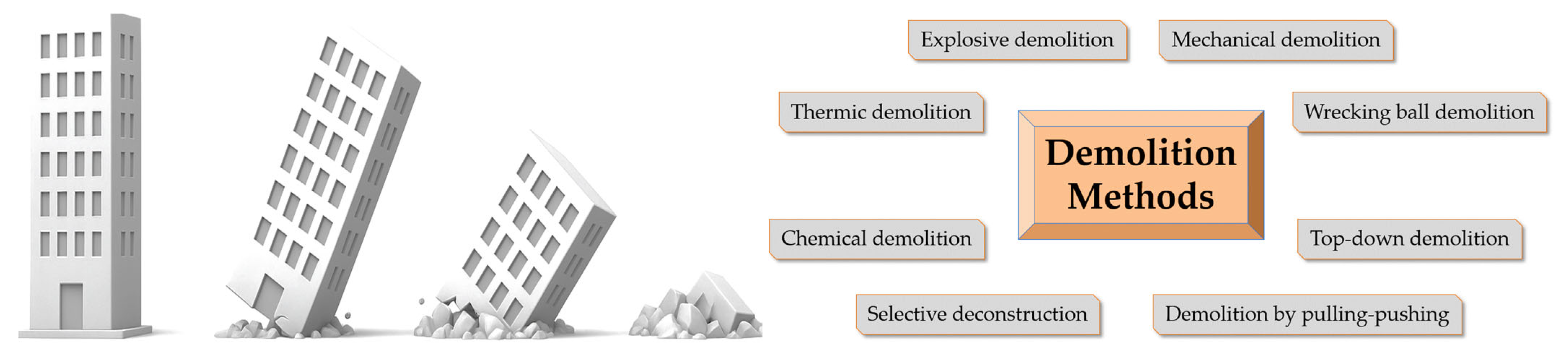
Together, these demolition methods (Figure 1) form a toolkit of possibilities, each with its own strengths, limitations, and contextual appropriateness. The successful execution of a demolition project depends not only on choosing the correct technique but also on integrating engineering judgment, safety regulations, and environmental considerations into a unified strategy. In an era of increasing demand for resilient, adaptive, and sustainable cities, mastering these methods is not merely a technical necessity; it is a professional imperative.

3. Procedures and Models

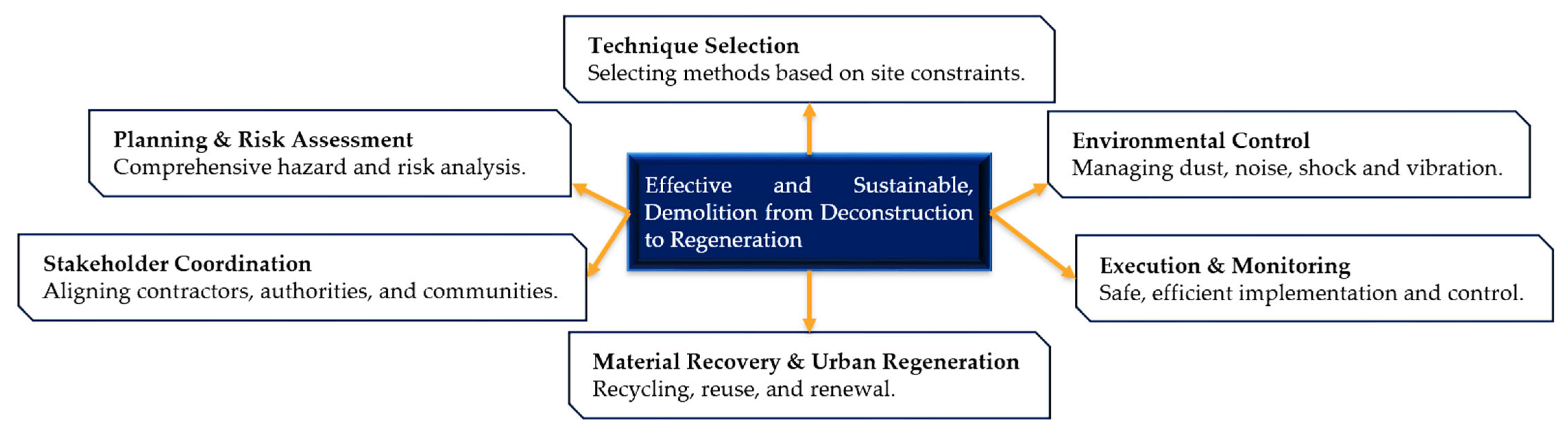
Effective demolition is not solely determined by the method employed, but by the quality of its management across every stage of planning and execution. Robust project management frameworks are essential to ensure that demolition operations are carried out safely, within budget, and in compliance with increasingly stringent environmental regulations. This involves comprehensive risk assessments, stakeholder coordination, scheduling, and the strategic selection of demolition techniques based on site-specific constraints. Importantly, sustainability considerations must now be embedded into this decision-making process, from minimizing noise, dust, and vibrations in urban settings to maximizing material recovery and recycling. Integrated demolition management that aligns technical execution with sustainable development goals should no longer be optional; it is an ethical and professional responsibility. By adopting a lifecycle perspective and prioritizing circular economy principles, demolition can evolve from a destructive process into a regenerative opportunity for urban renewal (Figure 2)
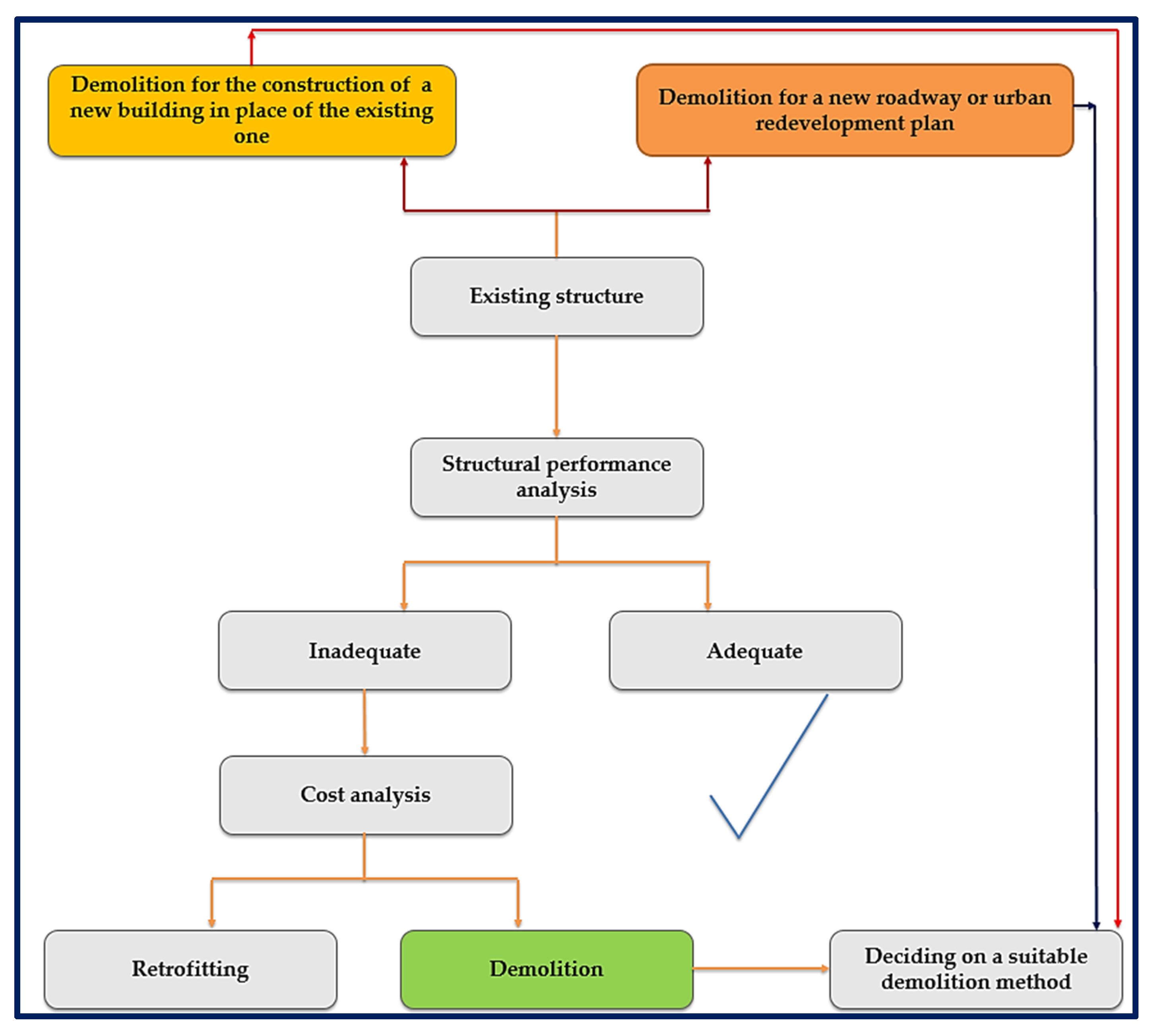
As shown in Figure 3, the demolition of existing structures is governed by a structured decision-making process that integrates engineering performance assessments, economic evaluations, and project-specific planning procedures (Figure 3). This process typically begins with an evaluation of the existing structure in terms of its structural adequacy, functionality, and compatibility with future development goals. A dynamic structural performance analysis should be employed to assess whether the structure/infrastructure meets required safety and serviceability thresholds under both static and dynamic loading conditions [15,16,17,18,19,20,21].
If the structure is found to be adequate, a cost–benefit analysis may lead to a decision to retrofit the existing building instead of proceeding with demolition, especially in cases where retrofitting [22,23,24,25,26,27,28,29] aligns with sustainability goals by preserving embodied carbon and reducing waste [30,31,32]. Conversely, if the structure is deemed inadequate or incompatible with future development plans, a strategic decision is made to demolish either progressively [33,34] or at once by mostly using explosives. This may be done either to enable the construction of a new structure or to allow for infrastructure expansion, such as the development of new transportation corridors.
Once the demolition decision is confirmed, project managers must determine the pace and sequencing of the demolition operation. This stage is crucial for mitigating risks, minimizing disruption to surrounding areas, and ensuring logistical feasibility. For high-risk or large-scale projects, particularly in dense urban environments or post-seismic zones, this step requires the integration of high-fidelity numerical simulations—models capable of capturing non-linear material behavior, failure mechanisms, and progressive collapse under complex loading scenarios [1,13].
The final and most critical phase involves selecting a suitable demolition method—a decision that must account for structural typology, proximity to other buildings, debris management for sustainability [35,36], and environmental regulations. In recent years, studies such as [37,38] have significantly contributed to this domain by coupling full-scale demolition case studies with advanced simulation techniques, thereby offering validated frameworks for method selection and performance prediction. High-fidelity models are particularly valuable in this context, not only for simulating blast loads and sequential failures, but also for validating field data through real-time monitoring systems.
Effective demolition management should be viewed not merely as a process of physical dismantling but as a proactive environmental and safety strategy grounded in comprehensive planning and regulatory compliance [37]. Prior to any site activity, a structured assessment should identify potential hazards such as structural instability, asbestos, or other regulated materials. International frameworks such as the UK Construction (Design and Management) Regulations 2015 (CDM 2015, Reg. 20) [39] and the EU Directive 92/57/EEC [40] emphasize the preparation of written demolition plans that outline work sequences, safety measures, and communication protocols. Similar principles can be applied elsewhere; projects may adopt Demolition Method Statements (DMS) and Risk Assessments (RAMS) even when not explicitly mandated by law. Despite these established examples, there remains no universally recognized global standard or comprehensive roadmap for demolition, and in many countries, practices are still project-specific or guided by general construction and occupational safety laws.
From an environmental perspective, demolition operations are significant sources of dust, noise, and vibration, all of which require continuous monitoring and adaptive control. Standards such as BS 5228 Parts 1 and 2 [41,42] provide guidance on measuring and mitigating these impacts, recommending baseline surveys, restricted operating hours, and the use of low-noise equipment. Turkiye’s Regulation on Environmental Noise Control (2022) [43] similarly introduces time restrictions, acoustic assessments, and oversight by local authorities. Complementary rules, including the Regulation on Preventing Building Noise Pollution (2017) [44], reinforce these requirements by establishing acoustic performance criteria for adjacent structures. Aligning both international and national standards creates measurable benchmarks for noise and vibration control, thereby enhancing environmental accountability and supporting sustainable demolition practices. Beyond static controls, the use of real-time environmental monitoring technologies can further strengthen adaptive management. Deploying sensors for particulate matter and vibration enables immediate responses to exceedances, while drone-based LiDAR or photogrammetry supports debris tracking and exclusion-zone verification. Integrating these approaches within a formal ISO 14001 Environmental Management System [45] promotes continuous improvement and ensures verifiable documentation. Table 1 presents the relevant regulations and standards concerning demolition management
In jurisdictions where enforcement mechanisms are still developing, such digital records can also serve as credible evidence of compliance and transparency. Ultimately, a demolition framework that unites pre-planning, environmental mitigation, and technological feedback aligns with global best practice and promotes safer, more sustainable urban transformation [47], even in the absence of a universally defined international guideline. In Türkiye, the Law on Transformation of Areas under Disaster Risk (No. 6306) [46] establishes procedural requirements for the demolition of structurally deficient buildings, including the 90-day rule mandating that risk-designated structures be vacated and demolished within 90 days of official notification. While this provides a clear regulatory timeline, it focuses primarily on procedural deadlines rather than detailed operational planning, underscoring the continuing need for site-specific risk assessment and management.

4. Conclusions

This study provides an overview of various demolition techniques and emphasizes the critical importance of integrating robust management procedures and high-fidelity numerical models in the planning and execution of controlled demolition projects. By presenting a structured decision-making framework that combines structural performance assessments, economic evaluations, and sustainability considerations, the proposed approach aims to transform demolition from a purely destructive process into a strategic component of urban renewal. The outlined methodologies highlight the need for dynamic simulation tools, real-time monitoring, and adaptive planning to ensure safety, minimize environmental impact, and support circular economy objectives. These insights serve as a foundation for future research and practical implementations in the evolving field of demolition engineering. By synthesizing existing methods, relevant standards, and international regulations, this study reveals that current guidance remains fragmented, with limited comprehensive frameworks or globally recognized roadmaps. The presented perspective encourages the adoption of structured planning, dynamic monitoring, and sustainability-driven management to enhance safety, environmental accountability, and long-term urban resilience.

Funding

This research received no external funding.

Institutional Review Board Statement

Not applicable.

Informed Consent Statement

Not applicable.

Data Availability Statement

All data generated or used during the study appear in the article.

Conflicts of Interest

The author declares no conflicts of interest.

References

  1. Yuzbasi, J. Controlled demolition: Novel monitoring and experimental validation of blast-induced full-scale existing high-rise building implosion using numerical finite element simulations. J. Civ. Struct. Health Monit. 2024, 15, 891–914. [Google Scholar] [CrossRef]
  2. Yuzbasi, J. Research and practice on demolition of structures worldwide in the 21st century: Exploring methods using mechanics of solid bodies with object tracking validation. In Proceedings of CIBv 2024. CIBv 2024. Lecture Notes in Civil Engineering; Tuns, I., Muntean, R., Gălățanu, T., Cazacu, C., Conțiu, M., Eds.; Springer: Cham, Switzerland, 2025; Volume 665. [Google Scholar]
  3. Öser, C.; Sarğin, S.; Yildirim, A.K.; Korkmaz, G.; Altinok, E.; Kelesoglu, M.K. Geotechnical aspects and site investigations on Kahramanmaras earthquakes, February 06, 2023. Nat. Hazards 2025, 121, 5637–5668. [Google Scholar] [CrossRef]
  4. Chen, K.; Wei, G.; Milliner, C.; Zilio, L.D.; Liang, C.; Avouac, J.-P. Super-shear ruptures steered by pre-stress heterogeneities during the 2023 Kahramanmaraş earthquake doublet. Nat. Commun. 2024, 15, 7004. [Google Scholar] [CrossRef]
  5. Xu, L.; Mohanna, S.; Meng, L.; Ji, C.; Ampuero, J.-P.; Yunjun, Z.; Hasnain, M.; Chu, R.; Liang, C. The overall-subshear and multi-segment rupture of the 2023 Mw7.8 Kahramanmaraş, Turkey earthquake in millennia supercycle. Commun. Earth Environ. 2023, 4, 379. [Google Scholar] [CrossRef]
  6. Galasso, C.; Opabola, E.A. The 2023 Kahramanmaraş Earthquake Sequence: Finding a path to a more resilient, sustainable, and equitable society. Commun. Eng. 2024, 3, 24. [Google Scholar] [CrossRef]
  7. Yuzbasi, J. Post-earthquake damage assessment: Field observations and recent developments with recommendations from the Kahramanmaraş earthquakes in Türkiye on February 6th, 2023 (Pazarcık M7.8 and Elbistan M7.6). J. Earthq. Eng. 2024, 29, 3367–3392. [Google Scholar] [CrossRef]
  8. Guo, R.; Tang, X.; Zhang, Y.; Zhang, W.; Qin, M.; Xu, J.; Zhou, J.; Zou, X.; Sun, H. Seismic versus aseismic slip for the 2023 Kahramanmaraş earthquake doublet. Nat. Commun. 2025, 16, 959. [Google Scholar] [CrossRef] [PubMed]
  9. Chang, Z.; Wu, H.; Li, W.; Yan, Z.; Peng, L.; Zhu, G. Analysis of near-fault ground motions in the February 2023 Kahramanmaras, Türkiye, earthquake sequence. Bull. Earthq. Eng. 2025, 23, 1349–1369. [Google Scholar] [CrossRef]
  10. Xu, X.; Kang, W.; Wang, T.; Zhang, X.; Liu, Y.; Zhang, Y.; Zhao, J.; Li, K.; Wang, Q.; Cheng, J.; et al. The Mw7.7 Myanmar earthquake: A continental longest surface-rupturing supershear cascading event. Npj Nat. Hazards 2025, 2, 73. [Google Scholar] [CrossRef]
  11. Wang, T.; Zhou, Y.; Chen, J.; Wang, X.; Bi, H.; Wang, X. Field survey of building damage at Mandalay during 2025 Myanmar Mw7.7 earthquake. Earthq. Eng. Eng. Vib. 2025, 24, 613–627. [Google Scholar] [CrossRef]
  12. Vera, F.; Carrillo-Ponce, A.; Crosetto, S.; Kosari, E.; Metzger, S.; Motagh, M.; Liang, Y.; Lyu, S.; Petersen, G.; Saul, J.; et al. Supershear rupture along the Sagaing fault seismic gap: The 2025 Myanmar earthquake. Seism. Rec. 2025, 5, 289–299. [Google Scholar] [CrossRef]
  13. Yuzbasi, J. Experimental verification of full-scale silo structure demolition: Investigating successive column removal with finite element method and progressive collapse simulation through blast load. Struct. Concr. 2024, 25, 4408–4427. [Google Scholar] [CrossRef]
  14. Baylot, J.T. Parameters Affecting Loads on Buried Structures Subjected to Localized Blast Effects; Technical Report SL-92-9; U.S. Army Corps of Engineers, Waterways Experiment Station: Vicksburg, MS, USA, 1992. [Google Scholar]
  15. Saccone, M.; Stochino, F.; Zucca, M.; Simoncelli, M. Longitudinal shear behaviour in Recycled Aggregate Concrete Composite Slabs: A state-of-the-art review. J. Build. Eng. 2025, 113, 114002. [Google Scholar] [CrossRef]
  16. Limongelli, M.P. Performance evaluation of instrumented buildings. ISET J. Earthq. Technol. 2025, 42, 47–61. [Google Scholar] [CrossRef]
  17. Yuzbasi, J.; Arslan, H.M. Applied element method and Finite element method for progressive collapse assessment: A comparative study on the influence of slab types, thicknesses, and damping via three incremental column removals. Structures 2025, 73, 108358. [Google Scholar] [CrossRef]
  18. Di Sarno, L. Effects of multiple earthquakes on inelastic structural response. Eng. Struct. 2013, 56, 673–681. [Google Scholar] [CrossRef]
  19. Yuzbasi, J. Applied element method: Earthquake simulation analysis of soft story and weak story in building structures using solid mechanics. In Proceedings of CIBv 2024. CIBv 2024. Lecture Notes in Civil Engineering; Springer: Cham, Switzerland, 2025; Volume 665. [Google Scholar] [CrossRef]
  20. Forcellini, D. Numerical simulations of liquefaction on an ordinary building during Italian (20 May 2012) earthquake. Bull. Earthq. Eng. 2019, 17, 4797–4823. [Google Scholar] [CrossRef]
  21. Işık, E.; Avcil, F.; Büyüksaraç, A.; Arkan, E.; Harirchian, E. Impact of Local Soil Conditions on the Seismic Performance of Reinforced Concrete Structures: In the Context of the 2023 Kahramanmaraş Earthquakes. Appl. Sci. 2025, 15, 2389. [Google Scholar] [CrossRef]
  22. Vaiana, N.; Sessa, S.; Marmo, F.; Rosati, L. Nonlinear dynamic analysis of hysteretic mechanical systems by combining a novel rate-independent model and an explicit time integration method. Nonlinear Dyn. 2019, 98, 2879–2901. [Google Scholar] [CrossRef]
  23. Yuzbasi, J.; Yerli, H.R. Betonarme yapıların deprem etkisi altında performans analizlerinin yapılması ve güçlendirilmesi. Çukurova Üniversitesi Mühendislik-Mimar. Fakültesi Derg. 2018, 33, 273–286. [Google Scholar] [CrossRef]
  24. Di Sarno, L.; Manfredi, G. Seismic retrofitting with buckling restrained braces: Application to an existing non-ductile RC framed building. Soil Dyn. Earthq. Eng. 2010, 30, 1279–1297. [Google Scholar] [CrossRef]
  25. Nuzzo, I.; Losanno, D.; Caterino, N. Seismic design and retrofit of frame structures with hysteretic dampers: A simplified displacement-based procedure. Bull. Earthq. Eng. 2019, 17, 2787–2819. [Google Scholar] [CrossRef]
  26. Castro, J.M.; Araújo, M.; D’Aniello, M.; Landolfo, R. Strengthening of RC buildings with steel elements. In Strengthening and Retrofitting of Existing Structures; Building Pathology and Rehabilitation; Springer: Singapore, 2018; pp. 139–162. [Google Scholar] [CrossRef]
  27. Işık, E.; Radu, D.; Harirchian, E.; Avcil, F.; Arkan, E.; Büyüksaraç, A.; Hadzima-Nyarko, M. Failures in Reinforced-Concrete Columns and Proposals for Reinforcement Solutions: Insights from the 2023 Kahramanmaraş Earthquakes. Buildings 2025, 15, 1535. [Google Scholar] [CrossRef]
  28. Hadzima-Nyarko, M.; Čolak, S.; Bulajić, B.Đ.; Ademović, N. Assessment of selected models for FRP-retrofitted URM walls under in-plane loads. Buildings 2021, 11, 559. [Google Scholar] [CrossRef]
  29. Losanno, D.; Spizzuoco, M.; Serino, G. Design and retrofit of multistory frames with elastic-deformable viscous damping braces. J. Earthq. Eng. 2017, 23, 1441–1464. [Google Scholar] [CrossRef]
  30. American Society of Civil Engineers. Seismic Evaluation and Retrofit of Existing Buildings (ASCE/SEI 41-17); American Society of Civil Engineers: Reston, VA, USA, 2017. [Google Scholar]
  31. Castrillon, N.; Jativa, F.; Lantsoght, E.; Ukrainczyk, N.; Dubyey, L.; Koenders, E. Bio-based materials for eco-efficient construction. In Binding Materials for Sustainable Construction; Woodhead Publishing: Sawston, UK, 2025; pp. 461–496. [Google Scholar]
  32. Robayo, N.H.; Lantsoght, E.O.; Tituaña, J.B.; Défaz, M.M.; Játiva, F.; Orejuela-Escobar, L. Initial study on natural fibers for use in concrete mixes as a sustainable materials alternative. ACI Av. Cienc. Ing. 2024, 16, 12. [Google Scholar]
  33. Yang, Y.; Li, S.; Kong, D.; Liew, J.R. Steel beam to reinforced concrete column connection performance under column removal scenarios. J. Constr. Steel Res. 2025, 235, 109884. [Google Scholar] [CrossRef]
  34. Liu, B.; Hou, J.; Zhang, K.; Song, L.; Liu, J. Comparative Study between Horizontal–Vertical Mixed and Vertical Progressive Collapse Responses of Reinforced Concrete Planar Frames. J. Struct. Eng. 2025, 151, 04025200. [Google Scholar] [CrossRef]
  35. Batallas, J.; Hidalgo, N.; Montenegro, M.; Orejuela-Escobar, L.M.; Jativa, F.; Lantsoght, E.O. Natural Fibers For Sustainable Concrete Mixes. In Proceedings of International Structural Engineering and Construction: March 2024; ISEC Press: Fargo, ND, USA, 2024; Volume 11, p. MAT-02. [Google Scholar]
  36. de Azevedo, A.R.G.; Amin, M.; Hadzima-Nyarko, M.; Agwa, I.S.; Zeyad, A.M.; Tayeh, B.A.; Adesina, A. Possibilities for the application of agro-industrial wastes in cementitious materials: A brief review of the Brazilian perspective. Clean. Mater. 2022, 3, 100040. [Google Scholar] [CrossRef]
  37. Yuzbasi, J. Fundamentals of Controlled Demolition in Structures: Real-Life Applications, Discrete Element Methods, Monitoring, and Artificial Intelligence-Based Research Directions. Buildings 2025, 15, 3501. [Google Scholar] [CrossRef]
  38. Yuzbasi, J. Debris Simulation in Controlled Demolition of Tall Building Structures: Solid Model-Based Approach. Buildings 2025, 15, 3396. [Google Scholar] [CrossRef]
  39. The Stationery Office. Construction (Design and Management) Regulations 2015 (CDM 2015); Statutory Instrument 2015 No. 51; UK Government: London, UK, 2015.
  40. Council Directive 92/57/EEC; Council Directive of 24 June 1992 on the Implementation of Minimum Safety and Health Requirements at Temporary or Mobile Construction Sites. Official Journal of the European Communities: Brussels, Belgium, 1992.
  41. BS 5228-1:2009+A1:2014; Code of Practice for Noise and Vibration Control on Construction and Open Sites. Part 1: Noise. British Standards Institution: London, UK, 2014.
  42. BS 5228-2:2009; Code of Practice for Noise and Vibration Control on Construction and Open Sites. Part 2: Vibration. British Standards Institution: London, UK, 2009.
  43. Republic of Turkiye Ministry of Environment, Urbanization and Climate Change. Regulation on Environmental Noise Control; No. 31887; Official Gazette of the Republic of Turkey: Ankara, Turkiye, 2022. [Google Scholar]
  44. Republic of Turkey Ministry of Environment, Urbanization and Climate Change. Regulation on Preventing Building Noise Pollution; No. 30082; Official Gazette of the Republic of Turkiye: Ankara, Turkiye, 2017. [Google Scholar]
  45. ISO 14001:2015; Environmental Management Systems—Requirements with Guidance for Use. International Organization for Standardization (ISO): Geneva, Switzerland, 2015.
  46. Republic of Turkiye. Law on Transformation of Areas Under Disaster Risk (Law No. 6306); No. 28309; Official Gazette of the Republic of Turkiye: Ankara, Turkiye, 2012. [Google Scholar]
  47. Republic of Türkiye. Waste Management Regulation (Atık Yönetimi Yönetmeliği); No. 29314; Official Gazette of the Republic of Türkiye: Ankara, Turkiye, 2 April 2015. Available online: https://www.resmigazete.gov.tr/eskiler/2015/04/20150402-2.htm (accessed on 12 December 2025).
Figure 1. Methods used in structural demolition and deconstruction.
Engproc 125 00025 g001
Figure 2. Steps of integrated demolition management framework.
Engproc 125 00025 g002
Figure 3. Management and procedure scheme representing the progressive stages of demolition.
Engproc 125 00025 g003
Table 1. Relevant regulations and standards concerning demolition management.
Regulation/StandardJurisdiction/OriginRelevant Section/ClauseMain Relevance
Construction (Design and Management) Regulations 2015 (CDM 2015) [39]UKRegulation 20—
Demolition
or Dismantling
Requires that demolition work is planned, recorded, and executed to minimize danger
EU Directive 92/57/EEC on Temporary or Mobile Construction Sites [40]EUAnnex IVSpecifies safety requirements for sites including demolition
BS 5228-1:2009
+ A1:2014 [41]
UK/BSIPart 1—NoiseGuidance on measurement & mitigation of noise in demolition/construction sites
BS 5228-2:2009
+ A1:2014 [42]
UK/BSIPart 2—VibrationGuidance on vibration monitoring & control relevant to demolition
ISO 14001:2015—
Environmental
Management Systems [45]
InternationalClauses 6.1—10.3Provides structure for environmental monitoring, improvement & documentation
Law No. 6306—Transformation of Areas under Disaster Risk [46] TürkiyeRelevant provisions Regulates demolition/removal of unsafe buildings and procedures
Regulation on Environmental Noise Control (2022) [43]TürkiyeRelevant provisions Establishes permissible noise levels, work hours, measurement & control rules for sites
Waste Management Regulation (2015) [47]TürkiyeArticle 2 and Annex-4 (waste classification)The management of construction and demolition waste is addressed under Article 2 (Scope and Definitions) and Annex-4 on waste classification
Disclaimer/Publisher’s Note: The statements, opinions and data contained in all publications are solely those of the individual author(s) and contributor(s) and not of MDPI and/or the editor(s). MDPI and/or the editor(s) disclaim responsibility for any injury to people or property resulting from any ideas, methods, instructions or products referred to in the content.