


Abstract
In this study, Benzene-1,3,5-tricarboxylic acid (BTA)-functionalized gum (Cherry gum) (gum-Pr-BTA) was prepared as a novel nanocatalyst. This novel nanocatalyst was used for the expeditious and efficient synthesis of 1,4-polyhydroquinoline derivatives, as an important pharmaceutical scaffold, in ethanol reflux conditions. This method has several advantages such as high yields, low catalyst loading, short reaction times, and a simple workup and could be used for up to five reaction cycles without a noticeable decrease in catalytic activity.
1. Introduction
During recent years, scientists have been using multicomponent reactions to synthesize complex organic compounds due to their high efficiency [1]. These reactions have attracted a lot of attention due to their many applications in various fields, such as agriculture and medicine [2]. Significant advantages of multicomponent reactions (MCRs) are the elimination of intermediates, short reaction times, high reaction yield, and easy separation of products; the hantzch reaction is one of these reactions that is used for the synthesis of 1,4-dihydropyridine derivatives. These compounds are an important class of antihypertensive drugs [3], vasodilators [4], and have hypnotic and anti-tumor qualities [5].
Heterogeneous catalysts play a crucial role in determining chemical reaction conditions, especially in multicomponent reactions. Two of their significant advantages are easy separation and reusability [6,7].
These days, using an appropriate compound to prepare a heterogeneous catalyst is an essential factor, and 1,3,5-Benzenetricarboxylic acid, with its properties such as nontoxicity, ability to easily bind to catalytic support, and low cost for the preparation of acidic catalysts, can be a perfect selection for this task. Additionally, acidic catalysts are really beneficial to the synthesis of various heterocyclic compounds.
Cherry gum is a branched-chain polysaccharide that can be used as a catalyst support due to its excellent properties and exceptional performance. In addition, using this class of material can be harmless for the environment [8].
In this paper, we reported the synthesis of gum-BTA, a heterogeneous catalyst, for the preparation of 1,4-dihydropyridine derivatives through one multicomponent reaction, as shown in Scheme 1:
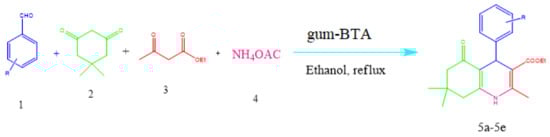
Scheme 1.
Synthesis of 1,4-dihydropyridine derivatives using gum-BTA nanocatalyst.
2. Experimental Section
2.1. General Procedure for Preparation of Nanocatalyst (gum-BTA)
Gum-BTA (0.1 g) and KI (0.01 g) were dispersed in DMSO (30 mL), and stirred for 10 h at room temperature, after which 1,3,5-Benzenetricarboxylic acid (BTA) (0.1 g) and K2CO3 (0.055 g) were added to the resulting mixture and stirred for 1 h. Then, the resulting white solid was filtered and washed with water (2.5 mL) and ethanol (2.5 mL). Finally, it was dried in avene.
2.2. General Procedure for Synthesis 1,4-dihydropyridine Derivatives
A mixture of aldehyde (1 mmol), ammonium acetate (1 mmol), ethylacetoacetate (1 mmol), and dimedone (1 mmol) was refluxed in EtOH (7 mL) in the presence of the catalytic amount of gum-BTA (0.02 g). The development of the reaction was monitored by TLC. The precipitated solid was washed with n-hexane and was dried.
3. Results and Discussion
The FTIR spectrum of the synthesized gum-Pr-BTA is shown in Figure 1. The absorption band at 3424 cm−1 is attributed to OH stretching. Two sharp absorption bands at 2928 cm−1 and 2856 cm−1 are assigned to the asymmetric and symmetric stretching of aliphatic C-H bonds, respectively. The absorption bands at 1746 and 1706 cm−1 correspond to the C=O bond stretching of esther and acid. The band at 1520 cm−1 can be assigned to the stretching vibration of the C=C bond.
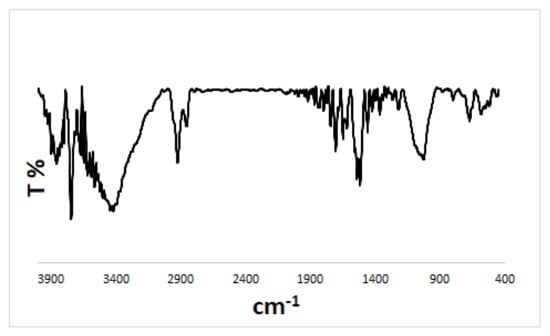
Figure 1.
FTIR of the gum-Pr-BTA.
EDX analysis confirms the presence of C, O and Si elements in the gum-Pr-BTA structure (Figure 2).
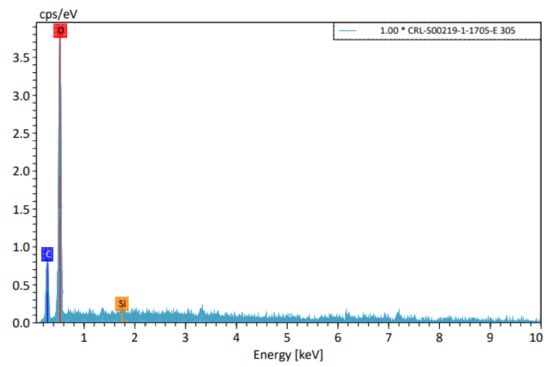
Figure 2.
EDX analysis of the gum-Pr-BTA.
In what follows, various aldehydes were applied for the synthesis of 1,4-dihydropyridine under optimal reaction conditions (Table 1).

Table 1.
Synthesis of 1,4-dihydropyridine derivatives using gum-BTA nanocatalyst.
Reaction conditions: benzaldehyde (1 mmol), ethyl acetoacetate (1 mmol), dimedone (1 mmol), ammonium acetate (1 mmol), gum-BTA (0.02 g) and ethanol (7 mL) under reflux conditions.
Ethyl 2, 7, 7-trimethyl-5-oxo-4-(4-hydroxylphenyl)-1,4,5,6,7,8-hexahydroquinoline-3-carboxylate (5c)
FTIR (KBr, cm−1): 3270, 3194, 3071, 2957, 1678, 1645, 1481, 1377, 1214 cm−1 (Figure 3). 1H NMR (500 MHz, DMSO): δ H (ppm)= 0.85(s, 3H, CH3), 1.0(s, 3H, CH3), 1.13(t, 3H, CH3), 1.9–2.41(m,4H, 2CH2), 2.25(s, 3H, CH3), 3.95–3.99(q, 2H, OCH2), 4.73(s, 1H, Ar-CH), 6.54(d, 2H, Ar-H), 6.93(d, 2H, Ar-H), 8.95(s, 1H, NH), 9.01(s,1H, OH) (Figure 4).
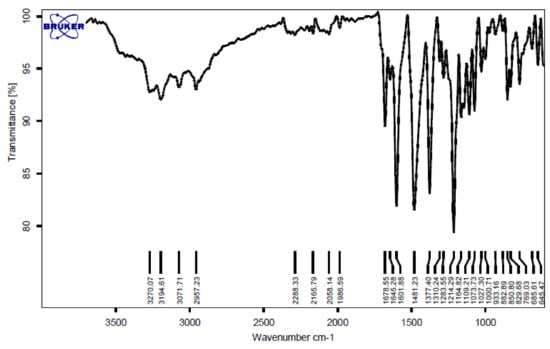
Figure 3.
FTIR spectrum of the ethyl 2, 7, 7-trimethyl-5-oxo-4-(4-hydroxylphenyl)-1,4,5,6,7,8-hexahydroquinoline-3-carboxylate (5c).
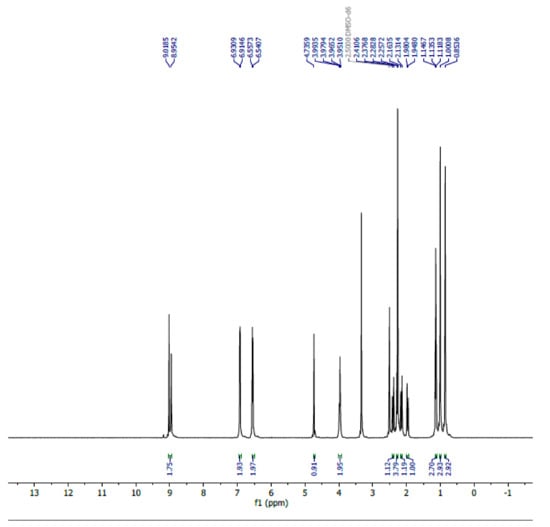
Figure 4.
1HNMR spectrum of the ethyl 2, 7, 7-trimethyl-5-oxo-4-(4-hydroxylphenyl)-1,4,5,6,7,8-hexahydroquinoline-3-carboxylate (5c).
Ethyl 1,4,7,8-tetrahydro-2,7,7-trimethyl-4-(4-nitrophenyl)-5(6H)-oxoquinoline-3-carboxylate (5d)
FTIR (KBr, cm−1): 3276, 3210, 3076, 2969, 2902, 1703, 1641, 1530, 1379 cm−1 (Figure 5). 1H NMR (500 MHz, DMSO): δH (ppm)= 0.83(s, 3H, CH3), 1.01(s, 3H, CH3), 1.11(t, 3H, CH3), 1.96–2.46(m,4H, 2CH2), 2.31(s, 3H, CH3), 3.93–4.0(m, 2H, OCH2), 4.97(s, 1H, Ar-CH), 7.5–7.61 (m, 4H, Ar-H), 7.97(s, 1H, NH), 9.23(s,1H, OH) (Figure 6).
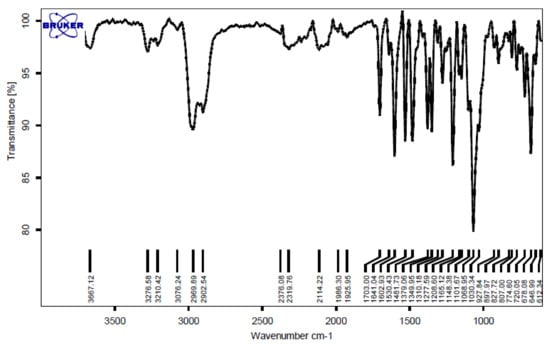
Figure 5.
FT-IR spectrum of the ethyl 1,4,7,8-tetrahydro-2,7,7-trimethyl-4-(4-nitrophenyl)-5(6H)-oxoquinoline-3-carboxylate (5d).
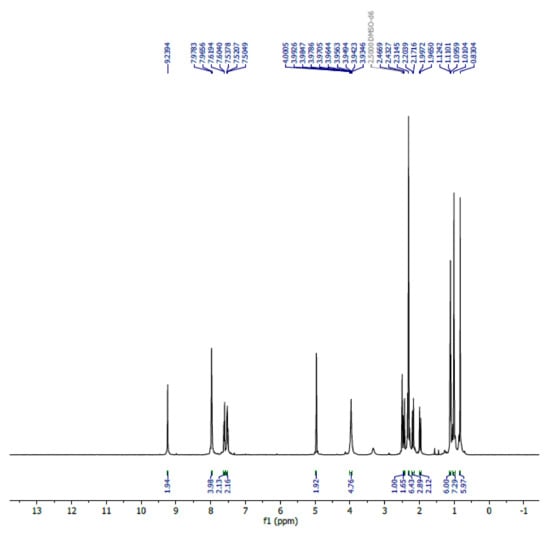
Figure 6.
1HNMR spectrum of the ethyl 1,4,7,8-tetrahydro-2,7,7-trimethyl-4-(4-nitrophenyl)-5(6H)-oxoquinoline-3-carboxylate (5d).
4. Conclusions
Briefly, the heterogeneous gum-BTA catalyst was synthesized and used for the synthesis of 1,4-dihydropyridine derivatives, a significant product in pharmacologically active compounds. The important advantages of this catalyst are its reusability, simple separation from the reaction mixture, short reaction time, and the synthesis of 1,4-dihydropyridine derivatives with a high yield. In general, the preparation and use of this simple catalyst is more noticeable than other reported catalysts.
Author Contributions
Methodology, H.G.; software, Y.R.; investigation, B.A. and N.G.; resources, B.A. and N.G.; writing—review and editing, Z.T. and M.A. All authors have read and agreed to the published version of the manuscript.
Funding
This research received no external funding.
Institutional Review Board Statement
Not applicable.
Informed Consent Statement
Not applicable.
Data Availability Statement
Not applicable.
Conflicts of Interest
The authors declare no conflict of interest.
References
- Nunes, G.P.S.; Vidal, H.D.A.; Corrêa, A.G. Recent advances in catalytic enantioselective multicomponent reactions. Org. Biomol. Chem. 2020, 18, 7751–7773. [Google Scholar] [CrossRef] [PubMed]
- Rahmati, M.; Ghafuri, H.; Ghanbari, N.; Tajik, Z. 1, 4 Butanesultone Functionalized Graphitic Carbon Nitride: Efficient Catalysts for the One-Pot Synthesis of 1, 4-Dihydropyridine and Polyhydroquinoline Derivative through Hantzsch Reaction. Polycycl. Aromat. Compd. 2020, 115–105, 1–17. [Google Scholar] [CrossRef]
- Laurent, S. Antihypertensive drugs. Pharmacol. Res. 2017, 124, 116–125. [Google Scholar] [CrossRef] [PubMed]
- Stevenson, L.W.; Fonarow, G. Vasodilators. Drugs 1992, 43, 15–36. [Google Scholar] [CrossRef] [PubMed]
- Kalafati, L.; Kourtzelis, I.; Schulte-Schrepping, J.; Li, X.; Hatzioannou, A.; Grinenko, T.; Hagag, E.; Sinha, A.; Has, C.; Dietz, S.; et al. Innate immune training of granulopoiesis promotes anti-tumor activity. Cell 2020, 183, 771–785.e12. [Google Scholar] [CrossRef] [PubMed]
- Allahresani, A.; Sangani, M.M.; Nasseri, M.A. CoFe2O4@ SiO2-NH2-CoII NPs catalyzed Hantzsch reaction as an efficient, reusable catalyst for the facile, green, one-pot synthesis of novel functionalized 1, 4-dihydropyridine derivatives. Appl. Organomet. Chem. 2020, 34, e5759. [Google Scholar] [CrossRef]
- Khodamorady, M.; Sohrabnezhad, S.; Bahrami, K. Efficient one-pot synthetic methods for the preparation of 3, 4-dihydropyrimidinones and 1, 4-dihydropyridine derivatives using BNPs@ SiO2 (CH2) 3NHSO3H as a ligand and metal free acidic heterogeneous nano-catalyst. Polyhedron 2020, 178, 114340. [Google Scholar] [CrossRef]
- Jones, J. 126. The constitution of cherry gum. Part I. Composition. J. Chem. Soc. 1939, 558–563. [Google Scholar] [CrossRef]
Publisher’s Note: MDPI stays neutral with regard to jurisdictional claims in published maps and institutional affiliations. |
© 2021 by the authors. Licensee MDPI, Basel, Switzerland. This article is an open access article distributed under the terms and conditions of the Creative Commons Attribution (CC BY) license (https://creativecommons.org/licenses/by/4.0/).