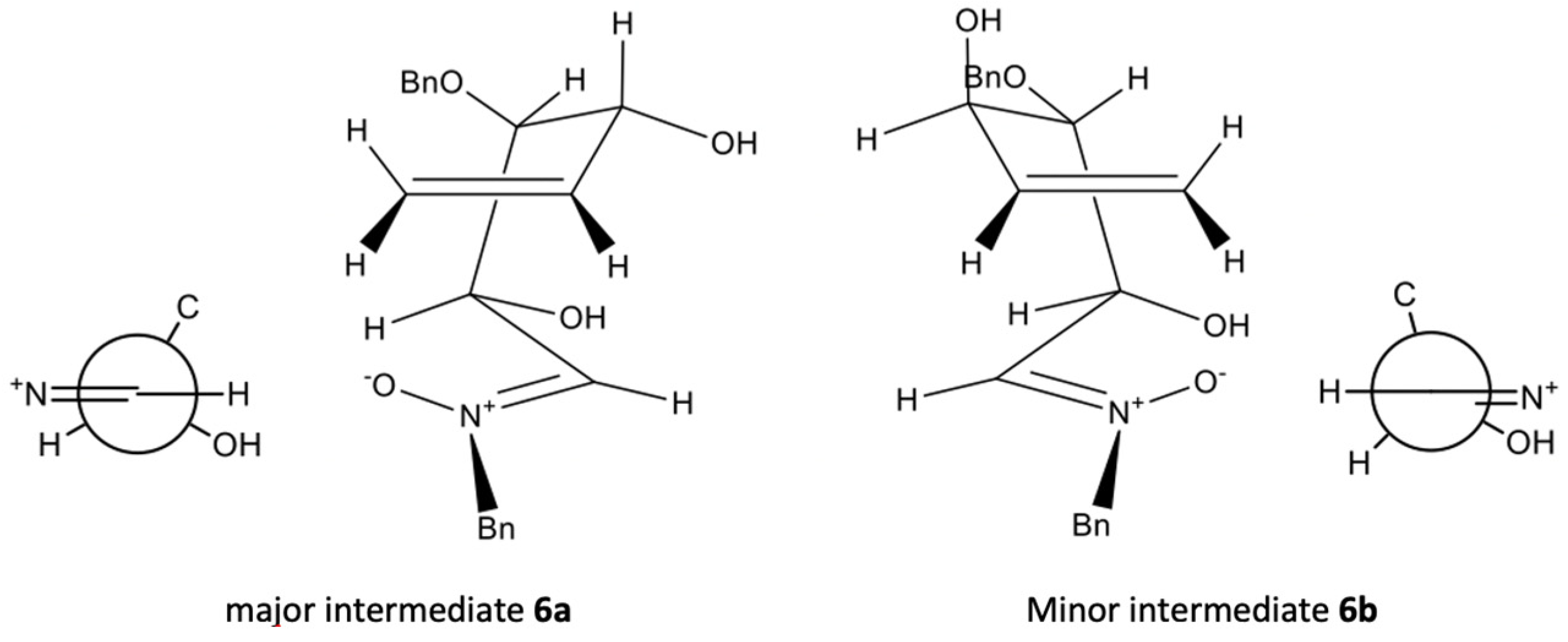

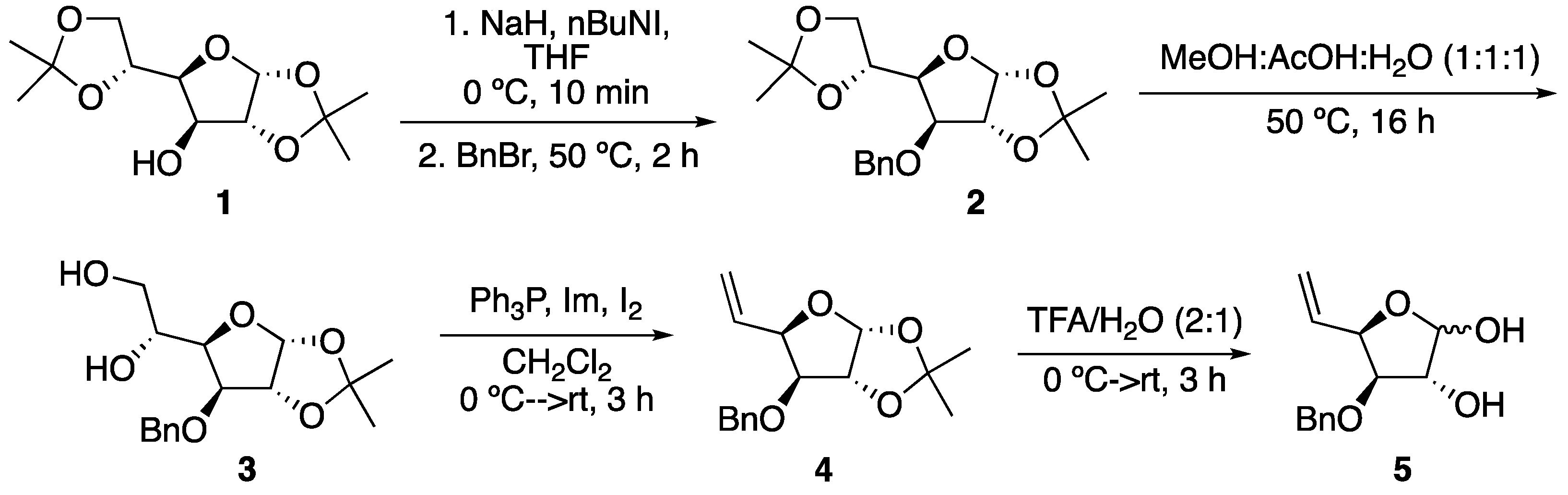
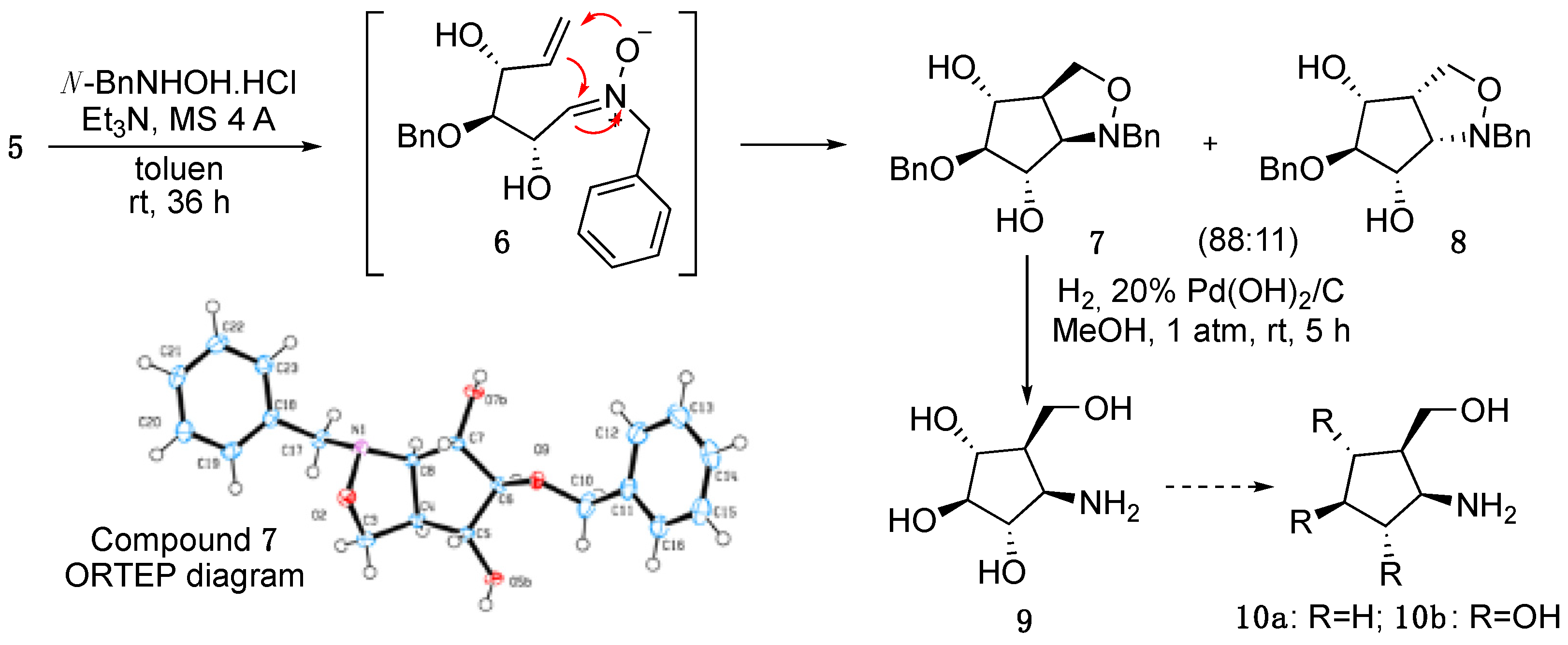
An Improved Stereoselective Synthesis of (1R,2S,3S,4R,5R)-4-Amino-5-(hydroxymethyl)-cyclopentane-1,2,3-triol †


Institutional Review Board Statement
Informed Consent Statement
Data Availability Statement
References
- Paulsen, H. Carbohydrates Containing Nitrogen or Sulfur in the “Hemiacetal” Ring. Angew. Chem. Int. Ed. Engl. 1966, 5, 495. [Google Scholar] [CrossRef]
- Inouye, S.; Tsuruoka, T.; Ito, T.; Niida, T. Structure and synthesis of nojirimycin. Tetrahedron 1968, 24, 2125. [Google Scholar] [CrossRef]
- Compain, P.; Martin, O.R. Iminosugars: From Synthesis to Therapeutic Applications; Wiley-VCH: Weinheim, Germany, 2007. [Google Scholar]
- Bøjstrup, M.; Lundt, I. Synthesis of aminocyclopentanols: α-d-galacto configured sugar mimics. Org. Biomol. Chem. 2005, 3, 1738. [Google Scholar] [CrossRef] [PubMed]
- Leroy, E.; Reymond, J.-L. Anomer-Selective Inhibition of Glycosidases Using Aminocyclopentanols. Org. Lett. 1999, 1, 775. [Google Scholar] [CrossRef] [PubMed]
- Boss, O.; Leroy, E.; Blaser, A.; Reymond, J.-L. Synthesis and Evaluation of Aminocyclopentitol Inhibitors of β-Glucosidases. Org. Lett. 2000, 2, 151. [Google Scholar] [CrossRef] [PubMed]
- Ogawa, S.; Morikawa, T. Chemical Modification of the α-Mannosidase Inhibitor Mannostain A: Synthesis of a Potent Inhibitor 1L-(1,2,3,5/4)-5-Amino-4-O-methyl-1,2,3,4-cyclopentanetetrol. Eur. J. Org. Chem. 2005; 4065. [Google Scholar]
- Yua, H.; Cao, H.; Tiwari, V.K.; Lia, Y.; Chena, X. An improved stereoselective synthesis of (1R,2S,3S,4R,5R)-4-amino-5-(hydroxymethyl)-cyclopentane-1,2,3-triol Bioorg. Med. Chem. Lett. 2011, 21, 5037. [Google Scholar]
- Liu, Z.; Classon, B. A novel route to olefins from vicinal diols. J. Org. Chem. 1990, 55, 4273. [Google Scholar] [CrossRef]
- LeBel, N.A.; Whang, J.J. The addition of nitrones to Olefins. A New Route to Isoxazolidines. J. Am. Chem. Soc. 1959, 81, 6334. [Google Scholar] [CrossRef]
- Alcaide, B.; Sáez, E.A. Stereoselective Synthesis of 1,2,3-Trisubstituted 1,3-Dienes through Novel [3,3]-Sigmatropic Rearrangements in α-Allenic Methanesulfonates: Application to the Preparation of Fused Tricyclic Systems by Tandem Rearrangement/Diels−Alder Reaction. Eur. J. Org. Chem. 2005, 1680. [Google Scholar] [CrossRef]
- Das, N.B.; Torssell, K.B.G. Silyl nitronates, nitrile oxides, and derived 2-isoxazolines in organic synthesis. Functionalization of butadiene, a novel route to furans and 2-isoxazolines as an alternative to aldol-type condensations. Tetrahedron 1983, 39, 2247. [Google Scholar] [CrossRef]
- Allinger, N.L. Conformational analysis. 130. MM2. A hydrocarbon force field utilizing V1 and V2 torsional terms. J. Am. Chem. Soc. 1977, 99, 8127. [Google Scholar] [CrossRef]
- Burkert, U.; Allinger, N.L. Molecular Mechanics; American Chemical Society: Washington, DC, USA, 1982. [Google Scholar]
- Kleban, M.; Hilgers, P.; Greul, J.N.; Kugler, R.D.; Li, J.; Picasso, S.; Vogel, P.; Jager, V. Amino(hydroxymethyl)cyclopentanetriols, an Emerging Class of Potent Glycosidase Inhibitors—Part I: Synthesis and Evaluation of β-D-Pyranoside Analogues in the manno, gluco, galacto, and GlcNAc Series. ChemBioChem 2001, 2, 365. [Google Scholar] [CrossRef]
- Dickson, L.G.; Leroy, E.; Reymond, J.-L. Structure–activity relationships in aminocyclopentitol glycosidase inhibitors. Org. Biomol. Chem. 2004, 2, 1217. [Google Scholar] [CrossRef] [PubMed]
- Soengas, R.G.; Pampin, M.B.; Estevez, J.C.; Estevez, R.J. Stereocontrolled transformation of nitrohexofuranoses into cyclopentylamines via 2-oxabicyclo[2.2.1]heptanes. Part 2: Synthesis of (1S,2R,3S,4S,5R)-3,4,5-trihydroxy-2-aminocyclopentanecarboxylic acid. Tetrahedron Asymm. 2005, 16, 205. [Google Scholar] [CrossRef]
- Soengas, R.; Lorca, M.; Pampin, B.; Sanchez-Pedregal, V.M.; Estevez, R.J.; Estevez, J.C. New Morphiceptin Peptidomimetic Incorporating (1S,2R,3S,4S,5R)-2-Amino-3,4,5-trihydroxycyclopen-tane-1-carboxylic acid: Synthesis and Structural Study. Molecules 2020, 25, 2574. [Google Scholar] [CrossRef] [PubMed]
- Konishi, M.; Nishio, M.; Saitoh, K.; Miyaki, T.; Oki, T.; Kawaguchi, H. Cispentacin, a new antifungal antibiotic. J. Antibiot. 1989, 42, 1749. [Google Scholar] [CrossRef] [PubMed]


Publisher’s Note: MDPI stays neutral with regard to jurisdictional claims in published maps and institutional affiliations. |
© 2020 by the authors. Licensee MDPI, Basel, Switzerland. This article is an open access article distributed under the terms and conditions of the Creative Commons Attribution (CC BY) license (https://creativecommons.org/licenses/by/4.0/).
Share and Cite
López-Cortés, R.; Vázquez, A.; Fernández, A.; Estévez, R.J.; Estévez, J.C. An Improved Stereoselective Synthesis of (1R,2S,3S,4R,5R)-4-Amino-5-(hydroxymethyl)-cyclopentane-1,2,3-triol. Chem. Proc. 2021, 3, 112. https://doi.org/10.3390/ecsoc-24-08474
López-Cortés R, Vázquez A, Fernández A, Estévez RJ, Estévez JC. An Improved Stereoselective Synthesis of (1R,2S,3S,4R,5R)-4-Amino-5-(hydroxymethyl)-cyclopentane-1,2,3-triol. Chemistry Proceedings. 2021; 3(1):112. https://doi.org/10.3390/ecsoc-24-08474
Chicago/Turabian StyleLópez-Cortés, Rubén, Alberto Vázquez, Alberto Fernández, Ramón J. Estévez, and Juan C. Estévez. 2021. "An Improved Stereoselective Synthesis of (1R,2S,3S,4R,5R)-4-Amino-5-(hydroxymethyl)-cyclopentane-1,2,3-triol" Chemistry Proceedings 3, no. 1: 112. https://doi.org/10.3390/ecsoc-24-08474
APA StyleLópez-Cortés, R., Vázquez, A., Fernández, A., Estévez, R. J., & Estévez, J. C. (2021). An Improved Stereoselective Synthesis of (1R,2S,3S,4R,5R)-4-Amino-5-(hydroxymethyl)-cyclopentane-1,2,3-triol. Chemistry Proceedings, 3(1), 112. https://doi.org/10.3390/ecsoc-24-08474